


























Pharmaceutical
Rheology
1
Unit II
Abhijit Debnath,
Asst. Professor
Faculty of Pharmaceutical Sciences
PDM University
By
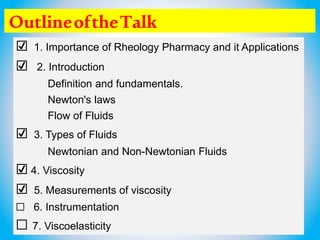
OutlineoftheTalk
☐ 1. Importance of Rheology Pharmacy and it Applications
☐ 2. Introduction
Definition and fundamentals.
Newton's laws
Flow of Fluids
☐ 3. Types of Fluids
Newtonian and Non-Newtonian Fluids
☐ 4. Viscosity
☐ 5. Measurements of viscosity
☐ 6. Instrumentation
☐ 7. Viscoelasticity
1.
Importance of
Rheology
Pharmacy &
It’s
Applications
In pharmaceutical technology, rheological measurements are involved in the
following:
1. Manufacturing of dosage forms: Materials undergo process such as mixing, flowing
through pipes, filling into the containers etc. Flow related changes influence the
selection of mixing equipment.
2. Handling of drugs for administration: The syringibility of the medicines, the
pouring of the liquids from containers, extrusion of ointment from tubes, all depend
on the changes in flow behavior of dosage forms.
3. Topical application of product onto skin
4. Physical stability of suspensions, emulsions and semisolids
5. Bioavailability, since viscosity has been shown to affect the absorption rate of
drugs.
6. Release of drug from dosage forms and delivery systems.
7. Formulation of medicinal and cosmetic creams, pastes and lotions.
1. Importance of Rheology Pharmacy & it Applications
8. Formulation of emulsions, suspensions, suppositories, and tablet coating.
9. Fluidity of solutions for injection.
10. In mixing and flow of materials, their packaging into the containers, their removal
prior to use, the pouring from the bottle.
11. Extrusion of a paste from a tube .
12. Passage of the liquid to a syringe needle.
13. Influence the choice of processing equipments in the pharmaceutical system.
14. Can affect the patient’s acceptability of the product, physical stability, biologic
availability, absorption rate of drugs in the gastrointestinal tract.
1. Importance of Rheology Pharmacy & it Applications
OutlineoftheTalk
☑ 1. Importance of Rheology Pharmacy and it Applications
☐ 2. Introduction
Definition and fundamentals.
Newton's laws
Flow of Fluids
☐ 3. Types of Fluids
Newtonian and Non-Newtonian Fluids
☐ 4. Viscosity
☐ 5. Measurements of viscosity
☐ 6. Instrumentation
☐ 7. Viscoelasticity
2. Introduction
2.1 Rheology
2.2 Definition and fundamentals.
2.3 Newton's laws
 rheo – to flow
 logos – science
Rheology is the study of the flow and deformation of matter under stress.
2.1 Rheology
 Rheology is the science/physics that concerns with the flow of liquids and the
deformation of solids.
 Study of flow properties of liquids is important for pharmacist working in the
manufacture of several dosage forms, viz., simple liquids, gels, ointments,
creams, and pastes.
 These systems change their flow behaviour when exposed to different stress
conditions
2.2 Definition and fundamentals
1) Shear stress (τ) : is the component of stress coplanar with a material cross
section. Shear stress arises from shear forces, which are pairs of equal and opposing
forces acting on opposite sides of an object
2) Rate of Shear or Shear rate: Shear rate is the rate at which a progressive
shearing deformation is applied to some material.
3) Rheogram: Plot of rate of shear as a function of shear stress.
4) Viscogram: Plot of rate of shear as a function of viscosity.
The deformation of matter under influence of force or stress can be described by
two components namely (1) Elasticity and (2) Viscosity.
2.2 Definition and fundamentals
1) Elasticity: Elasticity is achieved if the shape of the body is restored once the
force is withdrawn.
2) Viscosity: Viscosity or pure viscous flow occurs if there is continuous movement
during the applied force, and no restorative motion occurs once the force is
withdrawn.
21-Feb-162.3 Newton's law of viscous flow
• Two parallel planes are a distance dx
apart; the viscous body is confined
between the planes.
• When force, F, is applied the top,
plane A. moves horizontally with a
velocity dv but the lower plane B
remains motionless.
• As a consequence, there exists a
velocity gradient dv/dx between the‘
planes.
• This velocity gradient over a distance
is known as the rate of shear, D
(dvldx).
To understand the fundamental components of viscous flow, just consider,
• The horizontal force per unit area (P/A) creating the deformation is known as the
shear stress, S (F/A). According to Newton's law of viscous flow:
21-Feb-162.4 Temperature Dependence of Viscosity
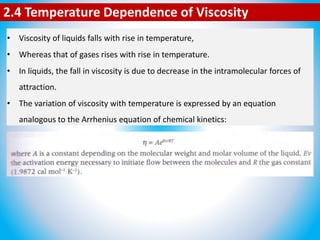
• Viscosity of liquids falls with rise in temperature,
• Whereas that of gases rises with rise in temperature.
• In liquids, the fall in viscosity is due to decrease in the intramolecular forces of
attraction.
• The variation of viscosity with temperature is expressed by an equation
analogous to the Arrhenius equation of chemical kinetics:
OutlineoftheTalk
☑ 1. Importance of Rheology Pharmacy and it Applications
☑ 2. Introduction
Definition and fundamentals.
Newton's laws
Flow of Fluids
☐ 3. Types of Fluids
Newtonian and Non-Newtonian Fluids
☐ 4. Viscosity
☐ 5. Measurements of viscosity
☐ 6. Instrumentation
☐ 7. Viscoelasticity
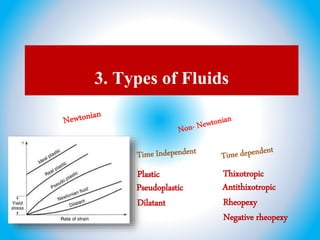
3. Types of Fluids
Plastic
Pseudoplastic
Dilatant
Thixotropic
Antithixotropic
Rheopexy
Negative rheopexy
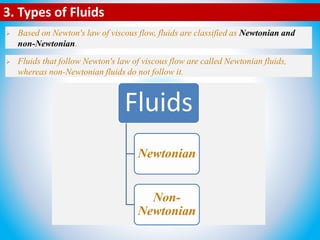
 Based on Newton's law of viscous flow, fluids are classified as Newtonian and
non-Newtonian.
3. Types of Fluids
 Fluids that follow Newton's law of viscous flow are called Newtonian fluids,
whereas non-Newtonian fluids do not follow it.
Fluids
Newtonian
Non-
Newtonian
3.1 Newtonian Fluid
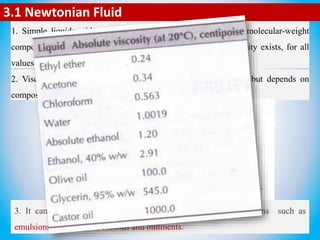
1. Simple liquids, either pure chemicals or solutions of lower-molecular-weight
compounds, are Newtonian fluids in which a direct proportionality exists, for all
values of shear, between shear stress and shear rate.
2. Viscosity of such fluids is independent of the rate of shear but depends on
composition, pressure and temperature.
3. It can be seen in liquids and in solid heterogeneous dispersions such as
emulsions, suspensions, colloids and ointments.
3.1 Non-Newtonian Fluid
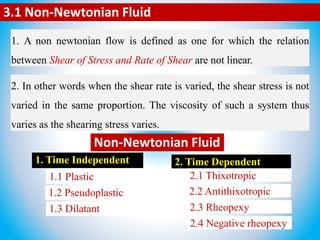
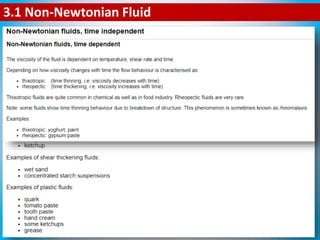
1. A non newtonian flow is defined as one for which the relation
between Shear of Stress and Rate of Shear are not linear.
2. In other words when the shear rate is varied, the shear stress is not
varied in the same proportion. The viscosity of such a system thus
varies as the shearing stress varies.
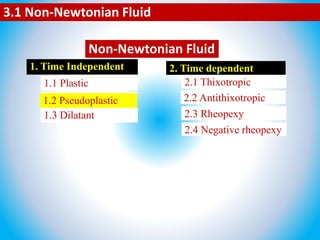
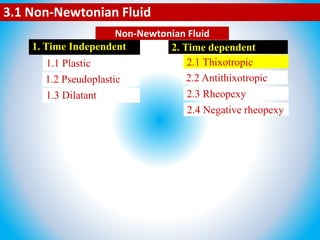
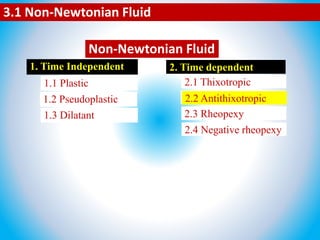
1. Time Independent 2. Time Dependent
1.1 Plastic
1.2 Pseudoplastic
1.3 Dilatant
2.1 Thixotropic
2.2 Antithixotropic
2.3 Rheopexy
2.4 Negative rheopexy
Non-Newtonian Fluid
3.1 Non-Newtonian Fluid
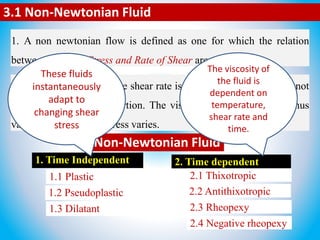
1. A non newtonian flow is defined as one for which the relation
between Shear of Stress and Rate of Shear are not linear.
2. In other words when the shear rate is varied, the shear stress is not
varied in the same proportion. The viscosity of such a system thus
varies as the shearing stress varies.
1. Time Independent 2. Time dependent
1.1 Plastic
1.2 Pseudoplastic
1.3 Dilatant
2.1 Thixotropic
2.2 Antithixotropic
2.3 Rheopexy
2.4 Negative rheopexy
Non-Newtonian Fluid
These fluids
instantaneously
adapt to
changing shear
stress
The viscosity of
the fluid is
dependent on
temperature,
shear rate and
time.
3.1 Non-Newtonian Fluid
1. Time Independent 2. Time dependent
1.1 Plastic
1.2 Pseudoplastic
1.3 Dilatant
2.1 Thixotropic
2.2 Antithixotropic
2.3 Rheopexy
2.4 Negative rheopexy
Non-Newtonian Fluid
1.1 Plastic
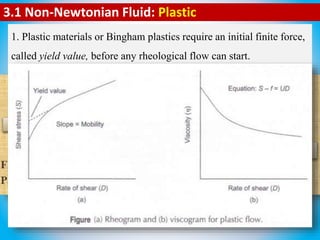
3.1 Non-Newtonian Fluid: Plastic
EXAMPLES: ZnO in mineral oil, certain pastes , paints and ointments.
1. Plastic materials or Bingham plastics require an initial finite force,
called yield value, before any rheological flow can start.
2. At shear stress values below the yield value, such plastic materials
substances behave as elastic solids exhibiting reversible deformation,
and above the yield value, they behave as Newtonian systems.
3. Concentrated flocculated suspensions (e.g. concentrated zinc oxide
suspension) and semisolid dosage forms, such as gels, creams and
ointments, are examples of plastic materials.
3.1 Non-Newtonian Fluid
1. Time Independent 2. Time dependent
1.1 Plastic
1.2 Pseudoplastic
1.3 Dilatant
2.1 Thixotropic
2.2 Antithixotropic
2.3 Rheopexy
2.4 Negative rheopexy
Non-Newtonian Fluid
1.2 Pseudoplastic
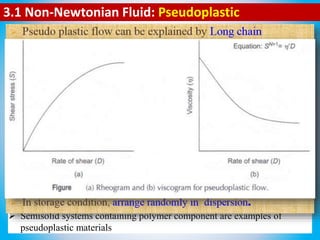
3.1 Non-Newtonian Fluid: Pseudoplastic
1. Shear-thinning behaviour is often referred to as pseudoplasticity.
2. Pseudoplastic material tends to become more fluid the faster they
are stirred.
3. The curve for a pseudoplastic material begins at the origin (or at
least approaches it at low rates of shear).
4. The curved rheogram for pseudoplastic materials is due to
shearing action on the long chain molecules of materials such as
linear polymers.
EXAMPLES:
 Weakly flocculated suspensions,
 Polymeric solutions such as solution of tragacanth,
 Methyl cellulose in water
 Sodium CMC in water
 Sodium alginate and cellulose derivatives' and
 Semisolid systems containing polymer component are examples of
pseudoplastic materials
3.1 Non-Newtonian Fluid
1. Time Independent 2. Time dependent
1.1 Plastic
1.2 Pseudoplastic
1.3 Dilatant
2.1 Thixotropic
2.2 Antithixotropic
2.3 Rheopexy
2.4 Negative rheopexy
Non-Newtonian Fluid
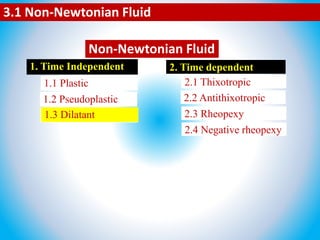
1.3 Dilatant
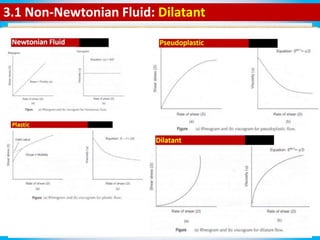
3.1 Non-Newtonian Fluid: Dilatant
1. Shear-thickening behaviour is often referred to as dilatancy.
2. Materials that increase in volume, i.e. dilate, when sheared are
known as dilatant.
3. Suspensions containing high concentrations (>50% w/w) of small,
deflocculated particles exhibit dilatant behaviour. Flow properties of
dilatants are opposite to that of pseudoplastics.
4. Certain suspensions with a high percentage of dispersed solids
exhibit an resistance to flow with increasing rate of shear.
5. Such systems actually increase in volume when sheared & are
called dilatant. Dilatant materials "shear thickening systems."
6. When the stress is removed, a dilatant system returns to its
original state of fluidity.
3.1 Non-Newtonian Fluid
1. Time Independent 2. Time dependent
1.1 Plastic
1.2 Pseudoplastic
1.3 Dilatant
2.1 Thixotropic
2.2 Antithixotropic
2.3 Rheopexy
2.4 Negative rheopexy
Non-Newtonian Fluid
3.1 Non-Newtonian Fluid
1. Time Independent 2. Time dependent
1.1 Plastic
1.2 Pseudoplastic
1.3 Dilatant
2.1 Thixotropic
2.2 Antithixotropic
2.3 Rheopexy
2.4 Negative rheopexy
Non-Newtonian Fluid
2.1 Thixotropic
3.1 Non-Newtonian Fluid: Thixotropic
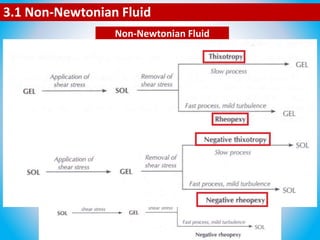
It is defined as, isothermal and comparatively slow recovery on
standing of material of a consistency lost through shearing.
It is shear thinning system, when agitated and kept aside it is
expected to return its original state of fluidity, but takes longer
time to recover compared to the time taken for agitation.
Thixotropic behaviour can be shown by plastic and pseudo plastic
system.
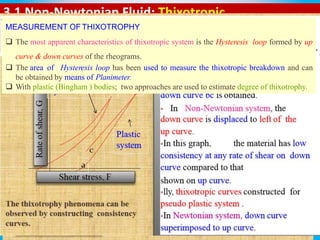
MEASUREMENT OF THIXOTROPHY
 The most apparent characteristics of thixotropic system is the Hysteresis loop formed by up
curve & down curves of the rheograms.
 The area of Hysteresis loop has been used to measure the thixotropic breakdown and can
be obtained by means of Planimeter.
 With plastic (Bingham ) bodies; two approaches are used to estimate degree of thixotrophy.
3.1 Non-Newtonian Fluid
1. Time Independent 2. Time dependent
1.1 Plastic
1.2 Pseudoplastic
1.3 Dilatant
2.1 Thixotropic
2.2 Antithixotropic
2.3 Rheopexy
2.4 Negative rheopexy
Non-Newtonian Fluid
2.2 Antithixotropic
3.1 Non-Newtonian Fluid: Antithixotropic
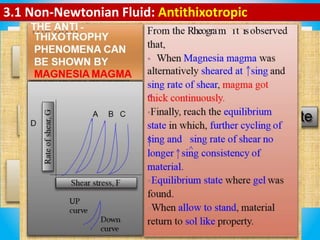
Anti-thixotrophy represents an increase in consistency (high
viscosity) rather decrease in consistency in the down curve.
The increase in thickness or resistance to flow with increase time
of shear observed or (magnesia magma).
Anti – thixotrophy is flocculated system containing low solid
content (1–10 %).
Dilatancy system is deflocculated system containing solid content (
> 50 %).
3.1 Non-Newtonian Fluid
1. Time Independent 2. Time dependent
1.1 Plastic
1.2 Pseudoplastic
1.3 Dilatant
2.1 Thixotropic
2.2 Antithixotropic
2.3 Rheopexy
2.4 Negative rheopexy
Non-Newtonian Fluid
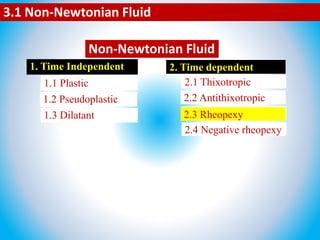
2.3 Rheopexy
3.1 Non-Newtonian Fluid: Rheopexy
 Rheopexy is phenomena in which a sol forms a gel more readily when shaken or
sheared than when allow to form the gel while the material is kept at rest.
 In rheopectic system, the gel is the equilibrium state.
 In anti – thixotropic system, the sol is the equilibrium state.
e.g. Magnesia magma, Clay suspension
3.1 Non-Newtonian Fluid: Negative rheopexy
Negative rheopexy is observed in antithixotropic systems where
gentle vibration, shaking and mild turbulence speed up the
reformation of solution from the gel state.
In this, an antithixotropic system, such as magnesia magma,
becomes more mobile under the influence of mild turbulence.
OutlineoftheTalk
☑ 1. Importance of Rheology Pharmacy and it Applications
☑ 2. Introduction
Definition and fundamentals.
Newton's laws
Flow of Fluids
☑ 3. Types of Fluids
Newtonian and Non-Newtonian Fluids
☐ 4. Viscosity
☐ 5. Measurements of viscosity
☐ 6. Instrumentation
☐ 7. Viscoelasticity
4. Viscosity
4. Viscosity
4.1 Why Viscosity is Important?
 Measuring viscosity is a good way to discover the properties of matter.
 Testing the viscosity of materials is practiced in many other industries before
packaging products.
Examples:
 If toothpaste has the wrong viscosity, a great amount of toothpaste will not
flow out of the tube.
 The same applies for ointments. If they do not have the right thickness, they
cannot be easily applied.
 The viscosity of creams and lotions may affect the rate of absorption of the
products by the skin.
 A greater release of active ingredients is generally possible from the softer,
less viscous bases.
 The viscosity of semi-solid products may affect absorption of these topical
products due to the effect of viscosity on the rate of diffusion of the active
ingredients.
 The rate of absorption of an ordinary suspension differs from thixotropic
suspension.
 Thixotropy is useful in the formulation of pharmaceutical suspensions and
emulsions.
OutlineoftheTalk
☑ 1. Importance of Rheology Pharmacy and it Applications
☑ 2. Introduction
Definition and fundamentals.
Newton's laws
Flow of Fluids
☑ 3. Types of Fluids
Newtonian and Non-Newtonian Fluids
☑ 4. Viscosity
☐ 5. Measurements of viscosity
☐ 6. Instrumentation
☐ 7. Viscoelasticity
5. Measurements of viscosity
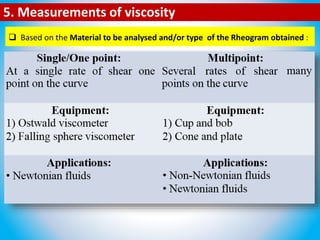
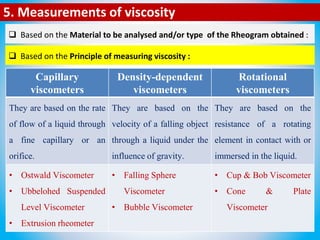
 Based on the Material to be analysed and/or type of the Rheogram obtained :
 Based on the Principle of measuring viscosity :
5. Measurements of viscosity
 Based on the Material to be analysed and/or type of the Rheogram obtained :
 Based on the Principle of measuring viscosity :
 Based on the Material to be analysed and/or type of the Rheogram obtained :
5. Measurements of viscosity
 Based on the Material to be analysed and/or type of the Rheogram obtained :
 Based on the Principle of measuring viscosity :
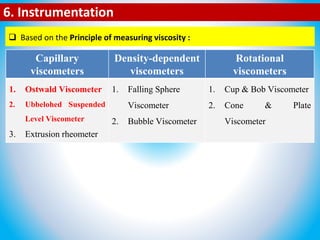
Capillary
viscometers
Density-dependent
viscometers
Rotational
viscometers
They are based on the rate
of flow of a liquid through
a fine capillary or an
orifice.
They are based on the
velocity of a falling object
through a liquid under the
influence of gravity.
They are based on the
resistance of a rotating
element in contact with or
immersed in the liquid.
• Ostwald Viscometer
• Ubbelohed Suspended
Level Viscometer
• Extrusion rheometer
• Falling Sphere
Viscometer
• Bubble Viscometer
• Cup & Bob Viscometer
• Cone & Plate
Viscometer
OutlineoftheTalk
☑ 1. Importance of Rheology Pharmacy and it Applications
☑ 2. Introduction
Definition and fundamentals.
Newton's laws
Flow of Fluids
☑ 3. Types of Fluids
Newtonian and Non-Newtonian Fluids
☑ 4. Viscosity
☑ 5. Measurements of viscosity
☐ 6. Instrumentation
☐ 7. Viscoelasticity
6. Instrumentation
6. Instrumentation
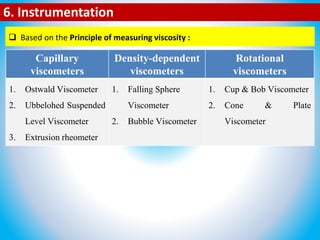
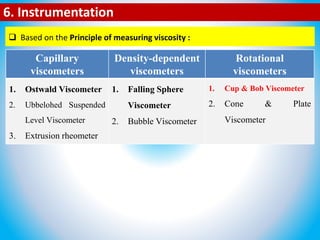
 Based on the Principle of measuring viscosity :
Capillary
viscometers
Density-dependent
viscometers
Rotational
viscometers
1. Ostwald Viscometer
2. Ubbelohed Suspended
Level Viscometer
3. Extrusion rheometer
1. Falling Sphere
Viscometer
2. Bubble Viscometer
1. Cup & Bob Viscometer
2. Cone & Plate
Viscometer
6. Instrumentation
 Based on the Principle of measuring viscosity :
Capillary
viscometers
Density-dependent
viscometers
Rotational
viscometers
1. Ostwald Viscometer
2. Ubbelohed Suspended
Level Viscometer
3. Extrusion rheometer
1. Falling Sphere
Viscometer
2. Bubble Viscometer
1. Cup & Bob Viscometer
2. Cone & Plate
Viscometer
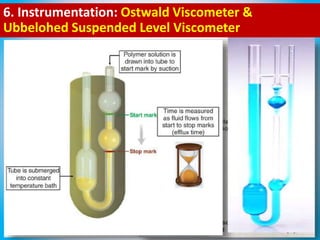
6. Instrumentation: Ostwald Viscometer &
Ubbelohed Suspended Level Viscometer
• Ostwald viscometer is
used to determine the
viscosity of a Newtonian
liquid. Both dynamic and
kinematic viscosities can
be obtained.
• When a liquid flows by
gravity, the time required
for the liquid to pass
between two marks (A
and B shown in Figure)
through a vertical
capillary tube is
determined.
6. Instrumentation
 Based on the Principle of measuring viscosity :
Capillary
viscometers
Density-dependent
viscometers
Rotational
viscometers
1. Ostwald Viscometer
2. Ubbelohed Suspended
Level Viscometer
3. Extrusion rheometer
1. Falling Sphere
Viscometer
2. Bubble Viscometer
1. Cup & Bob Viscometer
2. Cone & Plate
Viscometer
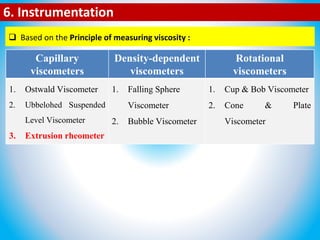
6. Instrumentation: Extrusion rheometer
6. Instrumentation
 Based on the Principle of measuring viscosity :
Capillary
viscometers
Density-dependent
viscometers
Rotational
viscometers
1. Ostwald Viscometer
2. Ubbelohed Suspended
Level Viscometer
3. Extrusion rheometer
1. Falling Sphere
Viscometer
2. Bubble Viscometer
1. Cup & Bob Viscometer
2. Cone & Plate
Viscometer
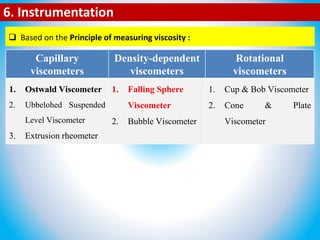
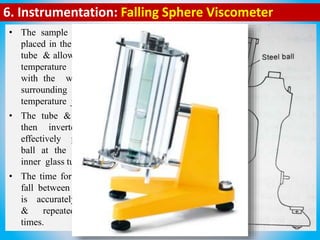
6. Instrumentation: Falling Sphere Viscometer
• The sample & ball are
placed in the inner glass
tube & allowed to reach
temperature equilibrium
with the water in the
surrounding constant
temperature jacket.
• The tube & jacket are
then inverted, which
effectively places the
ball at the top of the
inner glass tube.
• The time for the ball to
fall between two marks
is accurately measured
& repeated several
times.
6. Instrumentation
 Based on the Principle of measuring viscosity :
Capillary
viscometers
Density-dependent
viscometers
Rotational
viscometers
1. Ostwald Viscometer
2. Ubbelohed Suspended
Level Viscometer
3. Extrusion rheometer
1. Falling Sphere
Viscometer
2. Bubble Viscometer
1. Cup & Bob Viscometer
2. Cone & Plate
Viscometer
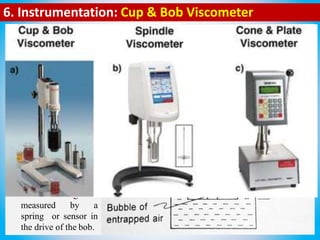
6. Instrumentation: Cup & Bob Viscometer
• This is a multipoint viscometer and
belongs to the category of rotational
viscometers.
• The sample is placed in the cup and the
bob is placed in the cup up-to an
appropriate height.
• The sample is
accommodated
between the gap of
cup and bob.
• Cup or bob is made
to rotate and the
torque (shearing
stress) from the
viscous drag is
measured by a
spring or sensor in
the drive of the bob.
6. Instrumentation
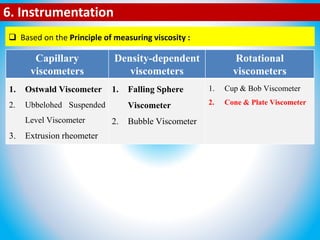
 Based on the Principle of measuring viscosity :
Capillary
viscometers
Density-dependent
viscometers
Rotational
viscometers
1. Ostwald Viscometer
2. Ubbelohed Suspended
Level Viscometer
3. Extrusion rheometer
1. Falling Sphere
Viscometer
2. Bubble Viscometer
1. Cup & Bob Viscometer
2. Cone & Plate Viscometer
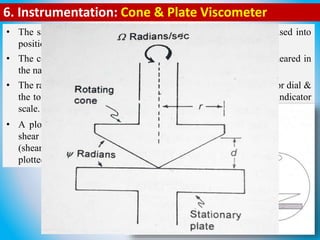
6. Instrumentation: Cone & Plate Viscometer
• The sample is placed at the center of the plate which is then raised into
position under the cone.
• The cone is driven by a variable speed motor & the sample is sheared in
the narrow gap between the stationary plate and the rotating cone.
• The rate of shear in rev./min. is increased & decreased by a selector dial &
the torque (shearing stress) produced on the cone is read on the indicator
scale.
• A plot of rpm or rate of
shear versus scale reading
(shearing stress) may be
plotted.
OutlineoftheTalk
☑ 1. Importance of Rheology Pharmacy and it Applications
☑ 2. Introduction
Definition and fundamentals.
Newton's laws
Flow of Fluids
☑ 3. Types of Fluids
Newtonian and Non-Newtonian Fluids
☑ 4. Viscosity
☑ 5. Measurements of viscosity
☑ 6. Instrumentation
☐ 7. Viscoelasticity
7. Viscoelasticity
7. Viscoelasticity
1. Viscoelastic materials exhibit both viscous fluidity and elastic solidity when
undergoing deformation.
2. Viscoelastic property is exhibited by most pharmaceutical semisolids such as
creams, lotions, ointments, colloidal dispersions and suppositories.
2. Viscoelastic property is exhibited by most pharmaceutical semisolids such as
creams, lotions, ointments, colloidal dispersions and suppositories.
3. Amorphous and semicrystalline polymers, carbopol gel and aqueous solution of
high molecular weight poly(ethylene oxide) also exhibit viscoelasticity.
4. Biological fluids such as blood, sputum and cervical fluid also exhibit
viscoelasticity.
OutlineoftheTalk
☑ 1. Importance of Rheology Pharmacy and it Applications
☑ 2. Introduction
Definition and fundamentals.
Newton's laws
Flow of Fluids
☑ 3. Types of Fluids
Newtonian and Non-Newtonian Fluids
☑ 4. Viscosity
☑ 5. Measurements of viscosity
☑ 6. Instrumentation
☑ 7. Viscoelasticity
ThankYou
Please Visit
TheAbhi.in
To Get the PPT

Rheology

  • 1.
    Pharmaceutical Rheology 1 Unit II Abhijit Debnath, Asst.Professor Faculty of Pharmaceutical Sciences PDM University By
  • 2.
    OutlineoftheTalk ☐ 1. Importanceof Rheology Pharmacy and it Applications ☐ 2. Introduction Definition and fundamentals. Newton's laws Flow of Fluids ☐ 3. Types of Fluids Newtonian and Non-Newtonian Fluids ☐ 4. Viscosity ☐ 5. Measurements of viscosity ☐ 6. Instrumentation ☐ 7. Viscoelasticity
  • 3.
  • 4.
    In pharmaceutical technology,rheological measurements are involved in the following: 1. Manufacturing of dosage forms: Materials undergo process such as mixing, flowing through pipes, filling into the containers etc. Flow related changes influence the selection of mixing equipment. 2. Handling of drugs for administration: The syringibility of the medicines, the pouring of the liquids from containers, extrusion of ointment from tubes, all depend on the changes in flow behavior of dosage forms. 3. Topical application of product onto skin 4. Physical stability of suspensions, emulsions and semisolids 5. Bioavailability, since viscosity has been shown to affect the absorption rate of drugs. 6. Release of drug from dosage forms and delivery systems. 7. Formulation of medicinal and cosmetic creams, pastes and lotions. 1. Importance of Rheology Pharmacy & it Applications
  • 5.
    8. Formulation ofemulsions, suspensions, suppositories, and tablet coating. 9. Fluidity of solutions for injection. 10. In mixing and flow of materials, their packaging into the containers, their removal prior to use, the pouring from the bottle. 11. Extrusion of a paste from a tube . 12. Passage of the liquid to a syringe needle. 13. Influence the choice of processing equipments in the pharmaceutical system. 14. Can affect the patient’s acceptability of the product, physical stability, biologic availability, absorption rate of drugs in the gastrointestinal tract. 1. Importance of Rheology Pharmacy & it Applications
  • 6.
    OutlineoftheTalk ☑ 1. Importanceof Rheology Pharmacy and it Applications ☐ 2. Introduction Definition and fundamentals. Newton's laws Flow of Fluids ☐ 3. Types of Fluids Newtonian and Non-Newtonian Fluids ☐ 4. Viscosity ☐ 5. Measurements of viscosity ☐ 6. Instrumentation ☐ 7. Viscoelasticity
  • 7.
    2. Introduction 2.1 Rheology 2.2Definition and fundamentals. 2.3 Newton's laws
  • 8.
     rheo –to flow  logos – science Rheology is the study of the flow and deformation of matter under stress. 2.1 Rheology  Rheology is the science/physics that concerns with the flow of liquids and the deformation of solids.  Study of flow properties of liquids is important for pharmacist working in the manufacture of several dosage forms, viz., simple liquids, gels, ointments, creams, and pastes.  These systems change their flow behaviour when exposed to different stress conditions
  • 9.
    2.2 Definition andfundamentals 1) Shear stress (τ) : is the component of stress coplanar with a material cross section. Shear stress arises from shear forces, which are pairs of equal and opposing forces acting on opposite sides of an object 2) Rate of Shear or Shear rate: Shear rate is the rate at which a progressive shearing deformation is applied to some material. 3) Rheogram: Plot of rate of shear as a function of shear stress. 4) Viscogram: Plot of rate of shear as a function of viscosity.
  • 10.
    The deformation ofmatter under influence of force or stress can be described by two components namely (1) Elasticity and (2) Viscosity. 2.2 Definition and fundamentals 1) Elasticity: Elasticity is achieved if the shape of the body is restored once the force is withdrawn. 2) Viscosity: Viscosity or pure viscous flow occurs if there is continuous movement during the applied force, and no restorative motion occurs once the force is withdrawn.
  • 11.
    21-Feb-162.3 Newton's lawof viscous flow • Two parallel planes are a distance dx apart; the viscous body is confined between the planes. • When force, F, is applied the top, plane A. moves horizontally with a velocity dv but the lower plane B remains motionless. • As a consequence, there exists a velocity gradient dv/dx between the‘ planes. • This velocity gradient over a distance is known as the rate of shear, D (dvldx). To understand the fundamental components of viscous flow, just consider, • The horizontal force per unit area (P/A) creating the deformation is known as the shear stress, S (F/A). According to Newton's law of viscous flow:
  • 12.
    21-Feb-162.4 Temperature Dependenceof Viscosity • Viscosity of liquids falls with rise in temperature, • Whereas that of gases rises with rise in temperature. • In liquids, the fall in viscosity is due to decrease in the intramolecular forces of attraction. • The variation of viscosity with temperature is expressed by an equation analogous to the Arrhenius equation of chemical kinetics:
  • 13.
    OutlineoftheTalk ☑ 1. Importanceof Rheology Pharmacy and it Applications ☑ 2. Introduction Definition and fundamentals. Newton's laws Flow of Fluids ☐ 3. Types of Fluids Newtonian and Non-Newtonian Fluids ☐ 4. Viscosity ☐ 5. Measurements of viscosity ☐ 6. Instrumentation ☐ 7. Viscoelasticity
  • 14.
    3. Types ofFluids Plastic Pseudoplastic Dilatant Thixotropic Antithixotropic Rheopexy Negative rheopexy
  • 15.
     Based onNewton's law of viscous flow, fluids are classified as Newtonian and non-Newtonian. 3. Types of Fluids  Fluids that follow Newton's law of viscous flow are called Newtonian fluids, whereas non-Newtonian fluids do not follow it. Fluids Newtonian Non- Newtonian
  • 16.
    3.1 Newtonian Fluid 1.Simple liquids, either pure chemicals or solutions of lower-molecular-weight compounds, are Newtonian fluids in which a direct proportionality exists, for all values of shear, between shear stress and shear rate. 2. Viscosity of such fluids is independent of the rate of shear but depends on composition, pressure and temperature. 3. It can be seen in liquids and in solid heterogeneous dispersions such as emulsions, suspensions, colloids and ointments.
  • 17.
    3.1 Non-Newtonian Fluid 1.A non newtonian flow is defined as one for which the relation between Shear of Stress and Rate of Shear are not linear. 2. In other words when the shear rate is varied, the shear stress is not varied in the same proportion. The viscosity of such a system thus varies as the shearing stress varies. 1. Time Independent 2. Time Dependent 1.1 Plastic 1.2 Pseudoplastic 1.3 Dilatant 2.1 Thixotropic 2.2 Antithixotropic 2.3 Rheopexy 2.4 Negative rheopexy Non-Newtonian Fluid
  • 18.
    3.1 Non-Newtonian Fluid 1.A non newtonian flow is defined as one for which the relation between Shear of Stress and Rate of Shear are not linear. 2. In other words when the shear rate is varied, the shear stress is not varied in the same proportion. The viscosity of such a system thus varies as the shearing stress varies. 1. Time Independent 2. Time dependent 1.1 Plastic 1.2 Pseudoplastic 1.3 Dilatant 2.1 Thixotropic 2.2 Antithixotropic 2.3 Rheopexy 2.4 Negative rheopexy Non-Newtonian Fluid These fluids instantaneously adapt to changing shear stress The viscosity of the fluid is dependent on temperature, shear rate and time.
  • 19.
  • 20.
    3.1 Non-Newtonian Fluid 1.Time Independent 2. Time dependent 1.1 Plastic 1.2 Pseudoplastic 1.3 Dilatant 2.1 Thixotropic 2.2 Antithixotropic 2.3 Rheopexy 2.4 Negative rheopexy Non-Newtonian Fluid 1.1 Plastic
  • 21.
    3.1 Non-Newtonian Fluid:Plastic EXAMPLES: ZnO in mineral oil, certain pastes , paints and ointments. 1. Plastic materials or Bingham plastics require an initial finite force, called yield value, before any rheological flow can start. 2. At shear stress values below the yield value, such plastic materials substances behave as elastic solids exhibiting reversible deformation, and above the yield value, they behave as Newtonian systems. 3. Concentrated flocculated suspensions (e.g. concentrated zinc oxide suspension) and semisolid dosage forms, such as gels, creams and ointments, are examples of plastic materials.
  • 22.
    3.1 Non-Newtonian Fluid 1.Time Independent 2. Time dependent 1.1 Plastic 1.2 Pseudoplastic 1.3 Dilatant 2.1 Thixotropic 2.2 Antithixotropic 2.3 Rheopexy 2.4 Negative rheopexy Non-Newtonian Fluid 1.2 Pseudoplastic
  • 23.
    3.1 Non-Newtonian Fluid:Pseudoplastic 1. Shear-thinning behaviour is often referred to as pseudoplasticity. 2. Pseudoplastic material tends to become more fluid the faster they are stirred. 3. The curve for a pseudoplastic material begins at the origin (or at least approaches it at low rates of shear). 4. The curved rheogram for pseudoplastic materials is due to shearing action on the long chain molecules of materials such as linear polymers. EXAMPLES:  Weakly flocculated suspensions,  Polymeric solutions such as solution of tragacanth,  Methyl cellulose in water  Sodium CMC in water  Sodium alginate and cellulose derivatives' and  Semisolid systems containing polymer component are examples of pseudoplastic materials
  • 24.
    3.1 Non-Newtonian Fluid 1.Time Independent 2. Time dependent 1.1 Plastic 1.2 Pseudoplastic 1.3 Dilatant 2.1 Thixotropic 2.2 Antithixotropic 2.3 Rheopexy 2.4 Negative rheopexy Non-Newtonian Fluid 1.3 Dilatant
  • 25.
    3.1 Non-Newtonian Fluid:Dilatant 1. Shear-thickening behaviour is often referred to as dilatancy. 2. Materials that increase in volume, i.e. dilate, when sheared are known as dilatant. 3. Suspensions containing high concentrations (>50% w/w) of small, deflocculated particles exhibit dilatant behaviour. Flow properties of dilatants are opposite to that of pseudoplastics. 4. Certain suspensions with a high percentage of dispersed solids exhibit an resistance to flow with increasing rate of shear. 5. Such systems actually increase in volume when sheared & are called dilatant. Dilatant materials "shear thickening systems." 6. When the stress is removed, a dilatant system returns to its original state of fluidity.
  • 26.
    3.1 Non-Newtonian Fluid 1.Time Independent 2. Time dependent 1.1 Plastic 1.2 Pseudoplastic 1.3 Dilatant 2.1 Thixotropic 2.2 Antithixotropic 2.3 Rheopexy 2.4 Negative rheopexy Non-Newtonian Fluid
  • 27.
    3.1 Non-Newtonian Fluid 1.Time Independent 2. Time dependent 1.1 Plastic 1.2 Pseudoplastic 1.3 Dilatant 2.1 Thixotropic 2.2 Antithixotropic 2.3 Rheopexy 2.4 Negative rheopexy Non-Newtonian Fluid 2.1 Thixotropic
  • 28.
    3.1 Non-Newtonian Fluid:Thixotropic It is defined as, isothermal and comparatively slow recovery on standing of material of a consistency lost through shearing. It is shear thinning system, when agitated and kept aside it is expected to return its original state of fluidity, but takes longer time to recover compared to the time taken for agitation. Thixotropic behaviour can be shown by plastic and pseudo plastic system. MEASUREMENT OF THIXOTROPHY  The most apparent characteristics of thixotropic system is the Hysteresis loop formed by up curve & down curves of the rheograms.  The area of Hysteresis loop has been used to measure the thixotropic breakdown and can be obtained by means of Planimeter.  With plastic (Bingham ) bodies; two approaches are used to estimate degree of thixotrophy.
  • 29.
    3.1 Non-Newtonian Fluid 1.Time Independent 2. Time dependent 1.1 Plastic 1.2 Pseudoplastic 1.3 Dilatant 2.1 Thixotropic 2.2 Antithixotropic 2.3 Rheopexy 2.4 Negative rheopexy Non-Newtonian Fluid 2.2 Antithixotropic
  • 30.
    3.1 Non-Newtonian Fluid:Antithixotropic Anti-thixotrophy represents an increase in consistency (high viscosity) rather decrease in consistency in the down curve. The increase in thickness or resistance to flow with increase time of shear observed or (magnesia magma). Anti – thixotrophy is flocculated system containing low solid content (1–10 %). Dilatancy system is deflocculated system containing solid content ( > 50 %).
  • 31.
    3.1 Non-Newtonian Fluid 1.Time Independent 2. Time dependent 1.1 Plastic 1.2 Pseudoplastic 1.3 Dilatant 2.1 Thixotropic 2.2 Antithixotropic 2.3 Rheopexy 2.4 Negative rheopexy Non-Newtonian Fluid 2.3 Rheopexy
  • 32.
    3.1 Non-Newtonian Fluid:Rheopexy  Rheopexy is phenomena in which a sol forms a gel more readily when shaken or sheared than when allow to form the gel while the material is kept at rest.  In rheopectic system, the gel is the equilibrium state.  In anti – thixotropic system, the sol is the equilibrium state. e.g. Magnesia magma, Clay suspension
  • 33.
    3.1 Non-Newtonian Fluid:Negative rheopexy Negative rheopexy is observed in antithixotropic systems where gentle vibration, shaking and mild turbulence speed up the reformation of solution from the gel state. In this, an antithixotropic system, such as magnesia magma, becomes more mobile under the influence of mild turbulence.
  • 34.
    OutlineoftheTalk ☑ 1. Importanceof Rheology Pharmacy and it Applications ☑ 2. Introduction Definition and fundamentals. Newton's laws Flow of Fluids ☑ 3. Types of Fluids Newtonian and Non-Newtonian Fluids ☐ 4. Viscosity ☐ 5. Measurements of viscosity ☐ 6. Instrumentation ☐ 7. Viscoelasticity
  • 35.
  • 36.
  • 37.
    4.1 Why Viscosityis Important?  Measuring viscosity is a good way to discover the properties of matter.  Testing the viscosity of materials is practiced in many other industries before packaging products. Examples:  If toothpaste has the wrong viscosity, a great amount of toothpaste will not flow out of the tube.  The same applies for ointments. If they do not have the right thickness, they cannot be easily applied.  The viscosity of creams and lotions may affect the rate of absorption of the products by the skin.  A greater release of active ingredients is generally possible from the softer, less viscous bases.  The viscosity of semi-solid products may affect absorption of these topical products due to the effect of viscosity on the rate of diffusion of the active ingredients.  The rate of absorption of an ordinary suspension differs from thixotropic suspension.  Thixotropy is useful in the formulation of pharmaceutical suspensions and emulsions.
  • 38.
    OutlineoftheTalk ☑ 1. Importanceof Rheology Pharmacy and it Applications ☑ 2. Introduction Definition and fundamentals. Newton's laws Flow of Fluids ☑ 3. Types of Fluids Newtonian and Non-Newtonian Fluids ☑ 4. Viscosity ☐ 5. Measurements of viscosity ☐ 6. Instrumentation ☐ 7. Viscoelasticity
  • 39.
  • 40.
    5. Measurements ofviscosity  Based on the Material to be analysed and/or type of the Rheogram obtained :  Based on the Principle of measuring viscosity :
  • 41.
    5. Measurements ofviscosity  Based on the Material to be analysed and/or type of the Rheogram obtained :  Based on the Principle of measuring viscosity :  Based on the Material to be analysed and/or type of the Rheogram obtained :
  • 42.
    5. Measurements ofviscosity  Based on the Material to be analysed and/or type of the Rheogram obtained :  Based on the Principle of measuring viscosity : Capillary viscometers Density-dependent viscometers Rotational viscometers They are based on the rate of flow of a liquid through a fine capillary or an orifice. They are based on the velocity of a falling object through a liquid under the influence of gravity. They are based on the resistance of a rotating element in contact with or immersed in the liquid. • Ostwald Viscometer • Ubbelohed Suspended Level Viscometer • Extrusion rheometer • Falling Sphere Viscometer • Bubble Viscometer • Cup & Bob Viscometer • Cone & Plate Viscometer
  • 43.
    OutlineoftheTalk ☑ 1. Importanceof Rheology Pharmacy and it Applications ☑ 2. Introduction Definition and fundamentals. Newton's laws Flow of Fluids ☑ 3. Types of Fluids Newtonian and Non-Newtonian Fluids ☑ 4. Viscosity ☑ 5. Measurements of viscosity ☐ 6. Instrumentation ☐ 7. Viscoelasticity
  • 44.
  • 45.
    6. Instrumentation  Basedon the Principle of measuring viscosity : Capillary viscometers Density-dependent viscometers Rotational viscometers 1. Ostwald Viscometer 2. Ubbelohed Suspended Level Viscometer 3. Extrusion rheometer 1. Falling Sphere Viscometer 2. Bubble Viscometer 1. Cup & Bob Viscometer 2. Cone & Plate Viscometer
  • 46.
    6. Instrumentation  Basedon the Principle of measuring viscosity : Capillary viscometers Density-dependent viscometers Rotational viscometers 1. Ostwald Viscometer 2. Ubbelohed Suspended Level Viscometer 3. Extrusion rheometer 1. Falling Sphere Viscometer 2. Bubble Viscometer 1. Cup & Bob Viscometer 2. Cone & Plate Viscometer
  • 47.
    6. Instrumentation: OstwaldViscometer & Ubbelohed Suspended Level Viscometer • Ostwald viscometer is used to determine the viscosity of a Newtonian liquid. Both dynamic and kinematic viscosities can be obtained. • When a liquid flows by gravity, the time required for the liquid to pass between two marks (A and B shown in Figure) through a vertical capillary tube is determined.
  • 48.
    6. Instrumentation  Basedon the Principle of measuring viscosity : Capillary viscometers Density-dependent viscometers Rotational viscometers 1. Ostwald Viscometer 2. Ubbelohed Suspended Level Viscometer 3. Extrusion rheometer 1. Falling Sphere Viscometer 2. Bubble Viscometer 1. Cup & Bob Viscometer 2. Cone & Plate Viscometer
  • 49.
  • 50.
    6. Instrumentation  Basedon the Principle of measuring viscosity : Capillary viscometers Density-dependent viscometers Rotational viscometers 1. Ostwald Viscometer 2. Ubbelohed Suspended Level Viscometer 3. Extrusion rheometer 1. Falling Sphere Viscometer 2. Bubble Viscometer 1. Cup & Bob Viscometer 2. Cone & Plate Viscometer
  • 51.
    6. Instrumentation: FallingSphere Viscometer • The sample & ball are placed in the inner glass tube & allowed to reach temperature equilibrium with the water in the surrounding constant temperature jacket. • The tube & jacket are then inverted, which effectively places the ball at the top of the inner glass tube. • The time for the ball to fall between two marks is accurately measured & repeated several times.
  • 52.
    6. Instrumentation  Basedon the Principle of measuring viscosity : Capillary viscometers Density-dependent viscometers Rotational viscometers 1. Ostwald Viscometer 2. Ubbelohed Suspended Level Viscometer 3. Extrusion rheometer 1. Falling Sphere Viscometer 2. Bubble Viscometer 1. Cup & Bob Viscometer 2. Cone & Plate Viscometer
  • 53.
    6. Instrumentation: Cup& Bob Viscometer • This is a multipoint viscometer and belongs to the category of rotational viscometers. • The sample is placed in the cup and the bob is placed in the cup up-to an appropriate height. • The sample is accommodated between the gap of cup and bob. • Cup or bob is made to rotate and the torque (shearing stress) from the viscous drag is measured by a spring or sensor in the drive of the bob.
  • 54.
    6. Instrumentation  Basedon the Principle of measuring viscosity : Capillary viscometers Density-dependent viscometers Rotational viscometers 1. Ostwald Viscometer 2. Ubbelohed Suspended Level Viscometer 3. Extrusion rheometer 1. Falling Sphere Viscometer 2. Bubble Viscometer 1. Cup & Bob Viscometer 2. Cone & Plate Viscometer
  • 55.
    6. Instrumentation: Cone& Plate Viscometer • The sample is placed at the center of the plate which is then raised into position under the cone. • The cone is driven by a variable speed motor & the sample is sheared in the narrow gap between the stationary plate and the rotating cone. • The rate of shear in rev./min. is increased & decreased by a selector dial & the torque (shearing stress) produced on the cone is read on the indicator scale. • A plot of rpm or rate of shear versus scale reading (shearing stress) may be plotted.
  • 56.
    OutlineoftheTalk ☑ 1. Importanceof Rheology Pharmacy and it Applications ☑ 2. Introduction Definition and fundamentals. Newton's laws Flow of Fluids ☑ 3. Types of Fluids Newtonian and Non-Newtonian Fluids ☑ 4. Viscosity ☑ 5. Measurements of viscosity ☑ 6. Instrumentation ☐ 7. Viscoelasticity
  • 57.
  • 58.
    7. Viscoelasticity 1. Viscoelasticmaterials exhibit both viscous fluidity and elastic solidity when undergoing deformation. 2. Viscoelastic property is exhibited by most pharmaceutical semisolids such as creams, lotions, ointments, colloidal dispersions and suppositories. 2. Viscoelastic property is exhibited by most pharmaceutical semisolids such as creams, lotions, ointments, colloidal dispersions and suppositories. 3. Amorphous and semicrystalline polymers, carbopol gel and aqueous solution of high molecular weight poly(ethylene oxide) also exhibit viscoelasticity. 4. Biological fluids such as blood, sputum and cervical fluid also exhibit viscoelasticity.
  • 59.
    OutlineoftheTalk ☑ 1. Importanceof Rheology Pharmacy and it Applications ☑ 2. Introduction Definition and fundamentals. Newton's laws Flow of Fluids ☑ 3. Types of Fluids Newtonian and Non-Newtonian Fluids ☑ 4. Viscosity ☑ 5. Measurements of viscosity ☑ 6. Instrumentation ☑ 7. Viscoelasticity
  • 60.