PREPARED BY:
K. ARSHAD AHMED KHAN
M.Pharm, (Ph.D)
Departmernt of Pharmaceutics
RIPER.
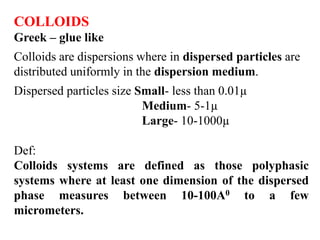
COLLOIDS
Greek – glue like
Colloids are dispersions where in dispersed particles are
distributed uniformly in the dispersion medium.
Dispersed particles size Small- less than 0.01µ
Medium- 5-1µ
Large- 10-1000µ
Def:
Colloids systems are defined as those polyphasic
systems where at least one dimension of the dispersed
phase measures between 10-100A0 to a few
micrometers.
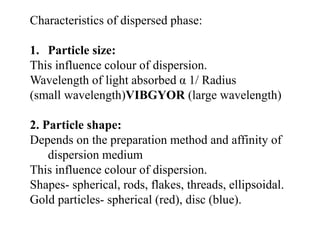
Characteristics of dispersed phase:
1. Particle size:
This influence colour of dispersion.
Wavelength of light absorbed α 1/ Radius
(small wavelength)VIBGYOR (large wavelength)
2. Particle shape:
Depends on the preparation method and affinity of
dispersion medium
This influence colour of dispersion.
Shapes- spherical, rods, flakes, threads, ellipsoidal.
Gold particles- spherical (red), disc (blue).
3. Surface area:
Particle size small- large surface area
Effective catalyst, enhance solubility.
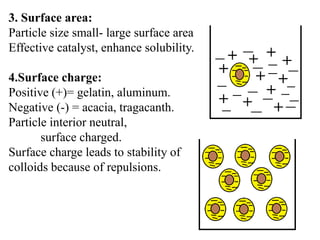
4.Surface charge:
Positive (+)= gelatin, aluminum.
Negative (-) = acacia, tragacanth.
Particle interior neutral,
surface charged.
Surface charge leads to stability of
colloids because of repulsions.
Pharmaceutical applications:
1. Therapy
2. Absorption & toxicity
3. Solubility
4. Stability
5. Targeting of drug to specific organ.
1. Therapy:
Small size – good absorption- better action- treatment.
Silver-germicidal
Copper-anticancer
Mercury- anti syphilis
2. Absorption & toxicity
Sulfur deficiency treatment
Colloidal sulfur- small size particles- faster absorption-
excess sulfur concentration in blood- toxicity
3. Solubility
Insoluble drug  Colloidal system+ Surfactants
(sulfonamides, (micellar solublization)
phenobarbitones)
4. Stability:
Colloidal systems are used as pharmaceutical excipients,
vehicles, carriers, product components.
Dispersion of surfactants  Association colloids –
increase stability of drug (liquid dosage form)
Dispersion of macromolecules (gelatin), Tablet Coating
synthetic polymers (HPMC)
5. Targeting of drug to specific organ.
Drug entrapped liposomes, niosomes, nanoparticles,
microemulsions targeted to liver, spleen.
Official preparations;
1. Iron drxtran inj (B.P)- anemia treatment
2. Iron sorbitol inj (B.P)- sorbitol, dextran, citric acid, iron.
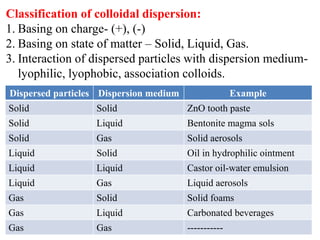
Classification of colloidal dispersion:
1. Basing on charge- (+), (-)
2. Basing on state of matter – Solid, Liquid, Gas.
3. Interaction of dispersed particles with dispersion medium-
lyophilic, lyophobic, association colloids.
Dispersed particles Dispersion medium Example
Solid Solid ZnO tooth paste
Solid Liquid Bentonite magma sols
Solid Gas Solid aerosols
Liquid Solid Oil in hydrophilic ointment
Liquid Liquid Castor oil-water emulsion
Liquid Gas Liquid aerosols
Gas Solid Solid foams
Gas Liquid Carbonated beverages
Gas Gas -----------
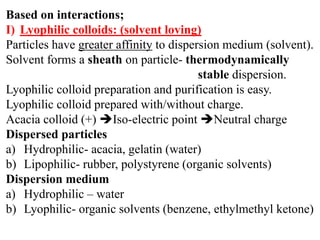
Based on interactions;
I) Lyophilic colloids: (solvent loving)
Particles have greater affinity to dispersion medium (solvent).
Solvent forms a sheath on particle- thermodynamically
stable dispersion.
Lyophilic colloid preparation and purification is easy.
Lyophilic colloid prepared with/without charge.
Acacia colloid (+) Iso-electric point Neutral charge
Dispersed particles
a) Hydrophilic- acacia, gelatin (water)
b) Lipophilic- rubber, polystyrene (organic solvents)
Dispersion medium
a) Hydrophilic – water
b) Lyophilic- organic solvents (benzene, ethylmethyl ketone)
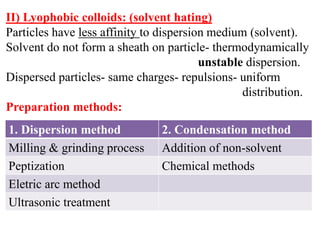
II) Lyophobic colloids: (solvent hating)
Particles have less affinity to dispersion medium (solvent).
Solvent do not form a sheath on particle- thermodynamically
unstable dispersion.
Dispersed particles- same charges- repulsions- uniform
distribution.
Preparation methods:
1. Dispersion method 2. Condensation method
Milling & grinding process Addition of non-solvent
Peptization Chemical methods
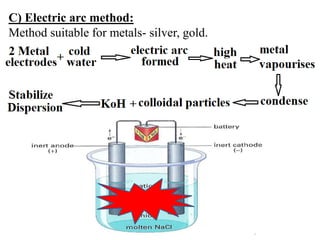
Eletric arc method
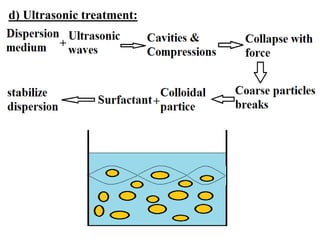
Ultrasonic treatment
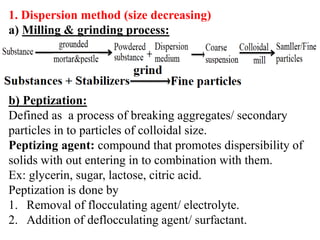
1. Dispersion method (size decreasing)
a) Milling & grinding process:
b) Peptization:
Defined as a process of breaking aggregates/ secondary
particles in to particles of colloidal size.
Peptizing agent: compound that promotes dispersibility of
solids with out entering in to combination with them.
Ex: glycerin, sugar, lactose, citric acid.
Peptization is done by
1. Removal of flocculating agent/ electrolyte.
2. Addition of deflocculating agent/ surfactant.
C) Electric arc method:
Method suitable for metals- silver, gold.
d) Ultrasonic treatment:
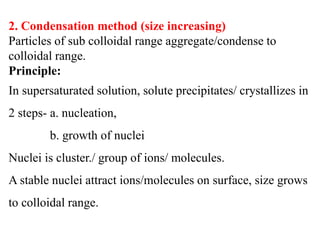
2. Condensation method (size increasing)
Particles of sub colloidal range aggregate/condense to
colloidal range.
Principle:
In supersaturated solution, solute precipitates/ crystallizes in
2 steps- a. nucleation,
b. growth of nuclei
Nuclei is cluster./ group of ions/ molecules.
A stable nuclei attract ions/molecules on surface, size grows
to colloidal range.
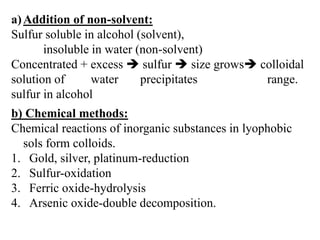
a)Addition of non-solvent:
Sulfur soluble in alcohol (solvent),
insoluble in water (non-solvent)
Concentrated + excess  sulfur  size grows colloidal
solution of water precipitates range.
sulfur in alcohol
b) Chemical methods:
Chemical reactions of inorganic substances in lyophobic
sols form colloids.
1. Gold, silver, platinum-reduction
2. Sulfur-oxidation
3. Ferric oxide-hydrolysis
4. Arsenic oxide-double decomposition.
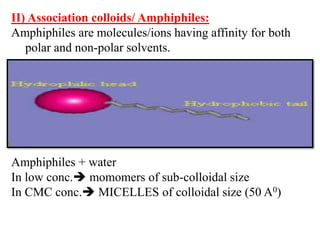
II) Association colloids/ Amphiphiles:
Amphiphiles are molecules/ions having affinity for both
polar and non-polar solvents.
Amphiphiles + water
In low conc. momomers of sub-colloidal size
In CMC conc. MICELLES of colloidal size (50 A0)
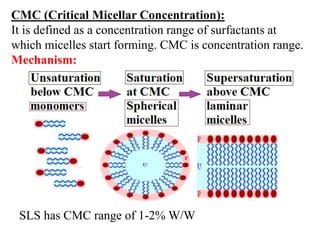
CMC (Critical Micellar Concentration):
It is defined as a concentration range of surfactants at
which micelles start forming. CMC is concentration range.
Mechanism:
SLS has CMC range of 1-2% W/W
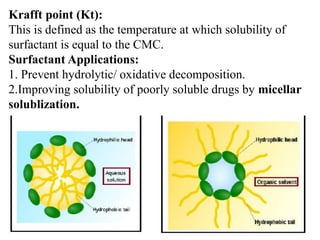
Krafft point (Kt):
This is defined as the temperature at which solubility of
surfactant is equal to the CMC.
Surfactant Applications:
1. Prevent hydrolytic/ oxidative decomposition.
2.Improving solubility of poorly soluble drugs by micellar
solublization.
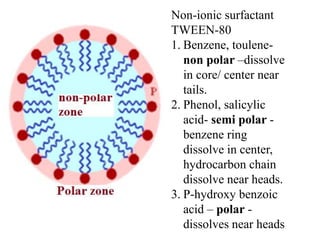
Non-ionic surfactant
TWEEN-80
1. Benzene, toulene-
non polar –dissolve
in core/ center near
tails.
2. Phenol, salicylic
acid- semi polar -
benzene ring
dissolve in center,
hydrocarbon chain
dissolve near heads.
3. P-hydroxy benzoic
acid – polar -
dissolves near heads
Formulation factors:
1. Type of surfactant:
a. non-ionic internal & external use.
b. ionic only external use. Internal use-toxicity.
2. Concentration of surfactant:
a. Low conc.  micelles not formed, drug precipitates.
b. at CMC conc.  Micelles formed, improve solubility,
absorption etc.,
c. High conc.  drug tightly binded by laminar micelles,
reduced absorption, action.
Surfactant high conc. cause toxicity.
PURIFICATION OF COLLOIDAL DISPERSION:
1. Dialysis
2. Electrodialysis
3. Ultrafiltration
a) Colloidal dispersions + electrolytes  Stable colloids
b) Stable colloids have dispersed particles, electrolytes,
dispersion medium.
c) Purification is separation of dispersed particles only.
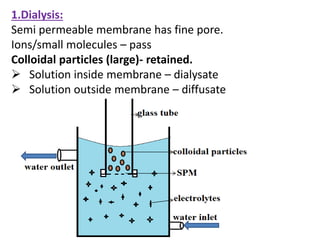
1.Dialysis:
Semi permeable membrane has fine pore.
Ions/small molecules – pass
Colloidal particles (large)- retained.
 Solution inside membrane – dialysate
 Solution outside membrane – diffusate
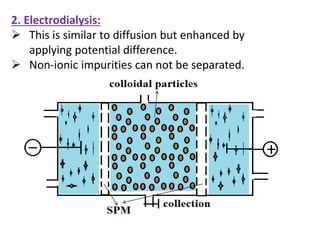
2. Electrodialysis:
 This is similar to diffusion but enhanced by
applying potential difference.
 Non-ionic impurities can not be separated.
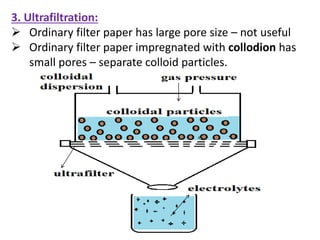
3. Ultrafiltration:
 Ordinary filter paper has large pore size – not useful
 Ordinary filter paper impregnated with collodion has
small pores – separate colloid particles.
Pharmaceutical applications of purification:
1. Membrane filters &artificial membranes are used as
models to explain principle of diffusion of drug through
natural membranes.
2. Drug-protein binding effects can be studied.
3. Principle in haemodialysis technique.
PROPERTIES OF COLLOIDS:
1. Optical properties
2. Kinetic properties
3. Electrical properties
1. Optical properties:
Useful to measure size, shape, structure & molecular weight
of colloids. Includes light scattering & turbidity.
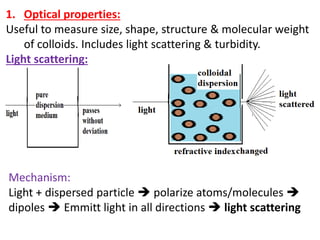
Light scattering:
Mechanism:
Light + dispersed particle  polarize atoms/molecules 
dipoles  Emmitt light in all directions  light scattering
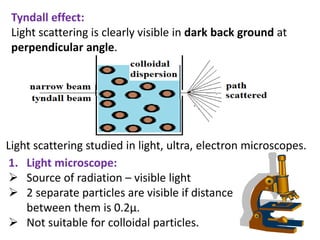
Tyndall effect:
Light scattering is clearly visible in dark back ground at
perpendicular angle.
Light scattering studied in light, ultra, electron microscopes.
1. Light microscope:
 Source of radiation – visible light
 2 separate particles are visible if distance
between them is 0.2µ.
 Not suitable for colloidal particles.
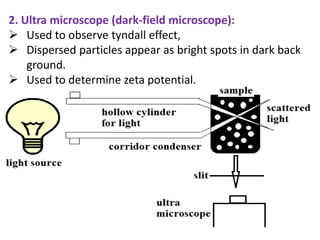
2. Ultra microscope (dark-field microscope):
 Used to observe tyndall effect,
 Dispersed particles appear as bright spots in dark back
ground.
 Used to determine zeta potential.
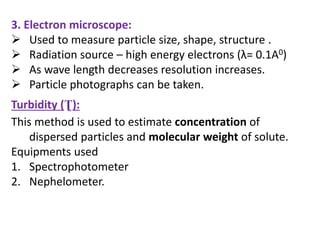
3. Electron microscope:
 Used to measure particle size, shape, structure .
 Radiation source – high energy electrons (λ= 0.1A0)
 As wave length decreases resolution increases.
 Particle photographs can be taken.
Turbidity (Ʈ):
This method is used to estimate concentration of
dispersed particles and molecular weight of solute.
Equipments used
1. Spectrophotometer
2. Nephelometer.
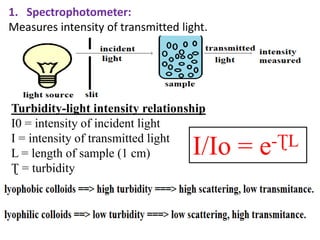
1. Spectrophotometer:
Measures intensity of transmitted light.
Turbidity-light intensity relationship
I0 = intensity of incident light
I = intensity of transmitted light
L = length of sample (1 cm)
Ʈ = turbidity
I/Io = e-ƮL
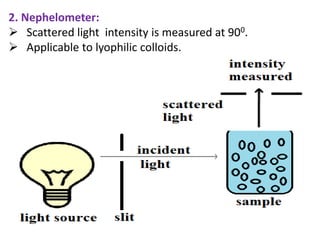
2. Nephelometer:
 Scattered light intensity is measured at 900.
 Applicable to lyophilic colloids.
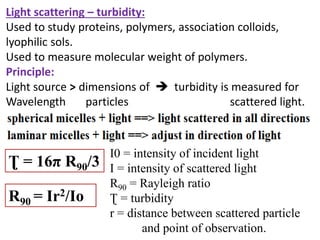
Light scattering – turbidity:
Used to study proteins, polymers, association colloids,
lyophilic sols.
Used to measure molecular weight of polymers.
Principle:
Light source > dimensions of  turbidity is measured for
Wavelength particles scattered light.
Ʈ = 16π R90/3
R90 = Ir2/Io
I0 = intensity of incident light
I = intensity of scattered light
R90 = Rayleigh ratio
Ʈ = turbidity
r = distance between scattered particle
and point of observation.
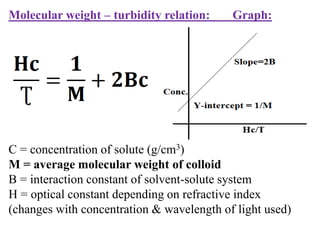
Molecular weight – turbidity relation: Graph:
C = concentration of solute (g/cm3)
M = average molecular weight of colloid
B = interaction constant of solvent-solute system
H = optical constant depending on refractive index
(changes with concentration & wavelength of light used)
2. Kinetic properties:
 Used to detect stability of system, molecular weight of
particles, transport kinetics.
 Includes Brownian motion, diffusion, sedimentation,
viscosity, colligative properties.
Brownian motion:
 Robert brown theory states colloidal particles (5µm)
continuous random motion b/o thermal energy.
 In motion they collide with walls, other particles and
change their direction, velocity. (light microscope)
 Particles move against gravitational force.
 Brownian motion stops with increase in size & viscosity.
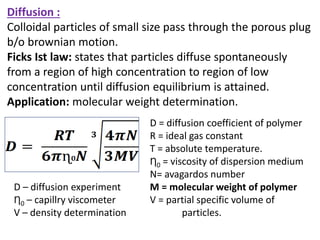
Diffusion :
Colloidal particles of small size pass through the porous plug
b/o brownian motion.
Ficks Ist law: states that particles diffuse spontaneously
from a region of high concentration to region of low
concentration until diffusion equilibrium is attained.
Application: molecular weight determination.
D = diffusion coefficient of polymer
R = ideal gas constant
T = absolute temperature.
Ƞ0 = viscosity of dispersion medium
N= avagardos number
M = molecular weight of polymer
V = partial specific volume of
particles.
D – diffusion experiment
Ƞ0 – capillry viscometer
V – density determination
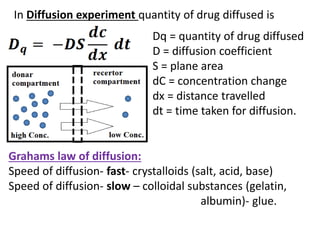
In Diffusion experiment quantity of drug diffused is
Dq = quantity of drug diffused
D = diffusion coefficient
S = plane area
dC = concentration change
dx = distance travelled
dt = time taken for diffusion.
Grahams law of diffusion:
Speed of diffusion- fast- crystalloids (salt, acid, base)
Speed of diffusion- slow – colloidal substances (gelatin,
albumin)- glue.
Sedimentation:
 This is influenced by gravitational force, applicable for
particle size > 0.5 µm.
 Stokes law equation – velocity of sedimentation.
 Colloidal particles have brownian motion No
sedimentation
 Forced sedimentation – ultra centrifuge.
Applications:
1. Molecular weight estimation
2. Study micellar properties of drug.
Colligative properties:
Only osmotic pressure is suitable for measurement of
molecular weight of dispersed particles.
Viscocity (ɳ):
Affected by many parameters
1. Shape of particle – Spherical (↓ ɳ), Liner shape (↑ ɳ)
2. Affinity of particle to medium - Lyophobic (Liner shape -
↑ɳ)
3. Types of colloid dispersions - dispersion medium of
Lyophilic (↑ɳ), Lyophobic (↓ ɳ).
4. Molecular weight of polymers – proportional to viscosity.
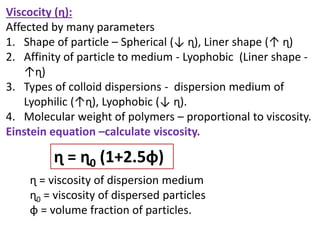
Einstein equation –calculate viscosity.
ɳ = ɳ0 (1+2.5ɸ)
ɳ = viscosity of dispersion medium
ɳ0 = viscosity of dispersed particles
ɸ = volume fraction of particles.
Relative viscosity (ɳ rel) = ɳ/ ɳ0 = 1+2.5ɸ
Specific viscocity (ɳ sp) = ɳ/ ɳ0 -1= 2.5ɸ
(ɳ sp) = 2.5ɸ
(ɳ sp)/ɸ = 2.5 (ɸ = concentration of particles)
(ɳ sp)/C = 2.5 = K (K = Intrinsic viscosity factor)
Molecular weight
determination:
[ɳ] = Kma
ɳ =intrinsic viscosity
(viscometer)
K, a = constants of polymer,
M= molecular weight of
polymer.
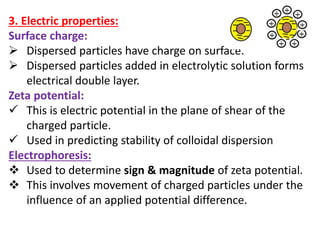
3. Electric properties:
Surface charge:
 Dispersed particles have charge on surface.
 Dispersed particles added in electrolytic solution forms
electrical double layer.
Zeta potential:
 This is electric potential in the plane of shear of the
charged particle.
 Used in predicting stability of colloidal dispersion
Electrophoresis:
 Used to determine sign & magnitude of zeta potential.
 This involves movement of charged particles under the
influence of an applied potential difference.
Sign:
Particles move towards anode – colloid (-) charged.
Particles move towards cathode – colloid (+) charged
Magnitude:
Rate of migration depends on charge of particle & potential
gradient applied.
Ultra microscope measures magnitude, standardized by
particles of known potential (RBC of rabbit).
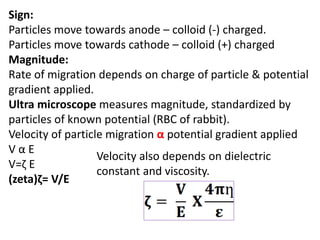
Velocity of particle migration α potential gradient applied
V α E
V=ζ E
(zeta)ζ= V/E
Velocity also depends on dielectric
constant and viscosity.
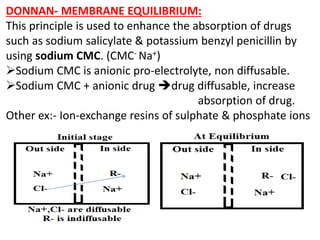
DONNAN- MEMBRANE EQUILIBRIUM:
This principle is used to enhance the absorption of drugs
such as sodium salicylate & potassium benzyl penicillin by
using sodium CMC. (CMC- Na+)
Sodium CMC is anionic pro-electrolyte, non diffusable.
Sodium CMC + anionic drug drug diffusable, increase
absorption of drug.
Other ex:- Ion-exchange resins of sulphate & phosphate ions
At Equilibrium  Charge balance  Electro neutrality
Out side  [Na+]o = [Cl-]o
In side  [Na+]I = [Cl-]I + [R-]I
According to principle of escaping tendency of the
electrolytes concentration on both sides of the membrane
should be same. (outside = inside)
[Na+]o [Cl-]o = [Na+]I [Cl-]I
Converting to [Cl-] concentrations.
[Cl-]o [Cl-]o = ([Cl-]I + [R-]I) [Cl-]I
[Cl-]o2 = [Cl-]I
[R-] = CMC-
[Cl-] = Drug = [D-]
Equation helps in selecting appropriate concentration of
components.
CASE- 1
If [R-]I/[D-]I= 8; then [D-]o /[D-]I = 3  D out= 3 D in
CASE- 2
If [R-]I/[D-]I= 99; then [D-]o /[D-]I = 10  D out = 10 D in
(GIT) (Blood)
STABILITY OF COLLOIDS:
Good colloidal dispersions should not change until usage.
Colloidal dispersion stable (Brownian motion),
unstable (Precipitate)
Stability reasons:
1. Lyophilic – solvent sheath on particles.
2. Lyophobic – electric charge on particles.
Lyophobic colloids stability:
DLVO theory- Derjaguin, Landau, Verway & Overbeek
 This theory is based on distance between 2 particles
and their interactions
 Colloidal particles exhibit brownian motion causing
collisions between particles.
 Amount of electrolytes control stabilization &
Precipitation.
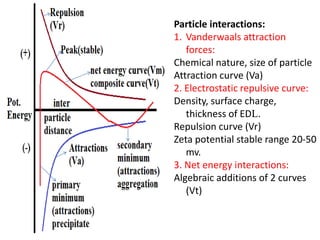
Particle interactions:
1. Vanderwaals attraction
forces:
Chemical nature, size of particle
Attraction curve (Va)
2. Electrostatic repulsive curve:
Density, surface charge,
thickness of EDL.
Repulsion curve (Vr)
Zeta potential stable range 20-50
mv.
3. Net energy interactions:
Algebraic additions of 2 curves
(Vt)
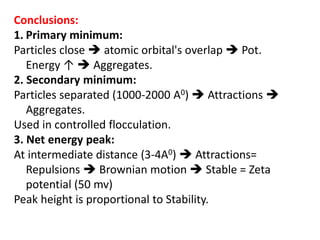
Conclusions:
1. Primary minimum:
Particles close  atomic orbital's overlap  Pot.
Energy ↑  Aggregates.
2. Secondary minimum:
Particles separated (1000-2000 A0)  Attractions 
Aggregates.
Used in controlled flocculation.
3. Net energy peak:
At intermediate distance (3-4A0)  Attractions=
Repulsions  Brownian motion  Stable = Zeta
potential (50 mv)
Peak height is proportional to Stability.
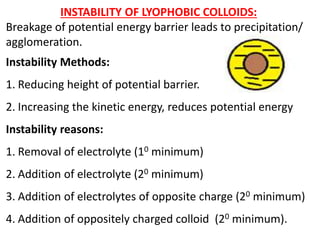
INSTABILITY OF LYOPHOBIC COLLOIDS:
Breakage of potential energy barrier leads to precipitation/
agglomeration.
Instability Methods:
1. Reducing height of potential barrier.
2. Increasing the kinetic energy, reduces potential energy
Instability reasons:
1. Removal of electrolyte (10 minimum)
2. Addition of electrolyte (20 minimum)
3. Addition of electrolytes of opposite charge (20 minimum)
4. Addition of oppositely charged colloid (20 minimum).
1. Removal of electrolyte (10 minimum)
Colloids + electrolytes  stable colloidal dispersion
Dialysis = remove Electrolytes  Particles coagulate 
Settle to bottom.
2. Addition of electrolyte (20 minimum)
Stable colloidal dispersion + excess electrolyte  electrolyte
Accumulate  instability.
3. Addition of electrolytes of opposite charge (20 minimum)
Stable colloidal dispersion + electrolyte opposite charge 
attractions between particles  Flocculation of particles.
Schulze-Hardy Rule: Precipitating power α ionic charge
Al+3>Ba+2>Na+ So4
-2>Cl-
4. Addition of oppositely charged colloid (20 minimum)
Bismuth colloids (+) + Tragacanth colloids (-)  Coagulation.
INSTABILITY OF LYOPHILIC COLLOIDS:
Stability – Solvent Sheath
Instability – aggregation/ precipitation.
Instability reasons:
1. Addition of excess electrolyte
2. Addition of oppositely charged colloid
3. Addition of non-solvent.
 Addition of excess electrolyte:
Electrolyte normal ConcZeta potential↓No Coagulation
Electrolyte high Conc ions + water No solvent for sheath
Hofmeister Rank Order:
States that the precipitating power of an ion is directly
related to ability of that ion to separate water molecule from
colloidal particle.
Mg+2> Ca+2> Na+ Cl->Br->I-
 Addition of oppositely charged colloid
Gelatin Colloid [+] + Acacia Colloid [-]  Electrostatic
attractive forces  Solvent sheath break Particles
aggregate.
 Addition of non-solvent.
Colloidal Dispersion + Alcohol/Acetone
Water(solvent) + Alcohol/Acetone(non-solvent)  Solution.
No water, No solvent Sheath  Unstable colloid.
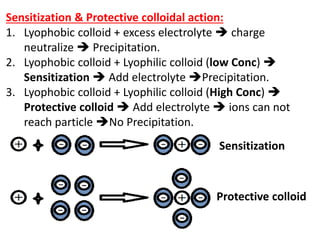
Sensitization & Protective colloidal action:
1. Lyophobic colloid + excess electrolyte  charge
neutralize  Precipitation.
2. Lyophobic colloid + Lyophilic colloid (low Conc) 
Sensitization  Add electrolyte Precipitation.
3. Lyophobic colloid + Lyophilic colloid (High Conc) 
Protective colloid  Add electrolyte  ions can not
reach particle No Precipitation.
Sensitization
Protective colloid
The colloids that help in stabilizing other colloids are called
Protective colloids.
This protective colloidal property is measured in GOLD
NUMBER.
Ex:
1. Colloidal gold (red) + electrolyte  coagulation (violet)
2. Colloidal gold (red) + Gelatin Colloid  Protective Colloid
(red)
Colloids

Colloids

  • 1.
    PREPARED BY: K. ARSHADAHMED KHAN M.Pharm, (Ph.D) Departmernt of Pharmaceutics RIPER.
  • 2.
    COLLOIDS Greek – gluelike Colloids are dispersions where in dispersed particles are distributed uniformly in the dispersion medium. Dispersed particles size Small- less than 0.01µ Medium- 5-1µ Large- 10-1000µ Def: Colloids systems are defined as those polyphasic systems where at least one dimension of the dispersed phase measures between 10-100A0 to a few micrometers.
  • 3.
    Characteristics of dispersedphase: 1. Particle size: This influence colour of dispersion. Wavelength of light absorbed α 1/ Radius (small wavelength)VIBGYOR (large wavelength) 2. Particle shape: Depends on the preparation method and affinity of dispersion medium This influence colour of dispersion. Shapes- spherical, rods, flakes, threads, ellipsoidal. Gold particles- spherical (red), disc (blue).
  • 4.
    3. Surface area: Particlesize small- large surface area Effective catalyst, enhance solubility. 4.Surface charge: Positive (+)= gelatin, aluminum. Negative (-) = acacia, tragacanth. Particle interior neutral, surface charged. Surface charge leads to stability of colloids because of repulsions.
  • 5.
    Pharmaceutical applications: 1. Therapy 2.Absorption & toxicity 3. Solubility 4. Stability 5. Targeting of drug to specific organ.
  • 6.
    1. Therapy: Small size– good absorption- better action- treatment. Silver-germicidal Copper-anticancer Mercury- anti syphilis 2. Absorption & toxicity Sulfur deficiency treatment Colloidal sulfur- small size particles- faster absorption- excess sulfur concentration in blood- toxicity 3. Solubility Insoluble drug  Colloidal system+ Surfactants (sulfonamides, (micellar solublization) phenobarbitones)
  • 7.
    4. Stability: Colloidal systemsare used as pharmaceutical excipients, vehicles, carriers, product components. Dispersion of surfactants  Association colloids – increase stability of drug (liquid dosage form) Dispersion of macromolecules (gelatin), Tablet Coating synthetic polymers (HPMC) 5. Targeting of drug to specific organ. Drug entrapped liposomes, niosomes, nanoparticles, microemulsions targeted to liver, spleen. Official preparations; 1. Iron drxtran inj (B.P)- anemia treatment 2. Iron sorbitol inj (B.P)- sorbitol, dextran, citric acid, iron.
  • 8.
    Classification of colloidaldispersion: 1. Basing on charge- (+), (-) 2. Basing on state of matter – Solid, Liquid, Gas. 3. Interaction of dispersed particles with dispersion medium- lyophilic, lyophobic, association colloids. Dispersed particles Dispersion medium Example Solid Solid ZnO tooth paste Solid Liquid Bentonite magma sols Solid Gas Solid aerosols Liquid Solid Oil in hydrophilic ointment Liquid Liquid Castor oil-water emulsion Liquid Gas Liquid aerosols Gas Solid Solid foams Gas Liquid Carbonated beverages Gas Gas -----------
  • 9.
    Based on interactions; I)Lyophilic colloids: (solvent loving) Particles have greater affinity to dispersion medium (solvent). Solvent forms a sheath on particle- thermodynamically stable dispersion. Lyophilic colloid preparation and purification is easy. Lyophilic colloid prepared with/without charge. Acacia colloid (+) Iso-electric point Neutral charge Dispersed particles a) Hydrophilic- acacia, gelatin (water) b) Lipophilic- rubber, polystyrene (organic solvents) Dispersion medium a) Hydrophilic – water b) Lyophilic- organic solvents (benzene, ethylmethyl ketone)
  • 10.
    II) Lyophobic colloids:(solvent hating) Particles have less affinity to dispersion medium (solvent). Solvent do not form a sheath on particle- thermodynamically unstable dispersion. Dispersed particles- same charges- repulsions- uniform distribution. Preparation methods: 1. Dispersion method 2. Condensation method Milling & grinding process Addition of non-solvent Peptization Chemical methods Eletric arc method Ultrasonic treatment
  • 11.
    1. Dispersion method(size decreasing) a) Milling & grinding process: b) Peptization: Defined as a process of breaking aggregates/ secondary particles in to particles of colloidal size. Peptizing agent: compound that promotes dispersibility of solids with out entering in to combination with them. Ex: glycerin, sugar, lactose, citric acid. Peptization is done by 1. Removal of flocculating agent/ electrolyte. 2. Addition of deflocculating agent/ surfactant.
  • 12.
    C) Electric arcmethod: Method suitable for metals- silver, gold.
  • 13.
  • 14.
    2. Condensation method(size increasing) Particles of sub colloidal range aggregate/condense to colloidal range. Principle: In supersaturated solution, solute precipitates/ crystallizes in 2 steps- a. nucleation, b. growth of nuclei Nuclei is cluster./ group of ions/ molecules. A stable nuclei attract ions/molecules on surface, size grows to colloidal range.
  • 15.
    a)Addition of non-solvent: Sulfursoluble in alcohol (solvent), insoluble in water (non-solvent) Concentrated + excess  sulfur  size grows colloidal solution of water precipitates range. sulfur in alcohol b) Chemical methods: Chemical reactions of inorganic substances in lyophobic sols form colloids. 1. Gold, silver, platinum-reduction 2. Sulfur-oxidation 3. Ferric oxide-hydrolysis 4. Arsenic oxide-double decomposition.
  • 16.
    II) Association colloids/Amphiphiles: Amphiphiles are molecules/ions having affinity for both polar and non-polar solvents. Amphiphiles + water In low conc. momomers of sub-colloidal size In CMC conc. MICELLES of colloidal size (50 A0)
  • 17.
    CMC (Critical MicellarConcentration): It is defined as a concentration range of surfactants at which micelles start forming. CMC is concentration range. Mechanism: SLS has CMC range of 1-2% W/W
  • 18.
    Krafft point (Kt): Thisis defined as the temperature at which solubility of surfactant is equal to the CMC. Surfactant Applications: 1. Prevent hydrolytic/ oxidative decomposition. 2.Improving solubility of poorly soluble drugs by micellar solublization.
  • 19.
    Non-ionic surfactant TWEEN-80 1. Benzene,toulene- non polar –dissolve in core/ center near tails. 2. Phenol, salicylic acid- semi polar - benzene ring dissolve in center, hydrocarbon chain dissolve near heads. 3. P-hydroxy benzoic acid – polar - dissolves near heads
  • 20.
    Formulation factors: 1. Typeof surfactant: a. non-ionic internal & external use. b. ionic only external use. Internal use-toxicity. 2. Concentration of surfactant: a. Low conc.  micelles not formed, drug precipitates. b. at CMC conc.  Micelles formed, improve solubility, absorption etc., c. High conc.  drug tightly binded by laminar micelles, reduced absorption, action. Surfactant high conc. cause toxicity.
  • 21.
    PURIFICATION OF COLLOIDALDISPERSION: 1. Dialysis 2. Electrodialysis 3. Ultrafiltration a) Colloidal dispersions + electrolytes  Stable colloids b) Stable colloids have dispersed particles, electrolytes, dispersion medium. c) Purification is separation of dispersed particles only.
  • 22.
    1.Dialysis: Semi permeable membranehas fine pore. Ions/small molecules – pass Colloidal particles (large)- retained.  Solution inside membrane – dialysate  Solution outside membrane – diffusate
  • 23.
    2. Electrodialysis:  Thisis similar to diffusion but enhanced by applying potential difference.  Non-ionic impurities can not be separated.
  • 24.
    3. Ultrafiltration:  Ordinaryfilter paper has large pore size – not useful  Ordinary filter paper impregnated with collodion has small pores – separate colloid particles.
  • 25.
    Pharmaceutical applications ofpurification: 1. Membrane filters &artificial membranes are used as models to explain principle of diffusion of drug through natural membranes. 2. Drug-protein binding effects can be studied. 3. Principle in haemodialysis technique. PROPERTIES OF COLLOIDS: 1. Optical properties 2. Kinetic properties 3. Electrical properties
  • 26.
    1. Optical properties: Usefulto measure size, shape, structure & molecular weight of colloids. Includes light scattering & turbidity. Light scattering: Mechanism: Light + dispersed particle  polarize atoms/molecules  dipoles  Emmitt light in all directions  light scattering
  • 27.
    Tyndall effect: Light scatteringis clearly visible in dark back ground at perpendicular angle. Light scattering studied in light, ultra, electron microscopes. 1. Light microscope:  Source of radiation – visible light  2 separate particles are visible if distance between them is 0.2µ.  Not suitable for colloidal particles.
  • 28.
    2. Ultra microscope(dark-field microscope):  Used to observe tyndall effect,  Dispersed particles appear as bright spots in dark back ground.  Used to determine zeta potential.
  • 29.
    3. Electron microscope: Used to measure particle size, shape, structure .  Radiation source – high energy electrons (λ= 0.1A0)  As wave length decreases resolution increases.  Particle photographs can be taken. Turbidity (Ʈ): This method is used to estimate concentration of dispersed particles and molecular weight of solute. Equipments used 1. Spectrophotometer 2. Nephelometer.
  • 30.
    1. Spectrophotometer: Measures intensityof transmitted light. Turbidity-light intensity relationship I0 = intensity of incident light I = intensity of transmitted light L = length of sample (1 cm) Ʈ = turbidity I/Io = e-ƮL
  • 31.
    2. Nephelometer:  Scatteredlight intensity is measured at 900.  Applicable to lyophilic colloids.
  • 32.
    Light scattering –turbidity: Used to study proteins, polymers, association colloids, lyophilic sols. Used to measure molecular weight of polymers. Principle: Light source > dimensions of  turbidity is measured for Wavelength particles scattered light. Ʈ = 16π R90/3 R90 = Ir2/Io I0 = intensity of incident light I = intensity of scattered light R90 = Rayleigh ratio Ʈ = turbidity r = distance between scattered particle and point of observation.
  • 33.
    Molecular weight –turbidity relation: Graph: C = concentration of solute (g/cm3) M = average molecular weight of colloid B = interaction constant of solvent-solute system H = optical constant depending on refractive index (changes with concentration & wavelength of light used)
  • 34.
    2. Kinetic properties: Used to detect stability of system, molecular weight of particles, transport kinetics.  Includes Brownian motion, diffusion, sedimentation, viscosity, colligative properties. Brownian motion:  Robert brown theory states colloidal particles (5µm) continuous random motion b/o thermal energy.  In motion they collide with walls, other particles and change their direction, velocity. (light microscope)  Particles move against gravitational force.  Brownian motion stops with increase in size & viscosity.
  • 35.
    Diffusion : Colloidal particlesof small size pass through the porous plug b/o brownian motion. Ficks Ist law: states that particles diffuse spontaneously from a region of high concentration to region of low concentration until diffusion equilibrium is attained. Application: molecular weight determination. D = diffusion coefficient of polymer R = ideal gas constant T = absolute temperature. Ƞ0 = viscosity of dispersion medium N= avagardos number M = molecular weight of polymer V = partial specific volume of particles. D – diffusion experiment Ƞ0 – capillry viscometer V – density determination
  • 36.
    In Diffusion experimentquantity of drug diffused is Dq = quantity of drug diffused D = diffusion coefficient S = plane area dC = concentration change dx = distance travelled dt = time taken for diffusion. Grahams law of diffusion: Speed of diffusion- fast- crystalloids (salt, acid, base) Speed of diffusion- slow – colloidal substances (gelatin, albumin)- glue.
  • 37.
    Sedimentation:  This isinfluenced by gravitational force, applicable for particle size > 0.5 µm.  Stokes law equation – velocity of sedimentation.  Colloidal particles have brownian motion No sedimentation  Forced sedimentation – ultra centrifuge. Applications: 1. Molecular weight estimation 2. Study micellar properties of drug. Colligative properties: Only osmotic pressure is suitable for measurement of molecular weight of dispersed particles.
  • 38.
    Viscocity (ɳ): Affected bymany parameters 1. Shape of particle – Spherical (↓ ɳ), Liner shape (↑ ɳ) 2. Affinity of particle to medium - Lyophobic (Liner shape - ↑ɳ) 3. Types of colloid dispersions - dispersion medium of Lyophilic (↑ɳ), Lyophobic (↓ ɳ). 4. Molecular weight of polymers – proportional to viscosity. Einstein equation –calculate viscosity. ɳ = ɳ0 (1+2.5ɸ) ɳ = viscosity of dispersion medium ɳ0 = viscosity of dispersed particles ɸ = volume fraction of particles.
  • 39.
    Relative viscosity (ɳrel) = ɳ/ ɳ0 = 1+2.5ɸ Specific viscocity (ɳ sp) = ɳ/ ɳ0 -1= 2.5ɸ (ɳ sp) = 2.5ɸ (ɳ sp)/ɸ = 2.5 (ɸ = concentration of particles) (ɳ sp)/C = 2.5 = K (K = Intrinsic viscosity factor) Molecular weight determination: [ɳ] = Kma ɳ =intrinsic viscosity (viscometer) K, a = constants of polymer, M= molecular weight of polymer.
  • 40.
    3. Electric properties: Surfacecharge:  Dispersed particles have charge on surface.  Dispersed particles added in electrolytic solution forms electrical double layer. Zeta potential:  This is electric potential in the plane of shear of the charged particle.  Used in predicting stability of colloidal dispersion Electrophoresis:  Used to determine sign & magnitude of zeta potential.  This involves movement of charged particles under the influence of an applied potential difference.
  • 41.
    Sign: Particles move towardsanode – colloid (-) charged. Particles move towards cathode – colloid (+) charged Magnitude: Rate of migration depends on charge of particle & potential gradient applied. Ultra microscope measures magnitude, standardized by particles of known potential (RBC of rabbit). Velocity of particle migration α potential gradient applied V α E V=ζ E (zeta)ζ= V/E Velocity also depends on dielectric constant and viscosity.
  • 42.
    DONNAN- MEMBRANE EQUILIBRIUM: Thisprinciple is used to enhance the absorption of drugs such as sodium salicylate & potassium benzyl penicillin by using sodium CMC. (CMC- Na+) Sodium CMC is anionic pro-electrolyte, non diffusable. Sodium CMC + anionic drug drug diffusable, increase absorption of drug. Other ex:- Ion-exchange resins of sulphate & phosphate ions
  • 43.
    At Equilibrium Charge balance  Electro neutrality Out side  [Na+]o = [Cl-]o In side  [Na+]I = [Cl-]I + [R-]I According to principle of escaping tendency of the electrolytes concentration on both sides of the membrane should be same. (outside = inside) [Na+]o [Cl-]o = [Na+]I [Cl-]I Converting to [Cl-] concentrations. [Cl-]o [Cl-]o = ([Cl-]I + [R-]I) [Cl-]I [Cl-]o2 = [Cl-]I
  • 44.
    [R-] = CMC- [Cl-]= Drug = [D-] Equation helps in selecting appropriate concentration of components. CASE- 1 If [R-]I/[D-]I= 8; then [D-]o /[D-]I = 3  D out= 3 D in CASE- 2 If [R-]I/[D-]I= 99; then [D-]o /[D-]I = 10  D out = 10 D in (GIT) (Blood)
  • 45.
    STABILITY OF COLLOIDS: Goodcolloidal dispersions should not change until usage. Colloidal dispersion stable (Brownian motion), unstable (Precipitate) Stability reasons: 1. Lyophilic – solvent sheath on particles. 2. Lyophobic – electric charge on particles. Lyophobic colloids stability: DLVO theory- Derjaguin, Landau, Verway & Overbeek  This theory is based on distance between 2 particles and their interactions  Colloidal particles exhibit brownian motion causing collisions between particles.  Amount of electrolytes control stabilization & Precipitation.
  • 46.
    Particle interactions: 1. Vanderwaalsattraction forces: Chemical nature, size of particle Attraction curve (Va) 2. Electrostatic repulsive curve: Density, surface charge, thickness of EDL. Repulsion curve (Vr) Zeta potential stable range 20-50 mv. 3. Net energy interactions: Algebraic additions of 2 curves (Vt)
  • 47.
    Conclusions: 1. Primary minimum: Particlesclose  atomic orbital's overlap  Pot. Energy ↑  Aggregates. 2. Secondary minimum: Particles separated (1000-2000 A0)  Attractions  Aggregates. Used in controlled flocculation. 3. Net energy peak: At intermediate distance (3-4A0)  Attractions= Repulsions  Brownian motion  Stable = Zeta potential (50 mv) Peak height is proportional to Stability.
  • 48.
    INSTABILITY OF LYOPHOBICCOLLOIDS: Breakage of potential energy barrier leads to precipitation/ agglomeration. Instability Methods: 1. Reducing height of potential barrier. 2. Increasing the kinetic energy, reduces potential energy Instability reasons: 1. Removal of electrolyte (10 minimum) 2. Addition of electrolyte (20 minimum) 3. Addition of electrolytes of opposite charge (20 minimum) 4. Addition of oppositely charged colloid (20 minimum).
  • 49.
    1. Removal ofelectrolyte (10 minimum) Colloids + electrolytes  stable colloidal dispersion Dialysis = remove Electrolytes  Particles coagulate  Settle to bottom. 2. Addition of electrolyte (20 minimum) Stable colloidal dispersion + excess electrolyte  electrolyte Accumulate  instability. 3. Addition of electrolytes of opposite charge (20 minimum) Stable colloidal dispersion + electrolyte opposite charge  attractions between particles  Flocculation of particles. Schulze-Hardy Rule: Precipitating power α ionic charge Al+3>Ba+2>Na+ So4 -2>Cl- 4. Addition of oppositely charged colloid (20 minimum) Bismuth colloids (+) + Tragacanth colloids (-)  Coagulation.
  • 50.
    INSTABILITY OF LYOPHILICCOLLOIDS: Stability – Solvent Sheath Instability – aggregation/ precipitation. Instability reasons: 1. Addition of excess electrolyte 2. Addition of oppositely charged colloid 3. Addition of non-solvent.  Addition of excess electrolyte: Electrolyte normal ConcZeta potential↓No Coagulation Electrolyte high Conc ions + water No solvent for sheath Hofmeister Rank Order: States that the precipitating power of an ion is directly related to ability of that ion to separate water molecule from colloidal particle. Mg+2> Ca+2> Na+ Cl->Br->I-
  • 51.
     Addition ofoppositely charged colloid Gelatin Colloid [+] + Acacia Colloid [-]  Electrostatic attractive forces  Solvent sheath break Particles aggregate.  Addition of non-solvent. Colloidal Dispersion + Alcohol/Acetone Water(solvent) + Alcohol/Acetone(non-solvent)  Solution. No water, No solvent Sheath  Unstable colloid.
  • 52.
    Sensitization & Protectivecolloidal action: 1. Lyophobic colloid + excess electrolyte  charge neutralize  Precipitation. 2. Lyophobic colloid + Lyophilic colloid (low Conc)  Sensitization  Add electrolyte Precipitation. 3. Lyophobic colloid + Lyophilic colloid (High Conc)  Protective colloid  Add electrolyte  ions can not reach particle No Precipitation. Sensitization Protective colloid
  • 53.
    The colloids thathelp in stabilizing other colloids are called Protective colloids. This protective colloidal property is measured in GOLD NUMBER. Ex: 1. Colloidal gold (red) + electrolyte  coagulation (violet) 2. Colloidal gold (red) + Gelatin Colloid  Protective Colloid (red)