COLLOIDS
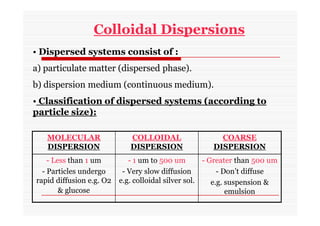
Colloidal Dispersions
• Dispersed systems consist of :
a) particulate matter (dispersed phase).
b) dispersion medium (continuous medium).
• Classification of dispersed systems (according to
particle size):
MOLECULAR
DISPERSION
COLLOIDAL
DISPERSION
COARSE
DISPERSION
- Less than 1 um
- Particles undergo
rapid diffusion e.g. O2
& glucose
- 1 um to 500 um
- Very slow diffusion
e.g. colloidal silver sol.
- Greater than 500 um
- Don’t diffuse
e.g. suspension &
emulsion
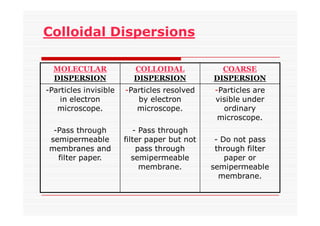
Colloidal Dispersions
MOLECULAR
DISPERSION
COLLOIDAL
DISPERSION
COARSE
DISPERSION
-Particles invisible
in electron
microscope.
-Pass through
semipermeable
membranes and
filter paper.
-Particles resolved
by electron
microscope.
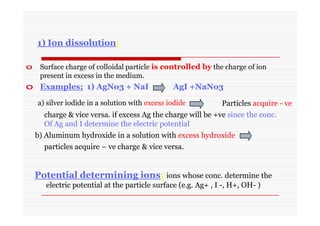
- Pass through
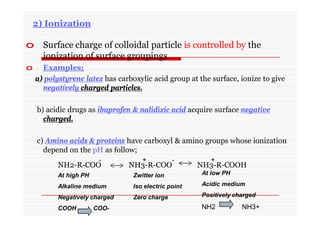
filter paper but not
pass through
semipermeable
membrane.
-Particles are
visible under
ordinary
microscope.
- Do not pass
through filter
paper or
semipermeable
membrane.
Types of colloidal systems:
o According to the interaction between particles of
dispersed phase & those of dispersion medium:
1) Lyophilic (solvent loving).
2) Lyophobic (solvent hating).
3) Association (amphiphilic).
• N.B.
• DISPERSION MEDIUM = SOLVENT.
• DISPERSED PHASE = MATERIAL = COLLOIDAL
PARTICLES.
• SOL. = COLLOIDAL SOLUTION.
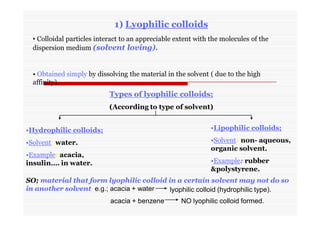
1) Lyophilic colloids
• Colloidal particles interact to an appreciable extent with the molecules of the
dispersion medium (solvent loving).
• Obtained simply by dissolving the material in the solvent ( due to the high
affinity).
Types of lyophilic colloids;
(According to type of solvent)
•Hydrophilic colloids;
•Solvent: water.
•Example: acacia,
insulin…. in water.
•Lipophilic colloids;
•Solvent: non- aqueous,
organic solvent.
•Example: rubber
&polystyrene.
SO; material that form lyophilic colloid in a certain solvent may not do so
in another solvent, e.g.; acacia + water lyophilic colloid (hydrophilic type).
acacia + benzene NO lyophilic colloid formed.
1) Lyophilic colloids
o the dispersed phase does not precipitate easily
o the sols are quite stable as the solute particle
surrounded by two stability factors:
a- negative or positive charge
b- layer of solvent
o If the dispersion medium is separated from the
dispersed phase, the sol can be reconstituted by
simply remixing with the dispersion medium.
Hence, these sols are called reversible sols
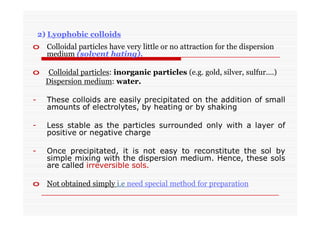
2) Lyophobic colloids
o Colloidal particles have very little or no attraction for the dispersion
medium (solvent hating).
o Colloidal particles: inorganic particles (e.g. gold, silver, sulfur….)
Dispersion medium: water.
- These colloids are easily precipitated on the addition of small
amounts of electrolytes, by heating or by shaking
- Less stable as the particles surrounded only with a layer of
positive or negative charge
- Once precipitated, it is not easy to reconstitute the sol by
simple mixing with the dispersion medium. Hence, these sols
are called irreversible sols.
o Not obtained simply i.e need special method for preparation
2) Lyophobic colloids
o Methods to prepare lyophobic
colloids:
A) Dispersion methods:
o coarse particles are reduced in size by;
1) Ultrasonic generator
2) Electric arc.
3) Colloid mill.
1) Ultrasonic generator:
• Dispersion achieved by high intensity UG at frequency more than
20,000 cycles/second
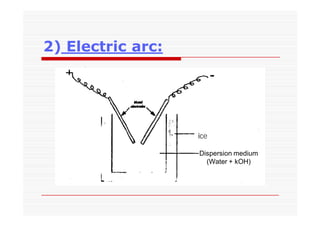
2) Electric arc:
• Involves production of an electric arc within the liquid and
dispersion achieved by intense heat generated by the arc so some
metal of the electrodes dispersed as vapor then condense to colloidal
particles.
3) Colloidal mill:
• Material sheared between 2 rapidly rotating close plates.
• Low efficiency & reduce the size of small proportion of particles
only.
2) Electric arc:
ice
Dispersion medium
(Water + kOH)
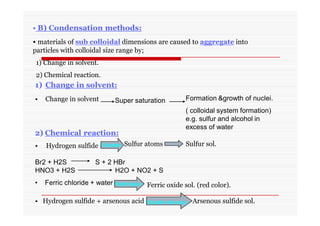
• B) Condensation methods:
• materials of sub colloidal dimensions are caused to aggregate into
particles with colloidal size range by;
1) Change in solvent.
2) Chemical reaction.
1) Change in solvent:
• Change in solvent Super saturation Formation &growth of nuclei.
( colloidal system formation)
e.g. sulfur and alcohol in
excess of water
2) Chemical reaction:
• Hydrogen sulfide
Br2 + H2S S + 2 HBr
HNO3 + H2S H2O + NO2 + S
Oxidatn. Sulfur atoms Sulfur sol.
Hydrolysis Ferric oxide sol. (red color).
• Hydrogen sulfide + arsenous acid Double decomp. Arsenous sulfide sol.
• Ferric chloride + water
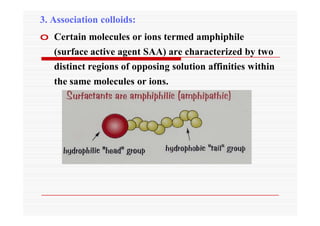
3. Association colloids:
o Certain molecules or ions termed amphiphile
(surface active agent SAA) are characterized by two
distinct regions of opposing solution affinities within
the same molecules or ions.
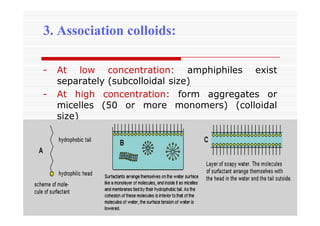
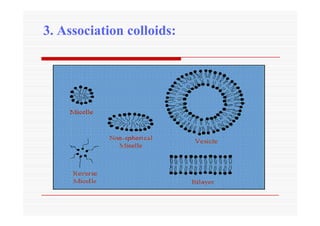
3. Association colloids:
- At low concentration: amphiphiles exist
separately (subcolloidal size)
- At high concentration: form aggregates or
micelles (50 or more monomers) (colloidal
size)
3. Association colloids:
As with lyophilic sols, formation of association colloids is
spontaneous, provided that the concentration of the
amphiphile in solution exceeds the cmc.
Amphiphiles may be
1. Anionic (e.g., Na. lauryl sulfate)
2. Cationic (e.g., cetyl triethylammonium bromide)
3. Nonionic (e.g., polyoxyethylene lauryl ether)
4. Ampholytic (zwitterionic) e.g., dimethyl dodecyl
ammonio propane sulfonate.
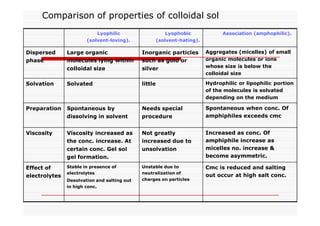
Comparison of properties of colloidal sol
Lyophilic
(solvent-loving).
Lyophobic
(solvent-hating).
Association (amphophilic).
Dispersed
phase
Large organic
molecules lying within
colloidal size
Inorganic particles
such as gold or
silver
Aggregates (micelles) of small
organic molecules or ions
whose size is below the
colloidal size
Solvation Solvated little Hydrophilic or lipophilic portion
of the molecules is solvated
depending on the medium
Preparation Spontaneous by
dissolving in solvent
Needs special
procedure
Spontaneous when conc. Of
amphiphiles exceeds cmc
Viscosity Viscosity increased as
the conc. increase. At
certain conc. Gel sol
gel formation.
Not greatly
increased due to
unsolvation
Increased as conc. Of
amphiphile increase as
micelles no. increase &
become asymmetric.
Effect of
electrolytes
Stable in presence of
electrolytes
Desolvation and salting out
in high conc.
Unstable due to
neutralization of
charges on particles
Cmc is reduced and salting
out occur at high salt conc.
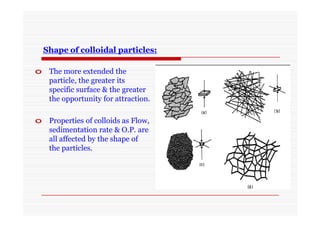
Shape of colloidal particles:
o The more extended the
particle, the greater its
specific surface & the greater
the opportunity for attraction.
o Properties of colloids as Flow,
sedimentation rate & O.P. are
all affected by the shape of
the particles.
Purification of colloids
o 1) Why?
Many lyophobic sols contain more or less material in true
solution. which may be undesirable for any number of
reasons; e.g.,
n electrolyte impurities : cause the flocculation of the
sol.
• 2) How?
a) Dialysis.
b) Electro dialysis.
c) Ultra filtration.
a)- Dialysis:
o Depend on difference in size between colloidal
particles & molecular particles (impurities).
o Technique;
1) use semi permeable membrane (e.g. collodion
(nitrocellulose), cellophane).
2) pore size of used semi permeable membrane prevent
passage of colloidal particles & permit passage of
small molecules & ions (impurities) such as urea,
glucose, and sodium chloride, to pass through.
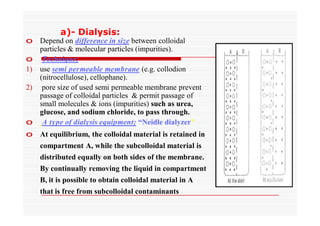
o A type of dialysis equipment; “Neidle dialyzer”
o At equilibrium, the colloidal material is retained in
compartment A, while the subcolloidal material is
distributed equally on both sides of the membrane.
By continually removing the liquid in compartment
B, it is possible to obtain colloidal material in A
that is free from subcolloidal contaminants
b)- Electro dialysis:o Technique;
o An electric potential may be used to
increase the rate of movement of ionic
impurities through a dialyzing
membrane and so provide rapid
purification.
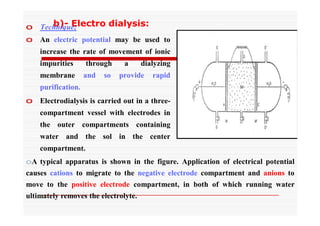
o Electrodialysis is carried out in a three-
compartment vessel with electrodes in
the outer compartments containing
water and the sol in the center
compartment.
oA typical apparatus is shown in the figure. Application of electrical potential
causes cations to migrate to the negative electrode compartment and anions to
move to the positive electrode compartment, in both of which running water
ultimately removes the electrolyte.
c) Ultra filtration:
• Technique;
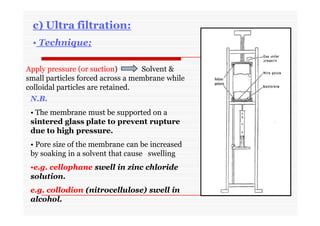
Apply pressure (or suction) Solvent &
small particles forced across a membrane while
colloidal particles are retained.
N.B.
• The membrane must be supported on a
sintered glass plate to prevent rupture
due to high pressure.
• Pore size of the membrane can be increased
by soaking in a solvent that cause swelling
•e.g. cellophane swell in zinc chloride
solution.
e.g. collodion (nitrocellulose) swell in
alcohol.
Artificial kidney machine:
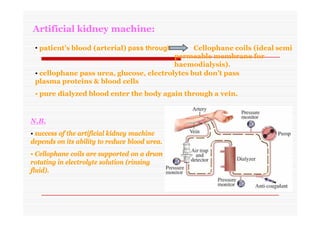
• patient’s blood (arterial) pass through Cellophane coils (ideal semi
permeable membrane for
haemodialysis).
• cellophane pass urea, glucose, electrolytes but don’t pass
plasma proteins & blood cells
• pure dialyzed blood enter the body again through a vein.
N.B.
• success of the artificial kidney machine
depends on its ability to reduce blood urea.
• Cellophane coils are supported on a drum
rotating in electrolyte solution (rinsing
fluid).
• Importance of the rinsing solution:
• Substances present in excess in blood (e.g. urea) diffuse from blood to
the rinsing solution.
• Substances which are deficient in blood (e.g. bicarbonate) diffuse from
the rinsing solution to blood.
• Substances which are present in normal amounts in blood are kept
unaltered have the same conc. In both blood and rinsing solution.
• Suit artificial kidney machine;
Pharmaceutical applications of colloids;
1) Colloidal silver iodide, silver chloride & silver protein are
effective germicides & not cause irritation as ionic silver salts.
2) Colloidal copper used in cancer.
3) Colloidal gold used as diagnostic agent.
4) Colloidal mercury used in syphilis.
5) Association colloids (SAA) are used to increase solubility &
stability of certain compounds in aqueous & oily
pharmaceutical preparations.
7) Blood plasma substitutes as dextran, PVP & gelatin are
hydrophilic colloids used to restore or maintain blood volume.
8) Iron - dextran complex form non-ionic hydrophilic sols
used for treatment of anemia.
Suit Pharmaceutical applications of
colloids;
6) Efficiency of certain substances is increased when used in
colloidal form due to large surface area.
e.g. efficiency of kaolin in adsorbing toxins from GIT.
e.g. efficiency of aluminum hydroxide as antacid.
Properties of colloids
A) Kinetic properties.
B) Optical properties.
C) Electrical properties.
A) Kinetic properties:
Which relate to the motion of the particles within the
dispersion medium as following:
• Brownian motion.
• Diffusion.
• Sedimentation.
• Osmotic pressure.
• The Donnan membrane effect.
• Viscosity.
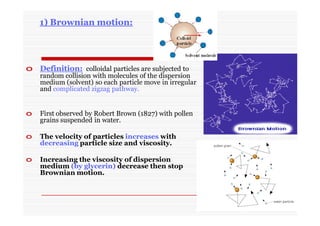
1) Brownian motion:
o Definition: colloidal particles are subjected to
random collision with molecules of the dispersion
medium (solvent) so each particle move in irregular
and complicated zigzag pathway.
o First observed by Robert Brown (1827) with pollen
grains suspended in water.
o The velocity of particles increases with
decreasing particle size and viscosity.
o Increasing the viscosity of dispersion
medium (by glycerin) decrease then stop
Brownian motion.
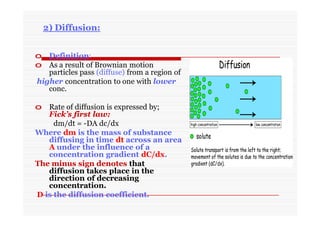
2) Diffusion:
o Definition:
o As a result of Brownian motion
particles pass (diffuse) from a region of
higher concentration to one with lower
conc.
o Rate of diffusion is expressed by;
Fick’s first law:
dm/dt = -DA dc/dx
Where dm is the mass of substance
diffusing in time dt across an area
A under the influence of a
concentration gradient dC/dx.
The minus sign denotes that
diffusion takes place in the
direction of decreasing
concentration.
D is the diffusion coefficient.
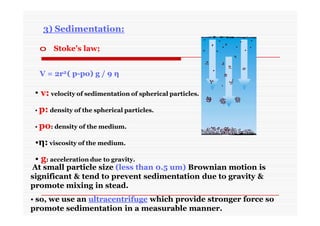
3) Sedimentation:
o Stoke’s law;
V = 2r2( p-po) g / 9 η
• v: velocity of sedimentation of spherical particles.
• p: density of the spherical particles.
• po: density of the medium.
•η: viscosity of the medium.
• g: acceleration due to gravity.
At small particle size (less than 0.5 um) Brownian motion is
significant & tend to prevent sedimentation due to gravity &
promote mixing in stead.
• so, we use an ultracentrifuge which provide stronger force so
promote sedimentation in a measurable manner.
4) Osmotic pressure:
o The method is based on Van's Hoff's law;
P = RTC / M
o From the equation;
a) The osmotic pressure (P) depends on molar conc. Of the
solute (C) & on absolute temp. (T).
b) The osmotic pressure is inversely proportional to
molecular weight (M).
R= molar gas constant
o The equation is valid for very dilute solutions in which
the molecules do not interact mutually.
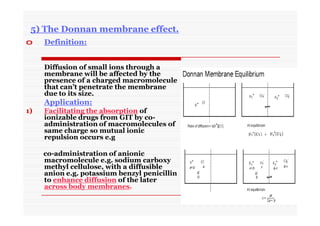
5) The Donnan membrane effect.
o Definition:
Diffusion of small ions through a
membrane will be affected by the
presence of a charged macromolecule
that can’t penetrate the membrane
due to its size.
Application:
1) Facilitating the absorption of
ionizable drugs from GIT by co-
administration of macromolecules of
same charge so mutual ionic
repulsion occurs e.g
co-administration of anionic
macromolecule e.g. sodium carboxy
methyl cellulose, with a diffusible
anion e.g. potassium benzyl penicillin
to enhance diffusion of the later
across body membranes.
6) viscosity
o Definition:
o The resistance to flow of a system under an
applied pressure
o Viscosity of colloid allows 1- calculation of the
molecular weight.
2- Provide useful information about the shape of
the colloidal particles.
o N.B.
o Spherocolloidal dispersions are of relatively low
viscosity.
o On the other hand Linear colloidal dispersions are of
high viscosity.
o If linear colloidal particles coil up into spheres
The viscosity of the system falls due to changing the
shape.
B) Optical properties:
1) Light scattering (Tyndall effect).
1) Ultra microscope.
2) Electron microscope.
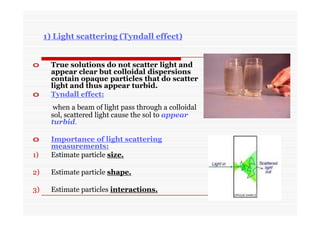
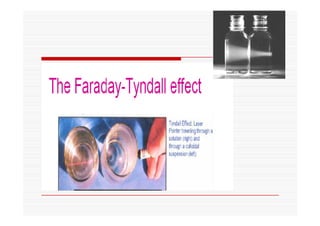
1) Light scattering (Tyndall effect)
o True solutions do not scatter light and
appear clear but colloidal dispersions
contain opaque particles that do scatter
light and thus appear turbid.
o Tyndall effect:
when a beam of light pass through a colloidal
sol, scattered light cause the sol to appear
turbid.
o Importance of light scattering
measurements:
1) Estimate particle size.
2) Estimate particle shape.
3) Estimate particles interactions.
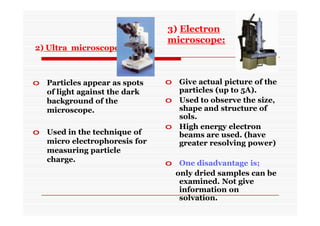
2) Ultra microscope:
o Particles appear as spots
of light against the dark
background of the
microscope.
o Used in the technique of
micro electrophoresis for
measuring particle
charge.
o Give actual picture of the
particles (up to 5A).
o Used to observe the size,
shape and structure of
sols.
o High energy electron
beams are used. (have
greater resolving power)
o One disadvantage is;
only dried samples can be
examined. Not give
information on
solvation.
3) Electron
microscope:
C) Electrical properties:
a) Electrical properties of interfaces.
b) The electrical double layer.
a) Electrical properties of interfaces:
Most surfaces acquire a surface electric charge
when brought into contact with an aqueous
medium, the principal charging mechanisms
being as follows:
1) Ion dissolution.
2) Ionization.
3) Ion adsorption.
1) Ion dissolution:
o Surface charge of colloidal particle is controlled by the charge of ion
present in excess in the medium.
o Examples; 1) AgNo3 + NaI AgI +NaNo3
a) silver iodide in a solution with excess iodide Particles acquire - ve
b) Aluminum hydroxide in a solution with excess hydroxide
Potential determining ions: ions whose conc. determine the
electric potential at the particle surface (e.g. Ag+ , I -, H+, OH- )
charge & vice versa. if excess Ag the charge will be +ve since the conc.
Of Ag and I determine the electric potential
particles acquire – ve charge & vice versa.
2) Ionization
o Surface charge of colloidal particle is controlled by the
ionization of surface groupings
o Examples;
a) polystyrene latex has carboxylic acid group at the surface, ionize to give
negatively charged particles.
b) acidic drugs as ibuprofen & nalidixic acid acquire surface negative
charged.
c) Amino acids & proteins have carboxyl & amino groups whose ionization
depend on the pH as follow;
-
NH3-R-COO
-
NH3-R-COOH
+ +
At high PH
Alkaline medium
Negatively charged
COOH COO-
Zwitter ion
Iso electric point
Zero charge
At low PH
Acidic medium
Positively charged
NH2 NH3+
NH2-R-COO
Suit ionization;
o Iso electric point:
o pH at which +ve charges = -ve charges,
o i.e. net charge of the amino acid = zero.
o It is a definite pH specific for each protein.
o At this pH protein is least soluble & precipitated.
o Q; How can you precipitate insulin???
o BY ADJUSTING THE pH OF the SOLUTION
TO THE ISO ELECTRIC POINT OF INSULIN
(PH 5.2).
3) Ion adsorption:
o Surface charge of colloidal particle is controlled by the
unequal adsorption of oppositely charged ions
o Examples;
o Surfaces of sol in water are more often –ve charged
than +ve charged ?!!!
Because cations are more hydrated than anions so
cations reside in the bulk while less hydrated anions
adsorbed on the surface.
b) The electrical double layer:
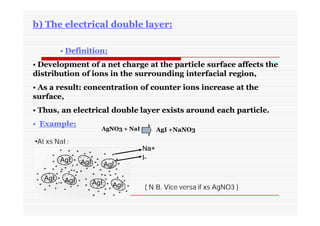
AgNO3 + NaI AgI +NaNO3
• Development of a net charge at the particle surface affects the
distribution of ions in the surrounding interfacial region,
• As a result: concentration of counter ions increase at the
surface,
• Thus, an electrical double layer exists around each particle.
• Example;
• Definition:
I-
Na+
•At xs NaI :
AgI
AgIAgIAgI
AgI
AgI
AgI
( N.B. Vice versa if xs AgNO3 )
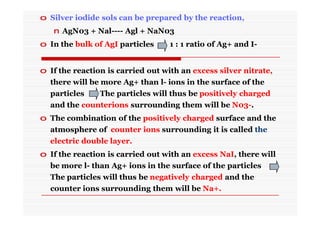
o Silver iodide sols can be prepared by the reaction,
n AgN03 + Nal---- Agl + NaN03
o In the bulk of AgI particles 1 : 1 ratio of Ag+ and I-
o If the reaction is carried out with an excess silver nitrate,
there will be more Ag+ than l- ions in the surface of the
particles The particles will thus be positively charged
and the counterions surrounding them will be N03-.
o The combination of the positively charged surface and the
atmosphere of counter ions surrounding it is called the
electric double layer.
o If the reaction is carried out with an excess NaI, there will
be more l- than Ag+ ions in the surface of the particles
The particles will thus be negatively charged and the
counter ions surrounding them will be Na+.

Colloids-basic

  • 1.
  • 2.
    Colloidal Dispersions • Dispersedsystems consist of : a) particulate matter (dispersed phase). b) dispersion medium (continuous medium). • Classification of dispersed systems (according to particle size): MOLECULAR DISPERSION COLLOIDAL DISPERSION COARSE DISPERSION - Less than 1 um - Particles undergo rapid diffusion e.g. O2 & glucose - 1 um to 500 um - Very slow diffusion e.g. colloidal silver sol. - Greater than 500 um - Don’t diffuse e.g. suspension & emulsion
  • 3.
    Colloidal Dispersions MOLECULAR DISPERSION COLLOIDAL DISPERSION COARSE DISPERSION -Particles invisible inelectron microscope. -Pass through semipermeable membranes and filter paper. -Particles resolved by electron microscope. - Pass through filter paper but not pass through semipermeable membrane. -Particles are visible under ordinary microscope. - Do not pass through filter paper or semipermeable membrane.
  • 4.
    Types of colloidalsystems: o According to the interaction between particles of dispersed phase & those of dispersion medium: 1) Lyophilic (solvent loving). 2) Lyophobic (solvent hating). 3) Association (amphiphilic).
  • 5.
    • N.B. • DISPERSIONMEDIUM = SOLVENT. • DISPERSED PHASE = MATERIAL = COLLOIDAL PARTICLES. • SOL. = COLLOIDAL SOLUTION.
  • 6.
    1) Lyophilic colloids •Colloidal particles interact to an appreciable extent with the molecules of the dispersion medium (solvent loving). • Obtained simply by dissolving the material in the solvent ( due to the high affinity). Types of lyophilic colloids; (According to type of solvent) •Hydrophilic colloids; •Solvent: water. •Example: acacia, insulin…. in water. •Lipophilic colloids; •Solvent: non- aqueous, organic solvent. •Example: rubber &polystyrene. SO; material that form lyophilic colloid in a certain solvent may not do so in another solvent, e.g.; acacia + water lyophilic colloid (hydrophilic type). acacia + benzene NO lyophilic colloid formed.
  • 7.
    1) Lyophilic colloids othe dispersed phase does not precipitate easily o the sols are quite stable as the solute particle surrounded by two stability factors: a- negative or positive charge b- layer of solvent o If the dispersion medium is separated from the dispersed phase, the sol can be reconstituted by simply remixing with the dispersion medium. Hence, these sols are called reversible sols
  • 8.
    2) Lyophobic colloids oColloidal particles have very little or no attraction for the dispersion medium (solvent hating). o Colloidal particles: inorganic particles (e.g. gold, silver, sulfur….) Dispersion medium: water. - These colloids are easily precipitated on the addition of small amounts of electrolytes, by heating or by shaking - Less stable as the particles surrounded only with a layer of positive or negative charge - Once precipitated, it is not easy to reconstitute the sol by simple mixing with the dispersion medium. Hence, these sols are called irreversible sols. o Not obtained simply i.e need special method for preparation
  • 9.
    2) Lyophobic colloids oMethods to prepare lyophobic colloids: A) Dispersion methods: o coarse particles are reduced in size by; 1) Ultrasonic generator 2) Electric arc. 3) Colloid mill.
  • 10.
    1) Ultrasonic generator: •Dispersion achieved by high intensity UG at frequency more than 20,000 cycles/second 2) Electric arc: • Involves production of an electric arc within the liquid and dispersion achieved by intense heat generated by the arc so some metal of the electrodes dispersed as vapor then condense to colloidal particles. 3) Colloidal mill: • Material sheared between 2 rapidly rotating close plates. • Low efficiency & reduce the size of small proportion of particles only.
  • 11.
    2) Electric arc: ice Dispersionmedium (Water + kOH)
  • 12.
    • B) Condensationmethods: • materials of sub colloidal dimensions are caused to aggregate into particles with colloidal size range by; 1) Change in solvent. 2) Chemical reaction. 1) Change in solvent: • Change in solvent Super saturation Formation &growth of nuclei. ( colloidal system formation) e.g. sulfur and alcohol in excess of water 2) Chemical reaction: • Hydrogen sulfide Br2 + H2S S + 2 HBr HNO3 + H2S H2O + NO2 + S Oxidatn. Sulfur atoms Sulfur sol. Hydrolysis Ferric oxide sol. (red color). • Hydrogen sulfide + arsenous acid Double decomp. Arsenous sulfide sol. • Ferric chloride + water
  • 13.
    3. Association colloids: oCertain molecules or ions termed amphiphile (surface active agent SAA) are characterized by two distinct regions of opposing solution affinities within the same molecules or ions.
  • 14.
    3. Association colloids: -At low concentration: amphiphiles exist separately (subcolloidal size) - At high concentration: form aggregates or micelles (50 or more monomers) (colloidal size)
  • 15.
  • 16.
    As with lyophilicsols, formation of association colloids is spontaneous, provided that the concentration of the amphiphile in solution exceeds the cmc. Amphiphiles may be 1. Anionic (e.g., Na. lauryl sulfate) 2. Cationic (e.g., cetyl triethylammonium bromide) 3. Nonionic (e.g., polyoxyethylene lauryl ether) 4. Ampholytic (zwitterionic) e.g., dimethyl dodecyl ammonio propane sulfonate.
  • 17.
    Comparison of propertiesof colloidal sol Lyophilic (solvent-loving). Lyophobic (solvent-hating). Association (amphophilic). Dispersed phase Large organic molecules lying within colloidal size Inorganic particles such as gold or silver Aggregates (micelles) of small organic molecules or ions whose size is below the colloidal size Solvation Solvated little Hydrophilic or lipophilic portion of the molecules is solvated depending on the medium Preparation Spontaneous by dissolving in solvent Needs special procedure Spontaneous when conc. Of amphiphiles exceeds cmc Viscosity Viscosity increased as the conc. increase. At certain conc. Gel sol gel formation. Not greatly increased due to unsolvation Increased as conc. Of amphiphile increase as micelles no. increase & become asymmetric. Effect of electrolytes Stable in presence of electrolytes Desolvation and salting out in high conc. Unstable due to neutralization of charges on particles Cmc is reduced and salting out occur at high salt conc.
  • 18.
    Shape of colloidalparticles: o The more extended the particle, the greater its specific surface & the greater the opportunity for attraction. o Properties of colloids as Flow, sedimentation rate & O.P. are all affected by the shape of the particles.
  • 19.
    Purification of colloids o1) Why? Many lyophobic sols contain more or less material in true solution. which may be undesirable for any number of reasons; e.g., n electrolyte impurities : cause the flocculation of the sol. • 2) How? a) Dialysis. b) Electro dialysis. c) Ultra filtration.
  • 20.
    a)- Dialysis: o Dependon difference in size between colloidal particles & molecular particles (impurities). o Technique; 1) use semi permeable membrane (e.g. collodion (nitrocellulose), cellophane). 2) pore size of used semi permeable membrane prevent passage of colloidal particles & permit passage of small molecules & ions (impurities) such as urea, glucose, and sodium chloride, to pass through. o A type of dialysis equipment; “Neidle dialyzer” o At equilibrium, the colloidal material is retained in compartment A, while the subcolloidal material is distributed equally on both sides of the membrane. By continually removing the liquid in compartment B, it is possible to obtain colloidal material in A that is free from subcolloidal contaminants
  • 21.
    b)- Electro dialysis:oTechnique; o An electric potential may be used to increase the rate of movement of ionic impurities through a dialyzing membrane and so provide rapid purification. o Electrodialysis is carried out in a three- compartment vessel with electrodes in the outer compartments containing water and the sol in the center compartment. oA typical apparatus is shown in the figure. Application of electrical potential causes cations to migrate to the negative electrode compartment and anions to move to the positive electrode compartment, in both of which running water ultimately removes the electrolyte.
  • 22.
    c) Ultra filtration: •Technique; Apply pressure (or suction) Solvent & small particles forced across a membrane while colloidal particles are retained. N.B. • The membrane must be supported on a sintered glass plate to prevent rupture due to high pressure. • Pore size of the membrane can be increased by soaking in a solvent that cause swelling •e.g. cellophane swell in zinc chloride solution. e.g. collodion (nitrocellulose) swell in alcohol.
  • 23.
    Artificial kidney machine: •patient’s blood (arterial) pass through Cellophane coils (ideal semi permeable membrane for haemodialysis). • cellophane pass urea, glucose, electrolytes but don’t pass plasma proteins & blood cells • pure dialyzed blood enter the body again through a vein. N.B. • success of the artificial kidney machine depends on its ability to reduce blood urea. • Cellophane coils are supported on a drum rotating in electrolyte solution (rinsing fluid).
  • 24.
    • Importance ofthe rinsing solution: • Substances present in excess in blood (e.g. urea) diffuse from blood to the rinsing solution. • Substances which are deficient in blood (e.g. bicarbonate) diffuse from the rinsing solution to blood. • Substances which are present in normal amounts in blood are kept unaltered have the same conc. In both blood and rinsing solution. • Suit artificial kidney machine;
  • 25.
    Pharmaceutical applications ofcolloids; 1) Colloidal silver iodide, silver chloride & silver protein are effective germicides & not cause irritation as ionic silver salts. 2) Colloidal copper used in cancer. 3) Colloidal gold used as diagnostic agent. 4) Colloidal mercury used in syphilis. 5) Association colloids (SAA) are used to increase solubility & stability of certain compounds in aqueous & oily pharmaceutical preparations.
  • 26.
    7) Blood plasmasubstitutes as dextran, PVP & gelatin are hydrophilic colloids used to restore or maintain blood volume. 8) Iron - dextran complex form non-ionic hydrophilic sols used for treatment of anemia. Suit Pharmaceutical applications of colloids; 6) Efficiency of certain substances is increased when used in colloidal form due to large surface area. e.g. efficiency of kaolin in adsorbing toxins from GIT. e.g. efficiency of aluminum hydroxide as antacid.
  • 27.
    Properties of colloids A)Kinetic properties. B) Optical properties. C) Electrical properties.
  • 28.
    A) Kinetic properties: Whichrelate to the motion of the particles within the dispersion medium as following: • Brownian motion. • Diffusion. • Sedimentation. • Osmotic pressure. • The Donnan membrane effect. • Viscosity.
  • 29.
    1) Brownian motion: oDefinition: colloidal particles are subjected to random collision with molecules of the dispersion medium (solvent) so each particle move in irregular and complicated zigzag pathway. o First observed by Robert Brown (1827) with pollen grains suspended in water. o The velocity of particles increases with decreasing particle size and viscosity. o Increasing the viscosity of dispersion medium (by glycerin) decrease then stop Brownian motion.
  • 30.
    2) Diffusion: o Definition: oAs a result of Brownian motion particles pass (diffuse) from a region of higher concentration to one with lower conc. o Rate of diffusion is expressed by; Fick’s first law: dm/dt = -DA dc/dx Where dm is the mass of substance diffusing in time dt across an area A under the influence of a concentration gradient dC/dx. The minus sign denotes that diffusion takes place in the direction of decreasing concentration. D is the diffusion coefficient.
  • 31.
    3) Sedimentation: o Stoke’slaw; V = 2r2( p-po) g / 9 η • v: velocity of sedimentation of spherical particles. • p: density of the spherical particles. • po: density of the medium. •η: viscosity of the medium. • g: acceleration due to gravity. At small particle size (less than 0.5 um) Brownian motion is significant & tend to prevent sedimentation due to gravity & promote mixing in stead. • so, we use an ultracentrifuge which provide stronger force so promote sedimentation in a measurable manner.
  • 32.
    4) Osmotic pressure: oThe method is based on Van's Hoff's law; P = RTC / M o From the equation; a) The osmotic pressure (P) depends on molar conc. Of the solute (C) & on absolute temp. (T). b) The osmotic pressure is inversely proportional to molecular weight (M). R= molar gas constant o The equation is valid for very dilute solutions in which the molecules do not interact mutually.
  • 33.
    5) The Donnanmembrane effect. o Definition: Diffusion of small ions through a membrane will be affected by the presence of a charged macromolecule that can’t penetrate the membrane due to its size. Application: 1) Facilitating the absorption of ionizable drugs from GIT by co- administration of macromolecules of same charge so mutual ionic repulsion occurs e.g co-administration of anionic macromolecule e.g. sodium carboxy methyl cellulose, with a diffusible anion e.g. potassium benzyl penicillin to enhance diffusion of the later across body membranes.
  • 34.
    6) viscosity o Definition: oThe resistance to flow of a system under an applied pressure o Viscosity of colloid allows 1- calculation of the molecular weight. 2- Provide useful information about the shape of the colloidal particles. o N.B. o Spherocolloidal dispersions are of relatively low viscosity. o On the other hand Linear colloidal dispersions are of high viscosity. o If linear colloidal particles coil up into spheres The viscosity of the system falls due to changing the shape.
  • 35.
    B) Optical properties: 1)Light scattering (Tyndall effect). 1) Ultra microscope. 2) Electron microscope.
  • 36.
    1) Light scattering(Tyndall effect) o True solutions do not scatter light and appear clear but colloidal dispersions contain opaque particles that do scatter light and thus appear turbid. o Tyndall effect: when a beam of light pass through a colloidal sol, scattered light cause the sol to appear turbid. o Importance of light scattering measurements: 1) Estimate particle size. 2) Estimate particle shape. 3) Estimate particles interactions.
  • 38.
    2) Ultra microscope: oParticles appear as spots of light against the dark background of the microscope. o Used in the technique of micro electrophoresis for measuring particle charge. o Give actual picture of the particles (up to 5A). o Used to observe the size, shape and structure of sols. o High energy electron beams are used. (have greater resolving power) o One disadvantage is; only dried samples can be examined. Not give information on solvation. 3) Electron microscope:
  • 39.
    C) Electrical properties: a)Electrical properties of interfaces. b) The electrical double layer.
  • 40.
    a) Electrical propertiesof interfaces: Most surfaces acquire a surface electric charge when brought into contact with an aqueous medium, the principal charging mechanisms being as follows: 1) Ion dissolution. 2) Ionization. 3) Ion adsorption.
  • 41.
    1) Ion dissolution: oSurface charge of colloidal particle is controlled by the charge of ion present in excess in the medium. o Examples; 1) AgNo3 + NaI AgI +NaNo3 a) silver iodide in a solution with excess iodide Particles acquire - ve b) Aluminum hydroxide in a solution with excess hydroxide Potential determining ions: ions whose conc. determine the electric potential at the particle surface (e.g. Ag+ , I -, H+, OH- ) charge & vice versa. if excess Ag the charge will be +ve since the conc. Of Ag and I determine the electric potential particles acquire – ve charge & vice versa.
  • 42.
    2) Ionization o Surfacecharge of colloidal particle is controlled by the ionization of surface groupings o Examples; a) polystyrene latex has carboxylic acid group at the surface, ionize to give negatively charged particles. b) acidic drugs as ibuprofen & nalidixic acid acquire surface negative charged. c) Amino acids & proteins have carboxyl & amino groups whose ionization depend on the pH as follow; - NH3-R-COO - NH3-R-COOH + + At high PH Alkaline medium Negatively charged COOH COO- Zwitter ion Iso electric point Zero charge At low PH Acidic medium Positively charged NH2 NH3+ NH2-R-COO
  • 43.
    Suit ionization; o Isoelectric point: o pH at which +ve charges = -ve charges, o i.e. net charge of the amino acid = zero. o It is a definite pH specific for each protein. o At this pH protein is least soluble & precipitated. o Q; How can you precipitate insulin??? o BY ADJUSTING THE pH OF the SOLUTION TO THE ISO ELECTRIC POINT OF INSULIN (PH 5.2).
  • 44.
    3) Ion adsorption: oSurface charge of colloidal particle is controlled by the unequal adsorption of oppositely charged ions o Examples; o Surfaces of sol in water are more often –ve charged than +ve charged ?!!! Because cations are more hydrated than anions so cations reside in the bulk while less hydrated anions adsorbed on the surface.
  • 45.
    b) The electricaldouble layer: AgNO3 + NaI AgI +NaNO3 • Development of a net charge at the particle surface affects the distribution of ions in the surrounding interfacial region, • As a result: concentration of counter ions increase at the surface, • Thus, an electrical double layer exists around each particle. • Example; • Definition: I- Na+ •At xs NaI : AgI AgIAgIAgI AgI AgI AgI ( N.B. Vice versa if xs AgNO3 )
  • 46.
    o Silver iodidesols can be prepared by the reaction, n AgN03 + Nal---- Agl + NaN03 o In the bulk of AgI particles 1 : 1 ratio of Ag+ and I- o If the reaction is carried out with an excess silver nitrate, there will be more Ag+ than l- ions in the surface of the particles The particles will thus be positively charged and the counterions surrounding them will be N03-. o The combination of the positively charged surface and the atmosphere of counter ions surrounding it is called the electric double layer. o If the reaction is carried out with an excess NaI, there will be more l- than Ag+ ions in the surface of the particles The particles will thus be negatively charged and the counter ions surrounding them will be Na+.