Emulsion
Parag Jain
Assistant Professor 

Chhattrapati Shivaji Institute
of Pharmacy

Durg, Chhattisgarh
Presented by
Definition
• An emulsion is a two phase system
consisting of two incompletely miscible
liquids, one of which is dispersed as finite
globules in the other. The particle size of the
globules range from 0.25 to 25 μm. An
emulsifying agent and mechanical energy are
needed to join the phases.
Emulsion
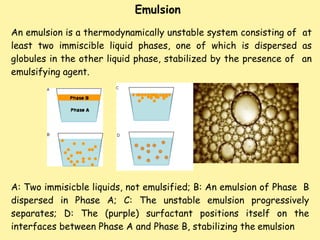
A: Two immisicble liquids, not emulsified; B: An emulsion of Phase B
dispersed in Phase A; C: The unstable emulsion progressively
separates; D: The (purple) surfactant positions itself on the
interfaces between Phase A and Phase B, stabilizing the emulsion
An emulsion is a thermodynamically unstable system consisting of at
least two immiscible liquid phases, one of which is dispersed as
globules in the other liquid phase, stabilized by the presence of an
emulsifying agent.
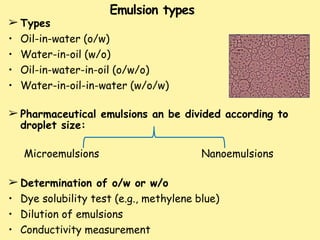
Emulsion types
➢ Types
• Oil-in-water (o/w)
• Water-in-oil (w/o)
• Oil-in-water-in-oil (o/w/o)
• Water-in-oil-in-water (w/o/w)
➢ Pharmaceutical emulsions an be divided according to
droplet size:
Microemulsions Nanoemulsions
➢ Determination of o/w or w/o
• Dye solubility test (e.g., methylene blue)
• Dilution of emulsions
• Conductivity measurement
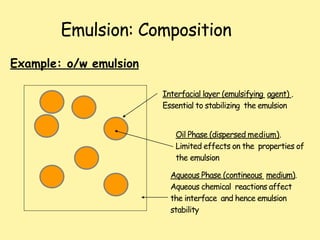
Emulsion: Composition
Interfacial layer (emulsifying agent) .
Essential to stabilizing the emulsion
Oil Phase (dispersed medium).
Limited effects on the properties of
the emulsion
Aqueous Phase (contineous medium).
Aqueous chemical reactions affect
the interface and hence emulsion
stability
Example: o/w emulsion
Pharmaceutical emulsions.
➢ Applications of emulsions:
- Oral emulsions: o/w (liquid)
- External emulsions: liniments, lotions (liquid)
Creams (semi-solid)
- Parenteral emulsions: o/w (parenteral nutrition)
o/w or w/o intramuscular.
Applications of emulsion
• Oral, rectal and topical administration of oils and oil-
soluble drugs. 

• The unpleasant taste or odor can be masked by
emulsification. 

• The absorption and penetration of medicament are
enhanced by emulsification. 

• Intramuscular injections of water-soluble drugs or
vaccine to provide slow release. 

• The use of sterile stable i.v emulsion containing fats,
carbohydrates and vitamins as a potential nutrition.
Formulation of emulsion
Selection of Emulsifying agents (emulsifiers): 

• An emulsifying agent is any material that
enhances the stability of an emulsion (i.e.
Prevention of coalescence and reducing
creaming). 

• The ideal emulsifying agent is colourless,
odourless, tasteless, non- toxic, non-irritant and
able to produce stable emulsions at low
concentrations.
Examples of Emulsifying agent

• Carbohydrate Materials:

• Acacia, Tragacanth, Agar, Pectin. o/w emulsion.

• Protein Substances:

• Gelatin, Egg yolk, Caesin o/w emulsion.

• High Molecular Weight Alcohols:

• Stearyl	 Alcohol,	Cetyl	 Alcohol,	Glyceryl	 Mono	 stearate	o/w	
emulsion, cholesterol w/o emulsion.

• Wetting agents 

• Anionic, Cationic, Nonionic -o/w emulsion, -w/o emulsion

• Finely divided solids

• Bentonite, Magnesium Hydroxide, Aluminum Hydroxide o/w emulsion.
Identification of emulsion type
• Dilution test (miscibility test)

• Staining test (dye solubility test)

• Conductivity measurement 

• Fluorescence test
Dilution test
• In this test the emulsion is diluted either with oil
or water. If the emulsion is o/w type and it is
diluted with water, it will remain stable as water is
the dispersion medium” but if it is diluted with oil,
the emulsion will break as oil and water are not
miscible with each other.

Conductivity Test:
• The basic principle of this test is that water is a
good conductor of electricity. Therefore in case
of o/w emulsion, this test will be positive as
water is the external phase
Dye solubility test
• In this test an emulsion is mixed with a water
soluble dye (amaranth) and observed under the
microscope. If the continuous phase appears
red, it means that the emulsion is o/w type as
water is in the external phase and the dye will
dissolve in it to give color.

• If the scattered globules appear red and
continuous phase colorless, then it is w/o type.
Fluorescence Test:
• If an emulsion on exposure to ultra-violet
radiations shows continuous fluorescence
under microscope, then it is w/o type and if it
shows only spotty fluorescence, then it is o/w
type.If the scattered globules appear red and
continuous phase colorless, then it is w/o type.
Selection of emulsifying agent 

• An ideal emulsifying agent should posses the following characteristics: 

• It should be able to reduce the interfacial tension between the two
immiscible liquids. 

• It should be physically and chemically stable , inert and compatible
with the other ingredients of the formulation. 

• It should be non irritant and non toxic in the conc., used. 

• It should be organoleptically inert i.e. should not impart any color ,
odour or taste to the preparation. 

• It should be able to produce and maintain the required viscosity of the
preparation. 

• It should be able to form a coherent film around the globules of the
dispersed phase and should prevent the coalescence of the droplet of
the dispersed phase.
Mechanism of action of
emulsifying agents
• When one liquid is broken in large no. of
small globules then interfacial area
increases
• Interfacial energy associated with interface
also increases
• To reduce interfacial energy, globules of
dispersed phase tends to coalesce
(merge)
• To prevent coalescence and to keep system
stable in disperse state it is necessary to add
emulsifying agent
Mechanism of action of emulsifying
agents
• Reduction of interfacial tension-
Thermodynamic stabilization
• Formation of interfacial film barrier
(stearic stabilization) Mechanical barrier to
coalescence
• Formation of electric double layer-
Electrical barrier to approach of globules
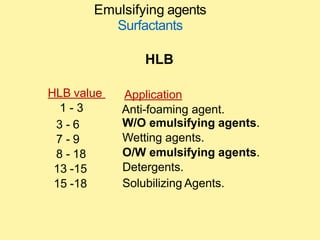
HLB value
1 - 3
3 - 6
7 - 9
8 - 18
13 -15
15 -18
Application
Anti-foaming agent.
W/O emulsifying agents.
Wetting agents.
O/W emulsifying agents.
Detergents.
Solubilizing Agents.
Emulsifying agents
Surfactants
HLB
Preservation of emulsion
Microbial contamination may occur due to: 

• Contamination during development or production of
emulsion or during its use. 

• Usage of impure raw materials 

• Poor sanitation conditions 

• Invasion by an opportunistic microorganisms. 

• Contamination by the consumer during use of the product.
• Precautions to prevent microbial growth ; 

• Use of uncontaminated raw materials 

• Careful cleaning of equipment with steam.

The preservative must be : 

• Less toxic 

• Stable to heat and storage 

• Chemically compatible 

• Reasonable cost 

• Acceptable taste, odor and color. 

• Effective against fungus, yeast, bacteria. 

• Available in oil and aqueous phase at effective level concentration. 

• Preservative should be in unionized state to penetrate the bacteria. 

• Preservative must no bind to other components of the emulsion.
Examples of antimicrobial preservatives used to preserve
emulsified systems include 

• Parahydroxybenzoate esters such as methyl, propyl and
butyl parabens,

• Organic acids such as ascorbic acid and benzoic acid, 

• Organic mercurials such as phenylmercuric acetate and 

phenylmercuric nitrate, 

• Quaternary ammonium compounds such as cetrimide, 

• Cresol derivatives such as chlorocresol 

• and miscellaneous agents such as sodium benzoate,
chloroform and phenoxyethanolamine
Stability of emulsion
• An emulsion is said to be stable if it remains as such after its
preparation , that is the dispersed globules are uniformly
distributed through out the dispersion medium during its
storage. The emulsion should be chemically stable and there
should not be any bacterial growth during it shelf life. 

• Emulsion instability may either reversible or irreversible and
manifest in the following ways:- 

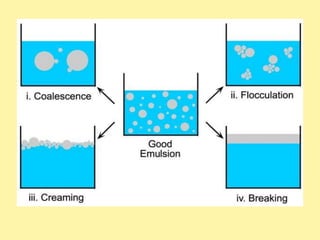
• Cracking (irreversible instability) 

• Flocculation

• Creaming

• Phase inversion
1. Cracking
• Cracking means the separation of two layers of disperse and
continuous phase , due to the coalescence of disperse phase
globules which are difficult to redisperse by shaking. 

• Cracking may occurs due to following reasons:- 

• By addition of emulsifying agent of opposite type 

• By decomposition or precipitation of emulsifying agent 

• By addition of common solvent 

• By microorganisms 

• Change in temperature 

• By creaming
2. Flocculation
• In flocculated state the secondary interaction (van der
waals forces) maintain the droplets at a defined
distance of separation. 

• Application of shearing stress to the formulation
(shaking) will redisperse these droplets to form a
homogeneous formulation. 

• Although flocculation may stabilise the formulation,
there is also possibility that the close location of
droplets would enable droplet coalescence to occur if
the mechanical properties of the interfacial film are
compromised.
3. Creaming
• Creaming may be defined as the upward movement of dispersed
globules to form a thick layer at the surface of emulsion. 

• Creaming is temporary phase because it can be re-distributed
by mild shaking or stirring to get again a homogenous emulsion. 

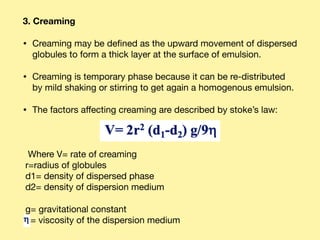
• The factors affecting creaming are described by stoke’s law: 


Where V= rate of creaming

r=radius of globules

d1= density of dispersed phase

d2= density of dispersion medium

g= gravitational constant

= viscosity of the dispersion medium
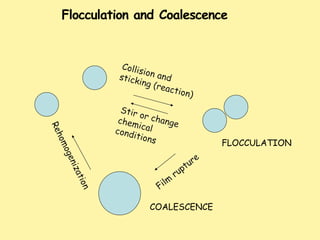
Flocculation and Coalescence
FLOCCULATION
COALESCENCE
• Radius of globules

• Difference in density of disperse phase and continuous
phase 

• Viscosity of dispersion medium

• Storage condition
4. Phase inversion:-
• Phase inversion means the change of one type of emulsion into
other type, that is oil in water emulsion changes into water in
oil type and vice-versa. 

• Phase inversion takes place due to:

• By the addition of an electrolyte 

• By changing the phase-volume ratio 

• By temperature change 

• By changing the emulsifying agent 

The phase inversion can be minimised by keeping concentration
of disperse phase between 30 to 60 % , storing the emulsion in
cool place and using a proper emulsifying agent in adequate
concentration.
Stability of emulsions
How to enhance stability (to prevent
cracking)?
• Globule size:
creaming and
✓ Smaller particles have slower creaming or sedimentation than
larger particles (Stoke’s law).
• Stable emulsions require a maximal number of small sized (1-3
µm) globules and as few as possible larger (>15 µm) diameter
globules.
• A homogenizer will efficiently reduce droplet size by forcing the
emulsion through a small aperture to reduce the size of the
globules.
✓ Additionally, reducing droplet size may additionally increase the
viscosity if more than 30% of disperse phase is present.
4/17/2019
Stability of emulsions
How to enhance stability ( to prevent creaming and
cracking)?
• Viscosity of the continuous phase:
✓ Increasing the viscosity of the continuous phase will reduce the
potential for globule creaming and hence coalescence as this
reduces the movement of globules.
✓ How to increase viscosity?
❖ Viscosity enhancing agents, which increase the viscosity of the
continuous phase, may be used in o/w emulsions. e.g tragacanth,
sodium alginate and methylcellulose.
❖ Higher percentages of oil phase (o/w).
❖ Decreasing the globule size of the internal phase.
❖ Higher amounts of solid fats in the oily phase (i.e. high ratios of
solid fat to liquid fats).
9
Stability of emulsions
How to enhance stability ( to prevent creaming and
cracking)?
• Using emulsifying agents (hydrocolloids, surfactants and
other) :
✓ Forming interfacial film mechanical barrier which decreases the
potential for coalescence (more important).
✓ Surfactants may reduce the interfacial tension between the two
phases (less important).
✓ Hydrocolloids enhance the viscosity of the medium.
Note: Care should be taken for any effects that could affect the
interfacial film (chemical, physical or biological effects).
9
Stability of emulsions
How to enhance stability ( to prevent creaming and
cracking)?
• Storage temperature:
✓ Extremes of temperature can lead to an emulsion cracking.
✓ When water freezes it expands, so undue pressure is exerted on
dispersed globules and the emulsifying agent film, which may lead
to cracking.
✓ Conversely, an increased temperature decreases the viscosity of
the continuous phase and disrupts the integrity of the interfacial
film. An increasing number of collisions between droplets will also
occur, leading to increased creaming and cracking.
Website: www.probecell.com Email: probecellinfo@gmail.com
Ph: 7415211131
Office: Smriti Nagar, Bhilai, Chhattisgarh - 490020
https://youtube.com/c/ParagJainthunderpassionate https://www.facebook.com/thesisresearchwriting

Pharmaceutical Emulsion

  • 1.
    Emulsion Parag Jain Assistant Professor Chhattrapati Shivaji Institute of Pharmacy Durg, Chhattisgarh Presented by
  • 2.
    Definition • An emulsionis a two phase system consisting of two incompletely miscible liquids, one of which is dispersed as finite globules in the other. The particle size of the globules range from 0.25 to 25 μm. An emulsifying agent and mechanical energy are needed to join the phases.
  • 3.
    Emulsion A: Two immisicbleliquids, not emulsified; B: An emulsion of Phase B dispersed in Phase A; C: The unstable emulsion progressively separates; D: The (purple) surfactant positions itself on the interfaces between Phase A and Phase B, stabilizing the emulsion An emulsion is a thermodynamically unstable system consisting of at least two immiscible liquid phases, one of which is dispersed as globules in the other liquid phase, stabilized by the presence of an emulsifying agent.
  • 4.
    Emulsion types ➢ Types •Oil-in-water (o/w) • Water-in-oil (w/o) • Oil-in-water-in-oil (o/w/o) • Water-in-oil-in-water (w/o/w) ➢ Pharmaceutical emulsions an be divided according to droplet size: Microemulsions Nanoemulsions ➢ Determination of o/w or w/o • Dye solubility test (e.g., methylene blue) • Dilution of emulsions • Conductivity measurement
  • 5.
    Emulsion: Composition Interfacial layer(emulsifying agent) . Essential to stabilizing the emulsion Oil Phase (dispersed medium). Limited effects on the properties of the emulsion Aqueous Phase (contineous medium). Aqueous chemical reactions affect the interface and hence emulsion stability Example: o/w emulsion
  • 6.
    Pharmaceutical emulsions. ➢ Applicationsof emulsions: - Oral emulsions: o/w (liquid) - External emulsions: liniments, lotions (liquid) Creams (semi-solid) - Parenteral emulsions: o/w (parenteral nutrition) o/w or w/o intramuscular.
  • 7.
    Applications of emulsion •Oral, rectal and topical administration of oils and oil- soluble drugs. • The unpleasant taste or odor can be masked by emulsification. • The absorption and penetration of medicament are enhanced by emulsification. • Intramuscular injections of water-soluble drugs or vaccine to provide slow release. • The use of sterile stable i.v emulsion containing fats, carbohydrates and vitamins as a potential nutrition.
  • 8.
    Formulation of emulsion Selectionof Emulsifying agents (emulsifiers): • An emulsifying agent is any material that enhances the stability of an emulsion (i.e. Prevention of coalescence and reducing creaming). • The ideal emulsifying agent is colourless, odourless, tasteless, non- toxic, non-irritant and able to produce stable emulsions at low concentrations.
  • 9.
    Examples of Emulsifyingagent • Carbohydrate Materials: • Acacia, Tragacanth, Agar, Pectin. o/w emulsion. • Protein Substances: • Gelatin, Egg yolk, Caesin o/w emulsion. • High Molecular Weight Alcohols: • Stearyl Alcohol, Cetyl Alcohol, Glyceryl Mono stearate o/w emulsion, cholesterol w/o emulsion. • Wetting agents • Anionic, Cationic, Nonionic -o/w emulsion, -w/o emulsion • Finely divided solids • Bentonite, Magnesium Hydroxide, Aluminum Hydroxide o/w emulsion.
  • 10.
    Identification of emulsiontype • Dilution test (miscibility test) • Staining test (dye solubility test) • Conductivity measurement • Fluorescence test
  • 11.
    Dilution test • Inthis test the emulsion is diluted either with oil or water. If the emulsion is o/w type and it is diluted with water, it will remain stable as water is the dispersion medium” but if it is diluted with oil, the emulsion will break as oil and water are not miscible with each other. Conductivity Test: • The basic principle of this test is that water is a good conductor of electricity. Therefore in case of o/w emulsion, this test will be positive as water is the external phase
  • 12.
    Dye solubility test •In this test an emulsion is mixed with a water soluble dye (amaranth) and observed under the microscope. If the continuous phase appears red, it means that the emulsion is o/w type as water is in the external phase and the dye will dissolve in it to give color. • If the scattered globules appear red and continuous phase colorless, then it is w/o type.
  • 13.
    Fluorescence Test: • Ifan emulsion on exposure to ultra-violet radiations shows continuous fluorescence under microscope, then it is w/o type and if it shows only spotty fluorescence, then it is o/w type.If the scattered globules appear red and continuous phase colorless, then it is w/o type.
  • 14.
    Selection of emulsifyingagent • An ideal emulsifying agent should posses the following characteristics: • It should be able to reduce the interfacial tension between the two immiscible liquids. • It should be physically and chemically stable , inert and compatible with the other ingredients of the formulation. • It should be non irritant and non toxic in the conc., used. • It should be organoleptically inert i.e. should not impart any color , odour or taste to the preparation. • It should be able to produce and maintain the required viscosity of the preparation. • It should be able to form a coherent film around the globules of the dispersed phase and should prevent the coalescence of the droplet of the dispersed phase.
  • 15.
    Mechanism of actionof emulsifying agents • When one liquid is broken in large no. of small globules then interfacial area increases • Interfacial energy associated with interface also increases • To reduce interfacial energy, globules of dispersed phase tends to coalesce (merge) • To prevent coalescence and to keep system stable in disperse state it is necessary to add emulsifying agent
  • 16.
    Mechanism of actionof emulsifying agents • Reduction of interfacial tension- Thermodynamic stabilization • Formation of interfacial film barrier (stearic stabilization) Mechanical barrier to coalescence • Formation of electric double layer- Electrical barrier to approach of globules
  • 17.
    HLB value 1 -3 3 - 6 7 - 9 8 - 18 13 -15 15 -18 Application Anti-foaming agent. W/O emulsifying agents. Wetting agents. O/W emulsifying agents. Detergents. Solubilizing Agents. Emulsifying agents Surfactants HLB
  • 18.
    Preservation of emulsion Microbialcontamination may occur due to: • Contamination during development or production of emulsion or during its use. • Usage of impure raw materials • Poor sanitation conditions • Invasion by an opportunistic microorganisms. • Contamination by the consumer during use of the product.
  • 19.
    • Precautions toprevent microbial growth ; • Use of uncontaminated raw materials • Careful cleaning of equipment with steam. The preservative must be : • Less toxic • Stable to heat and storage • Chemically compatible • Reasonable cost • Acceptable taste, odor and color. • Effective against fungus, yeast, bacteria. • Available in oil and aqueous phase at effective level concentration. • Preservative should be in unionized state to penetrate the bacteria. • Preservative must no bind to other components of the emulsion.
  • 20.
    Examples of antimicrobialpreservatives used to preserve emulsified systems include • Parahydroxybenzoate esters such as methyl, propyl and butyl parabens, • Organic acids such as ascorbic acid and benzoic acid, • Organic mercurials such as phenylmercuric acetate and 
 phenylmercuric nitrate, • Quaternary ammonium compounds such as cetrimide, • Cresol derivatives such as chlorocresol • and miscellaneous agents such as sodium benzoate, chloroform and phenoxyethanolamine
  • 21.
    Stability of emulsion •An emulsion is said to be stable if it remains as such after its preparation , that is the dispersed globules are uniformly distributed through out the dispersion medium during its storage. The emulsion should be chemically stable and there should not be any bacterial growth during it shelf life. • Emulsion instability may either reversible or irreversible and manifest in the following ways:- • Cracking (irreversible instability) • Flocculation • Creaming • Phase inversion
  • 22.
    1. Cracking • Crackingmeans the separation of two layers of disperse and continuous phase , due to the coalescence of disperse phase globules which are difficult to redisperse by shaking. • Cracking may occurs due to following reasons:- • By addition of emulsifying agent of opposite type • By decomposition or precipitation of emulsifying agent • By addition of common solvent • By microorganisms • Change in temperature • By creaming
  • 24.
    2. Flocculation • Inflocculated state the secondary interaction (van der waals forces) maintain the droplets at a defined distance of separation. • Application of shearing stress to the formulation (shaking) will redisperse these droplets to form a homogeneous formulation. • Although flocculation may stabilise the formulation, there is also possibility that the close location of droplets would enable droplet coalescence to occur if the mechanical properties of the interfacial film are compromised.
  • 25.
    3. Creaming • Creamingmay be defined as the upward movement of dispersed globules to form a thick layer at the surface of emulsion. • Creaming is temporary phase because it can be re-distributed by mild shaking or stirring to get again a homogenous emulsion. • The factors affecting creaming are described by stoke’s law: Where V= rate of creaming
 r=radius of globules
 d1= density of dispersed phase
 d2= density of dispersion medium g= gravitational constant
 = viscosity of the dispersion medium
  • 26.
  • 27.
    • Radius ofglobules • Difference in density of disperse phase and continuous phase • Viscosity of dispersion medium • Storage condition
  • 28.
    4. Phase inversion:- •Phase inversion means the change of one type of emulsion into other type, that is oil in water emulsion changes into water in oil type and vice-versa. • Phase inversion takes place due to: • By the addition of an electrolyte • By changing the phase-volume ratio • By temperature change • By changing the emulsifying agent The phase inversion can be minimised by keeping concentration of disperse phase between 30 to 60 % , storing the emulsion in cool place and using a proper emulsifying agent in adequate concentration.
  • 29.
    Stability of emulsions Howto enhance stability (to prevent cracking)? • Globule size: creaming and ✓ Smaller particles have slower creaming or sedimentation than larger particles (Stoke’s law). • Stable emulsions require a maximal number of small sized (1-3 µm) globules and as few as possible larger (>15 µm) diameter globules. • A homogenizer will efficiently reduce droplet size by forcing the emulsion through a small aperture to reduce the size of the globules. ✓ Additionally, reducing droplet size may additionally increase the viscosity if more than 30% of disperse phase is present. 4/17/2019
  • 30.
    Stability of emulsions Howto enhance stability ( to prevent creaming and cracking)? • Viscosity of the continuous phase: ✓ Increasing the viscosity of the continuous phase will reduce the potential for globule creaming and hence coalescence as this reduces the movement of globules. ✓ How to increase viscosity? ❖ Viscosity enhancing agents, which increase the viscosity of the continuous phase, may be used in o/w emulsions. e.g tragacanth, sodium alginate and methylcellulose. ❖ Higher percentages of oil phase (o/w). ❖ Decreasing the globule size of the internal phase. ❖ Higher amounts of solid fats in the oily phase (i.e. high ratios of solid fat to liquid fats). 9
  • 31.
    Stability of emulsions Howto enhance stability ( to prevent creaming and cracking)? • Using emulsifying agents (hydrocolloids, surfactants and other) : ✓ Forming interfacial film mechanical barrier which decreases the potential for coalescence (more important). ✓ Surfactants may reduce the interfacial tension between the two phases (less important). ✓ Hydrocolloids enhance the viscosity of the medium. Note: Care should be taken for any effects that could affect the interfacial film (chemical, physical or biological effects). 9
  • 32.
    Stability of emulsions Howto enhance stability ( to prevent creaming and cracking)? • Storage temperature: ✓ Extremes of temperature can lead to an emulsion cracking. ✓ When water freezes it expands, so undue pressure is exerted on dispersed globules and the emulsifying agent film, which may lead to cracking. ✓ Conversely, an increased temperature decreases the viscosity of the continuous phase and disrupts the integrity of the interfacial film. An increasing number of collisions between droplets will also occur, leading to increased creaming and cracking.
  • 33.
    Website: www.probecell.com Email:probecellinfo@gmail.com Ph: 7415211131 Office: Smriti Nagar, Bhilai, Chhattisgarh - 490020 https://youtube.com/c/ParagJainthunderpassionate https://www.facebook.com/thesisresearchwriting