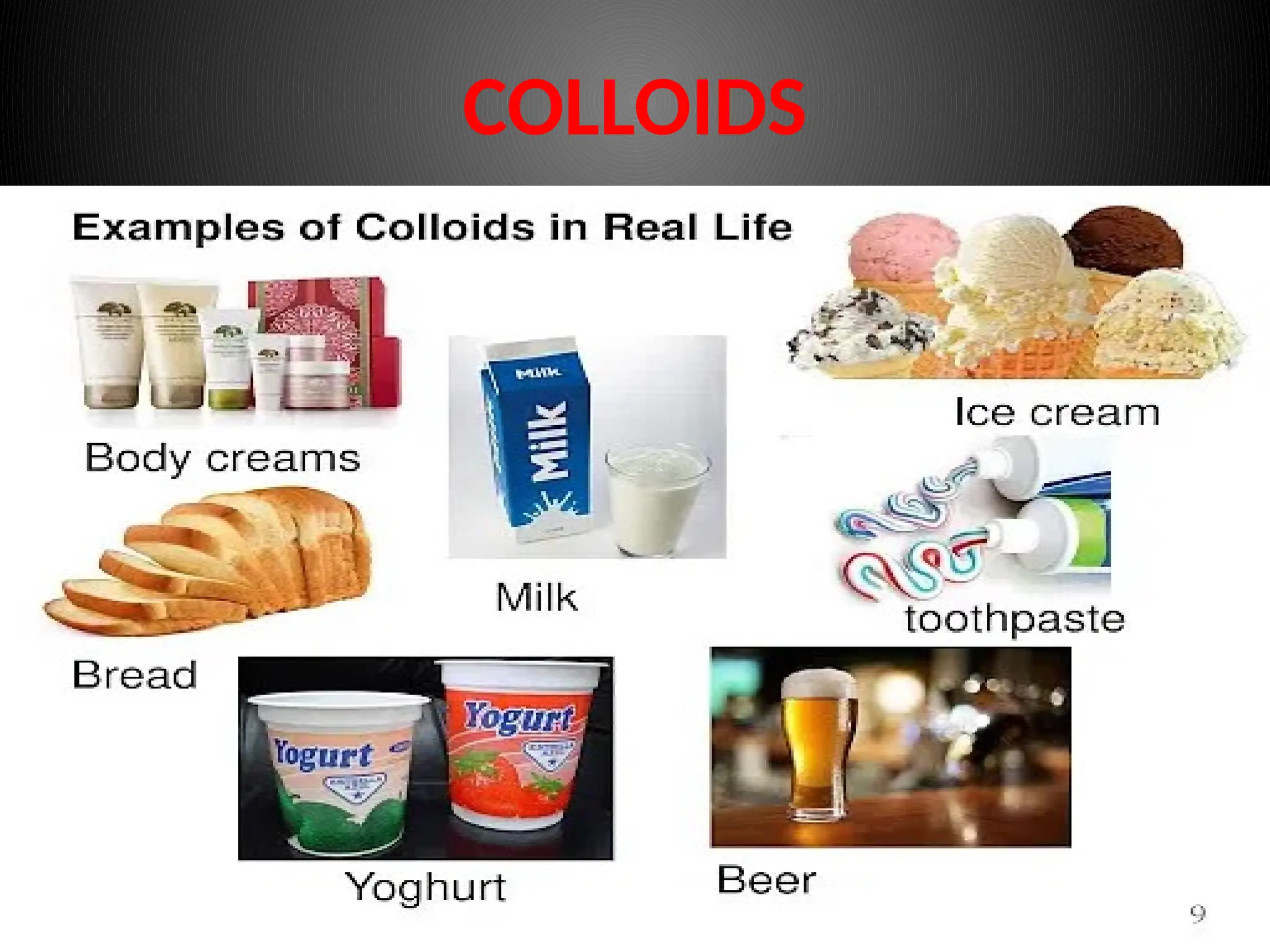
COLLOIDS
COMPARISION OF SUSPENSIONS, COLLOIDS AND TRUE
SOLUTIONS
1A0
=10-8
cm = 10-7
mm= 0.1 mµ(millimicron)
PROPERTY SUSPENSION COLLOID SOLUTION
PARTICLE SIZE >100mµ 1mµ to 100mµ < 1mµ
VISIBILITY Visible with
naked eye
Visible with
ultramicroscope
Not visible with
any of the optical
means
SEPARATION
WITH FILTER PAPER
Possible Not Possible Not Possible
DIFFUSION Does not Diffuse Diffuses very
slowly
Diffuses rapidly
SETTLING Settles under
gravity
Does not settle
but it may settle
when centrifuge.
Does not settle
NATURE Heterogeneous Heterogeneous Homogeneous
APPEARANCE OPAQUE Generally Clear Clear
STABILITY Unstable Stable Stable
Colloidal solution
Dispersed phase
(fractured part
dispersed
system) Dispersed
phase
Dispersion
medium
Dispersion medium
(continuous part of the
dispersion system)
Dispersed phase & Dispersing
medium
• The solute like component or the
dispersed particles in a colloid
form the dispersed phase.
• The component in which the
dispersed phase is suspended is
known as the dispersing medium.
Dispersed
phase
Dispersion
medium
Type of dispersed
system
Example
Gas Liquid Foam soap lather, whipped cream,
soda water
Gas Solid Solid foam bread, pumice stone, slag
Liquid Gas Aerosol fog, cloud,mist, spray
Liquid Liquid Emulsion milk, oil in water
Liquid Solid Gel cheese, curd, jelly, butter
Solid Gas Aerosol smoke
Solid Liquid Sol paints, clay, Gold Sol
Solid Solid Solid sol colored glass, gems (ruby,
emerald, black diamond)
Classification of the state of aggregation
of the dispersed phase and the dispersion medium
Depending upon the nature of interactions
between dispersed phase and dispersion medium,
the colloidal solutions can be classified into two
types as: lyophilic and lyophobic sols.
1. Lyophilic colloids – the colloidal solutions, in
which the particles of the dispersed phase have
a great affinity for the dispersion medium.
2. Lyophobic colloids – the colloidal solutions in
which there is no affinity between particles of
the dispersed phase and the dispersion medium.
Dispersed systems are very widely spread in nature!
Soils, clays, natural water, air, clouds, dust, minerals
(including precious stones), bread, milk, butter – are
colloidal systems.
Cells, genes, viruses – are colloidal particles.
Biological liquids – blood, lymph, urine, cerebrospinal fluid
– are colloidal dispersions. In these liquids substances, e.g.
proteins, cholesterine, glycogen and others are present
being in colloidal state.
Finely dispersed substances easily penetrate through the
pores of skin. Medicines in the form of colloids (emulsions,
ointments, pastes, aerosols) are widely used in medicine.
APPLICATIONS OF COLLOIDS
• NATURAL APPLICATION:
Sky looks Blue: Dust particles along with water
suspended in air scatter blue light which reaches our eyes and
sky looks blue.
 Fog, Mist are colloids.
 Milk, Butter are colloids.
 Blood is a colloidal solution.
 Fertile Soils are colloidal in nature.
 Formation of Delta: When river water meets the sea water,
the electrolytes present in sea water coagulates the colloidal
solution of clay which gets deposited with the formation of
Delta.
TECHNICAL APPLICATION:
Electrical precipitation of smoke.
Purification of water by adding Alum.
Colloidal Medicines are more effective
because they are easily assimilated.
Tanning.(hardening of leather)
Cleaning action of Soaps and
detergents.
Industrial products like Paints, Inks,
Rubber, Cement are Colloidal in nature.
Prepared by:
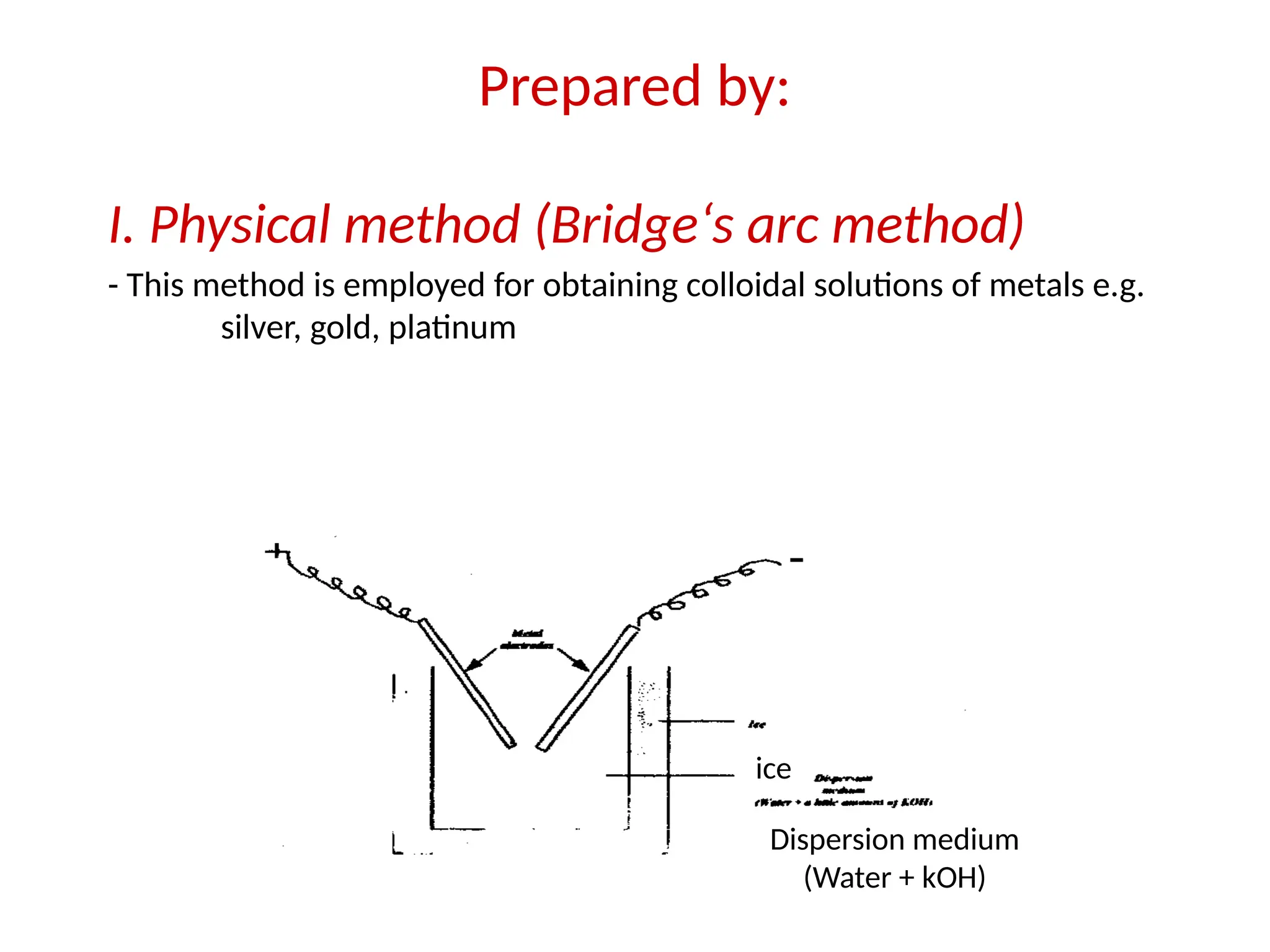
I. Physical method (Bridge‘s arc method)
- This method is employed for obtaining colloidal solutions of metals e.g.
silver, gold, platinum
ice
Dispersion medium
(Water + kOH)
I. Physical method (Bridge‘s arc method)
• An electric current is struck between two metallic electrodes
placed in a container of water.
• The intense heat of the arc converts the metal into vapours
which condensed immediately in the cold water bath.
• This results in the formation of particles of colloidal size.
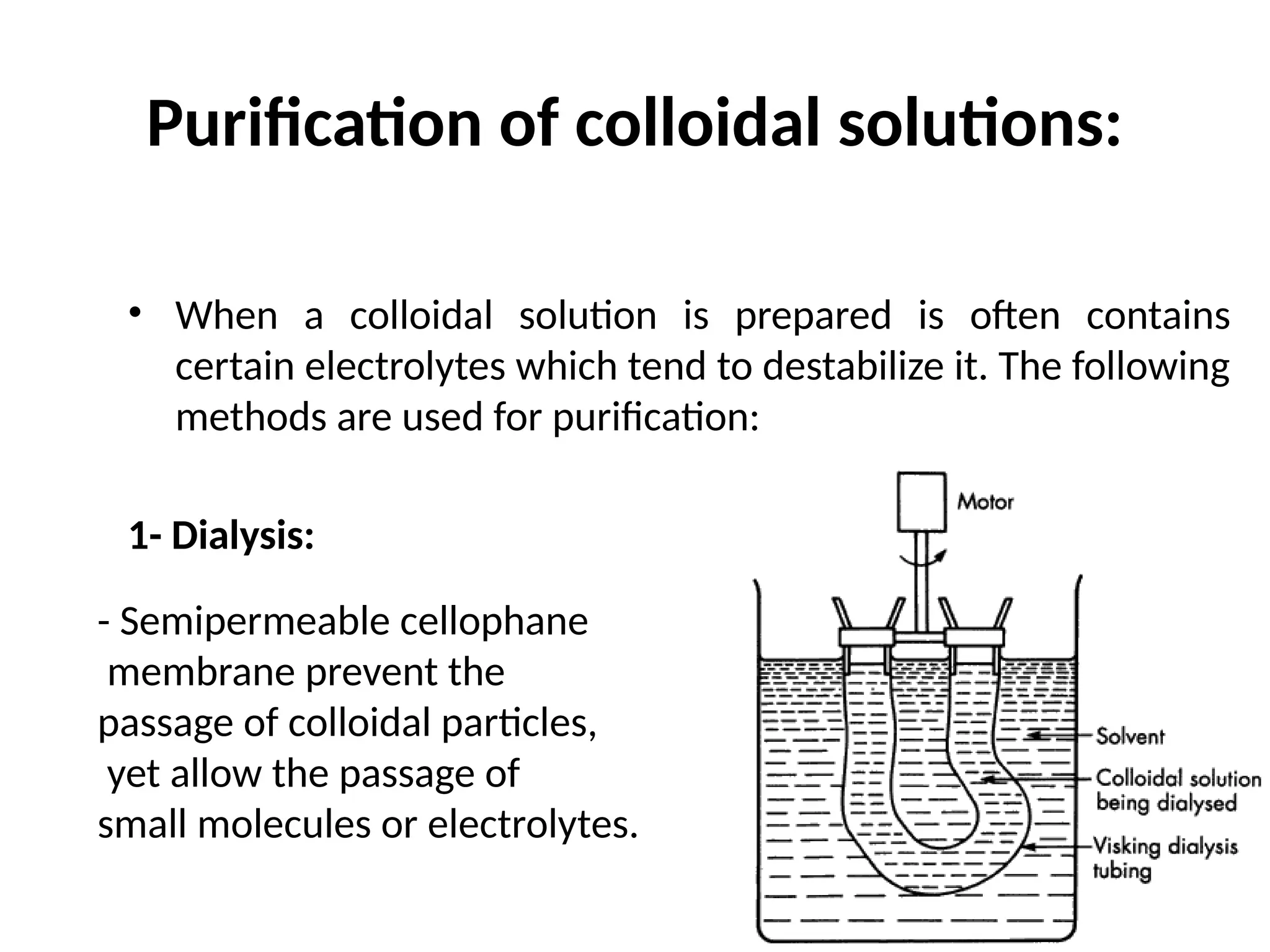
Purification of colloidal solutions:
• When a colloidal solution is prepared is often contains
certain electrolytes which tend to destabilize it. The following
methods are used for purification:
1- Dialysis:
- Semipermeable cellophane
membrane prevent the
passage of colloidal particles,
yet allow the passage of
small molecules or electrolytes.
Purification of colloidal solutions:
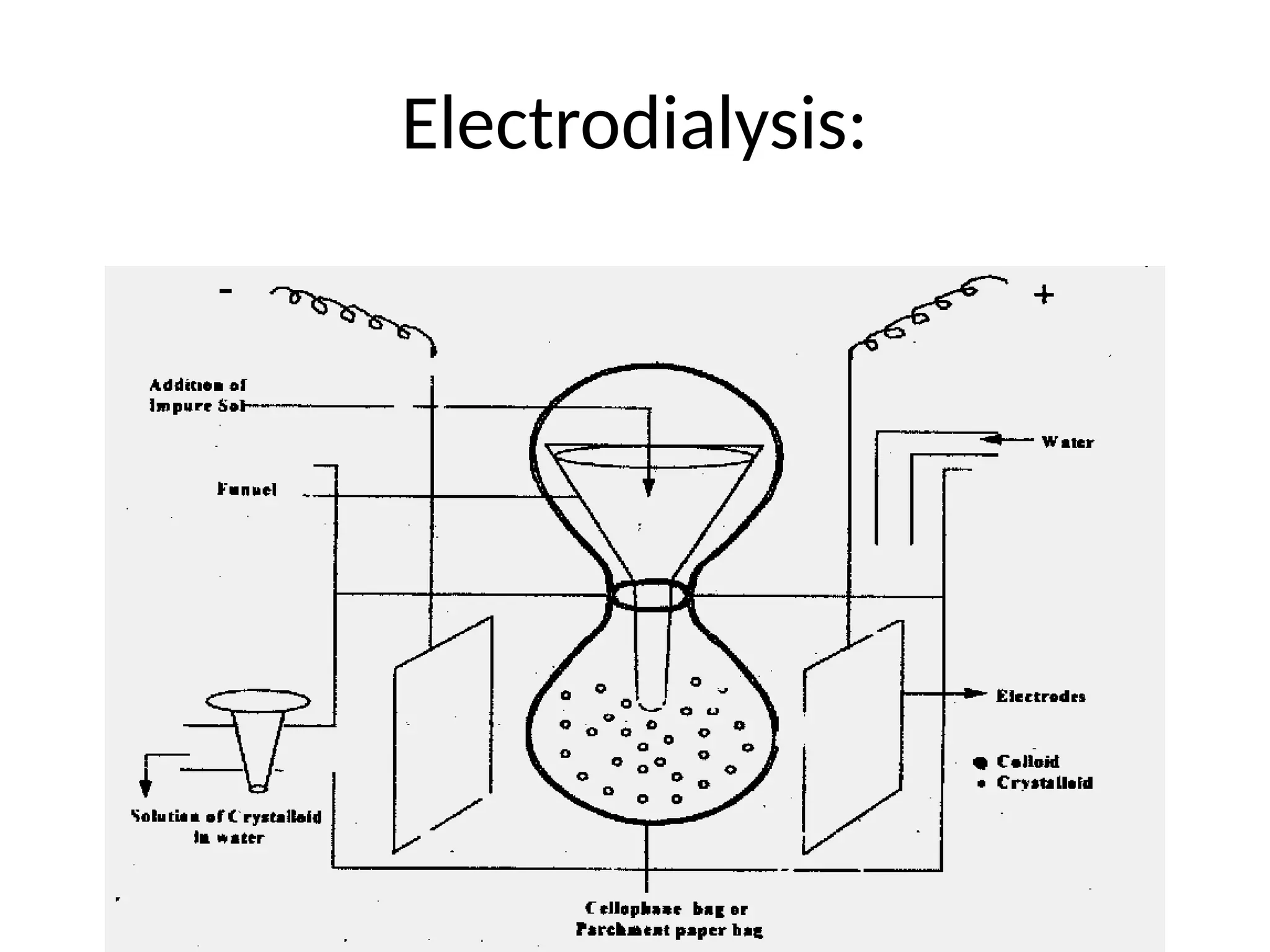
2- Electrodialysis:
- In the dialysis unit, the movement of ions across the
membrane can be speeded up by applying an electric current
through the electrodes induced in the solution.
- The most important use of dialysis is the purification of blood
in artificial kidney machines.
- The dialysis membrane allows small particles (ions) to pass
through but the colloidal size particles (haemoglobin) do not
pass through the membrane.
Electrodialysis:
Colloid substance and its types and description.

Colloid substance and its types and description.

  • 1.
  • 2.
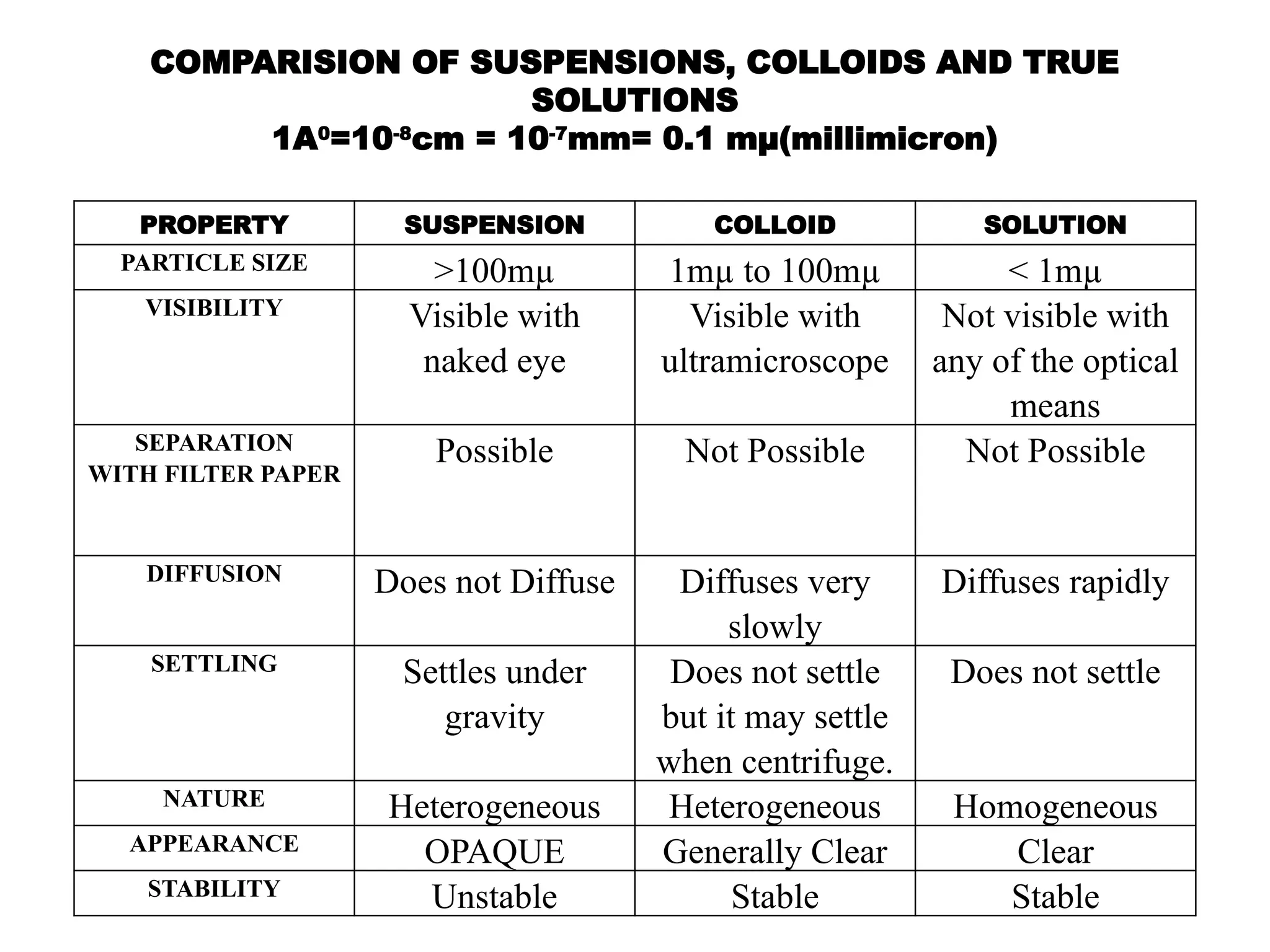
    COMPARISION OF SUSPENSIONS,COLLOIDS AND TRUE SOLUTIONS 1A0 =10-8 cm = 10-7 mm= 0.1 mµ(millimicron) PROPERTY SUSPENSION COLLOID SOLUTION PARTICLE SIZE >100mµ 1mµ to 100mµ < 1mµ VISIBILITY Visible with naked eye Visible with ultramicroscope Not visible with any of the optical means SEPARATION WITH FILTER PAPER Possible Not Possible Not Possible DIFFUSION Does not Diffuse Diffuses very slowly Diffuses rapidly SETTLING Settles under gravity Does not settle but it may settle when centrifuge. Does not settle NATURE Heterogeneous Heterogeneous Homogeneous APPEARANCE OPAQUE Generally Clear Clear STABILITY Unstable Stable Stable
  • 3.
    Colloidal solution Dispersed phase (fracturedpart dispersed system) Dispersed phase Dispersion medium Dispersion medium (continuous part of the dispersion system)
  • 4.
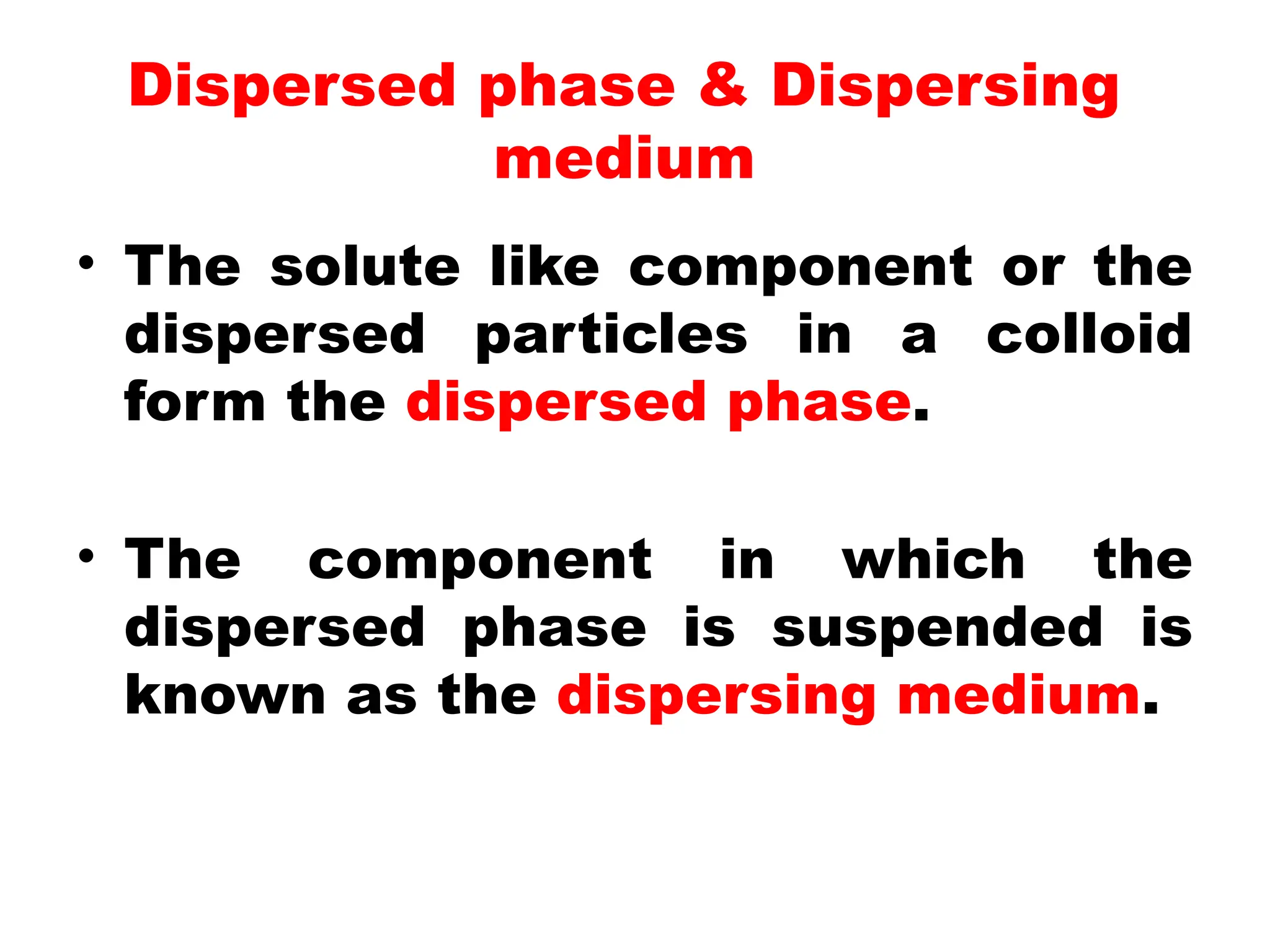
    Dispersed phase &Dispersing medium • The solute like component or the dispersed particles in a colloid form the dispersed phase. • The component in which the dispersed phase is suspended is known as the dispersing medium.
  • 5.
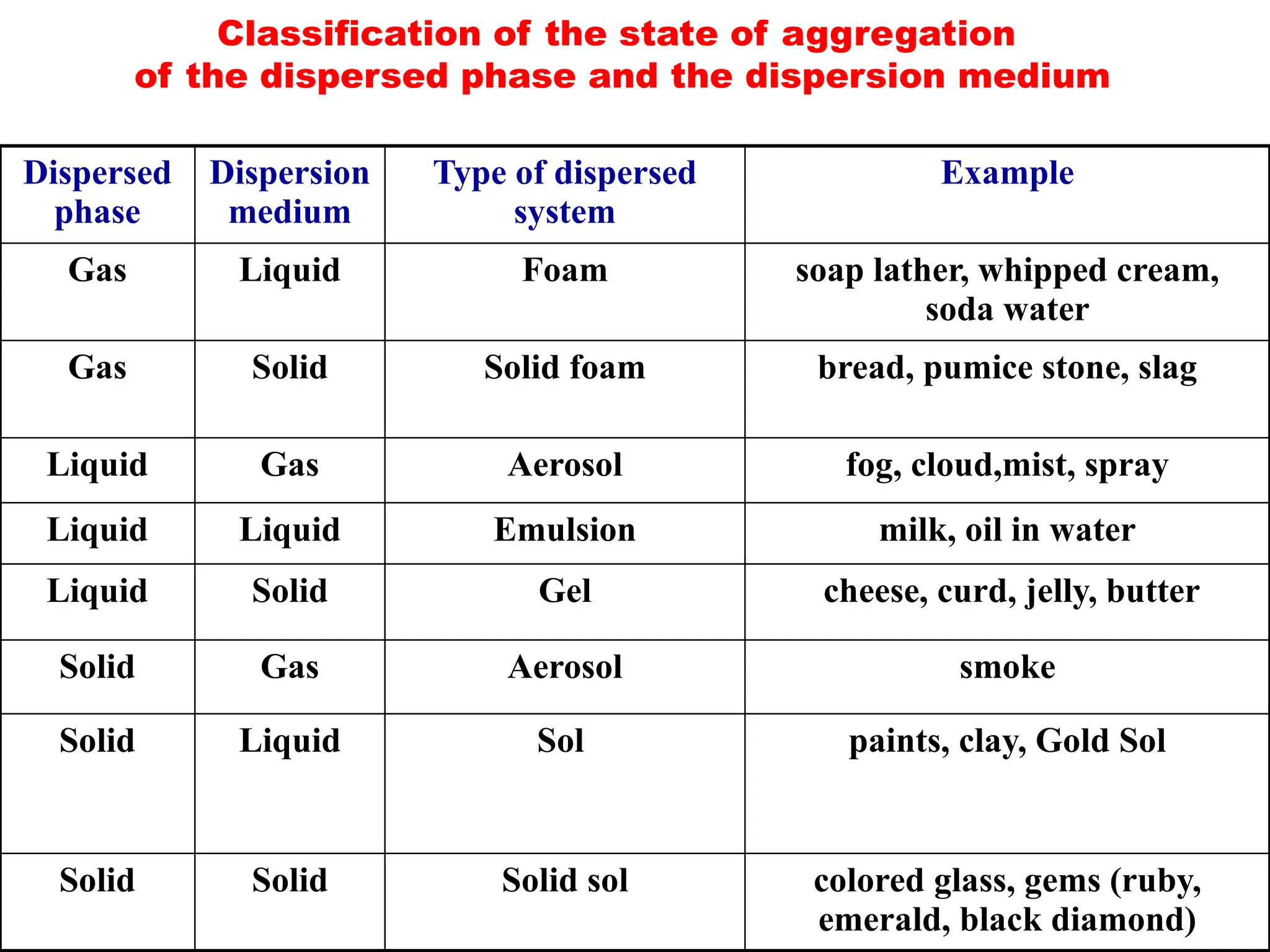
    Dispersed phase Dispersion medium Type of dispersed system Example GasLiquid Foam soap lather, whipped cream, soda water Gas Solid Solid foam bread, pumice stone, slag Liquid Gas Aerosol fog, cloud,mist, spray Liquid Liquid Emulsion milk, oil in water Liquid Solid Gel cheese, curd, jelly, butter Solid Gas Aerosol smoke Solid Liquid Sol paints, clay, Gold Sol Solid Solid Solid sol colored glass, gems (ruby, emerald, black diamond) Classification of the state of aggregation of the dispersed phase and the dispersion medium
  • 6.
    Depending upon thenature of interactions between dispersed phase and dispersion medium, the colloidal solutions can be classified into two types as: lyophilic and lyophobic sols. 1. Lyophilic colloids – the colloidal solutions, in which the particles of the dispersed phase have a great affinity for the dispersion medium. 2. Lyophobic colloids – the colloidal solutions in which there is no affinity between particles of the dispersed phase and the dispersion medium.
  • 7.
    Dispersed systems arevery widely spread in nature! Soils, clays, natural water, air, clouds, dust, minerals (including precious stones), bread, milk, butter – are colloidal systems. Cells, genes, viruses – are colloidal particles. Biological liquids – blood, lymph, urine, cerebrospinal fluid – are colloidal dispersions. In these liquids substances, e.g. proteins, cholesterine, glycogen and others are present being in colloidal state. Finely dispersed substances easily penetrate through the pores of skin. Medicines in the form of colloids (emulsions, ointments, pastes, aerosols) are widely used in medicine.
  • 8.
    APPLICATIONS OF COLLOIDS •NATURAL APPLICATION: Sky looks Blue: Dust particles along with water suspended in air scatter blue light which reaches our eyes and sky looks blue.  Fog, Mist are colloids.  Milk, Butter are colloids.  Blood is a colloidal solution.  Fertile Soils are colloidal in nature.  Formation of Delta: When river water meets the sea water, the electrolytes present in sea water coagulates the colloidal solution of clay which gets deposited with the formation of Delta.
  • 9.
    TECHNICAL APPLICATION: Electrical precipitationof smoke. Purification of water by adding Alum. Colloidal Medicines are more effective because they are easily assimilated. Tanning.(hardening of leather) Cleaning action of Soaps and detergents. Industrial products like Paints, Inks, Rubber, Cement are Colloidal in nature.
  • 10.
    Prepared by: I. Physicalmethod (Bridge‘s arc method) - This method is employed for obtaining colloidal solutions of metals e.g. silver, gold, platinum ice Dispersion medium (Water + kOH)
  • 11.
    I. Physical method(Bridge‘s arc method) • An electric current is struck between two metallic electrodes placed in a container of water. • The intense heat of the arc converts the metal into vapours which condensed immediately in the cold water bath. • This results in the formation of particles of colloidal size.
  • 12.
    Purification of colloidalsolutions: • When a colloidal solution is prepared is often contains certain electrolytes which tend to destabilize it. The following methods are used for purification: 1- Dialysis: - Semipermeable cellophane membrane prevent the passage of colloidal particles, yet allow the passage of small molecules or electrolytes.
  • 13.
    Purification of colloidalsolutions: 2- Electrodialysis: - In the dialysis unit, the movement of ions across the membrane can be speeded up by applying an electric current through the electrodes induced in the solution. - The most important use of dialysis is the purification of blood in artificial kidney machines. - The dialysis membrane allows small particles (ions) to pass through but the colloidal size particles (haemoglobin) do not pass through the membrane.
  • 14.