PHARMACEUTICAL
EMULSION
Mr Akshay M. Akotkar
M pharm
Department of Pharamaceutics
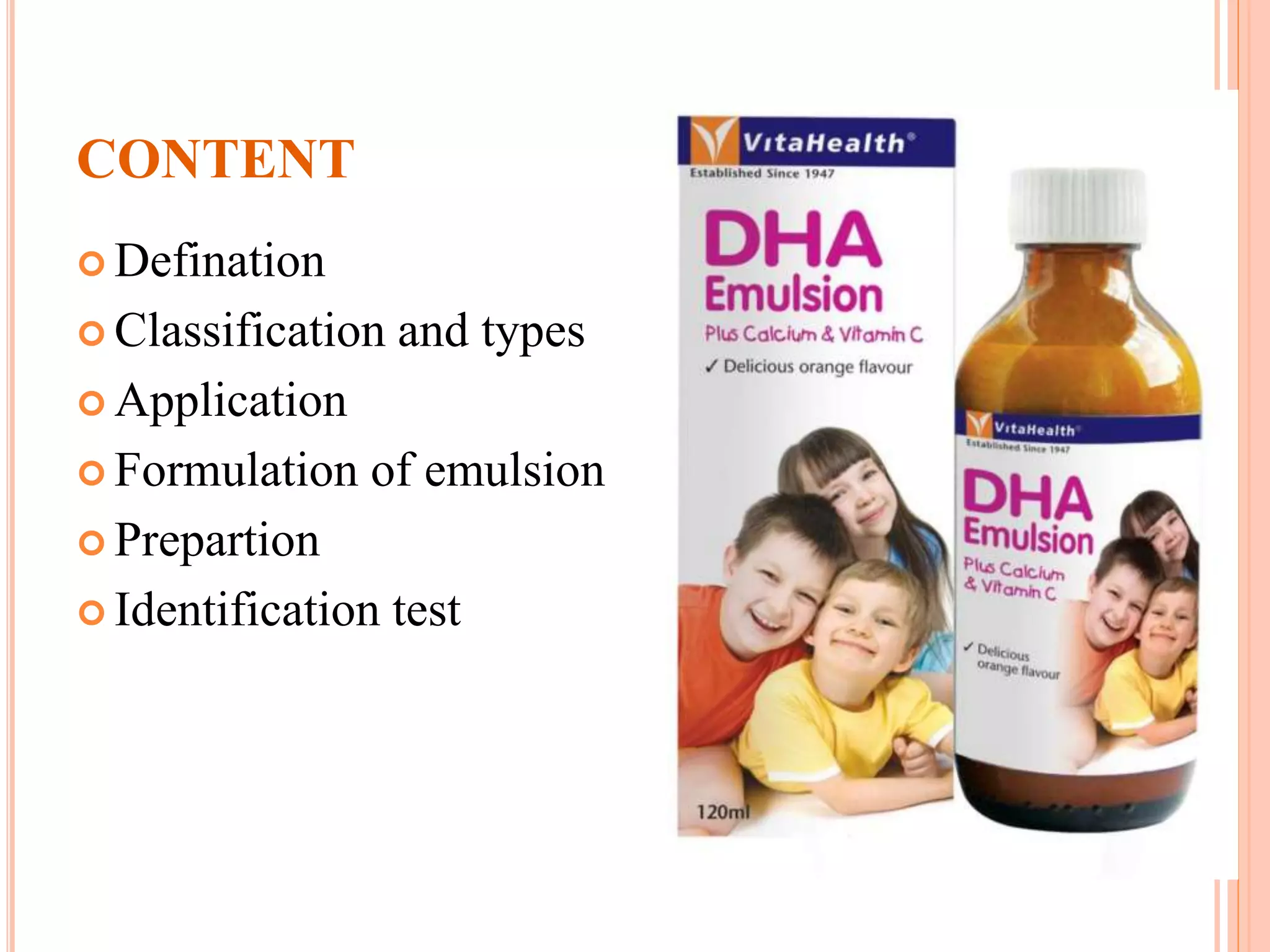
CONTENT
 Defination
 Classification and types
 Application
 Formulation of emulsion
 Prepartion
 Identification test
DEFINITION
 An emulsion is a two phase system consisting of two
incompletely miscible liquids, one of which is dispersed as
finite globules in the other. The particle size of the globules
range from 0.25 to 25 µm. An emulsifying agent and
mechanical energy are needed to join the phases.
 Thermodynamically unstable …
two
immiscible
phase
emulsion
Disperse
phase
+
Contineous
phase
+
Emulsifying
agent
add
Less
qty
More
qty
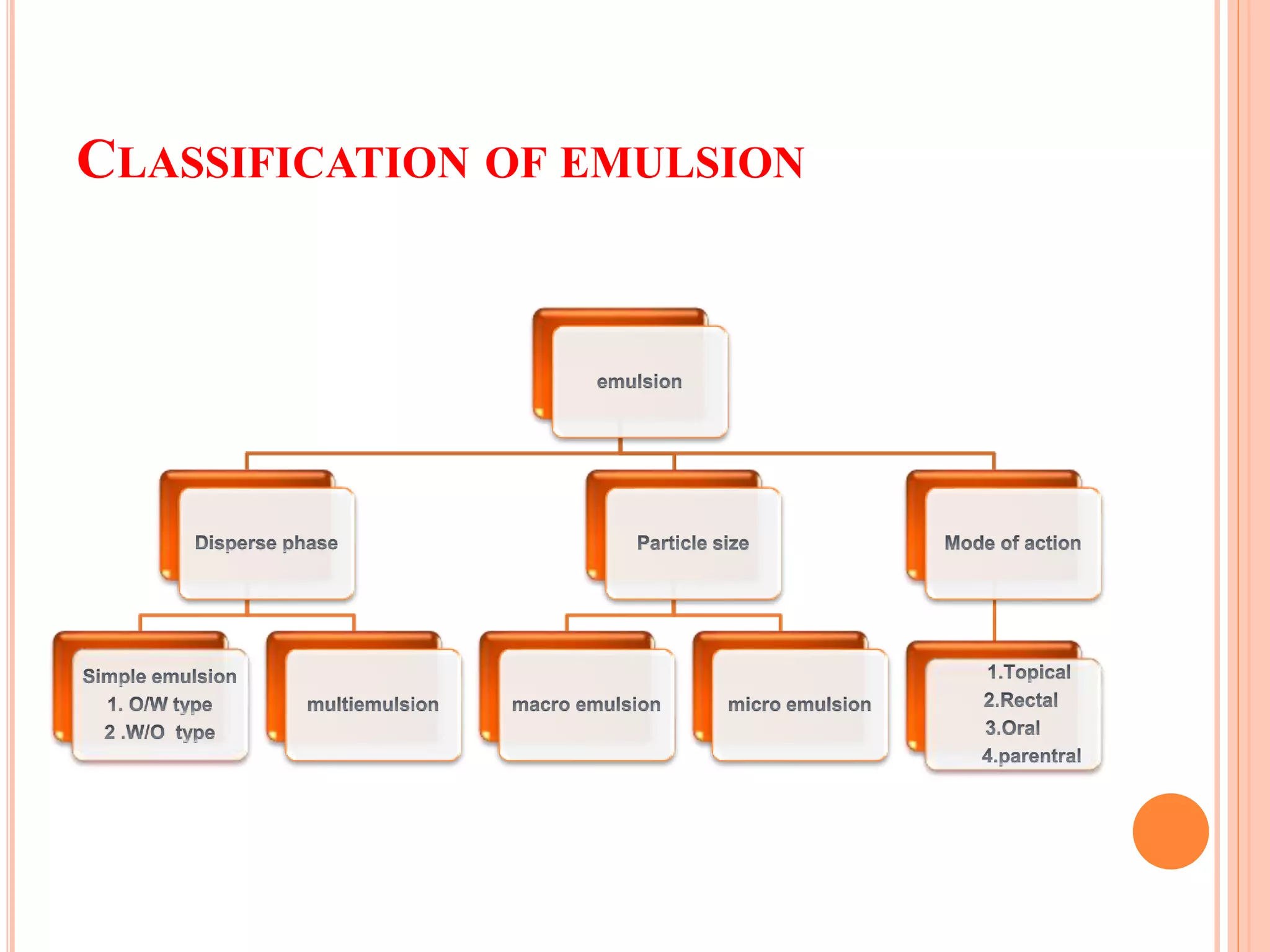
CLASSIFICATION OF EMULSION
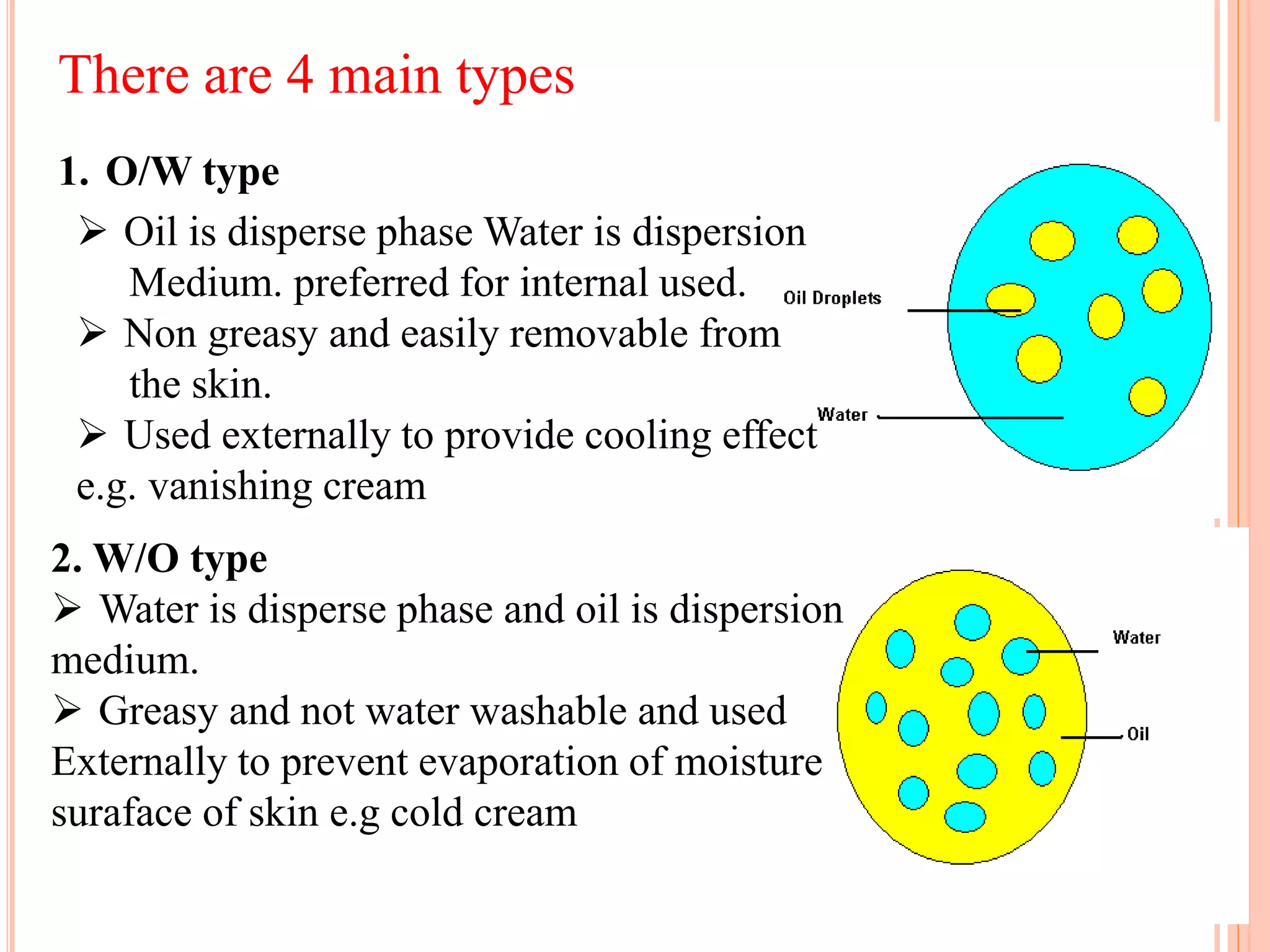
There are 4 main types
1. O/W type
2. W/O type
 Water is disperse phase and oil is dispersion
medium.
 Greasy and not water washable and used
Externally to prevent evaporation of moisture
suraface of skin e.g cold cream
 Oil is disperse phase Water is dispersion
Medium. preferred for internal used.
 Non greasy and easily removable from
the skin.
 Used externally to provide cooling effect
e.g. vanishing cream
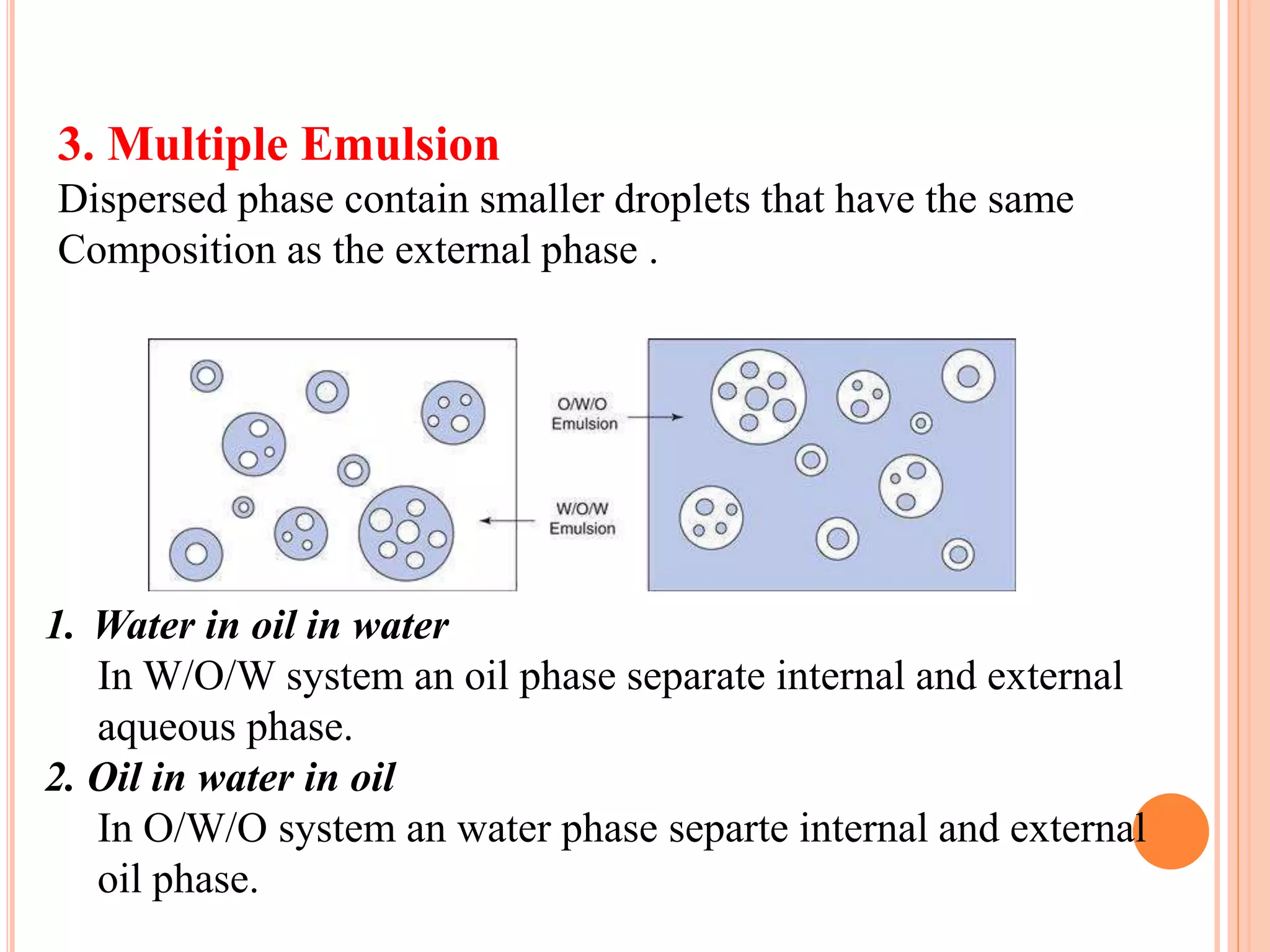
3. Multiple Emulsion
Dispersed phase contain smaller droplets that have the same
Composition as the external phase .
1. Water in oil in water
In W/O/W system an oil phase separate internal and external
aqueous phase.
2. Oil in water in oil
In O/W/O system an water phase separte internal and external
oil phase.
4. Base on Particle size
 0.2 – 50 mm Macroemulsions
0.01 – 0.2 mm Microemulsions
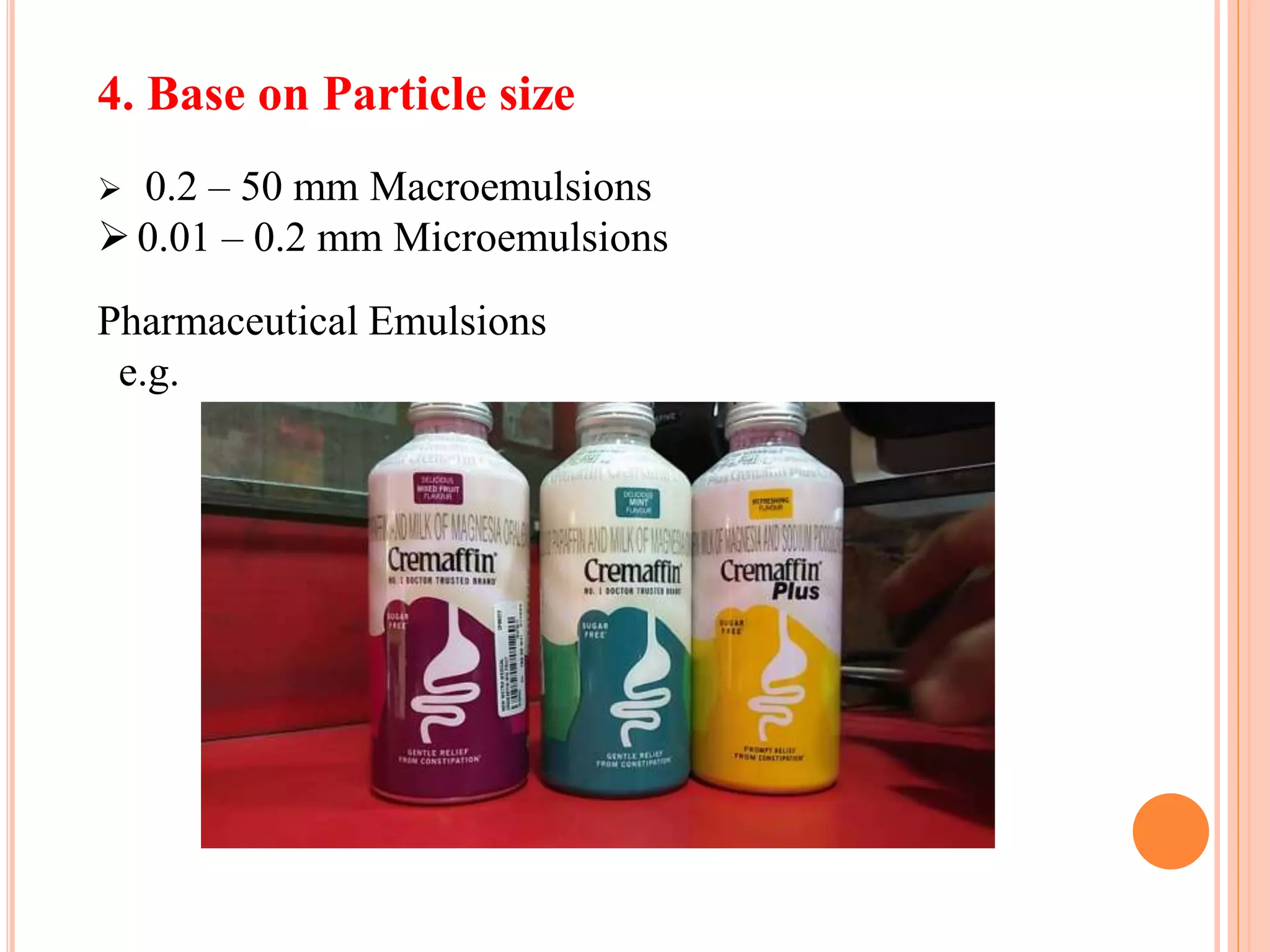
Pharmaceutical Emulsions
e.g.
Pharmaceutical Application
 Unpleasant medication or drug.
 Oral, rectal and topical administration of oils and oil-
soluble drugs.
 absorption and penetration of medicament are enhanced
 water-soluble drugs or vaccine to provide slow release.
Formulation of emulsion
1. Emulsifiers (selection E.A.)
An emulsifying agent is any material that enhances the stability
of an emulsion (i.e. Prevention of coalescence and reducing
creaming).
 The ideal emulsifying agent is colourless, odourless, tasteless,
non toxic, non-irritant and able to produce stable emulsions at
low concentrations.
Examples of Emulsifying agent
1. Carbohydrate Materials
- Acacia, Tragacanth, Agar, Pectin. o/w emulsion.
2. Protein Substances
- Gelatin, Egg yolk, Caesin o/w emulsion.
3.High Molecular Weight Alcohols
- Stearyl Alcohol, Cetyl Alcohol o/w emulsion,
cholesterol w/o emulsion.
4.Wetting agent
 Anionic surfactants possess a negative charge on
their hydrophilic end. e.g. SLS -O/W type
 Cationic e.g. Ammonium bromide -W/O
 Non ionic e.g. span 80,tween 20
5. Finely divided solids
- Bentonite, Magnesium Hydroxide, Aluminum Hydroxide o/w
emulsion
Selection of emulsifying agent
 HLB(hydrophilic lipophilic
balance) system:
1. It is derived by Graffin in
1949.
2. HLB system characterize
its relative polarity.
3. More the hydrophilic
interfacial barrier it
favour o/w emulsion and
while non polar barrier
favour w/o emulsion.
2. Preservatives
Inhibited the growth of microbes
e.g, benzoic acid ,salicylic acid, benzalkonium chloride.
Why we used preservative ?
Number of ingredients in emulsion support the growth of
microorganism which result into change in colour, odour
and taste of emulsion.
Preservative used in emulsion they must be …
Less toxic
Chemically stable
Reasonable cost
Acceptable odour ,test and colour
Effective against fungi ,yeast ,bacteria
Stable to heat and storage
3. Antioxidant
 Inhibited oxidation of emulsion
 Antioxidants are compounds that inhibit oxidation. Oxidation
is a chemical reaction that can produce free radicals, thereby
leading to chain reactions that may damage the cells of
organisms.
e.g. Gallic acid, Ascorbic acid etc.
Ideal properties of antioxidant
Nontoxic, non irritant
effective at low concentration under the expected conditions of
storage and use.
soluble in the medium and stable.
Antioxidants for use in oral preparation should also be odorless
and tasteless.
4. Flavouring agent
Flavouring agent is incorporated in the formulation to
impart the taste to it.
Example:
Vanillin – in liquid paraffin emulsion.
Benzaldehyde – in cod-liver oil emulsion.
Preparation of emulsion
The methods commonly used to prepare emulsions can be divided
into two categories
A) Trituration Method
This method consists of dry gum method and wet gum method.
1.Dry Gum Method
In this method the oil is first triturated with gum with a little
amount of water to form the primary emulsion. The trituration is
continued till a characteristic ‘clicking’ sound is heard and a thick
white cream is formed. Once the primary emulsion is formed, the
remaining quantity of water is slowly added to form the final
emulsion.
This method consists of
"4:2:1" formula
4 parts (volumes) of oil
2 parts of water
1 part of gum
2.Wet Gum Method
As the name implies, in this method first gum and water are
triturated together to form a mucilage. The required quantity of
oil is then added gradually in small proportions with thorough
trituration to form the primary emulsion. Once the primary
emulsion has been formed remaining quantity of water is added
to make the final emulsion.
"4:2:1" formula
4 parts (volumes) of oil
2 parts of water
1 part of gum
This method consists of
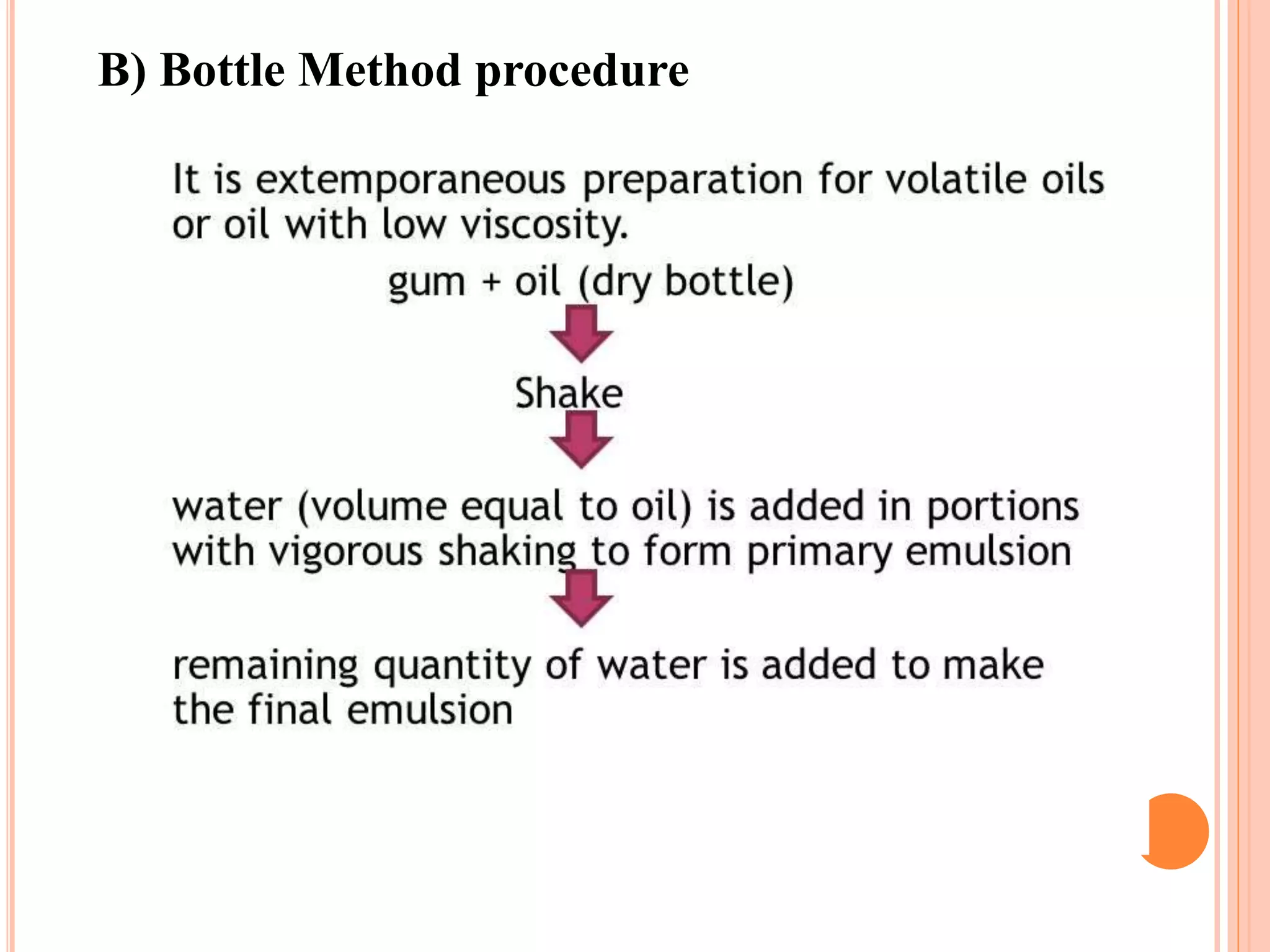
B) Bottle Method
 This method is employed for preparing emulsions
containing volatile and other non-viscous oils. Both dry
gum and wet gum methods can be employed for the
preparation.
 As volatile oils have a low viscosity as compared to
fixed oils, they require comparatively large quantity of
gum for emulsification.
 In this method, oil or water is first shaken thoroughly
and vigorously with the calculated amount of gum. Once
this has emulsified completely, the second liquid (either
oil or water) is then added all at once and the bottle is
again shaken vigorously to form the primary emulsion.
More of water is added in small portions with constant
agitation after each addition to produce the final volume.
B) Bottle Method procedure
Identification of emulsion
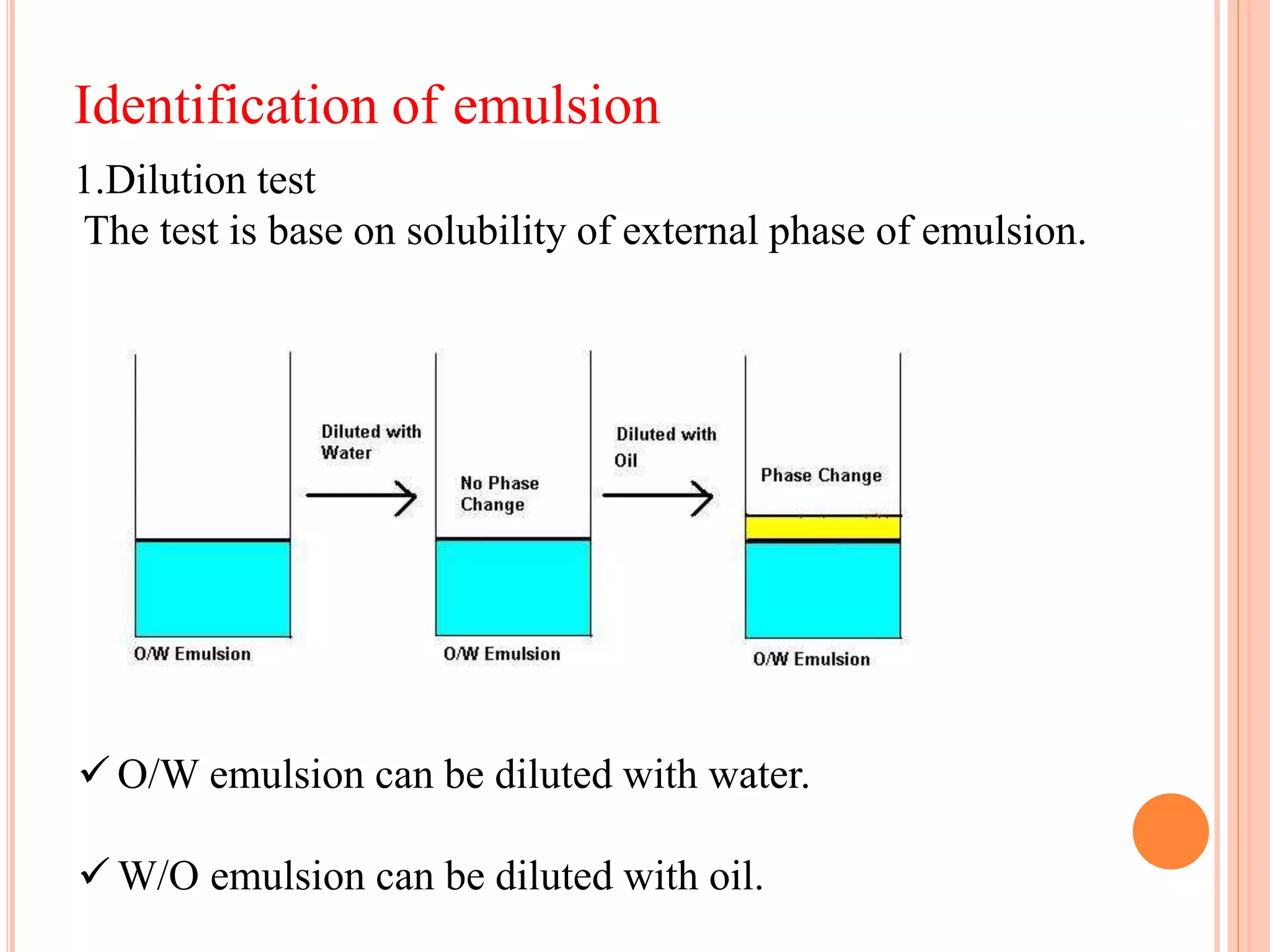
1.Dilution test
The test is base on solubility of external phase of emulsion.
 O/W emulsion can be diluted with water.
 W/O emulsion can be diluted with oil.
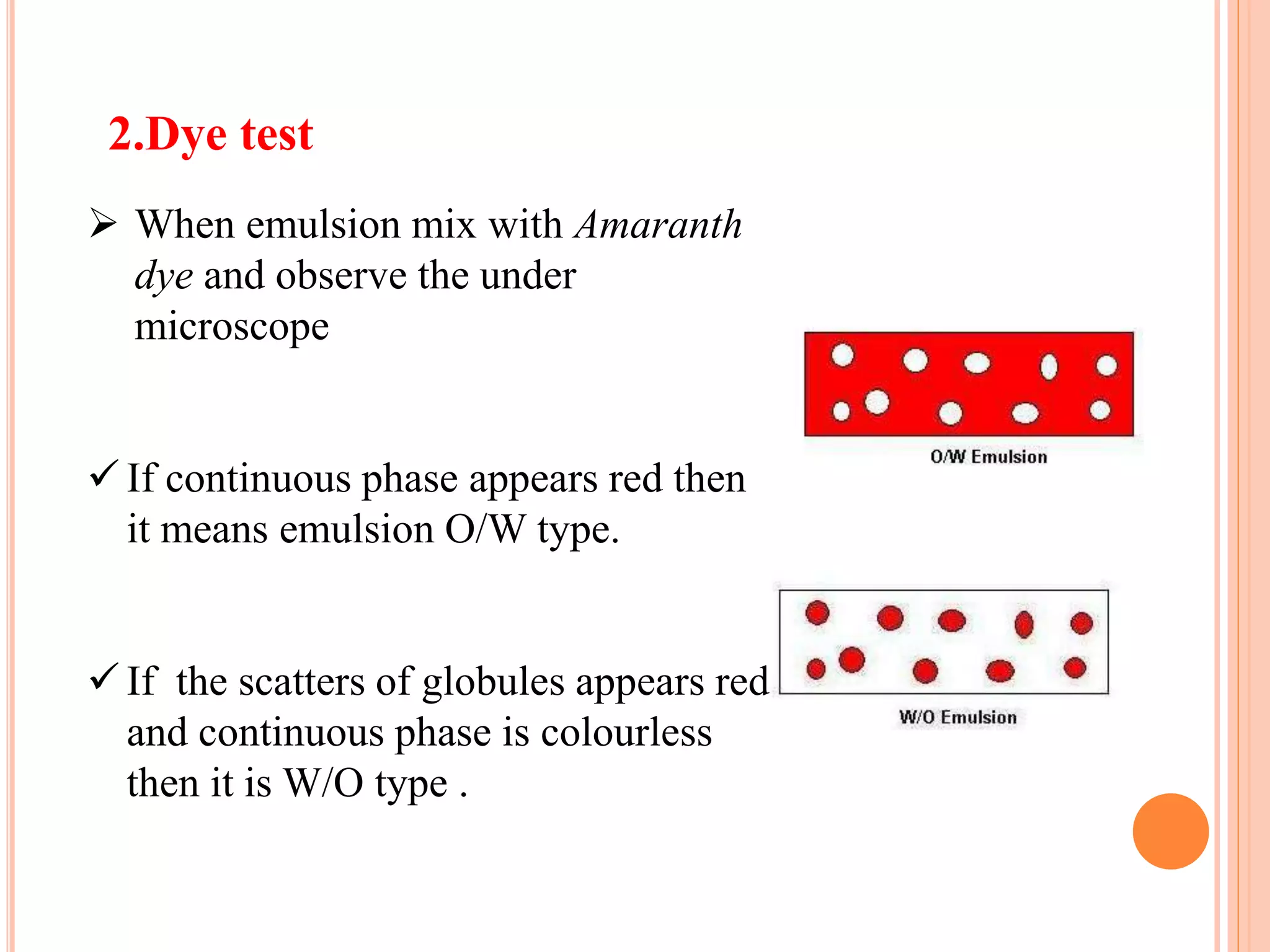
2.Dye test
 When emulsion mix with Amaranth
dye and observe the under
microscope
 If continuous phase appears red then
it means emulsion O/W type.
 If the scatters of globules appears red
and continuous phase is colourless
then it is W/O type .
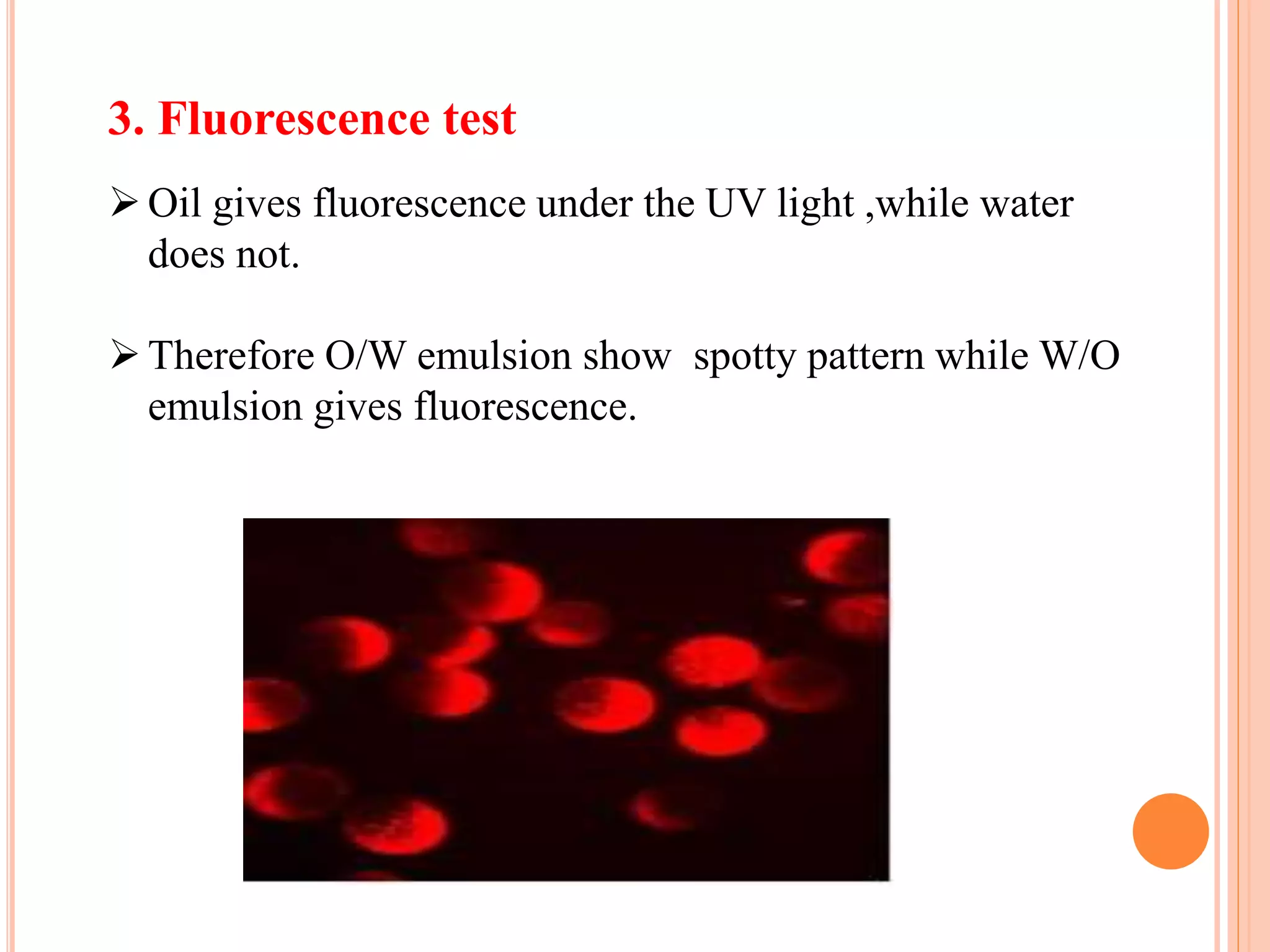
3. Fluorescence test
Oil gives fluorescence under the UV light ,while water
does not.
Therefore O/W emulsion show spotty pattern while W/O
emulsion gives fluorescence.
4. Conductivity test
 Water is good conductor of electricity and oil is bad
conductor of electricity.
 Therefore continuous phase of water run electricity more
than oil continuous phase.
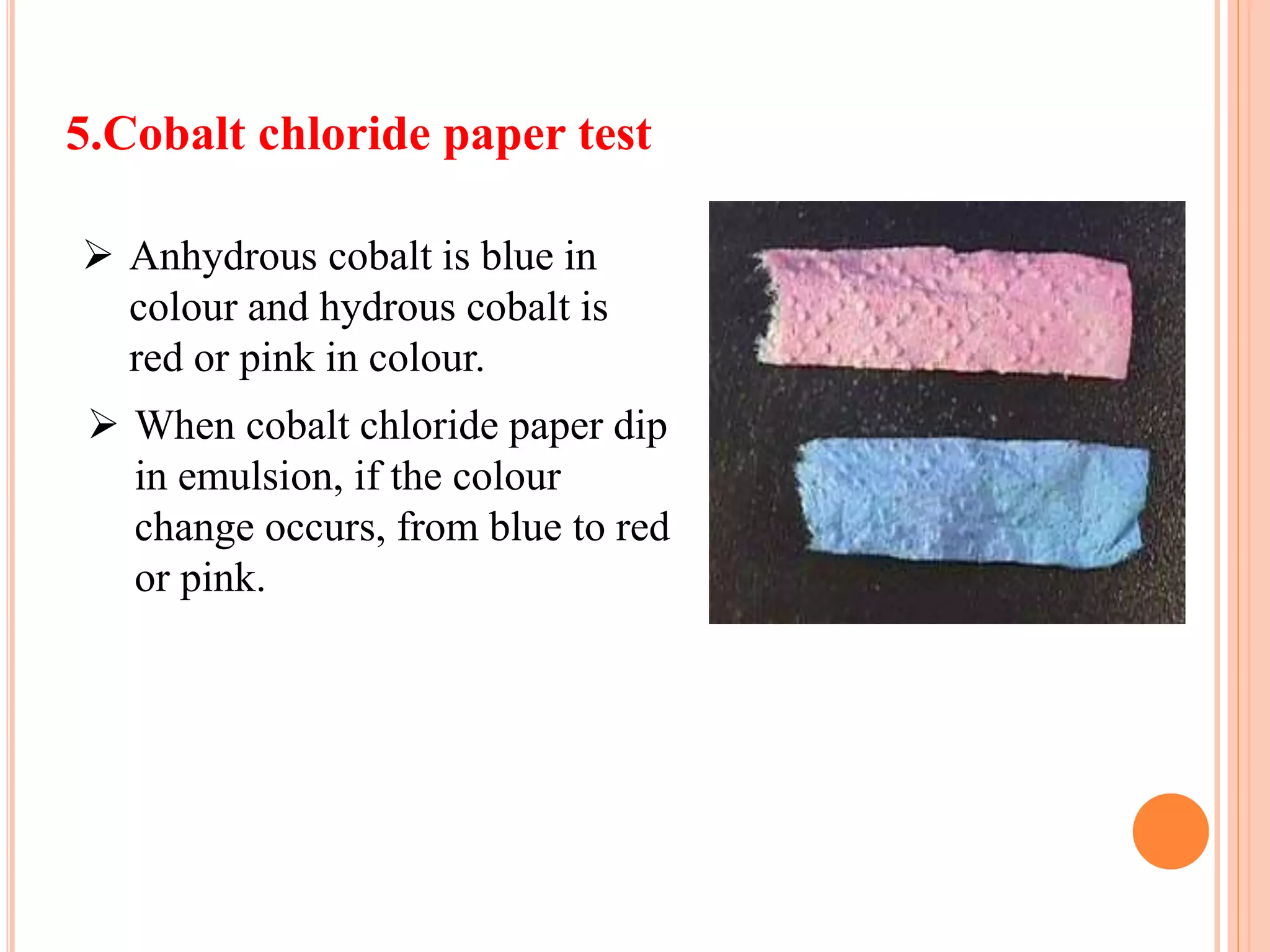
5.Cobalt chloride paper test
 Anhydrous cobalt is blue in
colour and hydrous cobalt is
red or pink in colour.
 When cobalt chloride paper dip
in emulsion, if the colour
change occurs, from blue to red
or pink.
 An emulsion is said to be stable if it remains as such
after its preparation , that is the dispersed globules are
uniformly distributed through out the dispersion medium
during its storage. The emulsion should be chemically
stable and there should not be any bacterial growth
during it shelf life.
 Emulsion instability may either reversible or irreversible
and manifest in the following ways:-
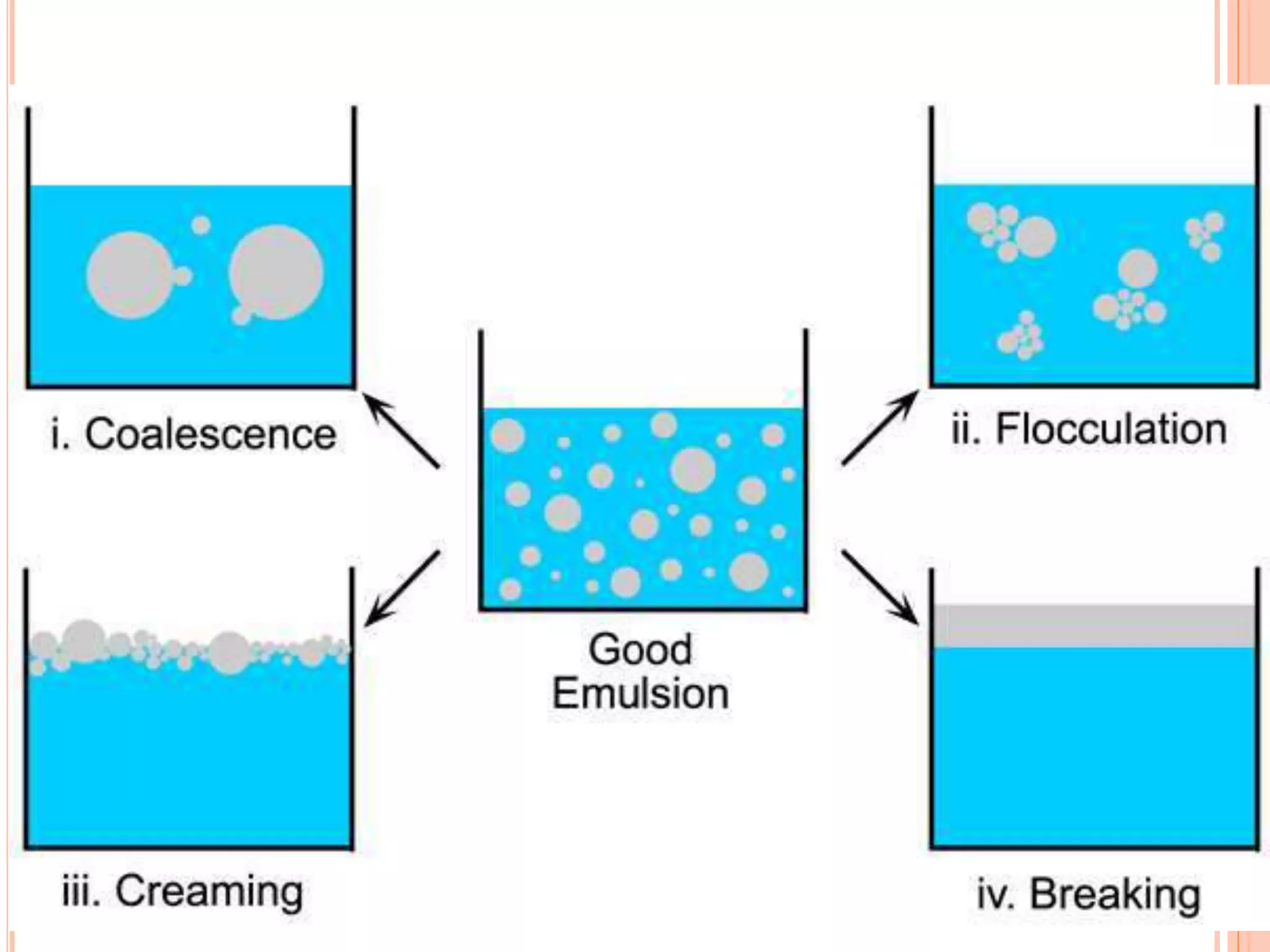
1) Cracking (irreversible instability)
2) Flocculation
3) Creaming
4) Phase inversion
Instabilities in emulsions
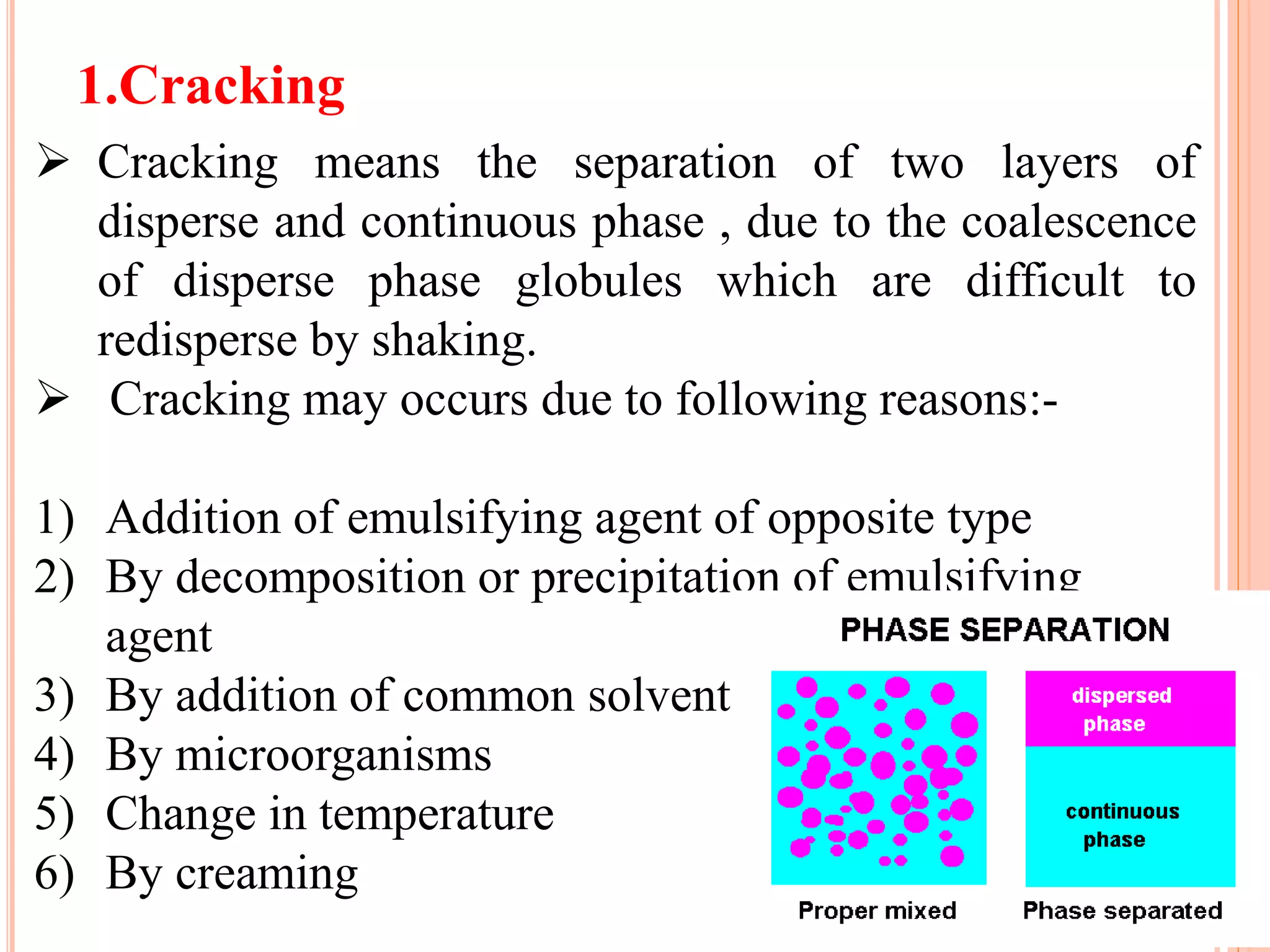
 Cracking means the separation of two layers of
disperse and continuous phase , due to the coalescence
of disperse phase globules which are difficult to
redisperse by shaking.
 Cracking may occurs due to following reasons:-
1) Addition of emulsifying agent of opposite type
2) By decomposition or precipitation of emulsifying
agent
3) By addition of common solvent
4) By microorganisms
5) Change in temperature
6) By creaming
1.Cracking
 When large globules or aggregate of globules rises to
the top of an emulsion or fall to the bottom and form
concentrated thick layer.
 Temporary phase.
 Creaming should be avoided because it leads to
cracking.
2.Creaming
Factor affecting creaming:
1. Radius of globules.
2. Density of dispersion medium/dispersin g
medium.
3. Viscosity.
4. Storage condition.
3.Phase inversion
 Phase inversion means change in the type of
emulsion i.e. o/w to w/o or vice versa .
 Reasons for phase inversion.
1. Addition of electrolyte.
2. Changing phase volume ratio.
3. Temperature change.
4. Changing the emulsifying agent.
 Stability of the active ingredient
 Stability of the excipients
 Visual appearance,Color,Odor (development of pungent
odor/loss of fragrance)
 Viscosity.
 Loss of water and other volatile vehicle components
 Concentration of emulsifier
 Particle size distribution of dispersed phases
 pH
 Temperature of emulsification
 Method and rate of cooling
 Texture, feel upon application (stiffness, grittiness,
greasiness, tackiness)
 Microbial contamination/sterility
 Release/bioavailability (percutaneous absorption)
Point consider during formulation
Emulsion

Emulsion

  • 1.
    PHARMACEUTICAL EMULSION Mr Akshay M.Akotkar M pharm Department of Pharamaceutics
  • 2.
    CONTENT  Defination  Classificationand types  Application  Formulation of emulsion  Prepartion  Identification test
  • 4.
    DEFINITION  An emulsionis a two phase system consisting of two incompletely miscible liquids, one of which is dispersed as finite globules in the other. The particle size of the globules range from 0.25 to 25 µm. An emulsifying agent and mechanical energy are needed to join the phases.  Thermodynamically unstable … two immiscible phase emulsion Disperse phase + Contineous phase + Emulsifying agent add Less qty More qty
  • 5.
  • 6.
    There are 4main types 1. O/W type 2. W/O type  Water is disperse phase and oil is dispersion medium.  Greasy and not water washable and used Externally to prevent evaporation of moisture suraface of skin e.g cold cream  Oil is disperse phase Water is dispersion Medium. preferred for internal used.  Non greasy and easily removable from the skin.  Used externally to provide cooling effect e.g. vanishing cream
  • 7.
    3. Multiple Emulsion Dispersedphase contain smaller droplets that have the same Composition as the external phase . 1. Water in oil in water In W/O/W system an oil phase separate internal and external aqueous phase. 2. Oil in water in oil In O/W/O system an water phase separte internal and external oil phase.
  • 8.
    4. Base onParticle size  0.2 – 50 mm Macroemulsions 0.01 – 0.2 mm Microemulsions Pharmaceutical Emulsions e.g.
  • 9.
    Pharmaceutical Application  Unpleasantmedication or drug.  Oral, rectal and topical administration of oils and oil- soluble drugs.  absorption and penetration of medicament are enhanced  water-soluble drugs or vaccine to provide slow release.
  • 10.
    Formulation of emulsion 1.Emulsifiers (selection E.A.) An emulsifying agent is any material that enhances the stability of an emulsion (i.e. Prevention of coalescence and reducing creaming).  The ideal emulsifying agent is colourless, odourless, tasteless, non toxic, non-irritant and able to produce stable emulsions at low concentrations. Examples of Emulsifying agent 1. Carbohydrate Materials - Acacia, Tragacanth, Agar, Pectin. o/w emulsion. 2. Protein Substances - Gelatin, Egg yolk, Caesin o/w emulsion.
  • 11.
    3.High Molecular WeightAlcohols - Stearyl Alcohol, Cetyl Alcohol o/w emulsion, cholesterol w/o emulsion. 4.Wetting agent  Anionic surfactants possess a negative charge on their hydrophilic end. e.g. SLS -O/W type  Cationic e.g. Ammonium bromide -W/O  Non ionic e.g. span 80,tween 20 5. Finely divided solids - Bentonite, Magnesium Hydroxide, Aluminum Hydroxide o/w emulsion
  • 12.
    Selection of emulsifyingagent  HLB(hydrophilic lipophilic balance) system: 1. It is derived by Graffin in 1949. 2. HLB system characterize its relative polarity. 3. More the hydrophilic interfacial barrier it favour o/w emulsion and while non polar barrier favour w/o emulsion.
  • 13.
    2. Preservatives Inhibited thegrowth of microbes e.g, benzoic acid ,salicylic acid, benzalkonium chloride. Why we used preservative ? Number of ingredients in emulsion support the growth of microorganism which result into change in colour, odour and taste of emulsion. Preservative used in emulsion they must be … Less toxic Chemically stable Reasonable cost Acceptable odour ,test and colour Effective against fungi ,yeast ,bacteria Stable to heat and storage
  • 14.
    3. Antioxidant  Inhibitedoxidation of emulsion  Antioxidants are compounds that inhibit oxidation. Oxidation is a chemical reaction that can produce free radicals, thereby leading to chain reactions that may damage the cells of organisms. e.g. Gallic acid, Ascorbic acid etc. Ideal properties of antioxidant Nontoxic, non irritant effective at low concentration under the expected conditions of storage and use. soluble in the medium and stable. Antioxidants for use in oral preparation should also be odorless and tasteless.
  • 15.
    4. Flavouring agent Flavouringagent is incorporated in the formulation to impart the taste to it. Example: Vanillin – in liquid paraffin emulsion. Benzaldehyde – in cod-liver oil emulsion.
  • 16.
    Preparation of emulsion Themethods commonly used to prepare emulsions can be divided into two categories A) Trituration Method This method consists of dry gum method and wet gum method. 1.Dry Gum Method In this method the oil is first triturated with gum with a little amount of water to form the primary emulsion. The trituration is continued till a characteristic ‘clicking’ sound is heard and a thick white cream is formed. Once the primary emulsion is formed, the remaining quantity of water is slowly added to form the final emulsion.
  • 17.
    This method consistsof "4:2:1" formula 4 parts (volumes) of oil 2 parts of water 1 part of gum 2.Wet Gum Method As the name implies, in this method first gum and water are triturated together to form a mucilage. The required quantity of oil is then added gradually in small proportions with thorough trituration to form the primary emulsion. Once the primary emulsion has been formed remaining quantity of water is added to make the final emulsion.
  • 18.
    "4:2:1" formula 4 parts(volumes) of oil 2 parts of water 1 part of gum This method consists of
  • 19.
    B) Bottle Method This method is employed for preparing emulsions containing volatile and other non-viscous oils. Both dry gum and wet gum methods can be employed for the preparation.  As volatile oils have a low viscosity as compared to fixed oils, they require comparatively large quantity of gum for emulsification.  In this method, oil or water is first shaken thoroughly and vigorously with the calculated amount of gum. Once this has emulsified completely, the second liquid (either oil or water) is then added all at once and the bottle is again shaken vigorously to form the primary emulsion. More of water is added in small portions with constant agitation after each addition to produce the final volume.
  • 20.
  • 21.
    Identification of emulsion 1.Dilutiontest The test is base on solubility of external phase of emulsion.  O/W emulsion can be diluted with water.  W/O emulsion can be diluted with oil.
  • 22.
    2.Dye test  Whenemulsion mix with Amaranth dye and observe the under microscope  If continuous phase appears red then it means emulsion O/W type.  If the scatters of globules appears red and continuous phase is colourless then it is W/O type .
  • 23.
    3. Fluorescence test Oilgives fluorescence under the UV light ,while water does not. Therefore O/W emulsion show spotty pattern while W/O emulsion gives fluorescence.
  • 24.
    4. Conductivity test Water is good conductor of electricity and oil is bad conductor of electricity.  Therefore continuous phase of water run electricity more than oil continuous phase.
  • 25.
    5.Cobalt chloride papertest  Anhydrous cobalt is blue in colour and hydrous cobalt is red or pink in colour.  When cobalt chloride paper dip in emulsion, if the colour change occurs, from blue to red or pink.
  • 26.
     An emulsionis said to be stable if it remains as such after its preparation , that is the dispersed globules are uniformly distributed through out the dispersion medium during its storage. The emulsion should be chemically stable and there should not be any bacterial growth during it shelf life.  Emulsion instability may either reversible or irreversible and manifest in the following ways:- 1) Cracking (irreversible instability) 2) Flocculation 3) Creaming 4) Phase inversion Instabilities in emulsions
  • 27.
     Cracking meansthe separation of two layers of disperse and continuous phase , due to the coalescence of disperse phase globules which are difficult to redisperse by shaking.  Cracking may occurs due to following reasons:- 1) Addition of emulsifying agent of opposite type 2) By decomposition or precipitation of emulsifying agent 3) By addition of common solvent 4) By microorganisms 5) Change in temperature 6) By creaming 1.Cracking
  • 29.
     When largeglobules or aggregate of globules rises to the top of an emulsion or fall to the bottom and form concentrated thick layer.  Temporary phase.  Creaming should be avoided because it leads to cracking. 2.Creaming Factor affecting creaming: 1. Radius of globules. 2. Density of dispersion medium/dispersin g medium. 3. Viscosity. 4. Storage condition.
  • 30.
    3.Phase inversion  Phaseinversion means change in the type of emulsion i.e. o/w to w/o or vice versa .  Reasons for phase inversion. 1. Addition of electrolyte. 2. Changing phase volume ratio. 3. Temperature change. 4. Changing the emulsifying agent.
  • 31.
     Stability ofthe active ingredient  Stability of the excipients  Visual appearance,Color,Odor (development of pungent odor/loss of fragrance)  Viscosity.  Loss of water and other volatile vehicle components  Concentration of emulsifier  Particle size distribution of dispersed phases  pH  Temperature of emulsification  Method and rate of cooling  Texture, feel upon application (stiffness, grittiness, greasiness, tackiness)  Microbial contamination/sterility  Release/bioavailability (percutaneous absorption) Point consider during formulation