Contents
Background
Introduction
Functional food as nutraceuticals
Cereals as functional food
Legumes as functional food
Vegetables as functional food
Fruits as functional food
Probiotics as functional food
Functional food and fortification
Conclusion
Background
 Humans for centuries have attributed to diet and
foods as a functional role in health.
 Understanding of the relationships between food,
physiological function and disease have
progressed in recent years, particularly over the
past decade.
 Growing interest in the role that nutrition plays in
our state of well being has led to the development
and marketing of a growing spectrum of products
called “nutraceuticals” and “functional foods.”
Introduction
 A functional food is a food given an
additional function.
 "Functional Food is a Natural or processed food
that contains known biologically-active
compounds which when in defined quantitative
and qualitative amounts provides a clinically
proven and documented health benefit.
 Functional foods includes processed food or foods
fortified with health-promoting additives, like
"vitamin-enriched" products.
Functional foods as
nutraceuticals
Nutraceuticals are functional foods which d0nt only
provide mere health benefits but helps in effective
prevention and treatment of different diseases.
Nutraceuticals have been claimed to have a
physiological benefit or provide protection against the
following diseases:-
 Cardiovascular agents
 Antiobese agents
 Antidiabetics
 Anticancer agents
 Immune boosters
 Chronic inflammatory disorders
 Degenerative diseases
Concept of functional foods
 The “functional food” concept was developed in
Japan at the early 1980s and as “food for
specified health use (FOSHU)” was established in
1991.
 Defined as “any food or ingredient that has a
positive impact on an individual’s health, physical
performance, or state of mind, in addition to its
nutritive value”.
 Should be naturally occurring, can be consumed
as part of the daily diet, and when ingested
should enhance or regulate a particular biological
process or mechanism to prevent or control
specific diseases.
Concept of Nutraceutical foods
 Dr Stephen DeFelice, founder and chairman of the
Foundation for Innovation in Medicine located in
Cranford, New Jersey, coined the term
"Nutraceutical“ from "Nutrition" and
"Pharmaceutical" in 1989,
 defined as ‘a food or part of food, that provides
medical or health benefits, including the
prevention and treatment of disease.
 Nutraceuticals are natural bioactive, chemical
compounds that have health promoting, disease
preventing or medicinal properties.
 components that not only maintain, support, and
normalize any physiological or metabolic function,
but can also potentiate, antagonize, or otherwise
modify physiological or metabolic functions.
 non-specific biological therapies, used to promote
wellness, prevent malignant processes and
control symptoms.
Cereals as functional food
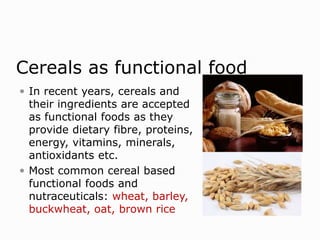
 In recent years, cereals and
their ingredients are accepted
as functional foods as they
provide dietary fibre, proteins,
energy, vitamins, minerals,
antioxidants etc.
 Most common cereal based
functional foods and
nutraceuticals: wheat, barley,
buckwheat, oat, brown rice
 The outer bran layer of cereals is rich in B
vitamins and phytonutrients such as flavonoids
and indoles, along with a small amount of protein.
The endosperm is predominantly carbohydrate,
and the germ layer is concentrated with minerals
such as iron and zinc, along with the antioxidant
vitamin E.
 Preventing cancer and CVDs, reducing tumour
incidence, reducing blood pressure, risk of heart
disease, cholesterol and fat absorption rate,
delaying gastric emptying, providing
gastrointestinal health- protective effects of
cereals.
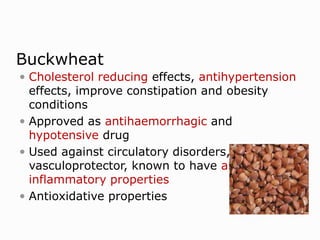
Buckwheat
 Cholesterol reducing effects, antihypertension
effects, improve constipation and obesity
conditions
 Approved as antihaemorrhagic and
hypotensive drug
 Used against circulatory disorders, and as
vasculoprotector, known to have anti-
inflammatory properties
 Antioxidative properties
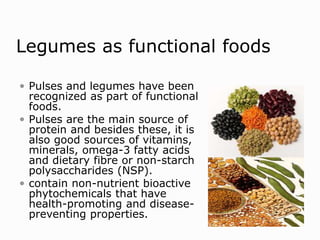
Legumes as functional foods
 Pulses and legumes have been
recognized as part of functional
foods.
 Pulses are the main source of
protein and besides these, it is
also good sources of vitamins,
minerals, omega-3 fatty acids
and dietary fibre or non-starch
polysaccharides (NSP).
 contain non-nutrient bioactive
phytochemicals that have
health-promoting and disease-
preventing properties.
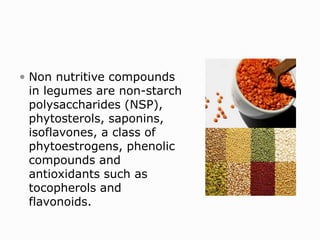
 Non nutritive compounds
in legumes are non-starch
polysaccharides (NSP),
phytosterols, saponins,
isoflavones, a class of
phytoestrogens, phenolic
compounds and
antioxidants such as
tocopherols and
flavonoids.
 demand for bean products is growing because of
the presence of several health-promoting
compounds in edible bean products
known as saponins which are naturally occurring
compounds widely distributed in all cells of
legume plants
 saponins have the ability to:
Help protect the human body against cancers
Lower cholesterol
Lower blood glucose responses
Soybeans
 In 1999, FDA approved a health claim for the
cholesterol-lowering properties of soy protein.
 American Heart Association (AHA) recommended
that patients with elevated cholesterol should
include soy protein foods in their diets.
 Soy has phytoestrogens called isoflavones.
 Soy isoflavones are believed to play a role in
prostate cancer, where supplementation with
isoflavones has shown a reduction in prostate
cancer risk in studies.
 Soy isoflavones, and possibly soy proteins as well,
are believed to play a role in bone health.
 There is also the biologically active non-isoflavone
component of soy that has received much
attention in past years– soy protein.
 The protein part is believed to be responsible for
the additional benefits seen from soy
consumption, which are:
Cholesterol-lowering effects
Blood pressure-lowering effects
Reduction of cancer risks
Favorable effects on kidney function
Vegetables as functional food
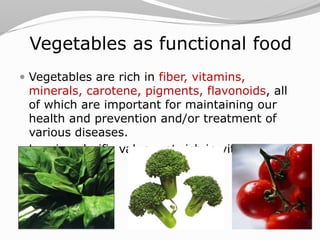
 Vegetables are rich in fiber, vitamins,
minerals, carotene, pigments, flavonoids, all
of which are important for maintaining our
health and prevention and/or treatment of
various diseases.
 Low in calorific value, yet rich in vital
components
Tomatoes
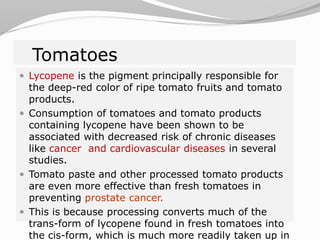
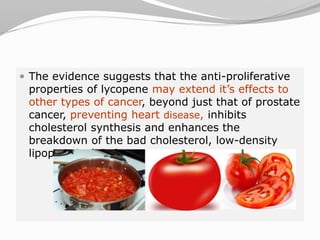
 Lycopene is the pigment principally responsible for
the deep-red color of ripe tomato fruits and tomato
products.
 Consumption of tomatoes and tomato products
containing lycopene have been shown to be
associated with decreased risk of chronic diseases
like cancer and cardiovascular diseases in several
studies.
 Tomato paste and other processed tomato products
are even more effective than fresh tomatoes in
preventing prostate cancer.
 This is because processing converts much of the
trans-form of lycopene found in fresh tomatoes into
the cis-form, which is much more readily taken up in
 The evidence suggests that the anti-proliferative
properties of lycopene may extend it’s effects to
other types of cancer, beyond just that of prostate
cancer, preventing heart disease, inhibits
cholesterol synthesis and enhances the
breakdown of the bad cholesterol, low-density
lipoprotein (LDL).
Fruits as functional foods
 Fruits are nature’s wonderful gift to mankind;
indeed, medicines packed with vitamins, minerals,
anti-oxidants and many phyto-nutrients.
 Fruits are low in calories and fat and provide
plenty of soluble dietary fibers which
consequently helps in prevention of chronic
diseases like obesity, diabetes, CVDs,hypertension
etc.
 Fruits contain many anti-oxidants like poly-
phenolic flavonoids, vitamin-C, and
anthocyanin offer protection against aging,
infections and some diseases like Alzheimer's
disease, colon cancers, weak bones
Mango
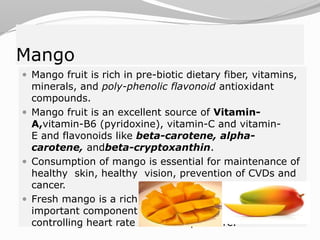
 Mango fruit is rich in pre-biotic dietary fiber, vitamins,
minerals, and poly-phenolic flavonoid antioxidant
compounds.
 Mango fruit is an excellent source of Vitamin-
A,vitamin-B6 (pyridoxine), vitamin-C and vitamin-
E and flavonoids like beta-carotene, alpha-
carotene, andbeta-cryptoxanthin.
 Consumption of mango is essential for maintenance of
healthy skin, healthy vision, prevention of CVDs and
cancer.
 Fresh mango is a rich source of potassium which is an
important component of cell and body fluids that helps
controlling heart rate and blood pressure.
Probiotics as functional
food
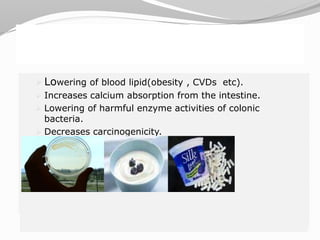
 Probiotics which means for life in Greek, is one of the
approach to inhibit harmful m/os in our body and is
widely used as functional foods.
 Probiotic approach involves the consumption of live
bacterial cells mainly lactic acid producing
bacteria(Lactobacillus or Bifidobacterium genera ) in
foods or dietary supplements.
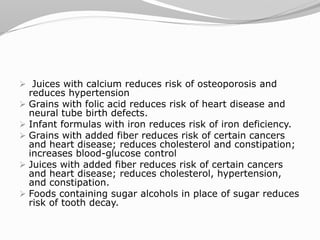
 Probiotic yoghurt are known to exert +ve response
towards lactose-intolerant people.
 Probiotics are known to exerts many health benefits
beyond inherent general nutrition. Some of them are
:-
 lowering of blood pressure
 Lowering of blood lipid(obesity , CVDs etc).
 Increases calcium absorption from the intestine.
 Lowering of harmful enzyme activities of colonic bacteria.
 Decreases carcinogenicity.
 Lowering of blood lipid(obesity , CVDs etc).
 Increases calcium absorption from the intestine.
 Lowering of harmful enzyme activities of colonic bacteria.
 Decreases carcinogenecity.
 Lowering of blood lipid(obesity , CVDs etc).
 Increases calcium absorption from the intestine.
 Lowering of harmful enzyme activities of colonic
bacteria.
 Decreases carcinogenicity.
Functional food and
fortification
 Foods are fortified and enriched with different
essential ingredients to make it functionally
bioactive for promoting health status of
consumer
 Products considered functional generally do
not include products where fortification has
been done to meet government regulations
and the change is not recorded on the label as
a significant addition ("invisible fortification").
 Some of the fortified food used as functional
food and their health benefits :-
 Juices with calcium reduces risk of osteoporosis and
reduces hypertension
 Grains with folic acid reduces risk of heart disease and
neural tube birth defects.
 Infant formulas with iron reduces risk of iron deficiency.
 Grains with added fiber reduces risk of certain cancers
and heart disease; reduces cholesterol and constipation;
increases blood-glucose control
 Juices with added fiber reduces risk of certain cancers
and heart disease; reduces cholesterol, hypertension,
and constipation.
 Foods containing sugar alcohols in place of sugar reduces
risk of tooth decay.
Conclusion
 Functional food offers great potential to improve
health and/or help prevent certain diseases when
taken as part of balanced diet and healthy
lifestyle.
 Thus, a functional food for one consumer can act
as a nutraceutical for another consumer.
 Many food pdts containing components with
health benefits are being incorporated with many
other beneficial components for desirable
physiological change.
 Functional foods are on peak demands due to
increasing consumer awareness for healthy
living, ageing population, increasing health
care cost, advancing scientific evidence that
diet can affect on prevalence and progression
of disease.
 Although the dangerous effects of many foods
like soy, honey mustn’t be overlooked;
nutraceuticals and functional foods should be
taken under proper supervision of nutritionist
or other medical assistant if possible.
THANK
YOU 

Functional food

  • 2.
    Contents Background Introduction Functional food asnutraceuticals Cereals as functional food Legumes as functional food Vegetables as functional food Fruits as functional food Probiotics as functional food Functional food and fortification Conclusion
  • 3.
    Background  Humans forcenturies have attributed to diet and foods as a functional role in health.  Understanding of the relationships between food, physiological function and disease have progressed in recent years, particularly over the past decade.  Growing interest in the role that nutrition plays in our state of well being has led to the development and marketing of a growing spectrum of products called “nutraceuticals” and “functional foods.”
  • 4.
    Introduction  A functionalfood is a food given an additional function.  "Functional Food is a Natural or processed food that contains known biologically-active compounds which when in defined quantitative and qualitative amounts provides a clinically proven and documented health benefit.  Functional foods includes processed food or foods fortified with health-promoting additives, like "vitamin-enriched" products.
  • 5.
    Functional foods as nutraceuticals Nutraceuticalsare functional foods which d0nt only provide mere health benefits but helps in effective prevention and treatment of different diseases. Nutraceuticals have been claimed to have a physiological benefit or provide protection against the following diseases:-  Cardiovascular agents  Antiobese agents  Antidiabetics  Anticancer agents  Immune boosters  Chronic inflammatory disorders  Degenerative diseases
  • 6.
    Concept of functionalfoods  The “functional food” concept was developed in Japan at the early 1980s and as “food for specified health use (FOSHU)” was established in 1991.  Defined as “any food or ingredient that has a positive impact on an individual’s health, physical performance, or state of mind, in addition to its nutritive value”.  Should be naturally occurring, can be consumed as part of the daily diet, and when ingested should enhance or regulate a particular biological process or mechanism to prevent or control specific diseases.
  • 7.
    Concept of Nutraceuticalfoods  Dr Stephen DeFelice, founder and chairman of the Foundation for Innovation in Medicine located in Cranford, New Jersey, coined the term "Nutraceutical“ from "Nutrition" and "Pharmaceutical" in 1989,  defined as ‘a food or part of food, that provides medical or health benefits, including the prevention and treatment of disease.  Nutraceuticals are natural bioactive, chemical compounds that have health promoting, disease preventing or medicinal properties.
  • 8.
     components thatnot only maintain, support, and normalize any physiological or metabolic function, but can also potentiate, antagonize, or otherwise modify physiological or metabolic functions.  non-specific biological therapies, used to promote wellness, prevent malignant processes and control symptoms.
  • 9.
    Cereals as functionalfood  In recent years, cereals and their ingredients are accepted as functional foods as they provide dietary fibre, proteins, energy, vitamins, minerals, antioxidants etc.  Most common cereal based functional foods and nutraceuticals: wheat, barley, buckwheat, oat, brown rice
  • 10.
     The outerbran layer of cereals is rich in B vitamins and phytonutrients such as flavonoids and indoles, along with a small amount of protein. The endosperm is predominantly carbohydrate, and the germ layer is concentrated with minerals such as iron and zinc, along with the antioxidant vitamin E.  Preventing cancer and CVDs, reducing tumour incidence, reducing blood pressure, risk of heart disease, cholesterol and fat absorption rate, delaying gastric emptying, providing gastrointestinal health- protective effects of cereals.
  • 11.
    Buckwheat  Cholesterol reducingeffects, antihypertension effects, improve constipation and obesity conditions  Approved as antihaemorrhagic and hypotensive drug  Used against circulatory disorders, and as vasculoprotector, known to have anti- inflammatory properties  Antioxidative properties
  • 12.
    Legumes as functionalfoods  Pulses and legumes have been recognized as part of functional foods.  Pulses are the main source of protein and besides these, it is also good sources of vitamins, minerals, omega-3 fatty acids and dietary fibre or non-starch polysaccharides (NSP).  contain non-nutrient bioactive phytochemicals that have health-promoting and disease- preventing properties.
  • 13.
     Non nutritivecompounds in legumes are non-starch polysaccharides (NSP), phytosterols, saponins, isoflavones, a class of phytoestrogens, phenolic compounds and antioxidants such as tocopherols and flavonoids.
  • 14.
     demand forbean products is growing because of the presence of several health-promoting compounds in edible bean products known as saponins which are naturally occurring compounds widely distributed in all cells of legume plants  saponins have the ability to: Help protect the human body against cancers Lower cholesterol Lower blood glucose responses
  • 15.
    Soybeans  In 1999,FDA approved a health claim for the cholesterol-lowering properties of soy protein.  American Heart Association (AHA) recommended that patients with elevated cholesterol should include soy protein foods in their diets.  Soy has phytoestrogens called isoflavones.  Soy isoflavones are believed to play a role in prostate cancer, where supplementation with isoflavones has shown a reduction in prostate cancer risk in studies.  Soy isoflavones, and possibly soy proteins as well, are believed to play a role in bone health.
  • 16.
     There isalso the biologically active non-isoflavone component of soy that has received much attention in past years– soy protein.  The protein part is believed to be responsible for the additional benefits seen from soy consumption, which are: Cholesterol-lowering effects Blood pressure-lowering effects Reduction of cancer risks Favorable effects on kidney function
  • 17.
    Vegetables as functionalfood  Vegetables are rich in fiber, vitamins, minerals, carotene, pigments, flavonoids, all of which are important for maintaining our health and prevention and/or treatment of various diseases.  Low in calorific value, yet rich in vital components
  • 18.
    Tomatoes  Lycopene isthe pigment principally responsible for the deep-red color of ripe tomato fruits and tomato products.  Consumption of tomatoes and tomato products containing lycopene have been shown to be associated with decreased risk of chronic diseases like cancer and cardiovascular diseases in several studies.  Tomato paste and other processed tomato products are even more effective than fresh tomatoes in preventing prostate cancer.  This is because processing converts much of the trans-form of lycopene found in fresh tomatoes into the cis-form, which is much more readily taken up in
  • 19.
     The evidencesuggests that the anti-proliferative properties of lycopene may extend it’s effects to other types of cancer, beyond just that of prostate cancer, preventing heart disease, inhibits cholesterol synthesis and enhances the breakdown of the bad cholesterol, low-density lipoprotein (LDL).
  • 20.
    Fruits as functionalfoods  Fruits are nature’s wonderful gift to mankind; indeed, medicines packed with vitamins, minerals, anti-oxidants and many phyto-nutrients.  Fruits are low in calories and fat and provide plenty of soluble dietary fibers which consequently helps in prevention of chronic diseases like obesity, diabetes, CVDs,hypertension etc.  Fruits contain many anti-oxidants like poly- phenolic flavonoids, vitamin-C, and anthocyanin offer protection against aging, infections and some diseases like Alzheimer's disease, colon cancers, weak bones
  • 21.
    Mango  Mango fruitis rich in pre-biotic dietary fiber, vitamins, minerals, and poly-phenolic flavonoid antioxidant compounds.  Mango fruit is an excellent source of Vitamin- A,vitamin-B6 (pyridoxine), vitamin-C and vitamin- E and flavonoids like beta-carotene, alpha- carotene, andbeta-cryptoxanthin.  Consumption of mango is essential for maintenance of healthy skin, healthy vision, prevention of CVDs and cancer.  Fresh mango is a rich source of potassium which is an important component of cell and body fluids that helps controlling heart rate and blood pressure.
  • 22.
    Probiotics as functional food Probiotics which means for life in Greek, is one of the approach to inhibit harmful m/os in our body and is widely used as functional foods.  Probiotic approach involves the consumption of live bacterial cells mainly lactic acid producing bacteria(Lactobacillus or Bifidobacterium genera ) in foods or dietary supplements.  Probiotic yoghurt are known to exert +ve response towards lactose-intolerant people.  Probiotics are known to exerts many health benefits beyond inherent general nutrition. Some of them are :-  lowering of blood pressure
  • 23.
     Lowering ofblood lipid(obesity , CVDs etc).  Increases calcium absorption from the intestine.  Lowering of harmful enzyme activities of colonic bacteria.  Decreases carcinogenicity.  Lowering of blood lipid(obesity , CVDs etc).  Increases calcium absorption from the intestine.  Lowering of harmful enzyme activities of colonic bacteria.  Decreases carcinogenecity.  Lowering of blood lipid(obesity , CVDs etc).  Increases calcium absorption from the intestine.  Lowering of harmful enzyme activities of colonic bacteria.  Decreases carcinogenicity.
  • 24.
    Functional food and fortification Foods are fortified and enriched with different essential ingredients to make it functionally bioactive for promoting health status of consumer  Products considered functional generally do not include products where fortification has been done to meet government regulations and the change is not recorded on the label as a significant addition ("invisible fortification").  Some of the fortified food used as functional food and their health benefits :-
  • 25.
     Juices withcalcium reduces risk of osteoporosis and reduces hypertension  Grains with folic acid reduces risk of heart disease and neural tube birth defects.  Infant formulas with iron reduces risk of iron deficiency.  Grains with added fiber reduces risk of certain cancers and heart disease; reduces cholesterol and constipation; increases blood-glucose control  Juices with added fiber reduces risk of certain cancers and heart disease; reduces cholesterol, hypertension, and constipation.  Foods containing sugar alcohols in place of sugar reduces risk of tooth decay.
  • 26.
    Conclusion  Functional foodoffers great potential to improve health and/or help prevent certain diseases when taken as part of balanced diet and healthy lifestyle.  Thus, a functional food for one consumer can act as a nutraceutical for another consumer.  Many food pdts containing components with health benefits are being incorporated with many other beneficial components for desirable physiological change.
  • 27.
     Functional foodsare on peak demands due to increasing consumer awareness for healthy living, ageing population, increasing health care cost, advancing scientific evidence that diet can affect on prevalence and progression of disease.  Although the dangerous effects of many foods like soy, honey mustn’t be overlooked; nutraceuticals and functional foods should be taken under proper supervision of nutritionist or other medical assistant if possible.
  • 28.