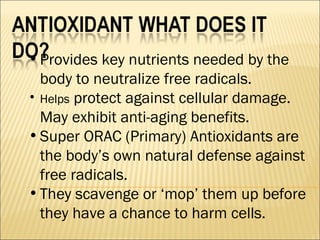
• Provides key nutrients needed by the
  body to neutralize free radicals.
• Helps protect against cellular damage.
  May exhibit anti-aging benefits.
• Super ORAC (Primary) Antioxidants are
  the body’s own natural defense against
  free radicals.
• They scavenge or ‘mop’ them up before
  they have a chance to harm cells.
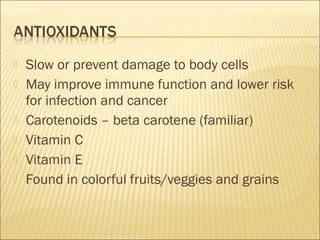
   Slow or prevent damage to body cells
   May improve immune function and lower risk
    for infection and cancer
   Carotenoids – beta carotene (familiar)
   Vitamin C
   Vitamin E
   Found in colorful fruits/veggies and grains
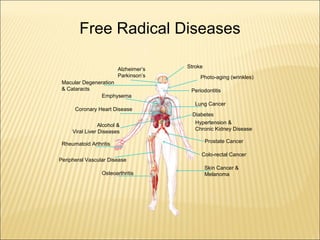
Free Radical Diseases

                         Alzheimer’s   Stroke
                         Parkinson’s        Photo-aging (wrinkles)
 Macular Degeneration
 & Cataracts                            Periodontitis
                Emphysema
                                          Lung Cancer
      Coronary Heart Disease
                                         Diabetes
                                          Hypertension &
                 Alcohol &
                                          Chronic Kidney Disease
     Viral Liver Diseases
                                                Prostate Cancer
 Rheumatoid Arthritis

                                            Colo-rectal Cancer
Peripheral Vascular Disease
                                                Skin Cancer &
                  Osteoarthritis                Melanoma
The free radical diseases

•Cancer initiation and promotion is
associated with chromosomal defects
and oncogene activation. It is possible
that endogenous free radical reactions,
like those initiated by ionizing radiation,
may result in tumour formation.
The free radical diseases

•Atherosclerosis may be due to free
radical reactions involving diet-derived
lipids in the arterial wall and serum to
yield peroxides and other substances.
These compounds induce endothelial
cell injury and produce changes in the
arterial walls .
Antioxidants
•vitamin E

•vitamin C

•carotenoids
vitamin E

•Vitamin E is a fat-soluble substance
present in all cellular membranes and is
mainly stored in adipose tissue, the liver
and muscle. Vitamin E is a principal
antioxidant in the body and protects
polyunsaturated fatty acids in cell
membranes from peroxidation.
Vitamin E and cancer

•Besides being a free radical scavenger,
vitamin E at high intakes enhances the
body's immune responses. Vitamin E also
inhibits the conversion of nitrites in the
stomach to nitrosamines, which are
cancer promoters.
Vitamin E and
   cardiovascular disease

•Vitamin E intakes are associated with
lowered risk of angina and mortality from
heart disease.
Vitamin E and neurological
        disorders

•Supplementation with vitamin C and
E might be of benefit in slowing the
progression of Parkinson's disease.
Vitamin C

•Vitamin C, or ascorbic acid, is a water-
soluble vitamin. This vitamin is a free
radical scavenger, it is considered to be
one of the most important antioxidants in
extra cellular fluids. Its protective effects
extend to cancer, coronary artery disease,
arthritis and aging.
Vitamin C and cancer

•Vitamin C is effective in protecting tissues
against oxidative damage. It suppresses the
formation of carcinogens. Numerous studies
have reported the protective effect of fruit and
vegetable consumption on incidence of
cancer . This is mainly attributed to the
protective effect of vitamin C against cancer.
Vitamin C and
    cardiovascular disease

•Vitamin C may lower total cholesterol in
the blood, thus reducing the risk of
cardiovascular disease. Coronary heart
disease mortality is higher in those with
blood vitamin C levels that are near or in
the deficient range.
Vitamin C and cataracts

•High intake of fruits and vegetables
which are rich sources of ascorbic acid
appear to be protective too. In several
studies, cataract patients were shown to
have low vitamin C and E intakes and
low plasma vitamin C levels.
Carotenoids

•Carotenoids are a group of red, orange
and yellow pigments found in plant
foods, particularly fruits and vegetables.
• Some carotenoids like b-carotene act
as a precursor of vitamin A; others do
not.
Superoxide Dismutase (SOD) is
   essential for the body and is:
 A metalloprotein – containing several sub units
       organised around a metallic group
                And most importantly
  An enzyme – the antioxidant enzyme SOD
 eliminates, in a continuous way, superoxide
radicals, precursors of other oxygen reactive
       forms (secondary free radicals)
SOD acts at the source. It is the first and one of the
major components of the body’s antioxidant system.

SOD is a powerful and efficient antioxidant:
  • 1 iu SOD eliminates 1μmol superoxide/min and SOD has
  an active lifespan of several days!
  • In the end, billions of superoxide molecules destroyed

    SOD is a primary antioxidant and
    possibly our most important one
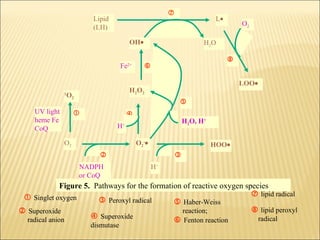
Reactive oxygen species:
     formation of secondary free radicals
Hydroxyl radical induces the formation of
secondary free radicals:
    • Secondary free radicals or organic peroxides
      are very toxic
    • They increase oxidative reactions which are
      propagated from one to the next
    • They are directly responsible for cell
      alterations and destruction
    • They indirectly participate in the inflammation
      process
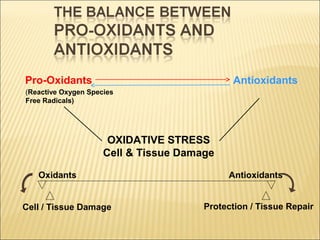
Pro-Oxidants                                 Antioxidants
(Reactive Oxygen Species
Free Radicals)


                      OXIDATIVE STRESS
                     Cell & Tissue Damage

   Oxidants                                 Antioxidants


Cell / Tissue Damage                   Protection / Tissue Repair
Antioxidant systems:
         the primary antioxidants
The primary antioxidants:
    • are endogenous molecules
    • act at the source (where free radicals are
       created)
    • are enzymes which continuously
       eliminate the free radicals just formed:
    - SOD eliminates the superoxide ion
    - catalase and the glutathione peroxidase
       eliminate hydrogen peroxide
Antioxidant systems:
       the secondary antioxidants
The secondary antioxidants
    • are exogenous molecules, carried by
      food (vitamins A, C, E, polyphenols…)
    • they scavenge the secondary free
      radicals
    • one molecule of a secondary antioxidant
      traps one free radical molecule – a 1:1
      relationship
Oxidants and antioxidants
              in the body
Under normal circumstances and
conditions, the body’s endogenous
antioxidant systems are able to neutralize
the oxidant (free radical) molecules

              Therefore
      → no oxidative stress means
          → no cell damage
Oxidative stress…

  …is the result of an imbalance
 between oxidant and antioxidant
            production

     increase of free radicals
→ antioxidant systems overpowered
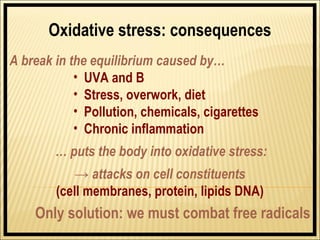
Oxidative stress: consequences
A break in the equilibrium caused by…
            • UVA and B
            • Stress, overwork, diet
            • Pollution, chemicals, cigarettes
            • Chronic inflammation
        … puts the body into oxidative stress:
           → attacks on cell constituents
        (cell membranes, protein, lipids DNA)
    Only solution: we must combat free radicals

                           Lipid                                               L•
                                                                                        O2
                           (LH)

                                           OH•                            H2O

                                                                                    
                                      Fe   2+
                                                  

                                                                                        LOO•
                                           H2O2
               1
                   O2
                                                                
    UV light                             
    heme Fe                                                         H2O, H+
    CoQ                            H  +


               O2                               O2-•                          HOO•
                                                               
                        NADPH                          H+
                        or CoQ
              Figure 5. Pathways for the formation of reactive oxygen species
  Singlet oxygen                                                        lipid radical
                          Peroxyl radical       Haber-Weiss
 Superoxide                                       reaction;             lipid peroxyl
  radical anion         Superoxide              Fenton reaction         radical
                          dismutase
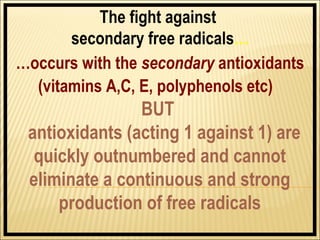
The fight against
       secondary free radicals…
…occurs with the secondary antioxidants
  (vitamins A,C, E, polyphenols etc)
                BUT
 antioxidants (acting 1 against 1) are
  quickly outnumbered and cannot
 eliminate a continuous and strong
     production of free radicals
Secondary antioxidants are vital
 but just slow down the oxidative
              stress

– we need to do something extra…
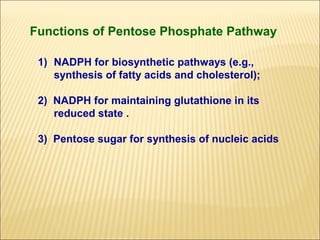
Functions of Pentose Phosphate Pathway

 1) NADPH for biosynthetic pathways (e.g.,
    synthesis of fatty acids and cholesterol);

 2) NADPH for maintaining glutathione in its
    reduced state .

 3) Pentose sugar for synthesis of nucleic acids
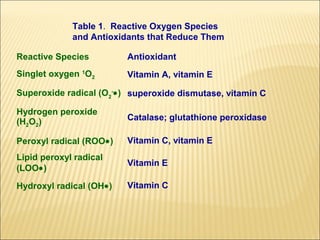
Table 1. Reactive Oxygen Species
             and Antioxidants that Reduce Them

Reactive Species         Antioxidant
Singlet oxygen 1O2       Vitamin A, vitamin E

Superoxide radical (O2-•) superoxide dismutase, vitamin C

Hydrogen peroxide
(H2O2)                   Catalase; glutathione peroxidase

Peroxyl radical (ROO•)   Vitamin C, vitamin E
Lipid peroxyl radical
                         Vitamin E
(LOO•)

Hydroxyl radical (OH•)   Vitamin C
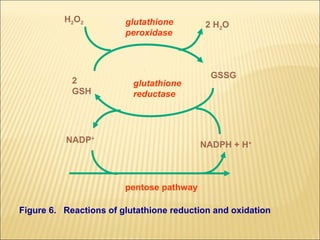
H2O2          glutathione        2 H2O
                        peroxidase


                                            GSSG
            2             glutathione
            GSH           reductase


          NADP+
                                          NADPH + H+


                        pentose pathway

Figure 6. Reactions of glutathione reduction and oxidation
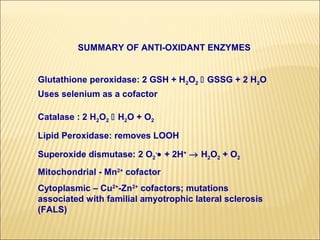
SUMMARY OF ANTI-OXIDANT ENZYMES


Glutathione peroxidase: 2 GSH + H2O2  GSSG + 2 H2O
Uses selenium as a cofactor

Catalase : 2 H2O2  H2O + O2

Lipid Peroxidase: removes LOOH

Superoxide dismutase: 2 O2-• + 2H+ → H2O2 + O2
Mitochondrial - Mn2+ cofactor
Cytoplasmic – Cu2+-Zn2+ cofactors; mutations
associated with familial amyotrophic lateral sclerosis
(FALS)
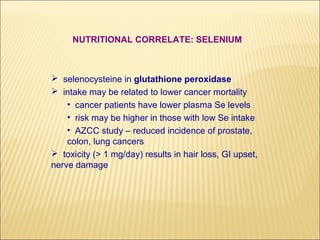
NUTRITIONAL CORRELATE: SELENIUM


 selenocysteine in glutathione peroxidase
 intake may be related to lower cancer mortality
    • cancer patients have lower plasma Se levels
    • risk may be higher in those with low Se intake
    • AZCC study – reduced incidence of prostate,
    colon, lung cancers
 toxicity (> 1 mg/day) results in hair loss, GI upset,
nerve damage
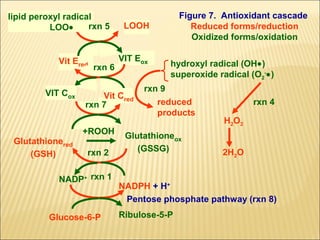
lipid peroxyl radical                         Figure 7. Antioxidant cascade
          LOO•      rxn 5       LOOH             Reduced forms/reduction
                                                 Oxidized forms/oxidation

            Vit Ered           VIT Eox
                       rxn 6              hydroxyl radical (OH•)
                                          superoxide radical (O2-•)
                                     rxn 9
         VIT Cox       Vit Cred
                   rxn 7                reduced                rxn 4
                                        products
                                                        H2O2
                   +ROOH        Glutathioneox
 Glutathionered
                   rxn 2           (GSSG)              2H2O
     (GSH)

            NADP+ rxn 1
                               NADPH + H+
                                Pentose phosphate pathway (rxn 8)

          Glucose-6-P          Ribulose-5-P
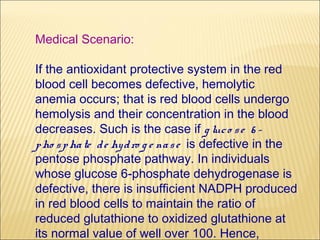
Medical Scenario:

If the antioxidant protective system in the red
blood cell becomes defective, hemolytic
anemia occurs; that is red blood cells undergo
hemolysis and their concentration in the blood
decreases. Such is the case if g luc o s e 6 -
p ho s p ha te d e hy d ro g e na s e is defective in the
pentose phosphate pathway. In individuals
whose glucose 6-phosphate dehydrogenase is
defective, there is insufficient NADPH produced
in red blood cells to maintain the ratio of
reduced glutathione to oxidized glutathione at
its normal value of well over 100. Hence,
Antioxidants

Antioxidants

  • 2.
    • Provides keynutrients needed by the body to neutralize free radicals. • Helps protect against cellular damage. May exhibit anti-aging benefits. • Super ORAC (Primary) Antioxidants are the body’s own natural defense against free radicals. • They scavenge or ‘mop’ them up before they have a chance to harm cells.
  • 3.
    Slow or prevent damage to body cells  May improve immune function and lower risk for infection and cancer  Carotenoids – beta carotene (familiar)  Vitamin C  Vitamin E  Found in colorful fruits/veggies and grains
  • 4.
    Free Radical Diseases Alzheimer’s Stroke Parkinson’s Photo-aging (wrinkles) Macular Degeneration & Cataracts Periodontitis Emphysema Lung Cancer Coronary Heart Disease Diabetes Hypertension & Alcohol & Chronic Kidney Disease Viral Liver Diseases Prostate Cancer Rheumatoid Arthritis Colo-rectal Cancer Peripheral Vascular Disease Skin Cancer & Osteoarthritis Melanoma
  • 5.
    The free radicaldiseases •Cancer initiation and promotion is associated with chromosomal defects and oncogene activation. It is possible that endogenous free radical reactions, like those initiated by ionizing radiation, may result in tumour formation.
  • 6.
    The free radicaldiseases •Atherosclerosis may be due to free radical reactions involving diet-derived lipids in the arterial wall and serum to yield peroxides and other substances. These compounds induce endothelial cell injury and produce changes in the arterial walls .
  • 7.
  • 8.
    vitamin E •Vitamin Eis a fat-soluble substance present in all cellular membranes and is mainly stored in adipose tissue, the liver and muscle. Vitamin E is a principal antioxidant in the body and protects polyunsaturated fatty acids in cell membranes from peroxidation.
  • 9.
    Vitamin E andcancer •Besides being a free radical scavenger, vitamin E at high intakes enhances the body's immune responses. Vitamin E also inhibits the conversion of nitrites in the stomach to nitrosamines, which are cancer promoters.
  • 10.
    Vitamin E and cardiovascular disease •Vitamin E intakes are associated with lowered risk of angina and mortality from heart disease.
  • 11.
    Vitamin E andneurological disorders •Supplementation with vitamin C and E might be of benefit in slowing the progression of Parkinson's disease.
  • 12.
    Vitamin C •Vitamin C,or ascorbic acid, is a water- soluble vitamin. This vitamin is a free radical scavenger, it is considered to be one of the most important antioxidants in extra cellular fluids. Its protective effects extend to cancer, coronary artery disease, arthritis and aging.
  • 13.
    Vitamin C andcancer •Vitamin C is effective in protecting tissues against oxidative damage. It suppresses the formation of carcinogens. Numerous studies have reported the protective effect of fruit and vegetable consumption on incidence of cancer . This is mainly attributed to the protective effect of vitamin C against cancer.
  • 14.
    Vitamin C and cardiovascular disease •Vitamin C may lower total cholesterol in the blood, thus reducing the risk of cardiovascular disease. Coronary heart disease mortality is higher in those with blood vitamin C levels that are near or in the deficient range.
  • 15.
    Vitamin C andcataracts •High intake of fruits and vegetables which are rich sources of ascorbic acid appear to be protective too. In several studies, cataract patients were shown to have low vitamin C and E intakes and low plasma vitamin C levels.
  • 16.
    Carotenoids •Carotenoids are agroup of red, orange and yellow pigments found in plant foods, particularly fruits and vegetables. • Some carotenoids like b-carotene act as a precursor of vitamin A; others do not.
  • 17.
    Superoxide Dismutase (SOD)is essential for the body and is: A metalloprotein – containing several sub units organised around a metallic group And most importantly An enzyme – the antioxidant enzyme SOD eliminates, in a continuous way, superoxide radicals, precursors of other oxygen reactive forms (secondary free radicals)
  • 18.
    SOD acts atthe source. It is the first and one of the major components of the body’s antioxidant system. SOD is a powerful and efficient antioxidant: • 1 iu SOD eliminates 1μmol superoxide/min and SOD has an active lifespan of several days! • In the end, billions of superoxide molecules destroyed SOD is a primary antioxidant and possibly our most important one
  • 19.
    Reactive oxygen species: formation of secondary free radicals Hydroxyl radical induces the formation of secondary free radicals: • Secondary free radicals or organic peroxides are very toxic • They increase oxidative reactions which are propagated from one to the next • They are directly responsible for cell alterations and destruction • They indirectly participate in the inflammation process
  • 20.
    Pro-Oxidants Antioxidants (Reactive Oxygen Species Free Radicals) OXIDATIVE STRESS Cell & Tissue Damage Oxidants Antioxidants Cell / Tissue Damage Protection / Tissue Repair
  • 21.
    Antioxidant systems: the primary antioxidants The primary antioxidants: • are endogenous molecules • act at the source (where free radicals are created) • are enzymes which continuously eliminate the free radicals just formed: - SOD eliminates the superoxide ion - catalase and the glutathione peroxidase eliminate hydrogen peroxide
  • 22.
    Antioxidant systems: the secondary antioxidants The secondary antioxidants • are exogenous molecules, carried by food (vitamins A, C, E, polyphenols…) • they scavenge the secondary free radicals • one molecule of a secondary antioxidant traps one free radical molecule – a 1:1 relationship
  • 23.
    Oxidants and antioxidants in the body Under normal circumstances and conditions, the body’s endogenous antioxidant systems are able to neutralize the oxidant (free radical) molecules Therefore → no oxidative stress means → no cell damage
  • 24.
    Oxidative stress… …is the result of an imbalance between oxidant and antioxidant production increase of free radicals → antioxidant systems overpowered
  • 25.
    Oxidative stress: consequences Abreak in the equilibrium caused by… • UVA and B • Stress, overwork, diet • Pollution, chemicals, cigarettes • Chronic inflammation … puts the body into oxidative stress: → attacks on cell constituents (cell membranes, protein, lipids DNA) Only solution: we must combat free radicals
  • 26.
    Lipid L• O2 (LH) OH• H2O  Fe 2+  LOO• H2O2 1 O2  UV light   heme Fe H2O, H+ CoQ H + O2 O2-• HOO•   NADPH H+ or CoQ Figure 5. Pathways for the formation of reactive oxygen species  Singlet oxygen  lipid radical  Peroxyl radical  Haber-Weiss  Superoxide reaction;  lipid peroxyl radical anion  Superoxide  Fenton reaction radical dismutase
  • 27.
    The fight against secondary free radicals… …occurs with the secondary antioxidants (vitamins A,C, E, polyphenols etc) BUT antioxidants (acting 1 against 1) are quickly outnumbered and cannot eliminate a continuous and strong production of free radicals
  • 28.
    Secondary antioxidants arevital but just slow down the oxidative stress – we need to do something extra…
  • 29.
    Functions of PentosePhosphate Pathway 1) NADPH for biosynthetic pathways (e.g., synthesis of fatty acids and cholesterol); 2) NADPH for maintaining glutathione in its reduced state . 3) Pentose sugar for synthesis of nucleic acids
  • 30.
    Table 1. ReactiveOxygen Species and Antioxidants that Reduce Them Reactive Species Antioxidant Singlet oxygen 1O2 Vitamin A, vitamin E Superoxide radical (O2-•) superoxide dismutase, vitamin C Hydrogen peroxide (H2O2) Catalase; glutathione peroxidase Peroxyl radical (ROO•) Vitamin C, vitamin E Lipid peroxyl radical Vitamin E (LOO•) Hydroxyl radical (OH•) Vitamin C
  • 31.
    H2O2 glutathione 2 H2O peroxidase GSSG 2 glutathione GSH reductase NADP+ NADPH + H+ pentose pathway Figure 6. Reactions of glutathione reduction and oxidation
  • 32.
    SUMMARY OF ANTI-OXIDANTENZYMES Glutathione peroxidase: 2 GSH + H2O2  GSSG + 2 H2O Uses selenium as a cofactor Catalase : 2 H2O2  H2O + O2 Lipid Peroxidase: removes LOOH Superoxide dismutase: 2 O2-• + 2H+ → H2O2 + O2 Mitochondrial - Mn2+ cofactor Cytoplasmic – Cu2+-Zn2+ cofactors; mutations associated with familial amyotrophic lateral sclerosis (FALS)
  • 33.
    NUTRITIONAL CORRELATE: SELENIUM selenocysteine in glutathione peroxidase  intake may be related to lower cancer mortality • cancer patients have lower plasma Se levels • risk may be higher in those with low Se intake • AZCC study – reduced incidence of prostate, colon, lung cancers  toxicity (> 1 mg/day) results in hair loss, GI upset, nerve damage
  • 34.
    lipid peroxyl radical Figure 7. Antioxidant cascade LOO• rxn 5 LOOH Reduced forms/reduction Oxidized forms/oxidation Vit Ered VIT Eox rxn 6 hydroxyl radical (OH•) superoxide radical (O2-•) rxn 9 VIT Cox Vit Cred rxn 7 reduced rxn 4 products H2O2 +ROOH Glutathioneox Glutathionered rxn 2 (GSSG) 2H2O (GSH) NADP+ rxn 1 NADPH + H+ Pentose phosphate pathway (rxn 8) Glucose-6-P Ribulose-5-P
  • 35.
    Medical Scenario: If theantioxidant protective system in the red blood cell becomes defective, hemolytic anemia occurs; that is red blood cells undergo hemolysis and their concentration in the blood decreases. Such is the case if g luc o s e 6 - p ho s p ha te d e hy d ro g e na s e is defective in the pentose phosphate pathway. In individuals whose glucose 6-phosphate dehydrogenase is defective, there is insufficient NADPH produced in red blood cells to maintain the ratio of reduced glutathione to oxidized glutathione at its normal value of well over 100. Hence,

Editor's Notes

  • #20 So what is the best way to work with Geon and our exciting new product range – as a customer or as a business owner? As one of our associates – a business owner – you get all the products at wholesale prices, enjoy tax advantages, and now have a plan to create wealth So if being a business owner makes sense…
  • #22 So what is the best way to work with Geon and our exciting new product range – as a customer or as a business owner? As one of our associates – a business owner – you get all the products at wholesale prices, enjoy tax advantages, and now have a plan to create wealth So if being a business owner makes sense…
  • #23 So what is the best way to work with Geon and our exciting new product range – as a customer or as a business owner? As one of our associates – a business owner – you get all the products at wholesale prices, enjoy tax advantages, and now have a plan to create wealth So if being a business owner makes sense…
  • #24 So what is the best way to work with Geon and our exciting new product range – as a customer or as a business owner? As one of our associates – a business owner – you get all the products at wholesale prices, enjoy tax advantages, and now have a plan to create wealth So if being a business owner makes sense…
  • #25 So what is the best way to work with Geon and our exciting new product range – as a customer or as a business owner? As one of our associates – a business owner – you get all the products at wholesale prices, enjoy tax advantages, and now have a plan to create wealth So if being a business owner makes sense…
  • #26 So what is the best way to work with Geon and our exciting new product range – as a customer or as a business owner? As one of our associates – a business owner – you get all the products at wholesale prices, enjoy tax advantages, and now have a plan to create wealth So if being a business owner makes sense…
  • #28 So what is the best way to work with Geon and our exciting new product range – as a customer or as a business owner? As one of our associates – a business owner – you get all the products at wholesale prices, enjoy tax advantages, and now have a plan to create wealth So if being a business owner makes sense…
  • #29 So what is the best way to work with Geon and our exciting new product range – as a customer or as a business owner? As one of our associates – a business owner – you get all the products at wholesale prices, enjoy tax advantages, and now have a plan to create wealth So if being a business owner makes sense…