Institute of Food Technologists (IFT)
Functional Foods:
Their Role & Opportunities

Presentation November 23, 2011

William Fisher
Vice President
Science & Policy Initiatives
Outline
§   Overview of IFT
§   What are functional foods?
§   Why all the interest?
§   History
§   It’s a BIG business!
§   Trends
§   Latest research
§   Regulatory landscape
§   Future outlook
§   Concluding points
INSTITUTE OF
FOOD TECHNOLOGISTS

   Since 1939, IFT has unlocked
   the potential of the food
   science community by creating
   a dynamic global forum where
   members from more than 100
   countries can share, learn &
   grow.


                     http://www.ift.org/
IFT’s Strategic Focus
Mission
   – Advance the science of food
Long-Range Vision
   – Ensure a safe and abundant food supply contributing to
     healthier people everywhere
Commitment
   – Strive to provide
      § An inclusive and welcoming community for all food science
         and technology professionals; and
      § The knowledge and tools food science and technology
         professionals need to enhance their professional capacity
         and competency
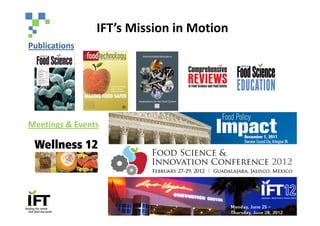
IFT’s Mission in Motion
Publications


Meetings & Events


                                     5
WHAT ARE FUNCTIONAL
              FOODS?
                  Foods & food components that
                  provide essential nutrients often
                  beyond quantities necessary for
                  normal maintenance, growth,
                  and development and/or other
                  biologically active components
                  that impart health benefits or
                  desirable physiological effects.


IFT Expert Report. Functional Foods: Opportunities and Challenges
Dietary Supplements
    § Taken by month that contains a “dietary ingredient” intended to supplement the diet
    § “Dietary ingredients” include: vitamins, minerals, herbs and other botanicals, amino
      acids, and substances such as enzymes, organ tissue, glandulars, and metabolites.
    § Excludes conventional foods or a sole item of a meal or the diet.
Drugs
   §    Prescribed to a specific individual by a medical doctor to treat a specific disease because
        of its active medicinal ingredient that usually has a specific target and an immediate
        effect
Nutraceutrials
    § Foods, or parts of food, that provide medical or health benefits, includes
       dietary supplements and functional foods.
Nutrients
    § Traditional vitamins, minerals, essential fatty acids for which recommended intakes have
      been established
    § And other components, such as phytonutrients or bioactives, present in foods for which
      a physical or physiological effect has been scientifically documented or for which a
      substantial body of evidence exists for a plausible mechanism but for which a
      recommended intake and function have not been definitively established.


                    IFT Expert Report. Functional Foods: Opportunities and Challenges
Functional Food Categories & Examples

Conventional foods (whole foods)        § Garlic, nuts, & tomatoes
Modified foods
   Fortified                            §   Iodized salt
   Enriched                             §   Folate-enriched breads
   Enhanced                             §   Energy bars, snacks, & yogurts
                                            formulated with bioactive
                                            components
Medical foods                           § Phenylketonuria (PKU) formulas,
                                          free of phenylalanine
Foods for special dietary use           §   Infant foods, weight-loss foods,
                                            gluten-free foods, & lactose-free
                                            foods


                 Position of the American Dietetic Association: Functional Foods.
                 J Am Diet Assoc. 2009;109:735-746
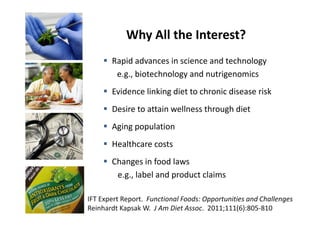
Why All the Interest?
     § Rapid advances in science and technology
        e.g., biotechnology and nutrigenomics
     § Evidence linking diet to chronic disease risk
     § Desire to attain wellness through diet
     § Aging population
     § Healthcare costs
     § Changes in food laws
        e.g., label and product claims

IFT Expert Report. Functional Foods: Opportunities and Challenges
Reinhardt Kapsak W. J Am Diet Assoc. 2011;111(6):805-810
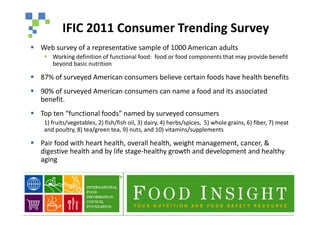
IFIC 2011 Consumer Trending Survey
§ Web survey of a representative sample of 1000 American adults
    § Working definition of functional food: food or food components that may provide benefit
      beyond basic nutrition

§ 87% of surveyed American consumers believe certain foods have health benefits
§ 90% of surveyed American consumers can name a food and its associated
  benefit.
§ Top ten “functional foods” named by surveyed consumers
    1) fruits/vegetables, 2) fish/fish oil, 3) dairy, 4) herbs/spices, 5) whole grains, 6) fiber, 7) meat
    and poultry, 8) tea/green tea, 9) nuts, and 10) vitamins/supplements

§ Pair food with heart health, overall health, weight management, cancer, &
  digestive health and by life stage-healthy growth and development and healthy
  aging
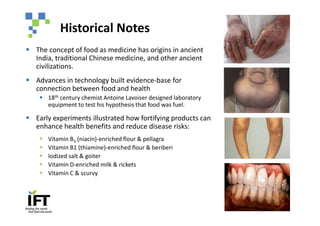
Historical Notes
§ The concept of food as medicine has origins in ancient
  India, traditional Chinese medicine, and other ancient
  civilizations.
§ Advances in technology built evidence-base for
  connection between food and health
    § 18th century chemist Antoine Lavoiser designed laboratory
      equipment to test his hypothesis that food was fuel.

§ Early experiments illustrated how fortifying products can
  enhance health benefits and reduce disease risks:
    §   Vitamin B3 (niacin)-enriched flour & pellagra
    §   Vitamin B1 (thiamine)-enriched flour & beriberi
    §   Iodized salt & goiter
    §   Vitamin D-enriched milk & rickets
    §   Vitamin C & scurvy
Functional Foods is BIG Business!
§ Health-conscious consumers are driving the demand for the
  development and promotion of products that
   – Promote wellness
   – Increase longevity
   – Prevent or manage chronic diseases
§ US sales of functional foods continue to increase, weathering
  economic downturn better than other food categories
   § Reached $37.4 billion in 2009
   § Estimated to represent 35-50% of global sales
§ Asia-Pacific also has a large market
§ Brazil has strong market potential


                                     Nutrition Business Journal. Feb 2010
                                     World Bank. Health Enhancing Foods. 2006
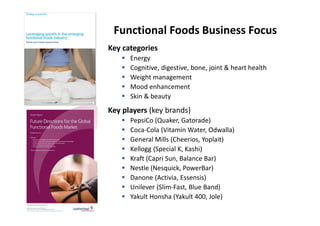
Functional Foods Business Focus
Key categories
   §   Energy
   §   Cognitive, digestive, bone, joint & heart health
   §   Weight management
   §   Mood enhancement
   §   Skin & beauty
Key players (key brands)
   §   PepsiCo (Quaker, Gatorade)
   §   Coca-Cola (Vitamin Water, Odwalla)
   §   General Mills (Cheerios, Yoplait)
   §   Kellogg (Special K, Kashi)
   §   Kraft (Capri Sun, Balance Bar)
   §   Nestle (Nesquick, PowerBar)
   §   Danone (Activia, Essensis)
   §   Unilever (Slim-Fast, Blue Band)
   §   Yakult Honsha (Yakult 400, Jole)
Facilitating Market Growth
§   Simplified approval process to market and label health claims
§   Increased awareness about food & chronic disease linkages
§   Gained acceptance about personalized medicine
§   Incentivized employees to develop better-for-you products
§   Incentivized customers to consume better-for-you products
§   Advanced food processing techniques
§   Demonstrated premium pricing potential
Emerging Functional Food Technologies
                        §   Enhancing product taste & smell
                        §   Optimizing texture
                        §   Stabilizing product ingredients
                        §   Improving body’s defenses
                        §   Maintaining food safety
                        §   Managing reasonable product costs


   http://www.ift.org
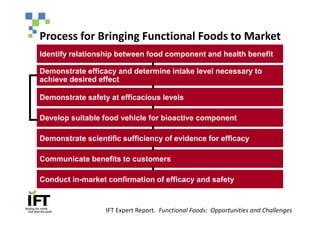
Process for Bringing Functional Foods to Market
Identify relationship between food component and health benefit

Demonstrate efficacy and determine intake level necessary to
achieve desired effect

Demonstrate safety at efficacious levels

Develop suitable food vehicle for bioactive component

Demonstrate scientific sufficiency of evidence for efficacy

Communicate benefits to customers

Conduct in-market confirmation of efficacy and safety


                  IFT Expert Report. Functional Foods: Opportunities and Challenges
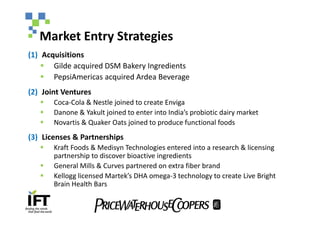
Market Entry Strategies
(1) Acquisitions
    § Gilde acquired DSM Bakery Ingredients
    § PepsiAmericas acquired Ardea Beverage
(2) Joint Ventures
   §   Coca-Cola & Nestle joined to create Enviga
   §   Danone & Yakult joined to enter into India’s probiotic dairy market
   §   Novartis & Quaker Oats joined to produce functional foods
(3) Licenses & Partnerships
   §   Kraft Foods & Medisyn Technologies entered into a research & licensing
       partnership to discover bioactive ingredients
   §   General Mills & Curves partnered on extra fiber brand
   §   Kellogg licensed Martek’s DHA omega-3 technology to create Live Bright
       Brain Health Bars
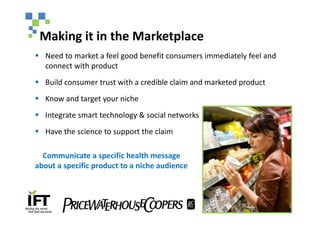
Making it in the Marketplace
§ Need to market a feel good benefit consumers immediately feel and
  connect with product
§ Build consumer trust with a credible claim and marketed product
§ Know and target your niche
§ Integrate smart technology & social networks
§ Have the science to support the claim

  Communicate a specific health message
about a specific product to a niche audience
Better-For-You Foods: It's Just Good Business

The Hudson Institute examined Nielsen sales data from grocery
stores, drug stores, and mass merchandisers; financial metrics,
such as operating income, share price appreciation, and return
to shareholders; and company reputation and favorability
rankings and found food and beverage companies that have a
higher percentage of product sales in the better-for-you product
category demonstrate comparatively better sales growth,
operating profits, returns to shareholders, and company
reputation.


                                                  www.hudson.org
Overcoming Consumer Perceived Barriers
§ Expense                      § Confidence in the science
§ Taste                        § Knowledge of how much to
§ Availability                   consume
§ Convenience                  § Uncertainty in how to
                                 prepare foods
§ Knowledge of foods/desired
  health benefits              § Lack of desire to try new
                                 foods
§ Confusion over conflicting
  information                  § Time it takes to learn about
                                 these foods
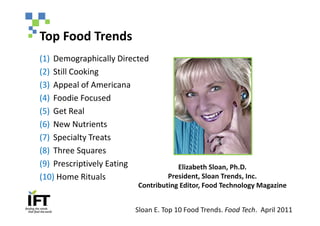
Top Food Trends
(1) Demographically Directed
(2) Still Cooking
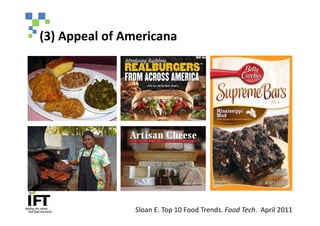
(3) Appeal of Americana
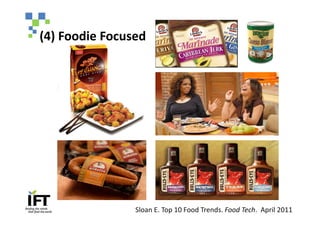
(4) Foodie Focused
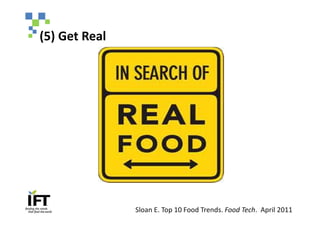
(5) Get Real
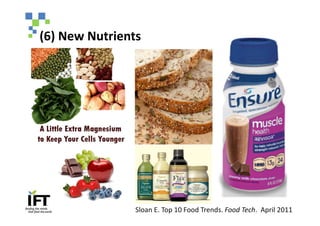
(6) New Nutrients
(7) Specialty Treats
(8) Three Squares
(9) Prescriptively Eating            Elizabeth Sloan, Ph.D.
(10) Home Rituals                 President, Sloan Trends, Inc.
                         Contributing Editor, Food Technology Magazine


                        Sloan E. Top 10 Food Trends. Food Tech. April 2011
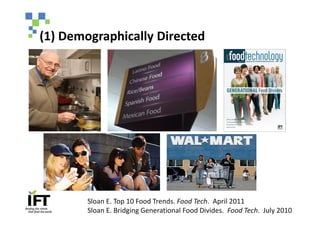
(1) Demographically Directed


        Sloan E. Top 10 Food Trends. Food Tech. April 2011
        Sloan E. Bridging Generational Food Divides. Food Tech. July 2010
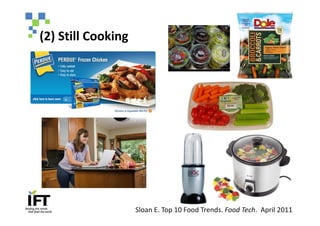
(2) Still Cooking


                    Sloan E. Top 10 Food Trends. Food Tech. April 2011
(3) Appeal of Americana


                Sloan E. Top 10 Food Trends. Food Tech. April 2011
(4) Foodie Focused


                Sloan E. Top 10 Food Trends. Food Tech. April 2011
(5) Get Real


               Sloan E. Top 10 Food Trends. Food Tech. April 2011
(6) New Nutrients


                Sloan E. Top 10 Food Trends. Food Tech. April 2011
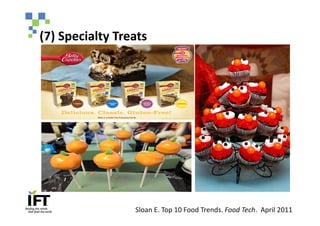
(7) Specialty Treats


                 Sloan E. Top 10 Food Trends. Food Tech. April 2011
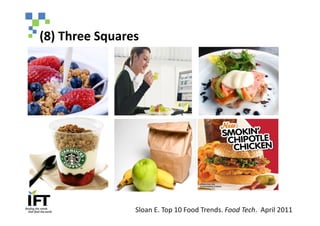
(8) Three Squares


                Sloan E. Top 10 Food Trends. Food Tech. April 2011
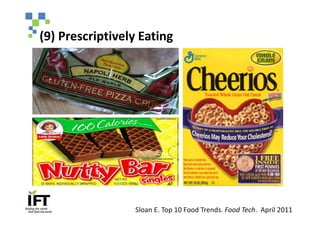
(9) Prescriptively Eating


                 Sloan E. Top 10 Food Trends. Food Tech. April 2011
(10) Home Rituals


                Sloan E. Top 10 Food Trends. Food Tech. April 2011
Top Functional Food Trends
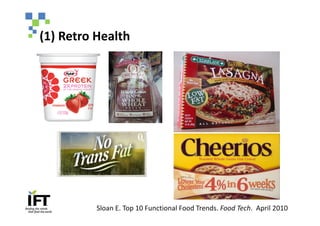
(1) Retro Health
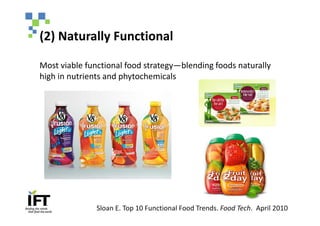
(2) Naturally Functional
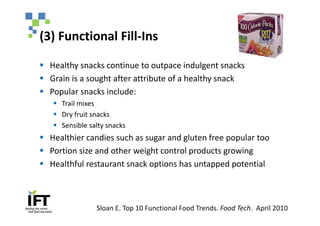
(3) Functional Fill-ins
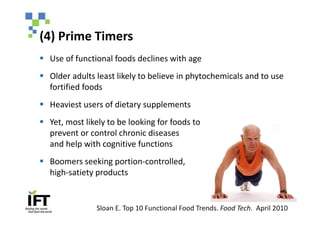
(4) Prime Timers
(5) Chemical Warfare
(6) Ailing Adolescents
(7) Meddling in Medications
(8) Daily Dynamics
(9) Get the Lowdown
(10)Finally Foodservice                Elizabeth Sloan, Ph.D.
                                    President, Sloan Trends, Inc.
                           Contributing Editor, Food Technology Magazine
              Sloan E. Top 10 Functional Food Trends. Food Tech. April 2010
(1) Retro Health


          Sloan E. Top 10 Functional Food Trends. Food Tech. April 2010
(2) Naturally Functional

Most viable functional food strategy—blending foods naturally
high in nutrients and phytochemicals


               Sloan E. Top 10 Functional Food Trends. Food Tech. April 2010
(3) Functional Fill-Ins

§ Healthy snacks continue to outpace indulgent snacks
§ Grain is a sought after attribute of a healthy snack
§ Popular snacks include:
   § Trail mixes
   § Dry fruit snacks
   § Sensible salty snacks
§ Healthier candies such as sugar and gluten free popular too
§ Portion size and other weight control products growing
§ Healthful restaurant snack options has untapped potential


                Sloan E. Top 10 Functional Food Trends. Food Tech. April 2010
(4) Prime Timers
§ Use of functional foods declines with age
§ Older adults least likely to believe in phytochemicals and to use
  fortified foods
§ Heaviest users of dietary supplements
§ Yet, most likely to be looking for foods to
  prevent or control chronic diseases
  and help with cognitive functions
§ Boomers seeking portion-controlled,
  high-satiety products


               Sloan E. Top 10 Functional Food Trends. Food Tech. April 2010
6) Ailing Adolescents


          Sloan E. Top 10 Functional Food Trends. Food Tech. April 2010
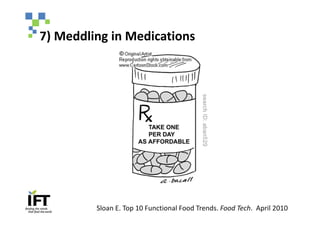
7) Meddling in Medications


         Sloan E. Top 10 Functional Food Trends. Food Tech. April 2010
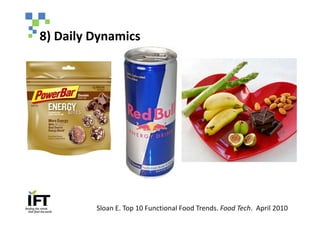
8) Daily Dynamics


         Sloan E. Top 10 Functional Food Trends. Food Tech. April 2010
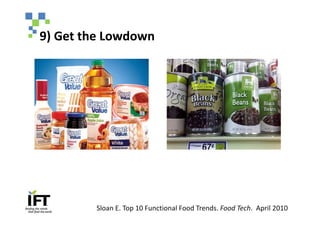
9) Get the Lowdown


        Sloan E. Top 10 Functional Food Trends. Food Tech. April 2010
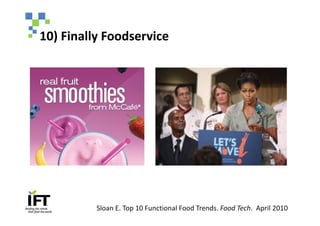
10) Finally Foodservice


          Sloan E. Top 10 Functional Food Trends. Food Tech. April 2010
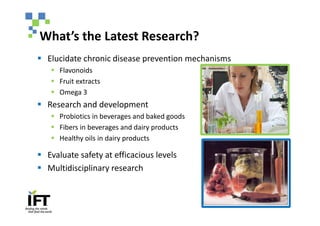
What’s the Latest Research?
§ Elucidate chronic disease prevention mechanisms
   § Flavonoids
   § Fruit extracts
   § Omega 3
§ Research and development
   § Probiotics in beverages and baked goods
   § Fibers in beverages and dairy products
   § Healthy oils in dairy products

§ Evaluate safety at efficacious levels
§ Multidisciplinary research
US National Institutes of Health Perspective
Opportunities
§ Need to identify the true site of action, e.g. establish
  biomarkers
§ Nutrigenomics
§ Establish optimal doses
Challenges
§ Bioactive compounds may vary by type and variety of food
§ Cooking changes the bioavailability of certain compounds
§ Bioactive compounds are complex & synergistically
§ Human tissues react differently

          Milner J. US Health & Human Services. National Cancer Institute.
          http://www.nutrientdataconf.org/PastConf/NDBC31/1-2_Milner.pdf
The Regulatory Landscape
Generally, functional foods are regulated as a combination of
substances, distinctly different from the drug approval process.

United States: Simplified health claim approval process
   § Enacted the Nutrition Labeling and Education Act (1997) and
     subsequent legislation
Europe: Increasingly difficult to make health claims
Japan: Permits health claims
Various Functional Food Definitions
United States Food and Drug Administration (FDA)
           Not officially recognized as a regulatory category.
Health Canada
            Similar in appearance to or, may be, a conventional food, is consumed as part of a
usual diet, and is demonstrated to have physiological benefits and/or reduce the risk of chronic
disease beyond basic nutritional functions.

European Commission Concerted Action on Functional Food
Science in Europe
           If it is satisfactorily demonstrated to affect beneficially one or more target function in
the body, beyond adequate nutritional effects, in a way that is relevant to either an improved
state of health and well-being and/or reduction of risk of disease.

Japanese Ministry of Health and Welfare
           Only country that recognizes functional foods as a distinct category, which they define
as foods providing a specific health benefit.


                       Position of the American Dietetic Association: Functional Foods.
                       J Am Diet Assoc. 2009;109:735-746
Authorized Claims in United States
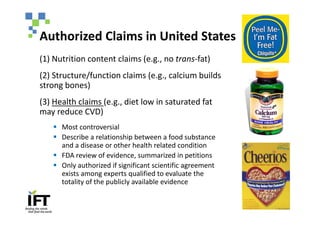
(1) Nutrition content claims (e.g., no trans-fat)
(2) Structure/function claims (e.g., calcium builds
strong bones)
(3) Health claims (e.g., diet low in saturated fat
may reduce CVD)
   § Most controversial
   § Describe a relationship between a food substance
     and a disease or other health related condition
   § FDA review of evidence, summarized in petitions
   § Only authorized if significant scientific agreement
     exists among experts qualified to evaluate the
     totality of the publicly available evidence
Example U.S. Authorized Health Claims

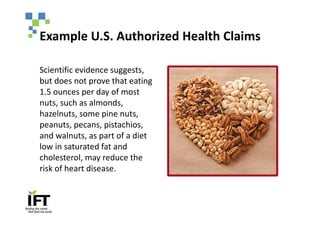
Scientific evidence suggests,
but does not prove that eating
1.5 ounces per day of most
nuts, such as almonds,
hazelnuts, some pine nuts,
peanuts, pecans, pistachios,
and walnuts, as part of a diet
low in saturated fat and
cholesterol, may reduce the
risk of heart disease.
Authorized Health Claims in the United States
Heart disease benefit (petitioner)
§ Barley soluable fiber (National Barley Foods Council)
§ Oatrim (The Quaker Oats Company & Rhodia, Inc.)
§ Plant sterol esters (Lipton Tea Company & McNeil Consumer
  Healthcare)
§ Psyllium seed husk soluble fiber (Kellogg Company)
§ Soy protein (Protein Technologies International, Inc.)
§ Whole oat soluble fiber (Quaker Oats Company)


            Nutrition Labeling and Education Act (NLEA), 1997-2006
            Position of the American Dietetic Association: Functional Foods.
            J Am Diet Assoc. 2009;109:735-746
            IFT Expert Report. Functional Foods: Opportunities and Challenges
Example Authorized Health Claims in Brazil

§   Beta-glucan helps reduce absorption of cholesterol
§   Bifidobacter animallis helps with intestinal function
§   Dietary fiber helps with intestinal function
§   Lactulose helps with intestinal function
§   Lutein helps protect against cellular damage from free radicals
§   Plant sterols helps reduce the absorption of cholesterol
§   Quitson helps reduce the absorption of fats and cholesterol
§   Soy protein helps reduce cholesterol


                                 World Bank. Health Enhancing Foods. 2006
Future Outlook
§ Consumer interest in health benefits of food is strong
   § Particularly increasing knowledge and purchasing of functional foods

§ Research, regulation, and consumer outreach is facilitating
  market growth, but gaps remain
§ Understanding the research, regulation, and consumer
  insights can help target product development and consumer
  messaging
Brazil & Functional Foods
§ Consumer base is small but has significant growth potential
§ Food industry must improve its research and development capacity
   §   Laboratory capacity is a barrier
   §   Ability to purchase expensive ingredients can be a hurdle
   §   Significant dependence on imported materials for processing
   §   Process equipment is can quickly adoptable for innovation
   §   Strengths: agricultural production sector, large land area and favorable climate and food
       processing is the second-largest sector in the economy

§ Regulatory constrains
    § Demand food companies maintain food database to ensure compliance
§ Supportive government efforts
    § Nutrition labelling
    § Nutrition education in school and communities
    § Strict research requirements for authorized health claims


                                                 World Bank. Health Enhancing Foods. 2006
Functional Foods:
     Their Role & Opportunities

Will Fisher
Vice President, Science & Policy Initiatives
wfisher@ift.org
202-330-4977

Functional Foods: Their Role & Opportunities

  • 1.
    Institute of FoodTechnologists (IFT) Functional Foods: Their Role & Opportunities Presentation November 23, 2011 William Fisher Vice President Science & Policy Initiatives
  • 2.
    Outline § Overview of IFT § What are functional foods? § Why all the interest? § History § It’s a BIG business! § Trends § Latest research § Regulatory landscape § Future outlook § Concluding points
  • 3.
    INSTITUTE OF FOOD TECHNOLOGISTS Since 1939, IFT has unlocked the potential of the food science community by creating a dynamic global forum where members from more than 100 countries can share, learn & grow. http://www.ift.org/
  • 4.
    IFT’s Strategic Focus Mission – Advance the science of food Long-Range Vision – Ensure a safe and abundant food supply contributing to healthier people everywhere Commitment – Strive to provide § An inclusive and welcoming community for all food science and technology professionals; and § The knowledge and tools food science and technology professionals need to enhance their professional capacity and competency
  • 5.
    IFT’s Mission inMotion Publications Meetings & Events 5
  • 6.
    WHAT ARE FUNCTIONAL FOODS? Foods & food components that provide essential nutrients often beyond quantities necessary for normal maintenance, growth, and development and/or other biologically active components that impart health benefits or desirable physiological effects. IFT Expert Report. Functional Foods: Opportunities and Challenges
  • 7.
    Dietary Supplements § Taken by month that contains a “dietary ingredient” intended to supplement the diet § “Dietary ingredients” include: vitamins, minerals, herbs and other botanicals, amino acids, and substances such as enzymes, organ tissue, glandulars, and metabolites. § Excludes conventional foods or a sole item of a meal or the diet. Drugs § Prescribed to a specific individual by a medical doctor to treat a specific disease because of its active medicinal ingredient that usually has a specific target and an immediate effect Nutraceutrials § Foods, or parts of food, that provide medical or health benefits, includes dietary supplements and functional foods. Nutrients § Traditional vitamins, minerals, essential fatty acids for which recommended intakes have been established § And other components, such as phytonutrients or bioactives, present in foods for which a physical or physiological effect has been scientifically documented or for which a substantial body of evidence exists for a plausible mechanism but for which a recommended intake and function have not been definitively established. IFT Expert Report. Functional Foods: Opportunities and Challenges
  • 8.
    Functional Food Categories& Examples Conventional foods (whole foods) § Garlic, nuts, & tomatoes Modified foods Fortified § Iodized salt Enriched § Folate-enriched breads Enhanced § Energy bars, snacks, & yogurts formulated with bioactive components Medical foods § Phenylketonuria (PKU) formulas, free of phenylalanine Foods for special dietary use § Infant foods, weight-loss foods, gluten-free foods, & lactose-free foods Position of the American Dietetic Association: Functional Foods. J Am Diet Assoc. 2009;109:735-746
  • 9.
    Why All theInterest? § Rapid advances in science and technology e.g., biotechnology and nutrigenomics § Evidence linking diet to chronic disease risk § Desire to attain wellness through diet § Aging population § Healthcare costs § Changes in food laws e.g., label and product claims IFT Expert Report. Functional Foods: Opportunities and Challenges Reinhardt Kapsak W. J Am Diet Assoc. 2011;111(6):805-810
  • 10.
    IFIC 2011 ConsumerTrending Survey § Web survey of a representative sample of 1000 American adults § Working definition of functional food: food or food components that may provide benefit beyond basic nutrition § 87% of surveyed American consumers believe certain foods have health benefits § 90% of surveyed American consumers can name a food and its associated benefit. § Top ten “functional foods” named by surveyed consumers 1) fruits/vegetables, 2) fish/fish oil, 3) dairy, 4) herbs/spices, 5) whole grains, 6) fiber, 7) meat and poultry, 8) tea/green tea, 9) nuts, and 10) vitamins/supplements § Pair food with heart health, overall health, weight management, cancer, & digestive health and by life stage-healthy growth and development and healthy aging
  • 11.
    Historical Notes § Theconcept of food as medicine has origins in ancient India, traditional Chinese medicine, and other ancient civilizations. § Advances in technology built evidence-base for connection between food and health § 18th century chemist Antoine Lavoiser designed laboratory equipment to test his hypothesis that food was fuel. § Early experiments illustrated how fortifying products can enhance health benefits and reduce disease risks: § Vitamin B3 (niacin)-enriched flour & pellagra § Vitamin B1 (thiamine)-enriched flour & beriberi § Iodized salt & goiter § Vitamin D-enriched milk & rickets § Vitamin C & scurvy
  • 12.
    Functional Foods isBIG Business! § Health-conscious consumers are driving the demand for the development and promotion of products that – Promote wellness – Increase longevity – Prevent or manage chronic diseases § US sales of functional foods continue to increase, weathering economic downturn better than other food categories § Reached $37.4 billion in 2009 § Estimated to represent 35-50% of global sales § Asia-Pacific also has a large market § Brazil has strong market potential Nutrition Business Journal. Feb 2010 World Bank. Health Enhancing Foods. 2006
  • 13.
    Functional Foods BusinessFocus Key categories § Energy § Cognitive, digestive, bone, joint & heart health § Weight management § Mood enhancement § Skin & beauty Key players (key brands) § PepsiCo (Quaker, Gatorade) § Coca-Cola (Vitamin Water, Odwalla) § General Mills (Cheerios, Yoplait) § Kellogg (Special K, Kashi) § Kraft (Capri Sun, Balance Bar) § Nestle (Nesquick, PowerBar) § Danone (Activia, Essensis) § Unilever (Slim-Fast, Blue Band) § Yakult Honsha (Yakult 400, Jole)
  • 14.
    Facilitating Market Growth § Simplified approval process to market and label health claims § Increased awareness about food & chronic disease linkages § Gained acceptance about personalized medicine § Incentivized employees to develop better-for-you products § Incentivized customers to consume better-for-you products § Advanced food processing techniques § Demonstrated premium pricing potential
  • 15.
    Emerging Functional FoodTechnologies § Enhancing product taste & smell § Optimizing texture § Stabilizing product ingredients § Improving body’s defenses § Maintaining food safety § Managing reasonable product costs http://www.ift.org
  • 16.
    Process for BringingFunctional Foods to Market Identify relationship between food component and health benefit Demonstrate efficacy and determine intake level necessary to achieve desired effect Demonstrate safety at efficacious levels Develop suitable food vehicle for bioactive component Demonstrate scientific sufficiency of evidence for efficacy Communicate benefits to customers Conduct in-market confirmation of efficacy and safety IFT Expert Report. Functional Foods: Opportunities and Challenges
  • 17.
    Market Entry Strategies (1)Acquisitions § Gilde acquired DSM Bakery Ingredients § PepsiAmericas acquired Ardea Beverage (2) Joint Ventures § Coca-Cola & Nestle joined to create Enviga § Danone & Yakult joined to enter into India’s probiotic dairy market § Novartis & Quaker Oats joined to produce functional foods (3) Licenses & Partnerships § Kraft Foods & Medisyn Technologies entered into a research & licensing partnership to discover bioactive ingredients § General Mills & Curves partnered on extra fiber brand § Kellogg licensed Martek’s DHA omega-3 technology to create Live Bright Brain Health Bars
  • 18.
    Making it inthe Marketplace § Need to market a feel good benefit consumers immediately feel and connect with product § Build consumer trust with a credible claim and marketed product § Know and target your niche § Integrate smart technology & social networks § Have the science to support the claim Communicate a specific health message about a specific product to a niche audience
  • 19.
    Better-For-You Foods: It'sJust Good Business The Hudson Institute examined Nielsen sales data from grocery stores, drug stores, and mass merchandisers; financial metrics, such as operating income, share price appreciation, and return to shareholders; and company reputation and favorability rankings and found food and beverage companies that have a higher percentage of product sales in the better-for-you product category demonstrate comparatively better sales growth, operating profits, returns to shareholders, and company reputation. www.hudson.org
  • 20.
    Overcoming Consumer PerceivedBarriers § Expense § Confidence in the science § Taste § Knowledge of how much to § Availability consume § Convenience § Uncertainty in how to prepare foods § Knowledge of foods/desired health benefits § Lack of desire to try new foods § Confusion over conflicting information § Time it takes to learn about these foods
  • 21.
    Top Food Trends (1)Demographically Directed (2) Still Cooking (3) Appeal of Americana (4) Foodie Focused (5) Get Real (6) New Nutrients (7) Specialty Treats (8) Three Squares (9) Prescriptively Eating Elizabeth Sloan, Ph.D. (10) Home Rituals President, Sloan Trends, Inc. Contributing Editor, Food Technology Magazine Sloan E. Top 10 Food Trends. Food Tech. April 2011
  • 22.
    (1) Demographically Directed Sloan E. Top 10 Food Trends. Food Tech. April 2011 Sloan E. Bridging Generational Food Divides. Food Tech. July 2010
  • 23.
    (2) Still Cooking Sloan E. Top 10 Food Trends. Food Tech. April 2011
  • 24.
    (3) Appeal ofAmericana Sloan E. Top 10 Food Trends. Food Tech. April 2011
  • 25.
    (4) Foodie Focused Sloan E. Top 10 Food Trends. Food Tech. April 2011
  • 26.
    (5) Get Real Sloan E. Top 10 Food Trends. Food Tech. April 2011
  • 27.
    (6) New Nutrients Sloan E. Top 10 Food Trends. Food Tech. April 2011
  • 28.
    (7) Specialty Treats Sloan E. Top 10 Food Trends. Food Tech. April 2011
  • 29.
    (8) Three Squares Sloan E. Top 10 Food Trends. Food Tech. April 2011
  • 30.
    (9) Prescriptively Eating Sloan E. Top 10 Food Trends. Food Tech. April 2011
  • 31.
    (10) Home Rituals Sloan E. Top 10 Food Trends. Food Tech. April 2011
  • 32.
    Top Functional FoodTrends (1) Retro Health (2) Naturally Functional (3) Functional Fill-ins (4) Prime Timers (5) Chemical Warfare (6) Ailing Adolescents (7) Meddling in Medications (8) Daily Dynamics (9) Get the Lowdown (10)Finally Foodservice Elizabeth Sloan, Ph.D. President, Sloan Trends, Inc. Contributing Editor, Food Technology Magazine Sloan E. Top 10 Functional Food Trends. Food Tech. April 2010
  • 33.
    (1) Retro Health Sloan E. Top 10 Functional Food Trends. Food Tech. April 2010
  • 34.
    (2) Naturally Functional Mostviable functional food strategy—blending foods naturally high in nutrients and phytochemicals Sloan E. Top 10 Functional Food Trends. Food Tech. April 2010
  • 35.
    (3) Functional Fill-Ins §Healthy snacks continue to outpace indulgent snacks § Grain is a sought after attribute of a healthy snack § Popular snacks include: § Trail mixes § Dry fruit snacks § Sensible salty snacks § Healthier candies such as sugar and gluten free popular too § Portion size and other weight control products growing § Healthful restaurant snack options has untapped potential Sloan E. Top 10 Functional Food Trends. Food Tech. April 2010
  • 36.
    (4) Prime Timers §Use of functional foods declines with age § Older adults least likely to believe in phytochemicals and to use fortified foods § Heaviest users of dietary supplements § Yet, most likely to be looking for foods to prevent or control chronic diseases and help with cognitive functions § Boomers seeking portion-controlled, high-satiety products Sloan E. Top 10 Functional Food Trends. Food Tech. April 2010
  • 37.
    6) Ailing Adolescents Sloan E. Top 10 Functional Food Trends. Food Tech. April 2010
  • 38.
    7) Meddling inMedications Sloan E. Top 10 Functional Food Trends. Food Tech. April 2010
  • 39.
    8) Daily Dynamics Sloan E. Top 10 Functional Food Trends. Food Tech. April 2010
  • 40.
    9) Get theLowdown Sloan E. Top 10 Functional Food Trends. Food Tech. April 2010
  • 41.
    10) Finally Foodservice Sloan E. Top 10 Functional Food Trends. Food Tech. April 2010
  • 42.
    What’s the LatestResearch? § Elucidate chronic disease prevention mechanisms § Flavonoids § Fruit extracts § Omega 3 § Research and development § Probiotics in beverages and baked goods § Fibers in beverages and dairy products § Healthy oils in dairy products § Evaluate safety at efficacious levels § Multidisciplinary research
  • 43.
    US National Institutesof Health Perspective Opportunities § Need to identify the true site of action, e.g. establish biomarkers § Nutrigenomics § Establish optimal doses Challenges § Bioactive compounds may vary by type and variety of food § Cooking changes the bioavailability of certain compounds § Bioactive compounds are complex & synergistically § Human tissues react differently Milner J. US Health & Human Services. National Cancer Institute. http://www.nutrientdataconf.org/PastConf/NDBC31/1-2_Milner.pdf
  • 44.
    The Regulatory Landscape Generally,functional foods are regulated as a combination of substances, distinctly different from the drug approval process. United States: Simplified health claim approval process § Enacted the Nutrition Labeling and Education Act (1997) and subsequent legislation Europe: Increasingly difficult to make health claims Japan: Permits health claims
  • 45.
    Various Functional FoodDefinitions United States Food and Drug Administration (FDA) Not officially recognized as a regulatory category. Health Canada Similar in appearance to or, may be, a conventional food, is consumed as part of a usual diet, and is demonstrated to have physiological benefits and/or reduce the risk of chronic disease beyond basic nutritional functions. European Commission Concerted Action on Functional Food Science in Europe If it is satisfactorily demonstrated to affect beneficially one or more target function in the body, beyond adequate nutritional effects, in a way that is relevant to either an improved state of health and well-being and/or reduction of risk of disease. Japanese Ministry of Health and Welfare Only country that recognizes functional foods as a distinct category, which they define as foods providing a specific health benefit. Position of the American Dietetic Association: Functional Foods. J Am Diet Assoc. 2009;109:735-746
  • 46.
    Authorized Claims inUnited States (1) Nutrition content claims (e.g., no trans-fat) (2) Structure/function claims (e.g., calcium builds strong bones) (3) Health claims (e.g., diet low in saturated fat may reduce CVD) § Most controversial § Describe a relationship between a food substance and a disease or other health related condition § FDA review of evidence, summarized in petitions § Only authorized if significant scientific agreement exists among experts qualified to evaluate the totality of the publicly available evidence
  • 47.
    Example U.S. AuthorizedHealth Claims Scientific evidence suggests, but does not prove that eating 1.5 ounces per day of most nuts, such as almonds, hazelnuts, some pine nuts, peanuts, pecans, pistachios, and walnuts, as part of a diet low in saturated fat and cholesterol, may reduce the risk of heart disease.
  • 48.
    Authorized Health Claimsin the United States Heart disease benefit (petitioner) § Barley soluable fiber (National Barley Foods Council) § Oatrim (The Quaker Oats Company & Rhodia, Inc.) § Plant sterol esters (Lipton Tea Company & McNeil Consumer Healthcare) § Psyllium seed husk soluble fiber (Kellogg Company) § Soy protein (Protein Technologies International, Inc.) § Whole oat soluble fiber (Quaker Oats Company) Nutrition Labeling and Education Act (NLEA), 1997-2006 Position of the American Dietetic Association: Functional Foods. J Am Diet Assoc. 2009;109:735-746 IFT Expert Report. Functional Foods: Opportunities and Challenges
  • 49.
    Example Authorized HealthClaims in Brazil § Beta-glucan helps reduce absorption of cholesterol § Bifidobacter animallis helps with intestinal function § Dietary fiber helps with intestinal function § Lactulose helps with intestinal function § Lutein helps protect against cellular damage from free radicals § Plant sterols helps reduce the absorption of cholesterol § Quitson helps reduce the absorption of fats and cholesterol § Soy protein helps reduce cholesterol World Bank. Health Enhancing Foods. 2006
  • 50.
    Future Outlook § Consumerinterest in health benefits of food is strong § Particularly increasing knowledge and purchasing of functional foods § Research, regulation, and consumer outreach is facilitating market growth, but gaps remain § Understanding the research, regulation, and consumer insights can help target product development and consumer messaging
  • 51.
    Brazil & FunctionalFoods § Consumer base is small but has significant growth potential § Food industry must improve its research and development capacity § Laboratory capacity is a barrier § Ability to purchase expensive ingredients can be a hurdle § Significant dependence on imported materials for processing § Process equipment is can quickly adoptable for innovation § Strengths: agricultural production sector, large land area and favorable climate and food processing is the second-largest sector in the economy § Regulatory constrains § Demand food companies maintain food database to ensure compliance § Supportive government efforts § Nutrition labelling § Nutrition education in school and communities § Strict research requirements for authorized health claims World Bank. Health Enhancing Foods. 2006
  • 52.
    Functional Foods: Their Role & Opportunities Will Fisher Vice President, Science & Policy Initiatives wfisher@ift.org 202-330-4977