@Fnonah92!
Best%of%luck!
!!!!!!!!!!!!!!!!!!!!!!!!!!!!!!!!!!!!!!@bodour1818!
! !
Methods GTM DM ALM TPR CLT
The name of
the method
and why
The classical
method because
it was first used
in the teaching
of the classical
languages,
Latin and
Greek.
The direct
method
receives its
name from
the fact that
meaning is to
be conveyed
directly in the
target
language.
The Michigan
method
because
Charles Fries
of the
university of
Michigan led
the way in
applying
principles
from
structural
linguistics in
developing
the method.
Total physical
response. It
called also "
comprehension
approach "
because of the
importance it
gives to
listening
comprehension.
Communicative
Language
teaching. It aims
to make
communicative
competence the
goal of the
language
teaching.
The role of
the teacher
The teacher is
the authority in
the classroom.
The teacher
directs the
class
activities-
less
demanding.
The teacher is
like an
orchestra
leader,
directing and
controlling the
language
behavior of
her students.
She is also
responsible
for providing
her students
with good
model for
imitation.
The teacher is
the director of
all students’
behavior.
The teacher
facilitates
communication.
1) During the
activities he acts
as an advisor
2) he might be
“co
communicator”
@Fnonah92!
Best%of%luck!
!!!!!!!!!!!!!!!!!!!!!!!!!!!!!!!!!!!!!!@bodour1818!
! !
The role of
the students
They are
passive receiver
from the
teacher. They
do what the
teacher says.
They are less
passive than
the GTM.
The T and the
Ss are more
like partners,
Students are
imitators of
the teacher's
model or the
tapes she
supplies of
model
speakers.
They follow
the teacher's
directions and
respond as
accurately and
as rapidly as
possible.
The students
are imitators of
her nonverbal
model. There
will be a role
reversal with
individual
students
directing the
teacher and the
other students.
They are
responsible for
their own
learning. They
has a choice not
only about what
to say, but also
how to say it.
The nature
of the
interaction
The most of the
interaction is
from T to Ss
and a little
interaction from
Ss to Ss
The
interaction
goes both
ways.
There is
student-to-
student
interaction in
chain drills or
when students
take different
roles in
dialogues, but
this
interaction is
teacher-
directed. Most
of the
interaction is
between
teacher and
students and is
initiated by
the teacher.
The teacher
interacts with
the whole
group of the
students and
with individual
students.
Students
perform the
actions
together,
watching each
other and
observer.
The interaction
goes both ways.
The feeling
of the
students
_______ _______ _______
Silent period
should be taken
into
consideration.
Teacher should
By learning to
communicate, Ss
will be
motivated to
study another
@Fnonah92!
Best%of%luck!
!!!!!!!!!!!!!!!!!!!!!!!!!!!!!!!!!!!!!!@bodour1818!
! !
not force the Ss
to speak and
when they
begin speaking,
perfection
should not be
necessary.
language, Ss
security is
enhances and
they can express
their
individuality.
Grammar Deductive Inductively Inductive (Inductive)
They teach
them grammar
by imperatives
The Ss learn
grammar from
the function,
situational
context and the
roles of the
interlocutors.
The role of
the students’
L1
The interactions
mostly used in
L1
L1 should not
be used in the
classroom.
L2 is used in
the classroom,
not the student
native
language
(L1).
TPR is usually
introduced in
the students'
native
language. After
the
introduction,
rarely would
the native
language be
used. Meaning
is made clear
through body
movements.
L2 is used all the
time but if it
helps the
communication,
then L1 can be
used.
The
evaluation
Written tests
(Translate,
answer target
questions, apply
grammar rule)
Oral and
written skills.
Discrete point,
that is, each
question
should focus
on one point
of the
language at a
time.
By observing
their students'
actions. Formal
evaluation can
be conducted.
The teacher
evaluates the
students’
accuracy and
fluency. She he
can use formal
evaluation.
@Fnonah92!
Best%of%luck!
!!!!!!!!!!!!!!!!!!!!!!!!!!!!!!!!!!!!!!@bodour1818!
! !
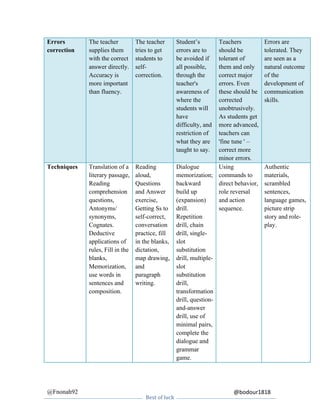
Errors
correction
The teacher
supplies them
with the correct
answer directly.
Accuracy is
more important
than fluency.
The teacher
tries to get
students to
self-
correction.
Student’s
errors are to
be avoided if
all possible,
through the
teacher's
awareness of
where the
students will
have
difficulty, and
restriction of
what they are
taught to say.
Teachers
should be
tolerant of
them and only
correct major
errors. Even
these should be
corrected
unobtrusively.
As students get
more advanced,
teachers can
'fine tune ' –
correct more
minor errors.
Errors are
tolerated. They
are seen as a
natural outcome
of the
development of
communication
skills.
Techniques Translation of a
literary passage,
Reading
comprehension
questions,
Antonyms/
synonyms,
Cognates.
Deductive
applications of
rules, Fill in the
blanks,
Memorization,
use words in
sentences and
composition.
Reading
aloud,
Questions
and Answer
exercise,
Getting Ss to
self-correct,
conversation
practice, fill
in the blanks,
dictation,
map drawing,
and
paragraph
writing.
Dialogue
memorization;
backward
build up
(expansion)
drill.
Repetition
drill, chain
drill, single-
slot
substitution
drill, multiple-
slot
substitution
drill,
transformation
drill, question-
and-answer
drill, use of
minimal pairs,
complete the
dialogue and
grammar
game.
Using
commands to
direct behavior,
role reversal
and action
sequence.
Authentic
materials,
scrambled
sentences,
language games,
picture strip
story and role-
play.

TEFL

  • 1.
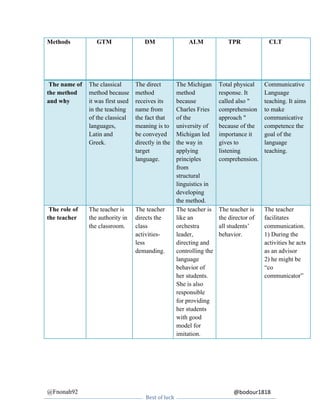
    @Fnonah92! Best%of%luck! !!!!!!!!!!!!!!!!!!!!!!!!!!!!!!!!!!!!!!@bodour1818! ! ! Methods GTMDM ALM TPR CLT The name of the method and why The classical method because it was first used in the teaching of the classical languages, Latin and Greek. The direct method receives its name from the fact that meaning is to be conveyed directly in the target language. The Michigan method because Charles Fries of the university of Michigan led the way in applying principles from structural linguistics in developing the method. Total physical response. It called also " comprehension approach " because of the importance it gives to listening comprehension. Communicative Language teaching. It aims to make communicative competence the goal of the language teaching. The role of the teacher The teacher is the authority in the classroom. The teacher directs the class activities- less demanding. The teacher is like an orchestra leader, directing and controlling the language behavior of her students. She is also responsible for providing her students with good model for imitation. The teacher is the director of all students’ behavior. The teacher facilitates communication. 1) During the activities he acts as an advisor 2) he might be “co communicator”
  • 2.
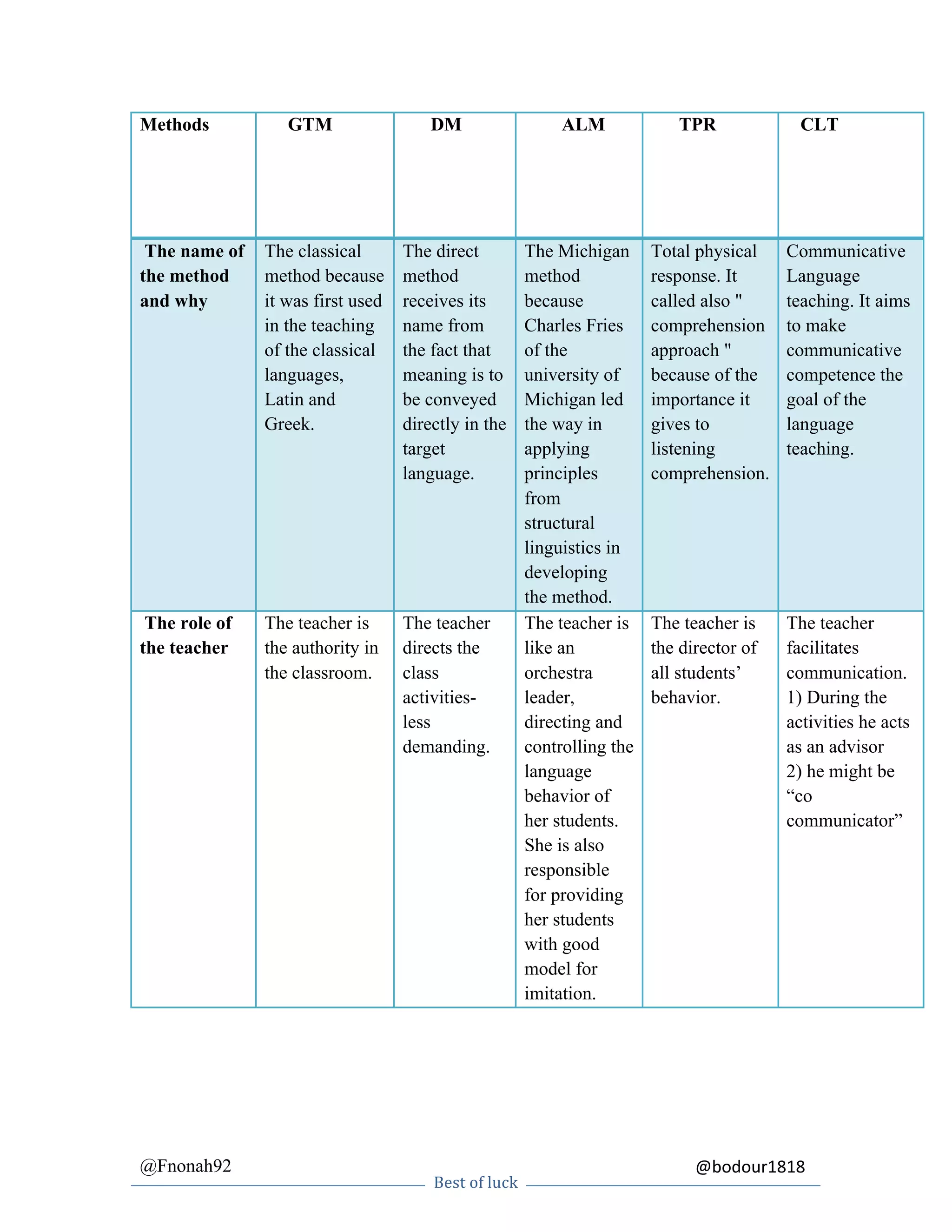
    @Fnonah92! Best%of%luck! !!!!!!!!!!!!!!!!!!!!!!!!!!!!!!!!!!!!!!@bodour1818! ! ! The roleof the students They are passive receiver from the teacher. They do what the teacher says. They are less passive than the GTM. The T and the Ss are more like partners, Students are imitators of the teacher's model or the tapes she supplies of model speakers. They follow the teacher's directions and respond as accurately and as rapidly as possible. The students are imitators of her nonverbal model. There will be a role reversal with individual students directing the teacher and the other students. They are responsible for their own learning. They has a choice not only about what to say, but also how to say it. The nature of the interaction The most of the interaction is from T to Ss and a little interaction from Ss to Ss The interaction goes both ways. There is student-to- student interaction in chain drills or when students take different roles in dialogues, but this interaction is teacher- directed. Most of the interaction is between teacher and students and is initiated by the teacher. The teacher interacts with the whole group of the students and with individual students. Students perform the actions together, watching each other and observer. The interaction goes both ways. The feeling of the students _______ _______ _______ Silent period should be taken into consideration. Teacher should By learning to communicate, Ss will be motivated to study another
  • 3.
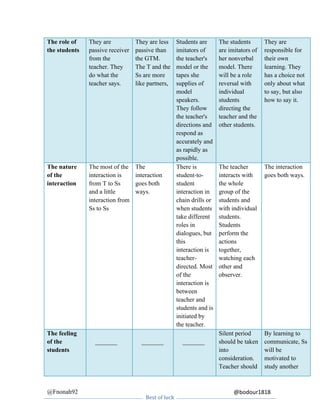
    @Fnonah92! Best%of%luck! !!!!!!!!!!!!!!!!!!!!!!!!!!!!!!!!!!!!!!@bodour1818! ! ! not forcethe Ss to speak and when they begin speaking, perfection should not be necessary. language, Ss security is enhances and they can express their individuality. Grammar Deductive Inductively Inductive (Inductive) They teach them grammar by imperatives The Ss learn grammar from the function, situational context and the roles of the interlocutors. The role of the students’ L1 The interactions mostly used in L1 L1 should not be used in the classroom. L2 is used in the classroom, not the student native language (L1). TPR is usually introduced in the students' native language. After the introduction, rarely would the native language be used. Meaning is made clear through body movements. L2 is used all the time but if it helps the communication, then L1 can be used. The evaluation Written tests (Translate, answer target questions, apply grammar rule) Oral and written skills. Discrete point, that is, each question should focus on one point of the language at a time. By observing their students' actions. Formal evaluation can be conducted. The teacher evaluates the students’ accuracy and fluency. She he can use formal evaluation.
  • 4.
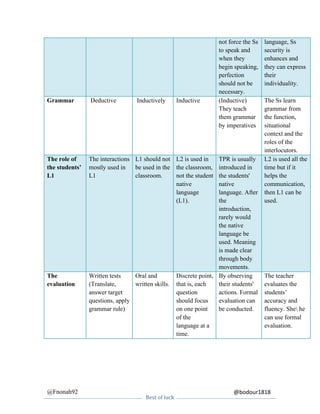
    @Fnonah92! Best%of%luck! !!!!!!!!!!!!!!!!!!!!!!!!!!!!!!!!!!!!!!@bodour1818! ! ! Errors correction The teacher suppliesthem with the correct answer directly. Accuracy is more important than fluency. The teacher tries to get students to self- correction. Student’s errors are to be avoided if all possible, through the teacher's awareness of where the students will have difficulty, and restriction of what they are taught to say. Teachers should be tolerant of them and only correct major errors. Even these should be corrected unobtrusively. As students get more advanced, teachers can 'fine tune ' – correct more minor errors. Errors are tolerated. They are seen as a natural outcome of the development of communication skills. Techniques Translation of a literary passage, Reading comprehension questions, Antonyms/ synonyms, Cognates. Deductive applications of rules, Fill in the blanks, Memorization, use words in sentences and composition. Reading aloud, Questions and Answer exercise, Getting Ss to self-correct, conversation practice, fill in the blanks, dictation, map drawing, and paragraph writing. Dialogue memorization; backward build up (expansion) drill. Repetition drill, chain drill, single- slot substitution drill, multiple- slot substitution drill, transformation drill, question- and-answer drill, use of minimal pairs, complete the dialogue and grammar game. Using commands to direct behavior, role reversal and action sequence. Authentic materials, scrambled sentences, language games, picture strip story and role- play.