December 28, 2015
Anadolu University Eskişehir
When two or more languages are spoken in a
country, how is the decision made?
Government, legal and educational bodies
have to plan which one to be used for official
business.
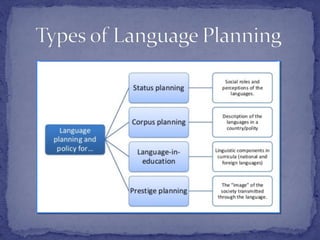
Language planning
is all conscious efforts that aim at changing the
linguistic behavior of a speech community.
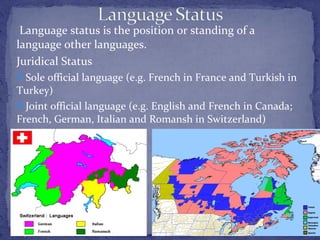
Language status is the position or standing of a
language other languages.
Juridical Status
Sole official language (e.g. French in France and Turkish in
Turkey)
Joint official language (e.g. English and French in Canada;
French, German, Italian and Romansh in Switzerland)
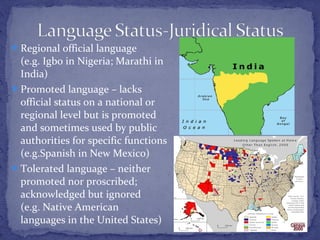
Regional official language
(e.g. Igbo in Nigeria; Marathi in
India)
Promoted language – lacks
official status on a national or
regional level but is promoted
and sometimes used by public
authorities for specific functions
(e.g.Spanish in New Mexico)
Tolerated language – neither
promoted nor proscribed;
acknowledged but ignored
(e.g. Native American
languages in the United States)
Proscribed language – discouraged by official
sanction or restriction (e.g. Macedonian in
Greece)
Codification
Elaboration Implementation
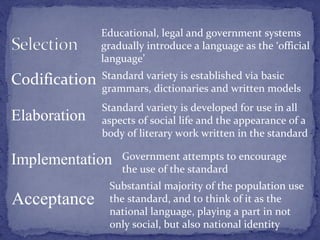
The process of language planning:
Selection
Acceptance
Educational, legal and government systems
gradually introduce a language as the ‘official
language’
Codification Standard variety is established via basic
grammars, dictionaries and written models
Elaboration
Standard variety is developed for use in all
aspects of social life and the appearance of a
body of literary work written in the standard
Implementation Government attempts to encourage
the use of the standard
Acceptance
Substantial majority of the population use
the standard, and to think of it as the
national language, playing a part in not
only social, but also national identity
Language Reform – deliberate change in specific aspects
of language, like orthography, spelling, or grammar, in
order to facilitate use. (Nahir 2003)
Language reform and modern Turkish
After the foundation of the Republic of Turkey and
the script reform, the Turkish Language
Association (TDK) was established in 1932 with the aim
of conducting research on Turkish. One of the tasks of
the newly established association was to initiate
a language reform to replace words of Arabic and
Persian origin with Turkish equivalents.
While the generations born before the 1940s tend to
use the older terms of Arabic or Persian origin, the
younger generations favor new expressions.
Atatürk himself, in his lengthy speech to the
new Parliament in 1927, used a style of Ottoman
which sounded so alien to later listeners that it had to
be "translated" three times into modern Turkish: first
in 1963, again in 1986, and most recently in 1995.
TDK
Banning the usage of imported words in the press, the
association succeeded in removing several hundred
foreign words from the language. While most of the
words introduced to the language by the TDK were
newly derived from Turkic roots, it also opted for
reviving Old Turkish words which had not been used
for centuries.
In 2005, 93% of the population of Turkey were native speakers
of Turkish, about 67 million at the time, with Kurdish making
up the biggest minority. However, most linguistic minorities in
Turkey are bilingual, speaking Turkish with native-like
fluency.
The past few decades have seen the continuing work
of the TDK to coin new Turkish words to express new
concepts and technologies as they enter the language,
mostly from English. Many of these new words
technology terms have received widespread
acceptance. However, the TDK is occasionally
criticized for coining words which sound artificial.
Dejenerasyon: Yozlaşma, Depresyon: Çökkünlük,
Deterjan: Kirgideren, Endoskop: İçgöreç,
Migren: Yarım Baş Ağrısı, Nüks: Depreşme,
Refleks: Tepke, Halusinasyon: Varsanım,
Akut: İvegen, Kronik: Süreğen, Radyoaktif: Işınetkin,
Nazal: Burundan, Makyöz: Düzgüncü-Yüzyapan,
Grip: Paçavra Hastalığı, Kürtaj: Kazıma,
Epilasyon: Kılsızlaştırma, Traş Bıçağı: Kılkeser,
Prospektüs: Tanıtmalık, Mazoşist: Özezer,
Anestezi: Uyuşturum

Language planning

  • 1.
    December 28, 2015 AnadoluUniversity Eskişehir
  • 2.
    When two ormore languages are spoken in a country, how is the decision made? Government, legal and educational bodies have to plan which one to be used for official business.
  • 3.
    Language planning is allconscious efforts that aim at changing the linguistic behavior of a speech community.
  • 4.
    Language status isthe position or standing of a language other languages. Juridical Status Sole official language (e.g. French in France and Turkish in Turkey) Joint official language (e.g. English and French in Canada; French, German, Italian and Romansh in Switzerland)
  • 5.
    Regional official language (e.g.Igbo in Nigeria; Marathi in India) Promoted language – lacks official status on a national or regional level but is promoted and sometimes used by public authorities for specific functions (e.g.Spanish in New Mexico) Tolerated language – neither promoted nor proscribed; acknowledged but ignored (e.g. Native American languages in the United States)
  • 6.
    Proscribed language –discouraged by official sanction or restriction (e.g. Macedonian in Greece)
  • 8.
    Codification Elaboration Implementation The processof language planning: Selection Acceptance
  • 9.
    Educational, legal andgovernment systems gradually introduce a language as the ‘official language’ Codification Standard variety is established via basic grammars, dictionaries and written models Elaboration Standard variety is developed for use in all aspects of social life and the appearance of a body of literary work written in the standard Implementation Government attempts to encourage the use of the standard Acceptance Substantial majority of the population use the standard, and to think of it as the national language, playing a part in not only social, but also national identity
  • 10.
    Language Reform –deliberate change in specific aspects of language, like orthography, spelling, or grammar, in order to facilitate use. (Nahir 2003) Language reform and modern Turkish After the foundation of the Republic of Turkey and the script reform, the Turkish Language Association (TDK) was established in 1932 with the aim of conducting research on Turkish. One of the tasks of the newly established association was to initiate a language reform to replace words of Arabic and Persian origin with Turkish equivalents.
  • 11.
    While the generationsborn before the 1940s tend to use the older terms of Arabic or Persian origin, the younger generations favor new expressions. Atatürk himself, in his lengthy speech to the new Parliament in 1927, used a style of Ottoman which sounded so alien to later listeners that it had to be "translated" three times into modern Turkish: first in 1963, again in 1986, and most recently in 1995.
  • 12.
    TDK Banning the usageof imported words in the press, the association succeeded in removing several hundred foreign words from the language. While most of the words introduced to the language by the TDK were newly derived from Turkic roots, it also opted for reviving Old Turkish words which had not been used for centuries.
  • 13.
    In 2005, 93%of the population of Turkey were native speakers of Turkish, about 67 million at the time, with Kurdish making up the biggest minority. However, most linguistic minorities in Turkey are bilingual, speaking Turkish with native-like fluency.
  • 14.
    The past fewdecades have seen the continuing work of the TDK to coin new Turkish words to express new concepts and technologies as they enter the language, mostly from English. Many of these new words technology terms have received widespread acceptance. However, the TDK is occasionally criticized for coining words which sound artificial.
  • 15.
    Dejenerasyon: Yozlaşma, Depresyon:Çökkünlük, Deterjan: Kirgideren, Endoskop: İçgöreç, Migren: Yarım Baş Ağrısı, Nüks: Depreşme, Refleks: Tepke, Halusinasyon: Varsanım, Akut: İvegen, Kronik: Süreğen, Radyoaktif: Işınetkin, Nazal: Burundan, Makyöz: Düzgüncü-Yüzyapan, Grip: Paçavra Hastalığı, Kürtaj: Kazıma, Epilasyon: Kılsızlaştırma, Traş Bıçağı: Kılkeser, Prospektüs: Tanıtmalık, Mazoşist: Özezer, Anestezi: Uyuşturum