Introduction
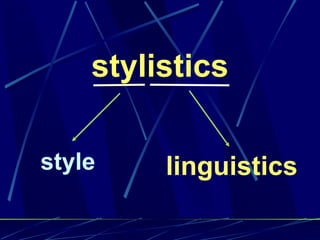
stylistics style linguistics
“ Take an egg, and make a  perforation  in the base and a  corresponding  one in the  apex . And then, apply the lips to the  aperture , and by  frocibly inhaling  the breath, the shell is entirely  discharged  of its  contents. ”
“ When I was a  gal , they made a  hole  in each  end  and  sucked . ”
I. Concepts of Style A person ’ s  distinctive language habits, or the set of individual characteristics of language use e.g. Hemingway ’ s style Henry James ’ s style Mark Twain ’ s style
2. Some or all of the language habits shared by  a group of people  at one time,or over a period of time. e.g. Elizabethan style the style of legal document the style of news reporting
3. A characteristic of  “ good ”  or  “ beautiful ”   literary writings.  e.g. ornate style  terse style  plain style
Definition of style  Manner indicating  prominent  linguistic features, devices or patterns,  most (or least) frequently  occur in a particular text of a  particular variety  of language.
II. Concepts of Stylistics   1.  Stylistics is a discipline that studies the ways in which language is used; it is a discipline that studies the styles of language in use.
2. Stylistics is a branch of linguistics which  applies the theory and methodology of modern linguistics to the study of style.
Definition of Stylistics Stylistics is a branch of linguistics which studies style in a  scientific and systematic  way concerning the manners / linguistic features of different  varieties of language  at  different levels .
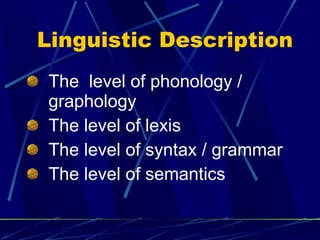
Linguistic Description The  level of phonology / graphology The level of lexis  The level of syntax / grammar The level of semantics
1. The level of phonology / graphology Phonology is the study of the rules for the organization of  the sound systems  of a language. Graphology is the study of  the writing system  of a language.
2. The level of lexis Lexicology  studies the choice of specific  lexical items  in a text, their  distribution  in relation to one another, and their  meanings . 3. The level of syntax / grammar Syntax  refers to rules for ordering and connecitng words into sentences.
4. The level of semantics Semantics  studies the overall meaning of a text, the meaning derived from  the way sentences / utterances are used and the way they are related to the context in which they are used / uttered and some rhetoric devices.
Literary Stylistics  General Stylistics III. The Scope of Studies
Literary stylistics :  concentrating on the unique features of various literary works,such as poem, novel, prose, drama … General stylistics:  concentrating on the general features of various types of language use, including  literary discourses  and  other practical styles
General stylistics Genres:  news reports, advertisements, public speeches, scientific treatises, leagal documents and other practical styles … Attitudes:  formal and informal language Media of communication:  spoken English, written English, e-discourse Regions:  British English, American English and other regional dialects Social groups : standard and non-standard language
IV. A brief introduction to the development of stylistics Rhetoric (Aristotle) Beginning (Charles Bally) Development  (L. Spitzer) Flourish ( Investigating English Style)
王佐良《英语文体学引论》 秦秀白《英语文体学入门》 钱瑗《实用文体学教程》  王守仁《英语文体学要略》 申丹《文学文体学与小说翻译》 张德禄《功能文体学》
 
 
V. Stylistics Analysis The stylistics analysis of a text involves the description of a writer ’ s / speaker ’ s  verbal choices. Stylistics does not reflect the views of the individual critic, but an  impersonal, reproducible   ‘ truth ’ .
VI. The Need For Stylistic Study
Stylistic study helps cultivate a sense of appropriateness *  Who speaks what language to whom and when   *  Proper words in proper places make the true definition of a style.    -- Swift
First, a certain style is determined by the characteristics of the  USER  of language, such as  the age, sex, education, socio-regional or ethnic background.
Second, it ’ s related to the characteristics of the  USE  of language in situation: #  role-relationship between addresser and  addressee (degree of intimacy)  #  medium of communication (speech or writing) #  setting: private or public #  purpose for which language is used (to inform, persuade … )
For Example: (1) Dear Sir, I must apologize for the delay in replying to your letter of the 30th of December … (2) Dear Jane, I ’ m terribly sorry not to have got round to writing before now  …
Now allow me to  propose a  toast  to  the friendship between  … Here ’ s to  the health of our friends! Cheers! Bottoms up!
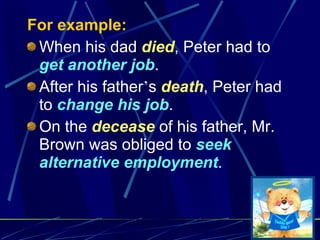
For example: When his dad  died , Peter had to  get another job . After his father ’ s  death , Peter had to  change his job . On the  decease  of his father, Mr. Brown was obliged to  seek alternative employment .
II. Stylistic study sharpens the understanding and appreciation of literary works
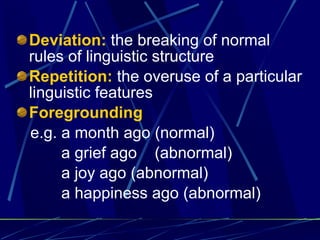
Deviation:  the breaking of normal rules of linguistic structure  Repetition:  the overuse of a particular linguistic features  Foregrounding e.g. a month ago (normal) a grief ago  (abnormal) a joy ago (abnormal) a happiness ago (abnormal)
III. Stylistic study helps achieve adaptation in translation
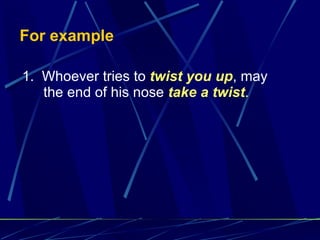
For example 1.  Whoever tries to  twist you up , may the end of his nose  take a twist .
(1) He said to his little son,  “ At that time , I was so  fatigued  after a day ’ s  drudgery  that I found it very hard to  mount  the  kang.  My whole  frame  aching  acutely , I couldn ’ t go to sleep however hard I tried. ” (2) He said to his little son,  “   In those days , I was usually so  done up  after a day ’ s  hard work  that I could hardly  get on  the  kang . As my whole  body  ached  like anything , I simply couldn ’ t get to sleep even I tried to.
3. For example: (1)It has been noted with concern that the stock of books in the library has been declining alarmingly. Students are requested to remind themselves of the rules of the borrowing and returning of books, and to bear in mind the needs of other students. Penalties for overdue book will in the future be strictly enforced. (2) The number of books in the library has been going down. Please make sure you know the rules for borrowing, and don ’ t forget that the library is for everyone ’ s convenience. So from now on, we ’ re going to enforce the rules strictly. You have been warned!
4. For example (1) Although learning  is judged  to require from teachers (and  sometimes indeed it does ), real  instructors  may be found  not so much  in school or in great laboratories  as  in the student ’ s powers of insight.

(2)  We think  we learn from teachers, and  we sometimes do .  But  teachers are not always be found in school or in great laboratories. Sometimes what we learn depends upon our own powers of insight.
(3)  You know , people are always saying they learn from teachers!  Ok, so they do, sometimes.  But what I want to  get across  is this: you don ’ t always find your teachers in schools or in  labs , either.  No sir!  Sometimes you find the teacher right in your own eyes and ears and brains.  That ’ s where it ’ s at!

Thank you for your attention!

Stylistics

  • 1.
  • 2.
  • 3.
    “ Take anegg, and make a perforation in the base and a corresponding one in the apex . And then, apply the lips to the aperture , and by frocibly inhaling the breath, the shell is entirely discharged of its contents. ”
  • 4.
    “ When Iwas a gal , they made a hole in each end and sucked . ”
  • 5.
    I. Concepts ofStyle A person ’ s distinctive language habits, or the set of individual characteristics of language use e.g. Hemingway ’ s style Henry James ’ s style Mark Twain ’ s style
  • 6.
    2. Some orall of the language habits shared by a group of people at one time,or over a period of time. e.g. Elizabethan style the style of legal document the style of news reporting
  • 7.
    3. A characteristicof “ good ” or “ beautiful ” literary writings. e.g. ornate style terse style plain style
  • 8.
    Definition of style Manner indicating prominent linguistic features, devices or patterns, most (or least) frequently occur in a particular text of a particular variety of language.
  • 9.
    II. Concepts ofStylistics 1. Stylistics is a discipline that studies the ways in which language is used; it is a discipline that studies the styles of language in use.
  • 10.
    2. Stylistics isa branch of linguistics which applies the theory and methodology of modern linguistics to the study of style.
  • 11.
    Definition of StylisticsStylistics is a branch of linguistics which studies style in a scientific and systematic way concerning the manners / linguistic features of different varieties of language at different levels .
  • 12.
    Linguistic Description The level of phonology / graphology The level of lexis The level of syntax / grammar The level of semantics
  • 13.
    1. The levelof phonology / graphology Phonology is the study of the rules for the organization of the sound systems of a language. Graphology is the study of the writing system of a language.
  • 14.
    2. The levelof lexis Lexicology studies the choice of specific lexical items in a text, their distribution in relation to one another, and their meanings . 3. The level of syntax / grammar Syntax refers to rules for ordering and connecitng words into sentences.
  • 15.
    4. The levelof semantics Semantics studies the overall meaning of a text, the meaning derived from the way sentences / utterances are used and the way they are related to the context in which they are used / uttered and some rhetoric devices.
  • 16.
    Literary Stylistics General Stylistics III. The Scope of Studies
  • 17.
    Literary stylistics : concentrating on the unique features of various literary works,such as poem, novel, prose, drama … General stylistics: concentrating on the general features of various types of language use, including literary discourses and other practical styles
  • 18.
    General stylistics Genres: news reports, advertisements, public speeches, scientific treatises, leagal documents and other practical styles … Attitudes: formal and informal language Media of communication: spoken English, written English, e-discourse Regions: British English, American English and other regional dialects Social groups : standard and non-standard language
  • 19.
    IV. A briefintroduction to the development of stylistics Rhetoric (Aristotle) Beginning (Charles Bally) Development (L. Spitzer) Flourish ( Investigating English Style)
  • 20.
    王佐良《英语文体学引论》 秦秀白《英语文体学入门》 钱瑗《实用文体学教程》 王守仁《英语文体学要略》 申丹《文学文体学与小说翻译》 张德禄《功能文体学》
  • 21.
  • 22.
  • 23.
    V. Stylistics AnalysisThe stylistics analysis of a text involves the description of a writer ’ s / speaker ’ s verbal choices. Stylistics does not reflect the views of the individual critic, but an impersonal, reproducible ‘ truth ’ .
  • 24.
    VI. The NeedFor Stylistic Study
  • 25.
    Stylistic study helpscultivate a sense of appropriateness * Who speaks what language to whom and when * Proper words in proper places make the true definition of a style. -- Swift
  • 26.
    First, a certainstyle is determined by the characteristics of the USER of language, such as the age, sex, education, socio-regional or ethnic background.
  • 27.
    Second, it ’s related to the characteristics of the USE of language in situation: # role-relationship between addresser and addressee (degree of intimacy) # medium of communication (speech or writing) # setting: private or public # purpose for which language is used (to inform, persuade … )
  • 28.
    For Example: (1)Dear Sir, I must apologize for the delay in replying to your letter of the 30th of December … (2) Dear Jane, I ’ m terribly sorry not to have got round to writing before now …
  • 29.
    Now allow meto propose a toast to the friendship between … Here ’ s to the health of our friends! Cheers! Bottoms up!
  • 30.
    For example: Whenhis dad died , Peter had to get another job . After his father ’ s death , Peter had to change his job . On the decease of his father, Mr. Brown was obliged to seek alternative employment .
  • 31.
    II. Stylistic studysharpens the understanding and appreciation of literary works
  • 32.
    Deviation: thebreaking of normal rules of linguistic structure Repetition: the overuse of a particular linguistic features Foregrounding e.g. a month ago (normal) a grief ago (abnormal) a joy ago (abnormal) a happiness ago (abnormal)
  • 33.
    III. Stylistic studyhelps achieve adaptation in translation
  • 34.
    For example 1. Whoever tries to twist you up , may the end of his nose take a twist .
  • 35.
    (1) He saidto his little son, “ At that time , I was so fatigued after a day ’ s drudgery that I found it very hard to mount the kang. My whole frame aching acutely , I couldn ’ t go to sleep however hard I tried. ” (2) He said to his little son, “ In those days , I was usually so done up after a day ’ s hard work that I could hardly get on the kang . As my whole body ached like anything , I simply couldn ’ t get to sleep even I tried to.
  • 36.
    3. For example:(1)It has been noted with concern that the stock of books in the library has been declining alarmingly. Students are requested to remind themselves of the rules of the borrowing and returning of books, and to bear in mind the needs of other students. Penalties for overdue book will in the future be strictly enforced. (2) The number of books in the library has been going down. Please make sure you know the rules for borrowing, and don ’ t forget that the library is for everyone ’ s convenience. So from now on, we ’ re going to enforce the rules strictly. You have been warned!
  • 37.
    4. For example(1) Although learning is judged to require from teachers (and sometimes indeed it does ), real instructors may be found not so much in school or in great laboratories as in the student ’ s powers of insight.
  • 38.
    (2) Wethink we learn from teachers, and we sometimes do . But teachers are not always be found in school or in great laboratories. Sometimes what we learn depends upon our own powers of insight.
  • 39.
    (3) Youknow , people are always saying they learn from teachers! Ok, so they do, sometimes. But what I want to get across is this: you don ’ t always find your teachers in schools or in labs , either. No sir! Sometimes you find the teacher right in your own eyes and ears and brains. That ’ s where it ’ s at!
  • 40.
    Thank you foryour attention!