PPCP’s and Their Impact
on Our Environment
By Cori LeBerth
Introduction
• North America = Greatest producers and consumers of
Pharmaceuticals and Personal Care Products (PPCPs)
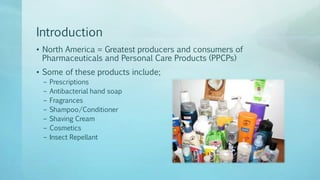
• Some of these products include;
– Prescriptions
– Antibacterial hand soap
– Fragrances
– Shampoo/Conditioner
– Shaving Cream
– Cosmetics
– Insect Repellant
Introduction
• Traces of pharmaceuticals in waste water were reportedly found
as far back as the 1960’s and 1970’s
• 50 to 90% of medical substances that people ingest are excreted
through urine and feces.
• Most substances remain unchanged or become metabolites,
which can be even more toxic
• The effects of PPCP’s are not well known in the aquatic
environment
• Waste Water Treatment Plants are unable to remove most PPCP’s
Introduction
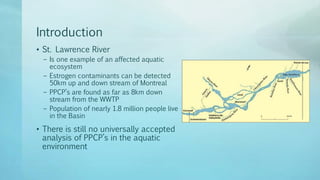
• St. Lawrence River
– Is one example of an affected aquatic
ecosystem
– Estrogen contaminants can be detected
50km up and down stream of Montreal
– PPCP’s are found as far as 8km down
stream from the WWTP
– Population of nearly 1.8 million people live
in the Basin
• There is still no universally accepted
analysis of PPCP’s in the aquatic
environment
Prescription Drugs
• Chemical properties of pharmaceuticals
allow them to bioaccumulate in the aquatic
environment
• Many chemicals act as endocrine
disruptors
• Endocrine disruptors affect reproduction
and development of aquatic organisms
• Metabolites of pharmaceuticals can be
more toxic than the original compound
• Find their way into the ecosystem through
human waste or disposal
Endocrine Disruptors
• Endocrine’s regulate normal function of all organ systems
• Disruptors mimic or block the natural endogenous hormones
• Small disruptions to normal endocrine function has lasting
effects
• Effects include
– Disruption of natural hormonal balance
– Masculinization of females/Feminization of males
– Reduction of fertility
– Neurological impairments
– Birth defects
• Many PPCP’s and synthetic chemicals act as endocrine disruptors
Antibiotics
• Ciprofloxacin, Sulfamethazole, Trimethoprim, Amoxicillin, etc.
• Found in WWTP effluent due to incomplete metabolization
• Ciprofloxacin
– Second generation Fluoroquinolone
– Negatively affects good bacteria like leaf litter bacteria
– Aquatic invertebrates obtain 20-40% of their carbon from bacteria
– Leaf litter processing is important for carbon cycling in aquatic ecosystems
– Disrupting the food supply of lower trophic levels (i.e. killing bacteria) affects
the functioning of upper trophic levels
• Some scientists worry that overexposure to antibiotics will cause
super immune bacteria
• This is a threat to the whole biosphere
Selective Serotonin Reuptake Inhibitors (SSRI’s)
• SSRI’s are commonly known as antidepressants
• Increases serotonin levels by binding to postsynaptic receptors
• Weak affinity as a dopamine transporter
– Dopamine is an amine that acts as a neurotransmitter
– Inadequate levels of dopamine causes neurological disorders including
ADHD, Parkinson’s Disease, and Schizophrenia
• Common SSRI’s include
– Fluoxetine (Prozac)
– Sertraline (Zoloft)
– Venlafaxine (Effexor)
– Citalopram (Celexa)
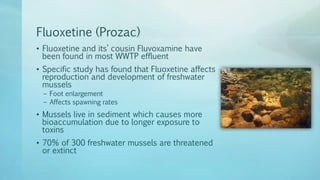
Fluoxetine (Prozac)
• Fluoxetine and its’ cousin Fluvoxamine have
been found in most WWTP effluent
• Specific study has found that Fluoxetine affects
reproduction and development of freshwater
mussels
– Foot enlargement
– Affects spawning rates
• Mussels live in sediment which causes more
bioaccumulation due to longer exposure to
toxins
• 70% of 300 freshwater mussels are threatened
or extinct
Venlafaxine (Effexor) and Citalopram (Celexa)
• Impacts aquatic life
– Increases phototaxis/geotaxis in cladocerans which increases their
predation
– Affects reproduction rates of amphipods
– Striped Bass exposed to SSRI’s have reduced ability to capture prey
• Causes Snails to detach from substrate
– Detachment is controlled through dopaminergic neurons
– Mortality by predation, desiccation, transport to unsuitable habitat, and
inability to feed due to detachment from substrate
– Snails have broad geographic distribution therefore there’s a high potential to
affect a large population
Venlafaxine (Effexor) and Citalopram (Celexa)
• Found to occur in wastewater at concentrations as much as 10
times greater than fluoxetine
• Lowest effective concentration (LOEC) was 313 pg/L (venlafaxine)
which is 7 thousand times less than the concentration found in
wastewater
• LOEC was 405 pg/L (citalopram) which was five times lower than
the average concentration found in wastewater
• They have the lowest LOEC’s of any SSRI
• Extremely low concentrations of these medications have a huge
impact on the aquatic environment
Pharmaceuticals and Personal Care Products
• Compounds from each category have been found in fish blood
and tissue
• Fluoxetine, its’ metabolite norfluoxetine, and sertraline have been
found in fish tissue
• Most sources of PPCP’s are from point sources such as WWTP
effluent
• Aquatic organisms are continuously exposed to these chemicals
from WWTP effluents
– Causes bioaccumulation in organisms due to length of exposure
Personal Care Products
• Triclosan (TCS)
– Chemical found in antibacterial soap
– Not completely removed from WWTP
– Stable compound and is readily bioavailable to organisms
– Bioaccumulation depends on concentration and exposure length
– Molecular structure resembles nonsteroidal estrogens
– In tests, TCS reduced testosterone production and disrupts other
steroidogenic processes
– Found to be an endocrine disrupting agent
– Detected in human milk, plasma, and urine indicating bioaccumulation
– Found to result in changes to fin length and masculination of fish fry
– Important to study its affects on the environment due to its extensive use
and occurrence in WWTP effluent
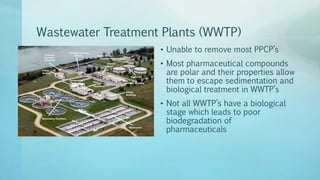
Wastewater Treatment Plants (WWTP)
• Unable to remove most PPCP’s
• Most pharmaceutical compounds
are polar and their properties allow
them to escape sedimentation and
biological treatment in WWTP’s
• Not all WWTP’s have a biological
stage which leads to poor
biodegradation of
pharmaceuticals
Effects on Ground Water
• Pharmaceuticals from human waste can be found in sewage,
septic systems, and septic leach fields
• Septic effluent can potentially leach into underlying aquifers
depending on soil structure
• 12 of 22 chemicals studied were found in septic effluent in a
Missoula, MT high school
• Some pharmaceuticals were found in unconfined aquifers which
could then be transported by the ground water in measurable
concentrations
Potential Solutions
• Ozone (O3) Oxidation
– Found to be an effective disinfectant and powerful oxidizer
– Reacts with organic contaminants through direct reaction or through
formation of free radicals
– Studies have shown that 90% of PPCP’s found in effluent was reduced to an
almost undetectable level
– 2 minutes of Ozone contact time was sufficient to remove the majority of
contaminants
– Viable cost effective option to treat waste water over current methods
– Drawbacks however-most ozone doses do not cause mineralization therefore
by products will be generated
– By-products were found to no longer be estrogenic
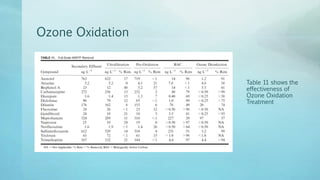
Ozone Oxidation
Table 11 shows the
effectiveness of
Ozone Oxidation
Treatment
Potential Solutions
• Pharmaceutical take back programs
– Allow consumers to dispose of their PPCP’s in an
environmentally friendly way
– Many communities offer this service but mostly
in urban areas
– Possibly have medical clinics offer this service in
order to promote proper disposal in the easiest
way possible for the consumer
– http://dontrushtoflush.org/
References
• Bringolf, R.B. et al. 2010. Environmental Occurrence and Reproductive Effects of the Pharmaceutical Fluoxetine in Native
Freshwater Mussels. Environmental Toxicology and Chemistry. 29-6: 1311-1318.
• Fong, P.P. and C.M. Hoy. 2012. Antidepressants (Venlafaxine and Citalopram) cause foot detachment from the substrate
in freshwater snails at environmentally relevant concentrations. Marine and Freshwater Behavior and Physiology.
45-2: 145-153.
• Godfrey, Emily et al. 2007. Pharmaceuticals in On-Site Sewage Effluent and Ground Water, Western Montana. Ground
Water. 45-3: 263-271.
• Maul, J.D. et al. 2006. Effects of the Anitbiotic Ciprofloxacin on Stream Microbial Communities and Detritivorous
Macroinvertebrates. Environmental Toxicology and Chemistry. 25-6: 1598-1606.
• Ramirez, A.J. et al. 2009. Occurrence of Pharmaceuticals and Personal Care Products in Fish: Results of a National
Pilot Study in the United States. Environmental Toxicology and Chemistry. 28-12: 2587-2597.
• Raut, S.A. et al. 2010. Triclosan has Endocrine-Disrupting Effects in Male Western Mosquitofish Gambusia affinis.
Environmental Toxicology and Chemistry. 29-6: 1287-1291.
• Robinson, Isabelle et al. 2007. Trends in the Detection of Pharmaceutical Products and Their Impact and Mitigation in
Water and Wastewater in North America. Analytical and Bioanalytical Chemistry. 387: 1143-1151.
• Snyder, S.A. et al. 2006. Ozone Oxidation of Endocrine Disruptors and Pharmaceuticals in Surface Water and
Wastewater. Ozone: Science and Engineering. 28: 445-460.

PPCP’s and Their Impact on Our Environment

  • 1.
    PPCP’s and TheirImpact on Our Environment By Cori LeBerth
  • 2.
    Introduction • North America= Greatest producers and consumers of Pharmaceuticals and Personal Care Products (PPCPs) • Some of these products include; – Prescriptions – Antibacterial hand soap – Fragrances – Shampoo/Conditioner – Shaving Cream – Cosmetics – Insect Repellant
  • 3.
    Introduction • Traces ofpharmaceuticals in waste water were reportedly found as far back as the 1960’s and 1970’s • 50 to 90% of medical substances that people ingest are excreted through urine and feces. • Most substances remain unchanged or become metabolites, which can be even more toxic • The effects of PPCP’s are not well known in the aquatic environment • Waste Water Treatment Plants are unable to remove most PPCP’s
  • 4.
    Introduction • St. LawrenceRiver – Is one example of an affected aquatic ecosystem – Estrogen contaminants can be detected 50km up and down stream of Montreal – PPCP’s are found as far as 8km down stream from the WWTP – Population of nearly 1.8 million people live in the Basin • There is still no universally accepted analysis of PPCP’s in the aquatic environment
  • 5.
    Prescription Drugs • Chemicalproperties of pharmaceuticals allow them to bioaccumulate in the aquatic environment • Many chemicals act as endocrine disruptors • Endocrine disruptors affect reproduction and development of aquatic organisms • Metabolites of pharmaceuticals can be more toxic than the original compound • Find their way into the ecosystem through human waste or disposal
  • 6.
    Endocrine Disruptors • Endocrine’sregulate normal function of all organ systems • Disruptors mimic or block the natural endogenous hormones • Small disruptions to normal endocrine function has lasting effects • Effects include – Disruption of natural hormonal balance – Masculinization of females/Feminization of males – Reduction of fertility – Neurological impairments – Birth defects • Many PPCP’s and synthetic chemicals act as endocrine disruptors
  • 7.
    Antibiotics • Ciprofloxacin, Sulfamethazole,Trimethoprim, Amoxicillin, etc. • Found in WWTP effluent due to incomplete metabolization • Ciprofloxacin – Second generation Fluoroquinolone – Negatively affects good bacteria like leaf litter bacteria – Aquatic invertebrates obtain 20-40% of their carbon from bacteria – Leaf litter processing is important for carbon cycling in aquatic ecosystems – Disrupting the food supply of lower trophic levels (i.e. killing bacteria) affects the functioning of upper trophic levels • Some scientists worry that overexposure to antibiotics will cause super immune bacteria • This is a threat to the whole biosphere
  • 8.
    Selective Serotonin ReuptakeInhibitors (SSRI’s) • SSRI’s are commonly known as antidepressants • Increases serotonin levels by binding to postsynaptic receptors • Weak affinity as a dopamine transporter – Dopamine is an amine that acts as a neurotransmitter – Inadequate levels of dopamine causes neurological disorders including ADHD, Parkinson’s Disease, and Schizophrenia • Common SSRI’s include – Fluoxetine (Prozac) – Sertraline (Zoloft) – Venlafaxine (Effexor) – Citalopram (Celexa)
  • 9.
    Fluoxetine (Prozac) • Fluoxetineand its’ cousin Fluvoxamine have been found in most WWTP effluent • Specific study has found that Fluoxetine affects reproduction and development of freshwater mussels – Foot enlargement – Affects spawning rates • Mussels live in sediment which causes more bioaccumulation due to longer exposure to toxins • 70% of 300 freshwater mussels are threatened or extinct
  • 10.
    Venlafaxine (Effexor) andCitalopram (Celexa) • Impacts aquatic life – Increases phototaxis/geotaxis in cladocerans which increases their predation – Affects reproduction rates of amphipods – Striped Bass exposed to SSRI’s have reduced ability to capture prey • Causes Snails to detach from substrate – Detachment is controlled through dopaminergic neurons – Mortality by predation, desiccation, transport to unsuitable habitat, and inability to feed due to detachment from substrate – Snails have broad geographic distribution therefore there’s a high potential to affect a large population
  • 11.
    Venlafaxine (Effexor) andCitalopram (Celexa) • Found to occur in wastewater at concentrations as much as 10 times greater than fluoxetine • Lowest effective concentration (LOEC) was 313 pg/L (venlafaxine) which is 7 thousand times less than the concentration found in wastewater • LOEC was 405 pg/L (citalopram) which was five times lower than the average concentration found in wastewater • They have the lowest LOEC’s of any SSRI • Extremely low concentrations of these medications have a huge impact on the aquatic environment
  • 12.
    Pharmaceuticals and PersonalCare Products • Compounds from each category have been found in fish blood and tissue • Fluoxetine, its’ metabolite norfluoxetine, and sertraline have been found in fish tissue • Most sources of PPCP’s are from point sources such as WWTP effluent • Aquatic organisms are continuously exposed to these chemicals from WWTP effluents – Causes bioaccumulation in organisms due to length of exposure
  • 13.
    Personal Care Products •Triclosan (TCS) – Chemical found in antibacterial soap – Not completely removed from WWTP – Stable compound and is readily bioavailable to organisms – Bioaccumulation depends on concentration and exposure length – Molecular structure resembles nonsteroidal estrogens – In tests, TCS reduced testosterone production and disrupts other steroidogenic processes – Found to be an endocrine disrupting agent – Detected in human milk, plasma, and urine indicating bioaccumulation – Found to result in changes to fin length and masculination of fish fry – Important to study its affects on the environment due to its extensive use and occurrence in WWTP effluent
  • 14.
    Wastewater Treatment Plants(WWTP) • Unable to remove most PPCP’s • Most pharmaceutical compounds are polar and their properties allow them to escape sedimentation and biological treatment in WWTP’s • Not all WWTP’s have a biological stage which leads to poor biodegradation of pharmaceuticals
  • 15.
    Effects on GroundWater • Pharmaceuticals from human waste can be found in sewage, septic systems, and septic leach fields • Septic effluent can potentially leach into underlying aquifers depending on soil structure • 12 of 22 chemicals studied were found in septic effluent in a Missoula, MT high school • Some pharmaceuticals were found in unconfined aquifers which could then be transported by the ground water in measurable concentrations
  • 16.
    Potential Solutions • Ozone(O3) Oxidation – Found to be an effective disinfectant and powerful oxidizer – Reacts with organic contaminants through direct reaction or through formation of free radicals – Studies have shown that 90% of PPCP’s found in effluent was reduced to an almost undetectable level – 2 minutes of Ozone contact time was sufficient to remove the majority of contaminants – Viable cost effective option to treat waste water over current methods – Drawbacks however-most ozone doses do not cause mineralization therefore by products will be generated – By-products were found to no longer be estrogenic
  • 17.
    Ozone Oxidation Table 11shows the effectiveness of Ozone Oxidation Treatment
  • 18.
    Potential Solutions • Pharmaceuticaltake back programs – Allow consumers to dispose of their PPCP’s in an environmentally friendly way – Many communities offer this service but mostly in urban areas – Possibly have medical clinics offer this service in order to promote proper disposal in the easiest way possible for the consumer – http://dontrushtoflush.org/
  • 19.
    References • Bringolf, R.B.et al. 2010. Environmental Occurrence and Reproductive Effects of the Pharmaceutical Fluoxetine in Native Freshwater Mussels. Environmental Toxicology and Chemistry. 29-6: 1311-1318. • Fong, P.P. and C.M. Hoy. 2012. Antidepressants (Venlafaxine and Citalopram) cause foot detachment from the substrate in freshwater snails at environmentally relevant concentrations. Marine and Freshwater Behavior and Physiology. 45-2: 145-153. • Godfrey, Emily et al. 2007. Pharmaceuticals in On-Site Sewage Effluent and Ground Water, Western Montana. Ground Water. 45-3: 263-271. • Maul, J.D. et al. 2006. Effects of the Anitbiotic Ciprofloxacin on Stream Microbial Communities and Detritivorous Macroinvertebrates. Environmental Toxicology and Chemistry. 25-6: 1598-1606. • Ramirez, A.J. et al. 2009. Occurrence of Pharmaceuticals and Personal Care Products in Fish: Results of a National Pilot Study in the United States. Environmental Toxicology and Chemistry. 28-12: 2587-2597. • Raut, S.A. et al. 2010. Triclosan has Endocrine-Disrupting Effects in Male Western Mosquitofish Gambusia affinis. Environmental Toxicology and Chemistry. 29-6: 1287-1291. • Robinson, Isabelle et al. 2007. Trends in the Detection of Pharmaceutical Products and Their Impact and Mitigation in Water and Wastewater in North America. Analytical and Bioanalytical Chemistry. 387: 1143-1151. • Snyder, S.A. et al. 2006. Ozone Oxidation of Endocrine Disruptors and Pharmaceuticals in Surface Water and Wastewater. Ozone: Science and Engineering. 28: 445-460.