Water Quality Monitoring
     Using Aquatic
  Macroinvertebrates


                 Presented by;

                 Surendra Bam
Presentation Outline
 Introduction
 Benthic Macroinvertebrates
 Macroinvertebrates as Indicators
 Benthic Index of Biotic Integrity (I-IBI)
 Macroinvertebrates Sampling- The
  Basics
 Common Macroinvertebrates
 References
Introduction
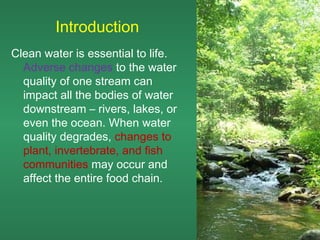
Clean water is essential to life.
  Adverse changes to the water
  quality of one stream can
  impact all the bodies of water
  downstream – rivers, lakes, or
  even the ocean. When water
  quality degrades, changes to
  plant, invertebrate, and fish
  communities may occur and
  affect the entire food chain.
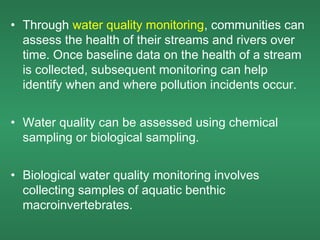
• Through water quality monitoring, communities can
  assess the health of their streams and rivers over
  time. Once baseline data on the health of a stream
  is collected, subsequent monitoring can help
  identify when and where pollution incidents occur.


• Water quality can be assessed using chemical
  sampling or biological sampling.


• Biological water quality monitoring involves
  collecting samples of aquatic benthic
  macroinvertebrates.
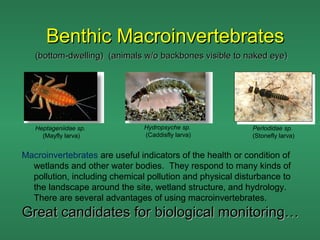
Benthic Macroinvertebrates
   (bottom-dwelling) (animals w/o backbones visible to naked eye)


   Heptageniidae sp.           Hydropsyche sp.              Perlodidae sp.
     (Mayfly larva)            (Caddisfly larva)            (Stonefly larva)


Macroinvertebrates are useful indicators of the health or condition of
  wetlands and other water bodies. They respond to many kinds of
  pollution, including chemical pollution and physical disturbance to
  the landscape around the site, wetland structure, and hydrology.
  There are several advantages of using macroinvertebrates.
Great candidates for biological monitoring…
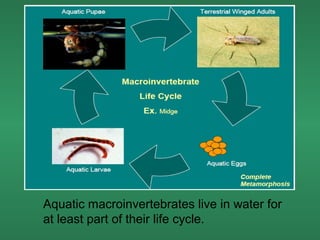
Aquatic macroinvertebrates live in water for
at least part of their life cycle.
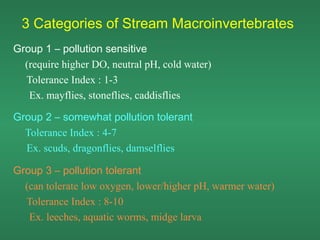
3 Categories of Stream Macroinvertebrates
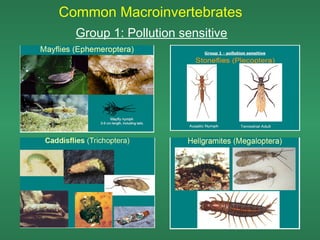
Group 1 – pollution sensitive
  (require higher DO, neutral pH, cold water)
  Tolerance Index : 1-3
   Ex. mayflies, stoneflies, caddisflies

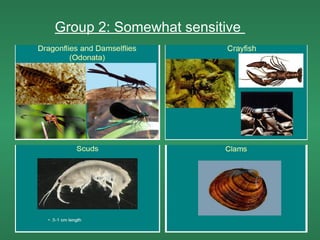
Group 2 – somewhat pollution tolerant
  Tolerance Index : 4-7
  Ex. scuds, dragonflies, damselflies

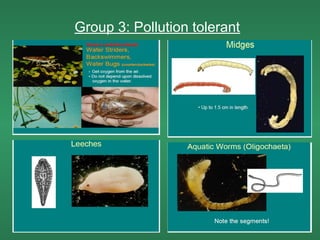
Group 3 – pollution tolerant
  (can tolerate low oxygen, lower/higher pH, warmer water)
  Tolerance Index : 8-10
   Ex. leeches, aquatic worms, midge larva
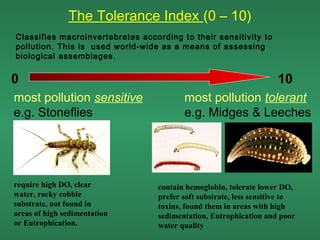
The Tolerance Index (0 – 10)
Classifies macroinvertebrates according to their sensitivity to
pollution. This is used world-wide as a means of assessing
biological assemblages .


0                                                                    10
most pollution sensitive                 most pollution tolerant
e.g. Stoneflies                          e.g. Midges & Leeches


require high DO, clear            contain hemoglobin, tolerate lower DO,
water, rocky cobble               prefer soft substrate, less sensitive to
substrate, not found in           toxins, found them in areas with high
areas of high sedimentation       sedimentation, Eutrophication and poor
or Eutrophication.                water quality
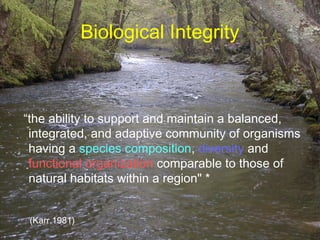
Biological Integrity


“the ability to support and maintain a balanced,
 integrated, and adaptive community of organisms
 having a species composition, diversity and
 functional organization comparable to those of
 natural habitats within a region" *


*
 (Karr,1981)
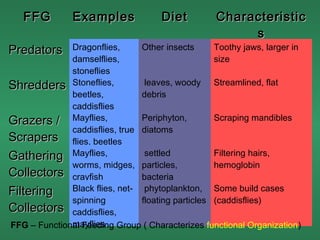
FFG          Examples              Diet         Characteristic
                                                        s
Predators     Dragonflies,      Other insects      Toothy jaws, larger in
              damselflies,                         size
              stoneflies
Shredders Stoneflies,            leaves, woody Streamlined, flat
              beetles,          debris
              caddisflies
Grazers / Mayflies,             Periphyton,        Scraping mandibles
              caddisflies, true diatoms
Scrapers flies, beetles
Gathering Mayflies,              settled           Filtering hairs,
              worms, midges, particles,            hemoglobin
Collectors crayfish             bacteria
Filtering     Black flies, net- phytoplankton, Some build cases
              spinning          floating particles (caddisflies)
Collectors caddisflies,
              mayflies
FFG – Functional Feeding Group ( Characterizes functional Organization)
Benthic Index of Biotic Integrity
                                  (B-IBI)
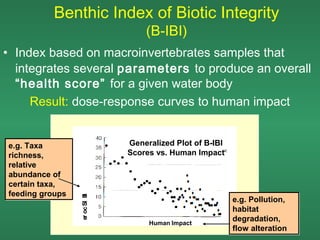
• Index based on macroinvertebrates samples that
  integrates several parameters to produce an overall
  “health score” for a given water body
     Result: dose-response curves to human impact


e.g. Taxa                     Generalized Plot of B-IBI
richness,                     Scores vs. Human Impact
relative
abundance of
certain taxa,
feeding groups
                 er oc SI B
                          I


                                                          e.g. Pollution,
                                                          habitat
                                   Human Impact
                                                          degradation,
                                                          flow alteration
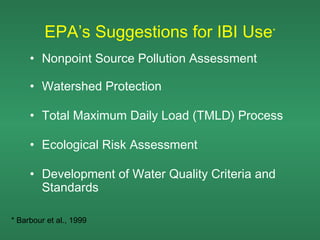
EPA’s Suggestions for IBI Use*
     • Nonpoint Source Pollution Assessment

     • Watershed Protection

     • Total Maximum Daily Load (TMLD) Process

     • Ecological Risk Assessment

     • Development of Water Quality Criteria and
       Standards

* Barbour et al., 1999
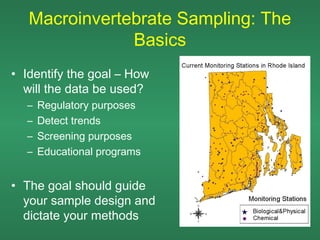
Macroinvertebrate Sampling: The
               Basics
• Identify the goal – How
  will the data be used?
  –   Regulatory purposes
  –   Detect trends
  –   Screening purposes
  –   Educational programs


• The goal should guide
  your sample design and
  dictate your methods
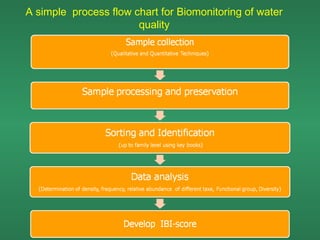
A simple process flow chart for Biomonitoring of water
                       quality
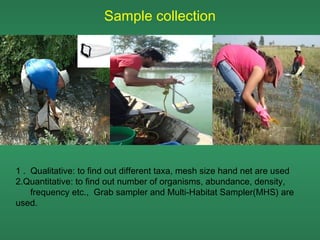
Sample collection


1 . Qualitative: to find out different taxa, mesh size hand net are used
2.Quantitative: to find out number of organisms, abundance, density,
    frequency etc., Grab sampler and Multi-Habitat Sampler(MHS) are
used.
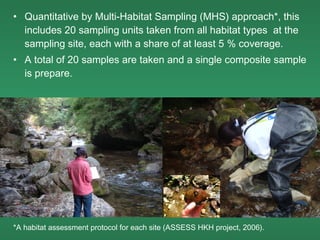
• Quantitative by Multi-Habitat Sampling (MHS) approach*, this
  includes 20 sampling units taken from all habitat types at the
  sampling site, each with a share of at least 5 % coverage.
• A total of 20 samples are taken and a single composite sample
  is prepare.


*A habitat assessment protocol for each site (ASSESS HKH project, 2006).
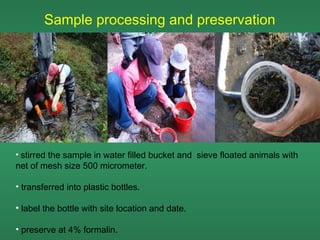
Sample processing and preservation


• stirred the sample in water filled bucket and sieve floated animals with
net of mesh size 500 micrometer.

• transferred into plastic bottles.

• label the bottle with site location and date.

• preserve at 4% formalin.
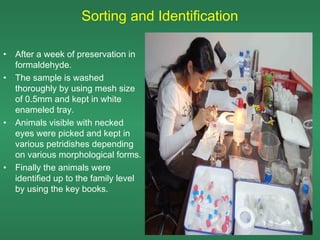
Sorting and Identification

•   After a week of preservation in
    formaldehyde.
•   The sample is washed
    thoroughly by using mesh size
    of 0.5mm and kept in white
    enameled tray.
•   Animals visible with necked
    eyes were picked and kept in
    various petridishes depending
    on various morphological forms.
•   Finally the animals were
    identified up to the family level
    by using the key books.
Common Macroinvertebrates
  Group 1: Pollution sensitive
Group 2: Somewhat sensitive
Group 3: Pollution tolerant
References
• www.cpawscalgary.org/education/pdf/p
  ond-study-lesson-plan.pdf
• USDA CSREES New England Water
  Quality Program
• www.epa.gov/indicators/html/benthoscl
  ean.html
Lets get to work!

Benthic macroinvertebrates

  • 1.
    Water Quality Monitoring Using Aquatic Macroinvertebrates Presented by; Surendra Bam
  • 2.
    Presentation Outline  Introduction Benthic Macroinvertebrates  Macroinvertebrates as Indicators  Benthic Index of Biotic Integrity (I-IBI)  Macroinvertebrates Sampling- The Basics  Common Macroinvertebrates  References
  • 3.
    Introduction Clean water isessential to life. Adverse changes to the water quality of one stream can impact all the bodies of water downstream – rivers, lakes, or even the ocean. When water quality degrades, changes to plant, invertebrate, and fish communities may occur and affect the entire food chain.
  • 4.
    • Through waterquality monitoring, communities can assess the health of their streams and rivers over time. Once baseline data on the health of a stream is collected, subsequent monitoring can help identify when and where pollution incidents occur. • Water quality can be assessed using chemical sampling or biological sampling. • Biological water quality monitoring involves collecting samples of aquatic benthic macroinvertebrates.
  • 5.
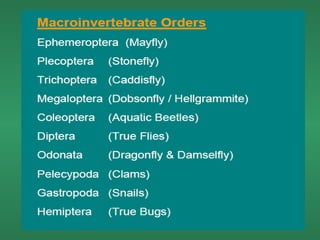
    Benthic Macroinvertebrates (bottom-dwelling) (animals w/o backbones visible to naked eye) Heptageniidae sp. Hydropsyche sp. Perlodidae sp. (Mayfly larva) (Caddisfly larva) (Stonefly larva) Macroinvertebrates are useful indicators of the health or condition of wetlands and other water bodies. They respond to many kinds of pollution, including chemical pollution and physical disturbance to the landscape around the site, wetland structure, and hydrology. There are several advantages of using macroinvertebrates. Great candidates for biological monitoring…
  • 7.
    Aquatic macroinvertebrates livein water for at least part of their life cycle.
  • 8.
    3 Categories ofStream Macroinvertebrates Group 1 – pollution sensitive (require higher DO, neutral pH, cold water) Tolerance Index : 1-3 Ex. mayflies, stoneflies, caddisflies Group 2 – somewhat pollution tolerant Tolerance Index : 4-7 Ex. scuds, dragonflies, damselflies Group 3 – pollution tolerant (can tolerate low oxygen, lower/higher pH, warmer water) Tolerance Index : 8-10 Ex. leeches, aquatic worms, midge larva
  • 9.
    The Tolerance Index(0 – 10) Classifies macroinvertebrates according to their sensitivity to pollution. This is used world-wide as a means of assessing biological assemblages . 0 10 most pollution sensitive most pollution tolerant e.g. Stoneflies e.g. Midges & Leeches require high DO, clear contain hemoglobin, tolerate lower DO, water, rocky cobble prefer soft substrate, less sensitive to substrate, not found in toxins, found them in areas with high areas of high sedimentation sedimentation, Eutrophication and poor or Eutrophication. water quality
  • 10.
    Biological Integrity “the abilityto support and maintain a balanced, integrated, and adaptive community of organisms having a species composition, diversity and functional organization comparable to those of natural habitats within a region" * * (Karr,1981)
  • 11.
    FFG Examples Diet Characteristic s Predators Dragonflies, Other insects Toothy jaws, larger in damselflies, size stoneflies Shredders Stoneflies, leaves, woody Streamlined, flat beetles, debris caddisflies Grazers / Mayflies, Periphyton, Scraping mandibles caddisflies, true diatoms Scrapers flies, beetles Gathering Mayflies, settled Filtering hairs, worms, midges, particles, hemoglobin Collectors crayfish bacteria Filtering Black flies, net- phytoplankton, Some build cases spinning floating particles (caddisflies) Collectors caddisflies, mayflies FFG – Functional Feeding Group ( Characterizes functional Organization)
  • 12.
    Benthic Index ofBiotic Integrity (B-IBI) • Index based on macroinvertebrates samples that integrates several parameters to produce an overall “health score” for a given water body Result: dose-response curves to human impact e.g. Taxa Generalized Plot of B-IBI richness, Scores vs. Human Impact relative abundance of certain taxa, feeding groups er oc SI B I e.g. Pollution, habitat Human Impact degradation, flow alteration
  • 13.
    EPA’s Suggestions forIBI Use* • Nonpoint Source Pollution Assessment • Watershed Protection • Total Maximum Daily Load (TMLD) Process • Ecological Risk Assessment • Development of Water Quality Criteria and Standards * Barbour et al., 1999
  • 14.
    Macroinvertebrate Sampling: The Basics • Identify the goal – How will the data be used? – Regulatory purposes – Detect trends – Screening purposes – Educational programs • The goal should guide your sample design and dictate your methods
  • 15.
    A simple processflow chart for Biomonitoring of water quality
  • 16.
    Sample collection 1 .Qualitative: to find out different taxa, mesh size hand net are used 2.Quantitative: to find out number of organisms, abundance, density, frequency etc., Grab sampler and Multi-Habitat Sampler(MHS) are used.
  • 17.
    • Quantitative byMulti-Habitat Sampling (MHS) approach*, this includes 20 sampling units taken from all habitat types at the sampling site, each with a share of at least 5 % coverage. • A total of 20 samples are taken and a single composite sample is prepare. *A habitat assessment protocol for each site (ASSESS HKH project, 2006).
  • 18.
    Sample processing andpreservation • stirred the sample in water filled bucket and sieve floated animals with net of mesh size 500 micrometer. • transferred into plastic bottles. • label the bottle with site location and date. • preserve at 4% formalin.
  • 19.
    Sorting and Identification • After a week of preservation in formaldehyde. • The sample is washed thoroughly by using mesh size of 0.5mm and kept in white enameled tray. • Animals visible with necked eyes were picked and kept in various petridishes depending on various morphological forms. • Finally the animals were identified up to the family level by using the key books.
  • 21.
    Common Macroinvertebrates Group 1: Pollution sensitive
  • 22.
  • 23.
  • 24.
    References • www.cpawscalgary.org/education/pdf/p ond-study-lesson-plan.pdf • USDA CSREES New England Water Quality Program • www.epa.gov/indicators/html/benthoscl ean.html
  • 25.

Editor's Notes

  • #10 Classifies macroinvertebrates according to their sensitivity to pollution For example: * Stoneflies require high DO, clear water, rocky cobble substrate to cling onto. So, they are not found in areas of high sedimenation or eutrophication. (Their absence is meaningful—at least tells us which conditions are not present). * Midges & Leeches contain hemoglobin and therefore don’t need as much oxygen in their environment. They prefer soft substrates to burrow into and have a high tolerance to toxins. Therefore, we find them in areas with high sedimentation, eutrophication and poor water quality
  • #11 Foundation concept of IBI Provides reasoning for individual component metrics, most of which have to do with species composition (taxa richness, relative abundance of different taxa)
  • #13 generalized plot of what we would expect to occur—IBI scores decrease with increasing human impact both are comprised of various components—IBI score is includes information about taxa richness and the types of organisms found. Human impact can encompass a wide range of measurements including impervious cover and various types of land use.
  • #14 TMDL—total maximum daily load NPDES—National Pollutant Discharge Elimination System EPA suggests these uses, but can IBI scores withstand scrutiny enough to be implemented in these programs?