MACENO, Evald
Graduate Student at UPR
September 9, 2015
Coastal Environment CIAM 6117
Professor: Loratta Roberson, P.h.D
Outline
 What is carbon?
 Physical and chemical properties
 Carbon as cycle
 Major reservoirs of carbon on the earth
 Components of carbon cycle
 Carbon distribution
 How carbon gets in the ocean
 Exchange process between the ocean and the atmosphre
 Mechanisms of carbon into the ocean
 Sequestration of carbon in the ocean
 Unexpected impact of human in the carbon cycle
 Effect of changing the carbon cycle
 Consequences and acidification of the ocean
 Discussion
 References
What is carbon?
 An element
 It has 6 as atomic number and 12.01115 as atomic mass
 It’s a latin word « carbo » meaning coal or charcoal
 Natural abundant non-metallic element that occurs in
many inorganic and all organic coumpounds
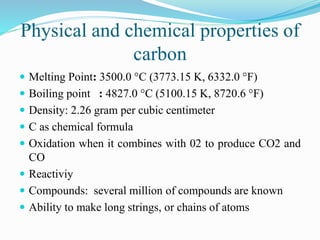
Physical and chemical properties of
carbon
 Melting Point: 3500.0 °C (3773.15 K, 6332.0 °F)
 Boiling point : 4827.0 °C (5100.15 K, 8720.6 °F)
 Density: 2.26 gram per cubic centimeter
 C as chemical formula
 Oxidation when it combines with 02 to produce CO2 and
CO
 Reactiviy
 Compounds: several million of compounds are known
 Ability to make long strings, or chains of atoms
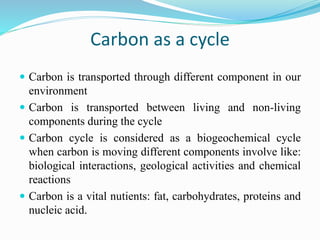
Carbon as a cycle
 Carbon is transported through different component in our
environment
 Carbon is transported between living and non-living
components during the cycle
 Carbon cycle is considered as a biogeochemical cycle
when carbon is moving different components involve like:
biological interactions, geological activities and chemical
reactions
 Carbon is a vital nutients: fat, carbohydrates, proteins and
nucleic acid.
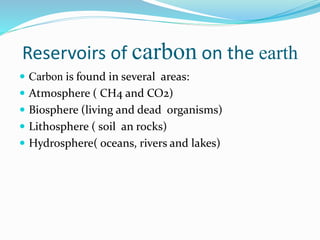
Reservoirs of carbon on the earth
 Carbon is found in several areas:
 Atmosphere ( CH4 and CO2)
 Biosphere (living and dead organisms)
 Lithosphere ( soil an rocks)
 Hydrosphere( oceans, rivers and lakes)
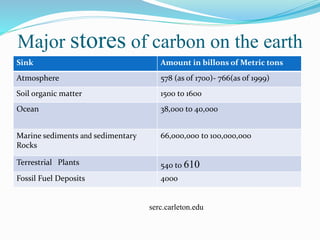
Major stores of carbon on the earth
Sink Amount in billons of Metric tons
Atmosphere 578 (as of 1700)- 766(as of 1999)
Soil organic matter 1500 to 1600
Ocean 38,000 to 40,000
Marine sediments and sedimentary
Rocks
66,000,000 to 100,000,000
Terrestrial Plants 540 to 610
Fossil Fuel Deposits 4000
: caserc.carleton.edu
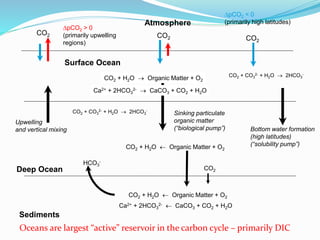
Atmosphere
Surface Ocean
Deep Ocean
Sediments
CO2
CO2
CO2
∆pCO2 > 0
(primarily upwelling
regions)
∆pCO2 < 0
(primarily high latitudes)
CO2 + CO3
2- + H2O  2HCO3
-
Upwelling
and vertical mixing
Sinking particulate
organic matter
(“biological pump”)
CO2 + H2O  Organic Matter + O2
CO2 + CO3
2- + H2O  2HCO3
-
CO2 + H2O  Organic Matter + O2
Ca2+ + 2HCO3
2-  CaCO3 + CO2 + H2O
CO2
HCO3
-
Bottom water formation
(high latitudes)
(“solubility pump”)
Ca2+ + 2HCO3
2-  CaCO3 + CO2 + H2O
CO2 + H2O  Organic Matter + O2
Oceans are largest “active” reservoir in the carbon cycle – primarily DIC
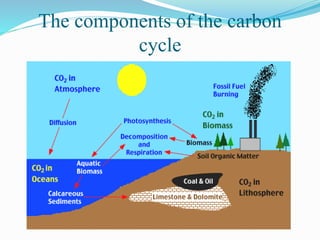
The components of the carbon
cycle
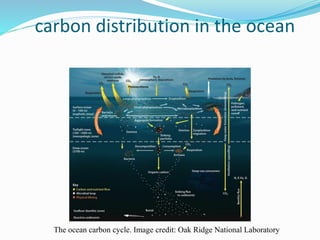
carbon distribution in the ocean
The ocean carbon cycle. Image credit: Oak Ridge National Laboratory
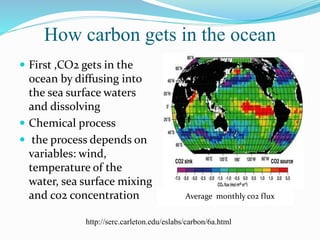
How carbon gets in the ocean
 First ,CO2 gets in the
ocean by diffusing into
the sea surface waters
and dissolving
 Chemical process
 the process depends on
variables: wind,
temperature of the
water, sea surface mixing
and co2 concentration AaAverage monthly co2 flux
http://serc.carleton.edu/eslabs/carbon/6a.html
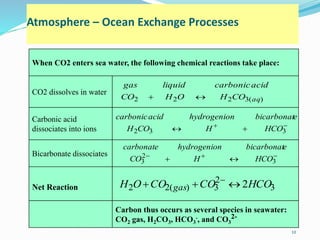
Atmosphere – Ocean Exchange Processes
12
When CO2 enters sea water, the following chemical reactions take place:
CO2 dissolves in water
Carbonic acid
dissociates into ions
Bicarbonate dissociates
Net Reaction
Carbon thus occurs as several species in seawater:
CO2 gas, H2CO3, HCO3
-, and CO3
2-
)(3222 aqCOHOHCO
acidcarbonicliquidgas


 332 HCOHCOH
ebicarbonationhydrogenacidcarbonic

 3
2
3 HCOHCO
ebicarbonationhydrogencarbonate
3
2
3)(22 2HCOCOCOOH gas  
Carbon gets into the ocean in three
mechanisms
 The Physical carbon pump
 Biological carbon pump
 The Carbonate pump
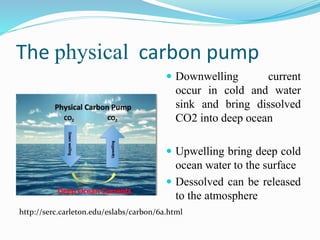
The physical carbon pump
 Downwelling current
occur in cold and water
sink and bring dissolved
CO2 into deep ocean
 Upwelling bring deep cold
ocean water to the surface
 Dessolved can be released
to the atmosphere
http://serc.carleton.edu/eslabs/carbon/6a.html
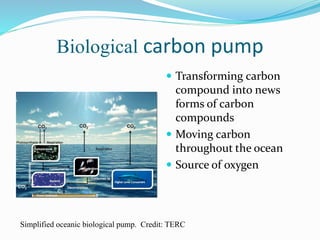
Biological carbon pump
 Transforming carbon
compound into news
forms of carbon
compounds
 Moving carbon
throughout the ocean
 Source of oxygen
Simplified oceanic biological pump. Credit: TERC
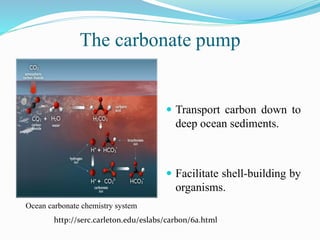
The carbonate pump
 Transport carbon down to
deep ocean sediments.
 Facilitate shell-building by
organisms.
Ocean carbonate chemistry system
http://serc.carleton.edu/eslabs/carbon/6a.html
Sequestration of carbon in the ocean
 Three mains process to capture atmospheric carbon
dioxide (CO2) such as:
 Biological process
 Physical process
 Chemical process
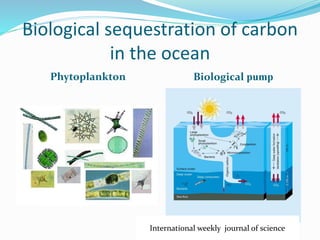
Biological sequestration of carbon
in the ocean
Phytoplankton Biological pump
International weekly journal of science
How the process is happened
 Biological pump
 Phytoplankton as marine plant float in the photic zone for
photosyntesis
 They use photosynthesis to create their own food
 Some species of fish and zooplankton eat phytoplanktons
 Those organisms release carbon dioxide back to the water
and the atmosphere
 Dead phytoplankton go into sediment
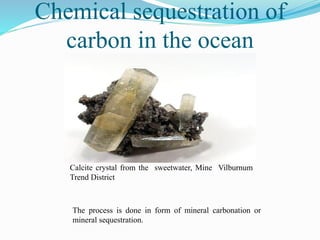
Chemical sequestration of
carbon in the ocean
The process is done in form of mineral carbonation or
mineral sequestration.
Calcite crystal from the sweetwater, Mine Vilburnum
Trend District
Unexpected impact of human on the
carbon cycle
 According to the scientific resaerch made by Earth
Observatory/NASA, people have a serious impact in the
carbon cycle.
 Burning fossil fuels
 Land use
 Deforestation
Effect of changing the carbon cycle
 Ocean and plants have taken up 55% of the extra carbon
people put into the atmosphere
 The rest of 45% stays in the atmosphere
 Impact each reservoir
 Warm the planet
 Make the ocean more acid putting marine life in danger
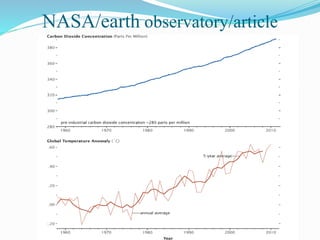
NASA/earth observatory/article
Consequences according to NASA
article
 Earth temperature will increase at least another 0.6
degrees celicius( degree fahrenheit)
 Since 1750, the pH of the ocean’s surface is dropped to
0.1 to 30 percent change to in acidity.
 Warmer oceans
 Marine animals will have trouble to build their shell.
Effects of Changing the Carbon Cycle/
http://earthobservatory.nasa.gov
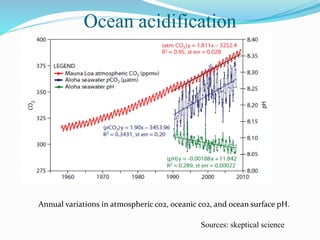
Ocean acidification
Sources: skeptical science
Sssssssssssss
Annual variations in atmospheric co2, oceanic co2, and ocean surface pH.
Discussion questions
 Why is the ocean carbon cycle important to study? What is the
response time?
 How is the ocean carbon cycle affected by the climate change?
 How do anthropogenic activities affect the whole global carbon
cycle?
 How does the ocean carbon cycle compare with the terrestrial
carbon cycle?
 Do we think CO2 emission is significant in Porto Rico today?
 Will local changes in anthropogenic inputs impact the global
carbon cycle? Is there a local cycle?
 Who is responsible for doing this important work - individuals,
businesses, research institutions, governments, or........all of us?
references
 https://en.wikipedia.org/wiki/Oceanic_carbon_cycle
 http://climatica.org.uk/climate-science-information/carbon-cycle
 http://www.indiana.edu/~geol105b/1425chap8.htm
 http://serc.carleton.edu/eslabs/carbon/6a.html
 https://en.wikipedia.org/wiki/Carbon_sequestration
 http://jrscience.wcp.muohio.edu/climate_projects_05/productivity/ph
ytoplankton.html
 http://science.nasa.gov/earth-science/oceanography/ocean-earth-
system/ocean-carbon-cycle
 https://skepticalscience.com/ocean-acidification-global-warming-
intermediate.htm
 https://en.wikipedia.org/wiki/Carbonate_minerals
 http://earthobservatory.nasa.gov/Features/CarbonCycle/page5.php

Carbon cycle in the ocean discussion

  • 1.
    MACENO, Evald Graduate Studentat UPR September 9, 2015 Coastal Environment CIAM 6117 Professor: Loratta Roberson, P.h.D
  • 2.
    Outline  What iscarbon?  Physical and chemical properties  Carbon as cycle  Major reservoirs of carbon on the earth  Components of carbon cycle  Carbon distribution  How carbon gets in the ocean  Exchange process between the ocean and the atmosphre  Mechanisms of carbon into the ocean  Sequestration of carbon in the ocean  Unexpected impact of human in the carbon cycle  Effect of changing the carbon cycle  Consequences and acidification of the ocean  Discussion  References
  • 3.
    What is carbon? An element  It has 6 as atomic number and 12.01115 as atomic mass  It’s a latin word « carbo » meaning coal or charcoal  Natural abundant non-metallic element that occurs in many inorganic and all organic coumpounds
  • 4.
    Physical and chemicalproperties of carbon  Melting Point: 3500.0 °C (3773.15 K, 6332.0 °F)  Boiling point : 4827.0 °C (5100.15 K, 8720.6 °F)  Density: 2.26 gram per cubic centimeter  C as chemical formula  Oxidation when it combines with 02 to produce CO2 and CO  Reactiviy  Compounds: several million of compounds are known  Ability to make long strings, or chains of atoms
  • 5.
    Carbon as acycle  Carbon is transported through different component in our environment  Carbon is transported between living and non-living components during the cycle  Carbon cycle is considered as a biogeochemical cycle when carbon is moving different components involve like: biological interactions, geological activities and chemical reactions  Carbon is a vital nutients: fat, carbohydrates, proteins and nucleic acid.
  • 6.
    Reservoirs of carbonon the earth  Carbon is found in several areas:  Atmosphere ( CH4 and CO2)  Biosphere (living and dead organisms)  Lithosphere ( soil an rocks)  Hydrosphere( oceans, rivers and lakes)
  • 7.
    Major stores ofcarbon on the earth Sink Amount in billons of Metric tons Atmosphere 578 (as of 1700)- 766(as of 1999) Soil organic matter 1500 to 1600 Ocean 38,000 to 40,000 Marine sediments and sedimentary Rocks 66,000,000 to 100,000,000 Terrestrial Plants 540 to 610 Fossil Fuel Deposits 4000 : caserc.carleton.edu
  • 8.
    Atmosphere Surface Ocean Deep Ocean Sediments CO2 CO2 CO2 ∆pCO2> 0 (primarily upwelling regions) ∆pCO2 < 0 (primarily high latitudes) CO2 + CO3 2- + H2O  2HCO3 - Upwelling and vertical mixing Sinking particulate organic matter (“biological pump”) CO2 + H2O  Organic Matter + O2 CO2 + CO3 2- + H2O  2HCO3 - CO2 + H2O  Organic Matter + O2 Ca2+ + 2HCO3 2-  CaCO3 + CO2 + H2O CO2 HCO3 - Bottom water formation (high latitudes) (“solubility pump”) Ca2+ + 2HCO3 2-  CaCO3 + CO2 + H2O CO2 + H2O  Organic Matter + O2 Oceans are largest “active” reservoir in the carbon cycle – primarily DIC
  • 9.
    The components ofthe carbon cycle
  • 10.
    carbon distribution inthe ocean The ocean carbon cycle. Image credit: Oak Ridge National Laboratory
  • 11.
    How carbon getsin the ocean  First ,CO2 gets in the ocean by diffusing into the sea surface waters and dissolving  Chemical process  the process depends on variables: wind, temperature of the water, sea surface mixing and co2 concentration AaAverage monthly co2 flux http://serc.carleton.edu/eslabs/carbon/6a.html
  • 12.
    Atmosphere – OceanExchange Processes 12 When CO2 enters sea water, the following chemical reactions take place: CO2 dissolves in water Carbonic acid dissociates into ions Bicarbonate dissociates Net Reaction Carbon thus occurs as several species in seawater: CO2 gas, H2CO3, HCO3 -, and CO3 2- )(3222 aqCOHOHCO acidcarbonicliquidgas    332 HCOHCOH ebicarbonationhydrogenacidcarbonic   3 2 3 HCOHCO ebicarbonationhydrogencarbonate 3 2 3)(22 2HCOCOCOOH gas  
  • 13.
    Carbon gets intothe ocean in three mechanisms  The Physical carbon pump  Biological carbon pump  The Carbonate pump
  • 14.
    The physical carbonpump  Downwelling current occur in cold and water sink and bring dissolved CO2 into deep ocean  Upwelling bring deep cold ocean water to the surface  Dessolved can be released to the atmosphere http://serc.carleton.edu/eslabs/carbon/6a.html
  • 15.
    Biological carbon pump Transforming carbon compound into news forms of carbon compounds  Moving carbon throughout the ocean  Source of oxygen Simplified oceanic biological pump. Credit: TERC
  • 16.
    The carbonate pump Transport carbon down to deep ocean sediments.  Facilitate shell-building by organisms. Ocean carbonate chemistry system http://serc.carleton.edu/eslabs/carbon/6a.html
  • 17.
    Sequestration of carbonin the ocean  Three mains process to capture atmospheric carbon dioxide (CO2) such as:  Biological process  Physical process  Chemical process
  • 18.
    Biological sequestration ofcarbon in the ocean Phytoplankton Biological pump International weekly journal of science
  • 19.
    How the processis happened  Biological pump  Phytoplankton as marine plant float in the photic zone for photosyntesis  They use photosynthesis to create their own food  Some species of fish and zooplankton eat phytoplanktons  Those organisms release carbon dioxide back to the water and the atmosphere  Dead phytoplankton go into sediment
  • 20.
    Chemical sequestration of carbonin the ocean The process is done in form of mineral carbonation or mineral sequestration. Calcite crystal from the sweetwater, Mine Vilburnum Trend District
  • 21.
    Unexpected impact ofhuman on the carbon cycle  According to the scientific resaerch made by Earth Observatory/NASA, people have a serious impact in the carbon cycle.  Burning fossil fuels  Land use  Deforestation
  • 22.
    Effect of changingthe carbon cycle  Ocean and plants have taken up 55% of the extra carbon people put into the atmosphere  The rest of 45% stays in the atmosphere  Impact each reservoir  Warm the planet  Make the ocean more acid putting marine life in danger
  • 23.
  • 24.
    Consequences according toNASA article  Earth temperature will increase at least another 0.6 degrees celicius( degree fahrenheit)  Since 1750, the pH of the ocean’s surface is dropped to 0.1 to 30 percent change to in acidity.  Warmer oceans  Marine animals will have trouble to build their shell. Effects of Changing the Carbon Cycle/ http://earthobservatory.nasa.gov
  • 25.
    Ocean acidification Sources: skepticalscience Sssssssssssss Annual variations in atmospheric co2, oceanic co2, and ocean surface pH.
  • 26.
    Discussion questions  Whyis the ocean carbon cycle important to study? What is the response time?  How is the ocean carbon cycle affected by the climate change?  How do anthropogenic activities affect the whole global carbon cycle?  How does the ocean carbon cycle compare with the terrestrial carbon cycle?  Do we think CO2 emission is significant in Porto Rico today?  Will local changes in anthropogenic inputs impact the global carbon cycle? Is there a local cycle?  Who is responsible for doing this important work - individuals, businesses, research institutions, governments, or........all of us?
  • 27.
    references  https://en.wikipedia.org/wiki/Oceanic_carbon_cycle  http://climatica.org.uk/climate-science-information/carbon-cycle http://www.indiana.edu/~geol105b/1425chap8.htm  http://serc.carleton.edu/eslabs/carbon/6a.html  https://en.wikipedia.org/wiki/Carbon_sequestration  http://jrscience.wcp.muohio.edu/climate_projects_05/productivity/ph ytoplankton.html  http://science.nasa.gov/earth-science/oceanography/ocean-earth- system/ocean-carbon-cycle  https://skepticalscience.com/ocean-acidification-global-warming- intermediate.htm  https://en.wikipedia.org/wiki/Carbonate_minerals  http://earthobservatory.nasa.gov/Features/CarbonCycle/page5.php