ENERGY RECYCLE IN DEEP-SEA
BENTHIC COMMUNITES
Presented by :
Md. Mazaharul Islam
ID: 16207119
Department of Oceanography,
University of Chittagong
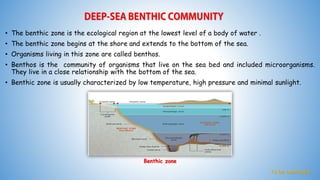
• The benthic zone is the ecological region at the lowest level of a body of water .
• The benthic zone begins at the shore and extends to the bottom of the sea.
• Organisms living in this zone are called benthos.
• Benthos is the community of organisms that live on the sea bed and included microorganisms.
They live in a close relationship with the bottom of the sea.
• Benthic zone is usually characterized by low temperature, high pressure and minimal sunlight.
To be continued…
Benthic zone
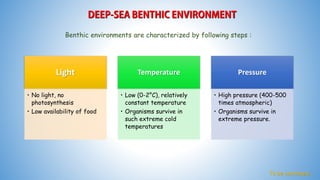
Light
• No light, no
photosynthesis
• Low availability of food
Temperature
• Low (0-2°C), relatively
constant temperature
• Organisms survive in
such extreme cold
temperatures
Pressure
• High pressure (400-500
times atmospheric)
• Organisms survive in
extreme pressure.
To be continued...
Benthic environments are characterized by following steps :
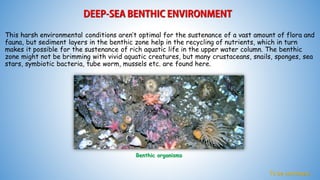
This harsh environmental conditions aren’t optimal for the sustenance of a vast amount of flora and
fauna, but sediment layers in the benthic zone help in the recycling of nutrients, which in turn
makes it possible for the sustenance of rich aquatic life in the upper water column. The benthic
zone might not be brimming with vivid aquatic creatures, but many crustaceans, snails, sponges, sea
stars, symbiotic bacteria, tube worm, mussels etc. are found here.
To be continued...
Benthic organisms
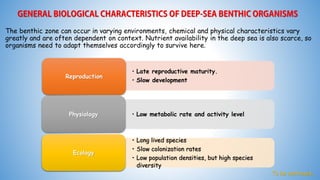
The benthic zone can occur in varying environments, chemical and physical characteristics vary
greatly and are often dependent on context. Nutrient availability in the deep sea is also scarce, so
organisms need to adapt themselves accordingly to survive here.
• Late reproductive maturity.
• Slow development
Reproduction
• Low metabolic rate and activity levelPhysiology
• Long lived species
• Slow colonization rates
• Low population densities, but high species
diversity
Ecology
To be continued...
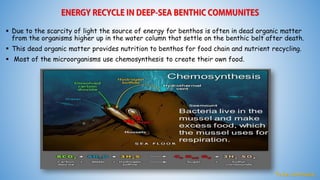
 Due to the scarcity of light the source of energy for benthos is often in dead organic matter
from the organisms higher up in the water column that settle on the benthic belt after death.
 This dead organic matter provides nutrition to benthos for food chain and nutrient recycling.
 Most of the microorganisms use chemosynthesis to create their own food.
To be continued...
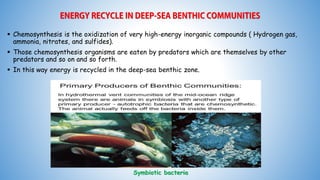
 Chemosynthesis is the oxidization of very high-energy inorganic compounds ( Hydrogen gas,
ammonia, nitrates, and sulfides).
 Those chemosynthesis organisms are eaten by predators which are themselves by other
predators and so on and so forth.
 In this way energy is recycled in the deep-sea benthic zone.
Symbiotic bacteria

Benthic community

  • 1.
    ENERGY RECYCLE INDEEP-SEA BENTHIC COMMUNITES Presented by : Md. Mazaharul Islam ID: 16207119 Department of Oceanography, University of Chittagong
  • 2.
    • The benthiczone is the ecological region at the lowest level of a body of water . • The benthic zone begins at the shore and extends to the bottom of the sea. • Organisms living in this zone are called benthos. • Benthos is the community of organisms that live on the sea bed and included microorganisms. They live in a close relationship with the bottom of the sea. • Benthic zone is usually characterized by low temperature, high pressure and minimal sunlight. To be continued… Benthic zone
  • 3.
    Light • No light,no photosynthesis • Low availability of food Temperature • Low (0-2°C), relatively constant temperature • Organisms survive in such extreme cold temperatures Pressure • High pressure (400-500 times atmospheric) • Organisms survive in extreme pressure. To be continued... Benthic environments are characterized by following steps :
  • 4.
    This harsh environmentalconditions aren’t optimal for the sustenance of a vast amount of flora and fauna, but sediment layers in the benthic zone help in the recycling of nutrients, which in turn makes it possible for the sustenance of rich aquatic life in the upper water column. The benthic zone might not be brimming with vivid aquatic creatures, but many crustaceans, snails, sponges, sea stars, symbiotic bacteria, tube worm, mussels etc. are found here. To be continued... Benthic organisms
  • 5.
    The benthic zonecan occur in varying environments, chemical and physical characteristics vary greatly and are often dependent on context. Nutrient availability in the deep sea is also scarce, so organisms need to adapt themselves accordingly to survive here. • Late reproductive maturity. • Slow development Reproduction • Low metabolic rate and activity levelPhysiology • Long lived species • Slow colonization rates • Low population densities, but high species diversity Ecology To be continued...
  • 6.
     Due tothe scarcity of light the source of energy for benthos is often in dead organic matter from the organisms higher up in the water column that settle on the benthic belt after death.  This dead organic matter provides nutrition to benthos for food chain and nutrient recycling.  Most of the microorganisms use chemosynthesis to create their own food. To be continued...
  • 7.
     Chemosynthesis isthe oxidization of very high-energy inorganic compounds ( Hydrogen gas, ammonia, nitrates, and sulfides).  Those chemosynthesis organisms are eaten by predators which are themselves by other predators and so on and so forth.  In this way energy is recycled in the deep-sea benthic zone. Symbiotic bacteria