Integrated Coastal Zone
Management
Luis A. Aviles, Esq.
CIAM 6117 Ambiente Costero
Prof. Loretta Roberson
November 18, 2015
Coastal Zone
!  Coast is the zone of interaction between land and
sea where both land & oceanic processes works.
!  It is most dynamic, resourceful and disaster prone
zone of any country.
!  Coastal zone always include floodplains,
mangroves, marshes, and fringing coral reefs.
Coastal Zone Management
!  Coastal zone management involves managing
coastal areas to balance environmental, economic,
human health, and human activities.
!  Coastal Management integrates the biological,
physical, and policy sciences to plan and
execute sustainable solutions for environmental
challenges where land meets water.
Integrated Coastal Zone
Management
!  ICZM is a process for the management of the coast using
an integrated approach, regarding all aspects of the
coastal zone, including geographical and political
boundaries, in an attempt to achieve sustainability.
!  It is a dynamic, multidisciplinary and iterative process to
promote sustainable management of coastal zones.
!  It covers the full cycle of information collection, planning
(in its broadest sense), decision making, management
and monitoring of implementation.
International Players
!  International Maritime Organization (IMO)
!  UN Environmental Program
!  UN Conference on Trade and Development
!  Organization of Economic Cooperation and Development
(OECD)
!  World Health Organization
!  World Trade Organization
!  World Bank
!  International Treaties:
!  United Nations Convention of the Law of the Seas (UNCLOS)
!  Convention for the Prevention of Marine Pollution by Dumping
Wastes and Other Matter (London Dumping Convention, 1972)
!  International Convention for the Prevention of Pollution from
Ships, 1973
Federal Players
!  National Oceanic and Atmospheric Administration (NOAA-US
Department of Commerce)
!  US Army Corps of Engineers (Department of Defense)
!  Federal Emergency Management Agency (FEMA)
!  National Park Service (Dept. of Interior)
!  Fish and Wildlife Service (Dept. of Interior)
!  National Marine Fisheries Service (Dept. of Interior)
!  US Coast Guard
!  Environmental Protection Agency
!  US Geological Survey
!  US Minerals Management Service
!  US Natural Resources Conservation Service
Federal Legislation: Habitat
!  National Environmental Policy Act (1969)
!  Requires agencies to consider impacts to environment for proposed actions
!  Magnuson-Stevens Fishery Conservation and Management Act –
Sustainable Fishery Act Amendments (1996)
!  Provides for the sustainable management of U.S. fisheries and the conservation and
protection of Essential Fish Habitats.
!  Coral Reef Protection Executive Order 13089 (1998)
!  Provides for the protection, research, monitoring and conservation of coral reefs
!  Marine Protected Areas Executive Order 13158 (2000):
!  Provides for the establishment and protection of marine areas that have special
preservation needs: about 5,000 worldwide in 2010
Federal Legislation: Pollution
!  Federal Water Pollution Control Act (1972)
!  Regulates pollutant discharges into U.S. waters
!  Marine Protection, Research, and Sanctuaries Act (1972)
!  Regulates ocean dumping and transport of waste
!  Also provides for the designation and protection of areas designated as marine
sanctuaries
!  Oil Pollution Act (1990)
!  Provides federal guidance for preventing, responding to, and defining liability for
oil pollution incidents (e.g., spills) in U.S. waters.
!  Coastal Zone Management Act (1972)
!  Provides for management of non-point source pollution
Federal Legislation: Disasters
!  National Flood Insurance Act of 1968
!  Flood Disaster Protection Act of 1973
!  Stafford Disaster Relief and Emergency Act
Federal Legislation: Fisheries
!  The Magnuson-Stevens Fishery Conservation and
Management Act (MSA) is the primary law governing
fisheries management in United States federal
waters
!  First enacted in 1976 to help regulate foreign fishing in US waters
!  Created 8 regional fishery management councils to help manage
the nation’s fisheries
!  1996 Sustainable Fisheries Act amendments most notably added
measures to protect Essential Fish Habitat
!  The Magnuson-Stevens Fishery Conservation and Management
Reauthorization Act of 2006 (MSRA) amended MSA and mandates
new measures to help prevent and end overfishing.
Federal Legislation: Climate
!  Federal Ocean Acidification Research and
Monitoring (FOARAM) Act (2009)
!  Provides for ocean acidification research and monitoring
!  Intergovernmental Panel on Climate Change (IPCC):
!  Established by the United Nations and World Meteorological Organization
!  Created to provide the world with a leading scientific group and perspective
on the current state and possible impacts of climate change
Federal Legislation: Animals
!  Marine Mammal Protection Act (1972)
!  prohibits the ‘taking’ of any marine mammals – which means in the U.S. it
is illegal to kill, hunt, trap or harass these species
!  Fact: The first international agreement to address wildlife conservation involved
protecting a marine mammal ! the Northern fur seal
!  Endangered Species Act (1973)
!  Provides for the conservation of endangered and threatened species as
well as the ecosystems and habitats upon which they depend
!  International Whaling Commission (IWC)
!  An intergovernmental (international) governing body charged with the
conservation of whales and management of whaling
Federal Legislation: High Seas
!  United Nations Convention on the Law of the Sea
(UNCLOS):
!  Agreement resulting from 3rd United Nations Conference on the
Law of the Sea
!  Defined countries Exclusive Economic Zones (EEZ): Extends out
to 200 nautical miles from shore and provide countries with
resource and exploration rights
State Players: Puerto Rico
!  La Ley de Aguas de 1866
!  La Ley de Puertos de España de 1880
!  Ley Española de Ríos y Puertos de 1886
!  Acta Jones, Carta Orgánica de 1917 de Puerto Rico”
!  Ley de Puertos para la Isla de Puerto Rico” de 1886
!  Ley Orgánica Foraker del 12 de abril de 1900
!  Ley sobre Política Pública de Desarrollo Sostenible, Ley 267-2004
!  Constitución del Estado Libre Asociado de Puerto Rico de 1952
!  Ley de Municipios Autónomos del ELA, Ley 81-1991
Department of Natural and
Environmental Resources
!  “Ley de Aguas de Puerto Rico”, Ley 136-1976
!  “Ley de Arena Grava y Piedra”, Ley 132-1968
!  “Ley de Bosques de Puerto Rico”, Ley 133-1975
!  “Ley de Desarrollo de Recursos Minerales de Puerto
Rico”, Ley 145-1975
!  “Ley de la Junta Interagencial para el Manejo de las
Playas de Puerto Rico”, Ley 293-1999
!  “Ley de la Reserva Natural de la Finca "Seven Seas", Ley
228-1999
Department of Natural and
Environmental Resources
!  “Ley de Minas de Puerto Rico”, Ley 6-1954,
!  “Ley de Navegación y Seguridad Acuática en Puerto Rico”,
Ley 430-2000
!  “Ley de Pesquerías de Puerto Rico”, Ley 278-1998
!  “Ley de Política Pública sobre Humedales en Puerto Rico”,
Ley 314-1998
!  “Ley de recuperación del 3% de la plataforma insular de
Puerto Rico”, Ley 307-2000
!  “Ley de Servidumbre de Conservación de Puerto Rico”, Ley
183-2001
Department of Natural and
Environmental Resources
!  “Ley de Vigilantes del DRNA”, Ley 1-1977
!  “Ley del Fondo para la Adquisición y Conservación de
Terrenos de Puerto Rico”, Ley 268-2003
!  “Ley del Programa Adopte una Playa”, Ley 250-1999
!  “Ley del Programa del Patrimonio Natural de Puerto
Rico”, Ley 150-1988
!  “Ley Núm. 57-2014”, crea las Oficina Estatal de Política
Publica Energética
Department of Natural and
Environmental Resources
!  “Ley Orgánica del Departamento de Recursos Naturales y Ambientales”,
Ley 23-1972
!  “Ley para crear el Programa de Reforestación, Administración y
Conservación de Recursos Vivientes”, Ley 195-1998
!  “Ley para el Fomento y Desarrollo de la Industria Pesquera”, Ley 61-1990
!  “Ley para Establecer el Programa para la Promoción, Protección y
Conservación de las Playas de Puerto Rico Aspirantes a la Bandera Azul”,
Ley 173-2000
!  “Ley para establecer la política pública sobre la prevención de
inundaciones en Puerto Rico,
!  la conservación de ríos y quebradas y la dedicación a uso público de
fajas verdes”, Ley 49-2003
Department of Natural and
Environmental Resources
!  “Ley para la Conservación, el Desarrollo y Uso de los Recursos
de Agua de Puerto Rico”, Ley 136-1976
!  “Ley de la Reserva Marina Tres Palmas de Rincón”, Ley
17-2004
!  “Ley Para designar como reserva marina, media milla de las
aguas territoriales marítimas alrededor de la Isla Desecheo”,
Ley Núm. 57-2000
!  “Ley para la extracción y excavación de materiales de la
corteza terrestre”, Ley 144-1976
!  “Ley Para la promoción y el desarrollo de la pesca deportiva y
recreativa de Puerto Rico”, Ley 115-1997
Department of Natural and
Environmental Resources
!  “Ley para la Protección, Conservación y Manejo de los
Arrecifes de Coral de Puerto Rico”, Ley 147-1999
!  “Ley sobre el Control de Contaminación de las Aguas”, Ley
42-1950,
!  “Ley sobre prevención de inundaciones y conservación de ríos
y playas”, Ley 6-1968
!  “Nueva Ley de Vida Silvestre de Puerto Rico”, Ley 241-1999
!  “Ley para la Protección y Conservación de la Fisiografía
Cársica de Puerto Rico”, Ley 292-1999
JUNTA DE PLANIFICACIÓN DE
PUERTO RICO
!  “Ley Orgánica de la Junta de Planificación de Puerto
Rico”, Ley Núm. 75-1975
!  “Ley para el Plan de Uso de Terrenos del Estado Libre
Asociado de Puerto Rico”, Ley 550-2004
!  “Reglamento de Zonificación de la Zona Costanera y de
Acceso a las Playas y Costas de Puerto Rico” Reglamento
Núm. 17
JUNTA DE CALIDAD AMBIENTAL
!  “Ley de Política Pública Ambiental de Puerto Rico”, Ley
416-2004
!  “Derrames de Sustancias Nocivas”, Ley 13-1973
!  “Ley del Fondo de Emergencias Ambientales de Puerto
Rico”, Ley 81-1987
Other Puerto Rico Agencies
!  AUTORIDAD DE DESPERDICIOS SÓLIDOS
!  “Ley para el Fomento de la Reducción de Desperdicios Peligrosos
en Puerto Rico”, Ley 10-1995
!  DEPARTAMENTO DE AGRICULTURA
!  “Ley para autorizar la creación del Distrito de Conservación de
Suelos”, Ley 211-1946
!  INSTITUTO DE CULTURA PUERTORRIQUEÑA
!  “Ley de Protección, Conservación y Estudio de los Sitios y
Recursos Arqueológicos Subacuáticos”, Ley 10-1987,
!  “Ley de Zonas Históricas o Antiguas y de Interés Turístico”, Ley
374-1949
Other Puerto Rico Agencies
!  COMPAÑÍA DE TURISMO DE PUERTO RICO
!  “Ley de Política Pública para el Desarrollo Sostenible de Turismo en Puerto Rico”
Ley Núm. 254 de 2006
!  DEPARTAMENTO DE TRANSPORTACIÓN Y OBRAS PÚBLICAS
!  “Ley de la Autoridad de Transporte Marítimo de Puerto Rico y las Islas Municipio”,
Ley Núm. 1 de 2000
!  DEPARTAMENTO DE LA VIVIENDA
!  “Ley de Viviendas Enclavadas en Terrenos Ajenos”, Núm. 132 de 1975, según
enmendada
!  AUTORIDAD DE LOS PUERTOS
!  “Ley de Muelles y Puertos de Puerto Rico”, Ley Núm. 151 de 1968, según
enmendada
Puerto Rico Special Laws
!  “Ley para la Conservación y el Desarrollo de Culebra”,
!  Ley Núm. 66 del 22 de junio de 1975 “Ley para crear la
Zona Especial de Desarrollo Económico de Vieques-
Culebra”, Ley Núm. 153 de 2002
Local Players: Private Sector
!  Professional Developers and builders
!  Private property owners
!  Lenders (Banks)
!  Realtors
!  Homeowners Associations
!  Neighbors and other residents
!  Private Foundations
!  Conservation Groups
The need for a Regional
Approach?
!  Problems with Federal Jurisdictions
!  Too ambitious in scale
!  Not site specific
!  No assurance of inter-agency cooperation
!  Problems with State Jurisdictions
!  Too ambitious in scale
!  Lack of financial resources
!  Problems with Local Jurisdictions
!  Too small in scale
!  Too provincial in perspective
!  Too many and too fragmented
Regional Management Strategies
!  Watershed approach
!  Watershed management (used successfully in EU)
!  Estuary Approach
!  The Lake Approach
!  The Special Area Management Approach
!  The “Areas of Environmental Concern” Approach
Regional Management Strategies:
Not Panacea
!  General public resistance to government intervention
!  Community misguided feelings of resilience
!  Lack of funding for regional approaches
!  Opposition by local business people
!  No government incentives (tax relief, insurance) to
protect regional resources
!  Lack of clear priorities, trained personnel
Integrated Coastal Management
!  “At a minimum, any definition should include the integration
of programs and plans for economic development and
environmental quality management, and more specifically the
integration of cross-sectoral plans for fisheries, energy,
transportation, waste disposal, tourism, etc. ICM should also
include the vertical integration of responsibilities for
management actions among various levels of government-
international, national, state and local-or between the public
and private sectors. It should include all components of
management-from the planning tasks of analysis and design,
to the implementation of tasks of installation, operation and
maintenance, monitoring and evaluation of strategies over
time. ICM should be cross-disciplinary among the sciences,
engineering, economics, political science, and law. In
practice, it is all of the above.” Bower (1992)
Four Dimension of ICM
!  Intergovernmental
!  Land-water interface (ecosystems-based management)
!  Inter-sectoral
!  Interdisciplinary
!  (Knecht and Archer, 1993)
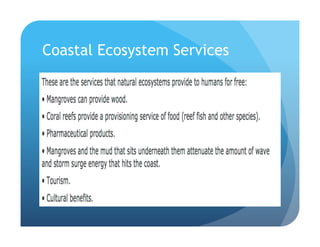
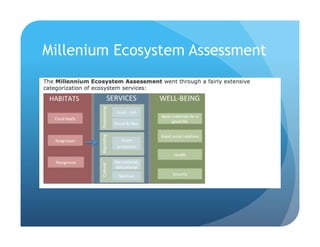
Coastal Ecosystem Services
Millenium Ecosystem Assessment
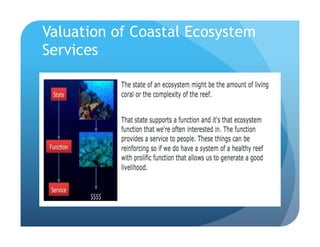
Valuation of Coastal Ecosystem
Services
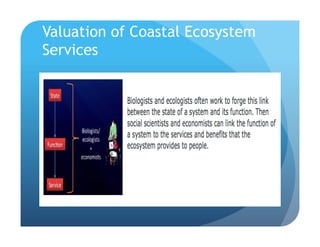
Valuation of Coastal Ecosystem
Services
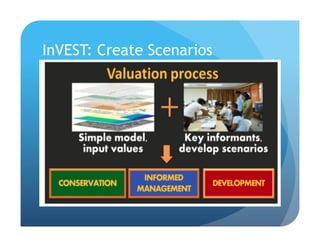
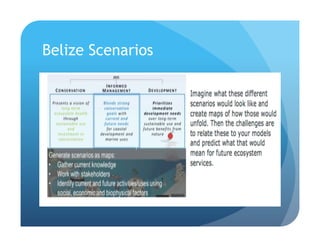
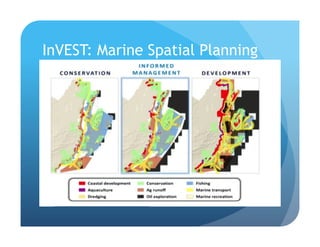
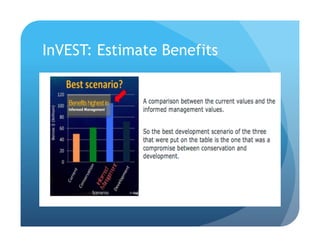
Case Study: Belize
!  In 2010, the Belize government began work on an ecosystem-
based plan intended to sustainably develop coastal resources for
the current and future benefit of all Belizeans. Belize partnered
with the World Wide Fund for Nature (NGO) and the Natural
Capital Project (NatCap) to help them use the Integrated
Valuation of Environmental Services and Tradeoffs (InVEST)
software suite to form a management plan that was scientifically
and economically sound.
!  case study highlights a real-world example of developing
scenarios to inform coastal and marine spatial planning
decisions.
!  stakeholders engaged in an iterative process of scenario
development, data were collected, ecosystem service impacts
were assessed, and the results were used to inform national
marine policy decisions in Belize.
Belize’s Coast
!  Belize’s coastal zone contains a rich diversity of habitats and attractions,
including three offshore atolls, coastal plains and lagoons, mangrove
forests, seagrass beds, coral reefs, and over 300 cayes.
!  This highly productive coastal zone is home to 35% of the population of
Belize as well as endangered species like the West Indian manatee,
American crocodile, sea turtles, and several bird species.
!  With over 280 km of barrier reef, Belize is home to the planet's second
longest unbroken reef system. World-renowned snorkelling and diving
draw around 900,000 tourists to the region annually, driving construction
of new coastal development, airports, urban areas, and cruise ship
ports.
!  The same coastal ecosystems also support several commercial,
recreational, and subsistence fisheries.
Questions sought to be answered
!  How are a diversity of human activities, e.g. coastal
development and marine transportation, likely to affect
key ecosystems and the services they provide for Belize?
!  How will alternative development and conservation
strategies and management recommendations affect
key ecosystem services for Belize?
!  Where should selected zones – or areas designated for a
particular purpose or use – be located or prohibited to
maximize economic benefits and also limit
environmental degradation?
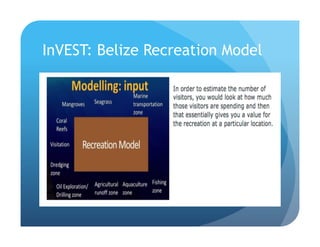
InVEST: Belize Recreation Model
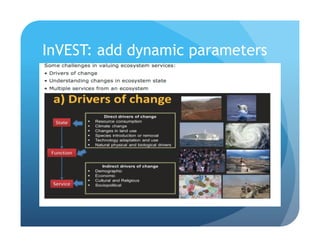
Valuation: Identify drivers of
change
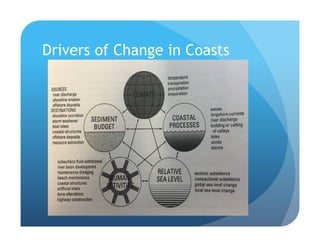
Drivers of Change in Coasts
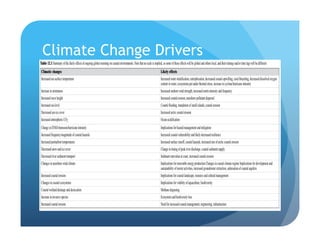
Climate Change Drivers
Valuation: Add analysis of
perturbations
Valuation: allocation
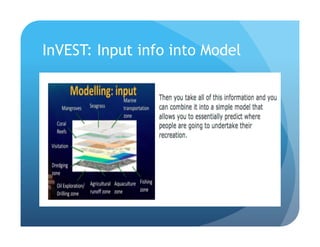
InVEST: Input info into Model
InVEST: Create Scenarios
Belize Scenarios
InVEST: Marine Spatial Planning
InVEST: Estimate Benefits
References
!  Clarke, C, M Canto, S Rosado. 2013. Belize Integrated Coastal Zone Management Plan. Coastal Zone Management Authority
and Institute, Belize City. http://www.coastalzonebelize.org/?page_id=681
!  Clarke, C, S Rosado, A Rosenthal, K Arkema, M Canto, I Gillett, G Verutes, and S Wood. 2012. Coastal Zone Planning in
Belize: a case study. Stanford, CA: Natural Capital Project.
!  Bower, B.T. 1992. Producing Information for Integrated Coastal Resource Management, cited in Klee 1999
!  French, P.W. 1997. Coastal and Estuaarine Management, London: Routledge.
!  Klee, G.A. 1999, The Coastal Environment (Prentice Hall, New Jersey)
!  Knecht, R. W., and Archer, J. 1993. “Integration” in the U.S. Coastal Zone Management Program, Ocean & Coastal
Management, Vol. 21, pp. 183-199.
!  Masselink, G., et al, 2011. Introduction to Coastal Processes & Geomorphology, 2nd Ed. London, England: Routledge.
!  McLeod, K., Leslie, H., Editors 2009 , Ecosystem-Based Management for the Oceans. Washington, DC: Island Press.
!  Williams, J. et al 1990. Coasts in Crisis. U.S. Geological Survey
Thanks!
Questions
!  1) Do you consider the US Coastal Zone Management
sufficiently integrated?
!  2) Do you consider the Puerto Rico Coastal Zone
Management sufficiently integrated?
!  3) Do you consider that Puerto Rico dedicates sufficient
financial resources to its coastal zone management programs?
!  4) Do you thing the Plan de Usos de Terrenos (PUT) being
proposed includes coastal zone management in an integrated
way?
!  5) What can Puerto Rico learn from the Belize case study?

Integrated coastal zone management

  • 1.
    Integrated Coastal Zone Management LuisA. Aviles, Esq. CIAM 6117 Ambiente Costero Prof. Loretta Roberson November 18, 2015
  • 2.
    Coastal Zone !  Coastis the zone of interaction between land and sea where both land & oceanic processes works. !  It is most dynamic, resourceful and disaster prone zone of any country. !  Coastal zone always include floodplains, mangroves, marshes, and fringing coral reefs.
  • 3.
    Coastal Zone Management ! Coastal zone management involves managing coastal areas to balance environmental, economic, human health, and human activities. !  Coastal Management integrates the biological, physical, and policy sciences to plan and execute sustainable solutions for environmental challenges where land meets water.
  • 4.
    Integrated Coastal Zone Management ! ICZM is a process for the management of the coast using an integrated approach, regarding all aspects of the coastal zone, including geographical and political boundaries, in an attempt to achieve sustainability. !  It is a dynamic, multidisciplinary and iterative process to promote sustainable management of coastal zones. !  It covers the full cycle of information collection, planning (in its broadest sense), decision making, management and monitoring of implementation.
  • 5.
    International Players !  InternationalMaritime Organization (IMO) !  UN Environmental Program !  UN Conference on Trade and Development !  Organization of Economic Cooperation and Development (OECD) !  World Health Organization !  World Trade Organization !  World Bank !  International Treaties: !  United Nations Convention of the Law of the Seas (UNCLOS) !  Convention for the Prevention of Marine Pollution by Dumping Wastes and Other Matter (London Dumping Convention, 1972) !  International Convention for the Prevention of Pollution from Ships, 1973
  • 6.
    Federal Players !  NationalOceanic and Atmospheric Administration (NOAA-US Department of Commerce) !  US Army Corps of Engineers (Department of Defense) !  Federal Emergency Management Agency (FEMA) !  National Park Service (Dept. of Interior) !  Fish and Wildlife Service (Dept. of Interior) !  National Marine Fisheries Service (Dept. of Interior) !  US Coast Guard !  Environmental Protection Agency !  US Geological Survey !  US Minerals Management Service !  US Natural Resources Conservation Service
  • 7.
    Federal Legislation: Habitat ! National Environmental Policy Act (1969) !  Requires agencies to consider impacts to environment for proposed actions !  Magnuson-Stevens Fishery Conservation and Management Act – Sustainable Fishery Act Amendments (1996) !  Provides for the sustainable management of U.S. fisheries and the conservation and protection of Essential Fish Habitats. !  Coral Reef Protection Executive Order 13089 (1998) !  Provides for the protection, research, monitoring and conservation of coral reefs !  Marine Protected Areas Executive Order 13158 (2000): !  Provides for the establishment and protection of marine areas that have special preservation needs: about 5,000 worldwide in 2010
  • 8.
    Federal Legislation: Pollution ! Federal Water Pollution Control Act (1972) !  Regulates pollutant discharges into U.S. waters !  Marine Protection, Research, and Sanctuaries Act (1972) !  Regulates ocean dumping and transport of waste !  Also provides for the designation and protection of areas designated as marine sanctuaries !  Oil Pollution Act (1990) !  Provides federal guidance for preventing, responding to, and defining liability for oil pollution incidents (e.g., spills) in U.S. waters. !  Coastal Zone Management Act (1972) !  Provides for management of non-point source pollution
  • 9.
    Federal Legislation: Disasters ! National Flood Insurance Act of 1968 !  Flood Disaster Protection Act of 1973 !  Stafford Disaster Relief and Emergency Act
  • 10.
    Federal Legislation: Fisheries ! The Magnuson-Stevens Fishery Conservation and Management Act (MSA) is the primary law governing fisheries management in United States federal waters !  First enacted in 1976 to help regulate foreign fishing in US waters !  Created 8 regional fishery management councils to help manage the nation’s fisheries !  1996 Sustainable Fisheries Act amendments most notably added measures to protect Essential Fish Habitat !  The Magnuson-Stevens Fishery Conservation and Management Reauthorization Act of 2006 (MSRA) amended MSA and mandates new measures to help prevent and end overfishing.
  • 11.
    Federal Legislation: Climate ! Federal Ocean Acidification Research and Monitoring (FOARAM) Act (2009) !  Provides for ocean acidification research and monitoring !  Intergovernmental Panel on Climate Change (IPCC): !  Established by the United Nations and World Meteorological Organization !  Created to provide the world with a leading scientific group and perspective on the current state and possible impacts of climate change
  • 12.
    Federal Legislation: Animals ! Marine Mammal Protection Act (1972) !  prohibits the ‘taking’ of any marine mammals – which means in the U.S. it is illegal to kill, hunt, trap or harass these species !  Fact: The first international agreement to address wildlife conservation involved protecting a marine mammal ! the Northern fur seal !  Endangered Species Act (1973) !  Provides for the conservation of endangered and threatened species as well as the ecosystems and habitats upon which they depend !  International Whaling Commission (IWC) !  An intergovernmental (international) governing body charged with the conservation of whales and management of whaling
  • 13.
    Federal Legislation: HighSeas !  United Nations Convention on the Law of the Sea (UNCLOS): !  Agreement resulting from 3rd United Nations Conference on the Law of the Sea !  Defined countries Exclusive Economic Zones (EEZ): Extends out to 200 nautical miles from shore and provide countries with resource and exploration rights
  • 14.
    State Players: PuertoRico !  La Ley de Aguas de 1866 !  La Ley de Puertos de España de 1880 !  Ley Española de Ríos y Puertos de 1886 !  Acta Jones, Carta Orgánica de 1917 de Puerto Rico” !  Ley de Puertos para la Isla de Puerto Rico” de 1886 !  Ley Orgánica Foraker del 12 de abril de 1900 !  Ley sobre Política Pública de Desarrollo Sostenible, Ley 267-2004 !  Constitución del Estado Libre Asociado de Puerto Rico de 1952 !  Ley de Municipios Autónomos del ELA, Ley 81-1991
  • 15.
    Department of Naturaland Environmental Resources !  “Ley de Aguas de Puerto Rico”, Ley 136-1976 !  “Ley de Arena Grava y Piedra”, Ley 132-1968 !  “Ley de Bosques de Puerto Rico”, Ley 133-1975 !  “Ley de Desarrollo de Recursos Minerales de Puerto Rico”, Ley 145-1975 !  “Ley de la Junta Interagencial para el Manejo de las Playas de Puerto Rico”, Ley 293-1999 !  “Ley de la Reserva Natural de la Finca "Seven Seas", Ley 228-1999
  • 16.
    Department of Naturaland Environmental Resources !  “Ley de Minas de Puerto Rico”, Ley 6-1954, !  “Ley de Navegación y Seguridad Acuática en Puerto Rico”, Ley 430-2000 !  “Ley de Pesquerías de Puerto Rico”, Ley 278-1998 !  “Ley de Política Pública sobre Humedales en Puerto Rico”, Ley 314-1998 !  “Ley de recuperación del 3% de la plataforma insular de Puerto Rico”, Ley 307-2000 !  “Ley de Servidumbre de Conservación de Puerto Rico”, Ley 183-2001
  • 17.
    Department of Naturaland Environmental Resources !  “Ley de Vigilantes del DRNA”, Ley 1-1977 !  “Ley del Fondo para la Adquisición y Conservación de Terrenos de Puerto Rico”, Ley 268-2003 !  “Ley del Programa Adopte una Playa”, Ley 250-1999 !  “Ley del Programa del Patrimonio Natural de Puerto Rico”, Ley 150-1988 !  “Ley Núm. 57-2014”, crea las Oficina Estatal de Política Publica Energética
  • 18.
    Department of Naturaland Environmental Resources !  “Ley Orgánica del Departamento de Recursos Naturales y Ambientales”, Ley 23-1972 !  “Ley para crear el Programa de Reforestación, Administración y Conservación de Recursos Vivientes”, Ley 195-1998 !  “Ley para el Fomento y Desarrollo de la Industria Pesquera”, Ley 61-1990 !  “Ley para Establecer el Programa para la Promoción, Protección y Conservación de las Playas de Puerto Rico Aspirantes a la Bandera Azul”, Ley 173-2000 !  “Ley para establecer la política pública sobre la prevención de inundaciones en Puerto Rico, !  la conservación de ríos y quebradas y la dedicación a uso público de fajas verdes”, Ley 49-2003
  • 19.
    Department of Naturaland Environmental Resources !  “Ley para la Conservación, el Desarrollo y Uso de los Recursos de Agua de Puerto Rico”, Ley 136-1976 !  “Ley de la Reserva Marina Tres Palmas de Rincón”, Ley 17-2004 !  “Ley Para designar como reserva marina, media milla de las aguas territoriales marítimas alrededor de la Isla Desecheo”, Ley Núm. 57-2000 !  “Ley para la extracción y excavación de materiales de la corteza terrestre”, Ley 144-1976 !  “Ley Para la promoción y el desarrollo de la pesca deportiva y recreativa de Puerto Rico”, Ley 115-1997
  • 20.
    Department of Naturaland Environmental Resources !  “Ley para la Protección, Conservación y Manejo de los Arrecifes de Coral de Puerto Rico”, Ley 147-1999 !  “Ley sobre el Control de Contaminación de las Aguas”, Ley 42-1950, !  “Ley sobre prevención de inundaciones y conservación de ríos y playas”, Ley 6-1968 !  “Nueva Ley de Vida Silvestre de Puerto Rico”, Ley 241-1999 !  “Ley para la Protección y Conservación de la Fisiografía Cársica de Puerto Rico”, Ley 292-1999
  • 21.
    JUNTA DE PLANIFICACIÓNDE PUERTO RICO !  “Ley Orgánica de la Junta de Planificación de Puerto Rico”, Ley Núm. 75-1975 !  “Ley para el Plan de Uso de Terrenos del Estado Libre Asociado de Puerto Rico”, Ley 550-2004 !  “Reglamento de Zonificación de la Zona Costanera y de Acceso a las Playas y Costas de Puerto Rico” Reglamento Núm. 17
  • 22.
    JUNTA DE CALIDADAMBIENTAL !  “Ley de Política Pública Ambiental de Puerto Rico”, Ley 416-2004 !  “Derrames de Sustancias Nocivas”, Ley 13-1973 !  “Ley del Fondo de Emergencias Ambientales de Puerto Rico”, Ley 81-1987
  • 23.
    Other Puerto RicoAgencies !  AUTORIDAD DE DESPERDICIOS SÓLIDOS !  “Ley para el Fomento de la Reducción de Desperdicios Peligrosos en Puerto Rico”, Ley 10-1995 !  DEPARTAMENTO DE AGRICULTURA !  “Ley para autorizar la creación del Distrito de Conservación de Suelos”, Ley 211-1946 !  INSTITUTO DE CULTURA PUERTORRIQUEÑA !  “Ley de Protección, Conservación y Estudio de los Sitios y Recursos Arqueológicos Subacuáticos”, Ley 10-1987, !  “Ley de Zonas Históricas o Antiguas y de Interés Turístico”, Ley 374-1949
  • 24.
    Other Puerto RicoAgencies !  COMPAÑÍA DE TURISMO DE PUERTO RICO !  “Ley de Política Pública para el Desarrollo Sostenible de Turismo en Puerto Rico” Ley Núm. 254 de 2006 !  DEPARTAMENTO DE TRANSPORTACIÓN Y OBRAS PÚBLICAS !  “Ley de la Autoridad de Transporte Marítimo de Puerto Rico y las Islas Municipio”, Ley Núm. 1 de 2000 !  DEPARTAMENTO DE LA VIVIENDA !  “Ley de Viviendas Enclavadas en Terrenos Ajenos”, Núm. 132 de 1975, según enmendada !  AUTORIDAD DE LOS PUERTOS !  “Ley de Muelles y Puertos de Puerto Rico”, Ley Núm. 151 de 1968, según enmendada
  • 25.
    Puerto Rico SpecialLaws !  “Ley para la Conservación y el Desarrollo de Culebra”, !  Ley Núm. 66 del 22 de junio de 1975 “Ley para crear la Zona Especial de Desarrollo Económico de Vieques- Culebra”, Ley Núm. 153 de 2002
  • 26.
    Local Players: PrivateSector !  Professional Developers and builders !  Private property owners !  Lenders (Banks) !  Realtors !  Homeowners Associations !  Neighbors and other residents !  Private Foundations !  Conservation Groups
  • 27.
    The need fora Regional Approach? !  Problems with Federal Jurisdictions !  Too ambitious in scale !  Not site specific !  No assurance of inter-agency cooperation !  Problems with State Jurisdictions !  Too ambitious in scale !  Lack of financial resources !  Problems with Local Jurisdictions !  Too small in scale !  Too provincial in perspective !  Too many and too fragmented
  • 28.
    Regional Management Strategies ! Watershed approach !  Watershed management (used successfully in EU) !  Estuary Approach !  The Lake Approach !  The Special Area Management Approach !  The “Areas of Environmental Concern” Approach
  • 29.
    Regional Management Strategies: NotPanacea !  General public resistance to government intervention !  Community misguided feelings of resilience !  Lack of funding for regional approaches !  Opposition by local business people !  No government incentives (tax relief, insurance) to protect regional resources !  Lack of clear priorities, trained personnel
  • 30.
    Integrated Coastal Management ! “At a minimum, any definition should include the integration of programs and plans for economic development and environmental quality management, and more specifically the integration of cross-sectoral plans for fisheries, energy, transportation, waste disposal, tourism, etc. ICM should also include the vertical integration of responsibilities for management actions among various levels of government- international, national, state and local-or between the public and private sectors. It should include all components of management-from the planning tasks of analysis and design, to the implementation of tasks of installation, operation and maintenance, monitoring and evaluation of strategies over time. ICM should be cross-disciplinary among the sciences, engineering, economics, political science, and law. In practice, it is all of the above.” Bower (1992)
  • 31.
    Four Dimension ofICM !  Intergovernmental !  Land-water interface (ecosystems-based management) !  Inter-sectoral !  Interdisciplinary !  (Knecht and Archer, 1993)
  • 32.
  • 33.
  • 34.
    Valuation of CoastalEcosystem Services
  • 35.
    Valuation of CoastalEcosystem Services
  • 36.
    Case Study: Belize ! In 2010, the Belize government began work on an ecosystem- based plan intended to sustainably develop coastal resources for the current and future benefit of all Belizeans. Belize partnered with the World Wide Fund for Nature (NGO) and the Natural Capital Project (NatCap) to help them use the Integrated Valuation of Environmental Services and Tradeoffs (InVEST) software suite to form a management plan that was scientifically and economically sound. !  case study highlights a real-world example of developing scenarios to inform coastal and marine spatial planning decisions. !  stakeholders engaged in an iterative process of scenario development, data were collected, ecosystem service impacts were assessed, and the results were used to inform national marine policy decisions in Belize.
  • 37.
    Belize’s Coast !  Belize’scoastal zone contains a rich diversity of habitats and attractions, including three offshore atolls, coastal plains and lagoons, mangrove forests, seagrass beds, coral reefs, and over 300 cayes. !  This highly productive coastal zone is home to 35% of the population of Belize as well as endangered species like the West Indian manatee, American crocodile, sea turtles, and several bird species. !  With over 280 km of barrier reef, Belize is home to the planet's second longest unbroken reef system. World-renowned snorkelling and diving draw around 900,000 tourists to the region annually, driving construction of new coastal development, airports, urban areas, and cruise ship ports. !  The same coastal ecosystems also support several commercial, recreational, and subsistence fisheries.
  • 38.
    Questions sought tobe answered !  How are a diversity of human activities, e.g. coastal development and marine transportation, likely to affect key ecosystems and the services they provide for Belize? !  How will alternative development and conservation strategies and management recommendations affect key ecosystem services for Belize? !  Where should selected zones – or areas designated for a particular purpose or use – be located or prohibited to maximize economic benefits and also limit environmental degradation?
  • 39.
  • 40.
  • 41.
  • 42.
  • 43.
    Valuation: Add analysisof perturbations
  • 44.
  • 45.
  • 46.
  • 47.
  • 48.
  • 49.
  • 50.
    References !  Clarke, C,M Canto, S Rosado. 2013. Belize Integrated Coastal Zone Management Plan. Coastal Zone Management Authority and Institute, Belize City. http://www.coastalzonebelize.org/?page_id=681 !  Clarke, C, S Rosado, A Rosenthal, K Arkema, M Canto, I Gillett, G Verutes, and S Wood. 2012. Coastal Zone Planning in Belize: a case study. Stanford, CA: Natural Capital Project. !  Bower, B.T. 1992. Producing Information for Integrated Coastal Resource Management, cited in Klee 1999 !  French, P.W. 1997. Coastal and Estuaarine Management, London: Routledge. !  Klee, G.A. 1999, The Coastal Environment (Prentice Hall, New Jersey) !  Knecht, R. W., and Archer, J. 1993. “Integration” in the U.S. Coastal Zone Management Program, Ocean & Coastal Management, Vol. 21, pp. 183-199. !  Masselink, G., et al, 2011. Introduction to Coastal Processes & Geomorphology, 2nd Ed. London, England: Routledge. !  McLeod, K., Leslie, H., Editors 2009 , Ecosystem-Based Management for the Oceans. Washington, DC: Island Press. !  Williams, J. et al 1990. Coasts in Crisis. U.S. Geological Survey
  • 51.
  • 52.
    Questions !  1) Doyou consider the US Coastal Zone Management sufficiently integrated? !  2) Do you consider the Puerto Rico Coastal Zone Management sufficiently integrated? !  3) Do you consider that Puerto Rico dedicates sufficient financial resources to its coastal zone management programs? !  4) Do you thing the Plan de Usos de Terrenos (PUT) being proposed includes coastal zone management in an integrated way? !  5) What can Puerto Rico learn from the Belize case study?