
The document outlines the process for examining a patient's shoulder, including inspection, feeling for tenderness and temperature, assessing range of motion actively and passively, and performing special tests. Key steps are introducing yourself to the patient, gaining consent, exposing the joint, systematically examining alignment, skin, muscles, and bones. A variety of special tests are described to check for impingement, rotator cuff pathology, instability, biceps issues, AC joint problems, and thoracic outlet syndrome. The exam is completed by examining adjacent joints and neurovascular status.
INTRODUCTION
SHOULDER EXAMINATION
• Washyour hands
• Introduce yourself to the patient.
• Clarify the patient’s identity.
• Explain what you would like to examine
• Gain their consent.
• Appropriately expose the joint
12.
SHOULDER EXAMINATION
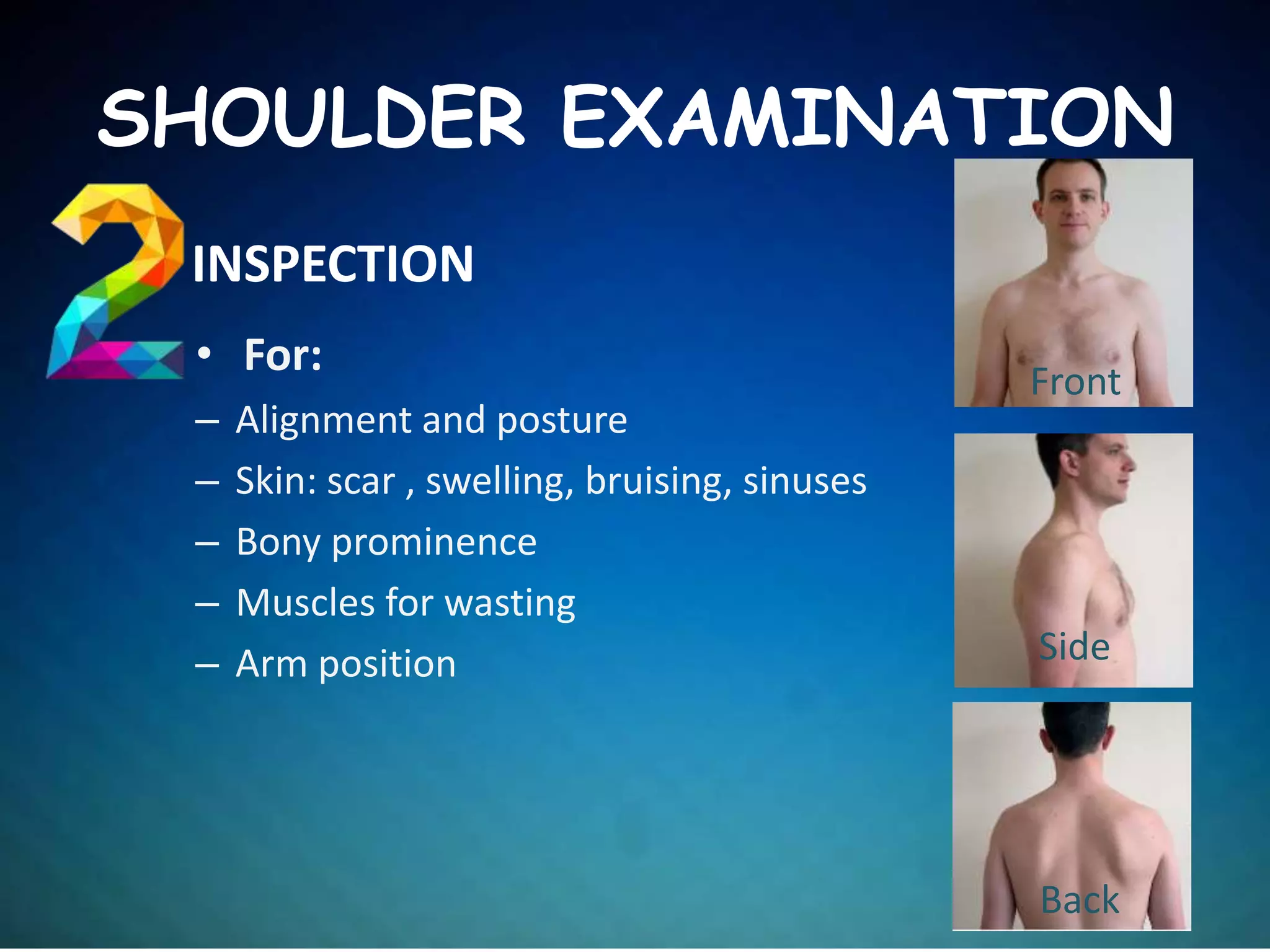
INSPECTION
• For:
–Alignment and posture
– Skin: scar , swelling, bruising, sinuses
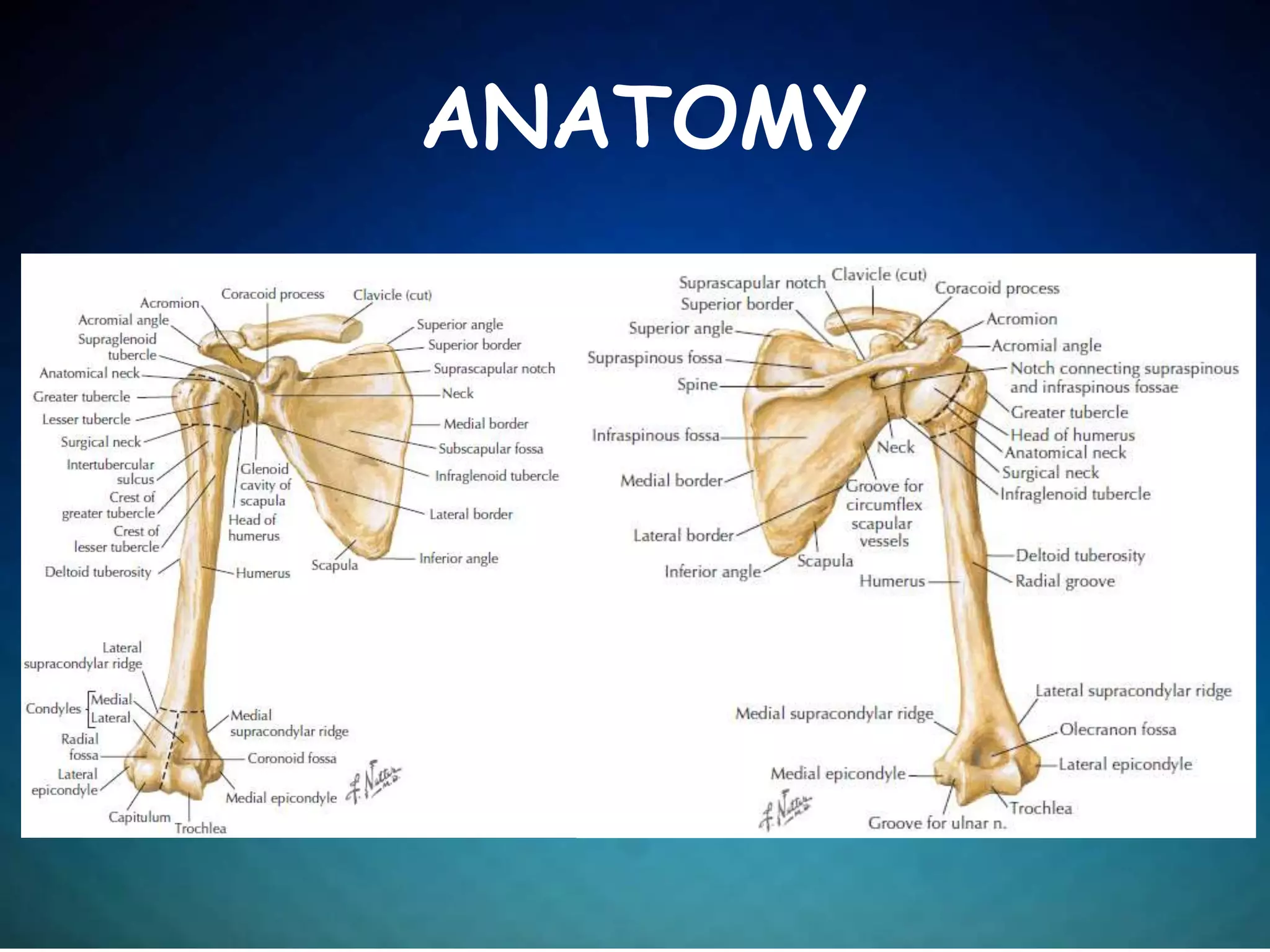
– Bony prominence
– Muscles for wasting
– Arm position
Front
Side
Back
FEEL
SHOULDER EXAMINATION
• overthe joint and its surrounding
areas for the TEMPERATURE
• Systematically feel along both sides
of the bony shoulder girdle for
TENDERNESS
• MUSCLES around the joint for any
tenderness.
• Check distal PULSES
15.
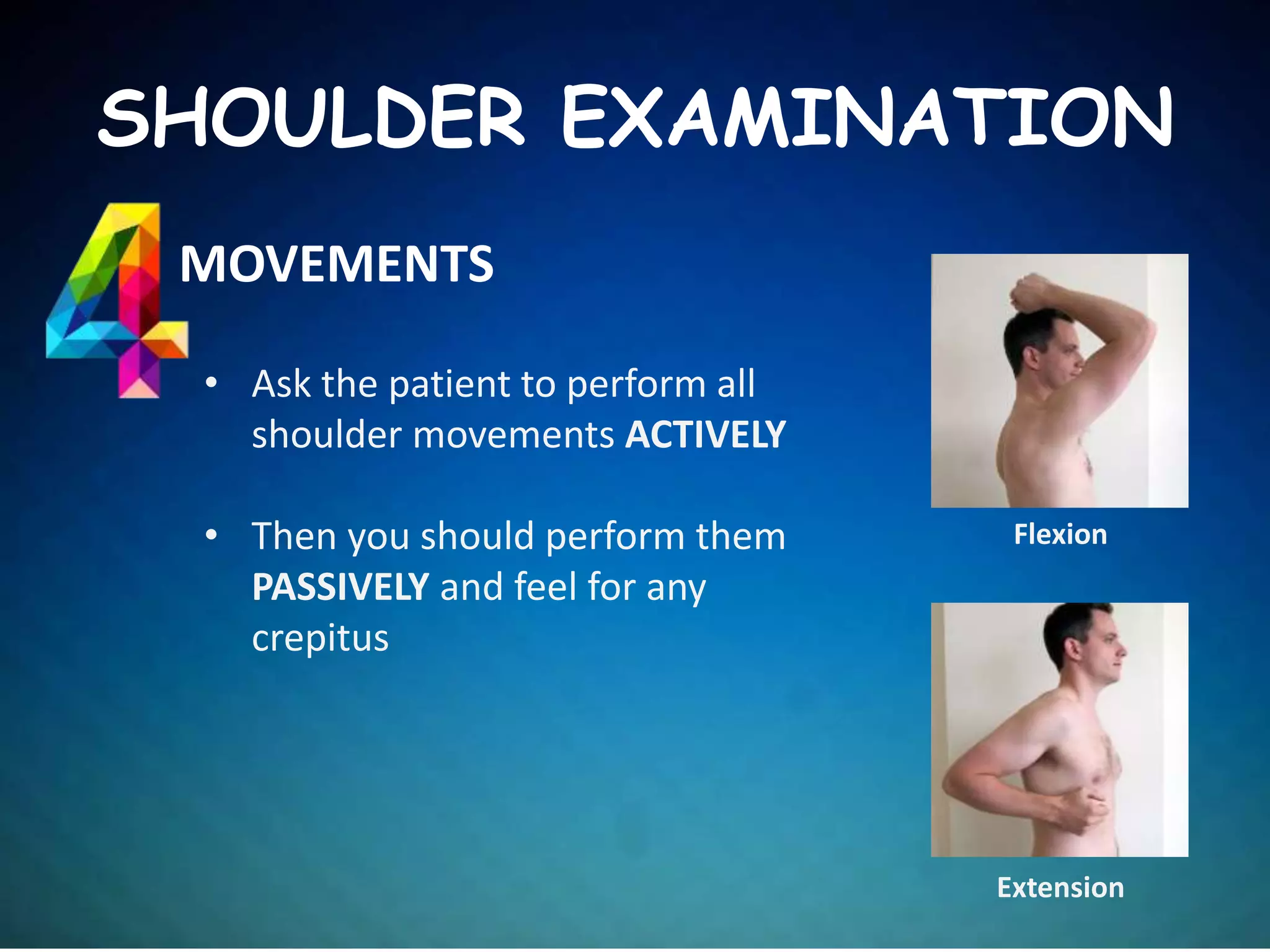
MOVEMENTS
SHOULDER EXAMINATION
• Askthe patient to perform all
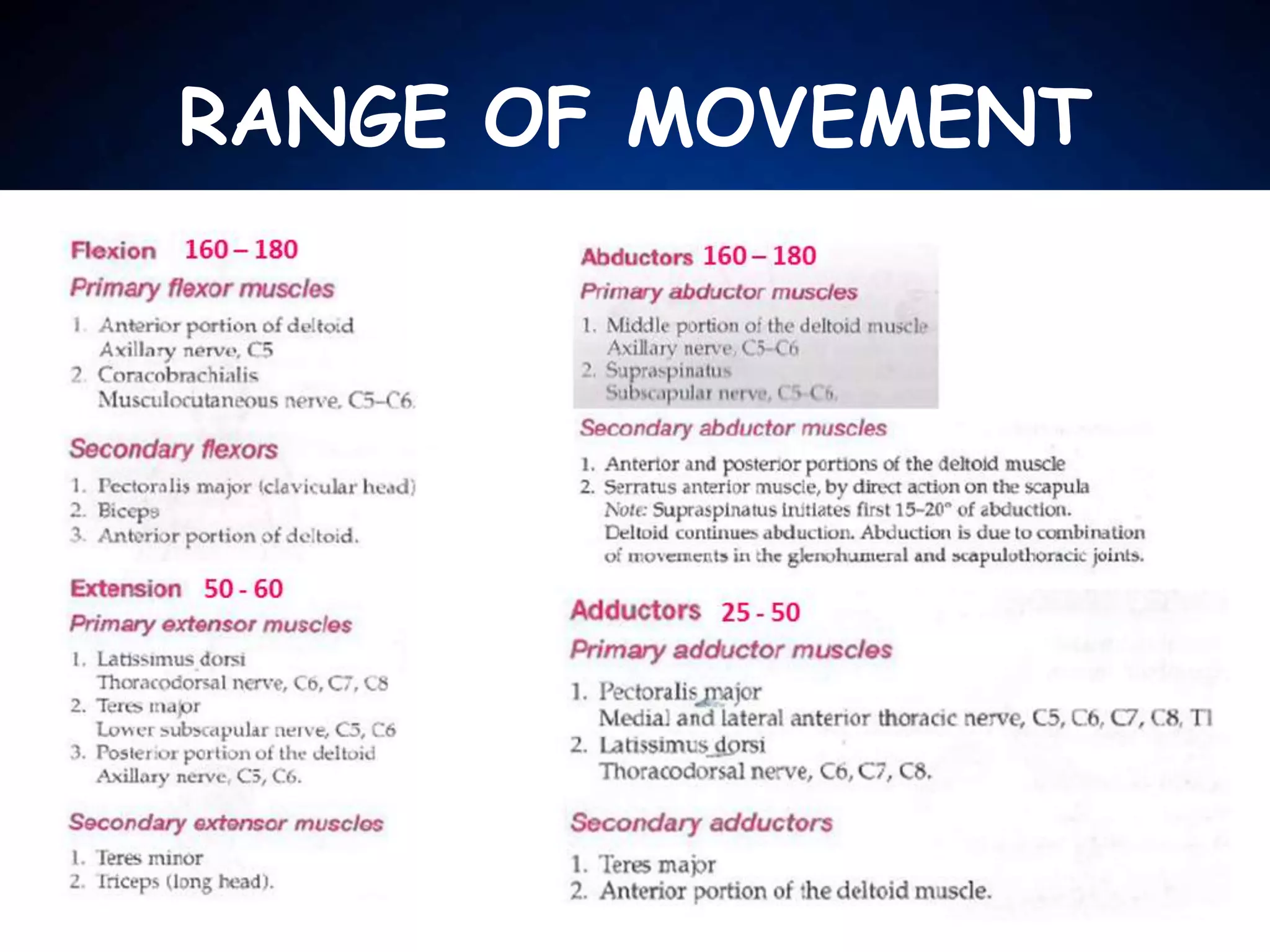
shoulder movements ACTIVELY
• Then you should perform them
PASSIVELY and feel for any
crepitus
Flexion
Extension
SPECIAL TESTS/ Impingementtest
SHOULDER EXAMINATION
Neer Impingement Sign
Neer Impingement Test
the test is repeated after injection of 10–15
mL of 1% xylocaine into the subacromial space
Neer Impingement Sign
19.
SPECIAL TESTS/ Impingementtest
SHOULDER EXAMINATION
Hawkins Test
Jobe’s Test (Empty Can Test)
Hawkins Test
Empty Can Test
20.
SPECIAL TESTS/ RotatorCuff Pathology
SHOULDER EXAMINATION
Supraspinatus Tests:
Supraspinatus Strength
Jobe (empty can)Test
Drop Arm Sign
Infraspinatus tests:
Infraspinatus Strength
External Rotation Lag Sign
21.
SPECIAL TESTS/ RotatorCuff Pathology
SHOULDER EXAMINATION
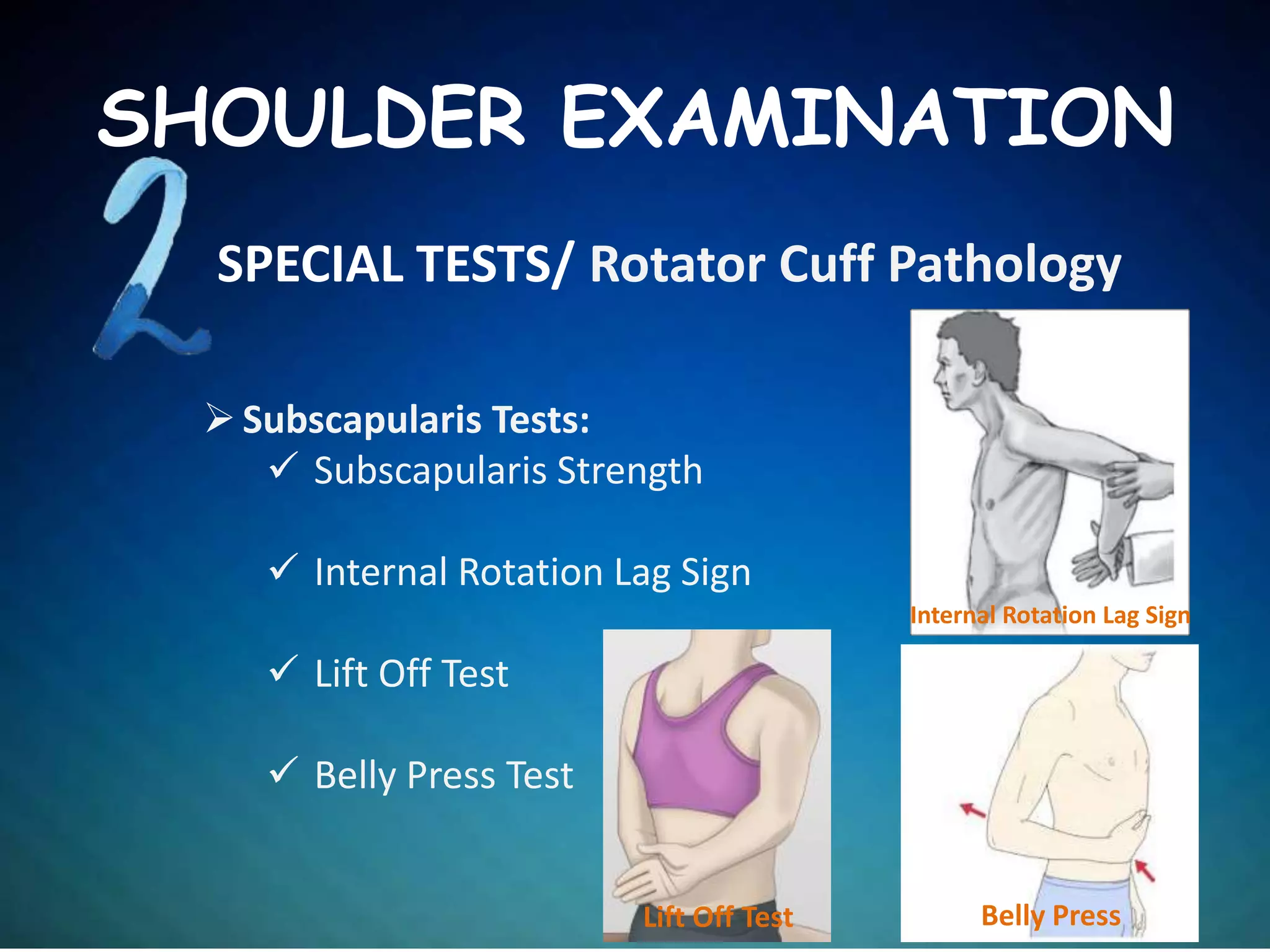
Subscapularis Tests:
Subscapularis Strength
Internal Rotation Lag Sign
Lift Off Test
Belly Press Test
Internal Rotation Lag Sign
Lift Off Test Belly Press
22.
SPECIAL TESTS/ RotatorCuff Pathology
SHOULDER EXAMINATION
Teres Minor tests:
Teres Minor Strength
Hornblower's sign
23.
SPECIAL TESTS/ Instabilitytests
SHOULDER EXAMINATION
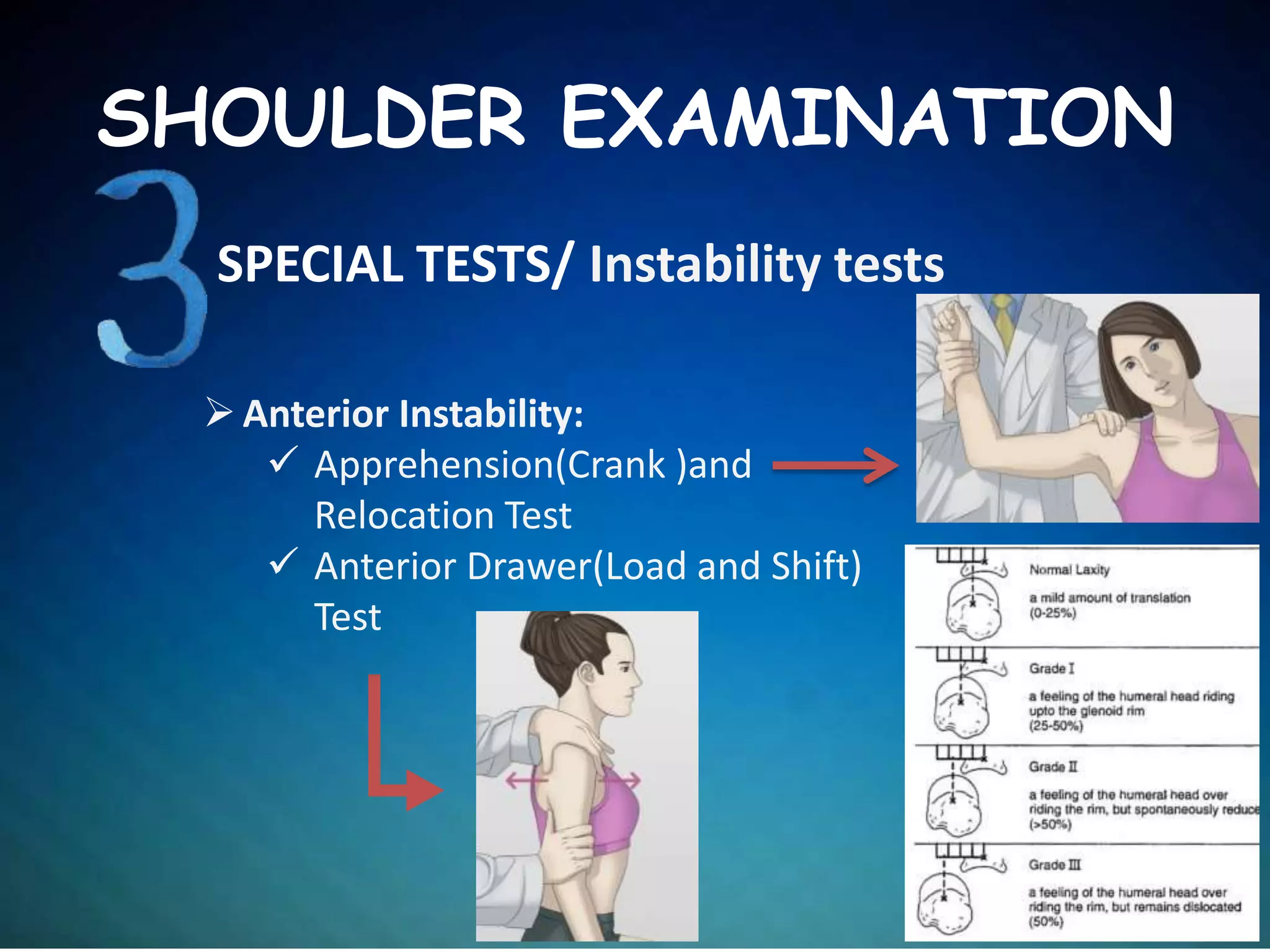
Anterior Instability:
Apprehension(Crank )and
Relocation Test
Anterior Drawer(Load and Shift)
Test
24.
SPECIAL TESTS/ Instabilitytests
SHOULDER EXAMINATION
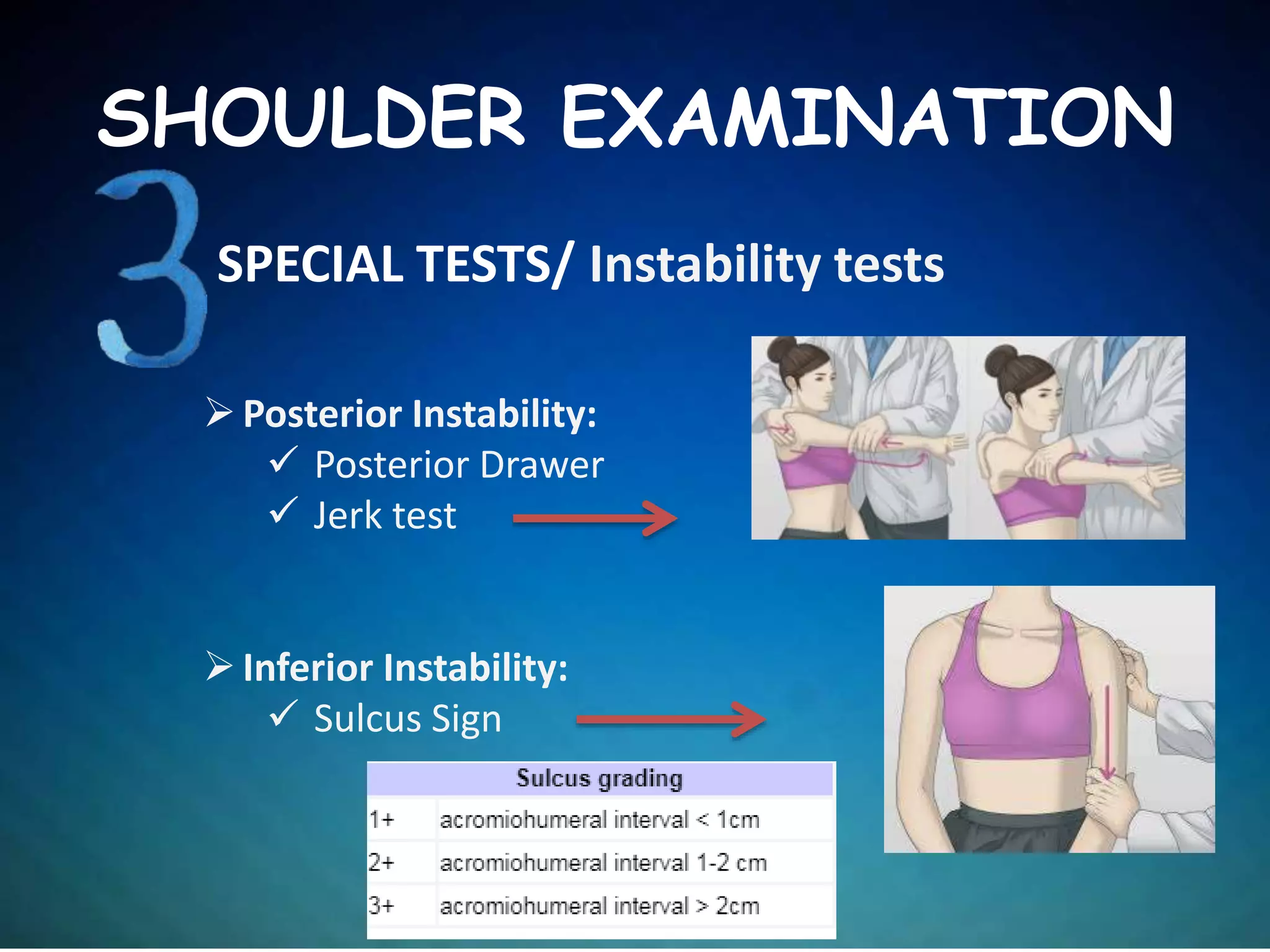
Posterior Instability:
Posterior Drawer
Jerk test
Inferior Instability:
Sulcus Sign
25.
SPECIAL TESTS/ Bicepstests
SHOULDER EXAMINATION
Bicipital Groove Tenderness
Tests:
Speed's Test
Yergason's Sign
Popeye Sign
Speed's Test
Yergason's test
26.
SPECIAL TESTS/ ACJoint
SHOULDER EXAMINATION
Acromioclavicular joint tenderness
Tests:
Cross-Body Adduction test
(scarf test)
AC Resisted Extension Test
Scarf Test
AC Resisted Extension Test
27.
SPECIAL TESTS/ Labrallesion
SHOULDER EXAMINATION
SLAP Lesion
Tests:
O’Brien’s test
1 2
28.
SPECIAL TESTS/ ThoracicOutlet Syndrome
SHOULDER EXAMINATION
Wright's Test
Adson’s test
Roo’s test
Wright's Test
Adson’s test
Roo’s test
29.
• Quick FunctionTest
SHOULDER EXAMINATION
Both Arms behind head
Both Arms behind back
Apley’s scratch test
30.
To Complete Exam….
SHOULDEREXAMINATION
Tell the examiner that you would like to
examine:
Joint above (Cervical Spine)
Joint below (Elbow Joint)
Neurovascular distal to the joint
31.
The End
SHOULDER EXAMINATION
allow the patient to dress
Thank them for their time
Wash your hands
Report your findings to the examiner.