Sp nal
nfection
Prepared by: Dr. Abdullah Kamal Ghafour
5th year IBFMS trainee
OSCE
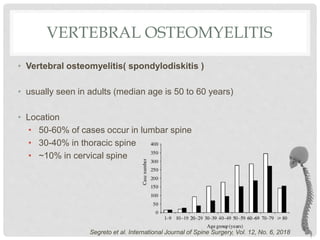
VERTEBRAL OSTEOMYELITIS
• Vertebral osteomyelitis( spondylodiskitis )
• usually seen in adults (median age is 50 to 60 years)
• Location
• 50-60% of cases occur in lumbar spine
• 30-40% in thoracic spine
• ~10% in cervical spine
Segreto et al. International Journal of Spine Surgery, Vol. 12, No. 6, 2018
• Risk factors include
• IV drug abuse
• diabetes
• recent systemic infection (UTI, pneumonia)
• obesity
• malignancy
• immunodeficiency or immunosuppressive medications
• malnutrition (serum albumin < 3 g/dL indicative of malnutrition)
• trauma
• smoking
• Pathogens:
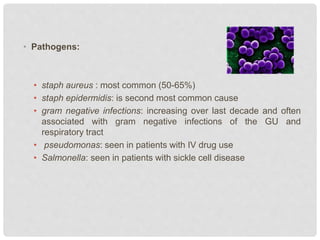
• staph aureus : most common (50-65%)
• staph epidermidis: is second most common cause
• gram negative infections: increasing over last decade and often
associated with gram negative infections of the GU and
respiratory tract
• pseudomonas: seen in patients with IV drug use
• Salmonella: seen in patients with sickle cell disease
• inoculation:
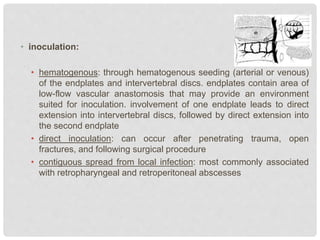
• hematogenous: through hematogenous seeding (arterial or venous)
of the endplates and intervertebral discs. endplates contain area of
low-flow vascular anastomosis that may provide an environment
suited for inoculation. involvement of one endplate leads to direct
extension into intervertebral discs, followed by direct extension into
the second endplate
• direct inoculation: can occur after penetrating trauma, open
fractures, and following surgical procedure
• contiguous spread from local infection: most commonly associated
with retropharyngeal and retroperitoneal abscesses
• Presentation:
• History of UTI, pneumonia, skin infection, of organ transplant are
common
• Symptoms:
 fever is only present in 1/3 of patients
 Pain is severe and insidious in onset, usually worse with activity
and unrelenting in nature, awakens patients at night should raise
concern for malignancy and infection
• neurologic symptoms present in 10-20%
 radiculopathy
 myelopathy
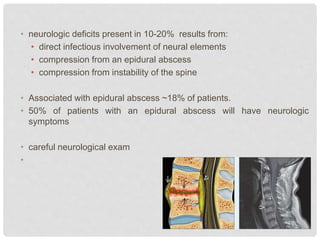
• neurologic deficits present in 10-20% results from:
• direct infectious involvement of neural elements
• compression from an epidural abscess
• compression from instability of the spine
• Associated with epidural abscess ~18% of patients.
• 50% of patients with an epidural abscess will have neurologic
symptoms
• careful neurological exam
•
• Imaging:
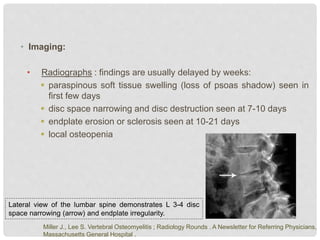
• Radiographs : findings are usually delayed by weeks:
 paraspinous soft tissue swelling (loss of psoas shadow) seen in
first few days
 disc space narrowing and disc destruction seen at 7-10 days
 endplate erosion or sclerosis seen at 10-21 days
 local osteopenia
Lateral view of the lumbar spine demonstrates L 3-4 disc
space narrowing (arrow) and endplate irregularity.
Miller J., Lee S. Vertebral Osteomyelitis ; Radiology Rounds . A Newsletter for Referring Physicians,
Massachusetts General Hospital .
• Imaging:
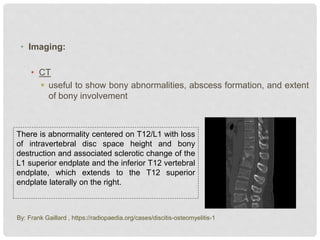
• CT
 useful to show bony abnormalities, abscess formation, and extent
of bony involvement
There is abnormality centered on T12/L1 with loss
of intravertebral disc space height and bony
destruction and associated sclerotic change of the
L1 superior endplate and the inferior T12 vertebral
endplate, which extends to the T12 superior
endplate laterally on the right.
By: Frank Gaillard , https://radiopaedia.org/cases/discitis-osteomyelitis-1
• Imaging:
• MRI with gadolinium contrast:
• gold standard for diagnosis and treatment and to differentiate from
tumor
• sensitivity (96%) and specificity (93%)
• findings include
 paraspinal and epidural inflammation
 disc and endplate enhancement with gadolinium
 T2-weighted hyperintensity of the disc and endplate (rim
enhancing )
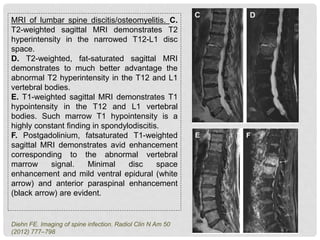
MRI of lumbar spine discitis/osteomyelitis. C.
T2-weighted sagittal MRI demonstrates T2
hyperintensity in the narrowed T12-L1 disc
space.
D. T2-weighted, fat-saturated sagittal MRI
demonstrates to much better advantage the
abnormal T2 hyperintensity in the T12 and L1
vertebral bodies.
E. T1-weighted sagittal MRI demonstrates T1
hypointensity in the T12 and L1 vertebral
bodies. Such marrow T1 hypointensity is a
highly constant finding in spondylodiscitis.
F. Postgadolinium, fatsaturated T1-weighted
sagittal MRI demonstrates avid enhancement
corresponding to the abnormal vertebral
marrow signal. Minimal disc space
enhancement and mild ventral epidural (white
arrow) and anterior paraspinal enhancement
(black arrow) are evident.
Diehn FE. Imaging of spine infection. Radiol Clin N Am 50
(2012) 777–798
• Imaging:
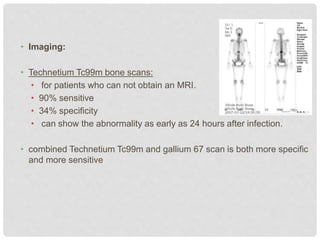
• Technetium Tc99m bone scans:
• for patients who can not obtain an MRI.
• 90% sensitive
• 34% specificity
• can show the abnormality as early as 24 hours after infection.
• combined Technetium Tc99m and gallium 67 scan is both more specific
and more sensitive
• Laboratory studies:
• WBC elevated only in ~ 50% not a sensitive indicator for early
infection
• ESR elevated in 90% of cases can be monitored serially to track
success of treatment, however is considered less reliable than CRP
• CRP elevated in 90% of cases can be monitored serially to track
success of treatment and is considered more reliable than ESR
• Blood cultures
• Biopsy
• Laboratory studies:
• Blood cultures
 identification of organism is mandatory for treatment
 least invasive method to determine a diagnosis
 ~33% have positive blood cultures
 when positive 85% are accurate for isolating the correct organism
 blood culture yield is improved by withholding antibiotic and
obtaining cultures when patient is febrile
• Laboratory studies:
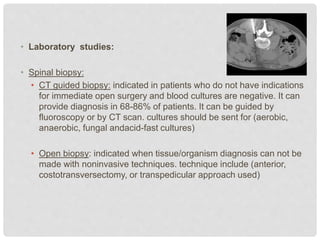
• Spinal biopsy:
• CT guided biopsy: indicated in patients who do not have indications
for immediate open surgery and blood cultures are negative. It can
provide diagnosis in 68-86% of patients. It can be guided by
fluoroscopy or by CT scan. cultures should be sent for (aerobic,
anaerobic, fungal andacid-fast cultures)
• Open biopsy: indicated when tissue/organism diagnosis can not be
made with noninvasive techniques. technique include (anterior,
costotransversectomy, or transpedicular approach used)
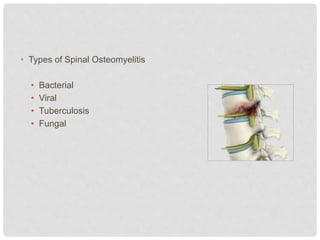
• Types of Spinal Osteomyelitis
• Bacterial
• Viral
• Tuberculosis
• Fungal
• Treatment
• Non-operative
 bracing and long term antibiotic (6-12 weeks)
 helps improve pain and prevent deformity
 IV (~ 4-6 weeks) and then converted to PO antibiotics
 outcomes : successful in 80%
• Treatment
• Operative indications:
 refractory cases
 neurologic deficits
 progressive deformity & gross spinal instability
EPIDURAL ABSCESS
• It is a collection of pus or inflammatory granulation tissue between
the duramater and surrounding adipose tissue.
• usually seen in adults > 60 years of age usually dorsal in
thoracolumbar spine
• risk factors
• IV drug abuse
• immunodeficiency
• malignancy
• HIV
• immunosuppressive medications
• recent spinal procedure
• 33% of patients with an epidural abscess will have neurologic
symptoms
• often associated with vertebral osteomyelitis and discitis
(spondylodiscitis)
• mortality ~ 5%
• Imaging
• Radiographs: usually normal
• CT: poor sensitivity for epidural abscess
• CT myelogram: 90% sensitivity but invasive
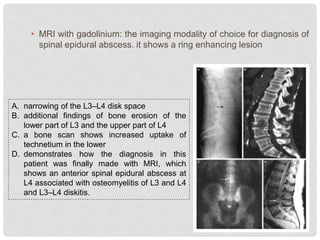
• MRI with gadolinium: the imaging modality of choice for diagnosis of
spinal epidural abscess. it shows a ring enhancing lesion
A. narrowing of the L3–L4 disk space
B. additional findings of bone erosion of the
lower part of L3 and the upper part of L4
C. a bone scan shows increased uptake of
technetium in the lower
D. demonstrates how the diagnosis in this
patient was finally made with MRI, which
shows an anterior spinal epidural abscess at
L4 associated with osteomyelitis of L3 and L4
and L3–L4 diskitis.
• Treatment
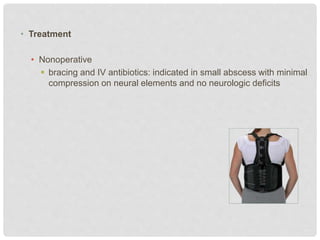
• Nonoperative
 bracing and IV antibiotics: indicated in small abscess with minimal
compression on neural elements and no neurologic deficits
• Treatment
• Operative: surgical decompression +/- spinal stabilization indicated
in:
 neurologic deficits present
 evidence of spinal cord compression on imaging studies
 persistent infection despite antibiotic therapy
 progressive deformity or gross spinal instability
SPINAL TUBERCULOSIS
POTT'S DISEASE
• 15% TB have extra-pulmonary and thoracic spine is the most
common site
• Early infection begins in the metaphysis of the vertebral body
and spreads under the anterior longitudinal ligament and leads to:
 Contiguous multilevel involvement
 Skip lesion or noncontiguous segments (15%)
 Paraspinal abscess formation (50%) usually anterior
 Initially does not involve the disc space
• Chronic infection leads to severe kyphosis
 In adults kyphosis stays static after healing of disease
 in children kyphosis progresses in 40% of cases
• symptoms
• onset of symptoms of tuberculous spondylitis is typically more insidious
than pyogenic infection (constitutional symptoms , chronic illness,
malaise , night sweats, weight loss, back pain which is often a late
symptom )
• Physical exam
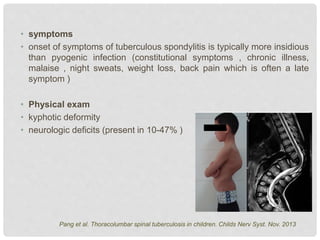
• kyphotic deformity
• neurologic deficits (present in 10-47% )
Pang et al. Thoracolumbar spinal tuberculosis in children. Childs Nerv Syst. Nov. 2013
• Imaging
• CXR: 66% will have an abnormal CXR
• Spine radiographs
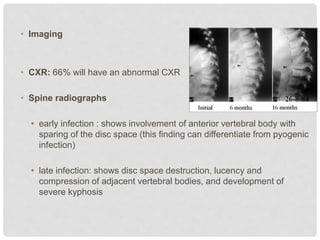
• early infection : shows involvement of anterior vertebral body with
sparing of the disc space (this finding can differentiate from pyogenic
infection)
• late infection: shows disc space destruction, lucency and
compression of adjacent vertebral bodies, and development of
severe kyphosis
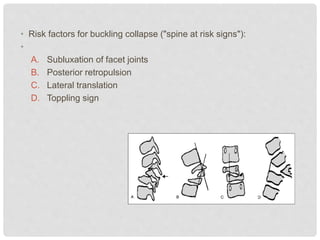
• Risk factors for buckling collapse ("spine at risk signs"):
•
A. Subluxation of facet joints
B. Posterior retropulsion
C. Lateral translation
D. Toppling sign
• Imaging
• MRI with gadolinium contrast: remains preferred imaging study for
diagnosis and treatment
• MRI findings :
• low signal on T1and bright signal on T2
• presence of a septate pre-/ paravertebral / intra-osseous smooth
walled abscess
• end-plate disruption: sensitivity 100%, specificity 81%
• paravertebral soft tissue shadow: sensitivity 97%, specificity 85%
• high signal intensity of the disc on the T2-weighted image: sensitivity
81%, specificity 82%
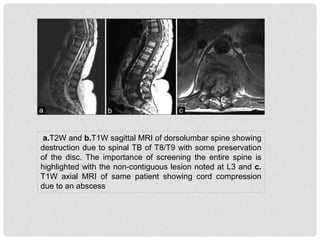
a.T2W and b.T1W sagittal MRI of dorsolumbar spine showing
destruction due to spinal TB of T8/T9 with some preservation
of the disc. The importance of screening the entire spine is
highlighted with the non-contiguous lesion noted at L3 and c.
T1W axial MRI of same patient showing cord compression
due to an abscess
• Imaging
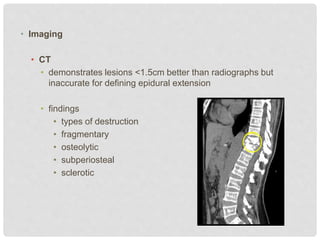
• CT
• demonstrates lesions <1.5cm better than radiographs but
inaccurate for defining epidural extension
• findings
• types of destruction
• fragmentary
• osteolytic
• subperiosteal
• sclerotic
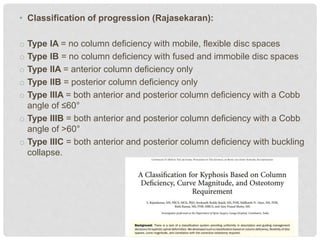
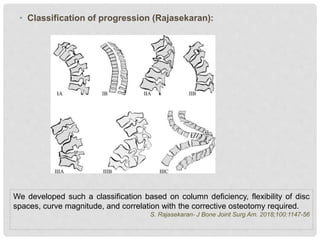
• Classification of progression (Rajasekaran):
o Type IA = no column deficiency with mobile, flexible disc spaces
o Type IB = no column deficiency with fused and immobile disc spaces
o Type IIA = anterior column deficiency only
o Type IIB = posterior column deficiency only
o Type IIIA = both anterior and posterior column deficiency with a Cobb
angle of ≤60°
o Type IIIB = both anterior and posterior column deficiency with a Cobb
angle of >60°
o Type IIIC = both anterior and posterior column deficiency with buckling
collapse.
• Classification of progression (Rajasekaran):
We developed such a classification based on column deficiency, flexibility of disc
spaces, curve magnitude, and correlation with the corrective osteotomy required.
S. Rajasekaran- J Bone Joint Surg Am. 2018;100:1147-56
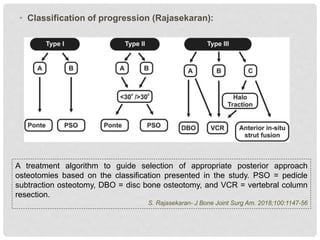
• Classification of progression (Rajasekaran):
A treatment algorithm to guide selection of appropriate posterior approach
osteotomies based on the classification presented in the study. PSO = pedicle
subtraction osteotomy, DBO = disc bone osteotomy, and VCR = vertebral column
resection.
S. Rajasekaran- J Bone Joint Surg Am. 2018;100:1147-56
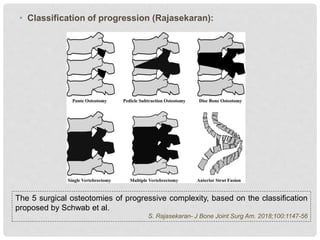
• Classification of progression (Rajasekaran):
The 5 surgical osteotomies of progressive complexity, based on the classification
proposed by Schwab et al.
S. Rajasekaran- J Bone Joint Surg Am. 2018;100:1147-56
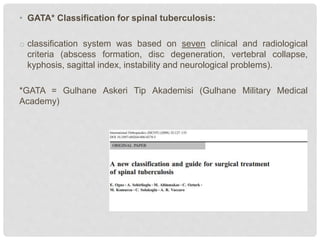
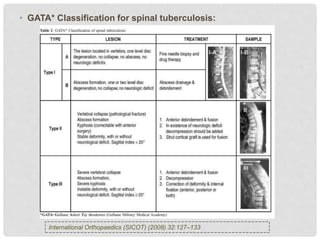
• GATA* Classification for spinal tuberculosis:
o classification system was based on seven clinical and radiological
criteria (abscess formation, disc degeneration, vertebral collapse,
kyphosis, sagittal index, instability and neurological problems).
*GATA = Gulhane Askeri Tip Akademisi (Gulhane Military Medical
Academy)
• GATA* Classification for spinal tuberculosis:
International Orthopaedics (SICOT) (2008) 32:127–133
• CBC
• relative lymphocytosis
• low hemoglobin
• ESR usually elevated but may be normal in up to 25%
• PPD (purified protein derivative of tuberculin) positive in ~ 80%
• Diagnosis
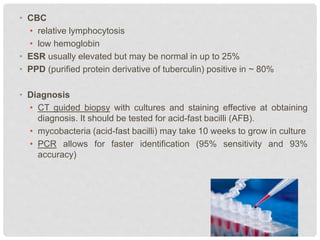
• CT guided biopsy with cultures and staining effective at obtaining
diagnosis. It should be tested for acid-fast bacilli (AFB).
• mycobacteria (acid-fast bacilli) may take 10 weeks to grow in culture
• PCR allows for faster identification (95% sensitivity and 93%
accuracy)
• Treatment
 Non-operative:
• pharmacologic treatment +/- spinal orthosis
• indicated in no neurological deficit
• pharmacologic agents : isoniazid (H), rifampin (R), ethambutol (E)
and pyrazanamide (Z) therapy
• regimen : RHZE for 2 months, then RH for 9 to 18 months
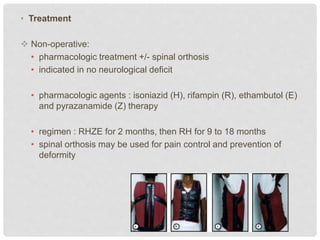
• spinal orthosis may be used for pain control and prevention of
deformity
• Treatment
 Operative indications:
• worsening neurological deficit
• acute severe paraplegia
• panvertebral involvement with/without subluxation/dislocation
• spinal instability
• kyphosis correction
 > 60° in adult
 progressive kyphosis in child:children ≤ 7 years with ≥3 vertebral
bodies affected in T/TL spine and ≥ 2 at risk signs are likely to
have progression and should undergo correction
• advanced disease with caseation preventing access by antibiotics
• failure of non-operative treatment after 3 to 6 months
• diagnosis uncertain
• Treatment
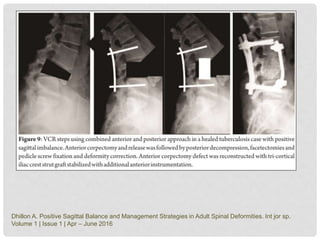
 Operative procedures:
• anterior decompression/corpectomy, strut grafting ± posterior
instrumented stabilization ± posterior column shortening
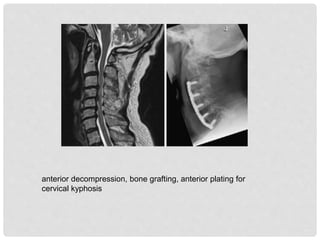
• Halo traction, anterior decompression, bone grafting, anterior plating
for cervical kyphosis
• Pedicle subtraction osteotomy for lumbar kyphosis
• Direct decompression / internal kyphectomy for correction of healed
thoracic/thoracolumbar kyphosis
Dhillon A. Positive Sagittal Balance and Management Strategies in Adult Spinal Deformities. Int jor sp.
Volume 1 | Issue 1 | Apr – June 2016
anterior decompression, bone grafting, anterior plating for
cervical kyphosis
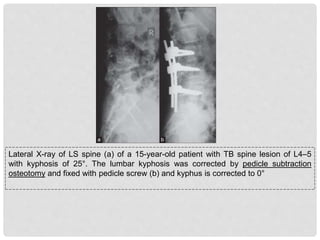
Lateral X-ray of LS spine (a) of a 15-year-old patient with TB spine lesion of L4–5
with kyphosis of 25°. The lumbar kyphosis was corrected by pedicle subtraction
osteotomy and fixed with pedicle screw (b) and kyphus is corrected to 0°
Thank You

Spinal infection

  • 1.
    Sp nal nfection Prepared by:Dr. Abdullah Kamal Ghafour 5th year IBFMS trainee OSCE
  • 2.
    VERTEBRAL OSTEOMYELITIS • Vertebralosteomyelitis( spondylodiskitis ) • usually seen in adults (median age is 50 to 60 years) • Location • 50-60% of cases occur in lumbar spine • 30-40% in thoracic spine • ~10% in cervical spine Segreto et al. International Journal of Spine Surgery, Vol. 12, No. 6, 2018
  • 3.
    • Risk factorsinclude • IV drug abuse • diabetes • recent systemic infection (UTI, pneumonia) • obesity • malignancy • immunodeficiency or immunosuppressive medications • malnutrition (serum albumin < 3 g/dL indicative of malnutrition) • trauma • smoking
  • 4.
    • Pathogens: • staphaureus : most common (50-65%) • staph epidermidis: is second most common cause • gram negative infections: increasing over last decade and often associated with gram negative infections of the GU and respiratory tract • pseudomonas: seen in patients with IV drug use • Salmonella: seen in patients with sickle cell disease
  • 5.
    • inoculation: • hematogenous:through hematogenous seeding (arterial or venous) of the endplates and intervertebral discs. endplates contain area of low-flow vascular anastomosis that may provide an environment suited for inoculation. involvement of one endplate leads to direct extension into intervertebral discs, followed by direct extension into the second endplate • direct inoculation: can occur after penetrating trauma, open fractures, and following surgical procedure • contiguous spread from local infection: most commonly associated with retropharyngeal and retroperitoneal abscesses
  • 6.
    • Presentation: • Historyof UTI, pneumonia, skin infection, of organ transplant are common • Symptoms:  fever is only present in 1/3 of patients  Pain is severe and insidious in onset, usually worse with activity and unrelenting in nature, awakens patients at night should raise concern for malignancy and infection • neurologic symptoms present in 10-20%  radiculopathy  myelopathy
  • 7.
    • neurologic deficitspresent in 10-20% results from: • direct infectious involvement of neural elements • compression from an epidural abscess • compression from instability of the spine • Associated with epidural abscess ~18% of patients. • 50% of patients with an epidural abscess will have neurologic symptoms • careful neurological exam •
  • 8.
    • Imaging: • Radiographs: findings are usually delayed by weeks:  paraspinous soft tissue swelling (loss of psoas shadow) seen in first few days  disc space narrowing and disc destruction seen at 7-10 days  endplate erosion or sclerosis seen at 10-21 days  local osteopenia Lateral view of the lumbar spine demonstrates L 3-4 disc space narrowing (arrow) and endplate irregularity. Miller J., Lee S. Vertebral Osteomyelitis ; Radiology Rounds . A Newsletter for Referring Physicians, Massachusetts General Hospital .
  • 9.
    • Imaging: • CT useful to show bony abnormalities, abscess formation, and extent of bony involvement There is abnormality centered on T12/L1 with loss of intravertebral disc space height and bony destruction and associated sclerotic change of the L1 superior endplate and the inferior T12 vertebral endplate, which extends to the T12 superior endplate laterally on the right. By: Frank Gaillard , https://radiopaedia.org/cases/discitis-osteomyelitis-1
  • 10.
    • Imaging: • MRIwith gadolinium contrast: • gold standard for diagnosis and treatment and to differentiate from tumor • sensitivity (96%) and specificity (93%) • findings include  paraspinal and epidural inflammation  disc and endplate enhancement with gadolinium  T2-weighted hyperintensity of the disc and endplate (rim enhancing )
  • 11.
    MRI of lumbarspine discitis/osteomyelitis. C. T2-weighted sagittal MRI demonstrates T2 hyperintensity in the narrowed T12-L1 disc space. D. T2-weighted, fat-saturated sagittal MRI demonstrates to much better advantage the abnormal T2 hyperintensity in the T12 and L1 vertebral bodies. E. T1-weighted sagittal MRI demonstrates T1 hypointensity in the T12 and L1 vertebral bodies. Such marrow T1 hypointensity is a highly constant finding in spondylodiscitis. F. Postgadolinium, fatsaturated T1-weighted sagittal MRI demonstrates avid enhancement corresponding to the abnormal vertebral marrow signal. Minimal disc space enhancement and mild ventral epidural (white arrow) and anterior paraspinal enhancement (black arrow) are evident. Diehn FE. Imaging of spine infection. Radiol Clin N Am 50 (2012) 777–798
  • 12.
    • Imaging: • TechnetiumTc99m bone scans: • for patients who can not obtain an MRI. • 90% sensitive • 34% specificity • can show the abnormality as early as 24 hours after infection. • combined Technetium Tc99m and gallium 67 scan is both more specific and more sensitive
  • 13.
    • Laboratory studies: •WBC elevated only in ~ 50% not a sensitive indicator for early infection • ESR elevated in 90% of cases can be monitored serially to track success of treatment, however is considered less reliable than CRP • CRP elevated in 90% of cases can be monitored serially to track success of treatment and is considered more reliable than ESR • Blood cultures • Biopsy
  • 14.
    • Laboratory studies: •Blood cultures  identification of organism is mandatory for treatment  least invasive method to determine a diagnosis  ~33% have positive blood cultures  when positive 85% are accurate for isolating the correct organism  blood culture yield is improved by withholding antibiotic and obtaining cultures when patient is febrile
  • 15.
    • Laboratory studies: •Spinal biopsy: • CT guided biopsy: indicated in patients who do not have indications for immediate open surgery and blood cultures are negative. It can provide diagnosis in 68-86% of patients. It can be guided by fluoroscopy or by CT scan. cultures should be sent for (aerobic, anaerobic, fungal andacid-fast cultures) • Open biopsy: indicated when tissue/organism diagnosis can not be made with noninvasive techniques. technique include (anterior, costotransversectomy, or transpedicular approach used)
  • 16.
    • Types ofSpinal Osteomyelitis • Bacterial • Viral • Tuberculosis • Fungal
  • 17.
    • Treatment • Non-operative bracing and long term antibiotic (6-12 weeks)  helps improve pain and prevent deformity  IV (~ 4-6 weeks) and then converted to PO antibiotics  outcomes : successful in 80%
  • 18.
    • Treatment • Operativeindications:  refractory cases  neurologic deficits  progressive deformity & gross spinal instability
  • 19.
    EPIDURAL ABSCESS • Itis a collection of pus or inflammatory granulation tissue between the duramater and surrounding adipose tissue. • usually seen in adults > 60 years of age usually dorsal in thoracolumbar spine • risk factors • IV drug abuse • immunodeficiency • malignancy • HIV • immunosuppressive medications • recent spinal procedure
  • 20.
    • 33% ofpatients with an epidural abscess will have neurologic symptoms • often associated with vertebral osteomyelitis and discitis (spondylodiscitis) • mortality ~ 5% • Imaging • Radiographs: usually normal • CT: poor sensitivity for epidural abscess • CT myelogram: 90% sensitivity but invasive
  • 21.
    • MRI withgadolinium: the imaging modality of choice for diagnosis of spinal epidural abscess. it shows a ring enhancing lesion A. narrowing of the L3–L4 disk space B. additional findings of bone erosion of the lower part of L3 and the upper part of L4 C. a bone scan shows increased uptake of technetium in the lower D. demonstrates how the diagnosis in this patient was finally made with MRI, which shows an anterior spinal epidural abscess at L4 associated with osteomyelitis of L3 and L4 and L3–L4 diskitis.
  • 22.
    • Treatment • Nonoperative bracing and IV antibiotics: indicated in small abscess with minimal compression on neural elements and no neurologic deficits
  • 23.
    • Treatment • Operative:surgical decompression +/- spinal stabilization indicated in:  neurologic deficits present  evidence of spinal cord compression on imaging studies  persistent infection despite antibiotic therapy  progressive deformity or gross spinal instability
  • 24.
    SPINAL TUBERCULOSIS POTT'S DISEASE •15% TB have extra-pulmonary and thoracic spine is the most common site • Early infection begins in the metaphysis of the vertebral body and spreads under the anterior longitudinal ligament and leads to:  Contiguous multilevel involvement  Skip lesion or noncontiguous segments (15%)  Paraspinal abscess formation (50%) usually anterior  Initially does not involve the disc space • Chronic infection leads to severe kyphosis  In adults kyphosis stays static after healing of disease  in children kyphosis progresses in 40% of cases
  • 25.
    • symptoms • onsetof symptoms of tuberculous spondylitis is typically more insidious than pyogenic infection (constitutional symptoms , chronic illness, malaise , night sweats, weight loss, back pain which is often a late symptom ) • Physical exam • kyphotic deformity • neurologic deficits (present in 10-47% ) Pang et al. Thoracolumbar spinal tuberculosis in children. Childs Nerv Syst. Nov. 2013
  • 26.
    • Imaging • CXR:66% will have an abnormal CXR • Spine radiographs • early infection : shows involvement of anterior vertebral body with sparing of the disc space (this finding can differentiate from pyogenic infection) • late infection: shows disc space destruction, lucency and compression of adjacent vertebral bodies, and development of severe kyphosis
  • 27.
    • Risk factorsfor buckling collapse ("spine at risk signs"): • A. Subluxation of facet joints B. Posterior retropulsion C. Lateral translation D. Toppling sign
  • 28.
    • Imaging • MRIwith gadolinium contrast: remains preferred imaging study for diagnosis and treatment • MRI findings : • low signal on T1and bright signal on T2 • presence of a septate pre-/ paravertebral / intra-osseous smooth walled abscess • end-plate disruption: sensitivity 100%, specificity 81% • paravertebral soft tissue shadow: sensitivity 97%, specificity 85% • high signal intensity of the disc on the T2-weighted image: sensitivity 81%, specificity 82%
  • 29.
    a.T2W and b.T1Wsagittal MRI of dorsolumbar spine showing destruction due to spinal TB of T8/T9 with some preservation of the disc. The importance of screening the entire spine is highlighted with the non-contiguous lesion noted at L3 and c. T1W axial MRI of same patient showing cord compression due to an abscess
  • 30.
    • Imaging • CT •demonstrates lesions <1.5cm better than radiographs but inaccurate for defining epidural extension • findings • types of destruction • fragmentary • osteolytic • subperiosteal • sclerotic
  • 31.
    • Classification ofprogression (Rajasekaran): o Type IA = no column deficiency with mobile, flexible disc spaces o Type IB = no column deficiency with fused and immobile disc spaces o Type IIA = anterior column deficiency only o Type IIB = posterior column deficiency only o Type IIIA = both anterior and posterior column deficiency with a Cobb angle of ≤60° o Type IIIB = both anterior and posterior column deficiency with a Cobb angle of >60° o Type IIIC = both anterior and posterior column deficiency with buckling collapse.
  • 32.
    • Classification ofprogression (Rajasekaran): We developed such a classification based on column deficiency, flexibility of disc spaces, curve magnitude, and correlation with the corrective osteotomy required. S. Rajasekaran- J Bone Joint Surg Am. 2018;100:1147-56
  • 33.
    • Classification ofprogression (Rajasekaran): A treatment algorithm to guide selection of appropriate posterior approach osteotomies based on the classification presented in the study. PSO = pedicle subtraction osteotomy, DBO = disc bone osteotomy, and VCR = vertebral column resection. S. Rajasekaran- J Bone Joint Surg Am. 2018;100:1147-56
  • 34.
    • Classification ofprogression (Rajasekaran): The 5 surgical osteotomies of progressive complexity, based on the classification proposed by Schwab et al. S. Rajasekaran- J Bone Joint Surg Am. 2018;100:1147-56
  • 35.
    • GATA* Classificationfor spinal tuberculosis: o classification system was based on seven clinical and radiological criteria (abscess formation, disc degeneration, vertebral collapse, kyphosis, sagittal index, instability and neurological problems). *GATA = Gulhane Askeri Tip Akademisi (Gulhane Military Medical Academy)
  • 36.
    • GATA* Classificationfor spinal tuberculosis: International Orthopaedics (SICOT) (2008) 32:127–133
  • 37.
    • CBC • relativelymphocytosis • low hemoglobin • ESR usually elevated but may be normal in up to 25% • PPD (purified protein derivative of tuberculin) positive in ~ 80% • Diagnosis • CT guided biopsy with cultures and staining effective at obtaining diagnosis. It should be tested for acid-fast bacilli (AFB). • mycobacteria (acid-fast bacilli) may take 10 weeks to grow in culture • PCR allows for faster identification (95% sensitivity and 93% accuracy)
  • 38.
    • Treatment  Non-operative: •pharmacologic treatment +/- spinal orthosis • indicated in no neurological deficit • pharmacologic agents : isoniazid (H), rifampin (R), ethambutol (E) and pyrazanamide (Z) therapy • regimen : RHZE for 2 months, then RH for 9 to 18 months • spinal orthosis may be used for pain control and prevention of deformity
  • 39.
    • Treatment  Operativeindications: • worsening neurological deficit • acute severe paraplegia • panvertebral involvement with/without subluxation/dislocation • spinal instability • kyphosis correction  > 60° in adult  progressive kyphosis in child:children ≤ 7 years with ≥3 vertebral bodies affected in T/TL spine and ≥ 2 at risk signs are likely to have progression and should undergo correction • advanced disease with caseation preventing access by antibiotics • failure of non-operative treatment after 3 to 6 months • diagnosis uncertain
  • 40.
    • Treatment  Operativeprocedures: • anterior decompression/corpectomy, strut grafting ± posterior instrumented stabilization ± posterior column shortening • Halo traction, anterior decompression, bone grafting, anterior plating for cervical kyphosis • Pedicle subtraction osteotomy for lumbar kyphosis • Direct decompression / internal kyphectomy for correction of healed thoracic/thoracolumbar kyphosis
  • 41.
    Dhillon A. PositiveSagittal Balance and Management Strategies in Adult Spinal Deformities. Int jor sp. Volume 1 | Issue 1 | Apr – June 2016
  • 42.
    anterior decompression, bonegrafting, anterior plating for cervical kyphosis
  • 43.
    Lateral X-ray ofLS spine (a) of a 15-year-old patient with TB spine lesion of L4–5 with kyphosis of 25°. The lumbar kyphosis was corrected by pedicle subtraction osteotomy and fixed with pedicle screw (b) and kyphus is corrected to 0°
  • 44.