DR. NIRAJ KUMAR , PT
BPT, MPT MHA & Ph. D (PHYSIOTHERAPY)
ORTHOPEDICS.
ASSOCIATE PROFESSOR PHYSIOTHERAPY
DEPT.
Shri Guru Rai Institute Of Paramedical Sciences
, Dehradun
ACROMIO-CLAVICULAR JOINT INJURY
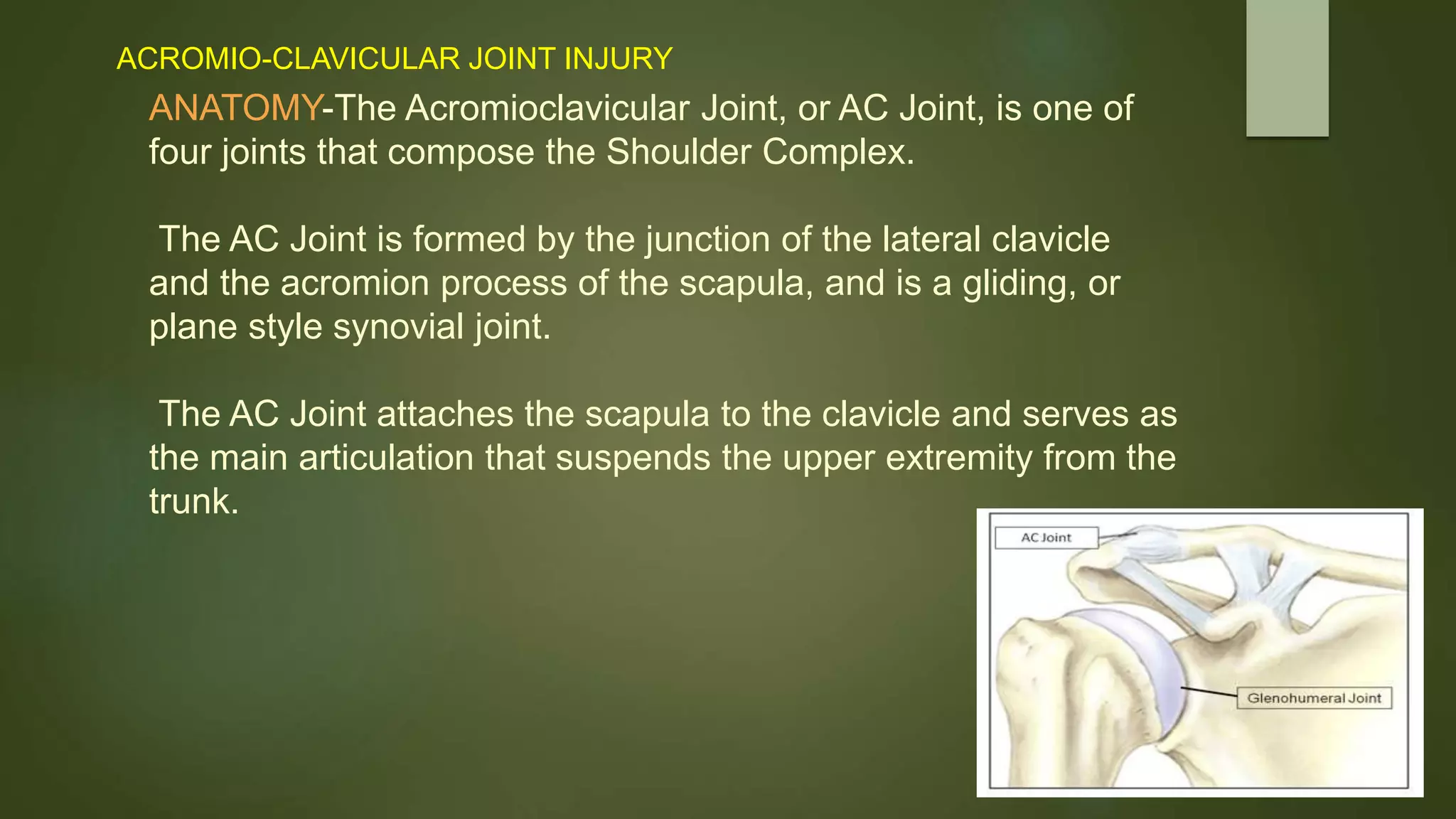
ANATOMY-The Acromioclavicular Joint, or AC Joint, is one of
four joints that compose the Shoulder Complex.
The AC Joint is formed by the junction of the lateral clavicle
and the acromion process of the scapula, and is a gliding, or
plane style synovial joint.
The AC Joint attaches the scapula to the clavicle and serves as
the main articulation that suspends the upper extremity from the
trunk.
ACROMIO-CLAVICULAR JOINT INJURY
The primary function of the AC Joint is:
To allow the scapula additional range of rotation on the thorax
Allow for adjustments of the scapula (tipping and internal/external rotation) outside
the initial plane of the scapula in order to follow the changing shape of the thorax as
arm movement occurs.
In addition, the joint allows transmission of forces from the upper extremity to the
clavicle
 The acromioclavicular (AC) joint is stabilized by two sets of ligaments: 1) the
acromioclavicular (AC) ligaments connect the end of the collarbone to the end of
the shoulder blade;
 2) the coracoclavicular (CC) ligaments, connect a bony projection of the shoulder
blade, known as the coracoid process, to the collarbone.
The ligaments that hold the joints
together are the
1. Acromio-clavicular liga.
2. Coracoacromial liga.
3. Coracoclavicular (trapezoid and conoid) ligaments.
 Acromioclavicular (AC) joint injury is a term used to describe an
injury to the top of the shoulder, where the front of the shoulder
blade (acromion) attaches to the collarbone (clavicle).
 It can be caused by a traumatic event, such as a fall directly on
the outside of the shoulder, or by repetitive overuse.
INCIDENCE
 AC joint injuries are most common in individuals younger than 35 years
of age, with males sustaining 5 times more traumatic AC joint injuries
than females.
 Because younger athletes are most likely to participate in high-risk and
collision activities, such as football, biking, snow sports, hockey, and
rugby traumatic AC joint injuries occur most often in this population.
What Are Acromioclavicular (AC) Joint Injuries?
• There are 4 ligaments holding the 2 bones of the AC joint
(the acromion and the clavicle) together.
• When an AC joint injury occurs, these ligaments are
stressed, resulting in some degree of joint separation.
• There are 2 types of injuries that can occur at the AC joint:
traumatic and overuse injuries.
• A traumatic AC joint injury occurs when there is a disruption of the joint
due to damaged ligaments holding the 2 bones of the joint together.
• This injury is called a shoulder separation (in contrast to a shoulder
dislocation, it involves the ball-and-socket joint of the shoulder).
Traumatic AC joint injuries are most common in individuals who
sustain a fall and land on the outside of the shoulder or onto a
hand (eg, a football player who is tackled, a bicyclist who
crashes, or a manual laborer who falls off a ladder.
 Traumatic AC joint injuries are graded from mild to severe based on
the amount of separation of the joint.
Treatment of mild cases likely will be provided by a physical therapist;
more severe cases may require surgery followed by physical therapy.
• An overuse AC joint injury occurs over time as repeated, excessive stress is placed
on the joint. Cartilage at the ends of the acromion and clavicle bones protects the
joint from daily wear and tear.
Over time, the demand placed on this cartilage may be more than it is capable of
enduring, resulting in an overuse injury.
Overuse AC joint injury is most common in individuals who
perform tasks, such as heavy weight lifting (bench and
military presses), or jobs that require physical labor with
the arms stretched over the head.
CLINICAL FEATURES
 General shoulder pain and swelling
 Swelling and tenderness over the AC joint
 Loss of shoulder strength
 A visible bump above the shoulder
 Pain when lying on the involved side
 Loss of shoulder motion
 A popping sound or catching sensation with movement of the shoulder
 Discomfort with daily activities that stress the AC joint, like lifting objects
overhead, reaching across your body, or carrying heavy objects at your
side
AC Joint Classifications
1. AC joint dislocation: Tossy Classification
2. AC joint injury: Allman classification
3. AC joint injury: Rockwood classification
AC joint dislocation: Tossy Classification
Tossy et al, CORR, 28: 111-119, 1963
Grade 1: strain and contusions of AC joint; No deformity visible clinically or on x-ray
• Grade 2: localised pain, swelling and deformity; X-rays show one-half separation of the AC joint, ie
clavicle displaced cephalad by one-half the depth of the AC joint; Coraco-clavicular distance increased
as compared to normal side; Partial tear of Coraco-clavicular ligaments
Grade 3- complete AC joint seperation more than one-half the depth of the AC joint; clavicle under skin;
Coraco-clavicular distance significantly increased; complete tear of coraco-clavicular ligaments
AC joint injury: Allman classification
Allman F L, JBJS (am) 49:774-784, 1967
Grade 1:
Sprain of AC joint capsule and AC ligament
No deformity
Xrays normal
Grade 2:
Rupture of AC capsule and ligaments
Mild deformity
Xrays show upward displacement of clavicle
Coraco-clavicular (C-C) ligaments normal
Grade 3:
Complete AC joint dislocation
Complete rupture of AC and C-C ligament
AC joint injury: Rockwood classification
Type 1:
AC ligament sprain
AC joint intact, CC ligaments intact
Deltoid, Trapezius intact
Type 1:
AC ligament sprain
AC joint intact, CC ligaments intact
Deltoid, Trapezius intact
Type 2:
AC Joint disruption
Slight vertical separation of ACJ
CC ligament sprain, CC distance wide
Deltoid, Trapezius intact
Type 2:
AC Joint disruption
Slight vertical separation of ACJ
CC ligament sprain, CC distance wide
Deltoid, Trapezius intact
Type 3:
AC ligament disruption
AC joint dislocated
CC ligaments torn
CC distance 25 to 100 % > than normal side
Deltoid, Trapezius may be detached
Type 4:
AC ligament disruption
AC joint dislocated
Clavicle displaced posteriorly into Trapezius
CC ligaments completely torn
Deltoid, Trapezius detached from distal clavicle
Type 4:
AC ligament disruption
AC joint dislocated
Clavicle displaced posteriorly into Trapezius
CC ligaments completely torn
Deltoid, Trapezius detached from distal clavicle
Type 5:
AC ligament disruption
AC joint dislocated
CC ligaments completely torn
CC distance 100 to 300 % > than normal side
Deltoid, Trapezius detached from distal half clavicle
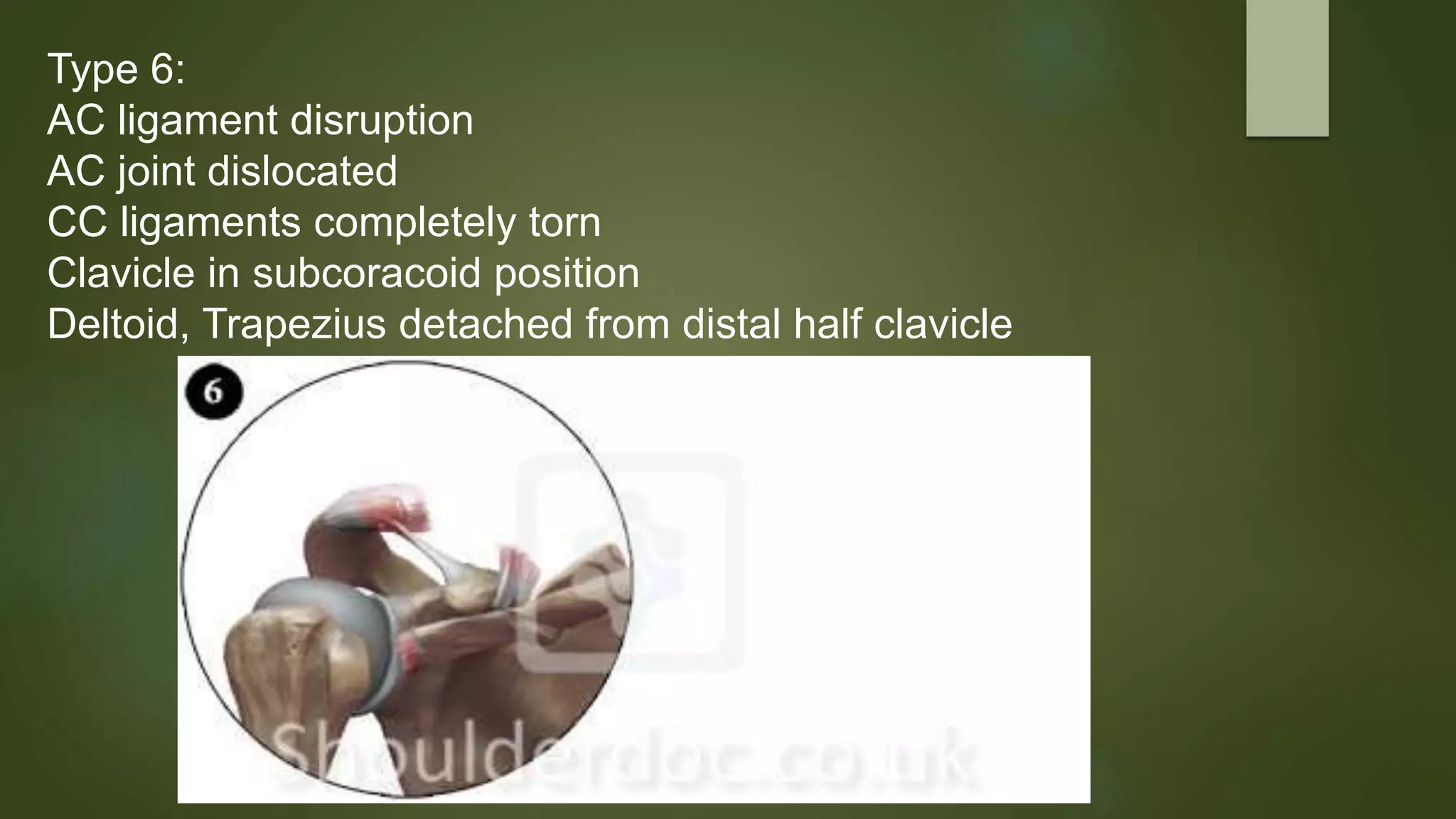
Type 6:
AC ligament disruption
AC joint dislocated
CC ligaments completely torn
Clavicle in subcoracoid position
Deltoid, Trapezius detached from distal half clavicle
DIAGNOSIS
Diagnosis of an AC joint injury starts with a thorough review of the patient’s medical
history, including specific questions regarding when the pain began, and what
aggravates and relieves the pain.
.
 physical therapist will examine PT shoulder and assess different measures, such
as sensation, motion, strength, flexibility, tenderness, and swelling.
While an AC joint injury can usually be identified through a shoulder examination,
diagnostic imaging, such as ultrasound, x-ray, or
MRI is often used to confirm the diagnosis and
determine the severity of the injury.
Physiotherapy Treatment
Most patients with acromioclavicular joint injury start to feel better within a few days or a
week of the injury. However, full ligament healing will take at least six weeks. During this
time it is important to protect your AC joint ligaments from overstretching the immature
scar tissue. It can be helpful to use a sling, taping or a shoulder brace that de-loads your
AC joint.
Goal of physiotherapist's treatment,
Reduce pain and inflammation.
Normalise joint range of motion.
Strengthen shoulder.
Improve your shoulder blade and shoulder alignment.
Normalise muscle lengths.
Improve upper limb proprioception.
Improve your technique and function eg lifting, overhead activities.
Pain Management.
1. Application of ice and heat to aid in pain management.
Manual Therapy. therapists are trained in manual (hands-on) therapy.
If needed, your physical therapist will gently move and mobilize your
shoulder joint and surrounding muscles as needed to improve their
motion, flexibility, and strength.
Range of Motion. An injury to the AC joint, whether traumatic or overuse, causes the joint
to be irritated, often resulting in swelling and stiffness, causing loss of normal motion.
Motions that are usually most difficult after an AC joint injury are reaching across your
body and lifting your arm directly overhead. While it is important to regain your normal
shoulder motion, it is also important to allow your injury to heal without placing excessive
stress on the healing joint. Your physical therapist will assess your motion and the
degree of your injury, and establish a plan that will balance joint protection and motion
restoration.
Strength Training. After an injury, the surrounding muscles demonstrate weakness. All of
the muscles near the shoulder and elbow as well as those of the upper back, work
together to allow for normal, coordinated upper-body motion. Therefore, balancing the
strength of all the upper-body muscles is crucial to making sure the shoulder joint is
protected and moves efficiently. Your physical therapist will design an individualized
exercise program to strengthen the muscles at and around the shoulder, so that each
muscle is able to properly perform its job.
THANKS

Acromio clavicular joint injury

  • 1.
    DR. NIRAJ KUMAR, PT BPT, MPT MHA & Ph. D (PHYSIOTHERAPY) ORTHOPEDICS. ASSOCIATE PROFESSOR PHYSIOTHERAPY DEPT. Shri Guru Rai Institute Of Paramedical Sciences , Dehradun ACROMIO-CLAVICULAR JOINT INJURY
  • 2.
    ANATOMY-The Acromioclavicular Joint,or AC Joint, is one of four joints that compose the Shoulder Complex. The AC Joint is formed by the junction of the lateral clavicle and the acromion process of the scapula, and is a gliding, or plane style synovial joint. The AC Joint attaches the scapula to the clavicle and serves as the main articulation that suspends the upper extremity from the trunk. ACROMIO-CLAVICULAR JOINT INJURY
  • 4.
    The primary functionof the AC Joint is: To allow the scapula additional range of rotation on the thorax Allow for adjustments of the scapula (tipping and internal/external rotation) outside the initial plane of the scapula in order to follow the changing shape of the thorax as arm movement occurs. In addition, the joint allows transmission of forces from the upper extremity to the clavicle  The acromioclavicular (AC) joint is stabilized by two sets of ligaments: 1) the acromioclavicular (AC) ligaments connect the end of the collarbone to the end of the shoulder blade;  2) the coracoclavicular (CC) ligaments, connect a bony projection of the shoulder blade, known as the coracoid process, to the collarbone.
  • 5.
    The ligaments thathold the joints together are the 1. Acromio-clavicular liga. 2. Coracoacromial liga. 3. Coracoclavicular (trapezoid and conoid) ligaments.
  • 6.
     Acromioclavicular (AC)joint injury is a term used to describe an injury to the top of the shoulder, where the front of the shoulder blade (acromion) attaches to the collarbone (clavicle).  It can be caused by a traumatic event, such as a fall directly on the outside of the shoulder, or by repetitive overuse.
  • 7.
    INCIDENCE  AC jointinjuries are most common in individuals younger than 35 years of age, with males sustaining 5 times more traumatic AC joint injuries than females.  Because younger athletes are most likely to participate in high-risk and collision activities, such as football, biking, snow sports, hockey, and rugby traumatic AC joint injuries occur most often in this population.
  • 8.
    What Are Acromioclavicular(AC) Joint Injuries? • There are 4 ligaments holding the 2 bones of the AC joint (the acromion and the clavicle) together. • When an AC joint injury occurs, these ligaments are stressed, resulting in some degree of joint separation. • There are 2 types of injuries that can occur at the AC joint: traumatic and overuse injuries.
  • 9.
    • A traumaticAC joint injury occurs when there is a disruption of the joint due to damaged ligaments holding the 2 bones of the joint together. • This injury is called a shoulder separation (in contrast to a shoulder dislocation, it involves the ball-and-socket joint of the shoulder). Traumatic AC joint injuries are most common in individuals who sustain a fall and land on the outside of the shoulder or onto a hand (eg, a football player who is tackled, a bicyclist who crashes, or a manual laborer who falls off a ladder.
  • 10.
     Traumatic ACjoint injuries are graded from mild to severe based on the amount of separation of the joint. Treatment of mild cases likely will be provided by a physical therapist; more severe cases may require surgery followed by physical therapy. • An overuse AC joint injury occurs over time as repeated, excessive stress is placed on the joint. Cartilage at the ends of the acromion and clavicle bones protects the joint from daily wear and tear. Over time, the demand placed on this cartilage may be more than it is capable of enduring, resulting in an overuse injury.
  • 11.
    Overuse AC jointinjury is most common in individuals who perform tasks, such as heavy weight lifting (bench and military presses), or jobs that require physical labor with the arms stretched over the head.
  • 12.
    CLINICAL FEATURES  Generalshoulder pain and swelling  Swelling and tenderness over the AC joint  Loss of shoulder strength  A visible bump above the shoulder  Pain when lying on the involved side  Loss of shoulder motion  A popping sound or catching sensation with movement of the shoulder  Discomfort with daily activities that stress the AC joint, like lifting objects overhead, reaching across your body, or carrying heavy objects at your side
  • 13.
    AC Joint Classifications 1.AC joint dislocation: Tossy Classification 2. AC joint injury: Allman classification 3. AC joint injury: Rockwood classification AC joint dislocation: Tossy Classification Tossy et al, CORR, 28: 111-119, 1963 Grade 1: strain and contusions of AC joint; No deformity visible clinically or on x-ray • Grade 2: localised pain, swelling and deformity; X-rays show one-half separation of the AC joint, ie clavicle displaced cephalad by one-half the depth of the AC joint; Coraco-clavicular distance increased as compared to normal side; Partial tear of Coraco-clavicular ligaments Grade 3- complete AC joint seperation more than one-half the depth of the AC joint; clavicle under skin; Coraco-clavicular distance significantly increased; complete tear of coraco-clavicular ligaments
  • 14.
    AC joint injury:Allman classification Allman F L, JBJS (am) 49:774-784, 1967 Grade 1: Sprain of AC joint capsule and AC ligament No deformity Xrays normal Grade 2: Rupture of AC capsule and ligaments Mild deformity Xrays show upward displacement of clavicle Coraco-clavicular (C-C) ligaments normal Grade 3: Complete AC joint dislocation Complete rupture of AC and C-C ligament
  • 15.
    AC joint injury:Rockwood classification Type 1: AC ligament sprain AC joint intact, CC ligaments intact Deltoid, Trapezius intact
  • 16.
    Type 1: AC ligamentsprain AC joint intact, CC ligaments intact Deltoid, Trapezius intact Type 2: AC Joint disruption Slight vertical separation of ACJ CC ligament sprain, CC distance wide Deltoid, Trapezius intact
  • 17.
    Type 2: AC Jointdisruption Slight vertical separation of ACJ CC ligament sprain, CC distance wide Deltoid, Trapezius intact Type 3: AC ligament disruption AC joint dislocated CC ligaments torn CC distance 25 to 100 % > than normal side Deltoid, Trapezius may be detached
  • 18.
    Type 4: AC ligamentdisruption AC joint dislocated Clavicle displaced posteriorly into Trapezius CC ligaments completely torn Deltoid, Trapezius detached from distal clavicle
  • 19.
    Type 4: AC ligamentdisruption AC joint dislocated Clavicle displaced posteriorly into Trapezius CC ligaments completely torn Deltoid, Trapezius detached from distal clavicle Type 5: AC ligament disruption AC joint dislocated CC ligaments completely torn CC distance 100 to 300 % > than normal side Deltoid, Trapezius detached from distal half clavicle
  • 20.
    Type 6: AC ligamentdisruption AC joint dislocated CC ligaments completely torn Clavicle in subcoracoid position Deltoid, Trapezius detached from distal half clavicle
  • 21.
    DIAGNOSIS Diagnosis of anAC joint injury starts with a thorough review of the patient’s medical history, including specific questions regarding when the pain began, and what aggravates and relieves the pain. .  physical therapist will examine PT shoulder and assess different measures, such as sensation, motion, strength, flexibility, tenderness, and swelling. While an AC joint injury can usually be identified through a shoulder examination, diagnostic imaging, such as ultrasound, x-ray, or MRI is often used to confirm the diagnosis and determine the severity of the injury.
  • 22.
    Physiotherapy Treatment Most patientswith acromioclavicular joint injury start to feel better within a few days or a week of the injury. However, full ligament healing will take at least six weeks. During this time it is important to protect your AC joint ligaments from overstretching the immature scar tissue. It can be helpful to use a sling, taping or a shoulder brace that de-loads your AC joint. Goal of physiotherapist's treatment, Reduce pain and inflammation. Normalise joint range of motion. Strengthen shoulder. Improve your shoulder blade and shoulder alignment. Normalise muscle lengths. Improve upper limb proprioception. Improve your technique and function eg lifting, overhead activities.
  • 23.
    Pain Management. 1. Applicationof ice and heat to aid in pain management. Manual Therapy. therapists are trained in manual (hands-on) therapy. If needed, your physical therapist will gently move and mobilize your shoulder joint and surrounding muscles as needed to improve their motion, flexibility, and strength.
  • 24.
    Range of Motion.An injury to the AC joint, whether traumatic or overuse, causes the joint to be irritated, often resulting in swelling and stiffness, causing loss of normal motion. Motions that are usually most difficult after an AC joint injury are reaching across your body and lifting your arm directly overhead. While it is important to regain your normal shoulder motion, it is also important to allow your injury to heal without placing excessive stress on the healing joint. Your physical therapist will assess your motion and the degree of your injury, and establish a plan that will balance joint protection and motion restoration. Strength Training. After an injury, the surrounding muscles demonstrate weakness. All of the muscles near the shoulder and elbow as well as those of the upper back, work together to allow for normal, coordinated upper-body motion. Therefore, balancing the strength of all the upper-body muscles is crucial to making sure the shoulder joint is protected and moves efficiently. Your physical therapist will design an individualized exercise program to strengthen the muscles at and around the shoulder, so that each muscle is able to properly perform its job.
  • 25.