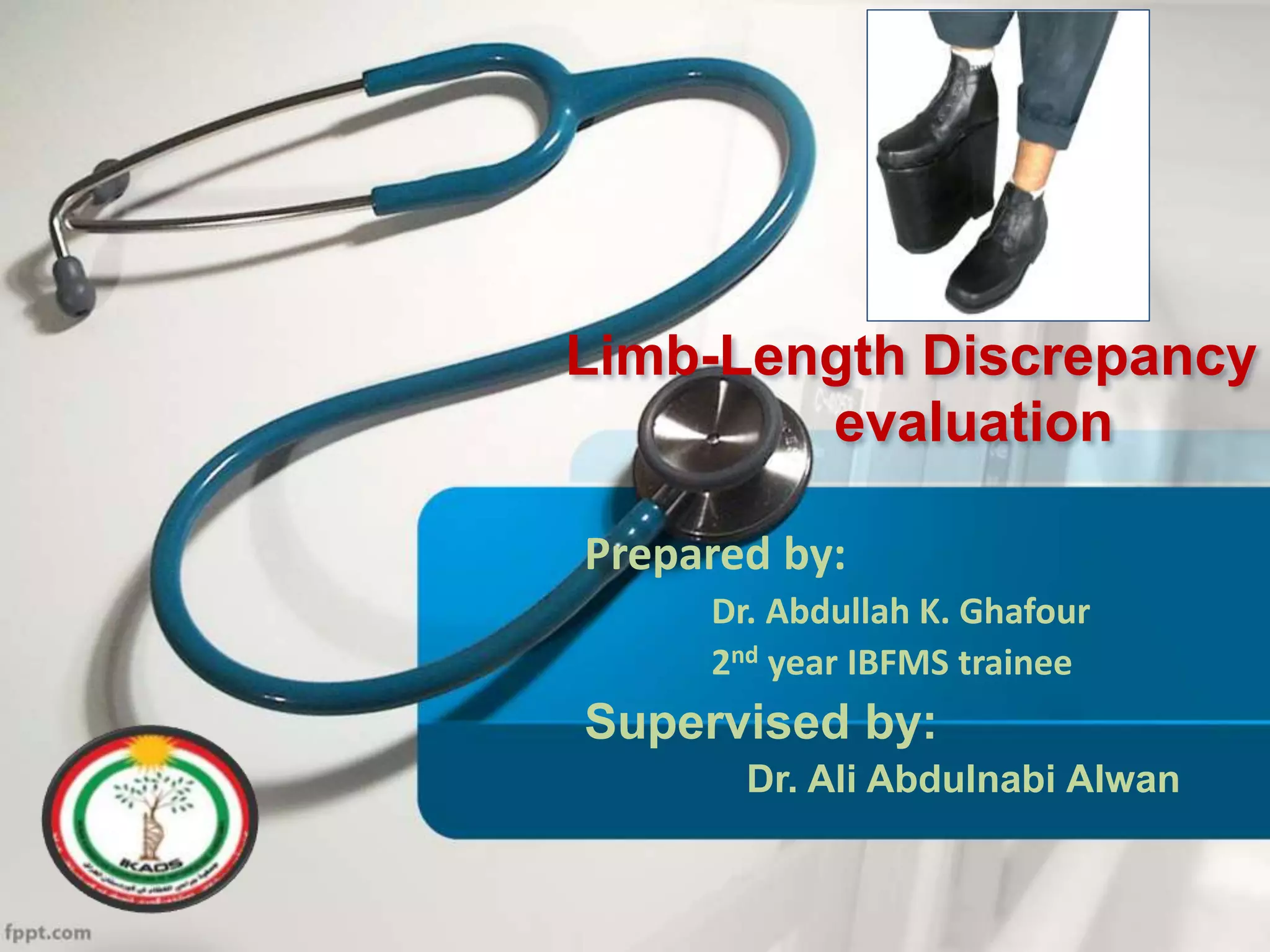
Limb-Length Discrepancy
evaluation
Prepared by:
Dr. Abdullah K. Ghafour
2nd year IBFMS trainee
Supervised by:
Dr. Ali Abdulnabi Alwan
Definition and epidemiology:
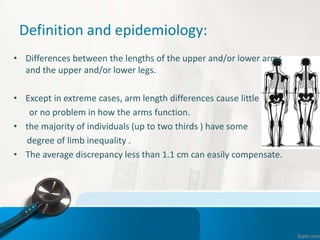
• Differences between the lengths of the upper and/or lower arms
and the upper and/or lower legs.
• Except in extreme cases, arm length differences cause little
or no problem in how the arms function.
• the majority of individuals (up to two thirds ) have some
degree of limb inequality .
• The average discrepancy less than 1.1 cm can easily compensate.
Symptoms :
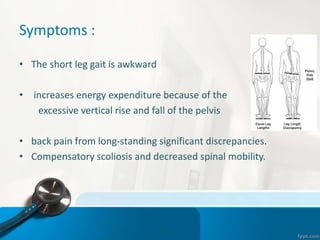
• The short leg gait is awkward
• increases energy expenditure because of the
excessive vertical rise and fall of the pelvis
• back pain from long-standing significant discrepancies.
• Compensatory scoliosis and decreased spinal mobility.
Types of LLD:
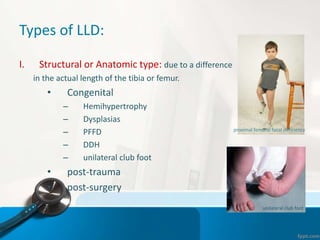
I. Structural or Anatomic type: due to a difference
in the actual length of the tibia or femur.
• Congenital
– Hemihypertrophy
– Dysplasias
– PFFD
– DDH
– unilateral club foot
• post-trauma
• post-surgery
proximal femoral focal deficiency
unilateral club foot
Types of LLD:
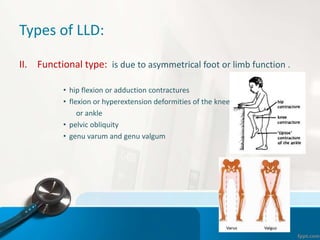
II. Functional type: is due to asymmetrical foot or limb function .
• hip flexion or adduction contractures
• flexion or hyperextension deformities of the knee
or ankle
• pelvic obliquity
• genu varum and genu valgum
Types of LLD:
III. Environmental type: is caused by the unevenness created by walking or
running on crowned road surfaces, banked running tracks or along the beach.
Another Classification is McCaw and Bates (1991):
o LLD has been classified according to the magnitude of the inequality,
generally expressed in cm or mm, and described as ;
 Mild Less than 3 cm
 Moderate 3-6 cm
 Severe More than 6 cm
Etiology of Undergrowth
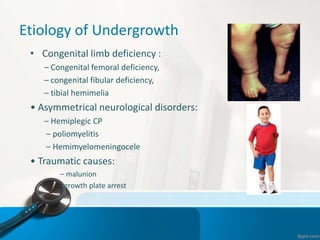
• Congenital limb deficiency :
– Congenital femoral deficiency,
– congenital fibular deficiency,
– tibial hemimelia
• Asymmetrical neurological disorders:
– Hemiplegic CP
– poliomyelitis
– Hemimyelomeningocele
• Traumatic causes:
– malunion
– growth plate arrest
Etiology of Undergrowth
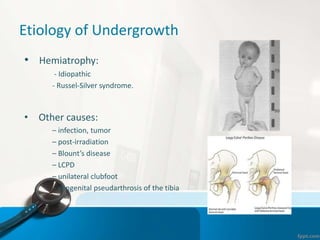
• Hemiatrophy:
- Idiopathic
- Russel-Silver syndrome.
• Other causes:
– infection, tumor
– post-irradiation
– Blount’s disease
– LCPD
– unilateral clubfoot
– congenital pseudarthrosis of the tibia
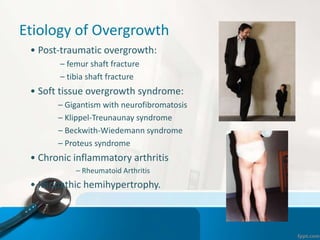
Etiology of Overgrowth
• Post-traumatic overgrowth:
– femur shaft fracture
– tibia shaft fracture
• Soft tissue overgrowth syndrome:
– Gigantism with neurofibromatosis
– Klippel-Treunaunay syndrome
– Beckwith-Wiedemann syndrome
– Proteus syndrome
• Chronic inflammatory arthritis
– Rheumatoid Arthritis
• Idiopathic hemihypertrophy.
Clinical assessment
• History:
– Congenital or acquired?
– Trauma / infection?
– Progressive / static?
– Onset and mode of deformity?
– Any Syndrome associated features?
Clinical assessment
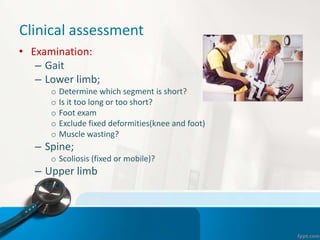
• Examination:
– Gait
– Lower limb;
o Determine which segment is short?
o Is it too long or too short?
o Foot exam
o Exclude fixed deformities(knee and foot)
o Muscle wasting?
– Spine;
o Scoliosis (fixed or mobile)?
– Upper limb
– face
Clinical assessment
• Examination:
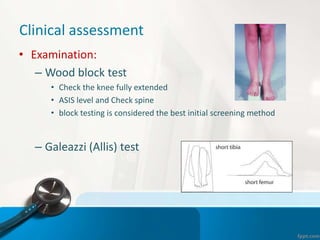
– Wood block test
• Check the knee fully extended
• ASIS level and Check spine
• block testing is considered the best initial screening method
– Galeazzi (Allis) test
Clinical assessment
• Examination:
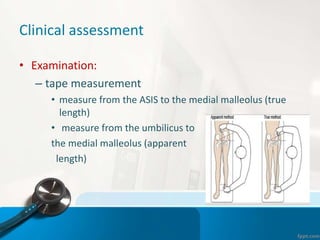
– tape measurement
• measure from the ASIS to the medial malleolus (true
length)
• measure from the umbilicus to
the medial malleolus (apparent
length)
Investigations
• Standing radiographs
• Teleroentgenogram
• Orthoroentgenogram
• CT–scannogram
Investigations
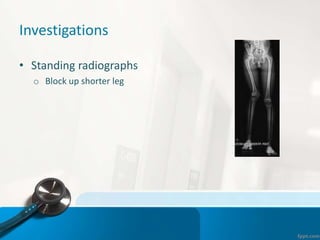
• Standing radiographs
o Block up shorter leg
Investigations
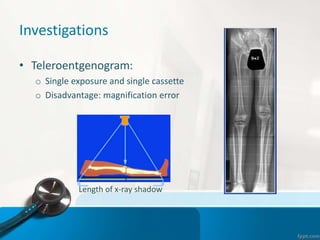
• Teleroentgenogram:
o Single exposure and single cassette
o Disadvantage: magnification error
Length of x-ray shadow
Investigations
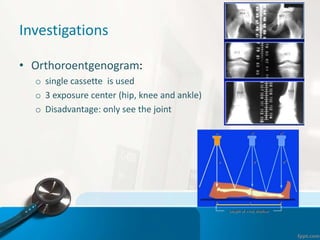
• Orthoroentgenogram:
o single cassette is used
o 3 exposure center (hip, knee and ankle)
o Disadvantage: only see the joint
Investigations
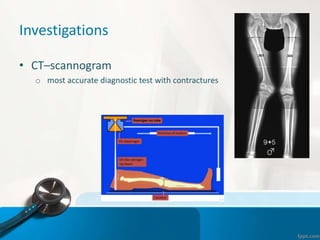
• CT–scannogram
o most accurate diagnostic test with contractures
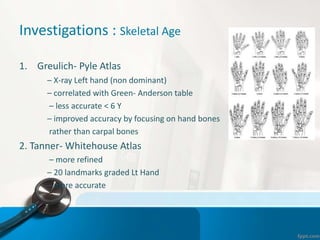
Investigations : Skeletal Age
1. Greulich- Pyle Atlas
– X-ray Left hand (non dominant)
– correlated with Green- Anderson table
– less accurate < 6 Y
– improved accuracy by focusing on hand bones
rather than carpal bones
2. Tanner- Whitehouse Atlas
– more refined
– 20 landmarks graded Lt Hand
– more accurate
Prediction Methods in LLD
I. Rule of thumb Westh and Menelaus (1981)
o Main use is to time growth arrest
II. Growth remaining Anderson and Green (1963)
o Determine the length of the long leg at maturity
o Calculate the future growth of the long leg
o Calculate % inhibition of shorter leg
o Calculate the future increase in discrepancy
III. Straight line Moseley (1978)
o Graphical representation of Green and Anderson method
IV. Paley Multiplier Method (2000)
o take LLD for boy or girl
o multiplier for chronological or skeletal age
o predicts LLD at maturity
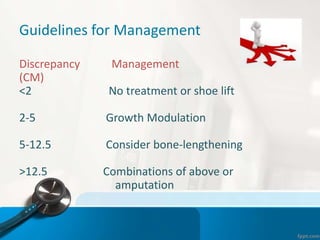
Guidelines for Management
Discrepancy Management
(CM)
<2 No treatment or shoe lift
2-5 Growth Modulation
5-12.5 Consider bone-lengthening
>12.5 Combinations of above or
amputation
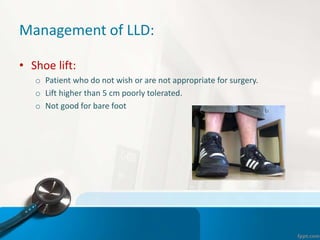
Management of LLD:
• Shoe lift:
o Patient who do not wish or are not appropriate for surgery.
o Lift higher than 5 cm poorly tolerated.
o Not good for bare foot
Management of LLD:
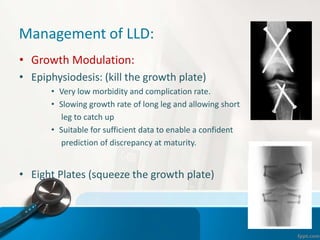
• Growth Modulation:
• Epiphysiodesis: (kill the growth plate)
• Very low morbidity and complication rate.
• Slowing growth rate of long leg and allowing short
leg to catch up
• Suitable for sufficient data to enable a confident
prediction of discrepancy at maturity.
• Eight Plates (squeeze the growth plate)
Management of LLD:
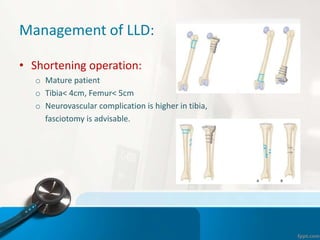
• Shortening operation:
o Mature patient
o Tibia< 4cm, Femur< 5cm
o Neurovascular complication is higher in tibia,
fasciotomy is advisable.
Management of LLD:
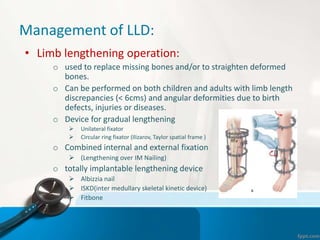
• Limb lengthening operation:
o used to replace missing bones and/or to straighten deformed
bones.
o Can be performed on both children and adults with limb length
discrepancies (< 6cms) and angular deformities due to birth
defects, injuries or diseases.
o Device for gradual lengthening
 Unilateral fixator
 Circular ring fixator (Ilizarov, Taylor spatial frame )
o Combined internal and external fixation
 (Lengthening over IM Nailing)
o totally implantable lengthening device
 Albizzia nail
 ISKD(inter medullary skeletal kinetic device)
 Fitbone
Management of LLD:
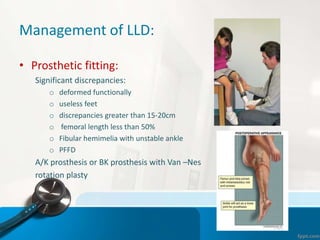
• Prosthetic fitting:
Significant discrepancies:
o deformed functionally
o useless feet
o discrepancies greater than 15-20cm
o femoral length less than 50%
o Fibular hemimelia with unstable ankle
o PFFD
A/K prosthesis or BK prosthesis with Van –Nes
rotation plasty
Management of LLD:
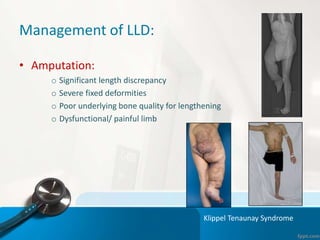
• Amputation:
o Significant length discrepancy
o Severe fixed deformities
o Poor underlying bone quality for lengthening
o Dysfunctional/ painful limb
Klippel Tenaunay Syndrome
References:
• Robert M. Kliegman, Bonita F. Stanton, [2016]Nelson TEXTBOOK of PEDIATRICS,
20th ed. by Elsevier, Inc. Canada.
• Albert J. Pomeranz, Svapna Sabnis, [2016] PEDIATRIC DECISION-MAKING
STRATEGIES, SECOND EDITION, 2nd ed. An Imprint of Elsevier , Tennessee, USA.
• Solomon L., Warwick D. , Nayagam S.,[2010] Apley’s System of Orthopaedics and
Fractures, 9th ed. Hodderarnold comp.,London, UK.
• Miller M. , Thompson S. , Hart J. ,[2012] REVIEW OF ORTHOPAEDICS [PDF], 6th
ed. by Saunders, an imprint of Elsevier Inc. , Philadelphia, USA.
• Canale S. , Beaty J. , [2007] Campbell’s Operative Orthopaedics [PDF], 11th ed. By
Mosby, An Imprint of Elsevier , Tennessee, USA.
• Jay R. Lieberman, MD. , [2009] AAOS Comprehensive Orthopaedic Review,2nd ed.
American Academy of Orthopaedic Surgeons, USA.
• L. Ombregt, [2013] A System of Orthopaedic Medicine, 3rd ed. Elsevier Ltd. China.
Limb length discrepancy evaluation

Limb length discrepancy evaluation

  • 1.
    Limb-Length Discrepancy evaluation Prepared by: Dr.Abdullah K. Ghafour 2nd year IBFMS trainee Supervised by: Dr. Ali Abdulnabi Alwan
  • 2.
    Definition and epidemiology: •Differences between the lengths of the upper and/or lower arms and the upper and/or lower legs. • Except in extreme cases, arm length differences cause little or no problem in how the arms function. • the majority of individuals (up to two thirds ) have some degree of limb inequality . • The average discrepancy less than 1.1 cm can easily compensate.
  • 3.
    Symptoms : • Theshort leg gait is awkward • increases energy expenditure because of the excessive vertical rise and fall of the pelvis • back pain from long-standing significant discrepancies. • Compensatory scoliosis and decreased spinal mobility.
  • 4.
    Types of LLD: I.Structural or Anatomic type: due to a difference in the actual length of the tibia or femur. • Congenital – Hemihypertrophy – Dysplasias – PFFD – DDH – unilateral club foot • post-trauma • post-surgery proximal femoral focal deficiency unilateral club foot
  • 5.
    Types of LLD: II.Functional type: is due to asymmetrical foot or limb function . • hip flexion or adduction contractures • flexion or hyperextension deformities of the knee or ankle • pelvic obliquity • genu varum and genu valgum
  • 6.
    Types of LLD: III.Environmental type: is caused by the unevenness created by walking or running on crowned road surfaces, banked running tracks or along the beach. Another Classification is McCaw and Bates (1991): o LLD has been classified according to the magnitude of the inequality, generally expressed in cm or mm, and described as ;  Mild Less than 3 cm  Moderate 3-6 cm  Severe More than 6 cm
  • 7.
    Etiology of Undergrowth •Congenital limb deficiency : – Congenital femoral deficiency, – congenital fibular deficiency, – tibial hemimelia • Asymmetrical neurological disorders: – Hemiplegic CP – poliomyelitis – Hemimyelomeningocele • Traumatic causes: – malunion – growth plate arrest
  • 8.
    Etiology of Undergrowth •Hemiatrophy: - Idiopathic - Russel-Silver syndrome. • Other causes: – infection, tumor – post-irradiation – Blount’s disease – LCPD – unilateral clubfoot – congenital pseudarthrosis of the tibia
  • 9.
    Etiology of Overgrowth •Post-traumatic overgrowth: – femur shaft fracture – tibia shaft fracture • Soft tissue overgrowth syndrome: – Gigantism with neurofibromatosis – Klippel-Treunaunay syndrome – Beckwith-Wiedemann syndrome – Proteus syndrome • Chronic inflammatory arthritis – Rheumatoid Arthritis • Idiopathic hemihypertrophy.
  • 10.
    Clinical assessment • History: –Congenital or acquired? – Trauma / infection? – Progressive / static? – Onset and mode of deformity? – Any Syndrome associated features?
  • 11.
    Clinical assessment • Examination: –Gait – Lower limb; o Determine which segment is short? o Is it too long or too short? o Foot exam o Exclude fixed deformities(knee and foot) o Muscle wasting? – Spine; o Scoliosis (fixed or mobile)? – Upper limb – face
  • 12.
    Clinical assessment • Examination: –Wood block test • Check the knee fully extended • ASIS level and Check spine • block testing is considered the best initial screening method – Galeazzi (Allis) test
  • 13.
    Clinical assessment • Examination: –tape measurement • measure from the ASIS to the medial malleolus (true length) • measure from the umbilicus to the medial malleolus (apparent length)
  • 14.
    Investigations • Standing radiographs •Teleroentgenogram • Orthoroentgenogram • CT–scannogram
  • 15.
  • 16.
    Investigations • Teleroentgenogram: o Singleexposure and single cassette o Disadvantage: magnification error Length of x-ray shadow
  • 17.
    Investigations • Orthoroentgenogram: o singlecassette is used o 3 exposure center (hip, knee and ankle) o Disadvantage: only see the joint
  • 18.
    Investigations • CT–scannogram o mostaccurate diagnostic test with contractures
  • 19.
    Investigations : SkeletalAge 1. Greulich- Pyle Atlas – X-ray Left hand (non dominant) – correlated with Green- Anderson table – less accurate < 6 Y – improved accuracy by focusing on hand bones rather than carpal bones 2. Tanner- Whitehouse Atlas – more refined – 20 landmarks graded Lt Hand – more accurate
  • 20.
    Prediction Methods inLLD I. Rule of thumb Westh and Menelaus (1981) o Main use is to time growth arrest II. Growth remaining Anderson and Green (1963) o Determine the length of the long leg at maturity o Calculate the future growth of the long leg o Calculate % inhibition of shorter leg o Calculate the future increase in discrepancy III. Straight line Moseley (1978) o Graphical representation of Green and Anderson method IV. Paley Multiplier Method (2000) o take LLD for boy or girl o multiplier for chronological or skeletal age o predicts LLD at maturity
  • 21.
    Guidelines for Management DiscrepancyManagement (CM) <2 No treatment or shoe lift 2-5 Growth Modulation 5-12.5 Consider bone-lengthening >12.5 Combinations of above or amputation
  • 22.
    Management of LLD: •Shoe lift: o Patient who do not wish or are not appropriate for surgery. o Lift higher than 5 cm poorly tolerated. o Not good for bare foot
  • 23.
    Management of LLD: •Growth Modulation: • Epiphysiodesis: (kill the growth plate) • Very low morbidity and complication rate. • Slowing growth rate of long leg and allowing short leg to catch up • Suitable for sufficient data to enable a confident prediction of discrepancy at maturity. • Eight Plates (squeeze the growth plate)
  • 24.
    Management of LLD: •Shortening operation: o Mature patient o Tibia< 4cm, Femur< 5cm o Neurovascular complication is higher in tibia, fasciotomy is advisable.
  • 25.
    Management of LLD: •Limb lengthening operation: o used to replace missing bones and/or to straighten deformed bones. o Can be performed on both children and adults with limb length discrepancies (< 6cms) and angular deformities due to birth defects, injuries or diseases. o Device for gradual lengthening  Unilateral fixator  Circular ring fixator (Ilizarov, Taylor spatial frame ) o Combined internal and external fixation  (Lengthening over IM Nailing) o totally implantable lengthening device  Albizzia nail  ISKD(inter medullary skeletal kinetic device)  Fitbone
  • 26.
    Management of LLD: •Prosthetic fitting: Significant discrepancies: o deformed functionally o useless feet o discrepancies greater than 15-20cm o femoral length less than 50% o Fibular hemimelia with unstable ankle o PFFD A/K prosthesis or BK prosthesis with Van –Nes rotation plasty
  • 27.
    Management of LLD: •Amputation: o Significant length discrepancy o Severe fixed deformities o Poor underlying bone quality for lengthening o Dysfunctional/ painful limb Klippel Tenaunay Syndrome
  • 28.
    References: • Robert M.Kliegman, Bonita F. Stanton, [2016]Nelson TEXTBOOK of PEDIATRICS, 20th ed. by Elsevier, Inc. Canada. • Albert J. Pomeranz, Svapna Sabnis, [2016] PEDIATRIC DECISION-MAKING STRATEGIES, SECOND EDITION, 2nd ed. An Imprint of Elsevier , Tennessee, USA. • Solomon L., Warwick D. , Nayagam S.,[2010] Apley’s System of Orthopaedics and Fractures, 9th ed. Hodderarnold comp.,London, UK. • Miller M. , Thompson S. , Hart J. ,[2012] REVIEW OF ORTHOPAEDICS [PDF], 6th ed. by Saunders, an imprint of Elsevier Inc. , Philadelphia, USA. • Canale S. , Beaty J. , [2007] Campbell’s Operative Orthopaedics [PDF], 11th ed. By Mosby, An Imprint of Elsevier , Tennessee, USA. • Jay R. Lieberman, MD. , [2009] AAOS Comprehensive Orthopaedic Review,2nd ed. American Academy of Orthopaedic Surgeons, USA. • L. Ombregt, [2013] A System of Orthopaedic Medicine, 3rd ed. Elsevier Ltd. China.