THE ORTHOPAEDIC EXAMINATION
BASIC RULES
LOOK
FEEL
MOVE
SPECIAL TESTS
SHOULDER EXAMINATION
KNOWLEDGE….
 “The eye doesn’t see what the mind doesn’t
know”
 Know common shoulder problems…
 Young – shoulder instability
 Old – shoulder impingement, rotator cuff tear
 TAILOR YOUR EXAMINATION TO WHAT IS
SUSPECTED – P.E IS NOT A SET
ROUTINE
LOOK
 Adequate exposure! (No shyness in exams!)
 Always look from front, side and back
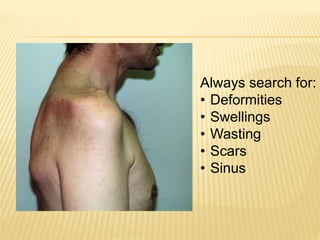
Always search for:
• Deformities
• Swellings
• Wasting
• Scars
• Sinus
AXILLA :
ALSO PART
OF
SHOULDER!
FEEL
 Do it in a sequence
 SC joint → clavicle → AC joint → acromion
→ scapula spine
 Ant and post glenohumeral joint line
 Axilla
 Also feel for warmth
MOVE
POINTS TO REMEMBER
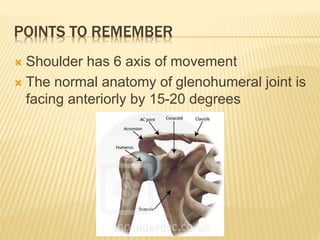
 Shoulder has 6 axis of movement
 The normal anatomy of glenohumeral joint is
facing anteriorly by 15-20 degrees
ABDUCTION / ADDUCTION
 Normal range: 0 – 160/180 degrees
 Supraspinatus → deltoid → scapula muscles
(trapezius / serratus anterior)
 Painful arc
Scapulohumeral rhythm
FLEXION / EXTENSION
 Normal range:
 Flexion: 0 – 180
 Extension: 0 – 40
 Always remember the plane of
scapulohumeral joint!
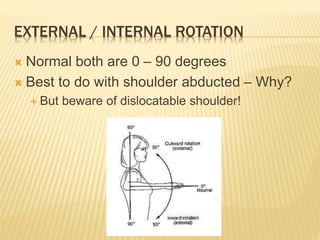
EXTERNAL / INTERNAL ROTATION
 Normal both are 0 – 90 degrees
 Best to do with shoulder abducted – Why?
 But beware of dislocatable shoulder!
SPECIAL TESTS
AIM OF TESTS
1) To detect impingement
AIM OF TESTS
2) To detect rotator cuff tear (specific muscles)
AIM OF TESTS
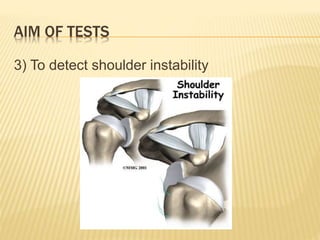
3) To detect shoulder instability
HOW TO DO
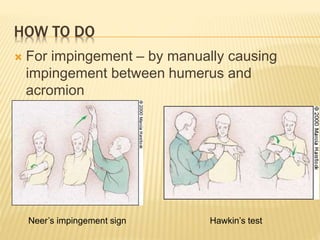
 For impingement – by manually causing
impingement between humerus and
acromion
Neer’s impingement sign Hawkin’s test
HOW TO DO
 For rotator cuff tear – motions and power of
each muscle must be tested
Jobe’s test -
Supraspinatus
External rotation test –
Infraspinatus / Teres
minor
HOW TO DO
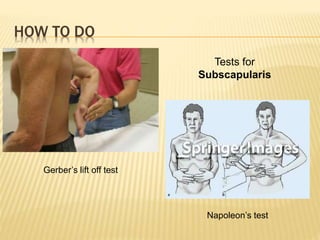
Gerber’s lift off test
Tests for
Subscapularis
Napoleon’s test
HOW TO DO
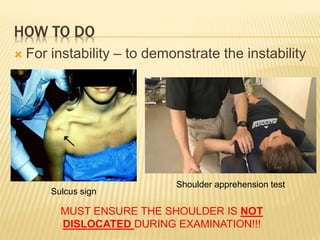
 For instability – to demonstrate the instability
Sulcus sign
Shoulder apprehension test
MUST ENSURE THE SHOULDER IS NOT
DISLOCATED DURING EXAMINATION!!!
POINTS TO PONDER
 P.E must be done with knowledge
 It is NOT a set routine
 Must be able to spot diagnosis even before
starting P.E
 Your P.E is to prove the diagnosis by
searching for relevant positives
 And to rule out other diagnosis by searching
for relevant negatives
THANK YOU

Shoulder examination

  • 1.
  • 2.
  • 3.
  • 4.
    KNOWLEDGE….  “The eyedoesn’t see what the mind doesn’t know”  Know common shoulder problems…  Young – shoulder instability  Old – shoulder impingement, rotator cuff tear  TAILOR YOUR EXAMINATION TO WHAT IS SUSPECTED – P.E IS NOT A SET ROUTINE
  • 5.
  • 6.
     Adequate exposure!(No shyness in exams!)  Always look from front, side and back
  • 7.
    Always search for: •Deformities • Swellings • Wasting • Scars • Sinus
  • 9.
  • 10.
  • 11.
     Do itin a sequence  SC joint → clavicle → AC joint → acromion → scapula spine  Ant and post glenohumeral joint line  Axilla  Also feel for warmth
  • 12.
  • 13.
    POINTS TO REMEMBER Shoulder has 6 axis of movement  The normal anatomy of glenohumeral joint is facing anteriorly by 15-20 degrees
  • 14.
    ABDUCTION / ADDUCTION Normal range: 0 – 160/180 degrees  Supraspinatus → deltoid → scapula muscles (trapezius / serratus anterior)  Painful arc Scapulohumeral rhythm
  • 15.
    FLEXION / EXTENSION Normal range:  Flexion: 0 – 180  Extension: 0 – 40  Always remember the plane of scapulohumeral joint!
  • 16.
    EXTERNAL / INTERNALROTATION  Normal both are 0 – 90 degrees  Best to do with shoulder abducted – Why?  But beware of dislocatable shoulder!
  • 17.
  • 18.
    AIM OF TESTS 1)To detect impingement
  • 19.
    AIM OF TESTS 2)To detect rotator cuff tear (specific muscles)
  • 20.
    AIM OF TESTS 3)To detect shoulder instability
  • 21.
    HOW TO DO For impingement – by manually causing impingement between humerus and acromion Neer’s impingement sign Hawkin’s test
  • 22.
    HOW TO DO For rotator cuff tear – motions and power of each muscle must be tested Jobe’s test - Supraspinatus External rotation test – Infraspinatus / Teres minor
  • 23.
    HOW TO DO Gerber’slift off test Tests for Subscapularis Napoleon’s test
  • 24.
    HOW TO DO For instability – to demonstrate the instability Sulcus sign Shoulder apprehension test MUST ENSURE THE SHOULDER IS NOT DISLOCATED DURING EXAMINATION!!!
  • 25.
    POINTS TO PONDER P.E must be done with knowledge  It is NOT a set routine  Must be able to spot diagnosis even before starting P.E  Your P.E is to prove the diagnosis by searching for relevant positives  And to rule out other diagnosis by searching for relevant negatives
  • 26.

Editor's Notes

  • #5 Brief on shoulder instability, impingement and rotator cuff tear
  • #8 When no symmetry – deformity!