Special Tests for
Shoulder, Elbow
and Wrist
Presenter: Mr. Kiran Kunwar
Ground Rules While Performing Special test:
• a thorough history and a basic physical examination should be performed priorly.
• know what is ‘normal’ for the patient.
• Be selective in which tests we use.
• Use the same tests regularly.
• Remember that no test is diagnostic.
How to do the test?
• Make sure the patient is comfortable.
• Keep yourself relaxed and comfortable.
• Interpret the findings correctly.
• Modify the technique depending on the condition.
• Modify the technique depending on the type of tissue.
Keyterms :
• Sensitivity :
Sensitivity is the defined as the ratio of the proportion of the patients who have the
condition of interest and whose test results are positive over the number who have the
disease.
If 100 people have the condition, then a test that is 98% sensitive will detect 98 of those
cases and miss two.
• Specificity :
Specificity measures ability of the test to correctly identify those without the
disease (true negative rate).
If 100 people are free from the condition, then a test that is 98% specific will
correctly exclude 98 of those cases but will incorrectly identify two people as
having the condition.
• Likelihood ratios:
combine the sensitivity and specificity into a ratio that quantifies a shift in the probability of a
condition being present or absent in the event of a negative or positive test.
for a positive test outcome (LR+) and one for a negative outcome (LR-).
A large LR+indicates that the condition is more likely to be present.
This can be calculated from the sensitivity and specificity values:
LR+ =sensitivity /1- specificity
Special Test in shoulder
For anterior shoulder
instability:
1. Apprehension release
test
2. Crank test
For Posterior Shoulder
Instability:
1. Jerk Test
For Inferior Shoulder
Instability:
1. Sulcus Sign
For Anterior Impingement:
1. Coracoid Impingement Sign
2. Hawkins-Kennedy Test
3. Neer test
4. Supine Impingement test
For Labral Lesions:
1. Active Compression Test of
O’Brien
2. Biceps load test II
For Scapular Dyskinesia:
1. Scapular Load test
For Acromioclavicular Joint
Pathology:
1. Horizontal adduction test
2. Paxinos Sign
For Ligament Pathology:
1. Crank test
Biceps pathology:
1. Speed test
2. Yergason’s test
Supraspinatus Test:
1. Empty Can test
Subscapularis test:
1. External rotation lag sign
2. Lift off sign
3. Medial rotation lag sign
Infraspinatus test:
1. Infraspinatus test
2. Lateral Rotation lag
sign
Rotator Cuff ( general)
1. Rent test
2. Whipple test
Trapezius
1. Trapezius test( three
positions)
Serratus Anterior
1. Punch out test
For Neurological function:
1. ULNT
For Thoracic Outlet
Syndrome:
1. Roos Test
1. Apprehension( Crank) test for anterior shoulder dislocation:
Procedures:
- primarily designed to check for traumatic instability problems causing gross or anatomical
instability of the shoulder.
- examiner abducts the arm to 90 and laterally rotates the shoulder slowly.
- mild anteriorly directed force to the posterior humeral head to see if apprehension or pain
increases.
- Positive sign: when the patient looks or feels apprehensive or alarmed or resists further
motion.
Specificity: 98.91%
Sensitivity: 52.78%
• For Posterior Shoulder( glenohumeral) instability:
Jerk Test:
The patient sits with the arm medially rotated and forward flexed to 90°.
The examiner grasps the patient’s elbow and axially loads the humerus in a proximal
direction.
While maintaining the axial loading, the examiner moves the arm horizontally
(crossflexion/horizontal adduction) across the body.
A positive test for recurrent posterior instability is the production of a sudden jerk or clunk
as the humeral head slides off (subluxes) the back of the glenoid.
When the arm is returned to the original 90° abduction position, a second jerk may be felt as
the head reduces.
• For inferior and multidirectional shoulder( glenohumeral) instability:
Sulcus Sign:
The patient stands with the arm by the side and shoulder muscles relaxed.
The examiner grasps the patient’s forearm below the elbow and pulls the arm distally.
The presence of a sulcus sign may indicate inferior instability or glenohumeral laxity but
should only be considered positive for instability if the patient is symptomatic (e.g., pain/ache
on activity)
Specificity: 85%
Sensitivity: 90%
• For Anterior Impingement:
i. Hawkins- Kennedy test:
The patient stands while the examiner forward flexes the arm to 90° and then forcibly
medially rotates the shoulder.
This movement pushes the supraspinatus tendon against the anterior surface of the
coracoacromial ligament and coracoid process.
Pain indicates a positive test.
Specificity: 25%
Sensitivity: 92%
ii. Coracoid- Impingement sign:
same as the Hawkins-Kennedy test but involves horizontally adducting the arm across the
body 10° to 20° before doing the medial rotation .
This is more likely to approximate the lesser tuberosity of the humerus and the coracoid
process.
• Neer test:
The patient’s arm is passively and forcibly fully elevated in the scapular plane with the arm
medially rotated by the examiner.
This passive stress causes the greater tuberosity to jam against the anteroinferior border of
the acromion .
The patient’s face shows pain, reflecting a positive test result .
Specificity: 30.5%
Sensitivity: 88.7%
• Supine Impingement test:
The patient is supine with the examiner at the side by the shoulder to be tested .
The examiner holds the patient’s wrist and humerus (near the elbow) and elevates the
patient’s arm to end range (approximately 170° to 180°).
The examiner then laterally rotates the arm and adducts it into further elevation with the
supinated arm against the patient’s ear.
The examiner then medially rotates the patient’s arm
positive test: pain
• For Labral lesions:
Active compression test of O’Brien:
This test is designed to detect SLAP (Type II) or superior labral lesions.
The patient is placed in the standing position with the arm forward flexed to 90° and
the elbow fully extended.
The arm is then horizontally adducted 10° to 15° (starting position) and medially
rotated so the thumb faces downward.
The examiner stands behind the patient and applies a downward eccentric force to the
arm .
The arm is returned to the starting position and the palm is supinated so the shoulder is
laterally rotated, and the downward eccentric load is repeated.
Results: If pain on the joint line or painful clicking is produced inside the shoulder (not
over the acromioclavicular joint) in the first part of the test and eliminated or decreased
in the second part, the test is considered positive for labral abnormalities.
Type I: Superior labrum markedly
frayed but attachments intact
Type II: Superior labrum has small
tear; instability of the labral-
biceps complex (most common)
Type III: Bucket-handle tear of
labrum that may displace into
joint; labral biceps attachment
intact
Type IV: Bucket-handle tear of
labrum that extends to biceps
tendon, allowing tendon to sublux
into joint
• Kim test ( biceps load test I)
The patient sits with the back supported.
The arm is abducted to 90° with the elbow supported in 90° flexion.
The examiner’s hand, while supporting the elbow and forearm, applies an axial compression
force to the glenoid through the humerus.
While maintaining the axial compression force, the arm is elevated diagonally upward using
the same hand while the other hand applies a downward and backward force to the proximal
arm .
A sudden onset of posterior shoulder pain and click indicates a positive test for a
posteroinferior labral lesion.
Specificity: 97%
Sensitivity:91%
• For Scapular dyskinesia:
Lateral Scapular slide test:
The patient sits or stands with the arm resting at the side.
The examiner measures the distance from the base of the spine of the scapula to the spinous
process of T2 or T3 (most common), from the inferior angle of the scapula to the spinous
process of T7 to T9, or from T2 to the superior angle of the scapula.
The patient is then tested holding two or four other positions:
45° abduction (hands on waist, thumbs posteriorly),
90° abduction with medial rotation,
120° abduction,
and 150° abduction.
in each position, the distance measured should not vary more than 1 cm to 1.5 cm (0.5 inch
to 0.75 inch) from the original measure.
Scapular Load test:
performed by loading the arm (providing resistance) at 45° and greater abduction
(scapular load test ) to see how the scapula stabilizes under dynamic load.
This load may be applied anteriorly, posteriorly, inferiorly, or superiorly to the arm .
The scapula should not move more than 1.5 cm (0.75 inch).
• For Acromioclavicular joint pathology:
Horizontal Adduction test:
Procedures:
The patient stands and reaches the hand across to the opposite shoulder.
The examiner may also passively perform the test.
With the patient in a sitting position, the examiner passively forward flexes the arm to 90°
and then horizontally adducts the arm as far as possible
If the patient feels localized pain over the acromioclavicular joint, the test is positive
Specificity: 79%
Sensitivity: 77%
Paxinos Sign:
The patient is seated with the test arm relaxed at the side.
The examiner stands beside the test arm and places one hand over the shoulder so that the
thumb is under the posterolateral aspect of the acromion and the index and long fingers of
the same hand (the fingers of the opposite hand may also be used instead) over the middle
part of the clavicle on the same side .
The examiner then applies pressure to the acromion with the thumb anterosuperiorly while
applying an inferior directed counterforce to the clavicle with the fingers.
The test is considered positive if pain in the area of acromioclavicular joint is increased.
Specificity: 50%
Sensitivity: 79%
• For ligament pathology:
Crank test:
• For Muscle Pathology:
Biceps:
1. Speed test:
The examiner resists shoulder forward flexion by the patient while the patient’s forearm is
first supinated, then pronated, and the elbow is completely extended.
The test may also be performed by forward flexing the patient’s arm to 90° and then asking the
patient to resist an eccentric movement into extension first with the arm supinated, then
pronated.
A positive test elicits increased tenderness in the bicipital groove especially with the arm
supinated.
Specificity: 55.5%
Sensitivity: 68.5%
2. Yergason’s test:
This test is primarily designed to check the ability of the transverse humeral ligament to hold
the biceps tendon in the bicipital groove.
With the patient’s elbow flexed to 90° and stabilized against the thorax and with the forearm
pronated, the examiner resists supination while the patient also laterally rotates the arm
against resistance.
positive :Tenderness in the bicipital groove
Specificity: 58%
Sensitivity: 74%
Supraspinatus:
Drop Arm test:
The examiner abducts the patient’s shoulder to 90° and then asks the patient to slowly
lower the arm to the side in the same arc of movement .
A positive test is indicated if the patient is unable to return the arm to the side slowly or has
severe pain when attempting to do so.
A positive result indicates a tear in the rotator cuff complex
2. Empty Can test:
The patient’s arm is abducted to 90° with neutral (no) rotation, and the examiner provides
resistance to abduction.
The shoulder is then medially rotated and angled forward 30° (“empty can” position) so that
the patient’s thumbs point toward the floor ) in the plane of the scapula.
Specificity: 50%
Sensitivity: 89%
Subscapularis:
1.Lift –off sign:
The patient stands and places the dorsum of the hand on the back pocket or against the
midlumbar spine.
The patient then lifts the hand away from the back. An inability to do so indicates a lesion of
the subscapularis muscle.
Abnormal motion in the scapula during the test may indicate scapular instability.
If the patient is able to take the hand away from the back, the examiner should apply a load
pushing the hand toward the back to test the strength of the subscapularis and to test how
the scapula acts under dynamic loading.
With a torn subscapularis tendon, passive (and active) lateral rotation increases.
Specificity: 79%
Sensitivity: 76%
Medial rotation lag or spring back test:
If the patient’s hand is passively medially rotated as far as possible and the patient is asked to
hold the position, it will be found that the hand moves toward the back ) because
subscapularis cannot hold the position due to weakness or pain
Infraspinatus:
Infraspinatus test:
The patient stands with the arm at the side with the elbow at 90° and the humerus medially
rotated to 45°.
The examiner then applies a medial rotation force that the patient resists.
Pain or the inability to resist medial rotation indicates a positive test for an infraspinatus strain.
Specificity: 90.1%
Sensitivity: 41.6%
Lateral Rotation lag sign:
The patient is seated or in standing position with the arm by the side and the elbow flexed to
90°.
The examiner passively abducts the arm to 90° in the scapular plane, laterally rotates the
shoulder to end range and asks the patient to hold it .
For a positive test, the patient cannot hold the position and the hand springs back anteriorly
toward midline, indicating infraspinatus and teres minor cannot hold the position due to
weakness or pain.
Rotator Cuff ( general)
Rent test:
The patient is seated with the arm by the side with the examiner standing behind .
The examiner palpates the anterior margin of the patient’s acromion with one hand while
holding the patient’s elbow at 90° with the other hand.
The examiner then passively extends the patient’s arm and slowly medially and laterally
rotates the patient’s humerus while palpating the greater tuberosity and rotator cuff
tendons.
The presence of a depression (“rent” or defect) of about one finger width or a more
prominent greater tuberosity (relative to the other side) indicates a positive test for a rotator
cuff tear.
Whipple test:
The patient stands with the arm forward flexed to 90° and adducted until the hand is opposite
the other shoulder.
The examiner pushes downward at the wrist while the patient resists.
The test is considered positive for partial rotator cuff tears and/or superior labrum tears.
Specificity: 33%
Sensitivity: 80% ( For
rotator cuff tear)
Specificity: 42%
Sensitivity: 65%( for slap
lesions)
Trapezius:
trapezius test( three positions) :
The upper trapezius can be tested separately by elevating the shoulder with the arm slightly
abducted or to resisted shoulder abduction and head side flexion.
If the shoulder is elevated with the arm by the side, levator scapulae and rhomboids are more
likely to be involved as well.
The middle trapezius can be tested with the patient in a prone position with the arm abducted
to 90° and laterally rotated.
The test involves the examiner resisting horizontal extension of the arm watching for retraction
of the scapula, which should normally occur
If scapular protraction occurs, the middle fibers of trapezius are weak.
To test the lower trapezius, the patient is in prone lying with arm abducted to 120° and the
shoulder laterally rotated.
The examiner applies resistance to diagonal extension and watches for scapular retraction
that should normally occur .
If scapular protraction occurs, the lower trapezius is weak.
Serratus Anterior:
Punch out test:
The patient is in a standing position and forward flexes the arm to 90°.
The examiner applies a backward force to the arm .
If serratus anterior is weak or paralyzed, the medial border of the scapula wings (classic
winging).
The patient also has difficulty abducting or forward flexing the arm above 90° with a weak
serratus anterior, but it still may be possible with lower trapezius compensation.
• For thoracic Outlet Syndrome:
Roos test:
The patient stands and abducts the arms to 90°, laterally rotates the shoulder, and flexes the
elbows to 90° .
The patient then opens and closes the hands slowly for 3 minutes.
If the patient is unable to keep the arms in the starting position for 3 minutes or suffers
ischemic pain, heaviness or profound weakness of the arm, or numbness and tingling of the
hand during the 3 minutes, the test is considered positive for thoracic outlet syndrome on the
affected side.
Minor fatigue and distress are considered negative tests.
• Special test for Elbow:
For ligamentous instability:
1. Ligamentous valgus instability test
2. Ligamentous varus instability test
3. Moving valgus stress test
4. Lateral pivot shift test
For biceps rupture:
1.Popeye sign
For Lateral Epicondylitis:
1. Cozens’s test
2. Mills test
For neurological dysfunction:
1. Elbow flexion test( ulnar nerve)
2. Pinch grip test( anterior interosseous
branch of median nerve)
3. Tinel sign at elbow( ulnar nerve)
For ligamentous instability:
1. Lateral Pivot shift of the elbow:
The patient lies supine with the arm to be tested overhead.
The examiner grasps the patient’s wrist and forearm with the elbow extended and the forearm
fully supinated.
The patient’s elbow is then flexed while a valgus stress and axial compression is applied to the
elbow while maintaining supination.
This causes the radius (and ulna) to sublux off the humerus leading to a prominent radial head
posterolaterally and a dimple between the radial head and capitellum.
If the examiner continues flexing the elbow, at about 40° to 70°, there is a sudden reduction
(clunk) of the joint, which can be palpated and seen.
2. Ligamentous Valgus instability test:
To test for valgus instability, the patient’s arm is stabilized with one of the examiner’s hands
at the elbow and the other hand placed above the patient’s wrist.
An abduction or valgus force at the distal forearm is applied to test the medial collateral
ligament (valgus instability) while the ligament is palpated .
The examiner should note any laxity, decreased mobility, or altered pain that may be present
compared with the uninvolved elbow.
3. Ligamentous varus instability test:
The patient’s elbow is slightly flexed ( 20 -30and stabilized with the examiner’s hand , as
adduction or varus force is applied by the examiner to the distal forearm to test the lateral
collateral ligament ( varus instability).
the examiner applies the force several times with increasing pressure while noting any
alteration in pain or ROM.
If excessive laxity is found when doing the test or a soft end feel is felt, it indicates injury to the
ligament especially with a 3 sprain, indicate a posterolateral joint instability.
4. Moving Valgus Stress test:
The patient lies supine or stands with the arm abducted and elbow flexed fully.
While maintaining a valgus stress, the examiner quickly extends the patient’s elbow.
Reproduction of the patient’s pain between 120° to 70° indicates a positive test and a partial
tear of the medial collateral ligament
Sensitivity:100%
Specificity: 75%
Test for Biceps Rupture( third degree strain):
when testing isometric elbow flexion:
For lateral Epicondylitis:
1. Cozen’s test:
The patient’s elbow is stabilized by the examiner’s thumb, which rests on the patient’s lateral
epicondyle .
The patient is then asked to actively make a fist, pronate the forearm, and radially deviate and
extend the wrist while the examiner resists the motion.
A sudden severe pain in the area of the lateral epicondyle of the humerus is a positive sign.
The epicondyle may be palpated to indicate the origin of the pain
2. Mills’s Test:
While palpating the lateral epicondyle, the examiner passively pronates
the patient’s forearm, flexes the wrist fully, and extends the elbow .
Pain over the lateral epicondyle of the humerus indicates a positive test.
3. Maudsleys’s test :
The examiner resists extension of the third digit of the hand distal to the
proximal interphalangeal joint, stressing the extensor digitorum muscle
and tendon .
A positive test is indicated by pain over the lateral epicondyle of the
humerus
• For Neurological dysfunction:
1. Elbow flexion test( ulnar nerve) :
The patient is asked to fully flex the elbow with extension of the wrist and shoulder girdle
abduction (90°) and depression and to hold this position for 3 to 5 minutes.
Tingling or paresthesia in the ulnar nerve distribution of the forearm and hand indicates a
positive test
Sensitivity: 75%
Specificity: 99%
2. Pinch grip test( anterior interosseous branch of median nerve)
The patient is asked to pinch the tips of the index finger and thumb together.
Normally, there should be a tip-to-tip pinch.
If the patient is unable to pinch tip-to-tip and instead has an abnormal pulp-to pulp
pinch of the index finger and thumb, this is a positive sign for pathology to the anterior
interosseous nerve, which is a branch of the median nerve.
Key tests performed on Wrist :
For ligament, capsule and joint
instability:
1. Ulnomeniscotriquetral
dorsal glide test
2. Watson ( scaphoid test)
For tendons and muscles:
1. Finkelstein test
For neurological dysfunction:
1. Carpal compression test
2. Phalen's test
3. Weber’s two point
discrimination test
For swelling and circulation:
1. Allen test
2. Digital Blood flow
3. Figure of eight measurement
for swelling
For ligament , capsule and joint instability:
1. Ulnomeniscotriquetral dorsal glide test:
The patient sits or stands with the arm pronated.
The examiner places a thumb over the ulna dorsally and places the proximal interphalangeal
joint of the index finger of the same hand over the pisotriquetral complex anteriorly.
While stabilizing the ulna, the examiner applies a posteriorly directed force through the
pisotriquetral complex stressing the TFCC .
Excessive laxity or pain when the posteriorly directed force is applied indicates a positive test for
TFCC pathology.
Specificity:64%
Sensitivity: 66%
2. Watson ( scaphoid shift ) test:
The patient sits with the elbow resting on the table and forearm pronated.
The examiner faces the patient.
With one hand, the examiner takes the patient’s wrist into full ulnar deviation and slight
extension while holding the metacarpals.
The examiner presses the thumb of the other hand against the distal pole of the scaphoid on
the palmar side to prevent it from moving toward the palm while the fingers provide a counter
pressure on the dorsum of the forearm.
With the first hand, the examiner radially deviates and slightly flexes the patient’s hand while
maintaining pressure on the scaphoid.
This creates a subluxation stress if the scaphoid is unstable.
If the scaphoid (and lunate) are unstable, the dorsal pole of the scaphoid subluxes or “shifts”
over the dorsal rim of the radius and the patient complains of pain, indicating a positive test
Specificity:66%
Sensitivity:69%
• Piano’s Key test:
The patient sits with both arms in pronation.
The examiner stabilizes the patient’s arm with one hand so that the examiner’s index
finger can push down on the distal ulna.
The examiner’s other hand supports the patient’s hand.
The examiner pushes down on the distal ulna as one would push down on a piano key.
The results are compared with the nonsymptomatic side.
A positive test is indicated by a difference in mobility and the production of pain and/or
tenderness.
A positive test indicates instability of the distal radioulnar joint
For tendons and muscles:
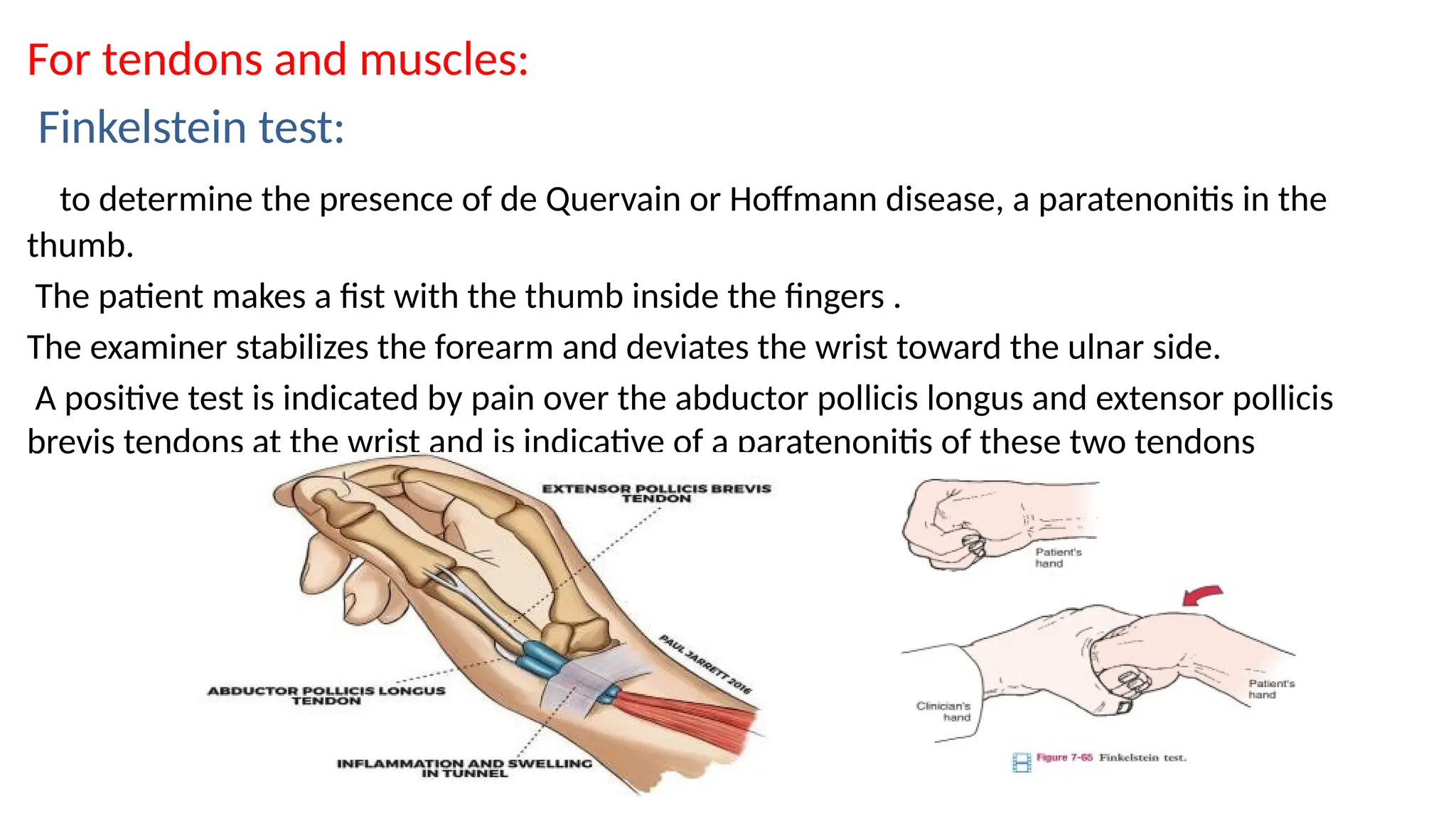
Finkelstein test:
to determine the presence of de Quervain or Hoffmann disease, a paratenonitis in the
thumb.
The patient makes a fist with the thumb inside the fingers .
The examiner stabilizes the forearm and deviates the wrist toward the ulnar side.
A positive test is indicated by pain over the abductor pollicis longus and extensor pollicis
brevis tendons at the wrist and is indicative of a paratenonitis of these two tendons
For Neurological dysfunction:
1. Carpal Compression test:
The examiner holds the supinated wrist in both hands and applies direct, even pressure
over the median nerve in the carpal tunnel for up to 30 seconds.
Production of the patient’s symptoms is considered to be a positive test for carpal tunnel
syndrome.
2. Phalen’s test:
The examiner flexes the patient’s wrists maximally and holds this position for 1 minute by
pushing the patient’s wrists together
A positive test is indicated by tingling in the thumb, index finger, and middle and lateral half
of the ring finger and is indicative of carpal tunnel syndrome caused by pressure on the
median nerve.
Specificity:95%
Sensitivity: 75%
3. Weber’s two point discrimination test:
The examiner uses a paper clip, two-point discriminator, or calipers to simultaneously apply
pressure on two adjacent points in a longitudinal direction or perpendicular to the long axis of
the finger.
the examiner moves proximal to distal in an attempt to find the minimal distance at which the
patient can distinguish between the two stimuli.
The patient must concentrate on feeling the points and must not be able to see the area being
tested.
Only the fingertips need to be tested.
Normal discrimination distance recognition is less than 6 mm.
• This test is best for hand sensation involving static holding of
an object between the fingers and thumb and requiring
pinch strength.
For Circulation and Swelling:
Allen test:
The patient is asked to open and close the hand several times as quickly as possible and
then squeeze the hand tightly .
The examiner’s thumb and index finger are placed over the radial and ulnar arteries,
compressing them.
The patient then opens the hand while pressure is maintained over the arteries.
One artery is tested by releasing the pressure over that artery to see if the hand flushes.
The other artery is then tested in a similar fashion. Both hands should be tested for
comparison
This test determines the patency of the radial and ulnar arteries and determines which
artery provides the major blood supply to the hand.
2. Digital Blood Flow:
To test distal blood flow, the examiner compresses the nail bed and notes the time taken for
color to return to the nail .
Normally, when the pressure is released, color should return to the nail bed within 3 seconds.
If return takes longer, arterial insufficiency to the fingers should be suspected. Comparison
with the normal side gives some indication of restricted flow.
3. Figure of eight measurement for swelling:
The examiner places a mark on the distal aspect of the ulnar styloid process as a starting point.
The examiner then takes the tape measure across the anterior wrist to the most distal aspect of
the radial styloid process .
From there, the tape is brought diagonally across the back (dorsum) of the hand and over the
fifth metacarophalangeal joint line , across the anterior surface of the metacarpophalangeal
joints and then diagonally across the back of the hand to where the tape started.
• References:
Orthopedic Physical Assesment , David G Maggie.

Special test for shoulder, elbow and wrist.pptx

  • 1.
    Special Tests for Shoulder,Elbow and Wrist Presenter: Mr. Kiran Kunwar
  • 2.
    Ground Rules WhilePerforming Special test: • a thorough history and a basic physical examination should be performed priorly. • know what is ‘normal’ for the patient. • Be selective in which tests we use. • Use the same tests regularly. • Remember that no test is diagnostic.
  • 3.
    How to dothe test? • Make sure the patient is comfortable. • Keep yourself relaxed and comfortable. • Interpret the findings correctly. • Modify the technique depending on the condition. • Modify the technique depending on the type of tissue.
  • 4.
    Keyterms : • Sensitivity: Sensitivity is the defined as the ratio of the proportion of the patients who have the condition of interest and whose test results are positive over the number who have the disease. If 100 people have the condition, then a test that is 98% sensitive will detect 98 of those cases and miss two.
  • 5.
    • Specificity : Specificitymeasures ability of the test to correctly identify those without the disease (true negative rate). If 100 people are free from the condition, then a test that is 98% specific will correctly exclude 98 of those cases but will incorrectly identify two people as having the condition.
  • 6.
    • Likelihood ratios: combinethe sensitivity and specificity into a ratio that quantifies a shift in the probability of a condition being present or absent in the event of a negative or positive test. for a positive test outcome (LR+) and one for a negative outcome (LR-). A large LR+indicates that the condition is more likely to be present. This can be calculated from the sensitivity and specificity values: LR+ =sensitivity /1- specificity
  • 7.
    Special Test inshoulder For anterior shoulder instability: 1. Apprehension release test 2. Crank test For Posterior Shoulder Instability: 1. Jerk Test For Inferior Shoulder Instability: 1. Sulcus Sign For Anterior Impingement: 1. Coracoid Impingement Sign 2. Hawkins-Kennedy Test 3. Neer test 4. Supine Impingement test For Labral Lesions: 1. Active Compression Test of O’Brien 2. Biceps load test II For Scapular Dyskinesia: 1. Scapular Load test
  • 8.
    For Acromioclavicular Joint Pathology: 1.Horizontal adduction test 2. Paxinos Sign For Ligament Pathology: 1. Crank test Biceps pathology: 1. Speed test 2. Yergason’s test Supraspinatus Test: 1. Empty Can test Subscapularis test: 1. External rotation lag sign 2. Lift off sign 3. Medial rotation lag sign Infraspinatus test: 1. Infraspinatus test 2. Lateral Rotation lag sign
  • 9.
    Rotator Cuff (general) 1. Rent test 2. Whipple test Trapezius 1. Trapezius test( three positions) Serratus Anterior 1. Punch out test For Neurological function: 1. ULNT For Thoracic Outlet Syndrome: 1. Roos Test
  • 10.
    1. Apprehension( Crank)test for anterior shoulder dislocation: Procedures: - primarily designed to check for traumatic instability problems causing gross or anatomical instability of the shoulder. - examiner abducts the arm to 90 and laterally rotates the shoulder slowly. - mild anteriorly directed force to the posterior humeral head to see if apprehension or pain increases. - Positive sign: when the patient looks or feels apprehensive or alarmed or resists further motion. Specificity: 98.91% Sensitivity: 52.78%
  • 11.
    • For PosteriorShoulder( glenohumeral) instability: Jerk Test: The patient sits with the arm medially rotated and forward flexed to 90°. The examiner grasps the patient’s elbow and axially loads the humerus in a proximal direction. While maintaining the axial loading, the examiner moves the arm horizontally (crossflexion/horizontal adduction) across the body. A positive test for recurrent posterior instability is the production of a sudden jerk or clunk as the humeral head slides off (subluxes) the back of the glenoid. When the arm is returned to the original 90° abduction position, a second jerk may be felt as the head reduces.
  • 13.
    • For inferiorand multidirectional shoulder( glenohumeral) instability: Sulcus Sign: The patient stands with the arm by the side and shoulder muscles relaxed. The examiner grasps the patient’s forearm below the elbow and pulls the arm distally. The presence of a sulcus sign may indicate inferior instability or glenohumeral laxity but should only be considered positive for instability if the patient is symptomatic (e.g., pain/ache on activity) Specificity: 85% Sensitivity: 90%
  • 14.
    • For AnteriorImpingement: i. Hawkins- Kennedy test: The patient stands while the examiner forward flexes the arm to 90° and then forcibly medially rotates the shoulder. This movement pushes the supraspinatus tendon against the anterior surface of the coracoacromial ligament and coracoid process. Pain indicates a positive test. Specificity: 25% Sensitivity: 92%
  • 15.
    ii. Coracoid- Impingementsign: same as the Hawkins-Kennedy test but involves horizontally adducting the arm across the body 10° to 20° before doing the medial rotation . This is more likely to approximate the lesser tuberosity of the humerus and the coracoid process.
  • 16.
    • Neer test: Thepatient’s arm is passively and forcibly fully elevated in the scapular plane with the arm medially rotated by the examiner. This passive stress causes the greater tuberosity to jam against the anteroinferior border of the acromion . The patient’s face shows pain, reflecting a positive test result . Specificity: 30.5% Sensitivity: 88.7%
  • 17.
    • Supine Impingementtest: The patient is supine with the examiner at the side by the shoulder to be tested . The examiner holds the patient’s wrist and humerus (near the elbow) and elevates the patient’s arm to end range (approximately 170° to 180°). The examiner then laterally rotates the arm and adducts it into further elevation with the supinated arm against the patient’s ear. The examiner then medially rotates the patient’s arm positive test: pain
  • 18.
    • For Labrallesions: Active compression test of O’Brien: This test is designed to detect SLAP (Type II) or superior labral lesions. The patient is placed in the standing position with the arm forward flexed to 90° and the elbow fully extended. The arm is then horizontally adducted 10° to 15° (starting position) and medially rotated so the thumb faces downward. The examiner stands behind the patient and applies a downward eccentric force to the arm . The arm is returned to the starting position and the palm is supinated so the shoulder is laterally rotated, and the downward eccentric load is repeated. Results: If pain on the joint line or painful clicking is produced inside the shoulder (not over the acromioclavicular joint) in the first part of the test and eliminated or decreased in the second part, the test is considered positive for labral abnormalities.
  • 19.
    Type I: Superiorlabrum markedly frayed but attachments intact Type II: Superior labrum has small tear; instability of the labral- biceps complex (most common) Type III: Bucket-handle tear of labrum that may displace into joint; labral biceps attachment intact Type IV: Bucket-handle tear of labrum that extends to biceps tendon, allowing tendon to sublux into joint
  • 20.
    • Kim test( biceps load test I) The patient sits with the back supported. The arm is abducted to 90° with the elbow supported in 90° flexion. The examiner’s hand, while supporting the elbow and forearm, applies an axial compression force to the glenoid through the humerus. While maintaining the axial compression force, the arm is elevated diagonally upward using the same hand while the other hand applies a downward and backward force to the proximal arm . A sudden onset of posterior shoulder pain and click indicates a positive test for a posteroinferior labral lesion. Specificity: 97% Sensitivity:91%
  • 22.
    • For Scapulardyskinesia: Lateral Scapular slide test: The patient sits or stands with the arm resting at the side. The examiner measures the distance from the base of the spine of the scapula to the spinous process of T2 or T3 (most common), from the inferior angle of the scapula to the spinous process of T7 to T9, or from T2 to the superior angle of the scapula. The patient is then tested holding two or four other positions: 45° abduction (hands on waist, thumbs posteriorly), 90° abduction with medial rotation, 120° abduction, and 150° abduction. in each position, the distance measured should not vary more than 1 cm to 1.5 cm (0.5 inch to 0.75 inch) from the original measure.
  • 23.
    Scapular Load test: performedby loading the arm (providing resistance) at 45° and greater abduction (scapular load test ) to see how the scapula stabilizes under dynamic load. This load may be applied anteriorly, posteriorly, inferiorly, or superiorly to the arm . The scapula should not move more than 1.5 cm (0.75 inch).
  • 24.
    • For Acromioclavicularjoint pathology: Horizontal Adduction test: Procedures: The patient stands and reaches the hand across to the opposite shoulder. The examiner may also passively perform the test. With the patient in a sitting position, the examiner passively forward flexes the arm to 90° and then horizontally adducts the arm as far as possible If the patient feels localized pain over the acromioclavicular joint, the test is positive Specificity: 79% Sensitivity: 77%
  • 25.
    Paxinos Sign: The patientis seated with the test arm relaxed at the side. The examiner stands beside the test arm and places one hand over the shoulder so that the thumb is under the posterolateral aspect of the acromion and the index and long fingers of the same hand (the fingers of the opposite hand may also be used instead) over the middle part of the clavicle on the same side . The examiner then applies pressure to the acromion with the thumb anterosuperiorly while applying an inferior directed counterforce to the clavicle with the fingers. The test is considered positive if pain in the area of acromioclavicular joint is increased. Specificity: 50% Sensitivity: 79%
  • 26.
    • For ligamentpathology: Crank test:
  • 27.
    • For MusclePathology: Biceps: 1. Speed test: The examiner resists shoulder forward flexion by the patient while the patient’s forearm is first supinated, then pronated, and the elbow is completely extended. The test may also be performed by forward flexing the patient’s arm to 90° and then asking the patient to resist an eccentric movement into extension first with the arm supinated, then pronated. A positive test elicits increased tenderness in the bicipital groove especially with the arm supinated. Specificity: 55.5% Sensitivity: 68.5%
  • 28.
    2. Yergason’s test: Thistest is primarily designed to check the ability of the transverse humeral ligament to hold the biceps tendon in the bicipital groove. With the patient’s elbow flexed to 90° and stabilized against the thorax and with the forearm pronated, the examiner resists supination while the patient also laterally rotates the arm against resistance. positive :Tenderness in the bicipital groove Specificity: 58% Sensitivity: 74%
  • 29.
    Supraspinatus: Drop Arm test: Theexaminer abducts the patient’s shoulder to 90° and then asks the patient to slowly lower the arm to the side in the same arc of movement . A positive test is indicated if the patient is unable to return the arm to the side slowly or has severe pain when attempting to do so. A positive result indicates a tear in the rotator cuff complex
  • 30.
    2. Empty Cantest: The patient’s arm is abducted to 90° with neutral (no) rotation, and the examiner provides resistance to abduction. The shoulder is then medially rotated and angled forward 30° (“empty can” position) so that the patient’s thumbs point toward the floor ) in the plane of the scapula. Specificity: 50% Sensitivity: 89%
  • 31.
    Subscapularis: 1.Lift –off sign: Thepatient stands and places the dorsum of the hand on the back pocket or against the midlumbar spine. The patient then lifts the hand away from the back. An inability to do so indicates a lesion of the subscapularis muscle. Abnormal motion in the scapula during the test may indicate scapular instability. If the patient is able to take the hand away from the back, the examiner should apply a load pushing the hand toward the back to test the strength of the subscapularis and to test how the scapula acts under dynamic loading. With a torn subscapularis tendon, passive (and active) lateral rotation increases.
  • 32.
  • 33.
    Medial rotation lagor spring back test: If the patient’s hand is passively medially rotated as far as possible and the patient is asked to hold the position, it will be found that the hand moves toward the back ) because subscapularis cannot hold the position due to weakness or pain
  • 34.
    Infraspinatus: Infraspinatus test: The patientstands with the arm at the side with the elbow at 90° and the humerus medially rotated to 45°. The examiner then applies a medial rotation force that the patient resists. Pain or the inability to resist medial rotation indicates a positive test for an infraspinatus strain. Specificity: 90.1% Sensitivity: 41.6%
  • 35.
    Lateral Rotation lagsign: The patient is seated or in standing position with the arm by the side and the elbow flexed to 90°. The examiner passively abducts the arm to 90° in the scapular plane, laterally rotates the shoulder to end range and asks the patient to hold it . For a positive test, the patient cannot hold the position and the hand springs back anteriorly toward midline, indicating infraspinatus and teres minor cannot hold the position due to weakness or pain.
  • 36.
    Rotator Cuff (general) Rent test: The patient is seated with the arm by the side with the examiner standing behind . The examiner palpates the anterior margin of the patient’s acromion with one hand while holding the patient’s elbow at 90° with the other hand. The examiner then passively extends the patient’s arm and slowly medially and laterally rotates the patient’s humerus while palpating the greater tuberosity and rotator cuff tendons. The presence of a depression (“rent” or defect) of about one finger width or a more prominent greater tuberosity (relative to the other side) indicates a positive test for a rotator cuff tear.
  • 37.
    Whipple test: The patientstands with the arm forward flexed to 90° and adducted until the hand is opposite the other shoulder. The examiner pushes downward at the wrist while the patient resists. The test is considered positive for partial rotator cuff tears and/or superior labrum tears. Specificity: 33% Sensitivity: 80% ( For rotator cuff tear) Specificity: 42% Sensitivity: 65%( for slap lesions)
  • 38.
    Trapezius: trapezius test( threepositions) : The upper trapezius can be tested separately by elevating the shoulder with the arm slightly abducted or to resisted shoulder abduction and head side flexion. If the shoulder is elevated with the arm by the side, levator scapulae and rhomboids are more likely to be involved as well. The middle trapezius can be tested with the patient in a prone position with the arm abducted to 90° and laterally rotated. The test involves the examiner resisting horizontal extension of the arm watching for retraction of the scapula, which should normally occur If scapular protraction occurs, the middle fibers of trapezius are weak.
  • 39.
    To test thelower trapezius, the patient is in prone lying with arm abducted to 120° and the shoulder laterally rotated. The examiner applies resistance to diagonal extension and watches for scapular retraction that should normally occur . If scapular protraction occurs, the lower trapezius is weak.
  • 40.
    Serratus Anterior: Punch outtest: The patient is in a standing position and forward flexes the arm to 90°. The examiner applies a backward force to the arm . If serratus anterior is weak or paralyzed, the medial border of the scapula wings (classic winging). The patient also has difficulty abducting or forward flexing the arm above 90° with a weak serratus anterior, but it still may be possible with lower trapezius compensation.
  • 41.
    • For thoracicOutlet Syndrome: Roos test: The patient stands and abducts the arms to 90°, laterally rotates the shoulder, and flexes the elbows to 90° . The patient then opens and closes the hands slowly for 3 minutes. If the patient is unable to keep the arms in the starting position for 3 minutes or suffers ischemic pain, heaviness or profound weakness of the arm, or numbness and tingling of the hand during the 3 minutes, the test is considered positive for thoracic outlet syndrome on the affected side. Minor fatigue and distress are considered negative tests.
  • 42.
    • Special testfor Elbow: For ligamentous instability: 1. Ligamentous valgus instability test 2. Ligamentous varus instability test 3. Moving valgus stress test 4. Lateral pivot shift test For biceps rupture: 1.Popeye sign For Lateral Epicondylitis: 1. Cozens’s test 2. Mills test For neurological dysfunction: 1. Elbow flexion test( ulnar nerve) 2. Pinch grip test( anterior interosseous branch of median nerve) 3. Tinel sign at elbow( ulnar nerve)
  • 43.
    For ligamentous instability: 1.Lateral Pivot shift of the elbow: The patient lies supine with the arm to be tested overhead. The examiner grasps the patient’s wrist and forearm with the elbow extended and the forearm fully supinated. The patient’s elbow is then flexed while a valgus stress and axial compression is applied to the elbow while maintaining supination. This causes the radius (and ulna) to sublux off the humerus leading to a prominent radial head posterolaterally and a dimple between the radial head and capitellum. If the examiner continues flexing the elbow, at about 40° to 70°, there is a sudden reduction (clunk) of the joint, which can be palpated and seen.
  • 45.
    2. Ligamentous Valgusinstability test: To test for valgus instability, the patient’s arm is stabilized with one of the examiner’s hands at the elbow and the other hand placed above the patient’s wrist. An abduction or valgus force at the distal forearm is applied to test the medial collateral ligament (valgus instability) while the ligament is palpated . The examiner should note any laxity, decreased mobility, or altered pain that may be present compared with the uninvolved elbow.
  • 46.
    3. Ligamentous varusinstability test: The patient’s elbow is slightly flexed ( 20 -30and stabilized with the examiner’s hand , as adduction or varus force is applied by the examiner to the distal forearm to test the lateral collateral ligament ( varus instability). the examiner applies the force several times with increasing pressure while noting any alteration in pain or ROM. If excessive laxity is found when doing the test or a soft end feel is felt, it indicates injury to the ligament especially with a 3 sprain, indicate a posterolateral joint instability.
  • 47.
    4. Moving ValgusStress test: The patient lies supine or stands with the arm abducted and elbow flexed fully. While maintaining a valgus stress, the examiner quickly extends the patient’s elbow. Reproduction of the patient’s pain between 120° to 70° indicates a positive test and a partial tear of the medial collateral ligament Sensitivity:100% Specificity: 75%
  • 48.
    Test for BicepsRupture( third degree strain): when testing isometric elbow flexion:
  • 49.
    For lateral Epicondylitis: 1.Cozen’s test: The patient’s elbow is stabilized by the examiner’s thumb, which rests on the patient’s lateral epicondyle . The patient is then asked to actively make a fist, pronate the forearm, and radially deviate and extend the wrist while the examiner resists the motion. A sudden severe pain in the area of the lateral epicondyle of the humerus is a positive sign. The epicondyle may be palpated to indicate the origin of the pain
  • 50.
    2. Mills’s Test: Whilepalpating the lateral epicondyle, the examiner passively pronates the patient’s forearm, flexes the wrist fully, and extends the elbow . Pain over the lateral epicondyle of the humerus indicates a positive test. 3. Maudsleys’s test : The examiner resists extension of the third digit of the hand distal to the proximal interphalangeal joint, stressing the extensor digitorum muscle and tendon . A positive test is indicated by pain over the lateral epicondyle of the humerus
  • 52.
    • For Neurologicaldysfunction: 1. Elbow flexion test( ulnar nerve) : The patient is asked to fully flex the elbow with extension of the wrist and shoulder girdle abduction (90°) and depression and to hold this position for 3 to 5 minutes. Tingling or paresthesia in the ulnar nerve distribution of the forearm and hand indicates a positive test Sensitivity: 75% Specificity: 99%
  • 53.
    2. Pinch griptest( anterior interosseous branch of median nerve) The patient is asked to pinch the tips of the index finger and thumb together. Normally, there should be a tip-to-tip pinch. If the patient is unable to pinch tip-to-tip and instead has an abnormal pulp-to pulp pinch of the index finger and thumb, this is a positive sign for pathology to the anterior interosseous nerve, which is a branch of the median nerve.
  • 54.
    Key tests performedon Wrist : For ligament, capsule and joint instability: 1. Ulnomeniscotriquetral dorsal glide test 2. Watson ( scaphoid test) For tendons and muscles: 1. Finkelstein test For neurological dysfunction: 1. Carpal compression test 2. Phalen's test 3. Weber’s two point discrimination test For swelling and circulation: 1. Allen test 2. Digital Blood flow 3. Figure of eight measurement for swelling
  • 55.
    For ligament ,capsule and joint instability: 1. Ulnomeniscotriquetral dorsal glide test: The patient sits or stands with the arm pronated. The examiner places a thumb over the ulna dorsally and places the proximal interphalangeal joint of the index finger of the same hand over the pisotriquetral complex anteriorly. While stabilizing the ulna, the examiner applies a posteriorly directed force through the pisotriquetral complex stressing the TFCC . Excessive laxity or pain when the posteriorly directed force is applied indicates a positive test for TFCC pathology. Specificity:64% Sensitivity: 66%
  • 56.
    2. Watson (scaphoid shift ) test: The patient sits with the elbow resting on the table and forearm pronated. The examiner faces the patient. With one hand, the examiner takes the patient’s wrist into full ulnar deviation and slight extension while holding the metacarpals. The examiner presses the thumb of the other hand against the distal pole of the scaphoid on the palmar side to prevent it from moving toward the palm while the fingers provide a counter pressure on the dorsum of the forearm. With the first hand, the examiner radially deviates and slightly flexes the patient’s hand while maintaining pressure on the scaphoid. This creates a subluxation stress if the scaphoid is unstable. If the scaphoid (and lunate) are unstable, the dorsal pole of the scaphoid subluxes or “shifts” over the dorsal rim of the radius and the patient complains of pain, indicating a positive test
  • 57.
  • 58.
    • Piano’s Keytest: The patient sits with both arms in pronation. The examiner stabilizes the patient’s arm with one hand so that the examiner’s index finger can push down on the distal ulna. The examiner’s other hand supports the patient’s hand. The examiner pushes down on the distal ulna as one would push down on a piano key. The results are compared with the nonsymptomatic side. A positive test is indicated by a difference in mobility and the production of pain and/or tenderness. A positive test indicates instability of the distal radioulnar joint
  • 59.
    For tendons andmuscles: Finkelstein test: to determine the presence of de Quervain or Hoffmann disease, a paratenonitis in the thumb. The patient makes a fist with the thumb inside the fingers . The examiner stabilizes the forearm and deviates the wrist toward the ulnar side. A positive test is indicated by pain over the abductor pollicis longus and extensor pollicis brevis tendons at the wrist and is indicative of a paratenonitis of these two tendons
  • 60.
    For Neurological dysfunction: 1.Carpal Compression test: The examiner holds the supinated wrist in both hands and applies direct, even pressure over the median nerve in the carpal tunnel for up to 30 seconds. Production of the patient’s symptoms is considered to be a positive test for carpal tunnel syndrome.
  • 61.
    2. Phalen’s test: Theexaminer flexes the patient’s wrists maximally and holds this position for 1 minute by pushing the patient’s wrists together A positive test is indicated by tingling in the thumb, index finger, and middle and lateral half of the ring finger and is indicative of carpal tunnel syndrome caused by pressure on the median nerve. Specificity:95% Sensitivity: 75%
  • 62.
    3. Weber’s twopoint discrimination test: The examiner uses a paper clip, two-point discriminator, or calipers to simultaneously apply pressure on two adjacent points in a longitudinal direction or perpendicular to the long axis of the finger. the examiner moves proximal to distal in an attempt to find the minimal distance at which the patient can distinguish between the two stimuli. The patient must concentrate on feeling the points and must not be able to see the area being tested. Only the fingertips need to be tested. Normal discrimination distance recognition is less than 6 mm.
  • 63.
    • This testis best for hand sensation involving static holding of an object between the fingers and thumb and requiring pinch strength.
  • 64.
    For Circulation andSwelling: Allen test: The patient is asked to open and close the hand several times as quickly as possible and then squeeze the hand tightly . The examiner’s thumb and index finger are placed over the radial and ulnar arteries, compressing them. The patient then opens the hand while pressure is maintained over the arteries. One artery is tested by releasing the pressure over that artery to see if the hand flushes. The other artery is then tested in a similar fashion. Both hands should be tested for comparison This test determines the patency of the radial and ulnar arteries and determines which artery provides the major blood supply to the hand.
  • 66.
    2. Digital BloodFlow: To test distal blood flow, the examiner compresses the nail bed and notes the time taken for color to return to the nail . Normally, when the pressure is released, color should return to the nail bed within 3 seconds. If return takes longer, arterial insufficiency to the fingers should be suspected. Comparison with the normal side gives some indication of restricted flow.
  • 67.
    3. Figure ofeight measurement for swelling: The examiner places a mark on the distal aspect of the ulnar styloid process as a starting point. The examiner then takes the tape measure across the anterior wrist to the most distal aspect of the radial styloid process . From there, the tape is brought diagonally across the back (dorsum) of the hand and over the fifth metacarophalangeal joint line , across the anterior surface of the metacarpophalangeal joints and then diagonally across the back of the hand to where the tape started.
  • 70.
    • References: Orthopedic PhysicalAssesment , David G Maggie.