Nangarhar University Teaching
Hospital
Surgical Ward
Presenter : Abdullah Ihsaas
Trainee Medical officer (TMO) of G.S 2nd Year
Topic to be present:
Guidance :- Asso prof Dr Said Baha karimi
Anatomy of shoulder joint
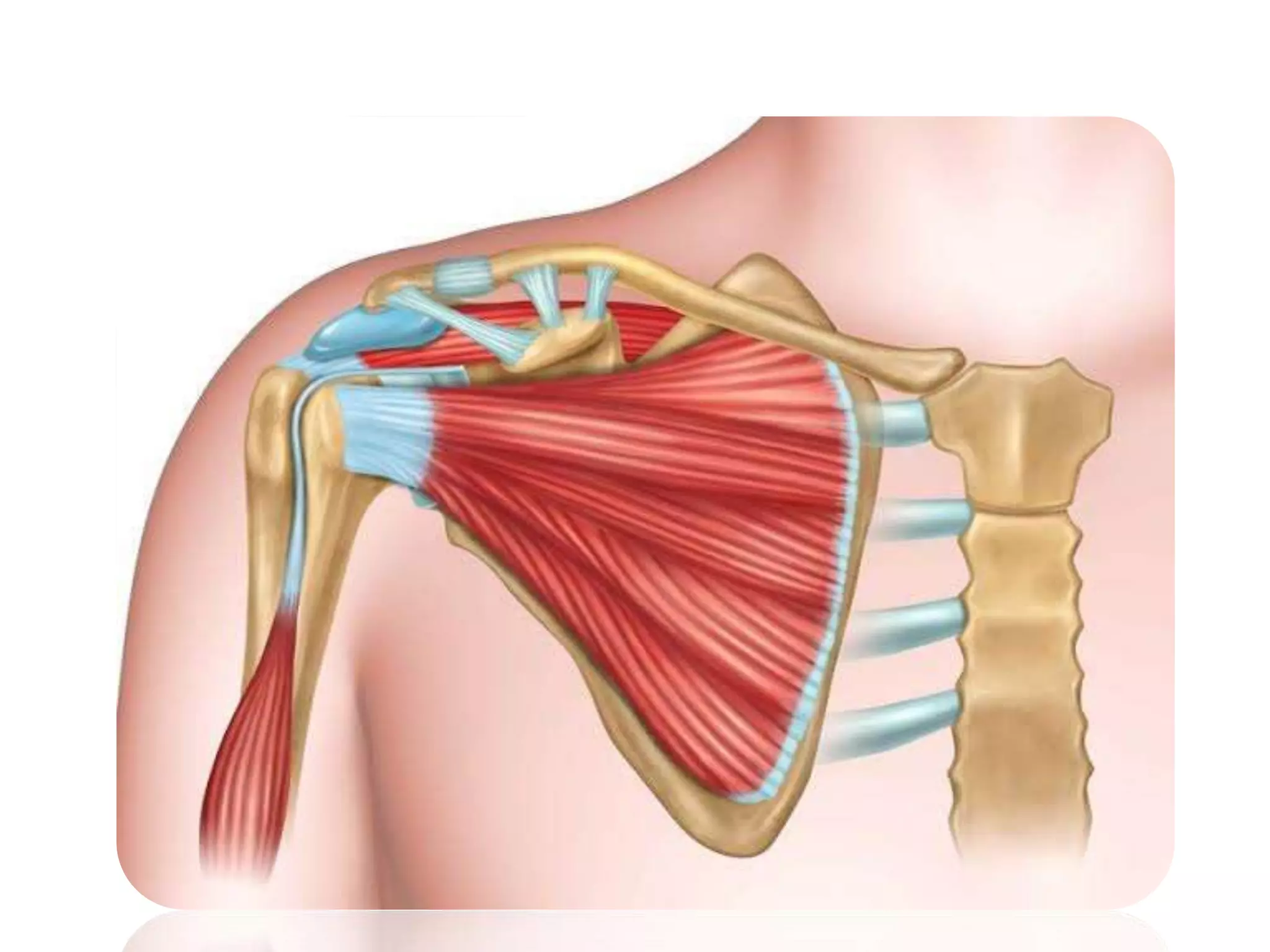
The shoulder is the region of upper attachment
to the trunk
The bone framework of the shoulder consists of :-
1. Clavicle ( Collarbone )
2. Scapula ( Shoulder blade )
3. Proximal end of the humorous
Roof of the shoulder form by the part of scapula
Acromion proses
Articulation
Consist of a series of four articulation
1. The glenohumeral joint ( True shoulder joint )
2. The acromiocalvicular joint
3. The sternoclavicular joint
4. The scapulothoracic joint
Ligaments
Ligaments are soft tissues joining bone to bone in orthopedics
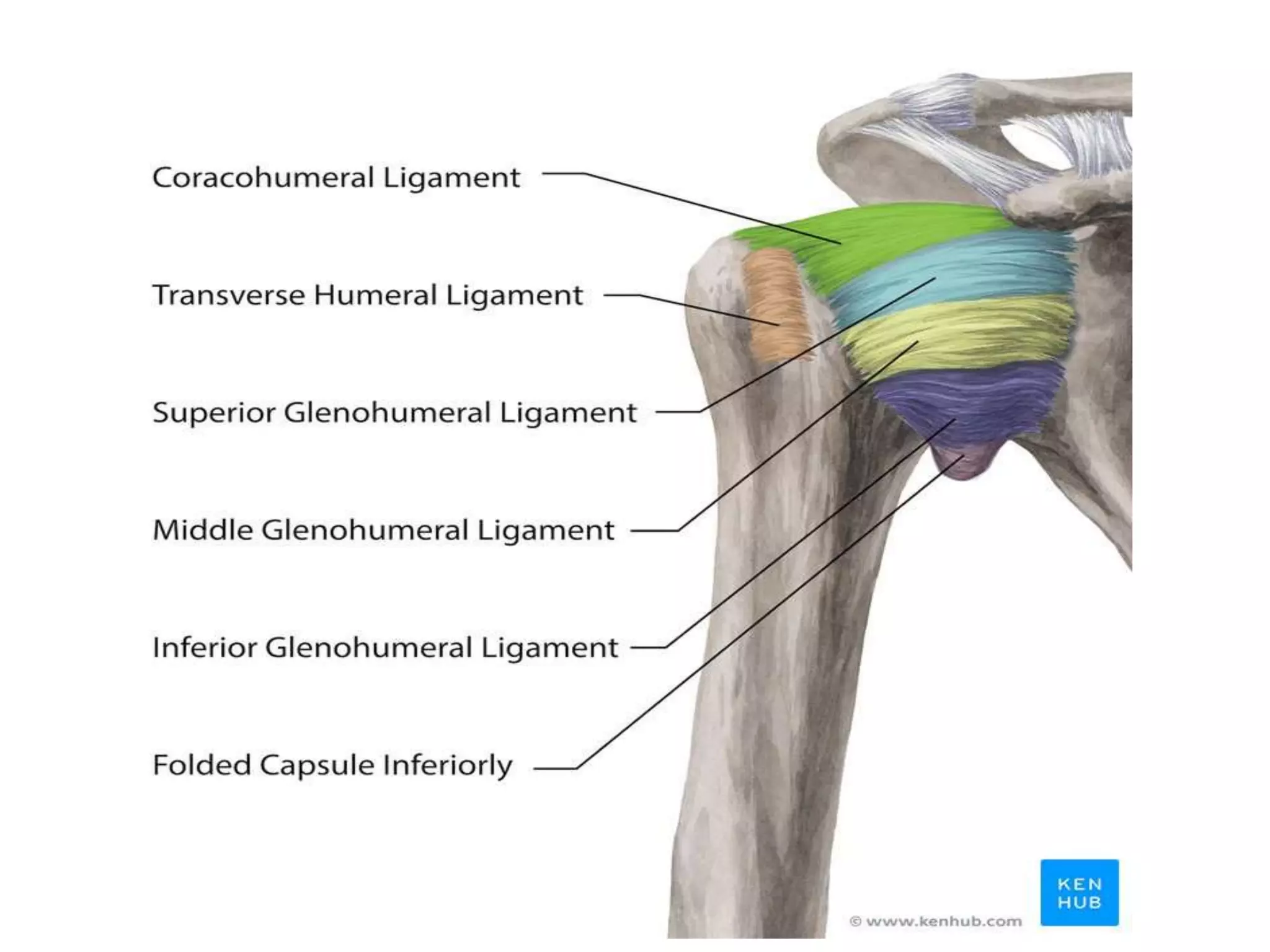
1. Glenohemural ligament
2. Transverse humeral ligament
3. Coracohumeral ligament
4. Accessory ligament ( Coraco acromial ligament )
5. Coracoa clavicular ligaments ( trapezoid and conoid lig )
Joint Capsule :- is water tight sac surround
shoulder joint. capsule enforced by group of ligaments
These ligaments are main source of stability
Muscle and Tendons
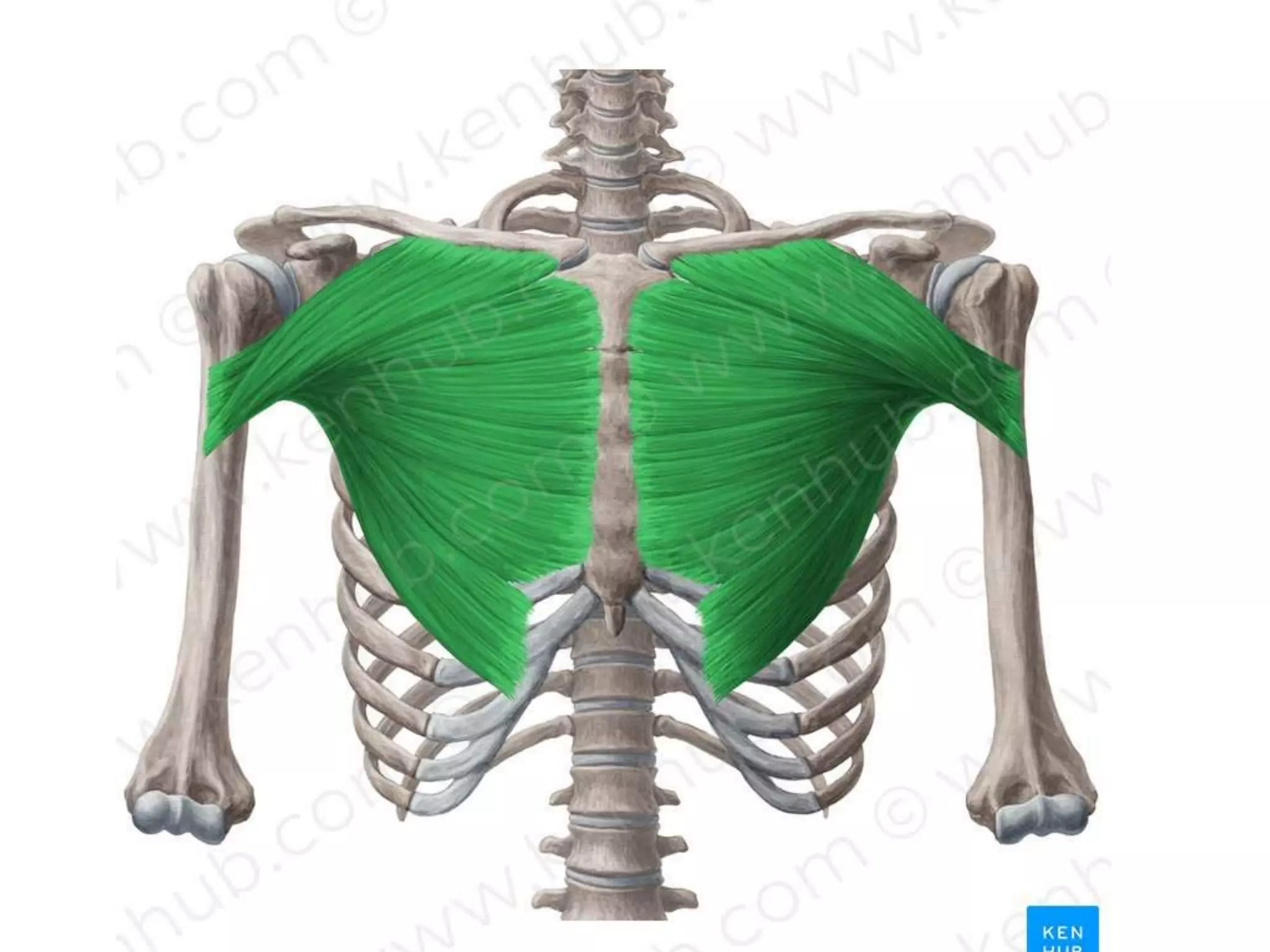
Anterior shoulder muscles:
Attach the upper extremity to the clavicle and
the thoracic cage :-
1. Pectoralis major
2. Pectoralis minor
3. Subclavius muscle
4. Serratus anterior muscle
Rotator cuff
Is a group of four muscle that enclosed the
glenohumeral joint by forming the cuff around it :
1. Supraspinatus
2. Infraspinatus
3. Teres minor
4. Subscapularis muscles
Mnemonic SITS
• Produce large spectrum of arm movements
• External and internal arm rotation
• Abduction and arm adduction
Other muscles
• Deltoid muscle
• Teres major muscle
From back
• Rhomboid major and rhomboid minor
• Trapezius
• Levator scapulae
• Litissimus dorsi
Blood Supply
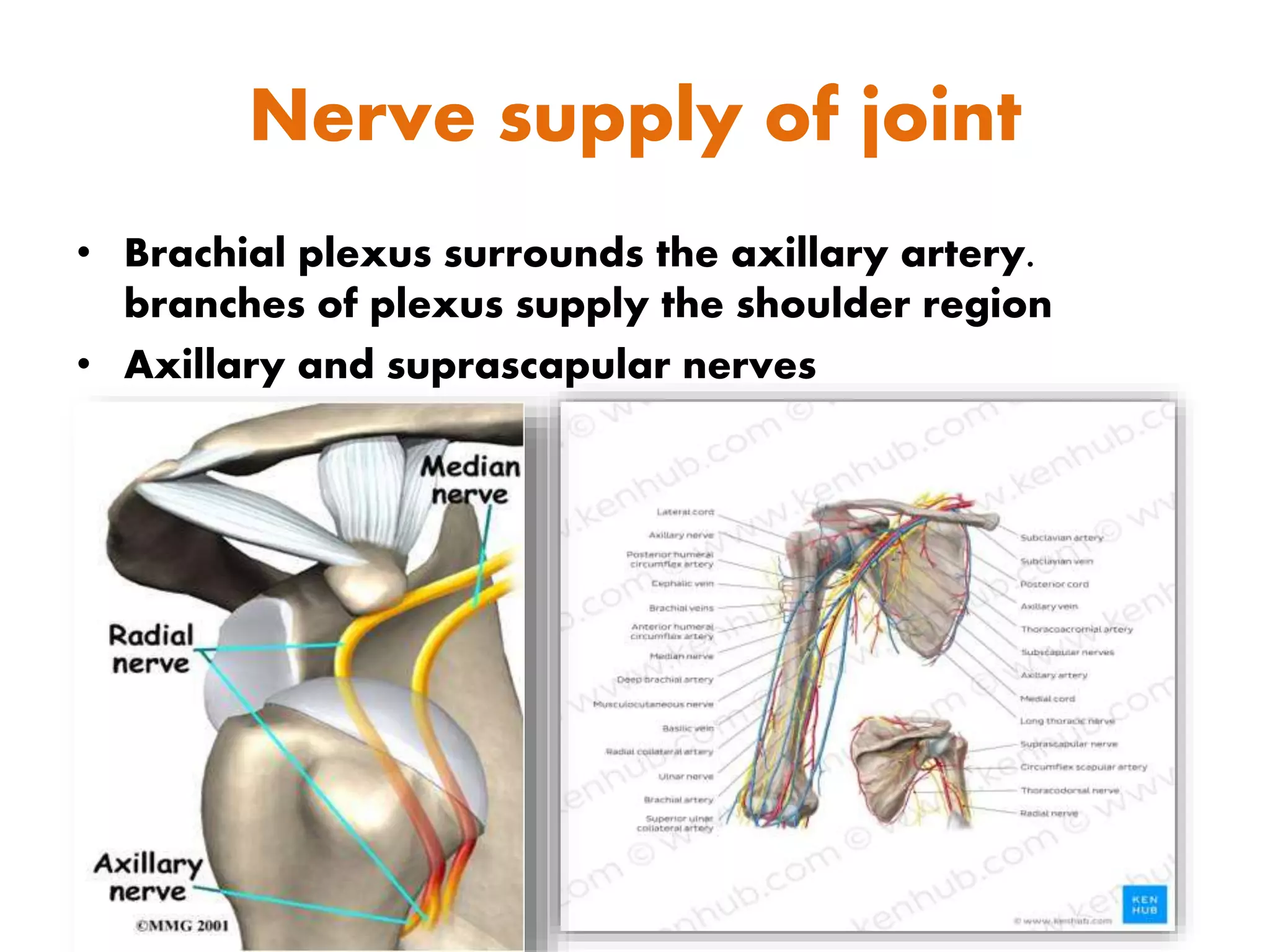
Nerve supply of joint
• Brachial plexus surrounds the axillary artery.
branches of plexus supply the shoulder region
• Axillary and suprascapular nerves
Shoulder joint
is an extremely mobile ball and Socket
synovial joint.
More prone to
injuries
Very
unstable
High
mobility
History
A patient with shoulder joint problems
presents with following complain
1. Pain
2. Swelling
3. Deformity
4. Loss of contour
5. Restriction and loss of movements
1. Pain
 Injuries  Acute and sever pain
 Chronic disorder  pain is dull aching
 Pain full arc syndrome  pain during midrange
of abduction
 Arthritis  pain all over the shoulder
True shoulder pain
Radiate from near
tip of acromion
Down the lateral
side of arm
To the level of
deltoid insertion
Never extend below
the elbow joint
Referred
shoulder pain
From
Cervical spine
Heart
Mediastinum
and diaphragm
Shoulder pain
2. Swelling
Could be due to injury or arthritis
3. Deformity
Anterior dislocation  Anterior prominence +
arm held in internal rotation
4. Loss of contour
due to shoulder dislocation or deltoid muscle
wasting in TB , Rheumatoid arthritis etc
5. Restriction and loss of movement
particularly due to frozen shoulder, arthritis etc
1. Inspection (look)
2. Palpation (Feel)
3. Movements
4. Special tests
1. Inspection (Look) :-
 Examine patient at sitting position
 From front
 Sides
 Behind
 and above
From front
Look for the prominence of :
 Sternoclavicular joint
 Deformity of clavicle
 Acromioclavicular joint
 Wasting of the deltoid muscle due to axillary
nerve palsy or chronic disease like TB, Rheumatoid
arthritis
From behind
Look for
 Position of scapula
 Size of scapula
 Wasting of supra – infra Spinatus muscle
 Winging of the scapula
(due to paralysis of Serratus anterior )
From above
Look for
 Asymmetry of supraclavicular fossae
 Swelling of the shoulder and any deformity
From the side
Look for
 Swelling
 Flattening ( Anterior dislocation ) or
( Rounded fellness of the joint ) ( effusion )
Note :-
 Attitude :- In disease of shoulder Adopted are usually
flexion, adduction and medial rotation
 Wasting of the Supraspinatus or Infraspinatus muscle
 Wasting of deltoid or rotator cuff muscles
2. Palpation ( Feel )
 Local temperature
 Tenderness
 Swelling
 Sensation
 Local temperature: feel for the local rise of temp
 Tenderness: try to elicit the tenderness along the
following points:
Just below the acromion  Supraspinatus tendinitis
Just below the acromion and
the arm abducted  sub deltoid bursitis
Along the Coracoid process  this is the anterior
aspect of the joint
All round the joint  arthritis
 Swelling :
Due to effusion in the joint best palpated in axilla.
Difficult to palpate through deltoid.
Beneath the Acromion process
Due to sub deltoid bursitis.
The sternoclavicular and the acromioclavicular
joint are also palpated for swilling , tenderness
etc
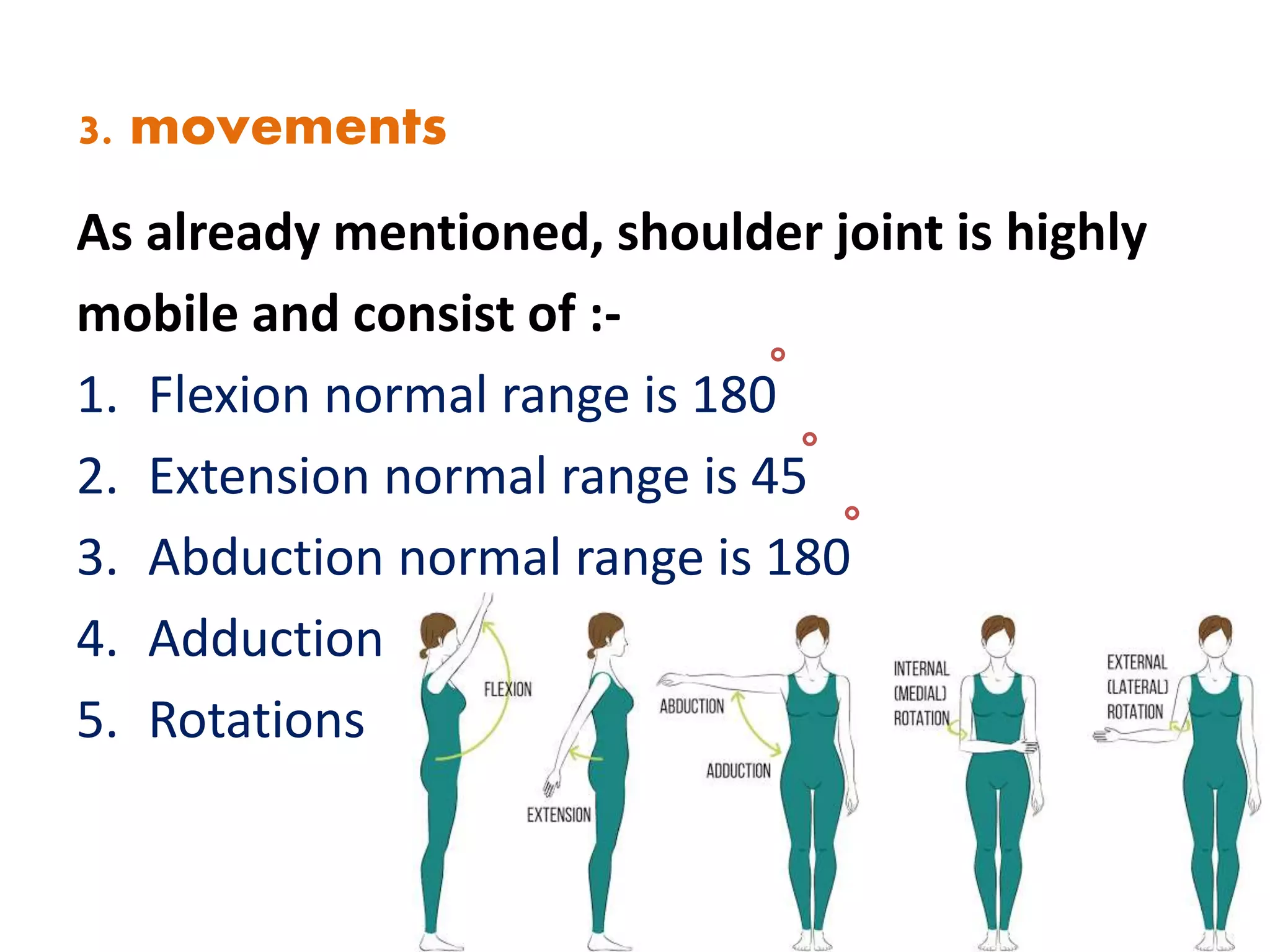
3. movements
As already mentioned, shoulder joint is highly
mobile and consist of :-
1. Flexion normal range is 180
2. Extension normal range is 45
3. Abduction normal range is 180
4. Adduction
5. Rotations
Flexion
 Best tested with the patient seated position
 Both passive and active movements are testes
Extension
 Best tested in the seated position
 Ask the patient to extend both arms behind
Abduction
• Best tested in standing position and both the
shoulder are tested simultaneously for
comparison.
• This is the most important movement of
shoulder
• Normal range is 180
Pain in abduction :-
Initial :- Supraspinatus rupture
Midrange pain and extremes of movement
painless : Sub Acromial bursitis
More than 90 :- ACM joint arthritis
All trough :- Glenohumral arthritis
Out of 180 abduction :- 100 – 120 is by
glenohumeral 60 - 80 is by scapula and clavicle
thus abduction can still take place even if
glenohumeral joint is ankylosed
Adduction
Ask the patient to touch there other shoulder tip.
Rotation
Both internal and external rotation are tested
in supine and sitting position.
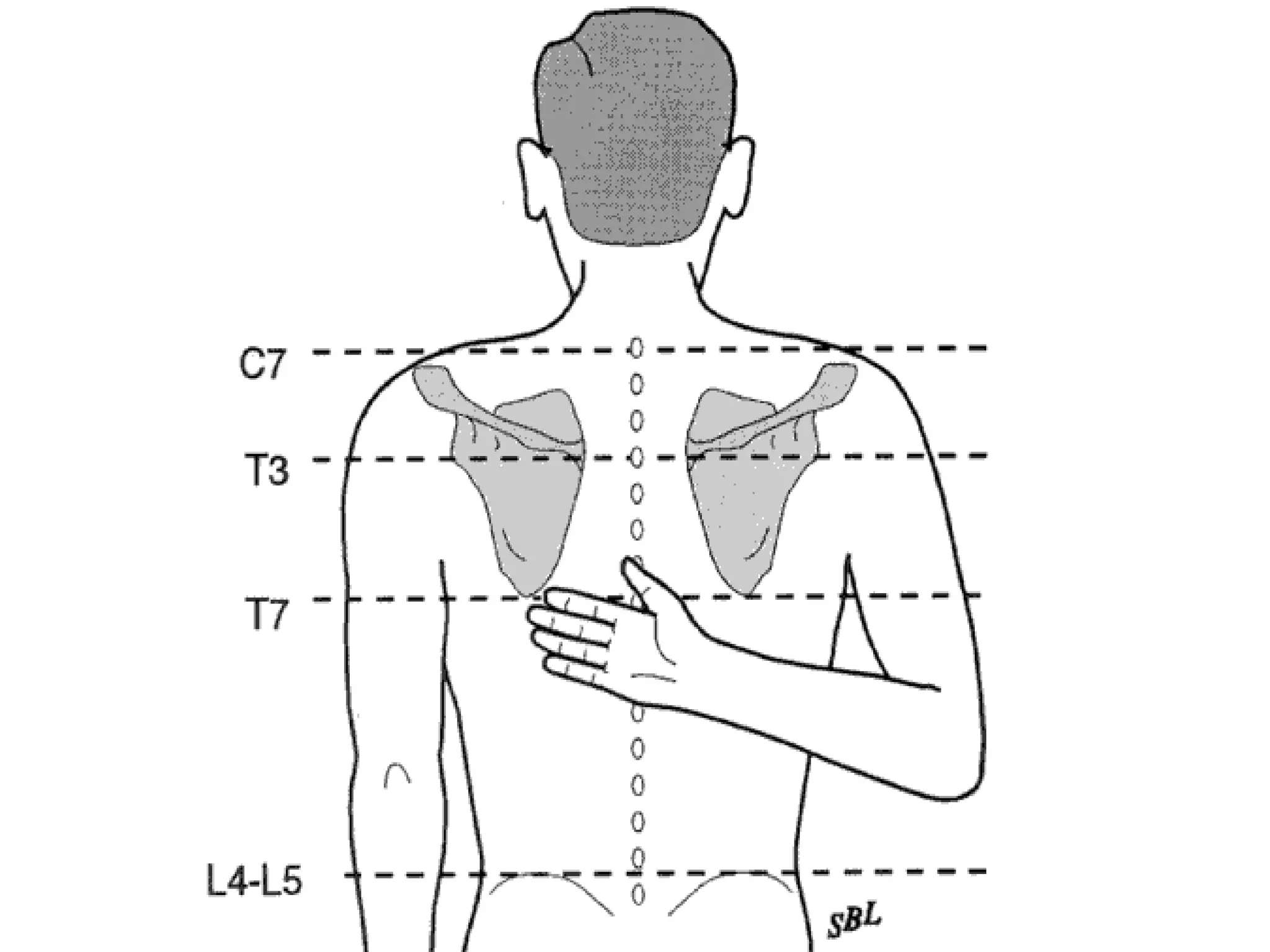
Internal rotation :
Ask the patient to touch their back with the
dorsum of the hand and to raise their hand up
the back high as possible ( Normal range is
thoracic spine level T7- T9 )
External rotation :
With the arms by the sides, bend the elbow to
90 and rotate the forearm to the mid – prone
position. Ask the patient to separate their
hands as much as possible
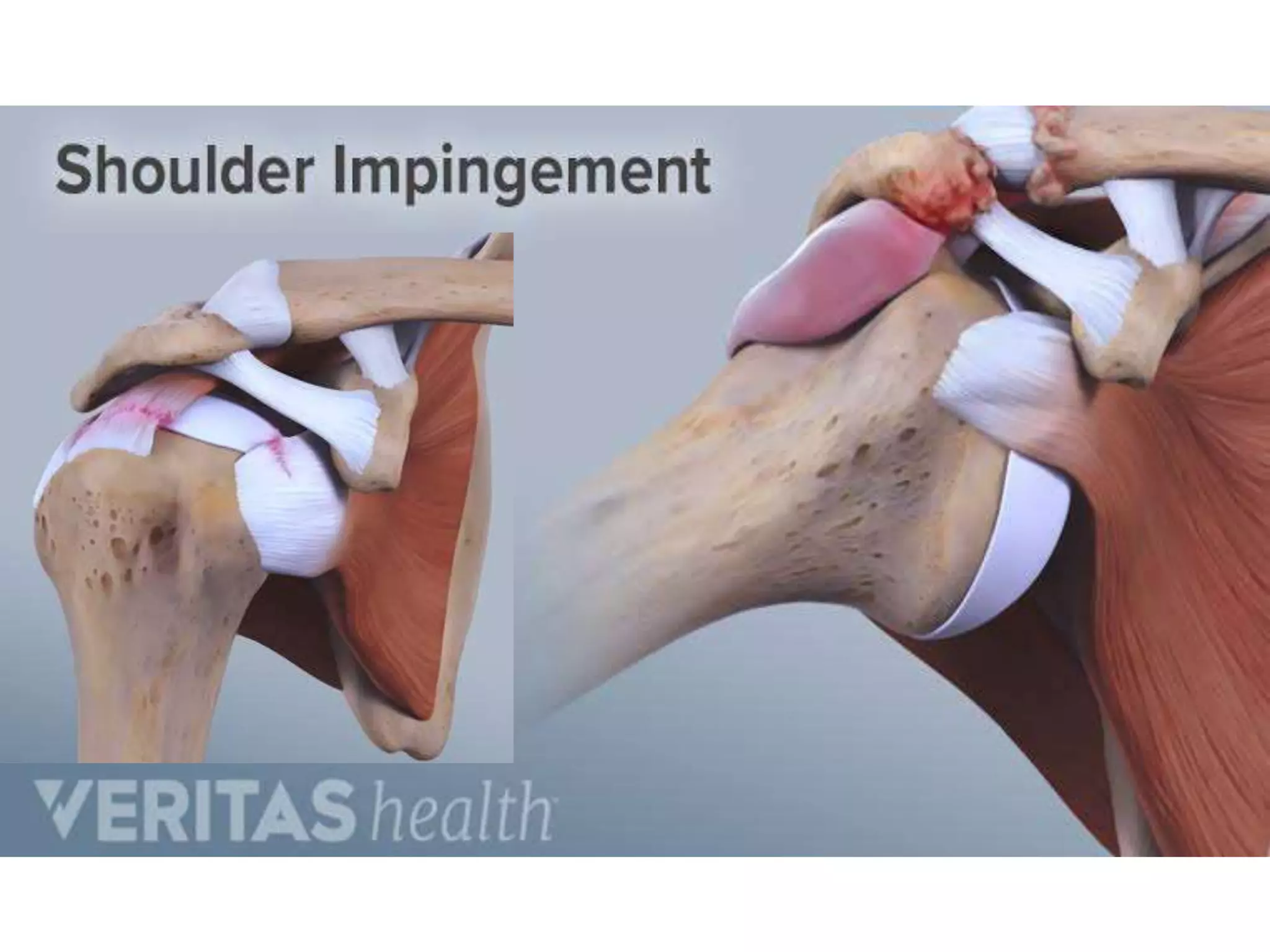
Impingement syndrome
 Impairment or compression of the rotator cuff
tendons in the subacromial space between
the lateral aspect of the acromion and the
humeral head
 May result in rotator cuff
tendonitis/tendinopathy , subacromial
bursitis, and degenerative rotator cuff tear.
Partial or full-thickness tear.
• Pain full arc test :
 Ask the patient to abduct their arms from their
sides. The presence of pain from 60 – 120 is
positive.
Jobe’s test ( Empty can ) :
Ask the patient to abduct the arm to 90 elevation in
the scapular plane with full internal rotation
( empty can position ). Ask the patient to resist
downward pressure the presence of pain is
positive.
Video
Hawkins test :-
Video
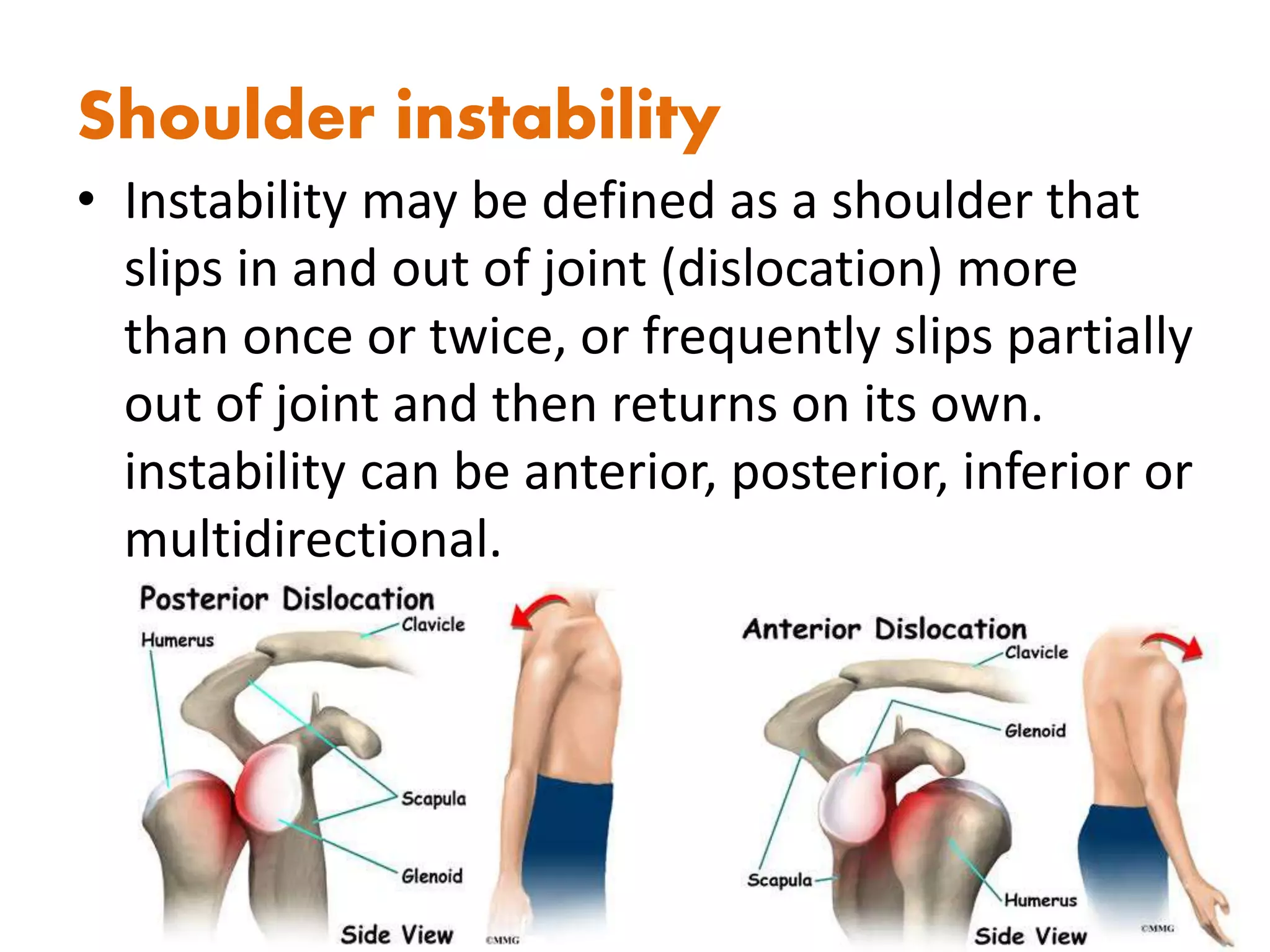
Shoulder instability
• Instability may be defined as a shoulder that
slips in and out of joint (dislocation) more
than once or twice, or frequently slips partially
out of joint and then returns on its own.
instability can be anterior, posterior, inferior or
multidirectional.
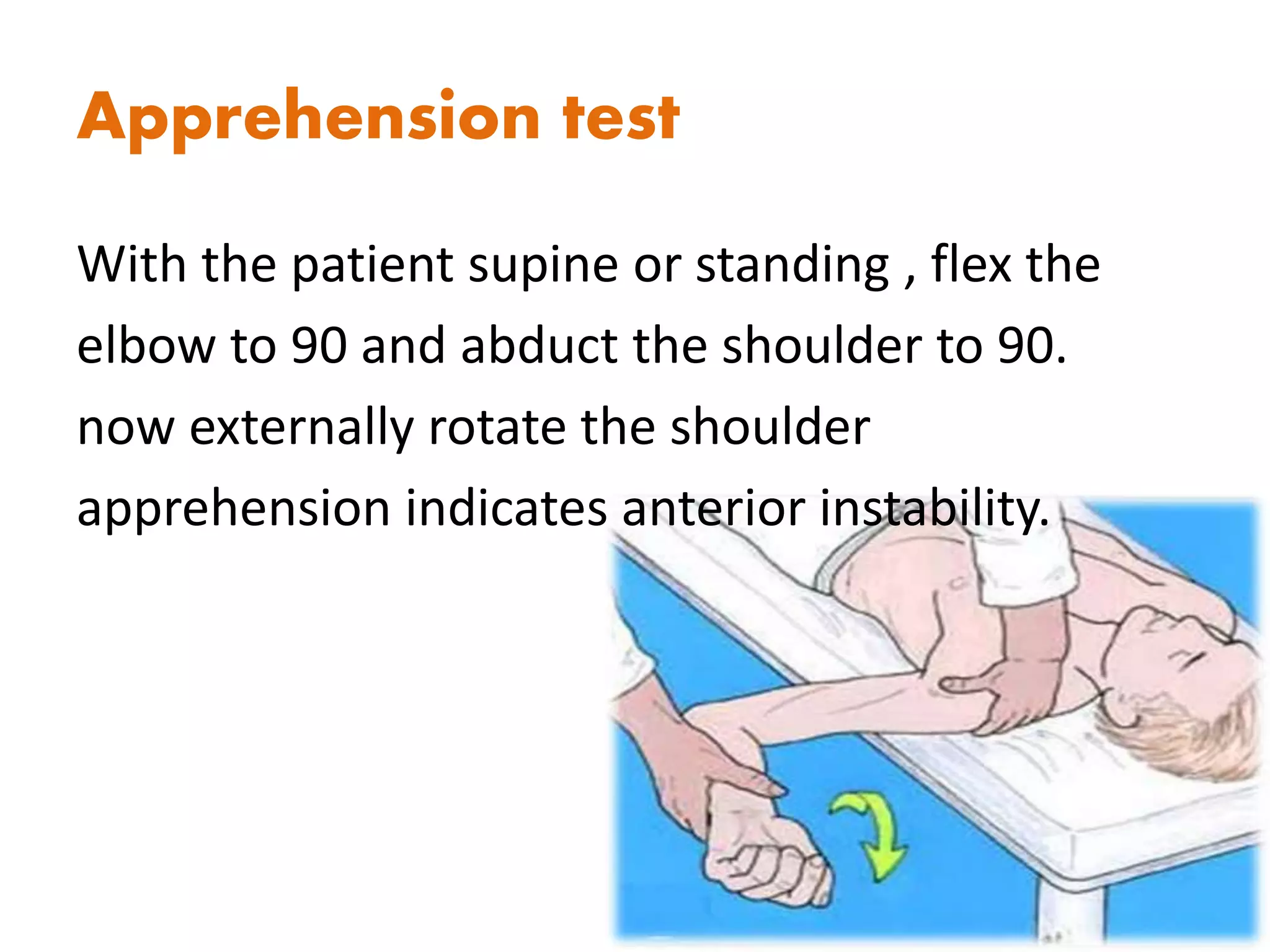
Apprehension test
With the patient supine or standing , flex the
elbow to 90 and abduct the shoulder to 90.
now externally rotate the shoulder
apprehension indicates anterior instability.
Other examination
 Examine the cervical spine.
 Examine the acromioclavicular and
sternoclavicular joints
 Neurovascular examination of the upper limbs
Winging of scapula  long thoracic nerve of bell is
paralyzed
Regimental badge anesthesia and loss of deltoid
power  damage to axillary nerve
 Systemic examination for TB, rheumatoid arthritis
Recap order of shoulder examination
Anatomy of shoulder joint
History
Inspection
Palpation
Movements
Special test
Examination of cervical spine
Neurovascular examination of the upper limbs
Systemic examination of TB , RA
Reference
1. Text book of orthopedics john Ebenezer
Rakish john
2. Apley & Solomon's system of orthopedics
and trauma 10th edition
3. Bialy and loves GS 27th edition
4. Grays Anatomy for students
5. Snell Regional Anatomy
6. Internet / YouTube
Thanks

Clinical Examination of shoulder joint

  • 2.
    Nangarhar University Teaching Hospital SurgicalWard Presenter : Abdullah Ihsaas Trainee Medical officer (TMO) of G.S 2nd Year Topic to be present: Guidance :- Asso prof Dr Said Baha karimi
  • 4.
    Anatomy of shoulderjoint The shoulder is the region of upper attachment to the trunk The bone framework of the shoulder consists of :- 1. Clavicle ( Collarbone ) 2. Scapula ( Shoulder blade ) 3. Proximal end of the humorous Roof of the shoulder form by the part of scapula Acromion proses
  • 6.
    Articulation Consist of aseries of four articulation 1. The glenohumeral joint ( True shoulder joint ) 2. The acromiocalvicular joint 3. The sternoclavicular joint 4. The scapulothoracic joint
  • 7.
    Ligaments Ligaments are softtissues joining bone to bone in orthopedics 1. Glenohemural ligament 2. Transverse humeral ligament 3. Coracohumeral ligament 4. Accessory ligament ( Coraco acromial ligament ) 5. Coracoa clavicular ligaments ( trapezoid and conoid lig ) Joint Capsule :- is water tight sac surround shoulder joint. capsule enforced by group of ligaments These ligaments are main source of stability
  • 10.
    Muscle and Tendons Anteriorshoulder muscles: Attach the upper extremity to the clavicle and the thoracic cage :- 1. Pectoralis major 2. Pectoralis minor 3. Subclavius muscle 4. Serratus anterior muscle
  • 12.
    Rotator cuff Is agroup of four muscle that enclosed the glenohumeral joint by forming the cuff around it : 1. Supraspinatus 2. Infraspinatus 3. Teres minor 4. Subscapularis muscles Mnemonic SITS • Produce large spectrum of arm movements • External and internal arm rotation • Abduction and arm adduction
  • 14.
    Other muscles • Deltoidmuscle • Teres major muscle From back • Rhomboid major and rhomboid minor • Trapezius • Levator scapulae • Litissimus dorsi
  • 16.
  • 17.
    Nerve supply ofjoint • Brachial plexus surrounds the axillary artery. branches of plexus supply the shoulder region • Axillary and suprascapular nerves
  • 18.
    Shoulder joint is anextremely mobile ball and Socket synovial joint. More prone to injuries Very unstable High mobility
  • 19.
    History A patient withshoulder joint problems presents with following complain 1. Pain 2. Swelling 3. Deformity 4. Loss of contour 5. Restriction and loss of movements
  • 20.
    1. Pain  Injuries Acute and sever pain  Chronic disorder  pain is dull aching  Pain full arc syndrome  pain during midrange of abduction  Arthritis  pain all over the shoulder
  • 21.
    True shoulder pain Radiatefrom near tip of acromion Down the lateral side of arm To the level of deltoid insertion Never extend below the elbow joint Referred shoulder pain From Cervical spine Heart Mediastinum and diaphragm Shoulder pain
  • 23.
    2. Swelling Could bedue to injury or arthritis 3. Deformity Anterior dislocation  Anterior prominence + arm held in internal rotation
  • 24.
    4. Loss ofcontour due to shoulder dislocation or deltoid muscle wasting in TB , Rheumatoid arthritis etc
  • 25.
    5. Restriction andloss of movement particularly due to frozen shoulder, arthritis etc
  • 26.
    1. Inspection (look) 2.Palpation (Feel) 3. Movements 4. Special tests
  • 27.
    1. Inspection (Look):-  Examine patient at sitting position  From front  Sides  Behind  and above
  • 28.
    From front Look forthe prominence of :  Sternoclavicular joint  Deformity of clavicle  Acromioclavicular joint  Wasting of the deltoid muscle due to axillary nerve palsy or chronic disease like TB, Rheumatoid arthritis
  • 29.
    From behind Look for Position of scapula  Size of scapula  Wasting of supra – infra Spinatus muscle  Winging of the scapula (due to paralysis of Serratus anterior )
  • 31.
    From above Look for Asymmetry of supraclavicular fossae  Swelling of the shoulder and any deformity
  • 32.
    From the side Lookfor  Swelling  Flattening ( Anterior dislocation ) or ( Rounded fellness of the joint ) ( effusion ) Note :-  Attitude :- In disease of shoulder Adopted are usually flexion, adduction and medial rotation  Wasting of the Supraspinatus or Infraspinatus muscle  Wasting of deltoid or rotator cuff muscles
  • 33.
    2. Palpation (Feel )  Local temperature  Tenderness  Swelling  Sensation
  • 34.
     Local temperature:feel for the local rise of temp  Tenderness: try to elicit the tenderness along the following points: Just below the acromion  Supraspinatus tendinitis Just below the acromion and the arm abducted  sub deltoid bursitis Along the Coracoid process  this is the anterior aspect of the joint All round the joint  arthritis
  • 36.
     Swelling : Dueto effusion in the joint best palpated in axilla. Difficult to palpate through deltoid. Beneath the Acromion process Due to sub deltoid bursitis. The sternoclavicular and the acromioclavicular joint are also palpated for swilling , tenderness etc
  • 37.
    3. movements As alreadymentioned, shoulder joint is highly mobile and consist of :- 1. Flexion normal range is 180 2. Extension normal range is 45 3. Abduction normal range is 180 4. Adduction 5. Rotations
  • 38.
    Flexion  Best testedwith the patient seated position  Both passive and active movements are testes
  • 39.
    Extension  Best testedin the seated position  Ask the patient to extend both arms behind
  • 40.
    Abduction • Best testedin standing position and both the shoulder are tested simultaneously for comparison. • This is the most important movement of shoulder • Normal range is 180
  • 41.
    Pain in abduction:- Initial :- Supraspinatus rupture Midrange pain and extremes of movement painless : Sub Acromial bursitis More than 90 :- ACM joint arthritis All trough :- Glenohumral arthritis Out of 180 abduction :- 100 – 120 is by glenohumeral 60 - 80 is by scapula and clavicle thus abduction can still take place even if glenohumeral joint is ankylosed
  • 42.
    Adduction Ask the patientto touch there other shoulder tip.
  • 43.
    Rotation Both internal andexternal rotation are tested in supine and sitting position. Internal rotation : Ask the patient to touch their back with the dorsum of the hand and to raise their hand up the back high as possible ( Normal range is thoracic spine level T7- T9 )
  • 45.
    External rotation : Withthe arms by the sides, bend the elbow to 90 and rotate the forearm to the mid – prone position. Ask the patient to separate their hands as much as possible
  • 47.
    Impingement syndrome  Impairmentor compression of the rotator cuff tendons in the subacromial space between the lateral aspect of the acromion and the humeral head  May result in rotator cuff tendonitis/tendinopathy , subacromial bursitis, and degenerative rotator cuff tear. Partial or full-thickness tear.
  • 49.
    • Pain fullarc test :  Ask the patient to abduct their arms from their sides. The presence of pain from 60 – 120 is positive.
  • 50.
    Jobe’s test (Empty can ) : Ask the patient to abduct the arm to 90 elevation in the scapular plane with full internal rotation ( empty can position ). Ask the patient to resist downward pressure the presence of pain is positive. Video
  • 51.
  • 52.
    Shoulder instability • Instabilitymay be defined as a shoulder that slips in and out of joint (dislocation) more than once or twice, or frequently slips partially out of joint and then returns on its own. instability can be anterior, posterior, inferior or multidirectional.
  • 53.
    Apprehension test With thepatient supine or standing , flex the elbow to 90 and abduct the shoulder to 90. now externally rotate the shoulder apprehension indicates anterior instability.
  • 54.
    Other examination  Examinethe cervical spine.  Examine the acromioclavicular and sternoclavicular joints  Neurovascular examination of the upper limbs Winging of scapula  long thoracic nerve of bell is paralyzed Regimental badge anesthesia and loss of deltoid power  damage to axillary nerve  Systemic examination for TB, rheumatoid arthritis
  • 56.
    Recap order ofshoulder examination Anatomy of shoulder joint History Inspection Palpation Movements Special test Examination of cervical spine Neurovascular examination of the upper limbs Systemic examination of TB , RA
  • 57.
    Reference 1. Text bookof orthopedics john Ebenezer Rakish john 2. Apley & Solomon's system of orthopedics and trauma 10th edition 3. Bialy and loves GS 27th edition 4. Grays Anatomy for students 5. Snell Regional Anatomy 6. Internet / YouTube
  • 58.