History & Physical Examination
of the Shoulder
Objectives
l Review pertinent anatomy of the
shoulder
l Review differential diagnosis of
shoulder complaints
l Review clinical history and physical
examination of the shoulder
l Review common shoulder injuries &
characteristic physical exam findings
Brief Epidemiology
l Shoulder pain: a common complaint
in primary care
– 2nd only to knee pain for specialist
referrals
– Most common causes in adults (peak
ages 40-60)
• Subacromial impingement syndrome
• Rotator cuff problems
l Athletic injuries
– Shoulder: 8-13% of all athletic injuries
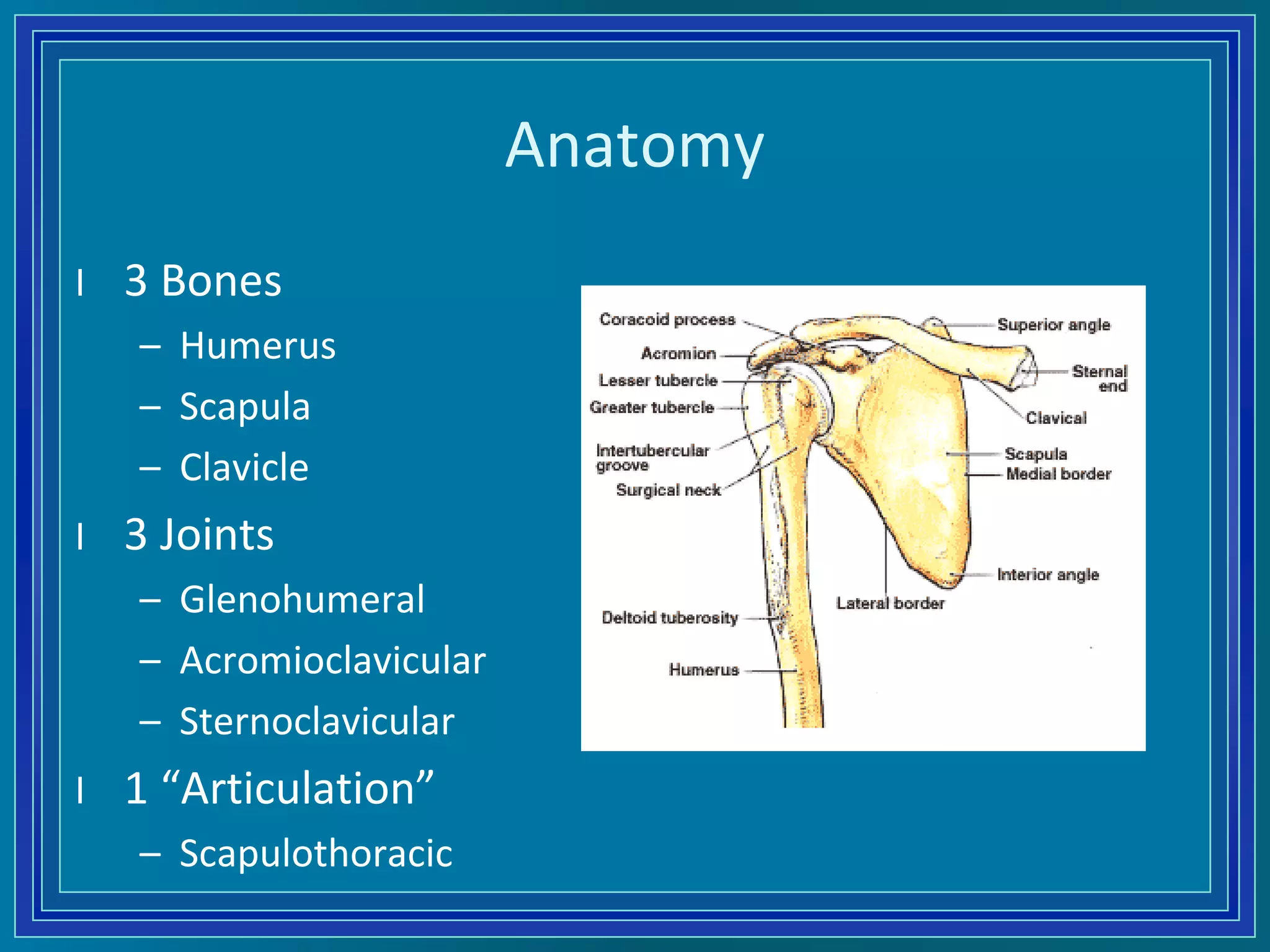
Anatomy
l 3 Bones
– Humerus
– Scapula
– Clavicle
l 3 Joints
– Glenohumeral
– Acromioclavicular
– Sternoclavicular
l 1 “Articulation”
– Scapulothoracic
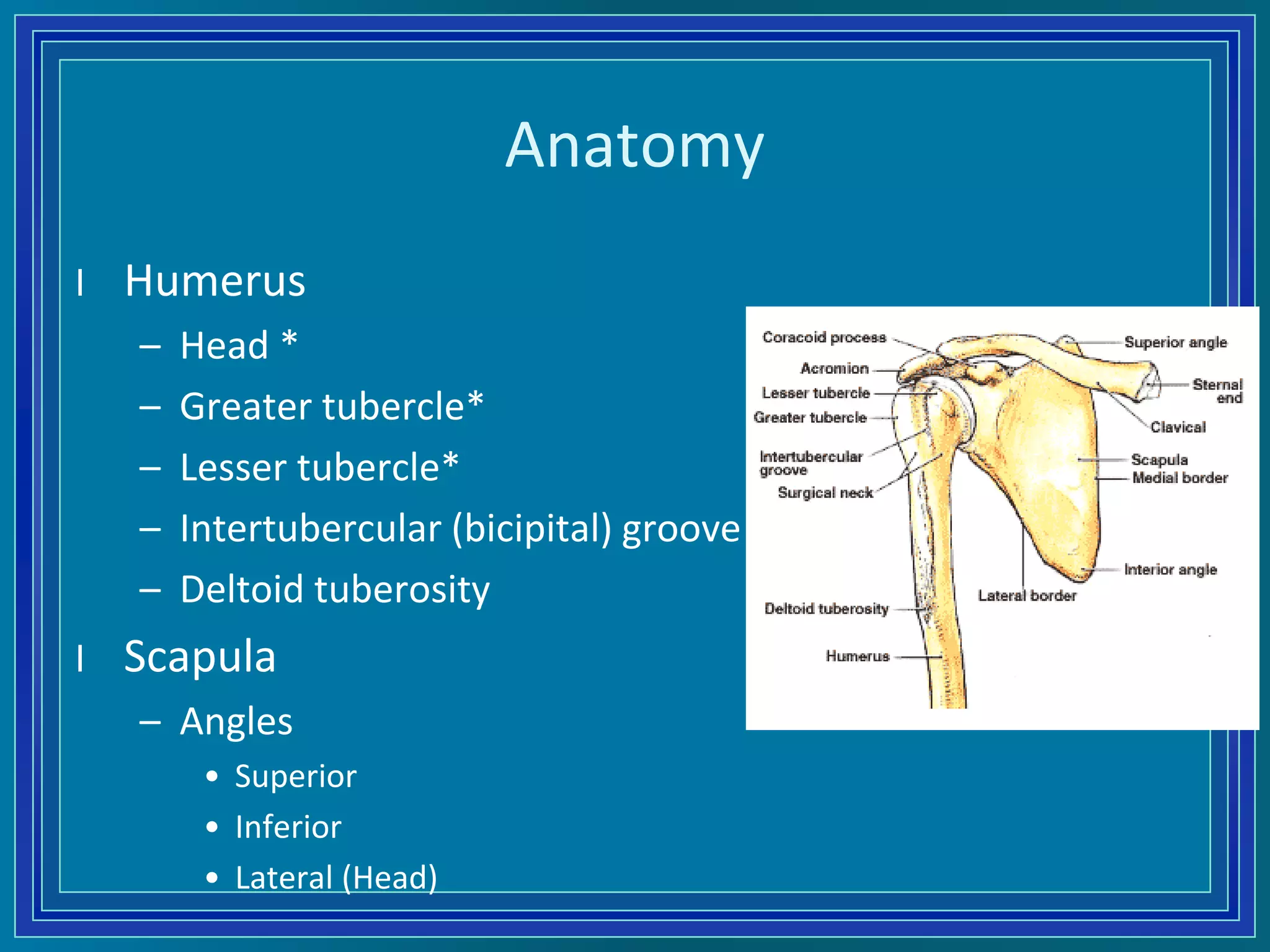
Anatomy
l Humerus
– Head *
– Greater tubercle*
– Lesser tubercle*
– Intertubercular (bicipital) groove
– Deltoid tuberosity
l Scapula
– Angles
• Superior
• Inferior
• Lateral (Head)
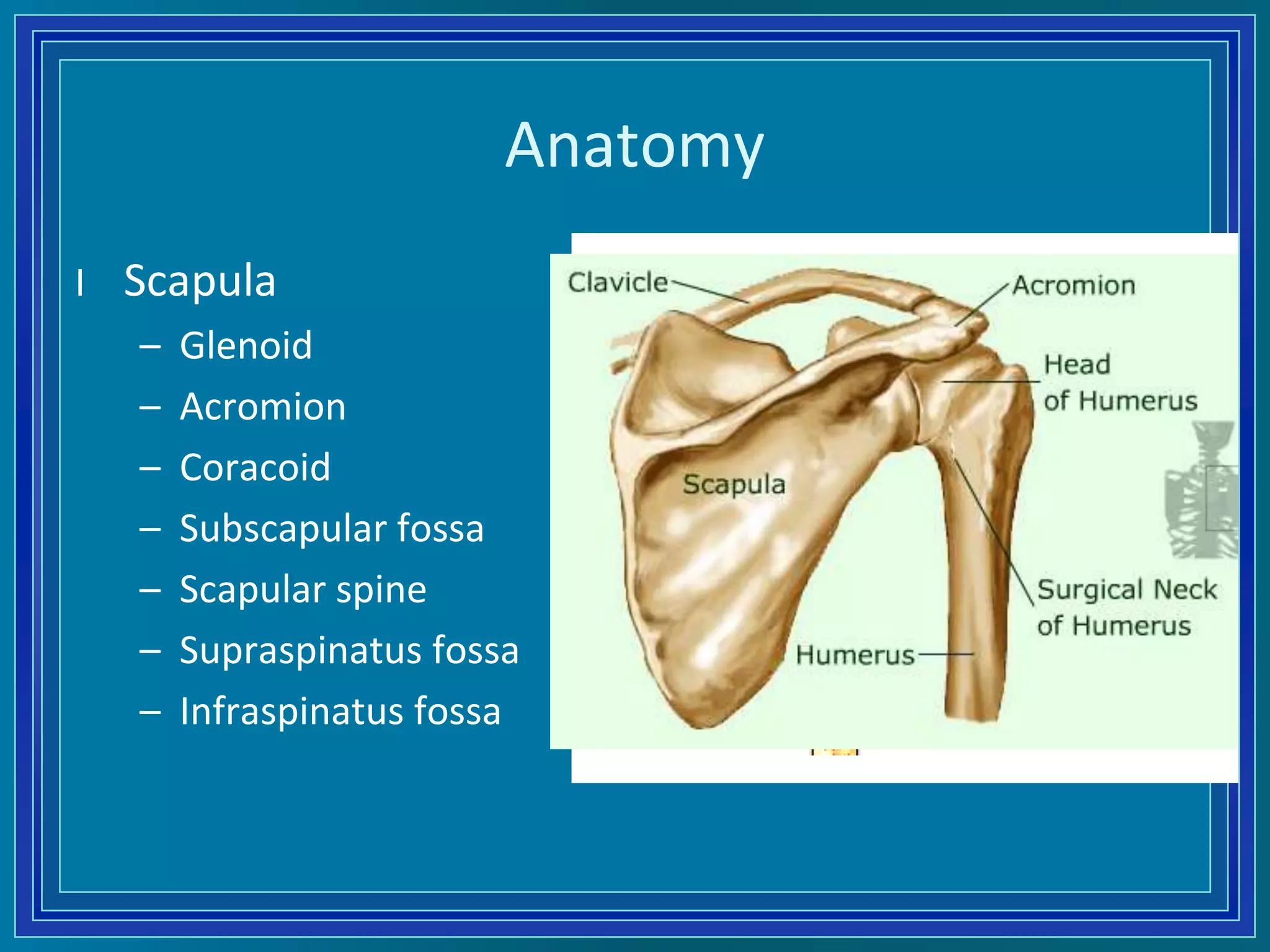
Anatomy
l Scapula
– Glenoid
– Acromion
– Coracoid
– Subscapular fossa
– Scapular spine
– Supraspinatus fossa
– Infraspinatus fossa
Anatomy
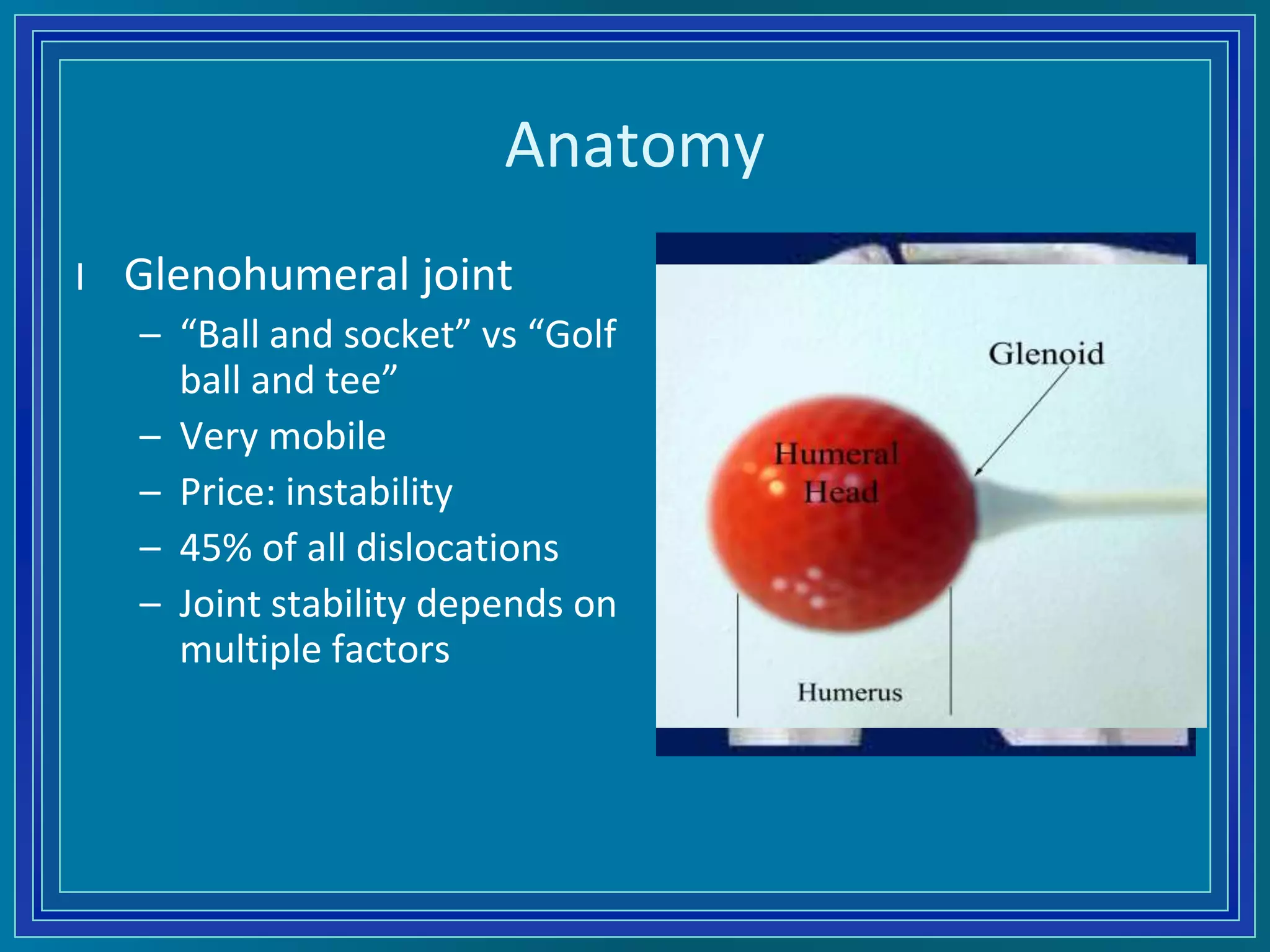
l Glenohumeral joint
– “Ball and socket” vs “Golf
ball and tee”
– Very mobile
– Price: instability
– 45% of all dislocations
– Joint stability depends on
multiple factors
Anatomy
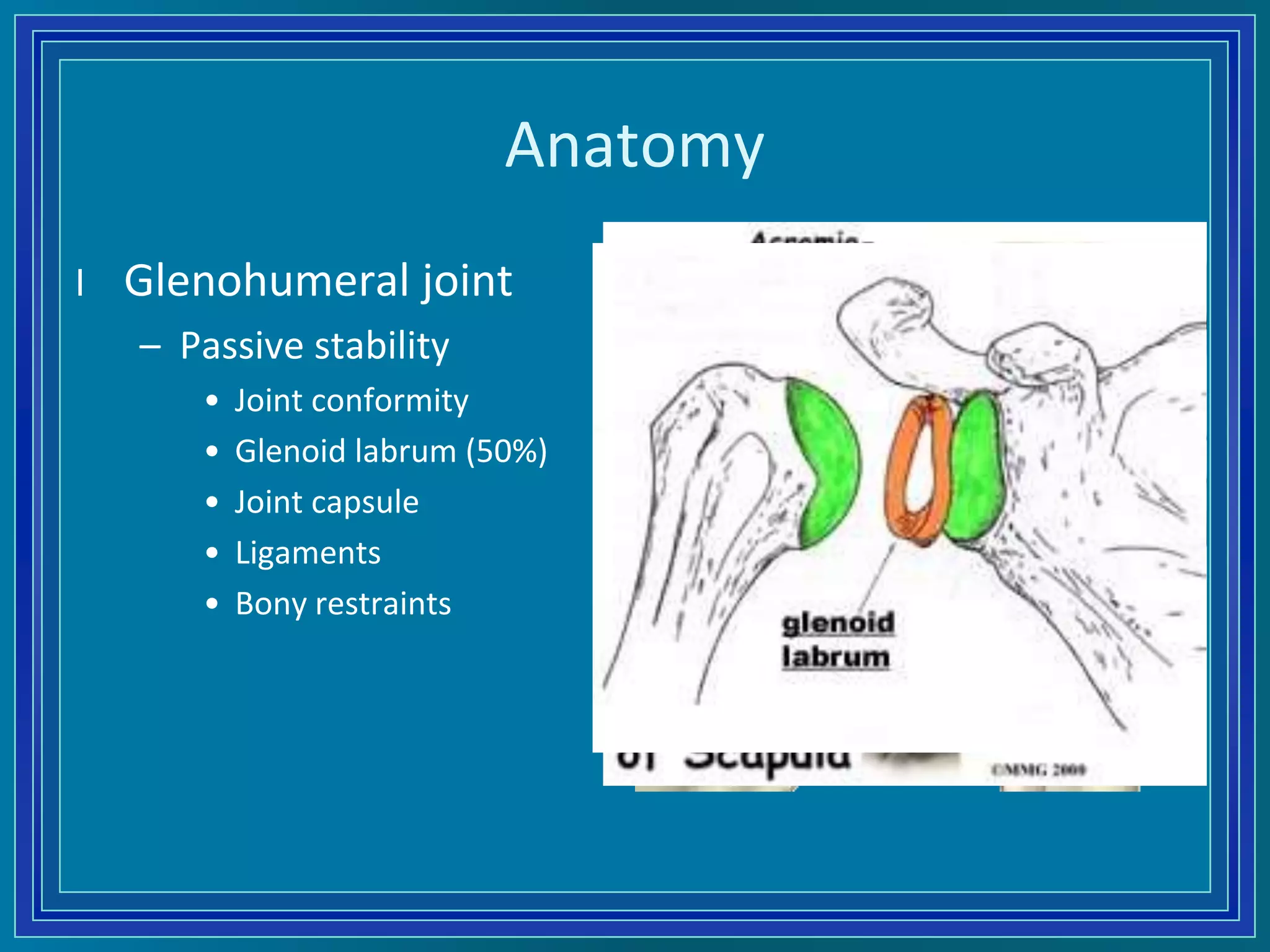
l Glenohumeral joint
– Passive stability
• Joint conformity
• Glenoid labrum (50%)
• Joint capsule
• Ligaments
• Bony restraints
Anatomy
l Muscles
– Deltoid
– Trapezius *
– Rhomboids *
– Levator scapulae *
– Rotator cuff
– Teres major
– Biceps
– Pectoralis muscles *
– Serratus anterior *
* Scapular stabilizers
Anatomy
l Rotator Cuff Muscles
– S – Supraspinatus
– I – Infraspinatus
– t - Teres minor
– S- Supscapularis
Anatomy
l Bursae
– Subacromial
(Subdeltoid)
– Subscapular
Anatomy
l Neurologic
– Nerve roots
– Brachial plexus
– Peripheral nerves
Anatomy
l Coordinated shoulder motion
– Glenohumeral motion
– Acromioclavicular motion
– Sternoclavicular motion
– Scapulothoracic motion
Scapular-humeral rhythm
Differential Diagnosis
l Impingement syndrome
– Subacromial bursitis
– Rotator cuff tendinopathy
– Rotator cuff tear
– Biceps tendinopathy
l Adhesive capsulitis
l SC joint arthritis, sprain
l AC joint arthritis, sprain
l Glenohumeral joint OA
l Instablity
– GH dislocation
– GH subluxation
– Labral tear (e.g. Bankart, SLAP, etc.)
l Clavicle fracture
l Proximal humerus fracture
l Scapular fracture
l Other arthritic disease
– Rheumatoid, Gout, SLE
– Septic, Lyme, etc.
l Avascular necrosis
l Neoplastic disease
l Thoracic outlet syndrome
l CRPS
l Myofascial pain
l Referred pain
– Cervical radiculopathy
– Cardiac
– Aortic aneurysm
– Abdominal / Diaphragm
– Other GI
Clinical History
l Characterize pain
l Location of pain
l Night pain
l Weakness
l Deformity
l Instability
l Locking / Clicking / Clunking
l Sport / Occupation
l Previous treatments
l Alleviating / Exacerbating
l Acute vs. Chronic
l Traumatic vs. Overuse
l History of prior injury
Clinical History
l Mechanism of Injury
Physical Exam
l Observation
– Undress waist → up
l Palpation
l Active & passive ROM
l Strength testing
l Special tests
Physical Exam – Observation /
Inspection
l Front & Back
l Height of shoulder &
scapulae
l Asymmetry
l Obvious deformity
l Ecchymosis
l Muscle atrophy
– Supraspinatus
– Infraspinatus
– Deltoid
Palpation
l At rest & with movement
l Bony structures
l Joints
l Soft tissues
Palpation
l Surface Anatomy (Anterior)
– Clavicle
– SC Joint
– Acromion process
– AC Joint
– Deltoid
– Coracoid process
– Pectoralis major
– Trapezius
– Biceps (long head)
AC joint
SC joint
biceps
Palpation
l Surface Anatomy (Posterior)
– Scapular spine
– Acromion process
– Supraspinatus
– Infraspinatus
– Deltoid
– Trapezius
– Latissumus dorsi
– Scapula
• Inferior angle
• Medial border
Supraspinatus
Infraspinatus
Inferior angle
of scapula
Range of Motion
l Forward flexion:
– 160 – 180°
l Extension:
– 40 - 60°
l Abduction:
– 180◦
l Adduction:
– 45 °
l Internal rotation:
– 60 - 90 °
l External rotation:
– 80 - 90 °
Apley Scratch Test
Range of Motion
l Scapular dyskinesis (Scapulothoracic
dysfuntion)
– Compare scapular motion through
ROM on both sides
– Wall push-ups
– Symmetrical
– Smooth
– No or minimal winging
Strength Testing
l Test & compare both sides
l Be specific to muscle or muscle group
l Grade strength on 0 → 5 scale
– 0: no contraction
– 1: muscle flicker; no movement
– 2: motion, but not against gravity
– 3: motion against gravity, but not resistance
– 4: motion against resistance
– 5: normal strength
Strength Testing
l External rotation
– Tests RTC muscles that ER the
shoulder
• Infraspinatus
• Teres minor
– Arms at the sides
– Elbows flexed to 90 degrees
– Externally rotates arms
against resistance
Strength Testing
l Internal rotation
– Tests RTC muscle that IR the
shoulder
• Subscapularis
– Arms at the sides
– Elbows flexed to 90 degrees
– Internally rotates arms
against resistance
– Subscapularis Lift-Off Test
– Other techniques
Strength Testing
l Supraspinatus
– “Empty can" test
– Jobe’s Test
– Tests Supraspinatus
– Attempt to isolate from
deltoid
– Positioned sitting
– Arms straight out
– Elbows locked straight
– Thumbs down
– Arm at 30 degrees
(in scapular plane)
– Attempts to elevate arms
against resistance
Special Provocative Tests
l Impingement Signs
l Drop-Arm Test
l Speed’s Test
l Yergason Test
l Cross-Arm Adduction
l Sulcus Sign
l Apprehension test
l Relocation test
l O’Brien’s Test
l Crank test
Subacromial Impingement Syndrome
l Impingement of:
– Subacromial bursa
– Rotator cuff muscles and
tendons
– Biceps tendon
l Between
– Acromion
– Coracoacromial ligament
– AC joint
– Coracoid process
– Humeral head
l Rotator cuff tendonosis
Impingement Signs
l Neer’s Sign
– Arm fully pronated and
placed in forced flexion
– Trying to impinge
subacromial structures
with humeral head
– Pain is positive test
Impingement Signs
l Hawkin’s Sign
– Arm is forward elevated
to 90 degrees, then
forcibly internally
rotated
– Trying to impinge
subacromial structures
with humeral head
– Pain is positive test
Rotator Cuff Tear
l Partial thickness tear
l Full (Complete) thickness
tear
l May be due to:
– Impingement
– Degeneration
– Overuse
– Trauma
l Partial tears
– Conservative
l Complete tears
– Surgery
Rotator Cuff Tear: Drop-Arm Test
l Abducted arm slowly lowered
– May be able to lower arm slowly
to 90° (deltoid function)
– Arm will then drop to side if
rotator cuff tear
l Positive test
– patient unable to lower arm
further with control
– If able to hold at 90º, pressure on
wrist will cause arm to fall
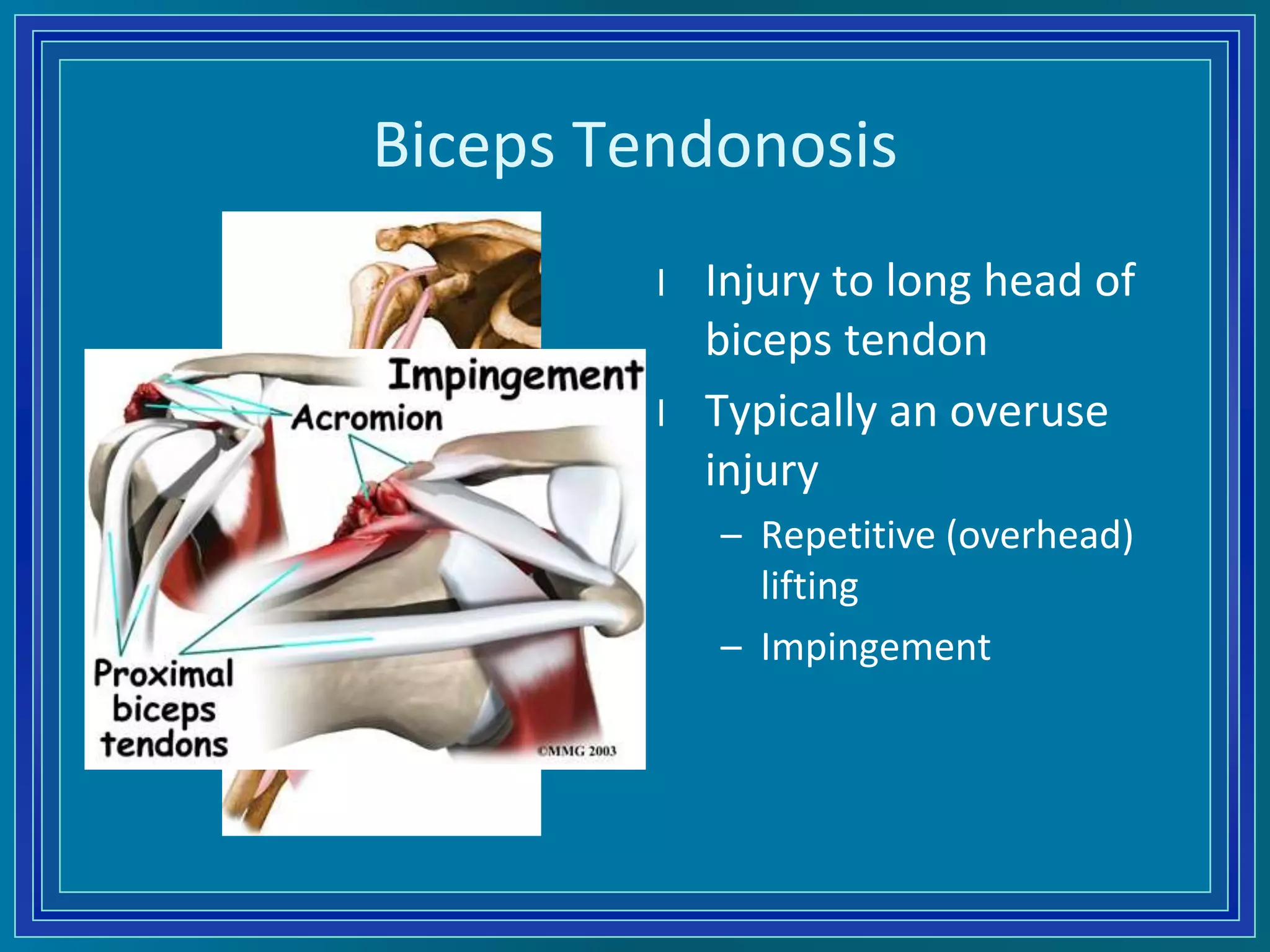
Biceps Tendonosis
l Injury to long head of
biceps tendon
l Typically an overuse
injury
– Repetitive (overhead)
lifting
– Impingement
Biceps Tendonosis: Speed’s Test
l Forward flex shoulder to
about 90°
l Abduct shoulder to about
10°
l Arm in full supination
l Apply downward force to
distal arm
l Pain is positive test
l Weakness without pain:
muscle weakness or rupture
Biceps Tendonosis: Yergason’s Test
l Elbow flexed to 90°
l Start in pronated position
l Active supination & flexion
against resistance
l Palpate biceps tendon
l Pain or painful pop is
positive test
– Tendonosis
– Subluxation
AC Separation
AC Sprain /
Separation
– Typically due to
fall onto tip of
shoulder
(acromion)
– Arm tucked into
side
– Treatment
depends on type
AC Separation
l AC Sprain / Separation
– Typically due to fall
onto tip of shoulder
(acromion)
– Arm tucked into side
– Treatment depends on
type
AC Arthritis / DJD
AC Joint: Cross-Arm Adduction Test
l Arm flexed to 90°
l Arm adducted to > 45°
l Hyperadduct shoulder
(down on elbow)
l Positive test is pain in AC
joint
l Watch out for false-
positives
– Where is the pain?
Shoulder Instability
l Failure to keep humeral
head centered in glenoid
l Dislocation
– Complete disruption of joint
congruity or alignment
l Subluxation
– Partial or incomplete
dislocation
l Laxity
– Slackness or looseness in joint
– May be normal or abnormal
Instability: Sulcus Sign
l Inferior instability
l Arm relaxed in neutral
position
l Arm pulled downward
at wrist
l Positive test is a visible
sulcus at infra-acromial
area
– Compare to
contralateral side
Instability: Apprehension Test
l Anterior instability
l Shoulder abducted to 90°
l Slight stress to humeral
head directed in anterior
direction
l While externally rotating
shoulder
l Positive test is
apprehension due to feeling
of instability or impending
dislocation
– Beware if false positives
Instability: Relocation Test
l Anterior instability
l After a positive
apprehension
l Apply posteriorly directed
force over externally
rotated humeral head
l Positive test is relief of
apprehension
l Anterior release test
Glenoid Labral Tear
l Tear in glenoid labrum
l Usually due to instability
l SLAP Tear (Superior Labrum
Anterior to Posterior)
– Superior labral tear
– Fall on outstretched hand or
shoulder
– Rotator cuff tendonosis or
tears
l Bankart Lesion
– Anterior-inferior labral tear
– Anterior shoulder dislocation
/ subluxation
O’Brien’s Active Compression Test
l Labral, AC, or biceps pathology
l Arm flexed to 90°
l Arm cross-arm adducted 10-
15°
l Elbow extended
l Max pronation
l Resist downward force
l Positive test if painful
l Beware location of pain
– AC
– Biceps
– Internal +/- click
O’Brien’s Active Compression Test
l For labral pathology
– Repeat testing with
– Max supination
– Should be pain free
Labral Tear: Crank Test
l Abduct arm to 90-120°
l Stabilize shoulder
l Elbow secured with one
hand
l Axially load with ER / IR at
shoulder
l Positive test: audible or
painful click / catch /
grind
Diagnostic Injection
l AC joint
l Subacromial space
l Glenohumeral joint
l Biceps tendon (long head)

Clinical_Examination_Shoulder (2).ppt

  • 1.
    History & PhysicalExamination of the Shoulder
  • 2.
    Objectives l Review pertinentanatomy of the shoulder l Review differential diagnosis of shoulder complaints l Review clinical history and physical examination of the shoulder l Review common shoulder injuries & characteristic physical exam findings
  • 3.
    Brief Epidemiology l Shoulderpain: a common complaint in primary care – 2nd only to knee pain for specialist referrals – Most common causes in adults (peak ages 40-60) • Subacromial impingement syndrome • Rotator cuff problems l Athletic injuries – Shoulder: 8-13% of all athletic injuries
  • 4.
    Anatomy l 3 Bones –Humerus – Scapula – Clavicle l 3 Joints – Glenohumeral – Acromioclavicular – Sternoclavicular l 1 “Articulation” – Scapulothoracic
  • 5.
    Anatomy l Humerus – Head* – Greater tubercle* – Lesser tubercle* – Intertubercular (bicipital) groove – Deltoid tuberosity l Scapula – Angles • Superior • Inferior • Lateral (Head)
  • 6.
    Anatomy l Scapula – Glenoid –Acromion – Coracoid – Subscapular fossa – Scapular spine – Supraspinatus fossa – Infraspinatus fossa
  • 7.
    Anatomy l Glenohumeral joint –“Ball and socket” vs “Golf ball and tee” – Very mobile – Price: instability – 45% of all dislocations – Joint stability depends on multiple factors
  • 8.
    Anatomy l Glenohumeral joint –Passive stability • Joint conformity • Glenoid labrum (50%) • Joint capsule • Ligaments • Bony restraints
  • 9.
    Anatomy l Muscles – Deltoid –Trapezius * – Rhomboids * – Levator scapulae * – Rotator cuff – Teres major – Biceps – Pectoralis muscles * – Serratus anterior * * Scapular stabilizers
  • 10.
    Anatomy l Rotator CuffMuscles – S – Supraspinatus – I – Infraspinatus – t - Teres minor – S- Supscapularis
  • 11.
  • 12.
    Anatomy l Neurologic – Nerveroots – Brachial plexus – Peripheral nerves
  • 13.
    Anatomy l Coordinated shouldermotion – Glenohumeral motion – Acromioclavicular motion – Sternoclavicular motion – Scapulothoracic motion Scapular-humeral rhythm
  • 14.
    Differential Diagnosis l Impingementsyndrome – Subacromial bursitis – Rotator cuff tendinopathy – Rotator cuff tear – Biceps tendinopathy l Adhesive capsulitis l SC joint arthritis, sprain l AC joint arthritis, sprain l Glenohumeral joint OA l Instablity – GH dislocation – GH subluxation – Labral tear (e.g. Bankart, SLAP, etc.) l Clavicle fracture l Proximal humerus fracture l Scapular fracture l Other arthritic disease – Rheumatoid, Gout, SLE – Septic, Lyme, etc. l Avascular necrosis l Neoplastic disease l Thoracic outlet syndrome l CRPS l Myofascial pain l Referred pain – Cervical radiculopathy – Cardiac – Aortic aneurysm – Abdominal / Diaphragm – Other GI
  • 15.
    Clinical History l Characterizepain l Location of pain l Night pain l Weakness l Deformity l Instability l Locking / Clicking / Clunking l Sport / Occupation l Previous treatments l Alleviating / Exacerbating l Acute vs. Chronic l Traumatic vs. Overuse l History of prior injury
  • 16.
  • 17.
    Physical Exam l Observation –Undress waist → up l Palpation l Active & passive ROM l Strength testing l Special tests
  • 18.
    Physical Exam –Observation / Inspection l Front & Back l Height of shoulder & scapulae l Asymmetry l Obvious deformity l Ecchymosis l Muscle atrophy – Supraspinatus – Infraspinatus – Deltoid
  • 19.
    Palpation l At rest& with movement l Bony structures l Joints l Soft tissues
  • 20.
    Palpation l Surface Anatomy(Anterior) – Clavicle – SC Joint – Acromion process – AC Joint – Deltoid – Coracoid process – Pectoralis major – Trapezius – Biceps (long head) AC joint SC joint biceps
  • 21.
    Palpation l Surface Anatomy(Posterior) – Scapular spine – Acromion process – Supraspinatus – Infraspinatus – Deltoid – Trapezius – Latissumus dorsi – Scapula • Inferior angle • Medial border Supraspinatus Infraspinatus Inferior angle of scapula
  • 22.
    Range of Motion lForward flexion: – 160 – 180° l Extension: – 40 - 60° l Abduction: – 180◦ l Adduction: – 45 ° l Internal rotation: – 60 - 90 ° l External rotation: – 80 - 90 ° Apley Scratch Test
  • 23.
    Range of Motion lScapular dyskinesis (Scapulothoracic dysfuntion) – Compare scapular motion through ROM on both sides – Wall push-ups – Symmetrical – Smooth – No or minimal winging
  • 24.
    Strength Testing l Test& compare both sides l Be specific to muscle or muscle group l Grade strength on 0 → 5 scale – 0: no contraction – 1: muscle flicker; no movement – 2: motion, but not against gravity – 3: motion against gravity, but not resistance – 4: motion against resistance – 5: normal strength
  • 25.
    Strength Testing l Externalrotation – Tests RTC muscles that ER the shoulder • Infraspinatus • Teres minor – Arms at the sides – Elbows flexed to 90 degrees – Externally rotates arms against resistance
  • 26.
    Strength Testing l Internalrotation – Tests RTC muscle that IR the shoulder • Subscapularis – Arms at the sides – Elbows flexed to 90 degrees – Internally rotates arms against resistance – Subscapularis Lift-Off Test – Other techniques
  • 27.
    Strength Testing l Supraspinatus –“Empty can" test – Jobe’s Test – Tests Supraspinatus – Attempt to isolate from deltoid – Positioned sitting – Arms straight out – Elbows locked straight – Thumbs down – Arm at 30 degrees (in scapular plane) – Attempts to elevate arms against resistance
  • 28.
    Special Provocative Tests lImpingement Signs l Drop-Arm Test l Speed’s Test l Yergason Test l Cross-Arm Adduction l Sulcus Sign l Apprehension test l Relocation test l O’Brien’s Test l Crank test
  • 29.
    Subacromial Impingement Syndrome lImpingement of: – Subacromial bursa – Rotator cuff muscles and tendons – Biceps tendon l Between – Acromion – Coracoacromial ligament – AC joint – Coracoid process – Humeral head l Rotator cuff tendonosis
  • 30.
    Impingement Signs l Neer’sSign – Arm fully pronated and placed in forced flexion – Trying to impinge subacromial structures with humeral head – Pain is positive test
  • 31.
    Impingement Signs l Hawkin’sSign – Arm is forward elevated to 90 degrees, then forcibly internally rotated – Trying to impinge subacromial structures with humeral head – Pain is positive test
  • 32.
    Rotator Cuff Tear lPartial thickness tear l Full (Complete) thickness tear l May be due to: – Impingement – Degeneration – Overuse – Trauma l Partial tears – Conservative l Complete tears – Surgery
  • 33.
    Rotator Cuff Tear:Drop-Arm Test l Abducted arm slowly lowered – May be able to lower arm slowly to 90° (deltoid function) – Arm will then drop to side if rotator cuff tear l Positive test – patient unable to lower arm further with control – If able to hold at 90º, pressure on wrist will cause arm to fall
  • 34.
    Biceps Tendonosis l Injuryto long head of biceps tendon l Typically an overuse injury – Repetitive (overhead) lifting – Impingement
  • 35.
    Biceps Tendonosis: Speed’sTest l Forward flex shoulder to about 90° l Abduct shoulder to about 10° l Arm in full supination l Apply downward force to distal arm l Pain is positive test l Weakness without pain: muscle weakness or rupture
  • 36.
    Biceps Tendonosis: Yergason’sTest l Elbow flexed to 90° l Start in pronated position l Active supination & flexion against resistance l Palpate biceps tendon l Pain or painful pop is positive test – Tendonosis – Subluxation
  • 37.
    AC Separation AC Sprain/ Separation – Typically due to fall onto tip of shoulder (acromion) – Arm tucked into side – Treatment depends on type
  • 38.
    AC Separation l ACSprain / Separation – Typically due to fall onto tip of shoulder (acromion) – Arm tucked into side – Treatment depends on type
  • 39.
  • 40.
    AC Joint: Cross-ArmAdduction Test l Arm flexed to 90° l Arm adducted to > 45° l Hyperadduct shoulder (down on elbow) l Positive test is pain in AC joint l Watch out for false- positives – Where is the pain?
  • 41.
    Shoulder Instability l Failureto keep humeral head centered in glenoid l Dislocation – Complete disruption of joint congruity or alignment l Subluxation – Partial or incomplete dislocation l Laxity – Slackness or looseness in joint – May be normal or abnormal
  • 42.
    Instability: Sulcus Sign lInferior instability l Arm relaxed in neutral position l Arm pulled downward at wrist l Positive test is a visible sulcus at infra-acromial area – Compare to contralateral side
  • 43.
    Instability: Apprehension Test lAnterior instability l Shoulder abducted to 90° l Slight stress to humeral head directed in anterior direction l While externally rotating shoulder l Positive test is apprehension due to feeling of instability or impending dislocation – Beware if false positives
  • 44.
    Instability: Relocation Test lAnterior instability l After a positive apprehension l Apply posteriorly directed force over externally rotated humeral head l Positive test is relief of apprehension l Anterior release test
  • 45.
    Glenoid Labral Tear lTear in glenoid labrum l Usually due to instability l SLAP Tear (Superior Labrum Anterior to Posterior) – Superior labral tear – Fall on outstretched hand or shoulder – Rotator cuff tendonosis or tears l Bankart Lesion – Anterior-inferior labral tear – Anterior shoulder dislocation / subluxation
  • 46.
    O’Brien’s Active CompressionTest l Labral, AC, or biceps pathology l Arm flexed to 90° l Arm cross-arm adducted 10- 15° l Elbow extended l Max pronation l Resist downward force l Positive test if painful l Beware location of pain – AC – Biceps – Internal +/- click
  • 47.
    O’Brien’s Active CompressionTest l For labral pathology – Repeat testing with – Max supination – Should be pain free
  • 48.
    Labral Tear: CrankTest l Abduct arm to 90-120° l Stabilize shoulder l Elbow secured with one hand l Axially load with ER / IR at shoulder l Positive test: audible or painful click / catch / grind
  • 49.
    Diagnostic Injection l ACjoint l Subacromial space l Glenohumeral joint l Biceps tendon (long head)