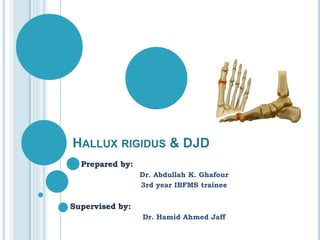
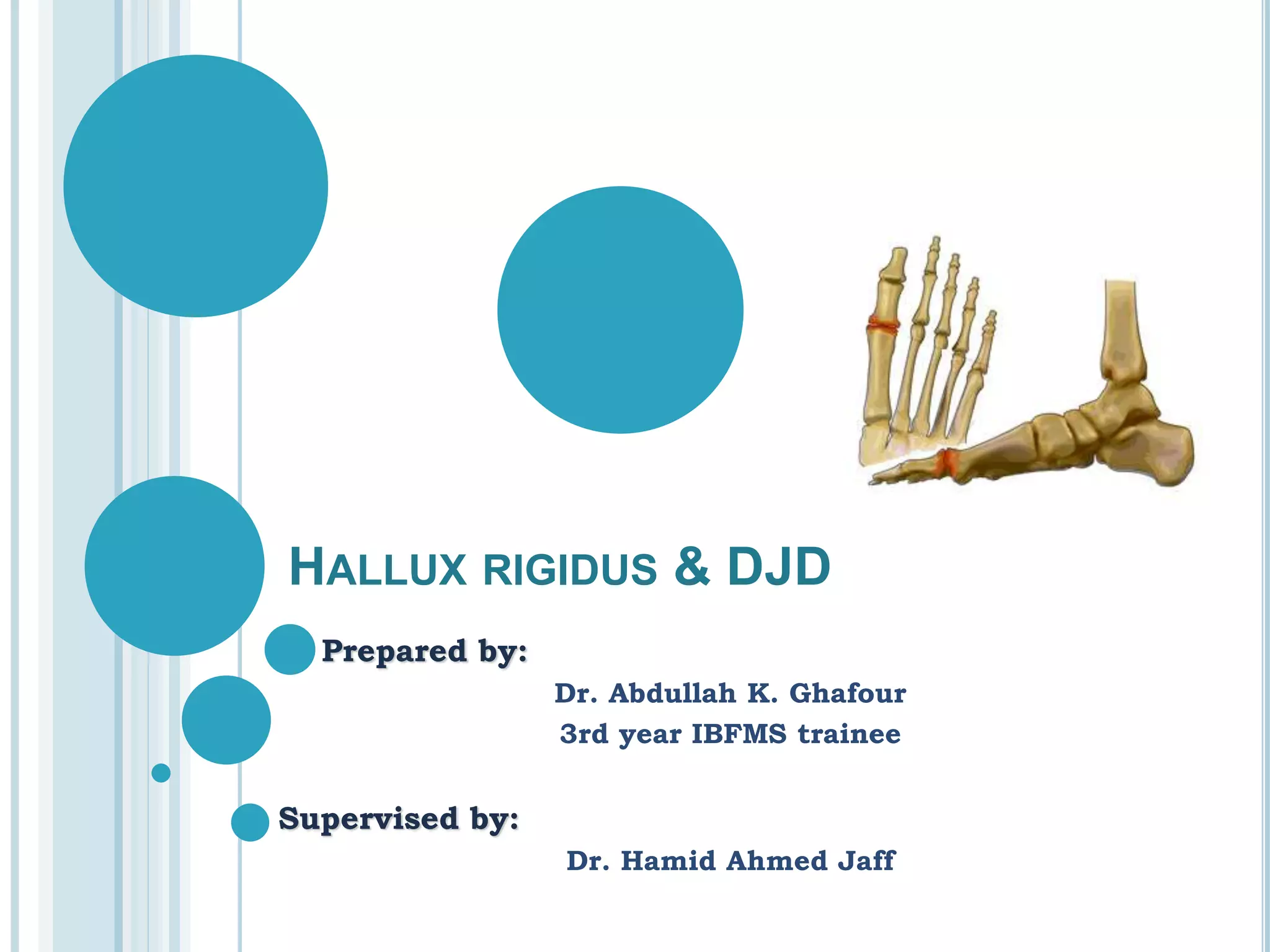
HALLUX RIGIDUS & DJD
Prepared by:
Dr. Abdullah K. Ghafour
3rd year IBFMS trainee
Supervised by:
Dr. Hamid Ahmed Jaff
INTRODUCTION
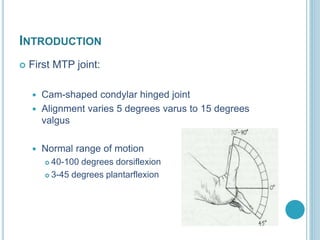
 First MTP joint:
 Cam-shaped condylar hinged joint
 Alignment varies 5 degrees varus to 15 degrees
valgus
 Normal range of motion
 40-100 degrees dorsiflexion
 3-45 degrees plantarflexion
INTRODUCTION
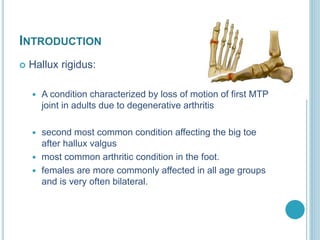
 Hallux rigidus:
 A condition characterized by loss of motion of first MTP
joint in adults due to degenerative arthritis
 second most common condition affecting the big toe
after hallux valgus
 most common arthritic condition in the foot.
 females are more commonly affected in all age groups
and is very often bilateral.
PATHOANATOMY
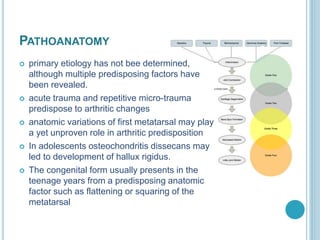
 primary etiology has not bee determined,
although multiple predisposing factors have
been revealed.
 acute trauma and repetitive micro-trauma
predispose to arthritic changes
 anatomic variations of first metatarsal may play
a yet unproven role in arthritic predisposition
 In adolescents osteochondritis dissecans may
led to development of hallux rigidus.
 The congenital form usually presents in the
teenage years from a predisposing anatomic
factor such as flattening or squaring of the
metatarsal
PRESENTATION
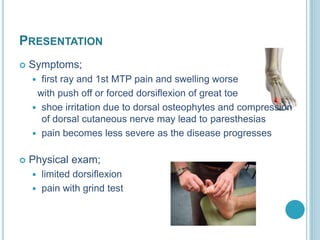
 Symptoms;
 first ray and 1st MTP pain and swelling worse
with push off or forced dorsiflexion of great toe
 shoe irritation due to dorsal osteophytes and compression
of dorsal cutaneous nerve may lead to paresthesias
 pain becomes less severe as the disease progresses
 Physical exam;
 limited dorsiflexion
 pain with grind test
PRESENTATION
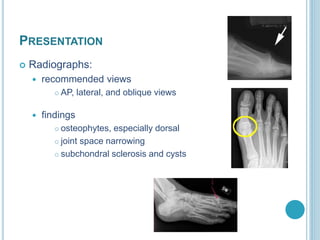
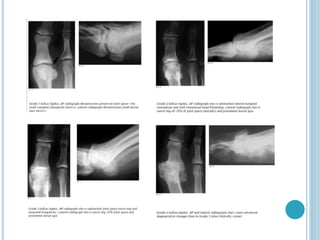
 Radiographs:
 recommended views
 AP, lateral, and oblique views
 findings
 osteophytes, especially dorsal
 joint space narrowing
 subchondral sclerosis and cysts
CLASSIFICATION
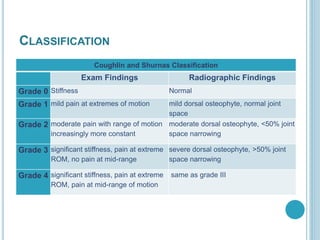
Coughlin and Shurnas Classification
Exam Findings Radiographic Findings
Grade 0 Stiffness Normal
Grade 1 mild pain at extremes of motion mild dorsal osteophyte, normal joint
space
Grade 2 moderate pain with range of motion
increasingly more constant
moderate dorsal osteophyte, <50% joint
space narrowing
Grade 3 significant stiffness, pain at extreme
ROM, no pain at mid-range
severe dorsal osteophyte, >50% joint
space narrowing
Grade 4 significant stiffness, pain at extreme
ROM, pain at mid-range of motion
same as grade III
CLASSIFICATION
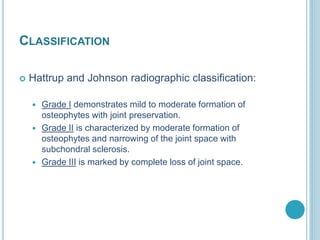
 Hattrup and Johnson radiographic classification:
 Grade I demonstrates mild to moderate formation of
osteophytes with joint preservation.
 Grade II is characterized by moderate formation of
osteophytes and narrowing of the joint space with
subchondral sclerosis.
 Grade III is marked by complete loss of joint space.
TREATMENT
 Nonoperative
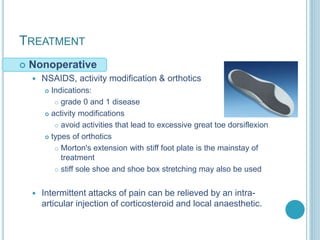
 NSAIDS, activity modification & orthotics
 Indications:
 grade 0 and 1 disease
 activity modifications
 avoid activities that lead to excessive great toe dorsiflexion
 types of orthotics
 Morton's extension with stiff foot plate is the mainstay of
treatment
 stiff sole shoe and shoe box stretching may also be used
 Intermittent attacks of pain can be relieved by an intra-
articular injection of corticosteroid and local anaesthetic.
TREATMENT
 Operative
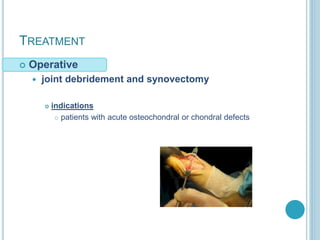
 joint debridement and synovectomy
 indications
 patients with acute osteochondral or chondral defects
TREATMENT
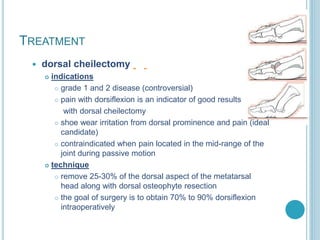
 dorsal cheilectomy
 indications
 grade 1 and 2 disease (controversial)
 pain with dorsiflexion is an indicator of good results
with dorsal cheilectomy
 shoe wear irritation from dorsal prominence and pain (ideal
candidate)
 contraindicated when pain located in the mid-range of the
joint during passive motion
 technique
 remove 25-30% of the dorsal aspect of the metatarsal
head along with dorsal osteophyte resection
 the goal of surgery is to obtain 70% to 90% dorsiflexion
intraoperatively
TREATMENT
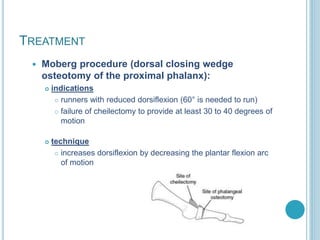
 Moberg procedure (dorsal closing wedge
osteotomy of the proximal phalanx):
 indications
 runners with reduced dorsiflexion (60° is needed to run)
 failure of cheilectomy to provide at least 30 to 40 degrees of
motion
 technique
 increases dorsiflexion by decreasing the plantar flexion arc
of motion
TREATMENT
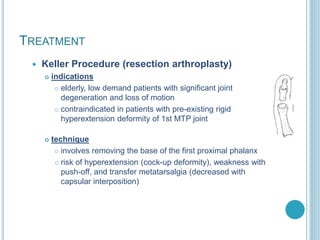
 Keller Procedure (resection arthroplasty)
 indications
 elderly, low demand patients with significant joint
degeneration and loss of motion
 contraindicated in patients with pre-existing rigid
hyperextension deformity of 1st MTP joint
 technique
 involves removing the base of the first proximal phalanx
 risk of hyperextension (cock-up deformity), weakness with
push-off, and transfer metatarsalgia (decreased with
capsular interposition)
TREATMENT
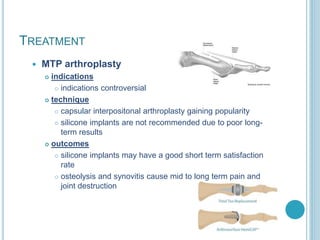
 MTP arthroplasty
 indications
 indications controversial
 technique
 capsular interpositonal arthroplasty gaining popularity
 silicone implants are not recommended due to poor long-
term results
 outcomes
 silicone implants may have a good short term satisfaction
rate
 osteolysis and synovitis cause mid to long term pain and
joint destruction
TREATMENT
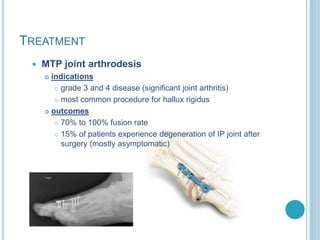
 MTP joint arthrodesis
 indications
 grade 3 and 4 disease (significant joint arthritis)
 most common procedure for hallux rigidus
 outcomes
 70% to 100% fusion rate
 15% of patients experience degeneration of IP joint after
surgery (mostly asymptomatic)
TREATMENT
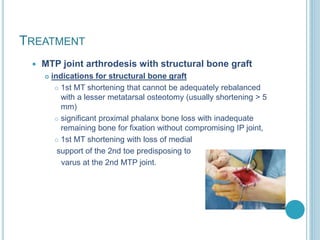
 MTP joint arthrodesis with structural bone graft
 indications for structural bone graft
 1st MT shortening that cannot be adequately rebalanced
with a lesser metatarsal osteotomy (usually shortening > 5
mm)
 significant proximal phalanx bone loss with inadequate
remaining bone for fixation without compromising IP joint,
 1st MT shortening with loss of medial
support of the 2nd toe predisposing to
varus at the 2nd MTP joint.
TREATMENT
 Techniques of MTP joint arthrodesis:
 dorsal plate with compression screw is biomechanically strongest
construct
 preferred surgical alignment
 10 to 15 degrees of valgus in relation to the metatarsal shaft
 15 degrees of dorsiflexion in relation to the floor
 fusion in excessive dorsiflexion causes pain at tip of the toe, over
the IP joint, and under the 1st metatarsal with excessive
dorsiflexion
 fusion in excessive plantar flexion causes increased pressure at
the tip of the toe
 fusion in excessive valgus increases the risk of IP joint
degeneration
REFERENCES
• Coetzee J. C., Hurwitz S. R. , [ 2009] Arthritis & arthroplasty. The foot
and ankle , Saunders, an imprint of Elsevier Inc. , Philadelphia,
Pennsylvania, USA.
• Solomon L., Warwick D. , Nayagam S.,[2010] Apley’s System of
Orthopaedics and Fractures, 9th ed. Hodderarnold comp.,London, UK.
• Miller M. , Thompson S. , Hart J. ,[2012] REVIEW OF ORTHOPAEDICS
[PDF], 6th ed. by Saunders, an imprint of Elsevier Inc. , Philadelphia,
USA.
• Canale S. , Beaty J. , [2007] Campbell’s Operative Orthopaedics [PDF],
11th ed. By Mosby, An Imprint of Elsevier , Tennessee, USA.
• ORTHOPAEDIC REVIEW [2015] by orthobullets, [PDF], Collected By
Islam Gomaa Beltage.
THANKS

Hallux rigidus

  • 1.
    HALLUX RIGIDUS &DJD Prepared by: Dr. Abdullah K. Ghafour 3rd year IBFMS trainee Supervised by: Dr. Hamid Ahmed Jaff
  • 2.
    INTRODUCTION  First MTPjoint:  Cam-shaped condylar hinged joint  Alignment varies 5 degrees varus to 15 degrees valgus  Normal range of motion  40-100 degrees dorsiflexion  3-45 degrees plantarflexion
  • 3.
    INTRODUCTION  Hallux rigidus: A condition characterized by loss of motion of first MTP joint in adults due to degenerative arthritis  second most common condition affecting the big toe after hallux valgus  most common arthritic condition in the foot.  females are more commonly affected in all age groups and is very often bilateral.
  • 4.
    PATHOANATOMY  primary etiologyhas not bee determined, although multiple predisposing factors have been revealed.  acute trauma and repetitive micro-trauma predispose to arthritic changes  anatomic variations of first metatarsal may play a yet unproven role in arthritic predisposition  In adolescents osteochondritis dissecans may led to development of hallux rigidus.  The congenital form usually presents in the teenage years from a predisposing anatomic factor such as flattening or squaring of the metatarsal
  • 5.
    PRESENTATION  Symptoms;  firstray and 1st MTP pain and swelling worse with push off or forced dorsiflexion of great toe  shoe irritation due to dorsal osteophytes and compression of dorsal cutaneous nerve may lead to paresthesias  pain becomes less severe as the disease progresses  Physical exam;  limited dorsiflexion  pain with grind test
  • 6.
    PRESENTATION  Radiographs:  recommendedviews  AP, lateral, and oblique views  findings  osteophytes, especially dorsal  joint space narrowing  subchondral sclerosis and cysts
  • 7.
    CLASSIFICATION Coughlin and ShurnasClassification Exam Findings Radiographic Findings Grade 0 Stiffness Normal Grade 1 mild pain at extremes of motion mild dorsal osteophyte, normal joint space Grade 2 moderate pain with range of motion increasingly more constant moderate dorsal osteophyte, <50% joint space narrowing Grade 3 significant stiffness, pain at extreme ROM, no pain at mid-range severe dorsal osteophyte, >50% joint space narrowing Grade 4 significant stiffness, pain at extreme ROM, pain at mid-range of motion same as grade III
  • 9.
    CLASSIFICATION  Hattrup andJohnson radiographic classification:  Grade I demonstrates mild to moderate formation of osteophytes with joint preservation.  Grade II is characterized by moderate formation of osteophytes and narrowing of the joint space with subchondral sclerosis.  Grade III is marked by complete loss of joint space.
  • 10.
    TREATMENT  Nonoperative  NSAIDS,activity modification & orthotics  Indications:  grade 0 and 1 disease  activity modifications  avoid activities that lead to excessive great toe dorsiflexion  types of orthotics  Morton's extension with stiff foot plate is the mainstay of treatment  stiff sole shoe and shoe box stretching may also be used  Intermittent attacks of pain can be relieved by an intra- articular injection of corticosteroid and local anaesthetic.
  • 11.
    TREATMENT  Operative  jointdebridement and synovectomy  indications  patients with acute osteochondral or chondral defects
  • 12.
    TREATMENT  dorsal cheilectomy indications  grade 1 and 2 disease (controversial)  pain with dorsiflexion is an indicator of good results with dorsal cheilectomy  shoe wear irritation from dorsal prominence and pain (ideal candidate)  contraindicated when pain located in the mid-range of the joint during passive motion  technique  remove 25-30% of the dorsal aspect of the metatarsal head along with dorsal osteophyte resection  the goal of surgery is to obtain 70% to 90% dorsiflexion intraoperatively
  • 13.
    TREATMENT  Moberg procedure(dorsal closing wedge osteotomy of the proximal phalanx):  indications  runners with reduced dorsiflexion (60° is needed to run)  failure of cheilectomy to provide at least 30 to 40 degrees of motion  technique  increases dorsiflexion by decreasing the plantar flexion arc of motion
  • 14.
    TREATMENT  Keller Procedure(resection arthroplasty)  indications  elderly, low demand patients with significant joint degeneration and loss of motion  contraindicated in patients with pre-existing rigid hyperextension deformity of 1st MTP joint  technique  involves removing the base of the first proximal phalanx  risk of hyperextension (cock-up deformity), weakness with push-off, and transfer metatarsalgia (decreased with capsular interposition)
  • 15.
    TREATMENT  MTP arthroplasty indications  indications controversial  technique  capsular interpositonal arthroplasty gaining popularity  silicone implants are not recommended due to poor long- term results  outcomes  silicone implants may have a good short term satisfaction rate  osteolysis and synovitis cause mid to long term pain and joint destruction
  • 16.
    TREATMENT  MTP jointarthrodesis  indications  grade 3 and 4 disease (significant joint arthritis)  most common procedure for hallux rigidus  outcomes  70% to 100% fusion rate  15% of patients experience degeneration of IP joint after surgery (mostly asymptomatic)
  • 17.
    TREATMENT  MTP jointarthrodesis with structural bone graft  indications for structural bone graft  1st MT shortening that cannot be adequately rebalanced with a lesser metatarsal osteotomy (usually shortening > 5 mm)  significant proximal phalanx bone loss with inadequate remaining bone for fixation without compromising IP joint,  1st MT shortening with loss of medial support of the 2nd toe predisposing to varus at the 2nd MTP joint.
  • 18.
    TREATMENT  Techniques ofMTP joint arthrodesis:  dorsal plate with compression screw is biomechanically strongest construct  preferred surgical alignment  10 to 15 degrees of valgus in relation to the metatarsal shaft  15 degrees of dorsiflexion in relation to the floor  fusion in excessive dorsiflexion causes pain at tip of the toe, over the IP joint, and under the 1st metatarsal with excessive dorsiflexion  fusion in excessive plantar flexion causes increased pressure at the tip of the toe  fusion in excessive valgus increases the risk of IP joint degeneration
  • 19.
    REFERENCES • Coetzee J.C., Hurwitz S. R. , [ 2009] Arthritis & arthroplasty. The foot and ankle , Saunders, an imprint of Elsevier Inc. , Philadelphia, Pennsylvania, USA. • Solomon L., Warwick D. , Nayagam S.,[2010] Apley’s System of Orthopaedics and Fractures, 9th ed. Hodderarnold comp.,London, UK. • Miller M. , Thompson S. , Hart J. ,[2012] REVIEW OF ORTHOPAEDICS [PDF], 6th ed. by Saunders, an imprint of Elsevier Inc. , Philadelphia, USA. • Canale S. , Beaty J. , [2007] Campbell’s Operative Orthopaedics [PDF], 11th ed. By Mosby, An Imprint of Elsevier , Tennessee, USA. • ORTHOPAEDIC REVIEW [2015] by orthobullets, [PDF], Collected By Islam Gomaa Beltage.
  • 20.