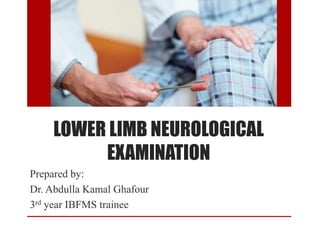
LOWER LIMB NEUROLOGICAL
EXAMINATION
Prepared by:
Dr. Abdulla Kamal Ghafour
3rd year IBFMS trainee
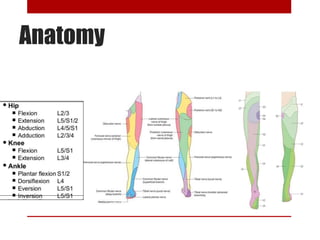
Anatomy
• Lumber plexus:
formed by the anterior rami (divisions) of the
lumbar spinal nerves L1, L2, L3 and L4. It also
receives contributions from thoracic spinal nerve
12. These roots divide into several cords. These
cords then combine together to form the six major
peripheral nerves:
1. Iliohypogastric Nerve [(L1 (with contributions
from T12)]
Motor: Innervates the internal oblique and
transversus abdominis.
Sensory: Innervates the posterolateral gluteal skin in
the pubic region.
Anatomy
2. Ilioinguinal Nerve [L1]
Motor: Innervates the internal oblique and
transversus abdominis.
Sensory: skin on the upper middle thigh In males,
it also supplies the skin over the root of the penis
and anterior scrotum. In females, it supplies the
skin over mons pubis and labia majora.
3. Genitofemoral Nerve [L1, L2]
Motor: cremasteric muscle.
Sensory: The genital branch innervates the skin of
the anterior scrotum (in males) or the skin over
mons pubis and labia majora (in females). The
femoral branch innervates the skin on the upper
anterior thigh.
Anatomy
4. Lateral Cutaneous Nerve of the Thigh
[L2,L3]
Motor: None
Sensory: anterior and lateral thigh down to
the level of the knee.
5. Obturator Nerve [L2, L3,L4]
Motor: obturator externus, pectineus, adductor
longus, adductor brevis, adductor magnus,
gracilis.
Sensory: Innervates the skin over the medial
thigh.
Anatomy
6. Femoral Nerve [L2,L3,L4]
Motor: Illiacus, pectineus, sartorius, all the
muscles of quadriceps femoris.
Sensory: skin on the anterior thigh and the medial
leg as a saphenous nerve.
Anatomy
• Sacral plexus:
formed by the anterior rami (divisions) of the sacral
spinal nerves S1, S2, S3 and S4. It also receives
contributions from the lumbar spinal nerves L4 and L5.
these spinal roots (and the lumbosacral trunk) divide into
several cords. These cords then combine together to form
the five major peripheral nerves:
1. superior gluteal nerve [L4, L5, S1]
Motor: gluteus minimus, gluteus medius and tensor
fascia lata
Sensory: None
Anatomy
2. Inferior gluteal nerve[ L5, S1, S2]
Motor: Innervates gluteus maximus
Sensory: none.
3. Sciatic Nerve [L4, L5, S1, S2, S3]
derived from the lumbosacral plexus.
When the sciatic nerve reaches the apex of
he popliteal fossa, it terminates by
bifurcating into the tibial and common
fibular nerves.
Anatomy
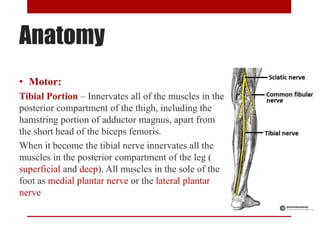
• Motor:
Tibial Portion – Innervates all of the muscles in the
posterior compartment of the thigh, including the
hamstring portion of adductor magnus, apart from
the short head of the biceps femoris.
When it become the tibial nerve innervates all the
muscles in the posterior compartment of the leg (
superficial and deep). All muscles in the sole of the
foot as medial plantar nerve or the lateral plantar
nerve
Anatomy
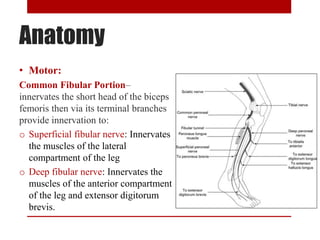
• Motor:
Common Fibular Portion–
innervates the short head of the biceps
femoris then via its terminal branches
provide innervation to:
o Superficial fibular nerve: Innervates
the muscles of the lateral
compartment of the leg
o Deep fibular nerve: Innervates the
muscles of the anterior compartment
of the leg and extensor digitorum
brevis.
Anatomy
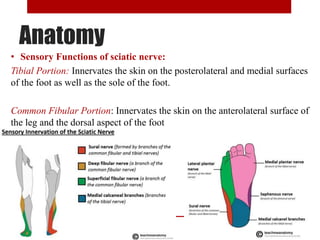
• Sensory Functions of sciatic nerve:
Tibial Portion: Innervates the skin on the posterolateral and medial surfaces
of the foot as well as the sole of the foot.
Common Fibular Portion: Innervates the skin on the anterolateral surface of
the leg and the dorsal aspect of the foot
Anatomy
4. Posterior Femoral Cutaneous: [S1, S2, S3}
Motor : none
Sensory : skin on the posterior surface of the thigh
and leg and skin of the perineum.
5. Pudendal Nerve: [S2, S3, S4]
Motor: skeletal muscles in the perineum, the external
urethral sphincter, the external anal sphincter, levator
ani.
Sensory: penis and the clitoris and most of the skin
of the perineum.
Anatomy
Introduction
• Wash hands
Introduce yourself
Confirm patient details – name / DOB
Explain the examination
Gain consent
Expose patient’s legs – shorts are most appropriate
Ask if the patient currently has any pain
Inspection
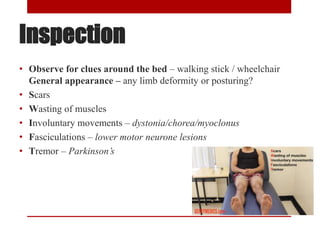
• Observe for clues around the bed – walking stick / wheelchair
General appearance – any limb deformity or posturing?
• Scars
• Wasting of muscles
• Involuntary movements – dystonia/chorea/myoclonus
• Fasciculations – lower motor neurone lesions
• Tremor – Parkinson’s
Gait
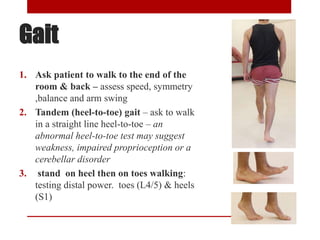
1. Ask patient to walk to the end of the
room & back – assess speed, symmetry
,balance and arm swing
2. Tandem (heel-to-toe) gait – ask to walk
in a straight line heel-to-toe – an
abnormal heel-to-toe test may suggest
weakness, impaired proprioception or a
cerebellar disorder
3. stand on heel then on toes walking:
testing distal power. toes (L4/5) & heels
(S1)
Gait
• Abnormal gaits:
· Hemiplegia: the foot is plantar flexed and the leg is swung in a lateral arc
· Spastic paraparesis: scissors gait
· Parkinson's: starting hesitation, shuffling, freezing, festination
pro/retropulsion
· Cerebellar: drunken wide-based or reeling on a narrow base gait; staggers
towards side of cerebellar lesion
· Posterior column lesion: clumsy slapping down of the feet on a broad base
· Footdrop: high stepping gait
· Proximal myopathy: waddling gait
· Prefrontal lobe (apraxic): feet appear glued to floor when erect, but move
more easily when the patient is supine
· Hysterical: characterised by a bizarre, inconsistent gait
Gait
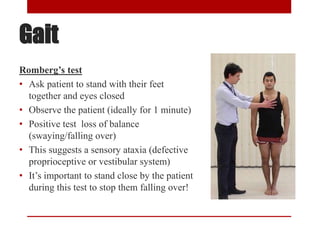
Romberg’s test
• Ask patient to stand with their feet
together and eyes closed
• Observe the patient (ideally for 1 minute)
• Positive test loss of balance
(swaying/falling over)
• This suggests a sensory ataxia (defective
proprioceptive or vestibular system)
• It’s important to stand close by the patient
during this test to stop them falling over!
Tone
• Ask the patient to keep their legs fully relaxed and “floppy”
throughout your assessment.
1. Leg roll – roll the patient’s leg & watch the foot – it should
flop independently of the leg
2. Leg lift – briskly lift leg off the bed at the knee joint – the heel
should remain in contact with the bed
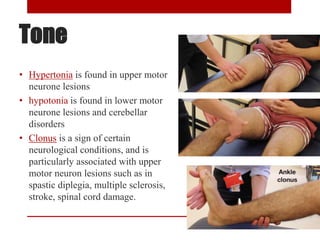
3. Ankle clonus
o Position the patient’s leg so that the knee & ankle are 90º flexed
o Rapidly dorsiflex & partially evert the foot
o Keep the foot in this position
o Clonus is felt as rhythmical beats on
dorsiflexion/plantarflexion (>5 is abnormal)
Tone
• Hypertonia is found in upper motor
neurone lesions
• hypotonia is found in lower motor
neurone lesions and cerebellar
disorders
• Clonus is a sign of certain
neurological conditions, and is
particularly associated with upper
motor neuron lesions such as in
spastic diplegia, multiple sclerosis,
stroke, spinal cord damage.
Power
• Assess one side at a time and compare like for like.
• Remember to stabilise the joint whilst testing power.
Hip
Flexion (L1/2) – “raise your leg off the bed & stop me from pushing it
down”
Extension (L5/S1) – “stop me from lifting your leg off the bed”
Abduction (L4/5) – “move your leg away from the midline”
Adduction (L2/3) – “stop me from moving your leg away from the
midline”
Power
Knee
Flexion (S1) – “bend your knee & stop me from straightening it”
Extension (L3/4) – “kick out your leg”
Ankle
Dorsiflexion (L4) – “point your foot towards your head & don’t let me
push it down”
Plantarflexion (S1/2) – “press against my hand with the sole of your
foot”
Inversion (L4) – “push your foot against my hand”
Eversion (L5/S1) – “push your foot out against my hand”
Big Toe
Extension (L5) – “don’t let me push your big toe down”
Power
.
MRC scale for muscle power
0 No muscle contraction is visible
1
Muscle contraction is visible but there is no movement of
the joint
2 Active joint movement is possible with gravity eliminated
3
Movement can overcome gravity but not resistance from
the examiner.
4
The muscle group can overcome gravity and move against
some resistance from the examiner.
5 Full and normal power against resistance
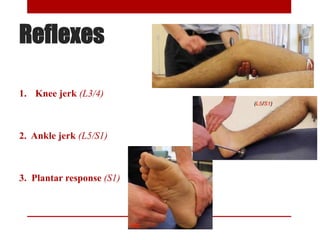
Reflexes
1. Knee jerk (L3/4)
2. Ankle jerk (L5/S1)
3. Plantar response (S1)
Reflexes
• Interpretation:
o Upper motor neurone lesions usually produce hyperreflexia.
o Lower motor neurone lesions usually produce a diminished or
absent response.
o It may be normal to have reduced or absent ankle reflexes in some
elderly people, although the frequency and significance of this is
disputed.
o Isolated loss of a reflex can point to a radiculopathy affecting that
segment - eg, loss of ankle jerk if there is an S1 disc prolapse.
o An extensor plantar response (upgoing big toe) is pathological and
signifies an upper motor neurone lesion.
Sensation
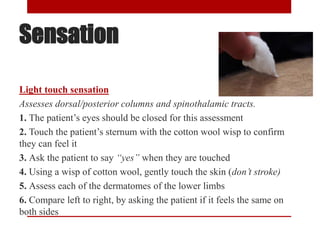
Light touch sensation
Assesses dorsal/posterior columns and spinothalamic tracts.
1. The patient’s eyes should be closed for this assessment
2. Touch the patient’s sternum with the cotton wool wisp to confirm
they can feel it
3. Ask the patient to say “yes” when they are touched
4. Using a wisp of cotton wool, gently touch the skin (don’t stroke)
5. Assess each of the dermatomes of the lower limbs
6. Compare left to right, by asking the patient if it feels the same on
both sides
Sensation
Pin-prick sensation
Assesses spinothalamic tracts.
Repeat the previous assessment steps, but this time using the sharp
end of a neurotip.
If sensation is reduced peripherally, assess from a distal point and
move proximally to identify ‘stocking’sensory loss.
Sensation
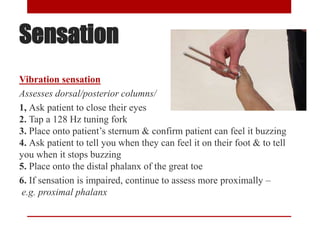
Vibration sensation
Assesses dorsal/posterior columns/
1, Ask patient to close their eyes
2. Tap a 128 Hz tuning fork
3. Place onto patient’s sternum & confirm patient can feel it buzzing
4. Ask patient to tell you when they can feel it on their foot & to tell
you when it stops buzzing
5. Place onto the distal phalanx of the great toe
6. If sensation is impaired, continue to assess more proximally –
e.g. proximal phalanx
Sensation
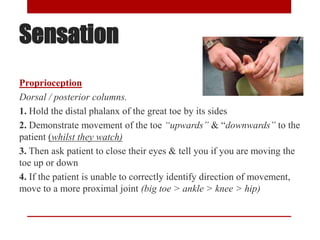
Proprioception
Dorsal / posterior columns.
1. Hold the distal phalanx of the great toe by its sides
2. Demonstrate movement of the toe “upwards” & “downwards” to the
patient (whilst they watch)
3. Then ask patient to close their eyes & tell you if you are moving the
toe up or down
4. If the patient is unable to correctly identify direction of movement,
move to a more proximal joint (big toe > ankle > knee > hip)
Co-ordination
• Heel to shin test – “run your heel down the other leg from the knee
& repeat in a smooth motion”
• Toe-finger test – lift leg short distance to touch examiner’s finger
with hallux.
• Foot tapping – rapid foot tapping with sole against examiners hand.
• An inability to perform this test may suggest loss of motor
strength, proprioception or a cerebellar disorder.
To complete the examination…
• Thank patient
Wash hands
Summarize findings
THANKS
• Lower Limb Neurological Examination - OSCE guide

Lower limb neurological examination

  • 1.
    LOWER LIMB NEUROLOGICAL EXAMINATION Preparedby: Dr. Abdulla Kamal Ghafour 3rd year IBFMS trainee
  • 2.
    Anatomy • Lumber plexus: formedby the anterior rami (divisions) of the lumbar spinal nerves L1, L2, L3 and L4. It also receives contributions from thoracic spinal nerve 12. These roots divide into several cords. These cords then combine together to form the six major peripheral nerves: 1. Iliohypogastric Nerve [(L1 (with contributions from T12)] Motor: Innervates the internal oblique and transversus abdominis. Sensory: Innervates the posterolateral gluteal skin in the pubic region.
  • 3.
    Anatomy 2. Ilioinguinal Nerve[L1] Motor: Innervates the internal oblique and transversus abdominis. Sensory: skin on the upper middle thigh In males, it also supplies the skin over the root of the penis and anterior scrotum. In females, it supplies the skin over mons pubis and labia majora. 3. Genitofemoral Nerve [L1, L2] Motor: cremasteric muscle. Sensory: The genital branch innervates the skin of the anterior scrotum (in males) or the skin over mons pubis and labia majora (in females). The femoral branch innervates the skin on the upper anterior thigh.
  • 4.
    Anatomy 4. Lateral CutaneousNerve of the Thigh [L2,L3] Motor: None Sensory: anterior and lateral thigh down to the level of the knee. 5. Obturator Nerve [L2, L3,L4] Motor: obturator externus, pectineus, adductor longus, adductor brevis, adductor magnus, gracilis. Sensory: Innervates the skin over the medial thigh.
  • 5.
    Anatomy 6. Femoral Nerve[L2,L3,L4] Motor: Illiacus, pectineus, sartorius, all the muscles of quadriceps femoris. Sensory: skin on the anterior thigh and the medial leg as a saphenous nerve.
  • 6.
    Anatomy • Sacral plexus: formedby the anterior rami (divisions) of the sacral spinal nerves S1, S2, S3 and S4. It also receives contributions from the lumbar spinal nerves L4 and L5. these spinal roots (and the lumbosacral trunk) divide into several cords. These cords then combine together to form the five major peripheral nerves: 1. superior gluteal nerve [L4, L5, S1] Motor: gluteus minimus, gluteus medius and tensor fascia lata Sensory: None
  • 7.
    Anatomy 2. Inferior glutealnerve[ L5, S1, S2] Motor: Innervates gluteus maximus Sensory: none. 3. Sciatic Nerve [L4, L5, S1, S2, S3] derived from the lumbosacral plexus. When the sciatic nerve reaches the apex of he popliteal fossa, it terminates by bifurcating into the tibial and common fibular nerves.
  • 8.
    Anatomy • Motor: Tibial Portion– Innervates all of the muscles in the posterior compartment of the thigh, including the hamstring portion of adductor magnus, apart from the short head of the biceps femoris. When it become the tibial nerve innervates all the muscles in the posterior compartment of the leg ( superficial and deep). All muscles in the sole of the foot as medial plantar nerve or the lateral plantar nerve
  • 9.
    Anatomy • Motor: Common FibularPortion– innervates the short head of the biceps femoris then via its terminal branches provide innervation to: o Superficial fibular nerve: Innervates the muscles of the lateral compartment of the leg o Deep fibular nerve: Innervates the muscles of the anterior compartment of the leg and extensor digitorum brevis.
  • 10.
    Anatomy • Sensory Functionsof sciatic nerve: Tibial Portion: Innervates the skin on the posterolateral and medial surfaces of the foot as well as the sole of the foot. Common Fibular Portion: Innervates the skin on the anterolateral surface of the leg and the dorsal aspect of the foot
  • 11.
    Anatomy 4. Posterior FemoralCutaneous: [S1, S2, S3} Motor : none Sensory : skin on the posterior surface of the thigh and leg and skin of the perineum. 5. Pudendal Nerve: [S2, S3, S4] Motor: skeletal muscles in the perineum, the external urethral sphincter, the external anal sphincter, levator ani. Sensory: penis and the clitoris and most of the skin of the perineum.
  • 12.
  • 13.
    Introduction • Wash hands Introduceyourself Confirm patient details – name / DOB Explain the examination Gain consent Expose patient’s legs – shorts are most appropriate Ask if the patient currently has any pain
  • 14.
    Inspection • Observe forclues around the bed – walking stick / wheelchair General appearance – any limb deformity or posturing? • Scars • Wasting of muscles • Involuntary movements – dystonia/chorea/myoclonus • Fasciculations – lower motor neurone lesions • Tremor – Parkinson’s
  • 15.
    Gait 1. Ask patientto walk to the end of the room & back – assess speed, symmetry ,balance and arm swing 2. Tandem (heel-to-toe) gait – ask to walk in a straight line heel-to-toe – an abnormal heel-to-toe test may suggest weakness, impaired proprioception or a cerebellar disorder 3. stand on heel then on toes walking: testing distal power. toes (L4/5) & heels (S1)
  • 16.
    Gait • Abnormal gaits: ·Hemiplegia: the foot is plantar flexed and the leg is swung in a lateral arc · Spastic paraparesis: scissors gait · Parkinson's: starting hesitation, shuffling, freezing, festination pro/retropulsion · Cerebellar: drunken wide-based or reeling on a narrow base gait; staggers towards side of cerebellar lesion · Posterior column lesion: clumsy slapping down of the feet on a broad base · Footdrop: high stepping gait · Proximal myopathy: waddling gait · Prefrontal lobe (apraxic): feet appear glued to floor when erect, but move more easily when the patient is supine · Hysterical: characterised by a bizarre, inconsistent gait
  • 17.
    Gait Romberg’s test • Askpatient to stand with their feet together and eyes closed • Observe the patient (ideally for 1 minute) • Positive test loss of balance (swaying/falling over) • This suggests a sensory ataxia (defective proprioceptive or vestibular system) • It’s important to stand close by the patient during this test to stop them falling over!
  • 18.
    Tone • Ask thepatient to keep their legs fully relaxed and “floppy” throughout your assessment. 1. Leg roll – roll the patient’s leg & watch the foot – it should flop independently of the leg 2. Leg lift – briskly lift leg off the bed at the knee joint – the heel should remain in contact with the bed 3. Ankle clonus o Position the patient’s leg so that the knee & ankle are 90º flexed o Rapidly dorsiflex & partially evert the foot o Keep the foot in this position o Clonus is felt as rhythmical beats on dorsiflexion/plantarflexion (>5 is abnormal)
  • 19.
    Tone • Hypertonia isfound in upper motor neurone lesions • hypotonia is found in lower motor neurone lesions and cerebellar disorders • Clonus is a sign of certain neurological conditions, and is particularly associated with upper motor neuron lesions such as in spastic diplegia, multiple sclerosis, stroke, spinal cord damage.
  • 20.
    Power • Assess oneside at a time and compare like for like. • Remember to stabilise the joint whilst testing power. Hip Flexion (L1/2) – “raise your leg off the bed & stop me from pushing it down” Extension (L5/S1) – “stop me from lifting your leg off the bed” Abduction (L4/5) – “move your leg away from the midline” Adduction (L2/3) – “stop me from moving your leg away from the midline”
  • 21.
    Power Knee Flexion (S1) –“bend your knee & stop me from straightening it” Extension (L3/4) – “kick out your leg” Ankle Dorsiflexion (L4) – “point your foot towards your head & don’t let me push it down” Plantarflexion (S1/2) – “press against my hand with the sole of your foot” Inversion (L4) – “push your foot against my hand” Eversion (L5/S1) – “push your foot out against my hand” Big Toe Extension (L5) – “don’t let me push your big toe down”
  • 22.
    Power . MRC scale formuscle power 0 No muscle contraction is visible 1 Muscle contraction is visible but there is no movement of the joint 2 Active joint movement is possible with gravity eliminated 3 Movement can overcome gravity but not resistance from the examiner. 4 The muscle group can overcome gravity and move against some resistance from the examiner. 5 Full and normal power against resistance
  • 23.
    Reflexes 1. Knee jerk(L3/4) 2. Ankle jerk (L5/S1) 3. Plantar response (S1)
  • 24.
    Reflexes • Interpretation: o Uppermotor neurone lesions usually produce hyperreflexia. o Lower motor neurone lesions usually produce a diminished or absent response. o It may be normal to have reduced or absent ankle reflexes in some elderly people, although the frequency and significance of this is disputed. o Isolated loss of a reflex can point to a radiculopathy affecting that segment - eg, loss of ankle jerk if there is an S1 disc prolapse. o An extensor plantar response (upgoing big toe) is pathological and signifies an upper motor neurone lesion.
  • 25.
    Sensation Light touch sensation Assessesdorsal/posterior columns and spinothalamic tracts. 1. The patient’s eyes should be closed for this assessment 2. Touch the patient’s sternum with the cotton wool wisp to confirm they can feel it 3. Ask the patient to say “yes” when they are touched 4. Using a wisp of cotton wool, gently touch the skin (don’t stroke) 5. Assess each of the dermatomes of the lower limbs 6. Compare left to right, by asking the patient if it feels the same on both sides
  • 26.
    Sensation Pin-prick sensation Assesses spinothalamictracts. Repeat the previous assessment steps, but this time using the sharp end of a neurotip. If sensation is reduced peripherally, assess from a distal point and move proximally to identify ‘stocking’sensory loss.
  • 27.
    Sensation Vibration sensation Assesses dorsal/posteriorcolumns/ 1, Ask patient to close their eyes 2. Tap a 128 Hz tuning fork 3. Place onto patient’s sternum & confirm patient can feel it buzzing 4. Ask patient to tell you when they can feel it on their foot & to tell you when it stops buzzing 5. Place onto the distal phalanx of the great toe 6. If sensation is impaired, continue to assess more proximally – e.g. proximal phalanx
  • 28.
    Sensation Proprioception Dorsal / posteriorcolumns. 1. Hold the distal phalanx of the great toe by its sides 2. Demonstrate movement of the toe “upwards” & “downwards” to the patient (whilst they watch) 3. Then ask patient to close their eyes & tell you if you are moving the toe up or down 4. If the patient is unable to correctly identify direction of movement, move to a more proximal joint (big toe > ankle > knee > hip)
  • 29.
    Co-ordination • Heel toshin test – “run your heel down the other leg from the knee & repeat in a smooth motion” • Toe-finger test – lift leg short distance to touch examiner’s finger with hallux. • Foot tapping – rapid foot tapping with sole against examiners hand. • An inability to perform this test may suggest loss of motor strength, proprioception or a cerebellar disorder.
  • 30.
    To complete theexamination… • Thank patient Wash hands Summarize findings
  • 31.
    THANKS • Lower LimbNeurological Examination - OSCE guide