Classical India
Indo-European Migrations
Mass Migrations from the Steppes to Europe, Anatolia, and India
Steppes
4
Hindu Kush Mountains
Khyber Pass
Through Hindu Kush Mts.
I. Classical Indian civilization began in the Indus River Valley, spread to the Ganges River Valley, and then spread
throughout the Indian subcontinent. This spread continued with little interruption because of the geographic location.
A. Why were physical geography and location important to the development of Indian
civilization?
1. Physical barriers: Himalayas, Hindu Kush & Indian Ocean made invasion
difficult
2. Mountain passes in the Hindu Kush provided migration routes into the Indian
subcontinent
3. The Indus & Ganges were most important rivers, for life & spiritual importance.
II. Indo-European Aryans migrated into the area, creating a structured society (caste system) and blending their beliefs
with those of the indigenous people.
A. What impact did the Aryans have on India?
1. Aryans migrated into subcontinent, asserted dominance
2. Brought religion; holy books = Vedas – Vedic religion evolved into
Hinduism
3. Established new social order Caste System
Indus
Ganges
Aryans
Himalayas
H
indu
K
ush
Caste
System
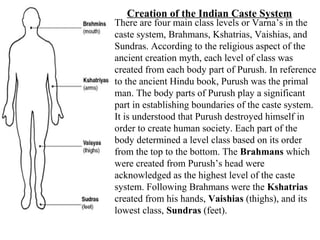
There are four main class levels or Varna’s in the
caste system, Brahmans, Kshatrias, Vaishias, and
Sundras. According to the religious aspect of the
ancient creation myth, each level of class was
created from each body part of Purush. In reference
to the ancient Hindu book, Purush was the primal
man. The body parts of Purush play a significant
part in establishing boundaries of the caste system.
It is understood that Purush destroyed himself in
order to create human society. Each part of the
body determined a level class based on its order
from the top to the bottom. The Brahmans which
were created from Purush’s head were
acknowledged as the highest level of the caste
system. Following Brahmans were the Kshatrias
created from his hands, Vaishias (thighs), and its
lowest class, Sundras (feet).
Creation of the Indian Caste System
No Social
Mobility! –
born & die in
same caste
III. Hinduism was an important contribution of classical India.
A. What are the beliefs of the Hindu religion?
1. No single founder – evolved from Aryan Vedic traditions
2. Interconnectedness of life; Atman = individual soul; & Brahman =
world soul
3. Reincarnation – rebirth of soul through many lifetimes
4. Dharma – duties specific to each caste; pride in fulfilling Dharma
5. Karma – all thoughts & actions result in future consequences (good
or bad)
6. Moksha – spiritual goal for Hindus; release from cycle of rebirth;
join world soul
Reincarnation
IV. Hindu Gods
A. How did Hindus view their gods? Many incarnations of one god -
Brahman
1. Brahma – the Creator
2. Vishnu – the Protector
3. Shiva – the Destroyer
IV. Hinduism relied on sacred literature as a foundation of the
religion.
A. What were the “Sacred Writings” of Hinduism?
1.Vedas = beginning of Hindu religion
2. Upanishads = introduced idea of universal spirit &
separation from material world
3. Mahabharata = 106,000 verse epic Indian poem;
addressing good & evil; importance of Dharma.
Brahma
Shiva
Vishnu
IV. Hinduism influenced Indian society and culture and is still practiced in India today.
A. How did Hinduism influence Indian society and culture?
1. Karma & reincarnation strengthened Caste System
2. Caste System influenced all social interactions & occupations
3. NO SOCIAL MOBILITY!
4. Hindu culture spread to SE Asia along trade routes.
No Social Mobility – born & die in same caste
H I N D U I S M
Siddhartha Gautama searches for
Enlightenment
Asoka’s Mauryan Empire - 324-184 B.C.E. Gupta Empire - 320-550 C.E.
Two Classical Indian Empires - Mauryan and Gupta Empires
Ashoka’s Edicts
Ashoka’s Rock
Edicts
The Golden Age of the Gupta Empire
Advancements
metalworking
universities
mathematicsliteraturepaintings
roads
architecture sculpture
Asoka’s Mauryan Empire - 324-184 B.C.E. Gupta Empire - 320-550 C.E.
Two Classical Indian Empires - Mauryan and Gupta Empires
1. Identify some geographical differences between the Mauryan and Gupta Empires.
___________________________________________________________________________________________
___________________________________________________________________________________________
___________________________________________________________________________________________
___
2. Identify some geographic commonalities between the Mauryan and Gupta Empires.
___________________________________________________________________________________________
___________________________________________________________________________________________
___________________________________________________________________________________________
___
3. Identify some possible reasons for the geographic commonalities. Be as specific as possible.
___________________________________________________________________________________________
___________________________________________________________________________________________
___________________________________________________________________________________________
___
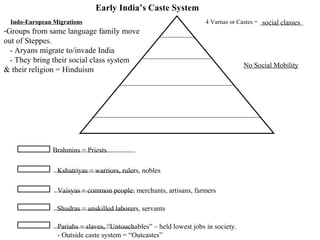
Early India’s Caste System
4 Varnas or Castes = ______________Indo-European Migrations
-Groups from same language family move
out of Steppes.
- Aryans migrate to/invade India
- They bring their social class system
& their religion = Hinduism
No Social Mobility
Brahmins = Priests
Kshatriyas = warriors, rulers, nobles
Vaisyas = common people: merchants, artisans, farmers
Shudras = unskilled laborers, servants
Pariahs = slaves, “Untouchables” – held lowest jobs in society.
- Outside caste system = “Outcastes”
social classes
AP Questions from text: pp. 105-109: The Mauryan and Gupta Empires
1. Create a timeline of development in India as you progress through these questions.
2. Describe the caste system, addressing the term Varna. Also use info. From top of 107.
3. Create a visual representing the Caste system.
4. Lawbook of Manu: What do the excerpts tell us about Indian society and culture?
5. Which 2 major world religions emerged in India?
6. Describe the difficulty rulers experienced in uniting the Indian subcontinent.
7. Create a web highlighting the attributes of Emperor Ashoka.
8. Describe, in just a few words, the period between the Mauryan and Gupta Empires.
9. How did the Gupta differ politically from the Mauryan?
10. How was the Gupta a “theatre state”?
Critical Intro.
Describe the common characteristic of the
Indo-European groups and what accounts
for that commonality.
Critical Intro.
Write a one-sentence, comprehensive,
analytical description of the nature and
goals of the Mauryan ruler Asoka.
Critical Intro.
Write an accurate and intelligent paragraph
about Indian culture using the following
terms:
Aryans Mauryan
Social stratification Gupta
Hinduism reincarnation
Caste Buddhism
Ashoka regionalism
Siddhartha Gautama missionaries

Classical India

  • 1.
  • 3.
    Indo-European Migrations Mass Migrationsfrom the Steppes to Europe, Anatolia, and India Steppes
  • 4.
  • 7.
  • 8.
  • 9.
    I. Classical Indiancivilization began in the Indus River Valley, spread to the Ganges River Valley, and then spread throughout the Indian subcontinent. This spread continued with little interruption because of the geographic location. A. Why were physical geography and location important to the development of Indian civilization? 1. Physical barriers: Himalayas, Hindu Kush & Indian Ocean made invasion difficult 2. Mountain passes in the Hindu Kush provided migration routes into the Indian subcontinent 3. The Indus & Ganges were most important rivers, for life & spiritual importance. II. Indo-European Aryans migrated into the area, creating a structured society (caste system) and blending their beliefs with those of the indigenous people. A. What impact did the Aryans have on India? 1. Aryans migrated into subcontinent, asserted dominance 2. Brought religion; holy books = Vedas – Vedic religion evolved into Hinduism 3. Established new social order Caste System Indus Ganges Aryans Himalayas H indu K ush Caste System
  • 10.
    There are fourmain class levels or Varna’s in the caste system, Brahmans, Kshatrias, Vaishias, and Sundras. According to the religious aspect of the ancient creation myth, each level of class was created from each body part of Purush. In reference to the ancient Hindu book, Purush was the primal man. The body parts of Purush play a significant part in establishing boundaries of the caste system. It is understood that Purush destroyed himself in order to create human society. Each part of the body determined a level class based on its order from the top to the bottom. The Brahmans which were created from Purush’s head were acknowledged as the highest level of the caste system. Following Brahmans were the Kshatrias created from his hands, Vaishias (thighs), and its lowest class, Sundras (feet). Creation of the Indian Caste System
  • 11.
    No Social Mobility! – born& die in same caste
  • 12.
    III. Hinduism wasan important contribution of classical India. A. What are the beliefs of the Hindu religion? 1. No single founder – evolved from Aryan Vedic traditions 2. Interconnectedness of life; Atman = individual soul; & Brahman = world soul 3. Reincarnation – rebirth of soul through many lifetimes 4. Dharma – duties specific to each caste; pride in fulfilling Dharma 5. Karma – all thoughts & actions result in future consequences (good or bad) 6. Moksha – spiritual goal for Hindus; release from cycle of rebirth; join world soul Reincarnation
  • 13.
    IV. Hindu Gods A.How did Hindus view their gods? Many incarnations of one god - Brahman 1. Brahma – the Creator 2. Vishnu – the Protector 3. Shiva – the Destroyer IV. Hinduism relied on sacred literature as a foundation of the religion. A. What were the “Sacred Writings” of Hinduism? 1.Vedas = beginning of Hindu religion 2. Upanishads = introduced idea of universal spirit & separation from material world 3. Mahabharata = 106,000 verse epic Indian poem; addressing good & evil; importance of Dharma.
  • 14.
  • 15.
    IV. Hinduism influencedIndian society and culture and is still practiced in India today. A. How did Hinduism influence Indian society and culture? 1. Karma & reincarnation strengthened Caste System 2. Caste System influenced all social interactions & occupations 3. NO SOCIAL MOBILITY! 4. Hindu culture spread to SE Asia along trade routes. No Social Mobility – born & die in same caste H I N D U I S M
  • 16.
    Siddhartha Gautama searchesfor Enlightenment
  • 19.
    Asoka’s Mauryan Empire- 324-184 B.C.E. Gupta Empire - 320-550 C.E. Two Classical Indian Empires - Mauryan and Gupta Empires
  • 20.
  • 21.
  • 22.
    The Golden Ageof the Gupta Empire Advancements metalworking universities mathematicsliteraturepaintings roads architecture sculpture
  • 23.
    Asoka’s Mauryan Empire- 324-184 B.C.E. Gupta Empire - 320-550 C.E. Two Classical Indian Empires - Mauryan and Gupta Empires 1. Identify some geographical differences between the Mauryan and Gupta Empires. ___________________________________________________________________________________________ ___________________________________________________________________________________________ ___________________________________________________________________________________________ ___ 2. Identify some geographic commonalities between the Mauryan and Gupta Empires. ___________________________________________________________________________________________ ___________________________________________________________________________________________ ___________________________________________________________________________________________ ___ 3. Identify some possible reasons for the geographic commonalities. Be as specific as possible. ___________________________________________________________________________________________ ___________________________________________________________________________________________ ___________________________________________________________________________________________ ___
  • 24.
    Early India’s CasteSystem 4 Varnas or Castes = ______________Indo-European Migrations -Groups from same language family move out of Steppes. - Aryans migrate to/invade India - They bring their social class system & their religion = Hinduism No Social Mobility Brahmins = Priests Kshatriyas = warriors, rulers, nobles Vaisyas = common people: merchants, artisans, farmers Shudras = unskilled laborers, servants Pariahs = slaves, “Untouchables” – held lowest jobs in society. - Outside caste system = “Outcastes” social classes
  • 25.
    AP Questions fromtext: pp. 105-109: The Mauryan and Gupta Empires 1. Create a timeline of development in India as you progress through these questions. 2. Describe the caste system, addressing the term Varna. Also use info. From top of 107. 3. Create a visual representing the Caste system. 4. Lawbook of Manu: What do the excerpts tell us about Indian society and culture? 5. Which 2 major world religions emerged in India?
  • 26.
    6. Describe thedifficulty rulers experienced in uniting the Indian subcontinent. 7. Create a web highlighting the attributes of Emperor Ashoka. 8. Describe, in just a few words, the period between the Mauryan and Gupta Empires. 9. How did the Gupta differ politically from the Mauryan? 10. How was the Gupta a “theatre state”?
  • 27.
    Critical Intro. Describe thecommon characteristic of the Indo-European groups and what accounts for that commonality.
  • 28.
    Critical Intro. Write aone-sentence, comprehensive, analytical description of the nature and goals of the Mauryan ruler Asoka.
  • 29.
    Critical Intro. Write anaccurate and intelligent paragraph about Indian culture using the following terms: Aryans Mauryan Social stratification Gupta Hinduism reincarnation Caste Buddhism Ashoka regionalism Siddhartha Gautama missionaries