• The Empire had an area of 1 700 000
square kilometers. It covered a grand
part of South America since Colombia
until Chile.
• Their limits were:
 North: until the Ancasmayo River
(Colombia), covering the coast and
the mountains of Ecuador and the
southern point of Colombia.
 South: until the Maule River,
covering the north and the center
of Chile.
 Southeast: cover Bolivia until
Tucuman (Argentina).
 East: the Jungle.
A. MANCO CAPAC AND MAMA OCLLO
LEGEND
 They emerged out of Lake Titicaca
 Their father – the Sun- gave them a
great golden staff to be used for a
specific task: Finding the most
appropriate location by sticking the
staff into the ground and found a
new kingdom.
 They came upon the most
beautiful place they had seen yet.
They stuck the staff in the ground
and it stuck. They founded the city
of Cusco, conquering the tribes
already living there and ruling
them under the Incan Empire.
B. AYAR BROTHERS LEGEND
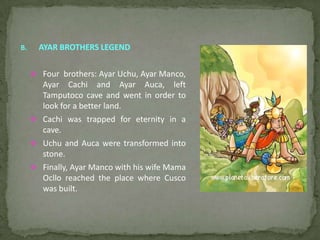
 Four brothers: Ayar Uchu, Ayar Manco,
Ayar Cachi and Ayar Auca, left
Tamputoco cave and went in order to
look for a better land.
 Cachi was trapped for eternity in a
cave.
 Uchu and Auca were transformed into
stone.
 Finally, Ayar Manco with his wife Mama
Ocllo reached the place where Cusco
was built.
• Pachacutec reorganized the kingdom of
Cusco into an empire that has 4 regions:
 Chinchaysuyo (NW)
 Antisuyo (NE)
 Contisuyo (SW)
 Collasuyo (SE)
• Each province had a governor who
supervised agriculturally-productive river
valleys, cities and mines.
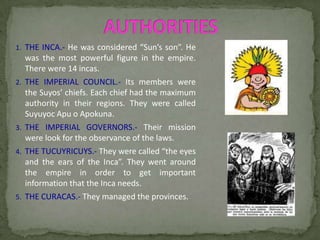
1. THE INCA.- He was considered “Sun’s son”. He
was the most powerful figure in the empire.
There were 14 incas.
2. THE IMPERIAL COUNCIL.- Its members were
the Suyos’ chiefs. Each chief had the maximum
authority in their regions. They were called
Suyuyoc Apu o Apokuna.
3. THE IMPERIAL GOVERNORS.- Their mission
were look for the observance of the laws.
4. THE TUCUYRICUYS.- They were called “the eyes
and the ears of the Inca”. They went around
the empire in order to get important
information that the Inca needs.
5. THE CURACAS.- They managed the provinces.
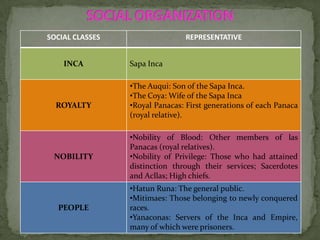
SOCIAL CLASSES REPRESENTATIVE
INCA Sapa Inca
ROYALTY
•The Auqui: Son of the Sapa Inca.
•The Coya: Wife of the Sapa Inca
•Royal Panacas: First generations of each Panaca
(royal relative).
NOBILITY
•Nobility of Blood: Other members of las
Panacas (royal relatives).
•Nobility of Privilege: Those who had attained
distinction through their services; Sacerdotes
and Acllas; High chiefs.
PEOPLE
•Hatun Runa: The general public.
•Mitimaes: Those belonging to newly conquered
races.
•Yanaconas: Servers of the Inca and Empire,
many of which were prisoners.
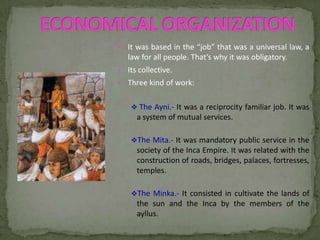
• It was based in the “job” that was a universal law, a
law for all people. That’s why it was obligatory.
• Its collective.
• Three kind of work:
 The Ayni.- It was a reciprocity familiar job. It was
a system of mutual services.
The Mita.- It was mandatory public service in the
society of the Inca Empire. It was related with the
construction of roads, bridges, palaces, fortresses,
temples.
The Minka.- It consisted in cultivate the lands of
the sun and the Inca by the members of the
ayllus.
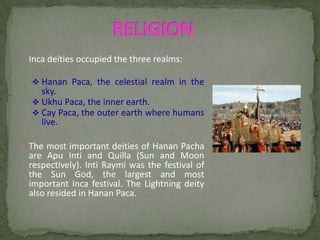
• Inca deities occupied the three realms:
 Hanan Paca, the celestial realm in the
sky.
 Ukhu Paca, the inner earth.
 Cay Paca, the outer earth where humans
live.
• The most important deities of Hanan Pacha
are Apu Inti and Quilla (Sun and Moon
respectively). Inti Raymi was the festival of
the Sun God, the largest and most
important Inca festival. The Lightning deity
also resided in Hanan Paca.
The incas had three principal laws:
Ama Sua: do not steal.
Ama Llulla: do not lie.
Ama Quella: do not be lazy.
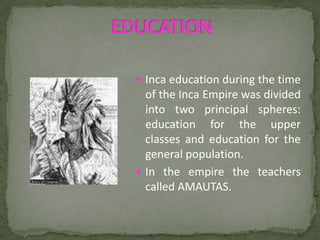
 Inca education during the time
of the Inca Empire was divided
into two principal spheres:
education for the upper
classes and education for the
general population.
 In the empire the teachers
called AMAUTAS.
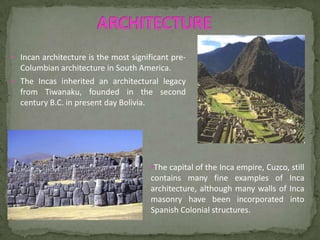
• Incan architecture is the most significant pre-
Columbian architecture in South America.
• The Incas inherited an architectural legacy
from Tiwanaku, founded in the second
century B.C. in present day Bolivia.
•The capital of the Inca empire, Cuzco, still
contains many fine examples of Inca
architecture, although many walls of Inca
masonry have been incorporated into
Spanish Colonial structures.
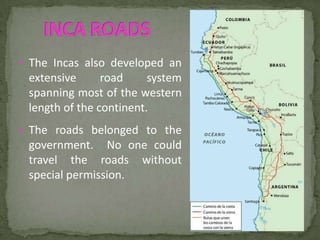
• The Incas also developed an
extensive road system
spanning most of the western
length of the continent.
• The roads belonged to the
government. No one could
travel the roads without
special permission.
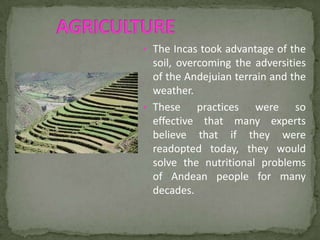
• The Incas took advantage of the
soil, overcoming the adversities
of the Andejuian terrain and the
weather.
• These practices were so
effective that many experts
believe that if they were
readopted today, they would
solve the nutritional problems
of Andean people for many
decades.
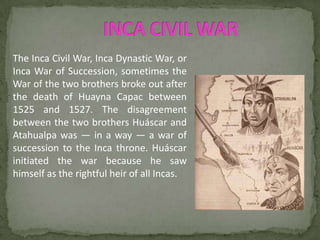
The Inca Civil War, Inca Dynastic War, or
Inca War of Succession, sometimes the
War of the two brothers broke out after
the death of Huayna Capac between
1525 and 1527. The disagreement
between the two brothers Huáscar and
Atahualpa was — in a way — a war of
succession to the Inca throne. Huáscar
initiated the war because he saw
himself as the rightful heir of all Incas.
Incas empire

Incas empire

  • 2.
    • The Empirehad an area of 1 700 000 square kilometers. It covered a grand part of South America since Colombia until Chile. • Their limits were:  North: until the Ancasmayo River (Colombia), covering the coast and the mountains of Ecuador and the southern point of Colombia.  South: until the Maule River, covering the north and the center of Chile.  Southeast: cover Bolivia until Tucuman (Argentina).  East: the Jungle.
  • 3.
    A. MANCO CAPACAND MAMA OCLLO LEGEND  They emerged out of Lake Titicaca  Their father – the Sun- gave them a great golden staff to be used for a specific task: Finding the most appropriate location by sticking the staff into the ground and found a new kingdom.  They came upon the most beautiful place they had seen yet. They stuck the staff in the ground and it stuck. They founded the city of Cusco, conquering the tribes already living there and ruling them under the Incan Empire.
  • 4.
    B. AYAR BROTHERSLEGEND  Four brothers: Ayar Uchu, Ayar Manco, Ayar Cachi and Ayar Auca, left Tamputoco cave and went in order to look for a better land.  Cachi was trapped for eternity in a cave.  Uchu and Auca were transformed into stone.  Finally, Ayar Manco with his wife Mama Ocllo reached the place where Cusco was built.
  • 5.
    • Pachacutec reorganizedthe kingdom of Cusco into an empire that has 4 regions:  Chinchaysuyo (NW)  Antisuyo (NE)  Contisuyo (SW)  Collasuyo (SE) • Each province had a governor who supervised agriculturally-productive river valleys, cities and mines.
  • 6.
    1. THE INCA.-He was considered “Sun’s son”. He was the most powerful figure in the empire. There were 14 incas. 2. THE IMPERIAL COUNCIL.- Its members were the Suyos’ chiefs. Each chief had the maximum authority in their regions. They were called Suyuyoc Apu o Apokuna. 3. THE IMPERIAL GOVERNORS.- Their mission were look for the observance of the laws. 4. THE TUCUYRICUYS.- They were called “the eyes and the ears of the Inca”. They went around the empire in order to get important information that the Inca needs. 5. THE CURACAS.- They managed the provinces.
  • 7.
    SOCIAL CLASSES REPRESENTATIVE INCASapa Inca ROYALTY •The Auqui: Son of the Sapa Inca. •The Coya: Wife of the Sapa Inca •Royal Panacas: First generations of each Panaca (royal relative). NOBILITY •Nobility of Blood: Other members of las Panacas (royal relatives). •Nobility of Privilege: Those who had attained distinction through their services; Sacerdotes and Acllas; High chiefs. PEOPLE •Hatun Runa: The general public. •Mitimaes: Those belonging to newly conquered races. •Yanaconas: Servers of the Inca and Empire, many of which were prisoners.
  • 8.
    • It wasbased in the “job” that was a universal law, a law for all people. That’s why it was obligatory. • Its collective. • Three kind of work:  The Ayni.- It was a reciprocity familiar job. It was a system of mutual services. The Mita.- It was mandatory public service in the society of the Inca Empire. It was related with the construction of roads, bridges, palaces, fortresses, temples. The Minka.- It consisted in cultivate the lands of the sun and the Inca by the members of the ayllus.
  • 9.
    • Inca deitiesoccupied the three realms:  Hanan Paca, the celestial realm in the sky.  Ukhu Paca, the inner earth.  Cay Paca, the outer earth where humans live. • The most important deities of Hanan Pacha are Apu Inti and Quilla (Sun and Moon respectively). Inti Raymi was the festival of the Sun God, the largest and most important Inca festival. The Lightning deity also resided in Hanan Paca.
  • 10.
    The incas hadthree principal laws: Ama Sua: do not steal. Ama Llulla: do not lie. Ama Quella: do not be lazy.
  • 11.
     Inca educationduring the time of the Inca Empire was divided into two principal spheres: education for the upper classes and education for the general population.  In the empire the teachers called AMAUTAS.
  • 12.
    • Incan architectureis the most significant pre- Columbian architecture in South America. • The Incas inherited an architectural legacy from Tiwanaku, founded in the second century B.C. in present day Bolivia. •The capital of the Inca empire, Cuzco, still contains many fine examples of Inca architecture, although many walls of Inca masonry have been incorporated into Spanish Colonial structures.
  • 13.
    • The Incasalso developed an extensive road system spanning most of the western length of the continent. • The roads belonged to the government. No one could travel the roads without special permission.
  • 14.
    • The Incastook advantage of the soil, overcoming the adversities of the Andejuian terrain and the weather. • These practices were so effective that many experts believe that if they were readopted today, they would solve the nutritional problems of Andean people for many decades.
  • 15.
    The Inca CivilWar, Inca Dynastic War, or Inca War of Succession, sometimes the War of the two brothers broke out after the death of Huayna Capac between 1525 and 1527. The disagreement between the two brothers Huáscar and Atahualpa was — in a way — a war of succession to the Inca throne. Huáscar initiated the war because he saw himself as the rightful heir of all Incas.