The Gift of the Nile
I. Ancient Egypt
A. Early Civilization on the Nile
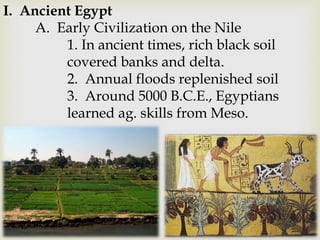
1. In ancient times, rich black soil
covered banks and delta.
2. Annual floods replenished soil
3. Around 5000 B.C.E., Egyptians
learned ag. skills from Meso.
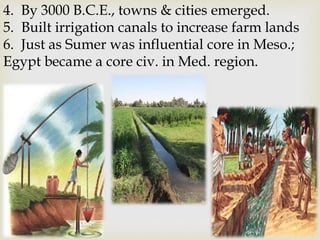
4. By 3000 B.C.E., towns & cities emerged.
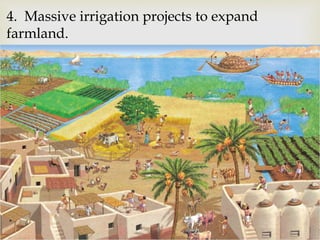
5. Built irrigation canals to increase farm lands
6. Just as Sumer was influential core in Meso.;
Egypt became a core civ. in Med. region.
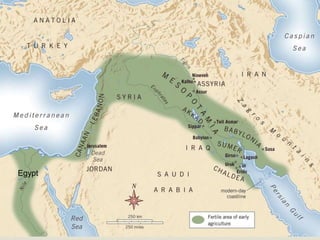
Egypt
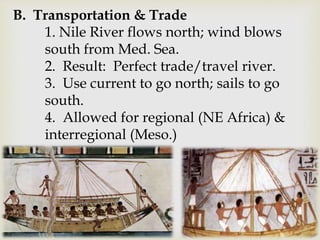
B. Transportation & Trade
1. Nile River flows north; wind blows
south from Med. Sea.
2. Result: Perfect trade/travel river.
3. Use current to go north; sails to go
south.
4. Allowed for regional (NE Africa) &
interregional (Meso.)
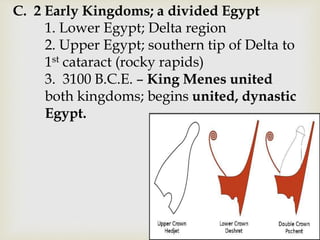
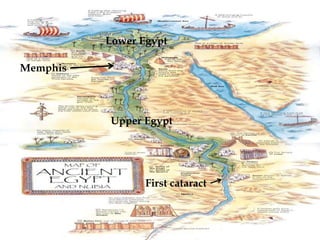
C. 2 Early Kingdoms; a divided Egypt
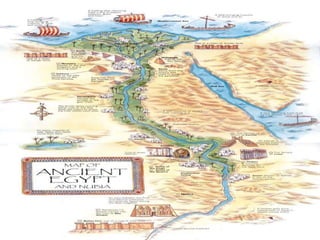
1. Lower Egypt; Delta region
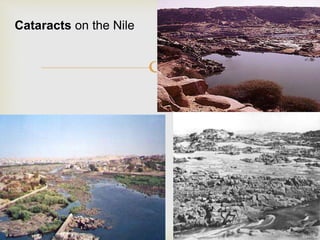
2. Upper Egypt; southern tip of Delta to
1st cataract (rocky rapids)
3. 3100 B.C.E. – King Menes united
both kingdoms; begins united, dynastic
Egypt.

Cataracts on the Nile
Lower Egypt
Upper Egypt
Memphis
First cataract
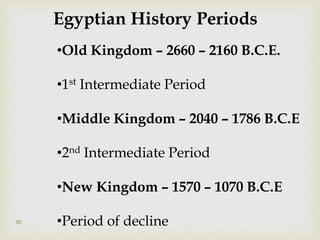
10
•Old Kingdom – 2660 – 2160 B.C.E.
•1st Intermediate Period
•Middle Kingdom – 2040 – 1786 B.C.E
•2nd Intermediate Period
•New Kingdom – 1570 – 1070 B.C.E
•Period of decline
Egyptian History Periods
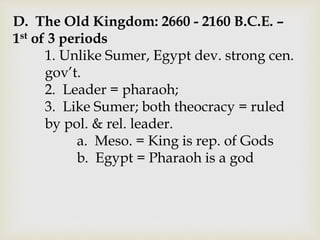
D. The Old Kingdom: 2660 - 2160 B.C.E. –
1st of 3 periods
1. Unlike Sumer, Egypt dev. strong cen.
gov’t.
2. Leader = pharaoh;
3. Like Sumer; both theocracy = ruled
by pol. & rel. leader.
a. Meso. = King is rep. of Gods
b. Egypt = Pharaoh is a god
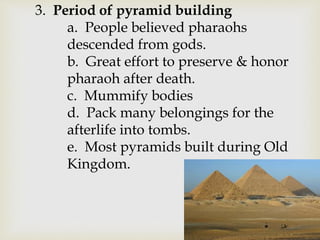
3. Period of pyramid building
a. People believed pharaohs
descended from gods.
b. Great effort to preserve & honor
pharaoh after death.
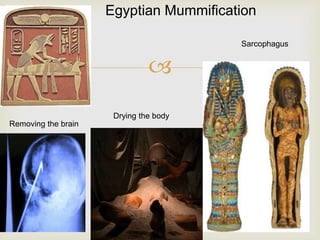
c. Mummify bodies
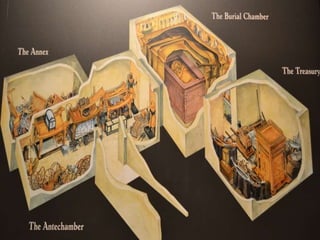
d. Pack many belongings for the
afterlife into tombs.
e. Most pyramids built during Old
Kingdom.

Sarcophagus
Drying the body
Egyptian Mummification
Removing the brain
14
4. Civil unrest among provincial
governors led to end of Old Kingdom
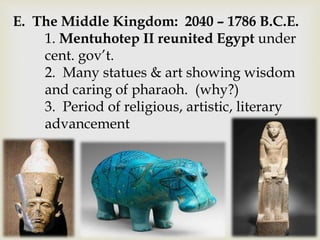
E. The Middle Kingdom: 2040 – 1786 B.C.E.
1. Mentuhotep II reunited Egypt under
cent. gov’t.
2. Many statues & art showing wisdom
and caring of pharaoh. (why?)
3. Period of religious, artistic, literary
advancement
4. Massive irrigation projects to expand
farmland.
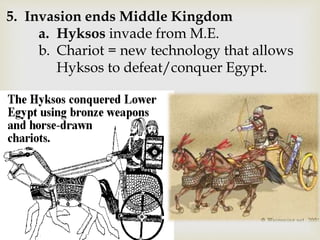
5. Invasion ends Middle Kingdom
a. Hyksos invade from M.E.
b. Chariot = new technology that allows
Hyksos to defeat/conquer Egypt.
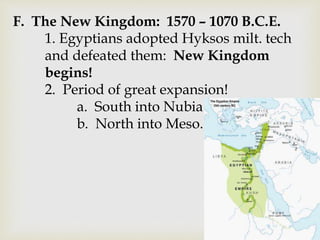
F. The New Kingdom: 1570 – 1070 B.C.E.
1. Egyptians adopted Hyksos milt. tech
and defeated them: New Kingdom
begins!
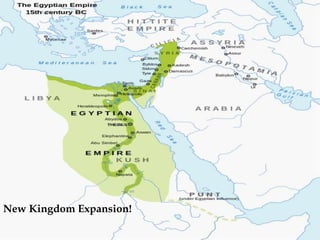
2. Period of great expansion!
a. South into Nubia
b. North into Meso.
New Kingdom Expansion!
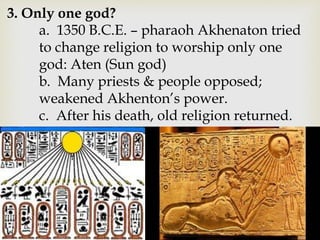
3. Only one god?
a. 1350 B.C.E. – pharaoh Akhenaton tried
to change religion to worship only one
god: Aten (Sun god)
b. Many priests & people opposed;
weakened Akhenton’s power.
c. After his death, old religion returned.
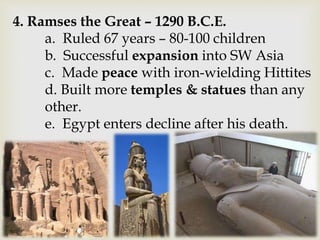
4. Ramses the Great – 1290 B.C.E.
a. Ruled 67 years – 80-100 children
b. Successful expansion into SW Asia
c. Made peace with iron-wielding Hittites
d. Built more temples & statues than any
other.
e. Egypt enters decline after his death.
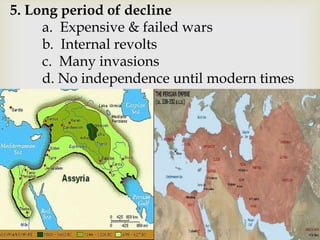
5. Long period of decline
a. Expensive & failed wars
b. Internal revolts
c. Many invasions
d. No independence until modern times
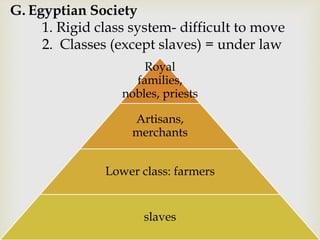
G. Egyptian Society
1. Rigid class system- difficult to move
2. Classes (except slaves) = under law
Royal
families,
nobles, priests
Artisans,
merchants
Lower class: farmers
slaves
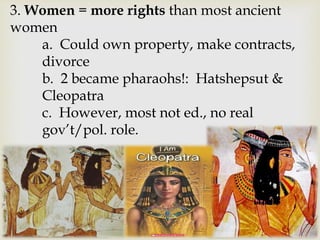
3. Women = more rights than most ancient
women
a. Could own property, make contracts,
divorce
b. 2 became pharaohs!: Hatshepsut &
Cleopatra
c. However, most not ed., no real
gov’t/pol. role.
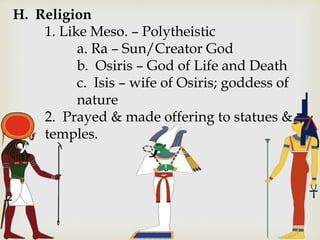
H. Religion
1. Like Meso. – Polytheistic
a. Ra – Sun/Creator God
b. Osiris – God of Life and Death
c. Isis – wife of Osiris; goddess of
nature
2. Prayed & made offering to statues &
temples.
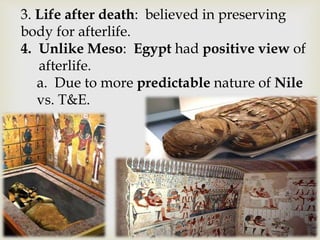
3. Life after death: believed in preserving
body for afterlife.
4. Unlike Meso: Egypt had positive view of
afterlife.
a. Due to more predictable nature of Nile
vs. T&E.
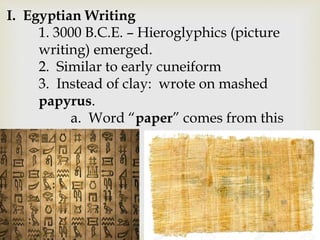
I. Egyptian Writing
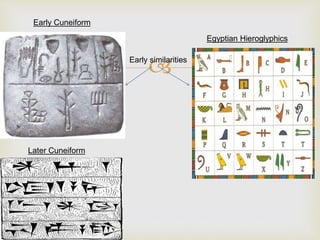
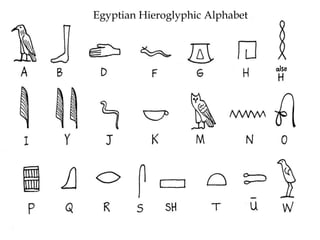
1. 3000 B.C.E. – Hieroglyphics (picture
writing) emerged.
2. Similar to early cuneiform
3. Instead of clay: wrote on mashed
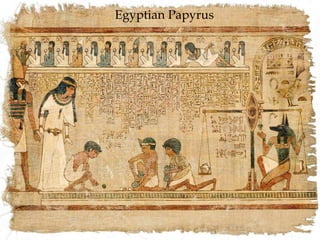
papyrus.
a. Word “paper” comes from this

Early Cuneiform
Later Cuneiform
Egyptian Hieroglyphics
Early similarities
Egyptian Hieroglyphic Alphabet
Egyptian Papyrus
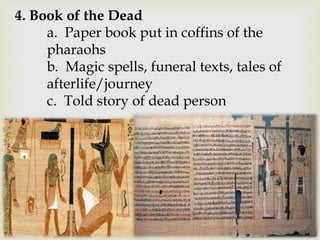
4. Book of the Dead
a. Paper book put in coffins of the
pharaohs
b. Magic spells, funeral texts, tales of
afterlife/journey
c. Told story of dead person
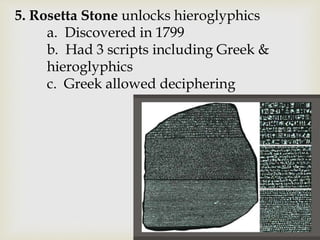
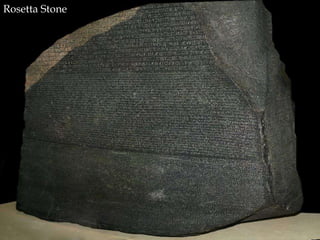
5. Rosetta Stone unlocks hieroglyphics
a. Discovered in 1799
b. Had 3 scripts including Greek &
hieroglyphics
c. Greek allowed deciphering
Rosetta Stone
J. Scientific Contributions
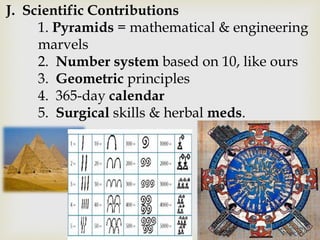
1. Pyramids = mathematical & engineering
marvels
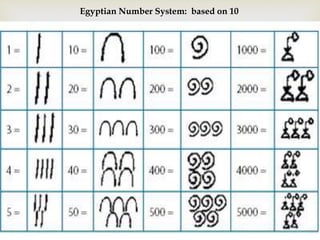
2. Number system based on 10, like ours
3. Geometric principles
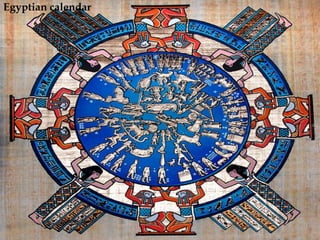
4. 365-day calendar
5. Surgical skills & herbal meds.
Egyptian Number System: based on 10
Egyptian calendar
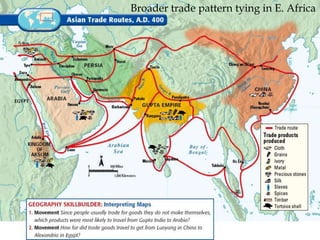
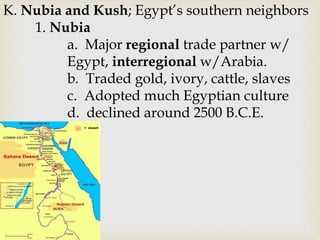
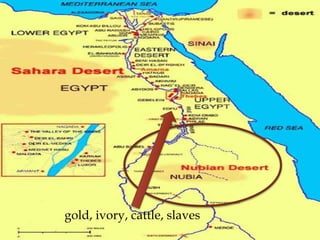
K. Nubia and Kush; Egypt’s southern neighbors
1. Nubia
a. Major regional trade partner w/
Egypt, interregional w/Arabia.
b. Traded gold, ivory, cattle, slaves
c. Adopted much Egyptian culture
d. declined around 2500 B.C.E.
gold, ivory, cattle, slaves
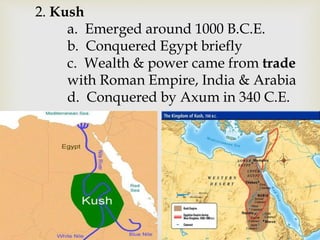
2. Kush
a. Emerged around 1000 B.C.E.
b. Conquered Egypt briefly
c. Wealth & power came from trade
with Roman Empire, India & Arabia
d. Conquered by Axum in 340 C.E.
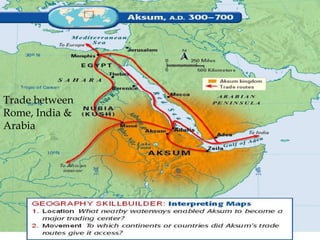
Trade between
Rome, India &
Arabia
Broader trade pattern tying in E. Africa
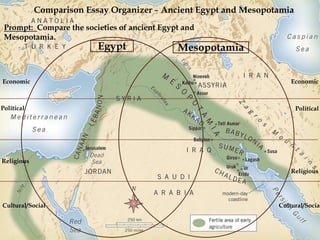
Comparison Essay Organizer – Ancient Egypt and Mesopotamia
Egypt Mesopotamia
Prompt: Compare the societies of ancient Egypt and
Mesopotamia.
Economic
Religious
Cultural/SocialCultural/Social
Religious
PoliticalPolitical
Economic
Critical Intro:
How did Egypt’s relationship with the
gods differ from Mesopotamia? Explain
Poster activity: 3 topics for posters
- Sumer and Early Empires (Akkadians +
Babylonians): groups 1+4
- Ancient Egypt: groups 2+5
- Mesopotamia Empires (Hittites, Assyrians,
Chaldeans, Persians): groups 3+6
Posters
- Centered around person from the region.
- Attach various headings and/or empires to different parts of
the body.
- Use headings, many images, & brief headline-like entries. Don’t
rewrite all notes on poster; meant to be overview, not every detail.

Ancient Egypt

  • 1.
    The Gift ofthe Nile
  • 2.
    I. Ancient Egypt A.Early Civilization on the Nile 1. In ancient times, rich black soil covered banks and delta. 2. Annual floods replenished soil 3. Around 5000 B.C.E., Egyptians learned ag. skills from Meso.
  • 3.
    4. By 3000B.C.E., towns & cities emerged. 5. Built irrigation canals to increase farm lands 6. Just as Sumer was influential core in Meso.; Egypt became a core civ. in Med. region.
  • 4.
  • 5.
    B. Transportation &Trade 1. Nile River flows north; wind blows south from Med. Sea. 2. Result: Perfect trade/travel river. 3. Use current to go north; sails to go south. 4. Allowed for regional (NE Africa) & interregional (Meso.)
  • 7.
    C. 2 EarlyKingdoms; a divided Egypt 1. Lower Egypt; Delta region 2. Upper Egypt; southern tip of Delta to 1st cataract (rocky rapids) 3. 3100 B.C.E. – King Menes united both kingdoms; begins united, dynastic Egypt.
  • 8.
  • 9.
  • 10.
    10 •Old Kingdom –2660 – 2160 B.C.E. •1st Intermediate Period •Middle Kingdom – 2040 – 1786 B.C.E •2nd Intermediate Period •New Kingdom – 1570 – 1070 B.C.E •Period of decline Egyptian History Periods
  • 11.
    D. The OldKingdom: 2660 - 2160 B.C.E. – 1st of 3 periods 1. Unlike Sumer, Egypt dev. strong cen. gov’t. 2. Leader = pharaoh; 3. Like Sumer; both theocracy = ruled by pol. & rel. leader. a. Meso. = King is rep. of Gods b. Egypt = Pharaoh is a god
  • 12.
    3. Period ofpyramid building a. People believed pharaohs descended from gods. b. Great effort to preserve & honor pharaoh after death. c. Mummify bodies d. Pack many belongings for the afterlife into tombs. e. Most pyramids built during Old Kingdom.
  • 13.
     Sarcophagus Drying the body EgyptianMummification Removing the brain
  • 14.
  • 15.
    4. Civil unrestamong provincial governors led to end of Old Kingdom
  • 16.
    E. The MiddleKingdom: 2040 – 1786 B.C.E. 1. Mentuhotep II reunited Egypt under cent. gov’t. 2. Many statues & art showing wisdom and caring of pharaoh. (why?) 3. Period of religious, artistic, literary advancement
  • 17.
    4. Massive irrigationprojects to expand farmland.
  • 18.
    5. Invasion endsMiddle Kingdom a. Hyksos invade from M.E. b. Chariot = new technology that allows Hyksos to defeat/conquer Egypt.
  • 19.
    F. The NewKingdom: 1570 – 1070 B.C.E. 1. Egyptians adopted Hyksos milt. tech and defeated them: New Kingdom begins! 2. Period of great expansion! a. South into Nubia b. North into Meso.
  • 20.
  • 21.
    3. Only onegod? a. 1350 B.C.E. – pharaoh Akhenaton tried to change religion to worship only one god: Aten (Sun god) b. Many priests & people opposed; weakened Akhenton’s power. c. After his death, old religion returned.
  • 22.
    4. Ramses theGreat – 1290 B.C.E. a. Ruled 67 years – 80-100 children b. Successful expansion into SW Asia c. Made peace with iron-wielding Hittites d. Built more temples & statues than any other. e. Egypt enters decline after his death.
  • 23.
    5. Long periodof decline a. Expensive & failed wars b. Internal revolts c. Many invasions d. No independence until modern times
  • 24.
    G. Egyptian Society 1.Rigid class system- difficult to move 2. Classes (except slaves) = under law Royal families, nobles, priests Artisans, merchants Lower class: farmers slaves
  • 25.
    3. Women =more rights than most ancient women a. Could own property, make contracts, divorce b. 2 became pharaohs!: Hatshepsut & Cleopatra c. However, most not ed., no real gov’t/pol. role.
  • 26.
    H. Religion 1. LikeMeso. – Polytheistic a. Ra – Sun/Creator God b. Osiris – God of Life and Death c. Isis – wife of Osiris; goddess of nature 2. Prayed & made offering to statues & temples.
  • 27.
    3. Life afterdeath: believed in preserving body for afterlife. 4. Unlike Meso: Egypt had positive view of afterlife. a. Due to more predictable nature of Nile vs. T&E.
  • 28.
    I. Egyptian Writing 1.3000 B.C.E. – Hieroglyphics (picture writing) emerged. 2. Similar to early cuneiform 3. Instead of clay: wrote on mashed papyrus. a. Word “paper” comes from this
  • 29.
     Early Cuneiform Later Cuneiform EgyptianHieroglyphics Early similarities
  • 30.
  • 31.
  • 32.
    4. Book ofthe Dead a. Paper book put in coffins of the pharaohs b. Magic spells, funeral texts, tales of afterlife/journey c. Told story of dead person
  • 33.
    5. Rosetta Stoneunlocks hieroglyphics a. Discovered in 1799 b. Had 3 scripts including Greek & hieroglyphics c. Greek allowed deciphering
  • 34.
  • 35.
    J. Scientific Contributions 1.Pyramids = mathematical & engineering marvels 2. Number system based on 10, like ours 3. Geometric principles 4. 365-day calendar 5. Surgical skills & herbal meds.
  • 36.
  • 37.
  • 38.
    K. Nubia andKush; Egypt’s southern neighbors 1. Nubia a. Major regional trade partner w/ Egypt, interregional w/Arabia. b. Traded gold, ivory, cattle, slaves c. Adopted much Egyptian culture d. declined around 2500 B.C.E.
  • 39.
  • 40.
    2. Kush a. Emergedaround 1000 B.C.E. b. Conquered Egypt briefly c. Wealth & power came from trade with Roman Empire, India & Arabia d. Conquered by Axum in 340 C.E.
  • 41.
  • 42.
    Broader trade patterntying in E. Africa
  • 43.
    Comparison Essay Organizer– Ancient Egypt and Mesopotamia Egypt Mesopotamia Prompt: Compare the societies of ancient Egypt and Mesopotamia. Economic Religious Cultural/SocialCultural/Social Religious PoliticalPolitical Economic
  • 44.
    Critical Intro: How didEgypt’s relationship with the gods differ from Mesopotamia? Explain
  • 45.
    Poster activity: 3topics for posters - Sumer and Early Empires (Akkadians + Babylonians): groups 1+4 - Ancient Egypt: groups 2+5 - Mesopotamia Empires (Hittites, Assyrians, Chaldeans, Persians): groups 3+6 Posters - Centered around person from the region. - Attach various headings and/or empires to different parts of the body. - Use headings, many images, & brief headline-like entries. Don’t rewrite all notes on poster; meant to be overview, not every detail.