River Valleys
Cradles of Civilization
Critical Intro
Describe some problems,
historically, you might see with
using the “5 Characteristics” to
describe a people as “Civilized”
2
Critical Intro
3
Describe some reasons why the
region of Mesopotamia was a
desirable place to control.
Critical Intro
Thesis statement:
Why did early civilizations first emerge in river
valleys?
4
Critical Intro
Use terms 11-15 in a comprehensive paragraph
about Mesopotamia.
5
Critical Intro
Describe an example of regional trade involving
Sumer, and describe an example of
interregional trade involving Sumer.
6
Critical Intro
7
Write a diary entry/paragraph
describing a day in your life as a
Sumerian teenager.
Remember to incorporate the
aspects of life from your homework.
Critical Intro.
Creative Writing
Create/Write a myth explaining a
naturally occurring phenomenon.
8
Critical Intro.
Explain how Hammurabi’s Code
reflected the social stratification of
Mesopotamia.
9
10
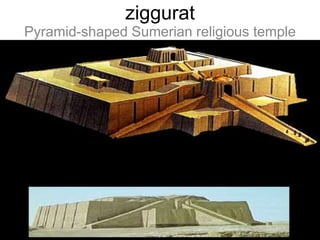
ziggurat
Pyramid-shaped Sumerian religious temple
Economic
Patterns
Political
Patterns
Religious
Patterns
Social
Patterns
•Hereditary rulers
•Dynasty – line of
rulers from same
family
•Class systems +
slavery
•1st city-states,
kingdoms & empires
•City-state = city &
surrounding land
•Centralized gov’t
•Law codes
• metal tools +
weapons
• increasing
agricultural surplus
• increased river &
sea trade
•Polytheism =
belief in many
gods.
•Priests
•Organized
religion
12
World Map - Label
Africa
Asia
Europe
Atlantic Ocean
Indian Ocean
Pacific Ocean
Mediterranean Sea
Make Key and Shade pp.4-5
4 River Civilizations
Mesopotamia (green in atlas)
Egypt (green in atlas)
Indus Valley (green in atlas)
Shang China (purple in atlas)
Americas
Olmecs
Chavin
Southwest Asia Map - Label
Anatolia
Zagros Mountains
Arabian Peninsula
Arabian Desert
Syrian Desert
Egypt
Mesopotamia
Mediterranean Sea
Red Sea
Persian Gulf
Tigris River (R.)
Euphrates R.
Nile R.
Cities - .
Ur
Lagash
Make Key and Shade
Sumer (green area in atlas)
Fertile Crescent (purple in atlas)
Olmec
Chavin
Southwest Asia
Anatolia
Syrian
Desert
Arabian Desert
Arabian Peninsula
Eastern Hemisphere
16
17
18
19
River Valley Civilizations
I. Mesopotamia - “Land between the rivers”
A. Fertile Crescent = arc of land from Persian Gulf to Med. Sea
1. Mesopotamia - area of land within Fertile Crescent, between the Tigris and
Euphrates Rivers.
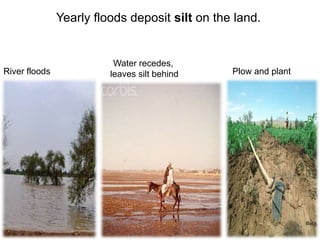
2. Flooding rivers deposit silt (thick bed of river mud)= fertile soil
3. Irrigation systems carried river water to the fields.
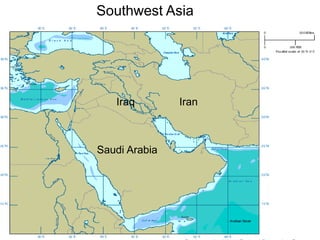
4. Mesopotamia is located in modern-day Iraq.
B. Rise of Sumerian city-states
1. city-state pops. of 5,000– 25,000
2. Centered around ziggurats = religious temple
3. Walled for protection
C. Sumerian Government
1. city-states governed independently
2. Powerful military leaders became kings/Priest kings = Theocracy
3. Priests held high rank & gov’t power
4. city-states ruled by dynasties (line of rulers from same family)
D. Sumerian Writing = Cuneiform “wedge-shaped”
1. 1st writing
2. Press symbols into soft clay then dry or bake
3. Keep records + trade documents
4. Epic of Gilgamesh = world’s 1st literature
20
E. Sumerian Religion
1. Polytheism = belief in many gods; explained natural events
2. Thousands of deities (gods and goddesses) controlled nature + life
3. People felt they had little control; bleak view of death
F. Sumerian Inventions
1. Wagon wheel
2. arch
3. sundial
4. potter’s wheel
5. number system
6. 12 month calendar
7. sail
8. plow
II. World’s 1st Empires
A. Akkadian Empire
1. Created when Sargon of Akkad conquered Sumerian city-states
B. Babylonian Empire
1. Created when Babylonians conquered Mesopotamia.
2. Hammurabi = Powerful Babylonian king
3. Hammurabi created first written law code – Hammurabi’s Code
21
Egypt
Tigris R.
Euphrates R.
Anatolia
Mediterranean Sea
Nile R.
Back
Sumer
22
23
Sumerian wheel
Back
24
Southwest Asia
Iraq Iran
Saudi Arabia
25
Mesopotamian Deities
Polytheism = belief in many gods
Back
26
Irrigation
•Moving water from rivers
to fields
Back
27
Cuneiform = Sumerian writing
Back
28
Yearly floods deposit silt on the land.
River floods Plow and plant
Water recedes,
leaves silt behind
Back
29
The Sumerian Ziggurat “Mountain of God”
religious temple
Back
30
The Epic of Gilgamesh
World’s Oldest work of literature
Gilgamesh – King of Uruk
Approx. 2700 B.C.
Gilgamesh, two-thirds god and one-
third human, is the greatest king on
earth and the strongest super-
human that ever existed; however,
he is young and oppresses his
people harshly.
Back
31
32
Hammurabi – “The Law Giver”
Babylonian king created law code of 282 laws and punishments
Back
Complete “Code” link
33
34
Sumerians develop the arch.
Back
35
sundial sail
plow
Other Sumerian Inventions
calendar
Potters Wheel
Number
system
Back
36
Sargon of Akkad creates world’s first empire = Akkadian Empire
Back
37
Hammurabi rules Babylonian Empire
Back
Economic
Patterns
Political
Patterns
Religious
Patterns
Social
Patterns
39
Back
The Sumerian Ziggurat “Mountain of God”
religious temple
40
Behistun Inscription
in Turkey
(Deciphered Cuneiform)
41
“Mesopotamians”
Song/Video

Sumerians & Early Empires