Geography of India
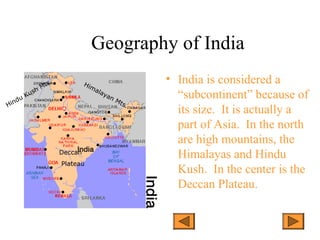
• India is considered a
“subcontinent” because of
its size. It is actually a
part of Asia. In the north
are high mountains, the
Himalayas and Hindu
Kush. In the center is the
Deccan Plateau.
Himalayan Mts.Hindu Kush Mts.
Deccan
Plateau
Indus Valley
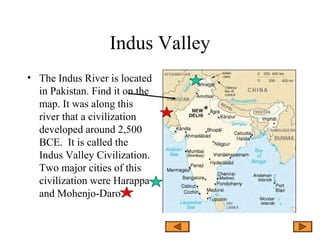
• The Indus River is located
in Pakistan. Find it on the
map. It was along this
river that a civilization
developed around 2,500
BCE. It is called the
Indus Valley Civilization.
Two major cities of this
civilization were Harappa
and Mohenjo-Daro.
The Indus Valley Culture
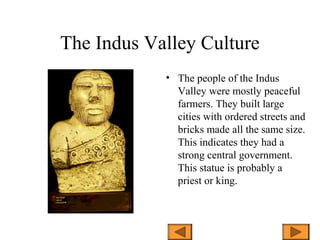
• The people of the Indus
Valley were mostly peaceful
farmers. They built large
cities with ordered streets and
bricks made all the same size.
This indicates they had a
strong central government.
This statue is probably a
priest or king.
Indus Valley Script
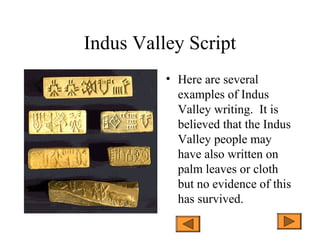
• Here are several
examples of Indus
Valley writing. It is
believed that the Indus
Valley people may
have also written on
palm leaves or cloth
but no evidence of this
has survived.
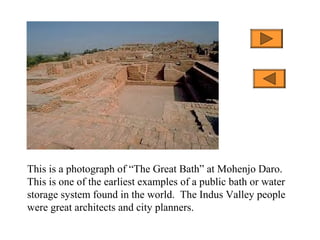
This is a photograph of “The Great Bath” at Mohenjo Daro.
This is one of the earliest examples of a public bath or water
storage system found in the world. The Indus Valley people
were great architects and city planners.
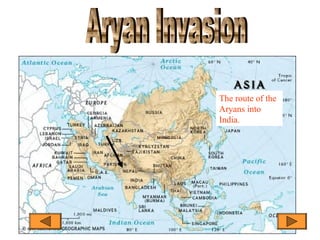
• Around 1500 BCE, a group of nomadic
warrior-herders crossed the narrow Khyber Pass
in the Hindu Kush Mountains and invaded the
Indus Valley culture. These people, the Aryans,
came from Eastern Europe between the Black
Sea and Caspian Sea, probably looking for
pastures for their animals. Flooding and
earthquakes had weakened the Indus Valley
culture and they were unable to withstand the
newcomers.
The route of the
Aryans into
India.
The Aryans brought with them their
own language, called Sanskrit and
religious and cultural beliefs. The
Indus Valley people eventually
became intermixed with the Aryan
people and the two cultures together
make up what is now much of the
culture of modern India. Hinduism,
the major religion of India, was a
mixture of Aryan and Indus Valley
beliefs. The caste system, which
keeps people in strict social classes,
was brought to India by the Aryans.
Hindu Religion
The Aryans and the Indus
Valley culture eventually
produced what is known
today as Hinduism. This
religion is polytheistic,
which means believing in
many gods. We know
about this ancient
religion because of Aryan
books called “Vedas”
that record the beliefs of
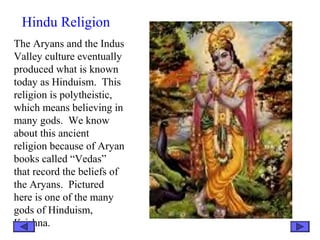
the Aryans. Pictured
here is one of the many
gods of Hinduism,
Krishna.
Hinduism differs from other religions like Christianity,
Judaism and Islam in that there is no one single founder or
one set of beliefs that must be followed. There are thousands
of Hindu gods and goddesses in Hinduism. Most of the
beliefs of Hinduism came from the oral traditions of the
Aryans which became the Vedas—or holy writings—of the
Hindus.
Reincarnation
• Central to Hinduism is the
belief in reincarnation.
Hindus believe that after a
person dies, they will be re-
born as some other creature
or thing. What you are re-
born as depends on your
“Karma” or the deeds you
did in your previous life. If
you did good deeds, you
will reborn into a higher,
better life. If you had bad
Karma, you may be re-born
as an insect or even a tree.
Caste System
• One social custom brought to
India by the Aryans was the
caste system. This system put
every person in society into a
certain class from which they
could never advance. The caste
system was very effective in
keeping social order but it was
rigid and strict. Those in the
lowest caste were looked down
on by upper caste members and
could never change castes.
Caste System
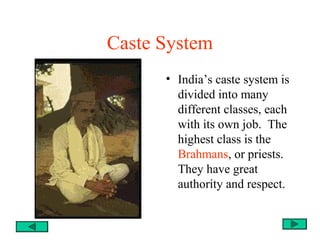
• India’s caste system is
divided into many
different classes, each
with its own job. The
highest class is the
Brahmans, or priests.
They have great
authority and respect.
Caste System
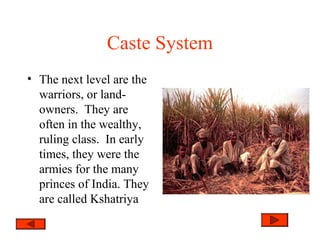
• The next level are the
warriors, or land-
owners. They are
often in the wealthy,
ruling class. In early
times, they were the
armies for the many
princes of India. They
are called Kshatriya
Caste System
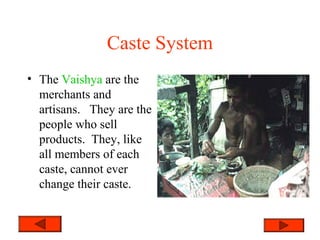
• The Vaishya are the
merchants and
artisans. They are the
people who sell
products. They, like
all members of each
caste, cannot ever
change their caste.
Caste System
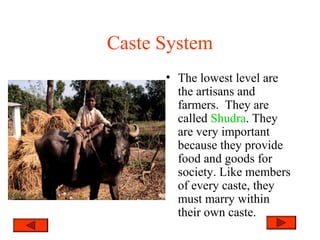
• The lowest level are
the artisans and
farmers. They are
called Shudra. They
are very important
because they provide
food and goods for
society. Like members
of every caste, they
must marry within
their own caste.
Caste System
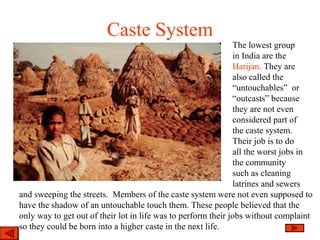
The lowest group
in India are the
Harijan. They are
also called the
“untouchables” or
“outcasts” because
they are not even
considered part of
the caste system.
Their job is to do
all the worst jobs in
the community
such as cleaning
latrines and sewers
and sweeping the streets. Members of the caste system were not even supposed to
have the shadow of an untouchable touch them. These people believed that the
only way to get out of their lot in life was to perform their jobs without complaint
so they could be born into a higher caste in the next life.
Contributions
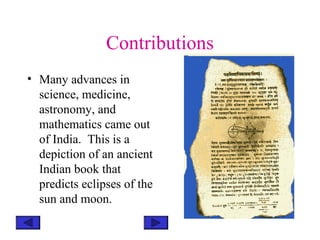
• Many advances in
science, medicine,
astronomy, and
mathematics came out
of India. This is a
depiction of an ancient
Indian book that
predicts eclipses of the
sun and moon.
Contributions
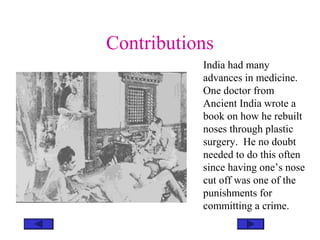
India had many
advances in medicine.
One doctor from
Ancient India wrote a
book on how he rebuilt
noses through plastic
surgery. He no doubt
needed to do this often
since having one’s nose
cut off was one of the
punishments for
committing a crime.
Contributions
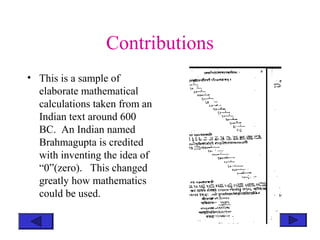
• This is a sample of
elaborate mathematical
calculations taken from an
Indian text around 600
BC. An Indian named
Brahmagupta is credited
with inventing the idea of
“0”(zero). This changed
greatly how mathematics
could be used.
Contributions
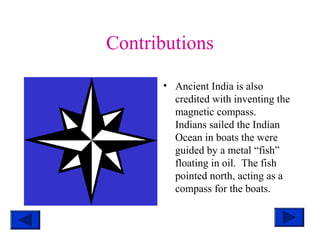
• Ancient India is also
credited with inventing the
magnetic compass.
Indians sailed the Indian
Ocean in boats the were
guided by a metal “fish”
floating in oil. The fish
pointed north, acting as a
compass for the boats.

Ancient india 2

  • 2.
    Geography of India •India is considered a “subcontinent” because of its size. It is actually a part of Asia. In the north are high mountains, the Himalayas and Hindu Kush. In the center is the Deccan Plateau. Himalayan Mts.Hindu Kush Mts. Deccan Plateau
  • 3.
    Indus Valley • TheIndus River is located in Pakistan. Find it on the map. It was along this river that a civilization developed around 2,500 BCE. It is called the Indus Valley Civilization. Two major cities of this civilization were Harappa and Mohenjo-Daro.
  • 4.
    The Indus ValleyCulture • The people of the Indus Valley were mostly peaceful farmers. They built large cities with ordered streets and bricks made all the same size. This indicates they had a strong central government. This statue is probably a priest or king.
  • 5.
    Indus Valley Script •Here are several examples of Indus Valley writing. It is believed that the Indus Valley people may have also written on palm leaves or cloth but no evidence of this has survived.
  • 6.
    This is aphotograph of “The Great Bath” at Mohenjo Daro. This is one of the earliest examples of a public bath or water storage system found in the world. The Indus Valley people were great architects and city planners.
  • 7.
    • Around 1500BCE, a group of nomadic warrior-herders crossed the narrow Khyber Pass in the Hindu Kush Mountains and invaded the Indus Valley culture. These people, the Aryans, came from Eastern Europe between the Black Sea and Caspian Sea, probably looking for pastures for their animals. Flooding and earthquakes had weakened the Indus Valley culture and they were unable to withstand the newcomers.
  • 8.
    The route ofthe Aryans into India.
  • 9.
    The Aryans broughtwith them their own language, called Sanskrit and religious and cultural beliefs. The Indus Valley people eventually became intermixed with the Aryan people and the two cultures together make up what is now much of the culture of modern India. Hinduism, the major religion of India, was a mixture of Aryan and Indus Valley beliefs. The caste system, which keeps people in strict social classes, was brought to India by the Aryans.
  • 10.
    Hindu Religion The Aryansand the Indus Valley culture eventually produced what is known today as Hinduism. This religion is polytheistic, which means believing in many gods. We know about this ancient religion because of Aryan books called “Vedas” that record the beliefs of the Aryans. Pictured here is one of the many gods of Hinduism, Krishna.
  • 11.
    Hinduism differs fromother religions like Christianity, Judaism and Islam in that there is no one single founder or one set of beliefs that must be followed. There are thousands of Hindu gods and goddesses in Hinduism. Most of the beliefs of Hinduism came from the oral traditions of the Aryans which became the Vedas—or holy writings—of the Hindus.
  • 12.
    Reincarnation • Central toHinduism is the belief in reincarnation. Hindus believe that after a person dies, they will be re- born as some other creature or thing. What you are re- born as depends on your “Karma” or the deeds you did in your previous life. If you did good deeds, you will reborn into a higher, better life. If you had bad Karma, you may be re-born as an insect or even a tree.
  • 13.
    Caste System • Onesocial custom brought to India by the Aryans was the caste system. This system put every person in society into a certain class from which they could never advance. The caste system was very effective in keeping social order but it was rigid and strict. Those in the lowest caste were looked down on by upper caste members and could never change castes.
  • 14.
    Caste System • India’scaste system is divided into many different classes, each with its own job. The highest class is the Brahmans, or priests. They have great authority and respect.
  • 15.
    Caste System • Thenext level are the warriors, or land- owners. They are often in the wealthy, ruling class. In early times, they were the armies for the many princes of India. They are called Kshatriya
  • 16.
    Caste System • TheVaishya are the merchants and artisans. They are the people who sell products. They, like all members of each caste, cannot ever change their caste.
  • 17.
    Caste System • Thelowest level are the artisans and farmers. They are called Shudra. They are very important because they provide food and goods for society. Like members of every caste, they must marry within their own caste.
  • 18.
    Caste System The lowestgroup in India are the Harijan. They are also called the “untouchables” or “outcasts” because they are not even considered part of the caste system. Their job is to do all the worst jobs in the community such as cleaning latrines and sewers and sweeping the streets. Members of the caste system were not even supposed to have the shadow of an untouchable touch them. These people believed that the only way to get out of their lot in life was to perform their jobs without complaint so they could be born into a higher caste in the next life.
  • 19.
    Contributions • Many advancesin science, medicine, astronomy, and mathematics came out of India. This is a depiction of an ancient Indian book that predicts eclipses of the sun and moon.
  • 20.
    Contributions India had many advancesin medicine. One doctor from Ancient India wrote a book on how he rebuilt noses through plastic surgery. He no doubt needed to do this often since having one’s nose cut off was one of the punishments for committing a crime.
  • 21.
    Contributions • This isa sample of elaborate mathematical calculations taken from an Indian text around 600 BC. An Indian named Brahmagupta is credited with inventing the idea of “0”(zero). This changed greatly how mathematics could be used.
  • 22.
    Contributions • Ancient Indiais also credited with inventing the magnetic compass. Indians sailed the Indian Ocean in boats the were guided by a metal “fish” floating in oil. The fish pointed north, acting as a compass for the boats.