Buddhism
Siddhartha Gautama and
the development of Buddhism
1. Who was the founder of Buddhism?
• Siddhartha Gautama
2. Describe the early life of Siddhartha Gautama.
• Born a prince in
northern India he was
isolated in the palace
walls and destined for
greatness.
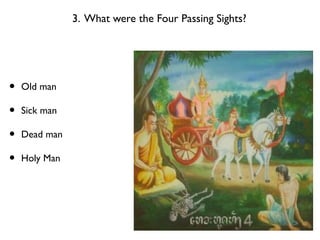
3. What were the Four Passing Sights?
• Old man
• Sick man
• Dead man
• Holy Man
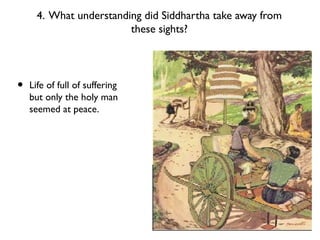
4. What understanding did Siddhartha take away from
these sights?
• Life of full of suffering
but only the holy man
seemed at peace.
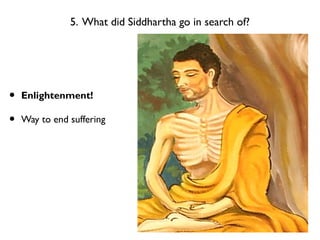
5. What did Siddhartha go in search of?
• Enlightenment!
• Way to end suffering
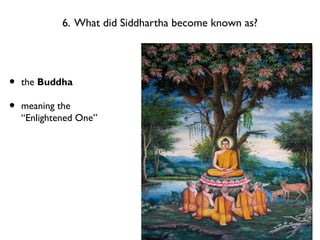
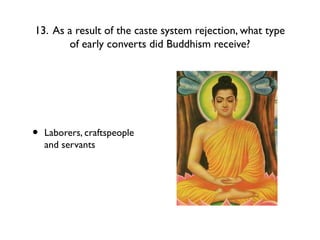
6. What did Siddhartha become known as?
• the Buddha
• meaning the
“Enlightened One”
7. In his first sermon, what were his four main ideas
called? List them.
• The Four NobleTruths
• 1. All suffer and know
sorrow.
• 2. We suffer because of
desires.
• 3. To end suffering we must
end desires.
• 4. End desires by following
the Eightfold Path
8. What is another term for the Eightfold Path?
• Middle Way
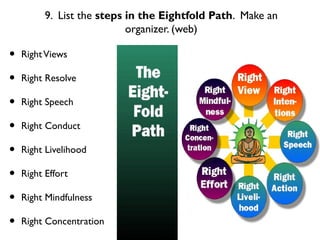
9. List the steps in the Eightfold Path. Make an
organizer. (web)
• RightViews
• Right Resolve
• Right Speech
• Right Conduct
• Right Livelihood
• Right Effort
• Right Mindfulness
• Right Concentration
10. What is the goal for Buddhists called?
• Nirvana
• Nirvana for Gautama is to live the life on
earth as the result of the Enlightenment, it is
not a place, but a state of mind in which
one is released from desire, craving, fear...
and, most specially, Nirvana brings a
Buddhist out of the cycles of the curse of
reincarnation for ever.
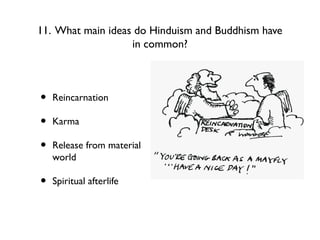
11. What main ideas do Hinduism and Buddhism have
in common?
• Reincarnation
• Karma
• Release from material
world
• Spiritual afterlife
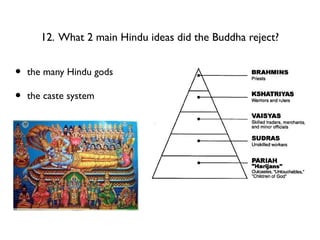
12. What 2 main Hindu ideas did the Buddha reject?
• the many Hindu gods
• the caste system
13. As a result of the caste system rejection, what type
of early converts did Buddhism receive?
• Laborers, craftspeople
and servants
14. How did Buddhism spread after the Buddha’s
death?
• Buddhist missionaries
spread Buddhism to new
areas
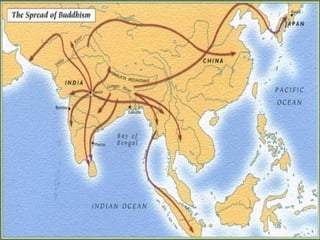
15. How did trade impact the spread of Buddhism
AND what are some areas in east Asia to which
Buddhism spread?
• Traders carried Buddhism
along trade routes such as the
Silk Roads to places like
China, Korea and Japan
and southeast Asia.
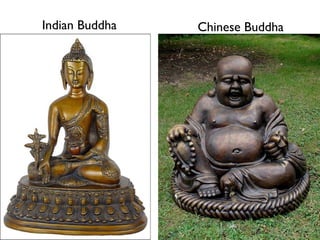
Indian Buddha Chinese Buddha
First the physical image of a Noble was different as was the concept of the results of enlightenment, a
Noble was not athletic or a warrior, but a well fed person of leisure. Enlightenment led to material
success and wealth and a position at least close to nobility. And a belief that fat men were inherently
benevolent, similar to the "jolly fat man", Jolly Ol' St. Nick for example.
3 Theories for “Fat Buddha”
Buddhism reached China around 100 CE, and was wide spread there by 600 CE. And we get three
theories on Fat Buddha.
Then there is the story of a Chinese Buddhist monk in the 6th
century who just happened to have a
belly that shook like jelly. He was a benevolent fellow who dedicated himself to helping others, and was
regarded as the incarnation of the Boddhisatva Metteya, who had reached nirvana but stayed around
just to help people
And finally, the theory held by most Buddhist scholars. A sagely Zen monk appeared in China around
850 CE and died in 916 CE. He said his name was "Knowing This" (ChiChe). No one knew where he
came from, he carried a big fat bag and was famous for his fat belly. When asked how to obtain nirvana
he would lay down the bag, not saying a word. When asked about what happened after reaching

nirvana, he would pick up the bag and walk away, still not uttering a word. It is pretty much accepted

that such a monk existed. He is probably the inspiration for Fat Buddha, as the statues began appearing
in the late 9th century, 1200 years after the Gautama's death.
Confucianism
Qin Shi Huangdi
Wudi
Huns
Civil service exam
crossbow
Great Wall
Book burning
Aryans
Indo-European
steppes
Caste system
brahmins
Hinduism
moksha
reincarnation
darma
Siddhartha Gautama
nirvana
Eightfold path

Buddhism

  • 1.
    Buddhism Siddhartha Gautama and thedevelopment of Buddhism
  • 2.
    1. Who wasthe founder of Buddhism? • Siddhartha Gautama
  • 3.
    2. Describe theearly life of Siddhartha Gautama. • Born a prince in northern India he was isolated in the palace walls and destined for greatness.
  • 4.
    3. What werethe Four Passing Sights? • Old man • Sick man • Dead man • Holy Man
  • 5.
    4. What understandingdid Siddhartha take away from these sights? • Life of full of suffering but only the holy man seemed at peace.
  • 6.
    5. What didSiddhartha go in search of? • Enlightenment! • Way to end suffering
  • 7.
    6. What didSiddhartha become known as? • the Buddha • meaning the “Enlightened One”
  • 8.
    7. In hisfirst sermon, what were his four main ideas called? List them. • The Four NobleTruths • 1. All suffer and know sorrow. • 2. We suffer because of desires. • 3. To end suffering we must end desires. • 4. End desires by following the Eightfold Path
  • 9.
    8. What isanother term for the Eightfold Path? • Middle Way
  • 10.
    9. List thesteps in the Eightfold Path. Make an organizer. (web) • RightViews • Right Resolve • Right Speech • Right Conduct • Right Livelihood • Right Effort • Right Mindfulness • Right Concentration
  • 12.
    10. What isthe goal for Buddhists called? • Nirvana • Nirvana for Gautama is to live the life on earth as the result of the Enlightenment, it is not a place, but a state of mind in which one is released from desire, craving, fear... and, most specially, Nirvana brings a Buddhist out of the cycles of the curse of reincarnation for ever.
  • 13.
    11. What mainideas do Hinduism and Buddhism have in common? • Reincarnation • Karma • Release from material world • Spiritual afterlife
  • 14.
    12. What 2main Hindu ideas did the Buddha reject? • the many Hindu gods • the caste system
  • 15.
    13. As aresult of the caste system rejection, what type of early converts did Buddhism receive? • Laborers, craftspeople and servants
  • 16.
    14. How didBuddhism spread after the Buddha’s death? • Buddhist missionaries spread Buddhism to new areas
  • 18.
    15. How didtrade impact the spread of Buddhism AND what are some areas in east Asia to which Buddhism spread? • Traders carried Buddhism along trade routes such as the Silk Roads to places like China, Korea and Japan and southeast Asia.
  • 19.
  • 21.
    First the physicalimage of a Noble was different as was the concept of the results of enlightenment, a Noble was not athletic or a warrior, but a well fed person of leisure. Enlightenment led to material success and wealth and a position at least close to nobility. And a belief that fat men were inherently benevolent, similar to the "jolly fat man", Jolly Ol' St. Nick for example. 3 Theories for “Fat Buddha” Buddhism reached China around 100 CE, and was wide spread there by 600 CE. And we get three theories on Fat Buddha. Then there is the story of a Chinese Buddhist monk in the 6th century who just happened to have a belly that shook like jelly. He was a benevolent fellow who dedicated himself to helping others, and was regarded as the incarnation of the Boddhisatva Metteya, who had reached nirvana but stayed around just to help people And finally, the theory held by most Buddhist scholars. A sagely Zen monk appeared in China around 850 CE and died in 916 CE. He said his name was "Knowing This" (ChiChe). No one knew where he came from, he carried a big fat bag and was famous for his fat belly. When asked how to obtain nirvana he would lay down the bag, not saying a word. When asked about what happened after reaching nirvana, he would pick up the bag and walk away, still not uttering a word. It is pretty much accepted that such a monk existed. He is probably the inspiration for Fat Buddha, as the statues began appearing in the late 9th century, 1200 years after the Gautama's death.
  • 22.
  • 23.
  • 24.
  • 25.
  • 26.
  • 27.
  • 28.
  • 29.
  • 30.
  • 31.
  • 32.
  • 33.
  • 34.
  • 35.
  • 36.
  • 37.
  • 38.
  • 39.
  • 40.
  • 41.