
The Era of Absolutism
                     (1550 – 1800)

• Absolute Monarchs –rulers with complete
  authority over the government and people. They
  share power with nobody!

• Divine Right – Belief that this power is derived
  from God.
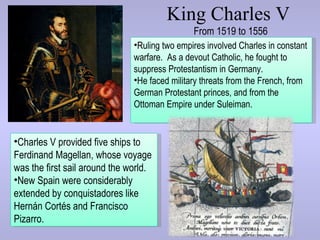
King Charles V
                                               From 1519 to 1556
                               •Ruling two empires involved Charles in constant
                               warfare. As a devout Catholic, he fought to
                               suppress Protestantism in Germany.
                               •He faced military threats from the French, from
                               German Protestant princes, and from the
                               Ottoman Empire under Suleiman.


•Charles V provided five ships to
Ferdinand Magellan, whose voyage
was the first sail around the world.
•New Spain were considerably
extended by conquistadores like
Hernán Cortés and Francisco
Pizarro.
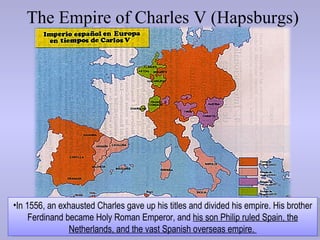
The Empire of Charles V (Hapsburgs)


•In 1556, an exhausted Charles gave up his titles and divided his empire. His brother
     Ferdinand became Holy Roman Emperor, and his son Philip ruled Spain, the
                Netherlands, and the vast Spanish overseas empire.
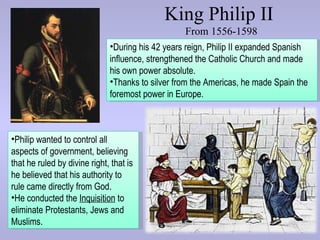
King Philip II
                                                  From 1556-1598
                              •During his 42 years reign, Philip II expanded Spanish
                              influence, strengthened the Catholic Church and made
                              his own power absolute.
                              •Thanks to silver from the Americas, he made Spain the
                              foremost power in Europe.


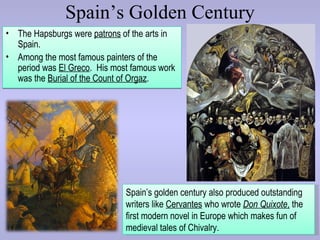
•Philip wanted to control all
aspects of government, believing
that he ruled by divine right, that is
he believed that his authority to
rule came directly from God.
•He conducted the Inquisition to
eliminate Protestants, Jews and
Muslims.
Spain’s Golden Century
• The Hapsburgs were patrons of the arts in
  Spain.
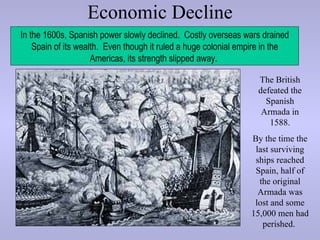
• Among the most famous painters of the
  period was El Greco. His most famous work
  was the Burial of the Count of Orgaz.


                              Spain’s golden century also produced outstanding
                              writers like Cervantes who wrote Don Quixote, the
                              first modern novel in Europe which makes fun of
                              medieval tales of Chivalry.
Economic Decline
In the 1600s, Spanish power slowly declined. Costly overseas wars drained
    Spain of its wealth. Even though it ruled a huge colonial empire in the
                     Americas, its strength slipped away.

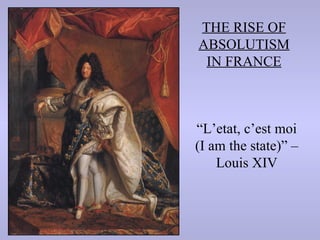
                                                                  The British
                                                                  defeated the
                                                                    Spanish
                                                                   Armada in
                                                                     1588.
                                                                By the time the
                                                                 last surviving
                                                                 ships reached
                                                                 Spain, half of
                                                                  the original
                                                                  Armada was
                                                                 lost and some
                                                                15,000 men had
                                                                   perished.
THE RISE OF
ABSOLUTISM
 IN FRANCE


“L’etat, c’est moi
(I am the state)” –
    Louis XIV
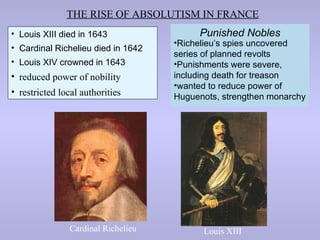
THE RISE OF ABSOLUTISM IN FRANCE
• Louis XIII died in 1643                Punished Nobles
                                    •Richelieu’s spies uncovered
• Cardinal Richelieu died in 1642
                                    series of planned revolts
• Louis XIV crowned in 1643         •Punishments were severe,
• reduced power of nobility         including death for treason
                                    •wanted to reduce power of
• restricted local authorities      Huguenots, strengthen monarchy


               Cardinal Richelieu         Louis XIII
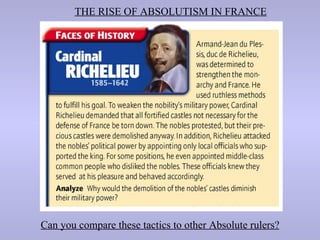
THE RISE OF ABSOLUTISM IN FRANCE


Can you compare these tactics to other Absolute rulers?
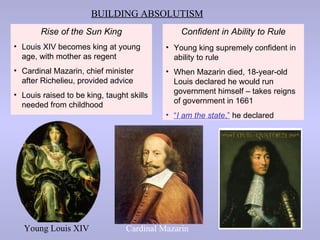
BUILDING ABSOLUTISM
        Rise of the Sun King                   Confident in Ability to Rule
• Louis XIV becomes king at young          • Young king supremely confident in
  age, with mother as regent                 ability to rule
• Cardinal Mazarin, chief minister         • When Mazarin died, 18-year-old
  after Richelieu, provided advice           Louis declared he would run
• Louis raised to be king, taught skills     government himself – takes reigns
                                             of government in 1661
  needed from childhood
                                           • “I am the state,” he declared


   Young Louis XIV               Cardinal Mazarin
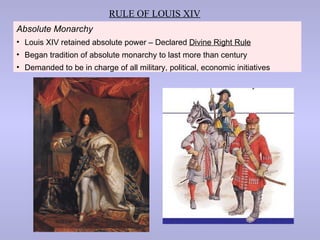
RULE OF LOUIS XIV
Absolute Monarchy
• Louis XIV retained absolute power – Declared Divine Right Rule
• Began tradition of absolute monarchy to last more than century
• Demanded to be in charge of all military, political, economic initiatives
RULE OF LOUIS XIV
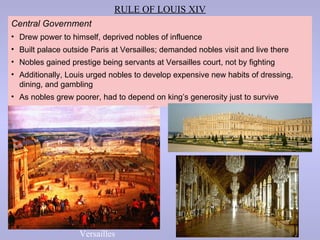
Central Government
• Drew power to himself, deprived nobles of influence
• Built palace outside Paris at Versailles; demanded nobles visit and live there
• Nobles gained prestige being servants at Versailles court, not by fighting
• Additionally, Louis urged nobles to develop expensive new habits of dressing,
  dining, and gambling
• As nobles grew poorer, had to depend on king’s generosity just to survive


                   Versailles
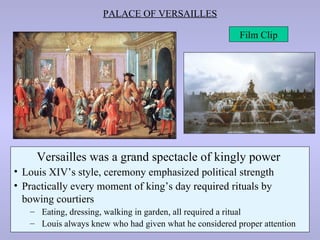
PALACE OF VERSAILLES

                                                         Film Clip


     Versailles was a grand spectacle of kingly power
• Louis XIV’s style, ceremony emphasized political strength
• Practically every moment of king’s day required rituals by
                                           Versailles
  bowing courtiers
   – Eating, dressing, walking in garden, all required a ritual
   – Louis always knew who had given what he considered proper attention
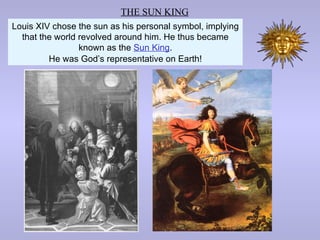
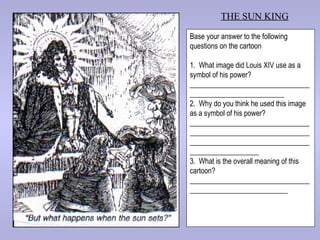
THE SUN KING
Louis XIV chose the sun as his personal symbol, implying
  that the world revolved around him. He thus became
                 known as the Sun King.
         He was God’s representative on Earth!
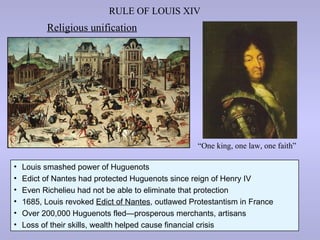
RULE OF LOUIS XIV
          Religious unification


                                                    “One king, one law, one faith”

•   Louis smashed power of Huguenots
•   Edict of Nantes had protected Huguenots since reign of Henry IV
•   Even Richelieu had not be able to eliminate that protection
•   1685, Louis revoked Edict of Nantes, outlawed Protestantism in France
•   Over 200,000 Huguenots fled—prosperous merchants, artisans
•   Loss of their skills, wealth helped cause financial crisis
RULE OF LOUIS XIV

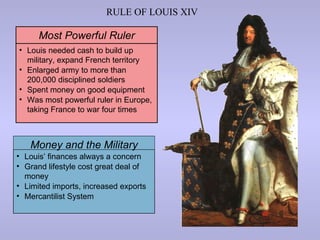
      Most Powerful Ruler
• Louis needed cash to build up
  military, expand French territory
• Enlarged army to more than
  200,000 disciplined soldiers
• Spent money on good equipment
• Was most powerful ruler in Europe,
  taking France to war four times


   Money and the Military
• Louis’ finances always a concern
• Grand lifestyle cost great deal of
  money
• Limited imports, increased exports
• Mercantilist System
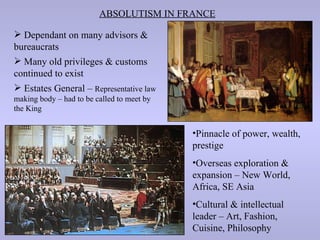
ABSOLUTISM IN FRANCE

 Dependant on many advisors &
bureaucrats
 Many old privileges & customs
continued to exist
 Estates General – Representative law
making body – had to be called to meet by
the King


                                            •Pinnacle of power, wealth,
                                            prestige
                                            •Overseas exploration &
                                            expansion – New World,
                                            Africa, SE Asia
                                            •Cultural & intellectual
                                            leader – Art, Fashion,
                                            Cuisine, Philosophy
THE SUN KING

Base your answer to the following
questions on the cartoon

1. What image did Louis XIV use as a
symbol of his power?
_________________________________
__________________________
2. Why do you think he used this image
as a symbol of his power?
_________________________________
_________________________________
_________________________________
___________________
3. What is the overall meaning of this
cartoon?
_________________________________
___________________________
Absolute monarchs

Absolute monarchs

  • 1.
    The Era ofAbsolutism (1550 – 1800) • Absolute Monarchs –rulers with complete authority over the government and people. They share power with nobody! • Divine Right – Belief that this power is derived from God.
  • 2.
    King Charles V From 1519 to 1556 •Ruling two empires involved Charles in constant warfare. As a devout Catholic, he fought to suppress Protestantism in Germany. •He faced military threats from the French, from German Protestant princes, and from the Ottoman Empire under Suleiman. •Charles V provided five ships to Ferdinand Magellan, whose voyage was the first sail around the world. •New Spain were considerably extended by conquistadores like Hernán Cortés and Francisco Pizarro.
  • 3.
    The Empire ofCharles V (Hapsburgs) •In 1556, an exhausted Charles gave up his titles and divided his empire. His brother Ferdinand became Holy Roman Emperor, and his son Philip ruled Spain, the Netherlands, and the vast Spanish overseas empire.
  • 4.
    King Philip II From 1556-1598 •During his 42 years reign, Philip II expanded Spanish influence, strengthened the Catholic Church and made his own power absolute. •Thanks to silver from the Americas, he made Spain the foremost power in Europe. •Philip wanted to control all aspects of government, believing that he ruled by divine right, that is he believed that his authority to rule came directly from God. •He conducted the Inquisition to eliminate Protestants, Jews and Muslims.
  • 5.
    Spain’s Golden Century •The Hapsburgs were patrons of the arts in Spain. • Among the most famous painters of the period was El Greco. His most famous work was the Burial of the Count of Orgaz. Spain’s golden century also produced outstanding writers like Cervantes who wrote Don Quixote, the first modern novel in Europe which makes fun of medieval tales of Chivalry.
  • 6.
    Economic Decline In the1600s, Spanish power slowly declined. Costly overseas wars drained Spain of its wealth. Even though it ruled a huge colonial empire in the Americas, its strength slipped away. The British defeated the Spanish Armada in 1588. By the time the last surviving ships reached Spain, half of the original Armada was lost and some 15,000 men had perished.
  • 7.
    THE RISE OF ABSOLUTISM IN FRANCE “L’etat, c’est moi (I am the state)” – Louis XIV
  • 8.
    THE RISE OFABSOLUTISM IN FRANCE • Louis XIII died in 1643 Punished Nobles •Richelieu’s spies uncovered • Cardinal Richelieu died in 1642 series of planned revolts • Louis XIV crowned in 1643 •Punishments were severe, • reduced power of nobility including death for treason •wanted to reduce power of • restricted local authorities Huguenots, strengthen monarchy Cardinal Richelieu Louis XIII
  • 9.
    THE RISE OFABSOLUTISM IN FRANCE Can you compare these tactics to other Absolute rulers?
  • 10.
    BUILDING ABSOLUTISM Rise of the Sun King Confident in Ability to Rule • Louis XIV becomes king at young • Young king supremely confident in age, with mother as regent ability to rule • Cardinal Mazarin, chief minister • When Mazarin died, 18-year-old after Richelieu, provided advice Louis declared he would run • Louis raised to be king, taught skills government himself – takes reigns of government in 1661 needed from childhood • “I am the state,” he declared Young Louis XIV Cardinal Mazarin
  • 11.
    RULE OF LOUISXIV Absolute Monarchy • Louis XIV retained absolute power – Declared Divine Right Rule • Began tradition of absolute monarchy to last more than century • Demanded to be in charge of all military, political, economic initiatives
  • 12.
    RULE OF LOUISXIV Central Government • Drew power to himself, deprived nobles of influence • Built palace outside Paris at Versailles; demanded nobles visit and live there • Nobles gained prestige being servants at Versailles court, not by fighting • Additionally, Louis urged nobles to develop expensive new habits of dressing, dining, and gambling • As nobles grew poorer, had to depend on king’s generosity just to survive Versailles
  • 13.
    PALACE OF VERSAILLES Film Clip Versailles was a grand spectacle of kingly power • Louis XIV’s style, ceremony emphasized political strength • Practically every moment of king’s day required rituals by Versailles bowing courtiers – Eating, dressing, walking in garden, all required a ritual – Louis always knew who had given what he considered proper attention
  • 14.
    THE SUN KING LouisXIV chose the sun as his personal symbol, implying that the world revolved around him. He thus became known as the Sun King. He was God’s representative on Earth!
  • 15.
    RULE OF LOUISXIV Religious unification “One king, one law, one faith” • Louis smashed power of Huguenots • Edict of Nantes had protected Huguenots since reign of Henry IV • Even Richelieu had not be able to eliminate that protection • 1685, Louis revoked Edict of Nantes, outlawed Protestantism in France • Over 200,000 Huguenots fled—prosperous merchants, artisans • Loss of their skills, wealth helped cause financial crisis
  • 16.
    RULE OF LOUISXIV Most Powerful Ruler • Louis needed cash to build up military, expand French territory • Enlarged army to more than 200,000 disciplined soldiers • Spent money on good equipment • Was most powerful ruler in Europe, taking France to war four times Money and the Military • Louis’ finances always a concern • Grand lifestyle cost great deal of money • Limited imports, increased exports • Mercantilist System
  • 17.
    ABSOLUTISM IN FRANCE Dependant on many advisors & bureaucrats  Many old privileges & customs continued to exist  Estates General – Representative law making body – had to be called to meet by the King •Pinnacle of power, wealth, prestige •Overseas exploration & expansion – New World, Africa, SE Asia •Cultural & intellectual leader – Art, Fashion, Cuisine, Philosophy
  • 18.
    THE SUN KING Baseyour answer to the following questions on the cartoon 1. What image did Louis XIV use as a symbol of his power? _________________________________ __________________________ 2. Why do you think he used this image as a symbol of his power? _________________________________ _________________________________ _________________________________ ___________________ 3. What is the overall meaning of this cartoon? _________________________________ ___________________________