Thin-Layer Chromatography
           and
 Column Chromatography
Background

Chromatography: refers to several related techniques for analyzing,
identifying, or separating mixtures of compounds.


Two-part operation:
  The sample mixture is placed into a liquid or gas: mobile phase
  The mobile phase carries the sample through a solid support:
  stationary phase
  Compounds in the sample mixture move through the stationary
  phase at different rates due to different attractions for the mobile
  and stationary phases
Choosing Adsorbents and Eluents

Stationary phase: Adsorbents.
   Alumina is generally used for chromatography of less
   polar compounds.
   Silica gel is better for compounds containing polar
   functional groups.
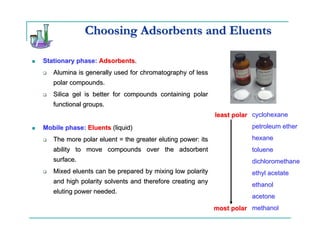
                                                            least polar cyclohexane
Mobile phase: Eluents (liquid)                                         petroleum ether

   The more polar eluent = the greater eluting power: its              hexane
   ability to move compounds over the adsorbent                        toluene
   surface.                                                            dichloromethane
   Mixed eluents can be prepared by mixing low polarity                ethyl acetate
   and high polarity solvents and therefore creating any
                                                                       ethanol
   eluting power needed.
                                                                       acetone
                                                            most polar methanol
TLC
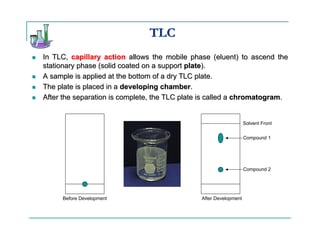
In TLC, capillary action allows the mobile phase (eluent) to ascend the
stationary phase (solid coated on a support plate).
A sample is applied at the bottom of a dry TLC plate.
The plate is placed in a developing chamber.
After the separation is complete, the TLC plate is called a chromatogram.
                                                            chromatogram


                                                                   Solvent Front


                                                                   Compound 1


                                                                   Compound 2


     Before Development                        After Development
Column Chromatography
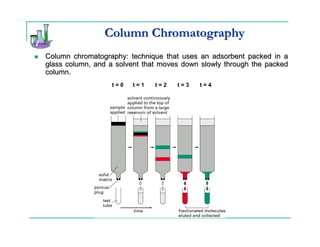
Column chromatography: technique that uses an adsorbent packed in a
glass column, and a solvent that moves down slowly through the packed
column.
                  t=0   t=1    t=2   t=3   t=4
TLC vs. Column Chromatography
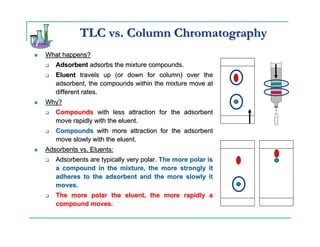
What happens?
   Adsorbent adsorbs the mixture compounds.
   Eluent travels up (or down for column) over the
   adsorbent, the compounds within the mixture move at
   different rates.
Why?
   Compounds with less attraction for the adsorbent
   move rapidly with the eluent.
   Compounds with more attraction for the adsorbent
   move slowly with the eluent.
Adsorbents vs. Eluents:
   Adsorbents are typically very polar. The more polar is
   a compound in the mixture, the more strongly it
   adheres to the adsorbent and the more slowly it
   moves.
   The more polar the eluent, the more rapidly a
   compound moves.
            moves
Retention Factor (Rf)
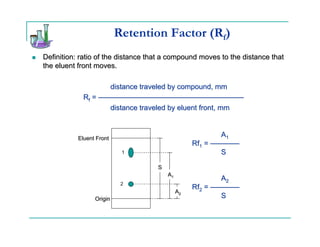
Definition: ratio of the distance that a compound moves to the distance that
the eluent front moves.

                    distance traveled by compound, mm
             Rf = ————————————————————
                    distance traveled by eluent front, mm


           Eluent Front
                                                         A1
                                                  Rf1 = ————
                           1                             S

                                    S
                                        A1
                                                         A2
                           2
                                                  Rf2 = ————
                                             A2
                 Origin                                  S
What You Need for TLC Experiment

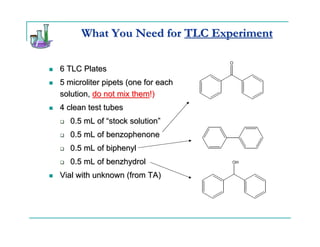
                                    O
6 TLC Plates
5 microliter pipets (one for each
solution, do not mix them!)
4 clean test tubes
   0.5 mL of “stock solution”
   0.5 mL of benzophenone
   0.5 mL of biphenyl
   0.5 mL of benzhydrol             OH


Vial with unknown (from TA)
1- Omit
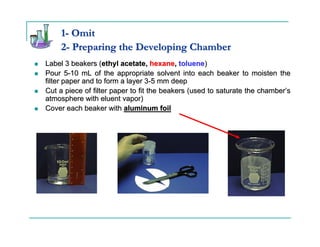
     2- Preparing the Developing Chamber
Label 3 beakers (ethyl acetate, hexane, toluene)
Pour 5-10 mL of the appropriate solvent into each beaker to moisten the
filter paper and to form a layer 3-5 mm deep
Cut a piece of filter paper to fit the beakers (used to saturate the chamber’s
atmosphere with eluent vapor)
Cover each beaker with aluminum foil
3- Spotting the TLC Plates

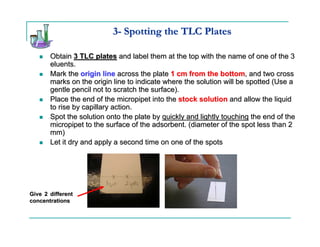
       Obtain 3 TLC plates and label them at the top with the name of one of the 3
       eluents.
       Mark the origin line across the plate 1 cm from the bottom, and two cross
       marks on the origin line to indicate where the solution will be spotted (Use a
       gentle pencil not to scratch the surface).
       Place the end of the micropipet into the stock solution and allow the liquid
       to rise by capillary action.
       Spot the solution onto the plate by quickly and lightly touching the end of the
       micropipet to the surface of the adsorbent. (diameter of the spot less than 2
       mm)
       Let it dry and apply a second time on one of the spots


Give 2 different
concentrations
3- Developing TLC Plates

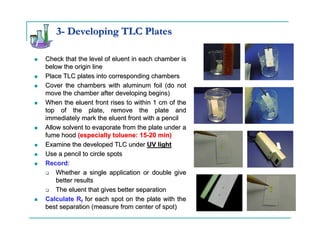
Check that the level of eluent in each chamber is
below the origin line
Place TLC plates into corresponding chambers
Cover the chambers with aluminum foil (do not
move the chamber after developing begins)
When the eluent front rises to within 1 cm of the
top of the plate, remove the plate and
immediately mark the eluent front with a pencil
Allow solvent to evaporate from the plate under a
fume hood (especially toluene: 15-20 min)
Examine the developed TLC under UV light
Use a pencil to circle spots
Record:
    Whether a single application or double give
    better results
    The eluent that gives better separation
Calculate Rf for each spot on the plate with the
best separation (measure from center of spot)
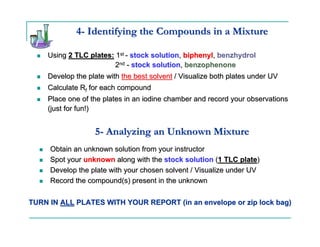
4- Identifying the Compounds in a Mixture

    Using 2 TLC plates: 1st - stock solution, biphenyl, benzhydrol
                        2nd - stock solution, benzophenone
    Develop the plate with the best solvent / Visualize both plates under UV
    Calculate Rf for each compound
    Place one of the plates in an iodine chamber and record your observations
    (just for fun!)


                  5- Analyzing an Unknown Mixture
     Obtain an unknown solution from your instructor
     Spot your unknown along with the stock solution (1 TLC plate)
     Develop the plate with your chosen solvent / Visualize under UV
     Record the compound(s) present in the unknown


TURN IN ALL PLATES WITH YOUR REPORT (in an envelope or zip lock bag)
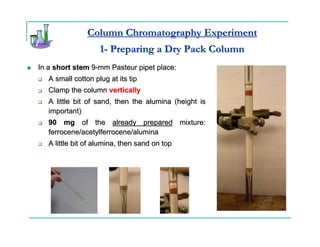
Column Chromatography Experiment
                    1- Preparing a Dry Pack Column
In a short stem 9-mm Pasteur pipet place:
   A small cotton plug at its tip
   Clamp the column vertically
   A little bit of sand, then the alumina (height is
   important)
   90 mg of the already prepared mixture:
   ferrocene/acetylferrocene/alumina
   A little bit of alumina, then sand on top
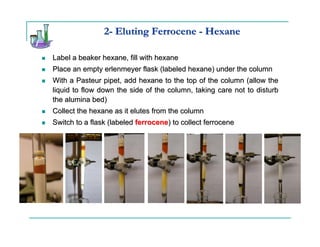
2- Eluting Ferrocene - Hexane

Label a beaker hexane, fill with hexane
Place an empty erlenmeyer flask (labeled hexane) under the column
With a Pasteur pipet, add hexane to the top of the column (allow the
liquid to flow down the side of the column, taking care not to disturb
the alumina bed)
Collect the hexane as it elutes from the column
Switch to a flask (labeled ferrocene) to collect ferrocene
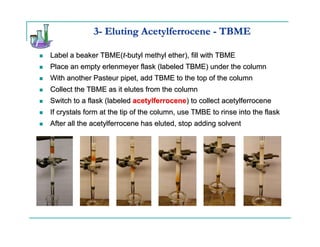
3- Eluting Acetylferrocene - TBME

Label a beaker TBME(t-butyl methyl ether), fill with TBME
Place an empty erlenmeyer flask (labeled TBME) under the column
With another Pasteur pipet, add TBME to the top of the column
Collect the TBME as it elutes from the column
Switch to a flask (labeled acetylferrocene) to collect acetylferrocene
If crystals form at the tip of the column, use TMBE to rinse into the flask
After all the acetylferrocene has eluted, stop adding solvent
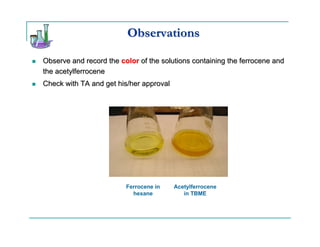
Observations

Observe and record the color of the solutions containing the ferrocene and
the acetylferrocene
Check with TA and get his/her approval


                         Ferrocene in    Acetylferrocene
                           hexane           in TBME
Waste Disposal

Waste solvents are collected in the hood.
Waste from Columns:
   If you have time at the end of the experiment, please try to dry out your
   columns using low level pressure from the house air.
   Dry column contents can be tapped out of the column into a paper towel
   and disposed in the collection flask in the hood.
   All glass pipets will be collected in the hood for proper disposal.
Good to know if you want to have a good grade:
   Your grade will suffer if you do not submit your TLC plates. 50% of your
   grade is based upon the results of your lab work and 50% upon your
   answers to lab questions and the write-up of your report.


                                  Have Fun!

Chromatography

  • 1.
    Thin-Layer Chromatography and Column Chromatography
  • 2.
    Background Chromatography: refers toseveral related techniques for analyzing, identifying, or separating mixtures of compounds. Two-part operation: The sample mixture is placed into a liquid or gas: mobile phase The mobile phase carries the sample through a solid support: stationary phase Compounds in the sample mixture move through the stationary phase at different rates due to different attractions for the mobile and stationary phases
  • 3.
    Choosing Adsorbents andEluents Stationary phase: Adsorbents. Alumina is generally used for chromatography of less polar compounds. Silica gel is better for compounds containing polar functional groups. least polar cyclohexane Mobile phase: Eluents (liquid) petroleum ether The more polar eluent = the greater eluting power: its hexane ability to move compounds over the adsorbent toluene surface. dichloromethane Mixed eluents can be prepared by mixing low polarity ethyl acetate and high polarity solvents and therefore creating any ethanol eluting power needed. acetone most polar methanol
  • 4.
    TLC In TLC, capillaryaction allows the mobile phase (eluent) to ascend the stationary phase (solid coated on a support plate). A sample is applied at the bottom of a dry TLC plate. The plate is placed in a developing chamber. After the separation is complete, the TLC plate is called a chromatogram. chromatogram Solvent Front Compound 1 Compound 2 Before Development After Development
  • 5.
    Column Chromatography Column chromatography:technique that uses an adsorbent packed in a glass column, and a solvent that moves down slowly through the packed column. t=0 t=1 t=2 t=3 t=4
  • 6.
    TLC vs. ColumnChromatography What happens? Adsorbent adsorbs the mixture compounds. Eluent travels up (or down for column) over the adsorbent, the compounds within the mixture move at different rates. Why? Compounds with less attraction for the adsorbent move rapidly with the eluent. Compounds with more attraction for the adsorbent move slowly with the eluent. Adsorbents vs. Eluents: Adsorbents are typically very polar. The more polar is a compound in the mixture, the more strongly it adheres to the adsorbent and the more slowly it moves. The more polar the eluent, the more rapidly a compound moves. moves
  • 7.
    Retention Factor (Rf) Definition:ratio of the distance that a compound moves to the distance that the eluent front moves. distance traveled by compound, mm Rf = ———————————————————— distance traveled by eluent front, mm Eluent Front A1 Rf1 = ———— 1 S S A1 A2 2 Rf2 = ———— A2 Origin S
  • 8.
    What You Needfor TLC Experiment O 6 TLC Plates 5 microliter pipets (one for each solution, do not mix them!) 4 clean test tubes 0.5 mL of “stock solution” 0.5 mL of benzophenone 0.5 mL of biphenyl 0.5 mL of benzhydrol OH Vial with unknown (from TA)
  • 9.
    1- Omit 2- Preparing the Developing Chamber Label 3 beakers (ethyl acetate, hexane, toluene) Pour 5-10 mL of the appropriate solvent into each beaker to moisten the filter paper and to form a layer 3-5 mm deep Cut a piece of filter paper to fit the beakers (used to saturate the chamber’s atmosphere with eluent vapor) Cover each beaker with aluminum foil
  • 10.
    3- Spotting theTLC Plates Obtain 3 TLC plates and label them at the top with the name of one of the 3 eluents. Mark the origin line across the plate 1 cm from the bottom, and two cross marks on the origin line to indicate where the solution will be spotted (Use a gentle pencil not to scratch the surface). Place the end of the micropipet into the stock solution and allow the liquid to rise by capillary action. Spot the solution onto the plate by quickly and lightly touching the end of the micropipet to the surface of the adsorbent. (diameter of the spot less than 2 mm) Let it dry and apply a second time on one of the spots Give 2 different concentrations
  • 11.
    3- Developing TLCPlates Check that the level of eluent in each chamber is below the origin line Place TLC plates into corresponding chambers Cover the chambers with aluminum foil (do not move the chamber after developing begins) When the eluent front rises to within 1 cm of the top of the plate, remove the plate and immediately mark the eluent front with a pencil Allow solvent to evaporate from the plate under a fume hood (especially toluene: 15-20 min) Examine the developed TLC under UV light Use a pencil to circle spots Record: Whether a single application or double give better results The eluent that gives better separation Calculate Rf for each spot on the plate with the best separation (measure from center of spot)
  • 12.
    4- Identifying theCompounds in a Mixture Using 2 TLC plates: 1st - stock solution, biphenyl, benzhydrol 2nd - stock solution, benzophenone Develop the plate with the best solvent / Visualize both plates under UV Calculate Rf for each compound Place one of the plates in an iodine chamber and record your observations (just for fun!) 5- Analyzing an Unknown Mixture Obtain an unknown solution from your instructor Spot your unknown along with the stock solution (1 TLC plate) Develop the plate with your chosen solvent / Visualize under UV Record the compound(s) present in the unknown TURN IN ALL PLATES WITH YOUR REPORT (in an envelope or zip lock bag)
  • 13.
    Column Chromatography Experiment 1- Preparing a Dry Pack Column In a short stem 9-mm Pasteur pipet place: A small cotton plug at its tip Clamp the column vertically A little bit of sand, then the alumina (height is important) 90 mg of the already prepared mixture: ferrocene/acetylferrocene/alumina A little bit of alumina, then sand on top
  • 14.
    2- Eluting Ferrocene- Hexane Label a beaker hexane, fill with hexane Place an empty erlenmeyer flask (labeled hexane) under the column With a Pasteur pipet, add hexane to the top of the column (allow the liquid to flow down the side of the column, taking care not to disturb the alumina bed) Collect the hexane as it elutes from the column Switch to a flask (labeled ferrocene) to collect ferrocene
  • 15.
    3- Eluting Acetylferrocene- TBME Label a beaker TBME(t-butyl methyl ether), fill with TBME Place an empty erlenmeyer flask (labeled TBME) under the column With another Pasteur pipet, add TBME to the top of the column Collect the TBME as it elutes from the column Switch to a flask (labeled acetylferrocene) to collect acetylferrocene If crystals form at the tip of the column, use TMBE to rinse into the flask After all the acetylferrocene has eluted, stop adding solvent
  • 16.
    Observations Observe and recordthe color of the solutions containing the ferrocene and the acetylferrocene Check with TA and get his/her approval Ferrocene in Acetylferrocene hexane in TBME
  • 17.
    Waste Disposal Waste solventsare collected in the hood. Waste from Columns: If you have time at the end of the experiment, please try to dry out your columns using low level pressure from the house air. Dry column contents can be tapped out of the column into a paper towel and disposed in the collection flask in the hood. All glass pipets will be collected in the hood for proper disposal. Good to know if you want to have a good grade: Your grade will suffer if you do not submit your TLC plates. 50% of your grade is based upon the results of your lab work and 50% upon your answers to lab questions and the write-up of your report. Have Fun!