Melting Points
Background Information

Melting point: temperature at which solid is in equilibrium with its
liquid

Melting point range: span of temperatures from the point at which
the crystals first begin to liquefy to the point at which the entire
sample is liquid

Pure compounds usually melt over a narrow temperature range of 1-
2°C

Presence of soluble impurity almost always decreases and
broadens the melting point range
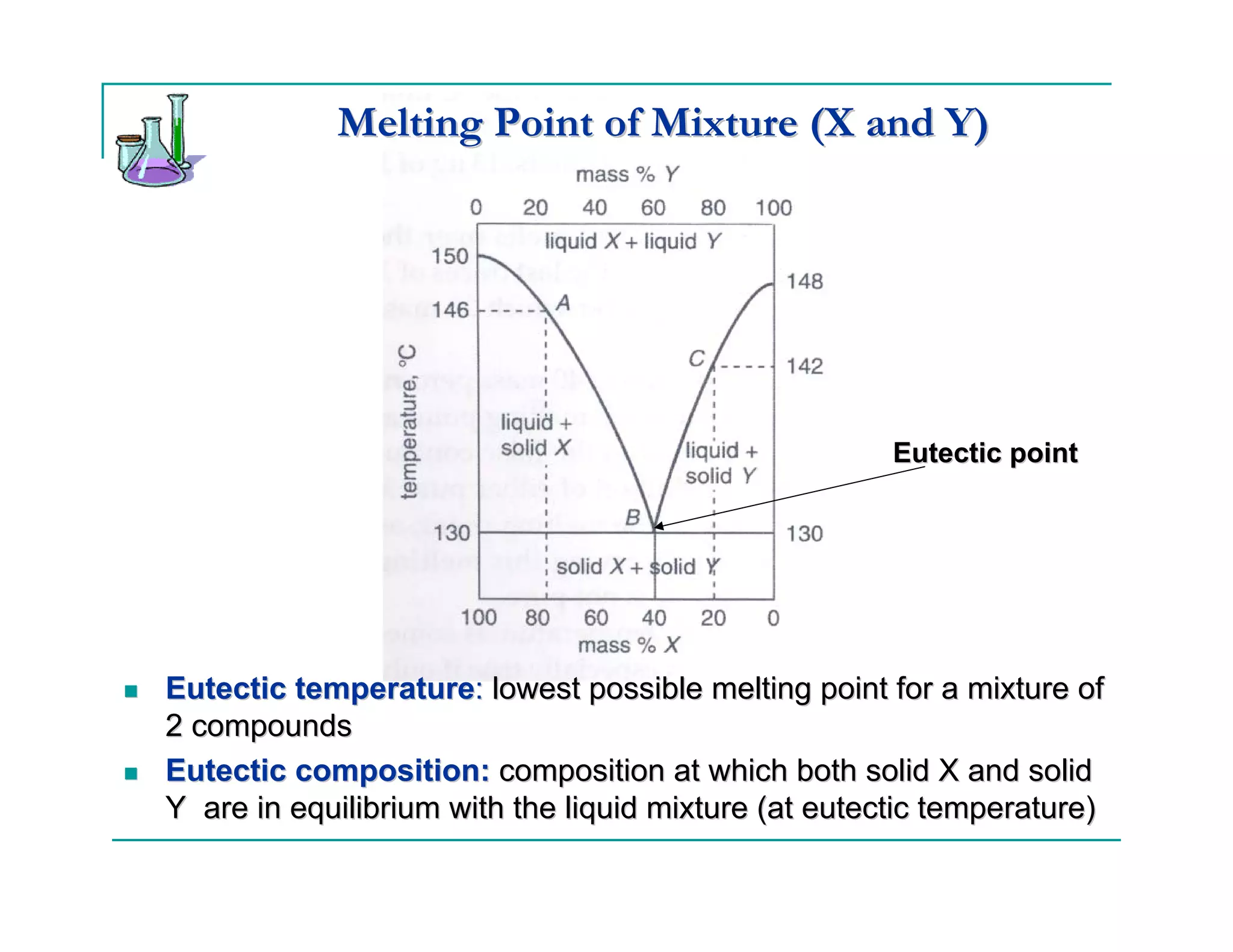
Melting Point of Mixture (X and Y)


                                                      Eutectic point


Eutectic temperature: lowest possible melting point for a mixture of
2 compounds
Eutectic composition: composition at which both solid X and solid
Y are in equilibrium with the liquid mixture (at eutectic temperature)
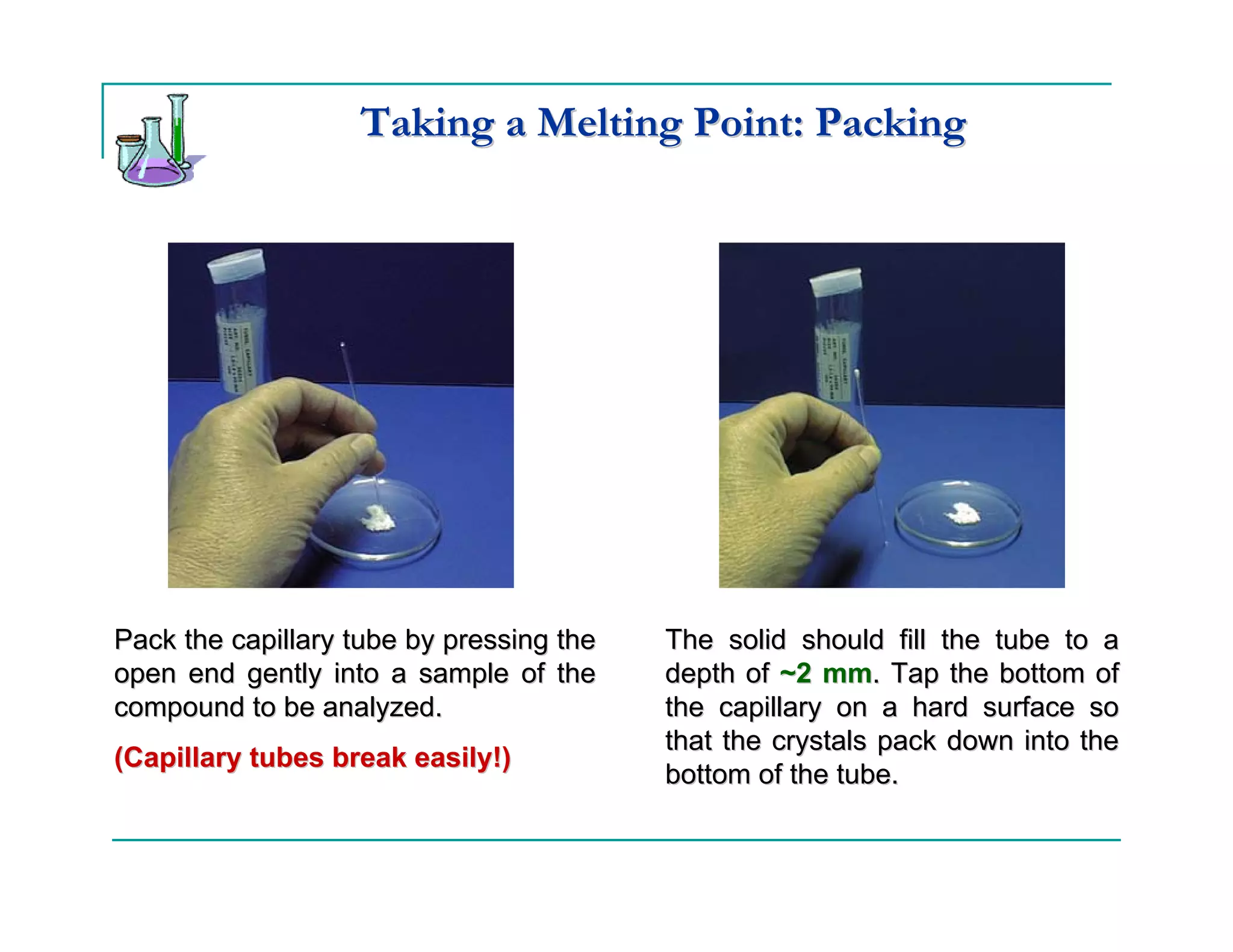
Taking a Melting Point: Packing


Pack the capillary tube by pressing the   The solid should fill the tube to a
open end gently into a sample of the      depth of ~2 mm. Tap the bottom of
compound to be analyzed.                  the capillary on a hard surface so
                                          that the crystals pack down into the
(Capillary tubes break easily!)
                                          bottom of the tube.
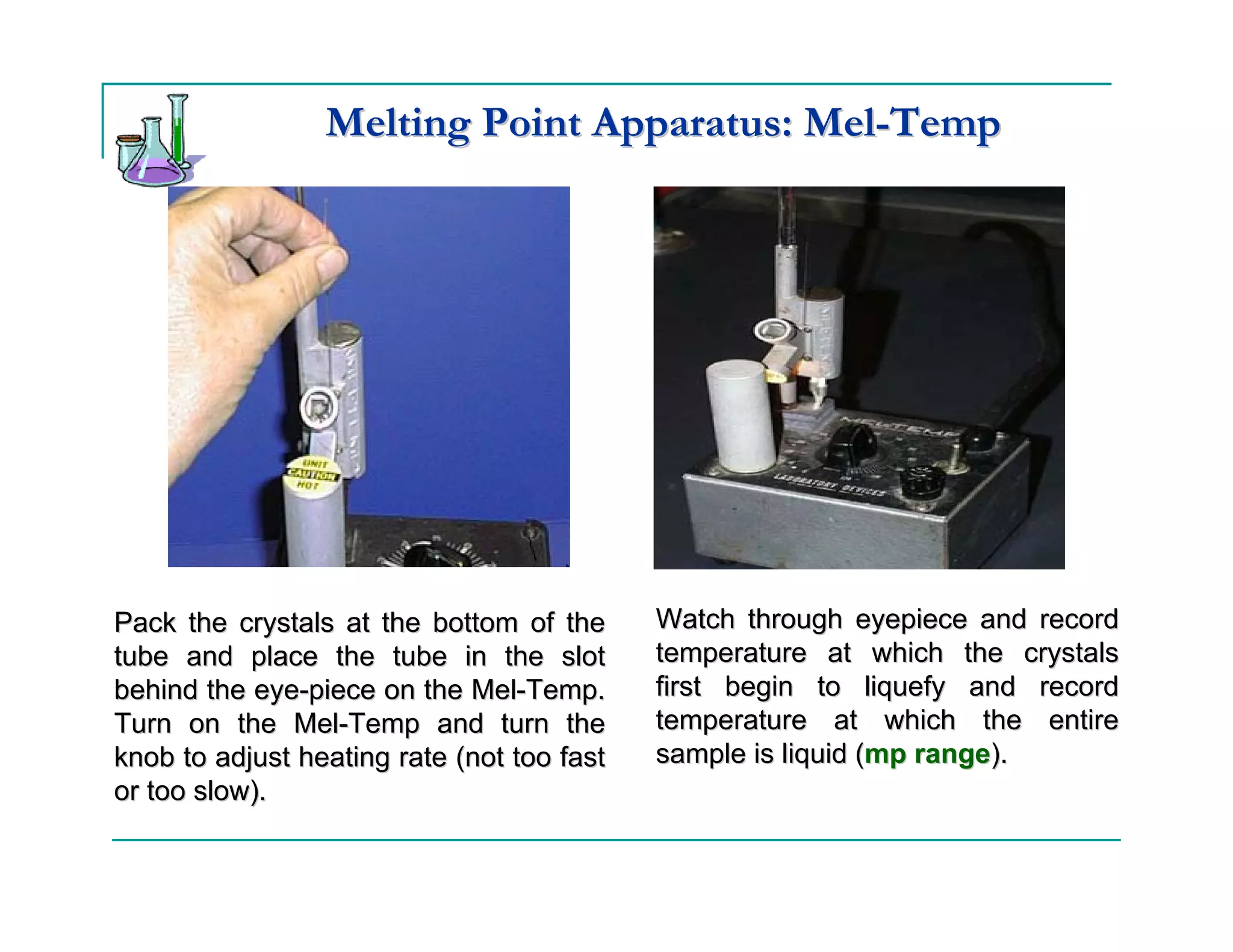
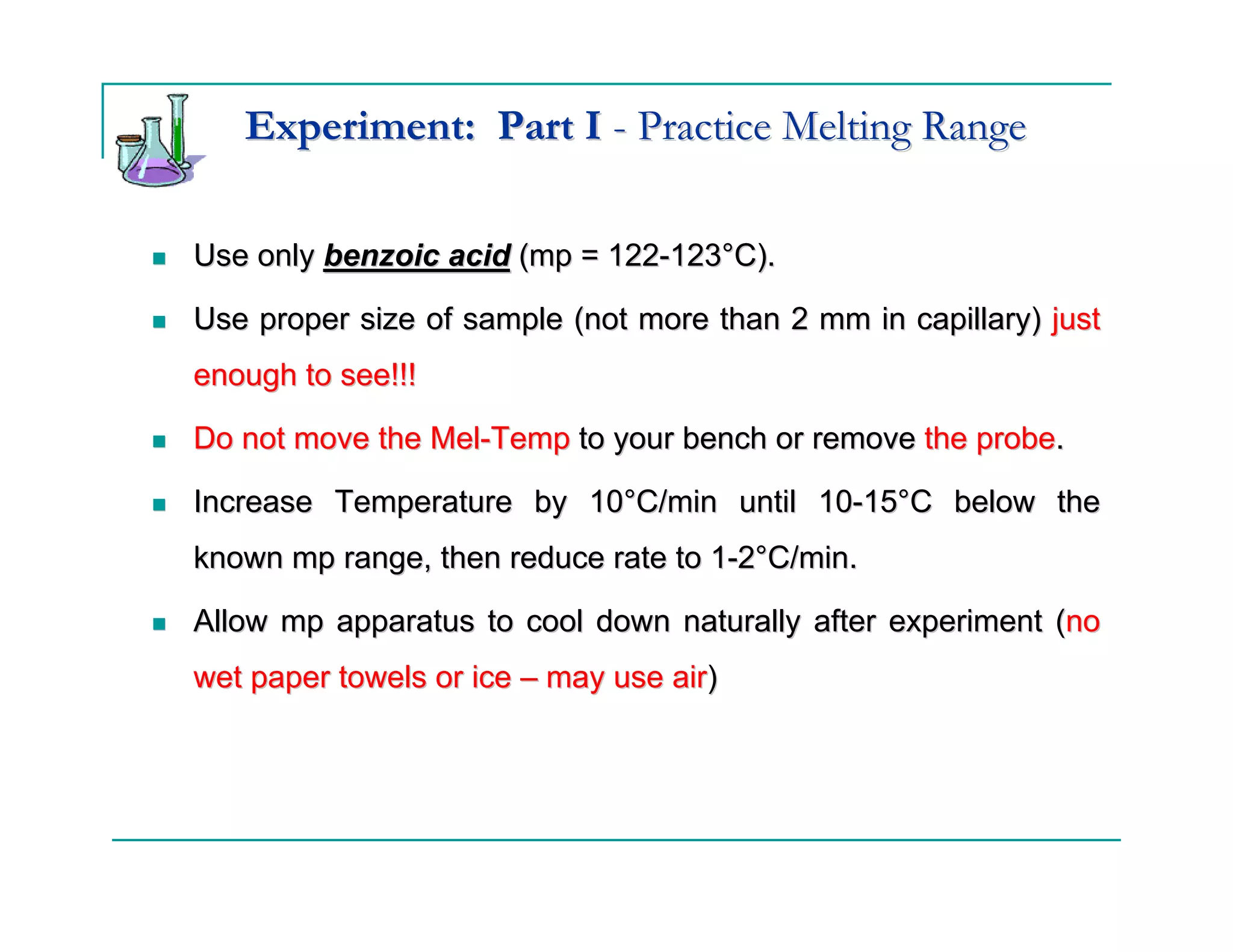
Melting Point Apparatus: Mel-Temp


Pack the crystals at the bottom of the      Watch through eyepiece and record
tube and place the tube in the slot         temperature at which the crystals
behind the eye-piece on the Mel-Temp.       first begin to liquefy and record
Turn on the Mel-Temp and turn the           temperature at which the entire
knob to adjust heating rate (not too fast   sample is liquid (mp range).
or too slow).
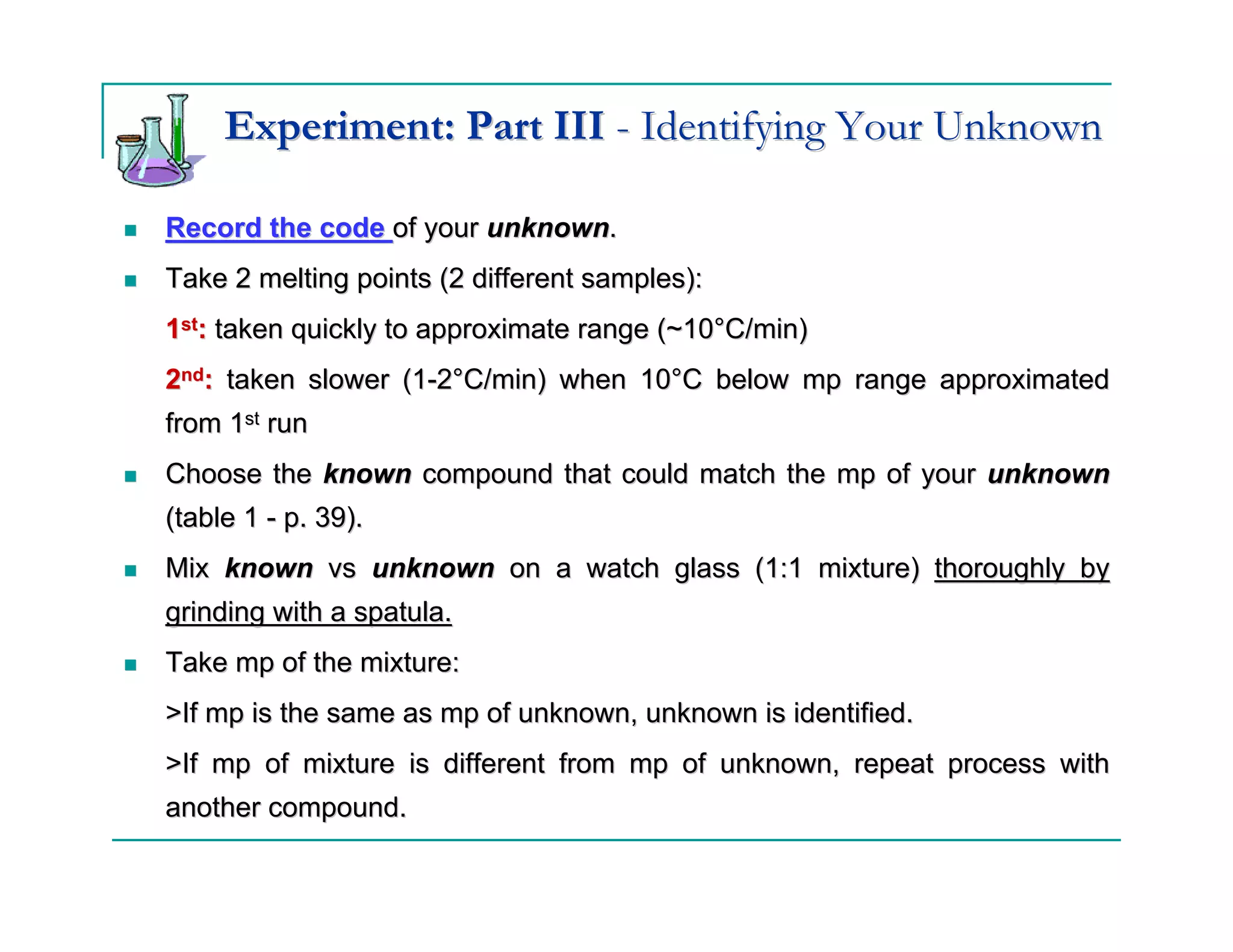
Experiment: Part I - Practice Melting Range

Use only benzoic acid (mp = 122-123°C).

Use proper size of sample (not more than 2 mm in capillary) just
enough to see!!!

Do not move the Mel-Temp to your bench or remove the probe.

Increase Temperature by 10°C/min until 10-15°C below the
known mp range, then reduce rate to 1-2°C/min.

Allow mp apparatus to cool down naturally after experiment (no
wet paper towels or ice – may use air)
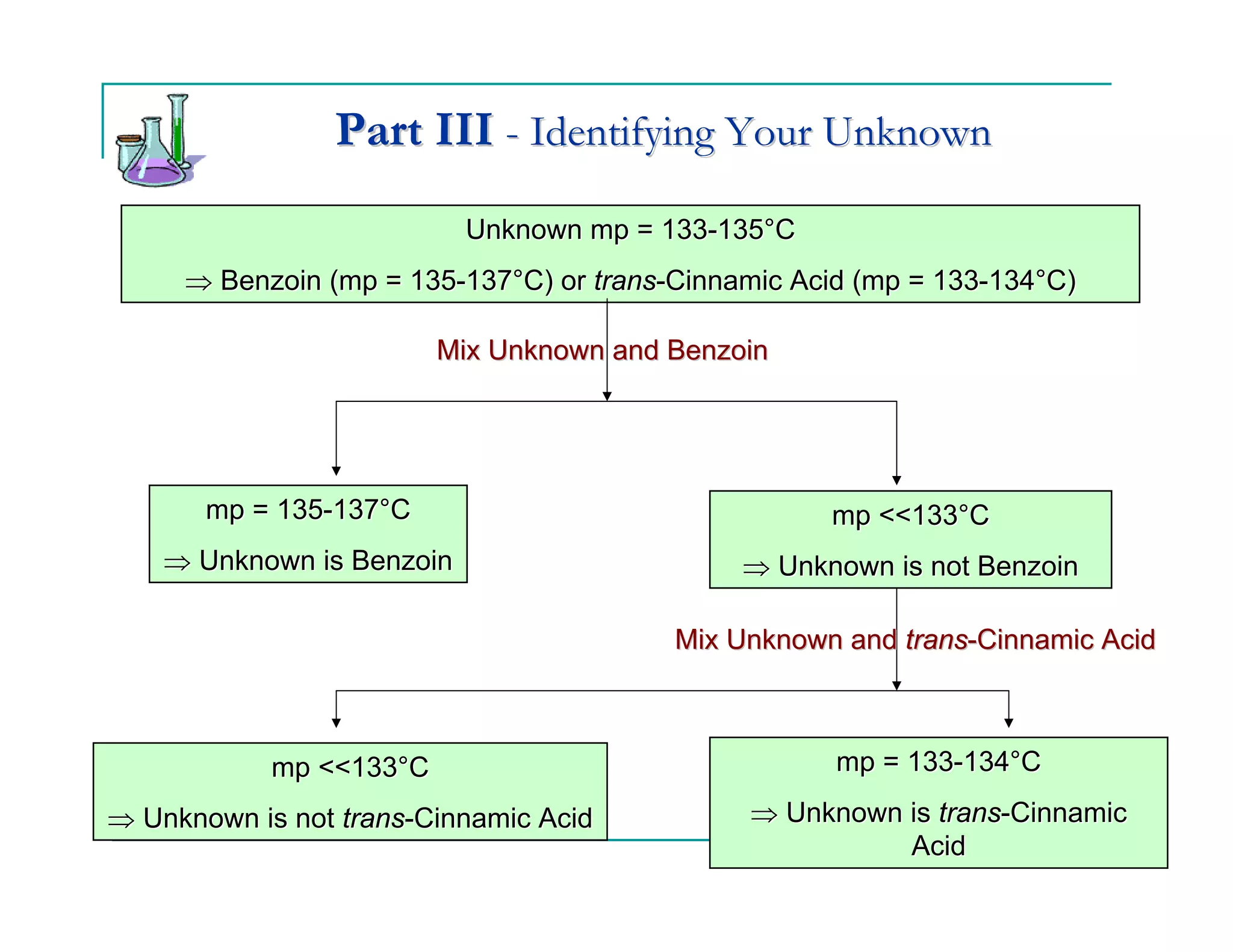
Experiment: Part III - Identifying Your Unknown

Record the code of your unknown.
Take 2 melting points (2 different samples):
1st: taken quickly to approximate range (~10°C/min)
2nd: taken slower (1-2°C/min) when 10°C below mp range approximated
from 1st run
Choose the known compound that could match the mp of your unknown
(table 1 - p. 39).
Mix known vs unknown on a watch glass (1:1 mixture) thoroughly by
grinding with a spatula.
Take mp of the mixture:
>If mp is the same as mp of unknown, unknown is identified.
>If mp of mixture is different from mp of unknown, repeat process with
another compound.
Part III - Identifying Your Unknown
                           Unknown mp = 133-135°C
     ⇒ Benzoin (mp = 135-137°C) or trans-Cinnamic Acid (mp = 133-134°C)

                         Mix Unknown and Benzoin


       mp = 135-137°C                               mp <<133°C
    ⇒ Unknown is Benzoin                      ⇒ Unknown is not Benzoin

                                         Mix Unknown and trans-Cinnamic Acid


            mp <<133°C                               mp = 133-134°C

⇒ Unknown is not trans-Cinnamic Acid          ⇒ Unknown is trans-Cinnamic
                                                        Acid
Waste Handling

Don’t discard capillaries in the trash. Put them in the collection
beaker labeled “3221 Melting Capillaries”. No glass in the trash!!
Any unused unknown is to be returned to the TA in the original
sample vial (properly capped).
Purifying Acetanilide by
   Recrystallization
Definition
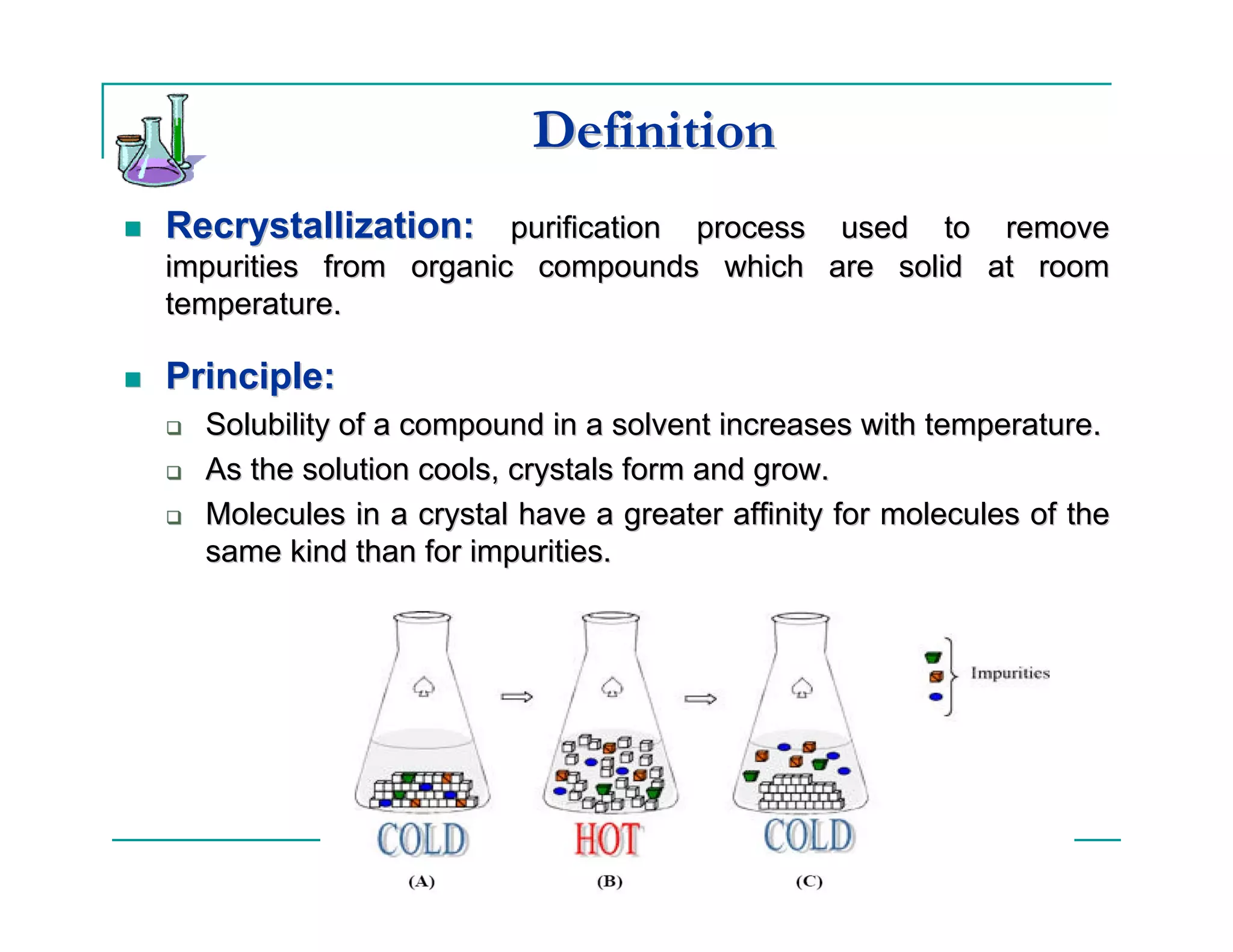
Recrystallization: purification process used to remove
impurities from organic compounds which are solid at room
temperature.

Principle:
  Solubility of a compound in a solvent increases with temperature.
  As the solution cools, crystals form and grow.
  Molecules in a crystal have a greater affinity for molecules of the
  same kind than for impurities.
Choosing a Recrystallizing Solvent
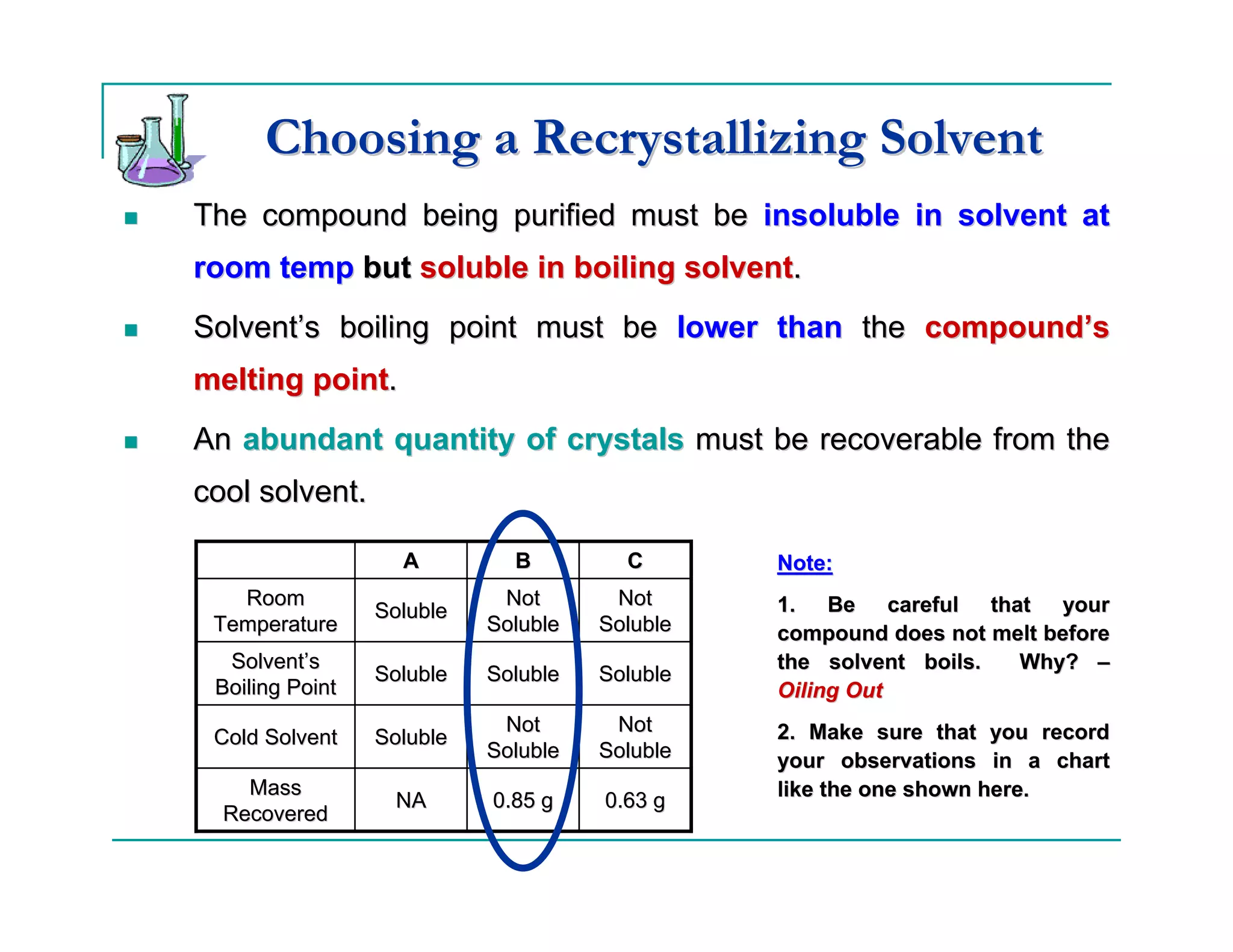
The compound being purified must be insoluble in solvent at
room temp but soluble in boiling solvent.
Solvent’s boiling point must be lower than the compound’s
melting point.
An abundant quantity of crystals must be recoverable from the
cool solvent.

                   A         B         C       Note:
   Room                     Not       Not      1. Be careful that your
                 Soluble
 Temperature               Soluble   Soluble   compound does not melt before
  Solvent’s                                    the solvent boils.  Why? –
                 Soluble   Soluble   Soluble
 Boiling Point                                 Oiling Out
                            Not       Not      2. Make sure that you record
 Cold Solvent    Soluble
                           Soluble   Soluble   your observations in a chart
    Mass                                       like the one shown here.
                   NA      0.85 g    0.63 g
  Recovered
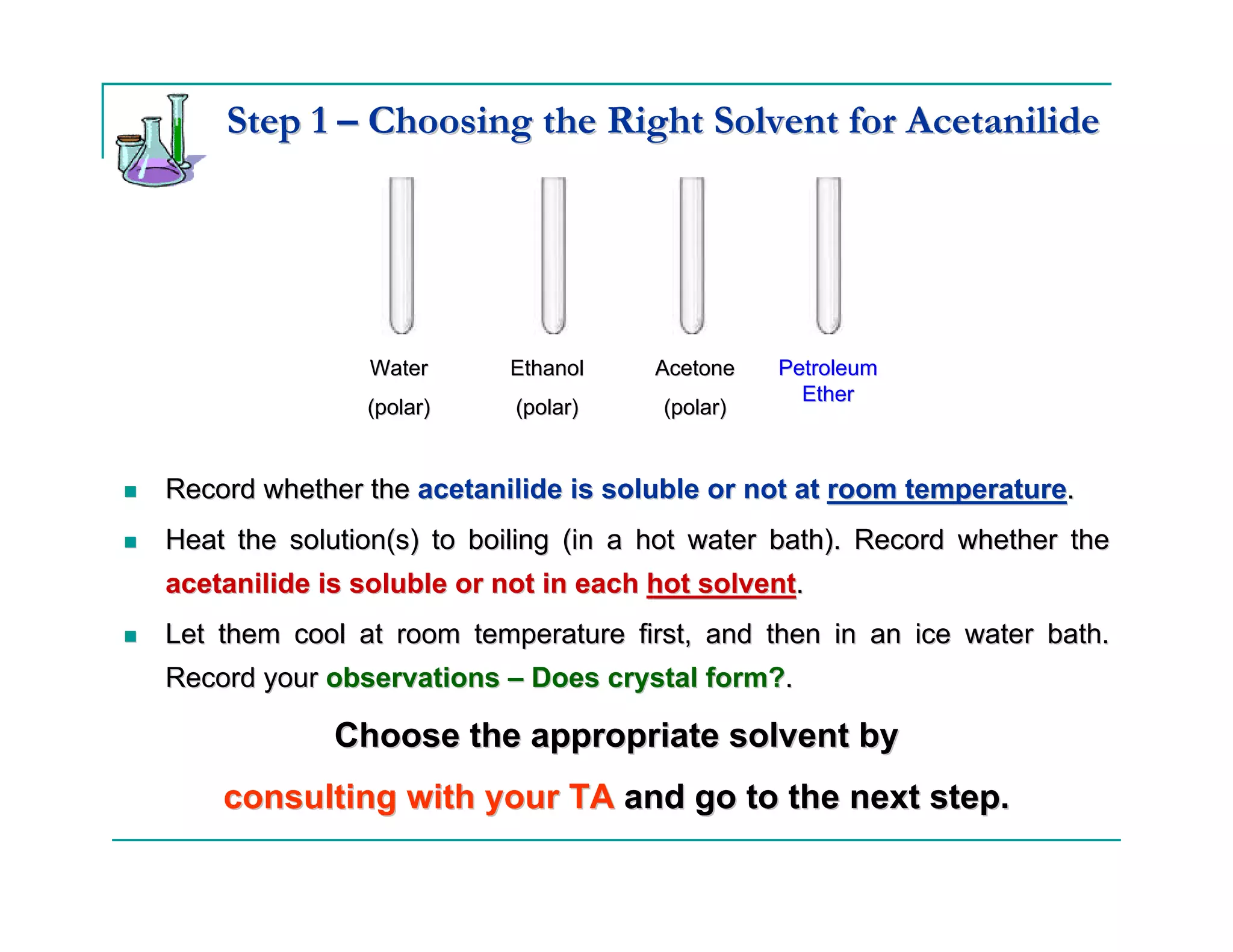
Step 1 – Choosing the Right Solvent for Acetanilide


               Water      Ethanol     Acetone   Petroleum
                                                  Ether
               (polar)     (polar)    (polar)


Record whether the acetanilide is soluble or not at room temperature.
Heat the solution(s) to boiling (in a hot water bath). Record whether the
acetanilide is soluble or not in each hot solvent.
Let them cool at room temperature first, and then in an ice water bath.
Record your observations – Does crystal form?.

             Choose the appropriate solvent by
    consulting with your TA and go to the next step.
Step 2 – Dissolving the Compound

Dissolve the compound in a MINIMUM volume of boiling solvent.
After all of the compound dissolves, add 5% excess to prevent
premature crystallization. (For example: if 10 mL of boiling solvent is
required to just dissolve a compound, 0.5 mL will be added)


             1- Heat some solvent to                               3- Swirl the flask
             boiling. Place the solid
             to be recrystallized in an
             Erlenmeyer flask.


             2- Add small amount (1                                4- Place the flask on the
             mL) of the hot solvent                                hot plate to keep the
             into the flask.                                       solution warm
             (Use a Pasteur pipet)

                 5- Repeat steps 2 to 4 until you have dissolved
                 the compound, and then add the 5% excess.
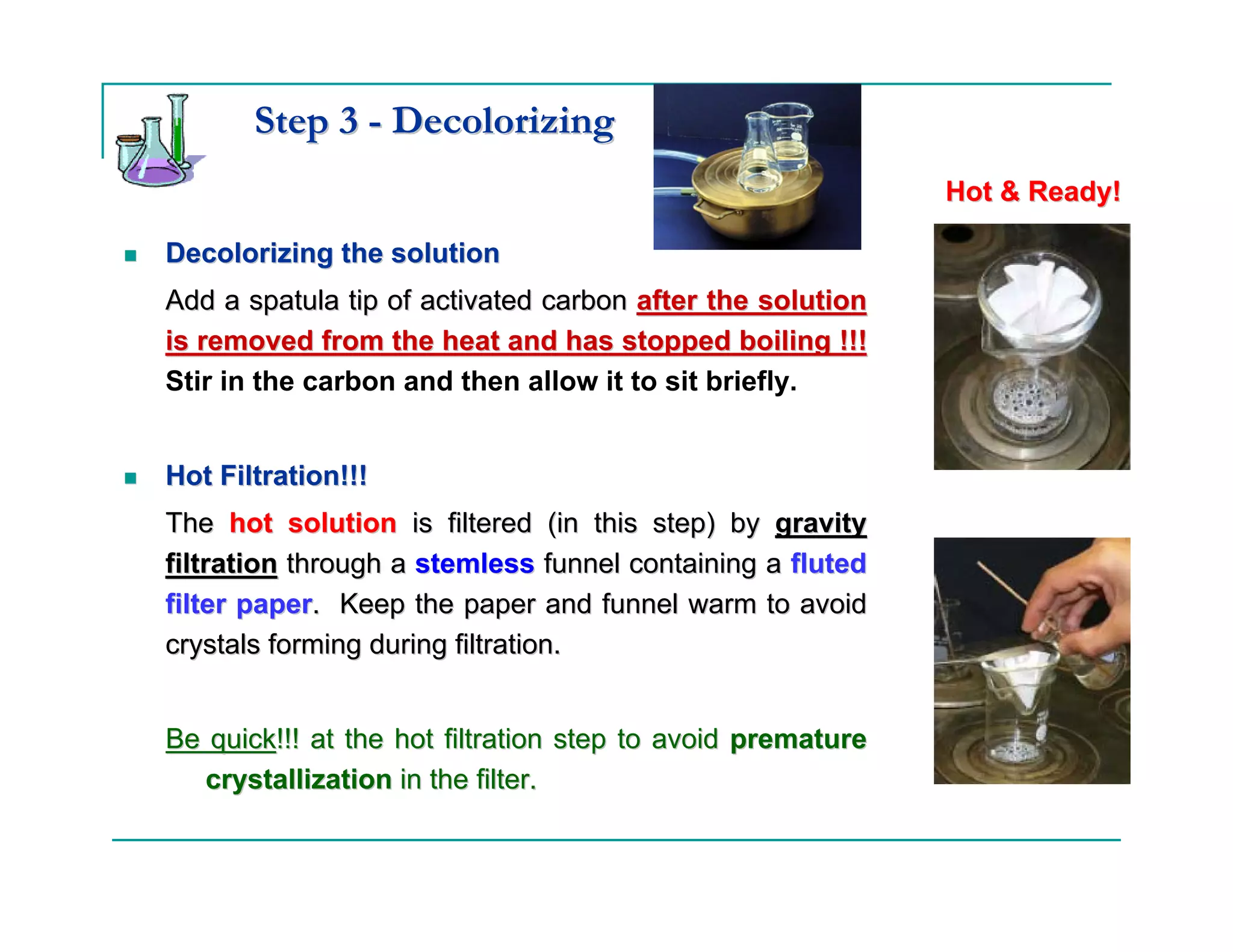
Step 3 - Decolorizing
                                                            Hot & Ready!

Decolorizing the solution
Add a spatula tip of activated carbon after the solution
is removed from the heat and has stopped boiling !!!
Stir in the carbon and then allow it to sit briefly.


Hot Filtration!!!
The hot solution is filtered (in this step) by gravity
filtration through a stemless funnel containing a fluted
filter paper. Keep the paper and funnel warm to avoid
crystals forming during filtration.


Be quick!!! at the hot filtration step to avoid premature
   crystallization in the filter.
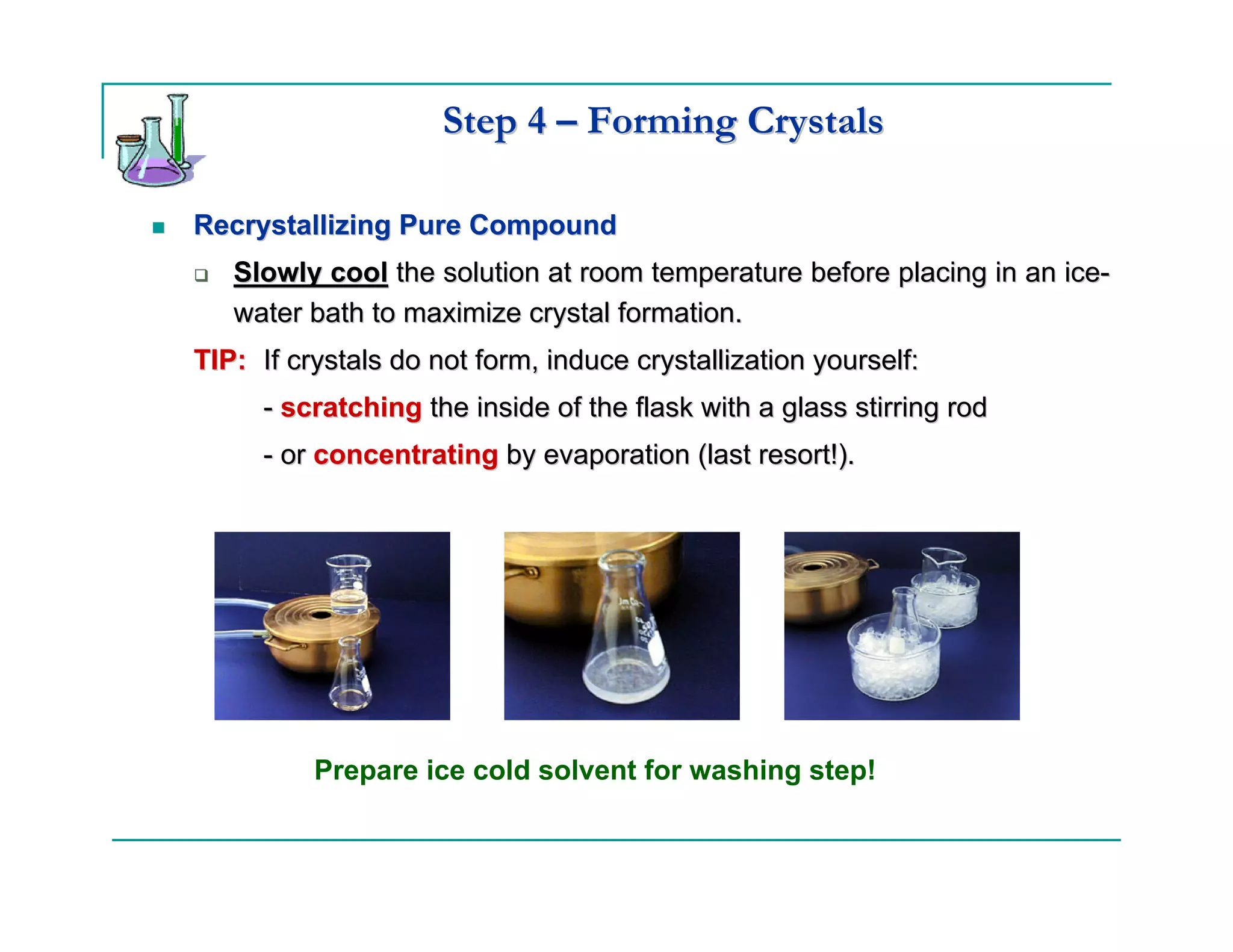
Step 4 – Forming Crystals

Recrystallizing Pure Compound
   Slowly cool the solution at room temperature before placing in an ice-
   water bath to maximize crystal formation.
TIP: If crystals do not form, induce crystallization yourself:
     - scratching the inside of the flask with a glass stirring rod
     - or concentrating by evaporation (last resort!).


          Prepare ice cold solvent for washing step!
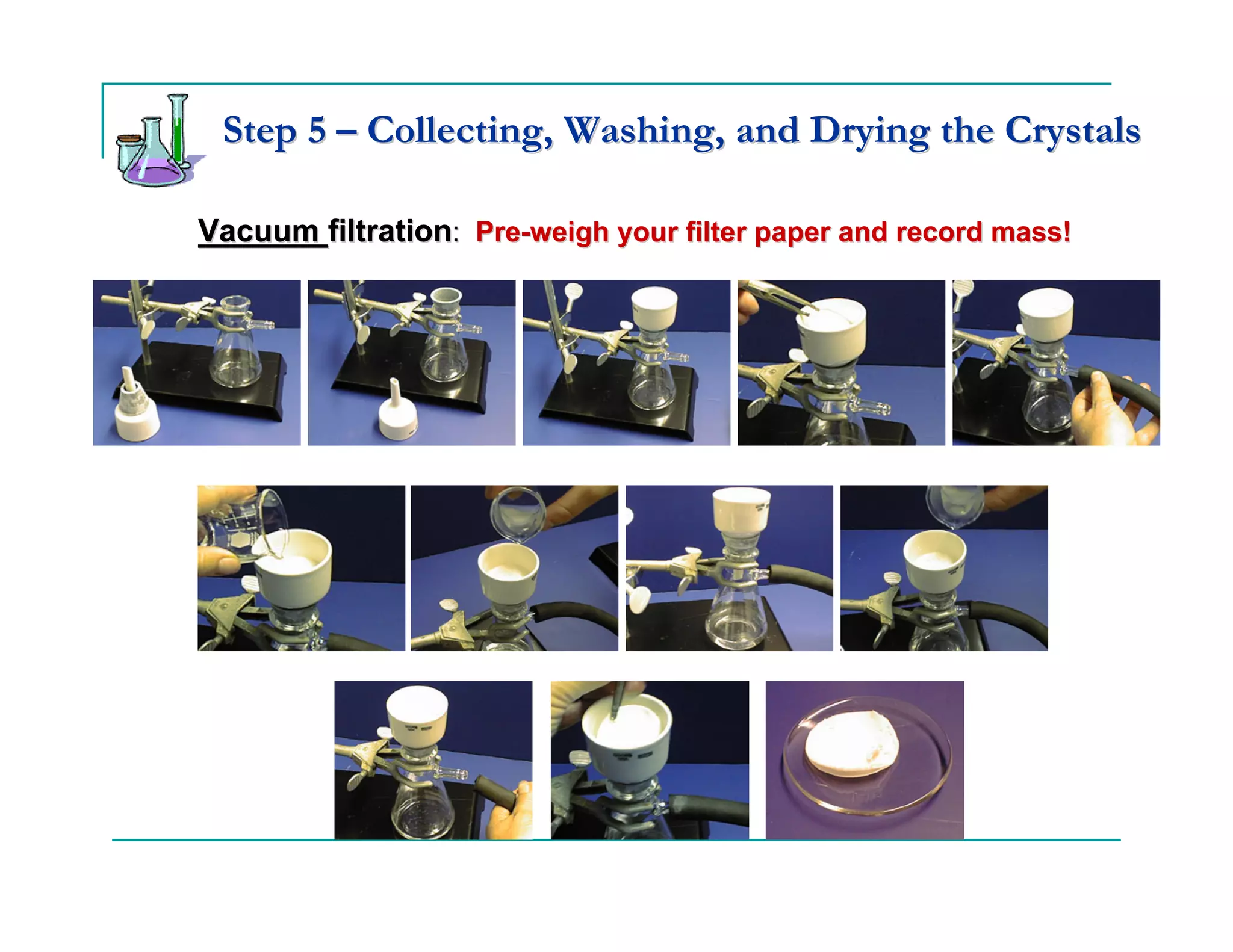
Step 5 – Collecting, Washing, and Drying the Crystals

Vacuum filtration: Pre-weigh your filter paper and record mass!
Step 6 – Recovery Analysis (Next Week)

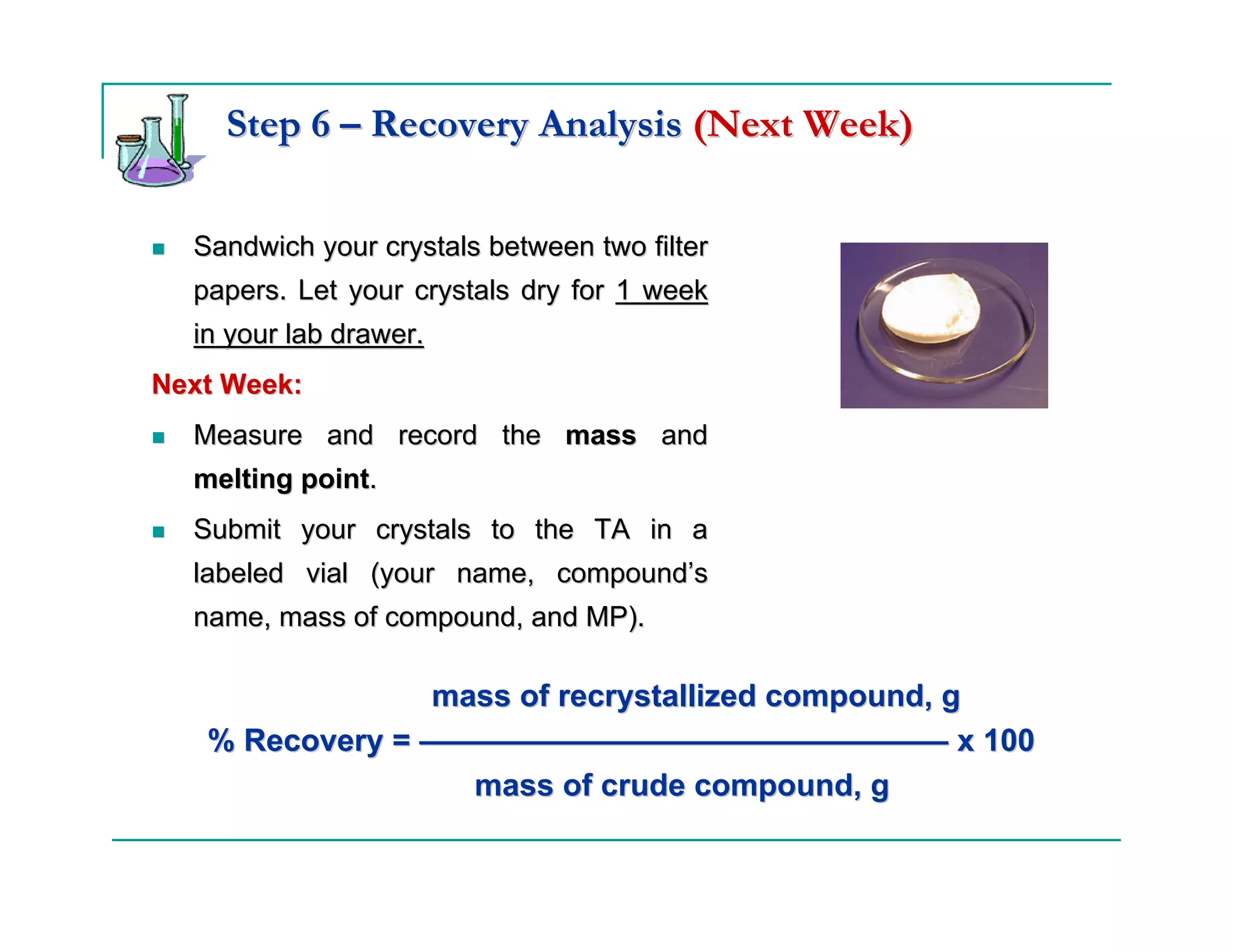
  Sandwich your crystals between two filter
  papers. Let your crystals dry for 1 week
  in your lab drawer.
Next Week:
  Measure and record the mass and
  melting point.
  Submit your crystals to the TA in a
  labeled vial (your name, compound’s
  name, mass of compound, and MP).

                mass of recrystallized compound, g
   % Recovery = ————————————————— x 100
                  mass of crude compound, g

Melting Point&Recrys

  • 1.
  • 2.
    Background Information Melting point:temperature at which solid is in equilibrium with its liquid Melting point range: span of temperatures from the point at which the crystals first begin to liquefy to the point at which the entire sample is liquid Pure compounds usually melt over a narrow temperature range of 1- 2°C Presence of soluble impurity almost always decreases and broadens the melting point range
  • 3.
    Melting Point ofMixture (X and Y) Eutectic point Eutectic temperature: lowest possible melting point for a mixture of 2 compounds Eutectic composition: composition at which both solid X and solid Y are in equilibrium with the liquid mixture (at eutectic temperature)
  • 4.
    Taking a MeltingPoint: Packing Pack the capillary tube by pressing the The solid should fill the tube to a open end gently into a sample of the depth of ~2 mm. Tap the bottom of compound to be analyzed. the capillary on a hard surface so that the crystals pack down into the (Capillary tubes break easily!) bottom of the tube.
  • 5.
    Melting Point Apparatus:Mel-Temp Pack the crystals at the bottom of the Watch through eyepiece and record tube and place the tube in the slot temperature at which the crystals behind the eye-piece on the Mel-Temp. first begin to liquefy and record Turn on the Mel-Temp and turn the temperature at which the entire knob to adjust heating rate (not too fast sample is liquid (mp range). or too slow).
  • 6.
    Experiment: Part I- Practice Melting Range Use only benzoic acid (mp = 122-123°C). Use proper size of sample (not more than 2 mm in capillary) just enough to see!!! Do not move the Mel-Temp to your bench or remove the probe. Increase Temperature by 10°C/min until 10-15°C below the known mp range, then reduce rate to 1-2°C/min. Allow mp apparatus to cool down naturally after experiment (no wet paper towels or ice – may use air)
  • 7.
    Experiment: Part III- Identifying Your Unknown Record the code of your unknown. Take 2 melting points (2 different samples): 1st: taken quickly to approximate range (~10°C/min) 2nd: taken slower (1-2°C/min) when 10°C below mp range approximated from 1st run Choose the known compound that could match the mp of your unknown (table 1 - p. 39). Mix known vs unknown on a watch glass (1:1 mixture) thoroughly by grinding with a spatula. Take mp of the mixture: >If mp is the same as mp of unknown, unknown is identified. >If mp of mixture is different from mp of unknown, repeat process with another compound.
  • 8.
    Part III -Identifying Your Unknown Unknown mp = 133-135°C ⇒ Benzoin (mp = 135-137°C) or trans-Cinnamic Acid (mp = 133-134°C) Mix Unknown and Benzoin mp = 135-137°C mp <<133°C ⇒ Unknown is Benzoin ⇒ Unknown is not Benzoin Mix Unknown and trans-Cinnamic Acid mp <<133°C mp = 133-134°C ⇒ Unknown is not trans-Cinnamic Acid ⇒ Unknown is trans-Cinnamic Acid
  • 9.
    Waste Handling Don’t discardcapillaries in the trash. Put them in the collection beaker labeled “3221 Melting Capillaries”. No glass in the trash!! Any unused unknown is to be returned to the TA in the original sample vial (properly capped).
  • 10.
    Purifying Acetanilide by Recrystallization
  • 11.
    Definition Recrystallization: purification processused to remove impurities from organic compounds which are solid at room temperature. Principle: Solubility of a compound in a solvent increases with temperature. As the solution cools, crystals form and grow. Molecules in a crystal have a greater affinity for molecules of the same kind than for impurities.
  • 12.
    Choosing a RecrystallizingSolvent The compound being purified must be insoluble in solvent at room temp but soluble in boiling solvent. Solvent’s boiling point must be lower than the compound’s melting point. An abundant quantity of crystals must be recoverable from the cool solvent. A B C Note: Room Not Not 1. Be careful that your Soluble Temperature Soluble Soluble compound does not melt before Solvent’s the solvent boils. Why? – Soluble Soluble Soluble Boiling Point Oiling Out Not Not 2. Make sure that you record Cold Solvent Soluble Soluble Soluble your observations in a chart Mass like the one shown here. NA 0.85 g 0.63 g Recovered
  • 13.
    Step 1 –Choosing the Right Solvent for Acetanilide Water Ethanol Acetone Petroleum Ether (polar) (polar) (polar) Record whether the acetanilide is soluble or not at room temperature. Heat the solution(s) to boiling (in a hot water bath). Record whether the acetanilide is soluble or not in each hot solvent. Let them cool at room temperature first, and then in an ice water bath. Record your observations – Does crystal form?. Choose the appropriate solvent by consulting with your TA and go to the next step.
  • 14.
    Step 2 –Dissolving the Compound Dissolve the compound in a MINIMUM volume of boiling solvent. After all of the compound dissolves, add 5% excess to prevent premature crystallization. (For example: if 10 mL of boiling solvent is required to just dissolve a compound, 0.5 mL will be added) 1- Heat some solvent to 3- Swirl the flask boiling. Place the solid to be recrystallized in an Erlenmeyer flask. 2- Add small amount (1 4- Place the flask on the mL) of the hot solvent hot plate to keep the into the flask. solution warm (Use a Pasteur pipet) 5- Repeat steps 2 to 4 until you have dissolved the compound, and then add the 5% excess.
  • 15.
    Step 3 -Decolorizing Hot & Ready! Decolorizing the solution Add a spatula tip of activated carbon after the solution is removed from the heat and has stopped boiling !!! Stir in the carbon and then allow it to sit briefly. Hot Filtration!!! The hot solution is filtered (in this step) by gravity filtration through a stemless funnel containing a fluted filter paper. Keep the paper and funnel warm to avoid crystals forming during filtration. Be quick!!! at the hot filtration step to avoid premature crystallization in the filter.
  • 16.
    Step 4 –Forming Crystals Recrystallizing Pure Compound Slowly cool the solution at room temperature before placing in an ice- water bath to maximize crystal formation. TIP: If crystals do not form, induce crystallization yourself: - scratching the inside of the flask with a glass stirring rod - or concentrating by evaporation (last resort!). Prepare ice cold solvent for washing step!
  • 17.
    Step 5 –Collecting, Washing, and Drying the Crystals Vacuum filtration: Pre-weigh your filter paper and record mass!
  • 18.
    Step 6 –Recovery Analysis (Next Week) Sandwich your crystals between two filter papers. Let your crystals dry for 1 week in your lab drawer. Next Week: Measure and record the mass and melting point. Submit your crystals to the TA in a labeled vial (your name, compound’s name, mass of compound, and MP). mass of recrystallized compound, g % Recovery = ————————————————— x 100 mass of crude compound, g