
Titrimetric analysis
Ayesha shafi
Content
• INTRODUCTION
• SOME DEFINITIONS
• TYPES OF TITRATION
• ACID BASE TITRATION
• TYPES OF THE ACID BASE TITRATION
Introduction
• Titration is a technique to determine the concentration of an
unknown solution.
• Titration is the slow addition of one solution of a known
concentration (called a titrant or titrator) to a known volume of
another solution of unknown concentration (called a titrant or
analyte) until the reaction reaches neutralization, which is often
indicated by a color change.
• Also known as Titrimetry or Volumetric Titration.
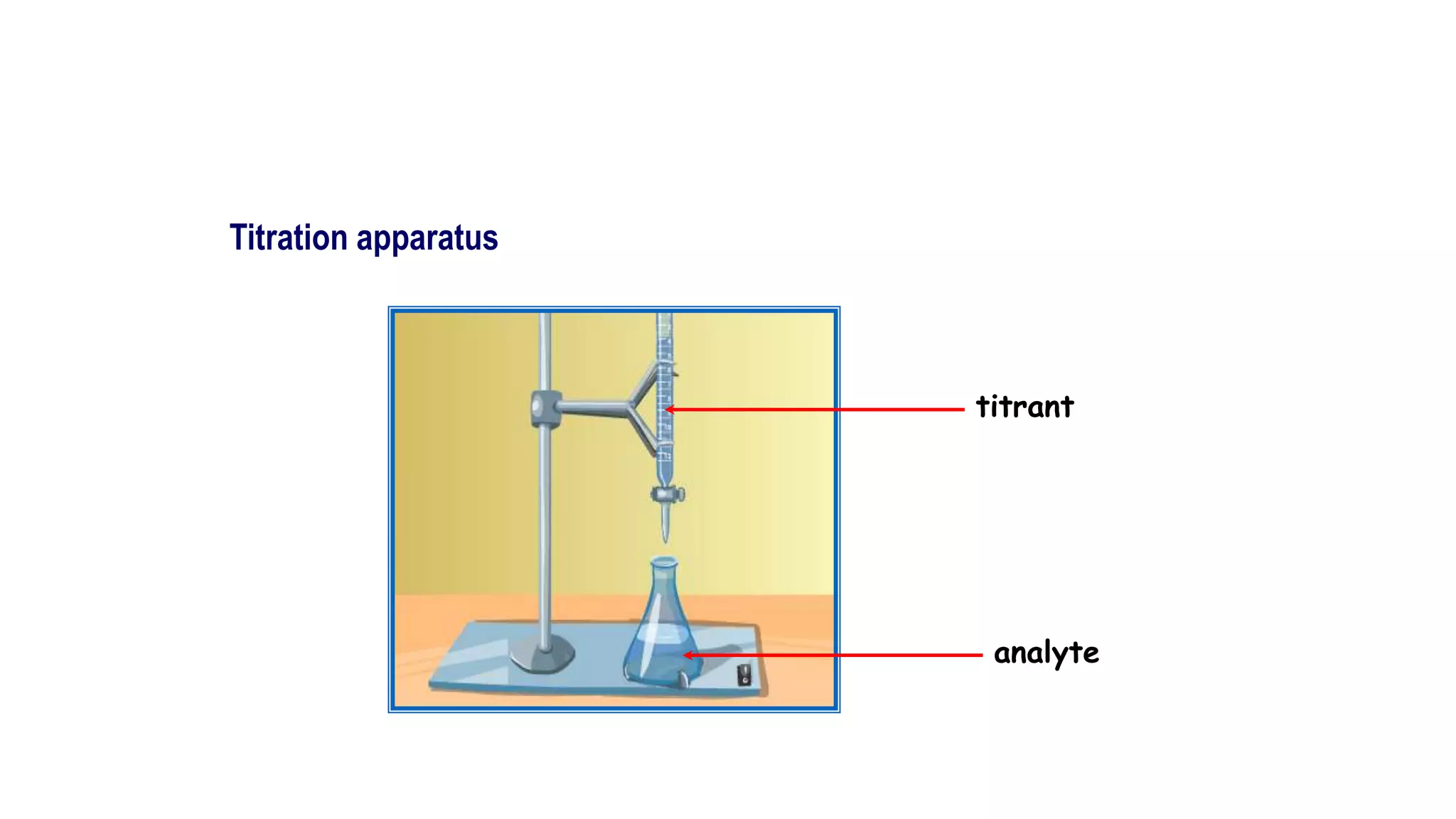
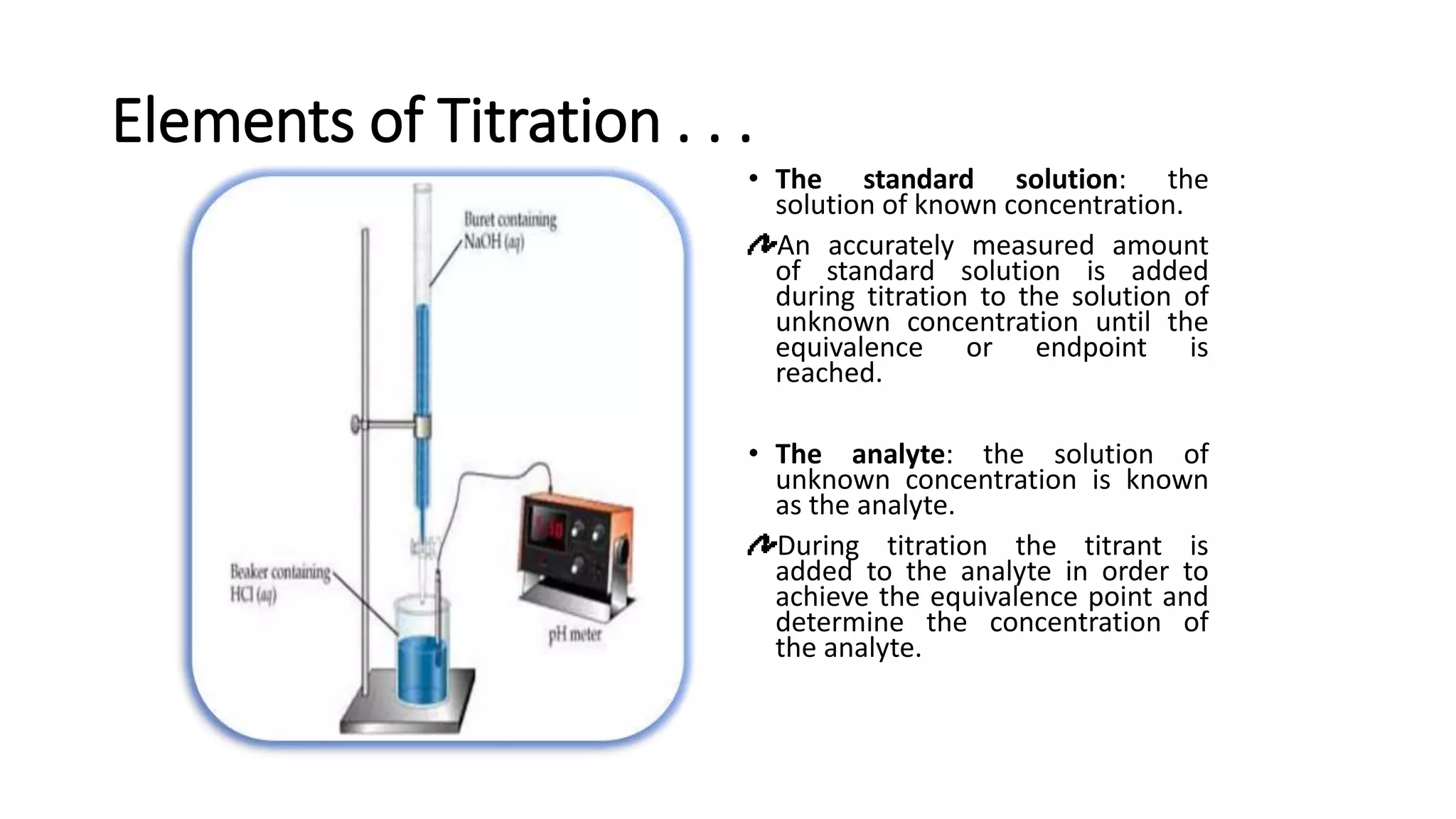
Titration apparatus
titrant
analyte
SOME DEFINITIONS
Titrant is the solution added from the burette.
The equivalent point is the point at which the amount of acid
and base present exactly neutralizes one another. (number of
moles of OH- ions and number of moles of H+ ions are equal)
Indicator is a substance that is generally added to the solution in
the receiving vessel an which undergoes some sort of colour
change when reaction is over.
The end point of titration is the point when the indicator changes
colour.
Elements of Titration . . .
• The standard solution: the
solution of known concentration.
An accurately measured amount
of standard solution is added
during titration to the solution of
unknown concentration until the
equivalence or endpoint is
reached.
• The analyte: the solution of
unknown concentration is known
as the analyte.
During titration the titrant is
added to the analyte in order to
achieve the equivalence point and
determine the concentration of
the analyte.
Type of Titrations
Classified into four types based on type of
reaction involved;
1. Acid-base titrations
2. Complexometric titrations
3. Redox titrations
4. Precipitation titrations
• An acid-base titration is a procedure used
in quantitative chemical analysis to
determine the concentration of either
acid or a base.
• The equivalence of an acid-base titration
is the point at which there are equal
amounts (in moles) of H3O+ and OH- in
titration flask.
Acid base titration
• End point of titration – the point in a titration at which
the indicator changes colour.
• The indicator should change colour sharply at the
equivalence point.
• At the end point of the titration,
- all the acid has been neutralised by the alkali
- the solution in the conical flask contain salt and water
only.
H3O+ + OH- H2O
Types of acid base titration
Acidimetric Titration:
• Direct or residual volumetric analysis of a base with a standard acid.
• E.g. Assay of sodium bicarbonate.
Alkalimetric Titration:
• it is an estimation of acidic drug by titration with the standard alkali.
• E.g. Assay of boric acid.

Titrimetric analysis lec

  • 1.
  • 2.
    Content • INTRODUCTION • SOMEDEFINITIONS • TYPES OF TITRATION • ACID BASE TITRATION • TYPES OF THE ACID BASE TITRATION
  • 3.
    Introduction • Titration isa technique to determine the concentration of an unknown solution. • Titration is the slow addition of one solution of a known concentration (called a titrant or titrator) to a known volume of another solution of unknown concentration (called a titrant or analyte) until the reaction reaches neutralization, which is often indicated by a color change. • Also known as Titrimetry or Volumetric Titration.
  • 4.
  • 5.
    SOME DEFINITIONS Titrant isthe solution added from the burette. The equivalent point is the point at which the amount of acid and base present exactly neutralizes one another. (number of moles of OH- ions and number of moles of H+ ions are equal) Indicator is a substance that is generally added to the solution in the receiving vessel an which undergoes some sort of colour change when reaction is over. The end point of titration is the point when the indicator changes colour.
  • 6.
    Elements of Titration. . . • The standard solution: the solution of known concentration. An accurately measured amount of standard solution is added during titration to the solution of unknown concentration until the equivalence or endpoint is reached. • The analyte: the solution of unknown concentration is known as the analyte. During titration the titrant is added to the analyte in order to achieve the equivalence point and determine the concentration of the analyte.
  • 7.
    Type of Titrations Classifiedinto four types based on type of reaction involved; 1. Acid-base titrations 2. Complexometric titrations 3. Redox titrations 4. Precipitation titrations
  • 8.
    • An acid-basetitration is a procedure used in quantitative chemical analysis to determine the concentration of either acid or a base. • The equivalence of an acid-base titration is the point at which there are equal amounts (in moles) of H3O+ and OH- in titration flask. Acid base titration
  • 9.
    • End pointof titration – the point in a titration at which the indicator changes colour. • The indicator should change colour sharply at the equivalence point. • At the end point of the titration, - all the acid has been neutralised by the alkali - the solution in the conical flask contain salt and water only. H3O+ + OH- H2O
  • 10.
    Types of acidbase titration Acidimetric Titration: • Direct or residual volumetric analysis of a base with a standard acid. • E.g. Assay of sodium bicarbonate. Alkalimetric Titration: • it is an estimation of acidic drug by titration with the standard alkali. • E.g. Assay of boric acid.