CONDUCTOMETRIC METHODS OF ANALYSIS
Introduction
Conductometry:
Is the simplest of the electroanalytical techniques.
Conductivity is:
“the ability of the medium to carry electric current”.
Conductors are:
either metallic (flow of electrons) or electrolytic (movement
of ions).
The conductivity of a wire or a solution is the reciprocal of
the resistance ; that is,
Cond. “ G” = 1 / R
Where: R = resistance in Ohms, and
G = conductance in mhos (Ω-1) or siemens “s”.
Also, from Ohm’s law we find that the resistance of a wire is
given by the equation:
I = E / R E= IR
Where E= voltage applied to the solution or wire in volts
I= current flowing through the solution in amperes
R= resistance of the solution
Introduction
Conductance of electricity:
The conductance of a solution is a measure of how well a
solution will carry current ( i.e pass electrons)
The electrons are usually carried on the ions . The positive,
such as M+, migrate through the solution toward the
cathode, where they pick up electrons. Anions symbolized
in general as A- , migrate towered the anode, where they
deliver electrons. The net result is a flow of electrons
through the solution
( i.e. The solution conducts electricity) .
(i.e.) current is carried by all ions present in solution.
Conductance depends on the number of ions in solution.
Introduction
Introduction
Factors that affect the mobility of the ion
1. The solvent ( e.g., water or organic),
2. The applied voltage
3. The size of the ion ( the larger it is the less mobile it
will be),
4. The nature of the ion ( if it becomes hydrated , its
effective size is increased).
The mobility is also affected by
• The viscosity
• The temperature of the solvent
Specific conductance (K)
• Resistance is inversely proportional to the cross section area
A and is directly proportional to the length of a conductor,
• Conductance is directly proportional to the cross section area
A and is inversely proportional to the length of a conductor,
Thus,
G  A/L so G =KA/L or K = GL/A
where K is the specific conductance
(the conductance when A and L are numerically equal).
When unit of A and L is centimeter, K is: “the conductance of a
cube of liquid one centimeter on a side
” its unit is mho-1 Cm-1 or S Cm-1
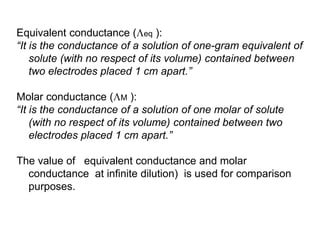
Equivalent conductance (eq ):
“It is the conductance of a solution of one-gram equivalent of
solute (with no respect of its volume) contained between
two electrodes placed 1 cm apart.”
Molar conductance (M ):
“It is the conductance of a solution of one molar of solute
(with no respect of its volume) contained between two
electrodes placed 1 cm apart.”
The value of equivalent conductance and molar
conductance at infinite dilution) is used for comparison
purposes.
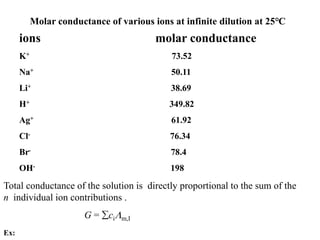
Molar conductance of various ions at infinite dilution at 25℃
ions molar conductance
K+ 73.52
Na+ 50.11
Li+ 38.69
H+ 349.82
Ag+ 61.92
Cl- 76.34
Br- 78.4
OH- 198
Total conductance of the solution is directly proportional to the sum of the
n individual ion contributions .
G = cim,I
Ex:
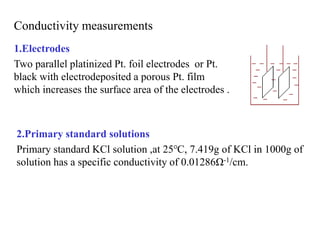
Conductivity measurements
2.Primary standard solutions
Primary standard KCl solution ,at 25℃, 7.419g of KCl in 1000g of
solution has a specific conductivity of 0.01286Ω-1/cm.
1.Electrodes
Two parallel platinized Pt. foil electrodes or Pt.
black with electrodeposited a porous Pt. film
which increases the surface area of the electrodes .
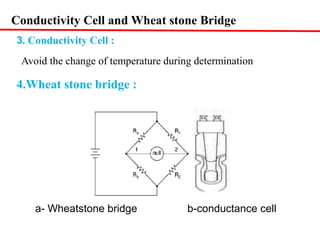
3. Conductivity Cell :
Avoid the change of temperature during determination
4.Wheat stone bridge :
Conductivity Cell and Wheat stone Bridge
a- Wheatstone bridge b-conductance cell
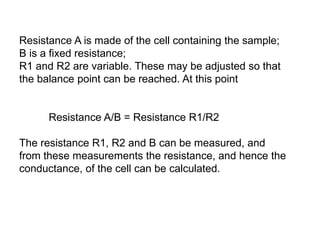
Resistance A is made of the cell containing the sample;
B is a fixed resistance;
R1 and R2 are variable. These may be adjusted so that
the balance point can be reached. At this point
Resistance A/B = Resistance R1/R2
The resistance R1, R2 and B can be measured, and
from these measurements the resistance, and hence the
conductance, of the cell can be calculated.
APPLICATIONS OF CONDUCTOMETRY
It can be used for the determination of:-
 Solubility of sparingly soluble salts
 Ionic product of water
 Basicity of organic acids
 Salinity of sea water (oceanographic work)
 Chemical equilibrium in ionic reactions
 Conductometric titration
ADVANTAGES OF CONDUCTOMETRIC TITRATIONS
 No need of indicator
 Colored or dilute solutions or turbid suspensions can be
used for titrations.
 Temperature is maintained constant throughout the titration.
 End point can be determined accurately and errors are
minimized as the end point is being determined graphically.
DISADVANTAGES OF CONDUCTOMETRIC TITRATIONS
- non specificity
- interference of high conc. of other electrolytes
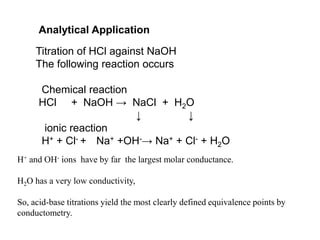
Analytical Application
Titration of HCl against NaOH
The following reaction occurs
Chemical reaction
HCl + NaOH → NaCl + H2O
↓ ↓
ionic reaction
H+ + Cl- + Na+ +OH-→ Na+ + Cl- + H2O
H+ and OH- ions have by far the largest molar conductance.
H2O has a very low conductivity,
So, acid-base titrations yield the most clearly defined equivalence points by
conductometry.
The original solution contained H+ and Cl- in water; the final solution
contain Na+ and Cl- in water. It can be seen that Na+ has replaced H+, if
we plot conductivity while NaOH is added, we observe the relationship
as in the Fig.
In part A of the curve H+ are being removed by the OH- of the NaOH
added to the solution.
The conductivity slowly decreases until the neutralization point C is
reached. In part B of the curve, the H+ has been effectively removed
from solution. Further addition of NaOH adds Na+ and OH- to the
solution. An increase in conductivity results.
The contribution of the Cl- , Na+, H+ and OH- ions to the total
conductivity of the solution can be seen in the Fig.
The volume of NaOH required to titrate the HCl can be measured by
projecting lines A and B to the intersection C.
Titration of HCl against NaOH
Titration of S A against S B
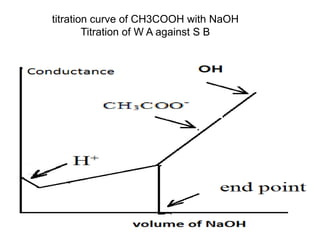
titration curve of CH3COOH with NaOH
Titration of W A against S B
Volume of NaOH
Strong acid
Weak acid
NaOH
Conductance
Titration of strong acid and weak acid in mixture with
S B “NaOH “
Applications of condutometry:
Conductometric determination of propranolol hydrochloride in
pharmaceuticals
Conductometric Determination of N-acetylcysteine in Pharmaceutical
Formulations Using Copper(II) Sulphate as Titrant
A Fast and Simple Conductometric Method for Verapamil Hydrochloride
Determination in Pharmaceutical Formulations
CONDUCTOMETRIC DETERMINATION OF THE ANTIHISTAMINIC
DIPHENHYDRAMINE HYDROCHLORIDE USING SILVER NITRATE
AS A TITRANT
Conductivity of solution
Volume of strong base
S/cm
0.00700
0.00
0.00660
1.00
0.00620
2.00
0.00580
3.00
0.00540
4.00
0.00500
5.00
0.00460
6.00
0.00420
7.00
0.00380
8.00
0.00340
9.00
0.00300
10.00
0.00260
11.00
0.00220
12.00
0.00213
13.00
0.00239
14.00
0.00265
15.00
0.00291
16.00
0.00317
17.00
0.00343
18.00
0.00369
19.00
0.00395
20.00
L m
Ex 1 :
Titration of a …… acid
with a strong base:
Ex 2 :
Titration of a …… acid
with a strong base:
Conductivity of solution
Volume of strong base
1.080
0.00
1.000
0.10
0.920
0.20
0.840
0.30
0.760
0.40
0.680
0.50
0.600
0.60
0.520
0.70
0.440
0.80
0.460
0.90
0.480
1.00
0.500
1.10
0.520
1.20
0.540
1.30
0.640
1.40
0.740
1.50
0.840
1.60
0.940
1.70
1.040
1.80
1.140
1.90
1.240
2.00
m
c/Sm
L m

CONDUCTOMETRIC METHODS OF ANALYSIS.ppt

  • 1.
    CONDUCTOMETRIC METHODS OFANALYSIS Introduction Conductometry: Is the simplest of the electroanalytical techniques. Conductivity is: “the ability of the medium to carry electric current”. Conductors are: either metallic (flow of electrons) or electrolytic (movement of ions).
  • 2.
    The conductivity ofa wire or a solution is the reciprocal of the resistance ; that is, Cond. “ G” = 1 / R Where: R = resistance in Ohms, and G = conductance in mhos (Ω-1) or siemens “s”. Also, from Ohm’s law we find that the resistance of a wire is given by the equation: I = E / R E= IR Where E= voltage applied to the solution or wire in volts I= current flowing through the solution in amperes R= resistance of the solution Introduction
  • 3.
    Conductance of electricity: Theconductance of a solution is a measure of how well a solution will carry current ( i.e pass electrons) The electrons are usually carried on the ions . The positive, such as M+, migrate through the solution toward the cathode, where they pick up electrons. Anions symbolized in general as A- , migrate towered the anode, where they deliver electrons. The net result is a flow of electrons through the solution ( i.e. The solution conducts electricity) . (i.e.) current is carried by all ions present in solution. Conductance depends on the number of ions in solution. Introduction
  • 4.
  • 5.
    Factors that affectthe mobility of the ion 1. The solvent ( e.g., water or organic), 2. The applied voltage 3. The size of the ion ( the larger it is the less mobile it will be), 4. The nature of the ion ( if it becomes hydrated , its effective size is increased). The mobility is also affected by • The viscosity • The temperature of the solvent
  • 6.
    Specific conductance (K) •Resistance is inversely proportional to the cross section area A and is directly proportional to the length of a conductor, • Conductance is directly proportional to the cross section area A and is inversely proportional to the length of a conductor, Thus, G  A/L so G =KA/L or K = GL/A where K is the specific conductance (the conductance when A and L are numerically equal). When unit of A and L is centimeter, K is: “the conductance of a cube of liquid one centimeter on a side ” its unit is mho-1 Cm-1 or S Cm-1
  • 7.
    Equivalent conductance (eq): “It is the conductance of a solution of one-gram equivalent of solute (with no respect of its volume) contained between two electrodes placed 1 cm apart.” Molar conductance (M ): “It is the conductance of a solution of one molar of solute (with no respect of its volume) contained between two electrodes placed 1 cm apart.” The value of equivalent conductance and molar conductance at infinite dilution) is used for comparison purposes.
  • 8.
    Molar conductance ofvarious ions at infinite dilution at 25℃ ions molar conductance K+ 73.52 Na+ 50.11 Li+ 38.69 H+ 349.82 Ag+ 61.92 Cl- 76.34 Br- 78.4 OH- 198 Total conductance of the solution is directly proportional to the sum of the n individual ion contributions . G = cim,I Ex:
  • 9.
    Conductivity measurements 2.Primary standardsolutions Primary standard KCl solution ,at 25℃, 7.419g of KCl in 1000g of solution has a specific conductivity of 0.01286Ω-1/cm. 1.Electrodes Two parallel platinized Pt. foil electrodes or Pt. black with electrodeposited a porous Pt. film which increases the surface area of the electrodes .
  • 10.
    3. Conductivity Cell: Avoid the change of temperature during determination 4.Wheat stone bridge : Conductivity Cell and Wheat stone Bridge a- Wheatstone bridge b-conductance cell
  • 11.
    Resistance A ismade of the cell containing the sample; B is a fixed resistance; R1 and R2 are variable. These may be adjusted so that the balance point can be reached. At this point Resistance A/B = Resistance R1/R2 The resistance R1, R2 and B can be measured, and from these measurements the resistance, and hence the conductance, of the cell can be calculated.
  • 12.
    APPLICATIONS OF CONDUCTOMETRY Itcan be used for the determination of:-  Solubility of sparingly soluble salts  Ionic product of water  Basicity of organic acids  Salinity of sea water (oceanographic work)  Chemical equilibrium in ionic reactions  Conductometric titration
  • 13.
    ADVANTAGES OF CONDUCTOMETRICTITRATIONS  No need of indicator  Colored or dilute solutions or turbid suspensions can be used for titrations.  Temperature is maintained constant throughout the titration.  End point can be determined accurately and errors are minimized as the end point is being determined graphically. DISADVANTAGES OF CONDUCTOMETRIC TITRATIONS - non specificity - interference of high conc. of other electrolytes
  • 14.
    Analytical Application Titration ofHCl against NaOH The following reaction occurs Chemical reaction HCl + NaOH → NaCl + H2O ↓ ↓ ionic reaction H+ + Cl- + Na+ +OH-→ Na+ + Cl- + H2O H+ and OH- ions have by far the largest molar conductance. H2O has a very low conductivity, So, acid-base titrations yield the most clearly defined equivalence points by conductometry.
  • 15.
    The original solutioncontained H+ and Cl- in water; the final solution contain Na+ and Cl- in water. It can be seen that Na+ has replaced H+, if we plot conductivity while NaOH is added, we observe the relationship as in the Fig. In part A of the curve H+ are being removed by the OH- of the NaOH added to the solution. The conductivity slowly decreases until the neutralization point C is reached. In part B of the curve, the H+ has been effectively removed from solution. Further addition of NaOH adds Na+ and OH- to the solution. An increase in conductivity results. The contribution of the Cl- , Na+, H+ and OH- ions to the total conductivity of the solution can be seen in the Fig. The volume of NaOH required to titrate the HCl can be measured by projecting lines A and B to the intersection C.
  • 16.
    Titration of HClagainst NaOH Titration of S A against S B
  • 17.
    titration curve ofCH3COOH with NaOH Titration of W A against S B
  • 18.
    Volume of NaOH Strongacid Weak acid NaOH Conductance Titration of strong acid and weak acid in mixture with S B “NaOH “
  • 19.
    Applications of condutometry: Conductometricdetermination of propranolol hydrochloride in pharmaceuticals Conductometric Determination of N-acetylcysteine in Pharmaceutical Formulations Using Copper(II) Sulphate as Titrant A Fast and Simple Conductometric Method for Verapamil Hydrochloride Determination in Pharmaceutical Formulations CONDUCTOMETRIC DETERMINATION OF THE ANTIHISTAMINIC DIPHENHYDRAMINE HYDROCHLORIDE USING SILVER NITRATE AS A TITRANT
  • 20.
    Conductivity of solution Volumeof strong base S/cm 0.00700 0.00 0.00660 1.00 0.00620 2.00 0.00580 3.00 0.00540 4.00 0.00500 5.00 0.00460 6.00 0.00420 7.00 0.00380 8.00 0.00340 9.00 0.00300 10.00 0.00260 11.00 0.00220 12.00 0.00213 13.00 0.00239 14.00 0.00265 15.00 0.00291 16.00 0.00317 17.00 0.00343 18.00 0.00369 19.00 0.00395 20.00 L m Ex 1 : Titration of a …… acid with a strong base:
  • 21.
    Ex 2 : Titrationof a …… acid with a strong base: Conductivity of solution Volume of strong base 1.080 0.00 1.000 0.10 0.920 0.20 0.840 0.30 0.760 0.40 0.680 0.50 0.600 0.60 0.520 0.70 0.440 0.80 0.460 0.90 0.480 1.00 0.500 1.10 0.520 1.20 0.540 1.30 0.640 1.40 0.740 1.50 0.840 1.60 0.940 1.70 1.040 1.80 1.140 1.90 1.240 2.00 m c/Sm L m