PLANAR CHROMATOGRAPHY
Submitted by
S. Srilakshmi
M.Pharm. 1st
Yeary
y14mph328
Department Of Pharmaceuticals Analysis
Under the guidance of
Ms. Srujani M.Pharm., PhD.
ACHARYA NAGARJUNA UNIVERSITY COLLEGE OF PHARMACEUTICAL SCIENCES
Chromatography
Chromatography is a technique for separating
mixtures into their components in order to analyze,
identify, purify, and/or quantify the mixture or
components.
Separate
• Analyze
• Identify
• Purify
• QuantifyComponentsMixture
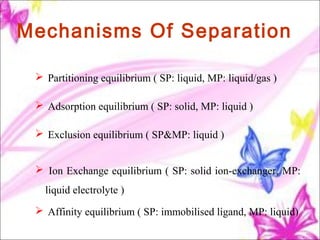
Mechanisms Of Separation
 Partitioning equilibrium ( SP: liquid, MP: liquid/gas )
 Adsorption equilibrium ( SP: solid, MP: liquid )
 Exclusion equilibrium ( SP&MP: liquid )
 Ion Exchange equilibrium ( SP: solid ion-exchanger, MP:
liquid electrolyte )
 Affinity equilibrium ( SP: immobilised ligand, MP: liquid)
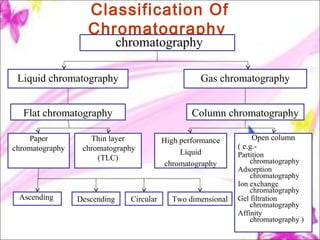
Classification Of
Chromatography
chromatography
Liquid chromatography Gas chromatography
Flat chromatography Column chromatography
Paper
chromatography
Thin layer
chromatography
(TLC)
Ascending Two dimensionalCircularDescending
High performance
Liquid
chromatography
Open column
( e.g.-
Partition
chromatography
Adsorption
chromatography
Ion exchange
chromatography
Gel filtration
chromatography
Affinity
chromatography )
Classification
 Column Chromatography
The stationary phase is held in a narrow tube through
which the mobile phase is forced under pressure or by
gravity.
 Planar Chromatography
The stationary phase is supported on a flat plate or
the interstices of a paper and the mobile phase moves
through the stationary phase by capillary action or by
gravity.
Planar Chromatography - Types
 Thin layer chromatography (TLC)
Separates dried liquid samples with a liquid
solvent (mobile phase) and a glass plate covered
with a thin layer of alumina or silica gel
(stationary phase).
 Paper Chromatography (PC)
Separates dried liquid samples with a liquid
solvent (mobile phase) and a paper strip
(stationary phase).
THIN LAYER
CHROMATOGRAP
HY (TLC)
Thin layer chromatography (TLC)
 In TLC, any substance that can be finely divided and
formed into a uniform layer can be used.
 Both organic and inorganic substances can be used to
form a uniform layer for TLC.
 Organic substances include: cellulose, polyamide,
polyethylene.
 Inorganic: silica gel, aluminum oxide and magnesium
silicate.
Continue…
 TLC to separate lipids
 Surface of the plate - very thin layer silica – SP
 Silica – polar (stationary phase)
 Spot the material at the bottom of the TLC plate
cellulose Al2O3
Continue…
 Place the plate into a glass jar - small amount of a
solvent
 This solvent - moving phase.
 Remove the plate from the bottle when the solvent is
close to the top of the plate.
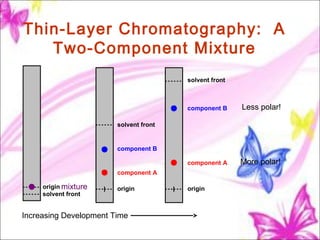
Thin-Layer Chromatography: A
Two-Component Mixture
More polar!
Less polar!
solvent front
origin mixture
solvent front
component B
component A
origin
solvent front
component B
component A
origin
Increasing Development Time
Thin Layer
Chromatography
TLC plate
O O O
| | |
−O−Si−O−Si−O−Si−O−H
| | |
O O O
| | |
−O−Si−O−Si−O−Si−O−H
| | |
O O O
silica gel - silicon dioxide (SiO2)x
(a common, inexpensive stationary phase)
bulk (SiO2)x
These exposed OH units
give silica gel a
relatively polar surface.
surface
Four Stages in TLC
1. Sample Application - Capillary used to spot solution of each sample.
2. Development - This is when the separation actually occurs.
3. Visualization - viewed under UV light.
4. Interpretation of Result - Comparison of retention factors.
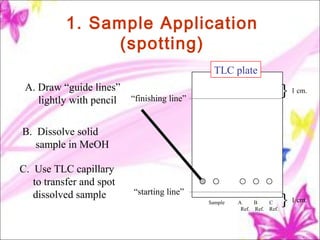
TLC plate
“finishing line”
} 1 cm.A. Draw “guide lines”
lightly with pencil
“starting line”
} 1 cm.
B. Dissolve solid
sample in MeOH
C. Use TLC capillary
to transfer and spot
dissolved sample
Sample A B C
Ref. Ref. Ref.
1. Sample Application
(spotting)
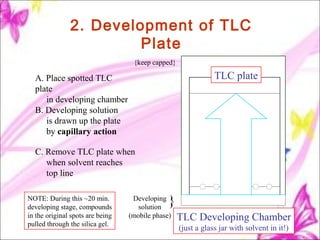
2. Development of TLC
Plate
TLC plate
TLC Developing Chamber
(just a glass jar with solvent in it!)
A. Place spotted TLC
plate
in developing chamber
B. Developing solution
is drawn up the plate
by capillary action
C. Remove TLC plate when
when solvent reaches
top line
Developing
solution
(mobile phase)
}
{keep capped}
NOTE: During this ~20 min.
developing stage, compounds
in the original spots are being
pulled through the silica gel.
3. Visualization of TLC
Results
A. Allow solvent to evaporate
from surface of TLC plate.
C. Mark spots with a pencil
while viewing under UV.
UV
B. View results under UV light.
look for grayish spots on the
fluorescent green background
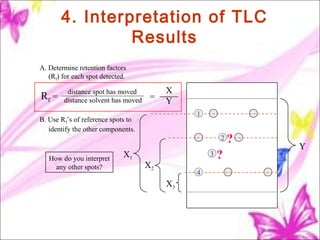
4. Interpretation of TLC
Results
A. Determine retention factors
(Rf) for each spot detected.
B. Use Rf’s of reference spots to
identify the other components.
distance spot has moved
distance solvent has moved
_______________________
Rf = =
X
Y
Y
- - - - - - - - - - - - - - - - - - - - - - -
X3
- - - - - - - - - - - - - - - - - - - - - - - - - - -
- - - - - - - - - - - - - - - - - - - - - - - - - - - - - - -
X1
X2
How do you interpret
any other spots?
4
1
3
2
?
?
Thin Layer Chromatography- Applications
1. Separation of carbohydrates:
Mobile phase:
acetonitrile : water (85:15)
Detection:
sulfuric acid : methanol (1:3)
Heat for 10 min at 110 C to see brown spots
Separation of Total Lipid into different Classes
Mobile Phase: hexane: diethyl ether: formic acid (80:20:2)
Cholesteryl esters
TAG
Free fatty acids
Cholesterol
1,3-DAG
1,2-DAG
Monoacyl glycerols
Phospholipids
Separation of Triacylglycerols
Mobile Phase: Pet ether: diethyl ether: acetic acid (90:9:1)
Tristearin
2-oleodistearin
1-stereodiolein
Triolein
Trolinolein
With HUFA
Paper Chromatography
 Purpose
Use the technique of paper chromatography to separate a
homogeneous mixture into its individual components.
 Uses
Separation
Identification
 Chromatography paper
Stationary phase
 Solvent
Mobile phase
Paper Chromatography
Continue…
 Paper chromatography is a variant of partition
chromatography procedure in which the cellulose
support is in the form of a sheet or paper.
 Cellulose contain a large amount of bound water even
when extensively dried.
 Partitioning occurs between the bound water and the
developing solvent.
Continue…
 In paper chromatography the mixture to be separated
is spotted onto the paper and dried
 Then the solvent flows along the sheet either by
gravity ( descending chromatography ) or capillary
attraction (ascending chromatography )
Place 25 mL of solvent in a 600 mL beaker.
Cover the beaker and set it aside.
25 mL
1 cm
2 mm
Obtain a piece of chromatography
paper and draw a line 1 cm from the
bottom with a pencil.
Place a small spot of each indicator
on the line.
Procedure
Spot and label each of the four indicators and
one of the unknowns.
The spots should be about 2 cm apart.
2 cm
When the spots have dried, re-spot each one.
Continue…
 When the spots have dried, form the paper
into a cylinder with the spots facing out.
Staple the edges together being careful to
keep them straight and not allowing them
to touch.
 Place the cylinder into the 600 mL beaker
and replace the cover. Be sure the
cylinder is not touching the sides of the
beaker.
Continue…
Let the chromatogram develop until the
solvent is 2 cm from the top of the paper.
Remove the chromatogram from the beaker
and immediately mark the solvent front
with a pencil.
Allow the chromatogram to dry before
going to the next step.
Continue…
Take the chromatogram to the hood
and lightly mist it with water. Place
it in the ammonia chamber.
Remove the cylinder
from the ammonia
chamber and unroll it.
Immediately circle the
colored regions with a
pencil.
Continue…
Continue…
Determine the RF values for
each colored spot in the
known and the unknown.
a
b
c
dRRF(a)F(a) ==
aa
dd
Use your computed RF values
to identify the components of
your unknown.
Paper Chromatography-
Applications
 Separation of amino acids
Mobile phase: butanol : acetic acid: water(4:1:1)
Detection: spray with ninhydrin reagent
 Separation of carbohydrates:
Mobile phase: ethylacetate : pyridine water(10:4:3)
Detection: 1. silver nitrate (1 ml in 200 ml of acetone)
2. 40% NaOH in methanol gives brown
spots
Planarchromatography

Planarchromatography

  • 1.
    PLANAR CHROMATOGRAPHY Submitted by S.Srilakshmi M.Pharm. 1st Yeary y14mph328 Department Of Pharmaceuticals Analysis Under the guidance of Ms. Srujani M.Pharm., PhD. ACHARYA NAGARJUNA UNIVERSITY COLLEGE OF PHARMACEUTICAL SCIENCES
  • 2.
    Chromatography Chromatography is atechnique for separating mixtures into their components in order to analyze, identify, purify, and/or quantify the mixture or components. Separate • Analyze • Identify • Purify • QuantifyComponentsMixture
  • 3.
    Mechanisms Of Separation Partitioning equilibrium ( SP: liquid, MP: liquid/gas )  Adsorption equilibrium ( SP: solid, MP: liquid )  Exclusion equilibrium ( SP&MP: liquid )  Ion Exchange equilibrium ( SP: solid ion-exchanger, MP: liquid electrolyte )  Affinity equilibrium ( SP: immobilised ligand, MP: liquid)
  • 4.
    Classification Of Chromatography chromatography Liquid chromatographyGas chromatography Flat chromatography Column chromatography Paper chromatography Thin layer chromatography (TLC) Ascending Two dimensionalCircularDescending High performance Liquid chromatography Open column ( e.g.- Partition chromatography Adsorption chromatography Ion exchange chromatography Gel filtration chromatography Affinity chromatography )
  • 5.
    Classification  Column Chromatography Thestationary phase is held in a narrow tube through which the mobile phase is forced under pressure or by gravity.  Planar Chromatography The stationary phase is supported on a flat plate or the interstices of a paper and the mobile phase moves through the stationary phase by capillary action or by gravity.
  • 6.
    Planar Chromatography -Types  Thin layer chromatography (TLC) Separates dried liquid samples with a liquid solvent (mobile phase) and a glass plate covered with a thin layer of alumina or silica gel (stationary phase).  Paper Chromatography (PC) Separates dried liquid samples with a liquid solvent (mobile phase) and a paper strip (stationary phase).
  • 7.
  • 8.
    Thin layer chromatography(TLC)  In TLC, any substance that can be finely divided and formed into a uniform layer can be used.  Both organic and inorganic substances can be used to form a uniform layer for TLC.  Organic substances include: cellulose, polyamide, polyethylene.  Inorganic: silica gel, aluminum oxide and magnesium silicate.
  • 10.
    Continue…  TLC toseparate lipids  Surface of the plate - very thin layer silica – SP  Silica – polar (stationary phase)  Spot the material at the bottom of the TLC plate cellulose Al2O3
  • 11.
    Continue…  Place theplate into a glass jar - small amount of a solvent  This solvent - moving phase.  Remove the plate from the bottle when the solvent is close to the top of the plate.
  • 12.
    Thin-Layer Chromatography: A Two-ComponentMixture More polar! Less polar! solvent front origin mixture solvent front component B component A origin solvent front component B component A origin Increasing Development Time
  • 13.
    Thin Layer Chromatography TLC plate OO O | | | −O−Si−O−Si−O−Si−O−H | | | O O O | | | −O−Si−O−Si−O−Si−O−H | | | O O O silica gel - silicon dioxide (SiO2)x (a common, inexpensive stationary phase) bulk (SiO2)x These exposed OH units give silica gel a relatively polar surface. surface
  • 14.
    Four Stages inTLC 1. Sample Application - Capillary used to spot solution of each sample. 2. Development - This is when the separation actually occurs. 3. Visualization - viewed under UV light. 4. Interpretation of Result - Comparison of retention factors.
  • 15.
    TLC plate “finishing line” }1 cm.A. Draw “guide lines” lightly with pencil “starting line” } 1 cm. B. Dissolve solid sample in MeOH C. Use TLC capillary to transfer and spot dissolved sample Sample A B C Ref. Ref. Ref. 1. Sample Application (spotting)
  • 16.
    2. Development ofTLC Plate TLC plate TLC Developing Chamber (just a glass jar with solvent in it!) A. Place spotted TLC plate in developing chamber B. Developing solution is drawn up the plate by capillary action C. Remove TLC plate when when solvent reaches top line Developing solution (mobile phase) } {keep capped} NOTE: During this ~20 min. developing stage, compounds in the original spots are being pulled through the silica gel.
  • 17.
    3. Visualization ofTLC Results A. Allow solvent to evaporate from surface of TLC plate. C. Mark spots with a pencil while viewing under UV. UV B. View results under UV light. look for grayish spots on the fluorescent green background
  • 18.
    4. Interpretation ofTLC Results A. Determine retention factors (Rf) for each spot detected. B. Use Rf’s of reference spots to identify the other components. distance spot has moved distance solvent has moved _______________________ Rf = = X Y Y - - - - - - - - - - - - - - - - - - - - - - - X3 - - - - - - - - - - - - - - - - - - - - - - - - - - - - - - - - - - - - - - - - - - - - - - - - - - - - - - - - - - X1 X2 How do you interpret any other spots? 4 1 3 2 ? ?
  • 19.
    Thin Layer Chromatography-Applications 1. Separation of carbohydrates: Mobile phase: acetonitrile : water (85:15) Detection: sulfuric acid : methanol (1:3) Heat for 10 min at 110 C to see brown spots
  • 20.
    Separation of TotalLipid into different Classes Mobile Phase: hexane: diethyl ether: formic acid (80:20:2) Cholesteryl esters TAG Free fatty acids Cholesterol 1,3-DAG 1,2-DAG Monoacyl glycerols Phospholipids
  • 21.
    Separation of Triacylglycerols MobilePhase: Pet ether: diethyl ether: acetic acid (90:9:1) Tristearin 2-oleodistearin 1-stereodiolein Triolein Trolinolein With HUFA
  • 23.
    Paper Chromatography  Purpose Usethe technique of paper chromatography to separate a homogeneous mixture into its individual components.  Uses Separation Identification  Chromatography paper Stationary phase  Solvent Mobile phase
  • 24.
  • 25.
    Continue…  Paper chromatographyis a variant of partition chromatography procedure in which the cellulose support is in the form of a sheet or paper.  Cellulose contain a large amount of bound water even when extensively dried.  Partitioning occurs between the bound water and the developing solvent.
  • 26.
    Continue…  In paperchromatography the mixture to be separated is spotted onto the paper and dried  Then the solvent flows along the sheet either by gravity ( descending chromatography ) or capillary attraction (ascending chromatography )
  • 27.
    Place 25 mLof solvent in a 600 mL beaker. Cover the beaker and set it aside. 25 mL 1 cm 2 mm Obtain a piece of chromatography paper and draw a line 1 cm from the bottom with a pencil. Place a small spot of each indicator on the line. Procedure
  • 28.
    Spot and labeleach of the four indicators and one of the unknowns. The spots should be about 2 cm apart. 2 cm When the spots have dried, re-spot each one. Continue…
  • 29.
     When thespots have dried, form the paper into a cylinder with the spots facing out. Staple the edges together being careful to keep them straight and not allowing them to touch.  Place the cylinder into the 600 mL beaker and replace the cover. Be sure the cylinder is not touching the sides of the beaker. Continue…
  • 30.
    Let the chromatogramdevelop until the solvent is 2 cm from the top of the paper. Remove the chromatogram from the beaker and immediately mark the solvent front with a pencil. Allow the chromatogram to dry before going to the next step. Continue…
  • 31.
    Take the chromatogramto the hood and lightly mist it with water. Place it in the ammonia chamber. Remove the cylinder from the ammonia chamber and unroll it. Immediately circle the colored regions with a pencil. Continue…
  • 32.
    Continue… Determine the RFvalues for each colored spot in the known and the unknown. a b c dRRF(a)F(a) == aa dd Use your computed RF values to identify the components of your unknown.
  • 33.
    Paper Chromatography- Applications  Separationof amino acids Mobile phase: butanol : acetic acid: water(4:1:1) Detection: spray with ninhydrin reagent  Separation of carbohydrates: Mobile phase: ethylacetate : pyridine water(10:4:3) Detection: 1. silver nitrate (1 ml in 200 ml of acetone) 2. 40% NaOH in methanol gives brown spots