Thin-Layer Chromatography and Column Chromatography
Background Chromatography:   refers to several related techniques for analyzing, identifying, or separating mixtures of compounds. Two-part operation: The sample mixture is placed into a moving liquid or gas:  mobile phase The mobile phase carries the sample through a solid support:  stationary phase Compounds move through the stationary phase at different rates due to different attractions from the mobile and stationary phases
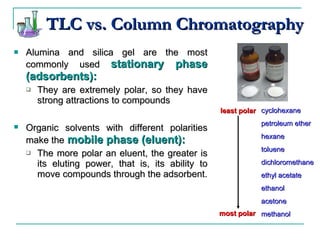
Alumina and silica gel are the most commonly used  stationary phase   (adsorbents):  They are extremely polar, so they have strong attractions to compounds Organic solvents with different polarities   make the  mobile phase (eluent): The more polar an eluent, the greater is its eluting power, that is, its ability to move compounds through the adsorbent. cyclohexane petroleum ether hexane toluene dichloromethane ethyl acetate ethanol acetone methanol least polar most polar TLC vs. Column Chromatography
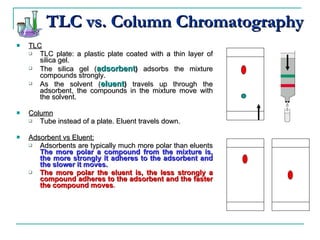
TLC vs. Column Chromatography TLC TLC plate: a plastic plate coated with a thin layer of silica gel. The silica gel ( adsorbent )  adsorbs the mixture compounds strongly. As the solvent ( eluent )  travels up through the adsorbent, the compounds in the mixture move with the solvent. Column Tube instead of a plate. Eluent travels down. Adsorbent vs Eluent: Adsorbents are typically much more polar than eluents  The more polar a compound from the mixture is, the more strongly it adheres to the adsorbent and the slower it moves. The more polar the eluent is, the less strongly a compound adheres to the adsorbent and the faster the compound moves .
Thin-Layer Chromatography
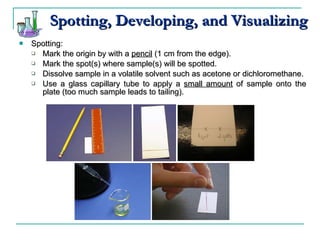
Spotting, Developing, and Visualizing Spotting: Mark the origin by with a  pencil  (1 cm from the edge). Mark the spot(s) where sample(s) will be spotted. Dissolve sample in a volatile solvent such as acetone or dichloromethane. Use a glass capillary tube to apply a  small amount  of sample onto the plate (too much sample leads to tailing).
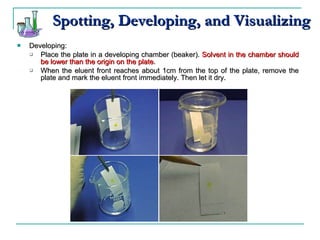
Spotting, Developing, and Visualizing Developing: Place the plate in a developing chamber (beaker).  Solvent in the chamber should be lower than the origin on the plate . When the eluent front reaches about 1cm from the top of the plate, remove the plate and mark the eluent front immediately. Then let it dry.
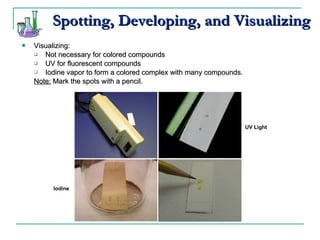
Spotting, Developing, and Visualizing Visualizing: Not necessary for colored compounds UV for fluorescent compounds Iodine vapor to form a colored complex with many compounds. Note:  Mark the spots with a pencil. UV Light Iodine
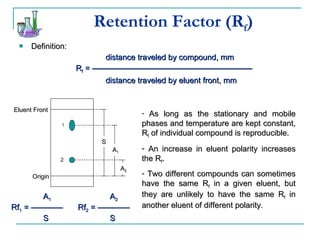
Retention Factor (R f ) Definition:    distance traveled by compound, mm   R f  =  ————————————————————   distance traveled by eluent front, mm Eluent Front S A 1 Origin A 1 Rf 1  = ———— S As long as the stationary and mobile phases and temperature are kept constant, R f  of individual compound is reproducible. An increase in eluent polarity increases the R f . Two different compounds can sometimes have the same R f  in a given eluent, but they are unlikely to have the same R f  in another eluent of different polarity . 1 2 A 2 A 2 Rf 2  = ———— S
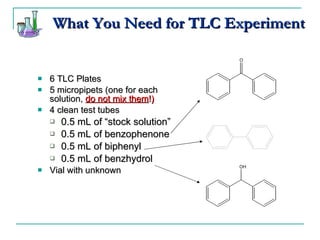
What You Need for TLC Experiment 6 TLC Plates 5 micropipets (one for each solution,  do not mix them !) 4 clean test tubes 0.5 mL of “stock solution” 0.5 mL of benzophenone 0.5 mL of biphenyl 0.5 mL of benzhydrol Vial with unknown
TLC Experiment Omit Part 1. Part 2: Al foil is used instead of plastic wrap in Fig. 4. Part 4: Only ethyl acetate, hexane and toluene are used (so only 3 plates are needed). Part 5: Use only 2 plates (ask TA how). Part 7: All solvents go into a waste bottle. Turn in ALL plates with your report (in an envelope or zip lock bag).
Column Chromatography
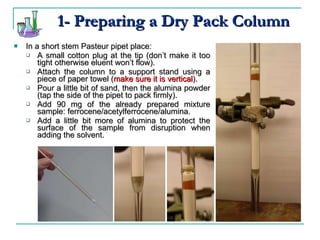
1- Preparing a Dry Pack Column In a short stem Pasteur pipet place:  A small cotton plug at the tip (don’t make it too tight otherwise eluent won’t flow). Attach the column to a support stand using a piece of paper towel ( make sure it is vertical ). Pour a little bit of sand, then the alumina powder (tap the side of the pipet to pack firmly). Add 90 mg of the already prepared mixture sample: ferrocene/acetylferrocene/alumina. Add a little bit more of alumina to protect the surface of the sample from disruption when adding the solvent.
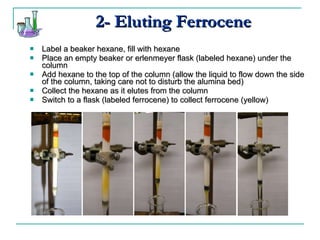
2- Eluting Ferrocene Label a beaker hexane, fill with hexane Place an empty beaker or erlenmeyer flask (labeled hexane) under the column Add hexane to the top of the column (allow the liquid to flow down the side of the column, taking care not to disturb the alumina bed) Collect the hexane as it elutes from the column Switch to a flask (labeled ferrocene) to collect ferrocene (yellow)
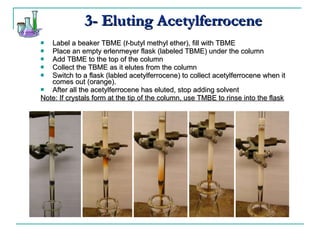
3- Eluting Acetylferrocene Label a beaker TBME ( t -butyl methyl ether), fill with TBME Place an empty erlenmeyer flask (labeled TBME) under the column Add TBME to the top of the column Collect the TBME as it elutes from the column Switch to a flask (labled acetylferrocene) to collect acetylferrocene when it comes out (orange). After all the acetylferrocene has eluted, stop adding solvent Note: If crystals form at the tip of the column, use TMBE to rinse into the flask
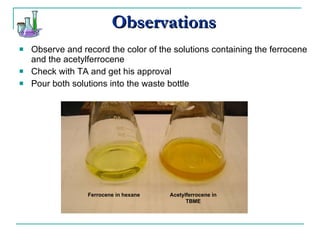
Observations Observe and record the color of the solutions containing the ferrocene and the acetylferrocene Check with TA and get his approval Pour both solutions into the waste bottle Ferrocene in hexane Acetylferrocene in TBME
Experiment Part 1: It’s unnecessary to weigh the flasks. Larger Erlenmeyer flasks may be substituted for the 50 ml flasks. Part 3: “Preparing the Sample” has already been done. Weigh out 90 mg of the prepared ferrocene/acetylferrocene/alumina sample. Part 7: Omit. Only observe and record the color and show your TA.
Waste Disposal Waste solvents are collected in the hood. Column glass pipets  will be collected in the hood for proper disposal. Good to know if you want to have a good grade: Your grade will suffer if you do not submit your  TLC plates .  50% of your grade is based upon the results of your lab work and 50% upon your answers to lab questions and the write-up of your report. Have fun!

Chromatography Fall 09

  • 1.
    Thin-Layer Chromatography andColumn Chromatography
  • 2.
    Background Chromatography: refers to several related techniques for analyzing, identifying, or separating mixtures of compounds. Two-part operation: The sample mixture is placed into a moving liquid or gas: mobile phase The mobile phase carries the sample through a solid support: stationary phase Compounds move through the stationary phase at different rates due to different attractions from the mobile and stationary phases
  • 3.
    Alumina and silicagel are the most commonly used stationary phase (adsorbents): They are extremely polar, so they have strong attractions to compounds Organic solvents with different polarities make the mobile phase (eluent): The more polar an eluent, the greater is its eluting power, that is, its ability to move compounds through the adsorbent. cyclohexane petroleum ether hexane toluene dichloromethane ethyl acetate ethanol acetone methanol least polar most polar TLC vs. Column Chromatography
  • 4.
    TLC vs. ColumnChromatography TLC TLC plate: a plastic plate coated with a thin layer of silica gel. The silica gel ( adsorbent ) adsorbs the mixture compounds strongly. As the solvent ( eluent ) travels up through the adsorbent, the compounds in the mixture move with the solvent. Column Tube instead of a plate. Eluent travels down. Adsorbent vs Eluent: Adsorbents are typically much more polar than eluents The more polar a compound from the mixture is, the more strongly it adheres to the adsorbent and the slower it moves. The more polar the eluent is, the less strongly a compound adheres to the adsorbent and the faster the compound moves .
  • 5.
  • 6.
    Spotting, Developing, andVisualizing Spotting: Mark the origin by with a pencil (1 cm from the edge). Mark the spot(s) where sample(s) will be spotted. Dissolve sample in a volatile solvent such as acetone or dichloromethane. Use a glass capillary tube to apply a small amount of sample onto the plate (too much sample leads to tailing).
  • 7.
    Spotting, Developing, andVisualizing Developing: Place the plate in a developing chamber (beaker). Solvent in the chamber should be lower than the origin on the plate . When the eluent front reaches about 1cm from the top of the plate, remove the plate and mark the eluent front immediately. Then let it dry.
  • 8.
    Spotting, Developing, andVisualizing Visualizing: Not necessary for colored compounds UV for fluorescent compounds Iodine vapor to form a colored complex with many compounds. Note: Mark the spots with a pencil. UV Light Iodine
  • 9.
    Retention Factor (Rf ) Definition: distance traveled by compound, mm R f = ———————————————————— distance traveled by eluent front, mm Eluent Front S A 1 Origin A 1 Rf 1 = ———— S As long as the stationary and mobile phases and temperature are kept constant, R f of individual compound is reproducible. An increase in eluent polarity increases the R f . Two different compounds can sometimes have the same R f in a given eluent, but they are unlikely to have the same R f in another eluent of different polarity . 1 2 A 2 A 2 Rf 2 = ———— S
  • 10.
    What You Needfor TLC Experiment 6 TLC Plates 5 micropipets (one for each solution, do not mix them !) 4 clean test tubes 0.5 mL of “stock solution” 0.5 mL of benzophenone 0.5 mL of biphenyl 0.5 mL of benzhydrol Vial with unknown
  • 11.
    TLC Experiment OmitPart 1. Part 2: Al foil is used instead of plastic wrap in Fig. 4. Part 4: Only ethyl acetate, hexane and toluene are used (so only 3 plates are needed). Part 5: Use only 2 plates (ask TA how). Part 7: All solvents go into a waste bottle. Turn in ALL plates with your report (in an envelope or zip lock bag).
  • 12.
  • 13.
    1- Preparing aDry Pack Column In a short stem Pasteur pipet place: A small cotton plug at the tip (don’t make it too tight otherwise eluent won’t flow). Attach the column to a support stand using a piece of paper towel ( make sure it is vertical ). Pour a little bit of sand, then the alumina powder (tap the side of the pipet to pack firmly). Add 90 mg of the already prepared mixture sample: ferrocene/acetylferrocene/alumina. Add a little bit more of alumina to protect the surface of the sample from disruption when adding the solvent.
  • 14.
    2- Eluting FerroceneLabel a beaker hexane, fill with hexane Place an empty beaker or erlenmeyer flask (labeled hexane) under the column Add hexane to the top of the column (allow the liquid to flow down the side of the column, taking care not to disturb the alumina bed) Collect the hexane as it elutes from the column Switch to a flask (labeled ferrocene) to collect ferrocene (yellow)
  • 15.
    3- Eluting AcetylferroceneLabel a beaker TBME ( t -butyl methyl ether), fill with TBME Place an empty erlenmeyer flask (labeled TBME) under the column Add TBME to the top of the column Collect the TBME as it elutes from the column Switch to a flask (labled acetylferrocene) to collect acetylferrocene when it comes out (orange). After all the acetylferrocene has eluted, stop adding solvent Note: If crystals form at the tip of the column, use TMBE to rinse into the flask
  • 16.
    Observations Observe andrecord the color of the solutions containing the ferrocene and the acetylferrocene Check with TA and get his approval Pour both solutions into the waste bottle Ferrocene in hexane Acetylferrocene in TBME
  • 17.
    Experiment Part 1:It’s unnecessary to weigh the flasks. Larger Erlenmeyer flasks may be substituted for the 50 ml flasks. Part 3: “Preparing the Sample” has already been done. Weigh out 90 mg of the prepared ferrocene/acetylferrocene/alumina sample. Part 7: Omit. Only observe and record the color and show your TA.
  • 18.
    Waste Disposal Wastesolvents are collected in the hood. Column glass pipets will be collected in the hood for proper disposal. Good to know if you want to have a good grade: Your grade will suffer if you do not submit your TLC plates . 50% of your grade is based upon the results of your lab work and 50% upon your answers to lab questions and the write-up of your report. Have fun!