
RAW MATERIALS, SPECIFICATION OF
   MATERIALS AND FINISHED
          PRODUCTS
                      1


         P R E PA R E D B Y: K E Y U R R . P R A J A PAT I
         M.PHARM SEM-I (Q . A)
         G U I D E D B Y : M R . A N A N D K . PAT E L


         D E PA R T M E N T O F Q . A
         A . P. M . C . C O L L E G E O F P H A R M A C Y
         H I M M AT N A G A R
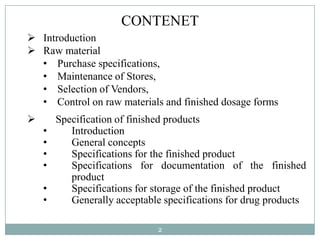
CONTENET
 Introduction
 Raw material
  • Purchase specifications,
  • Maintenance of Stores,
  • Selection of Vendors,
  • Control on raw materials and finished dosage forms
       Specification of finished products
    •      Introduction
    •      General concepts
    •      Specifications for the finished product
    •      Specifications for documentation of the finished
           product
    •      Specifications for storage of the finished product
    •      Generally acceptable specifications for drug products

                              2
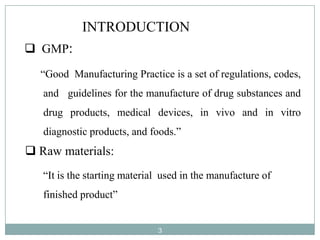
INTRODUCTION
 GMP:
  “Good Manufacturing Practice is a set of regulations, codes,
   and guidelines for the manufacture of drug substances and
   drug products, medical devices, in vivo and in vitro
   diagnostic products, and foods.”
 Raw materials:
   “It is the starting material used in the manufacture of
   finished product”


                              3
Principle
 Objective of the pharmaceutical manufacturer
    produce finished products for patient's use from a
       combination of materials
 Materials combined
    Active pharmaceutical ingredients and
    Excipients (auxiliary materials)
    Packaging materials
 Materials include also
    Gases, solvents, reagents, process aids, etc.
    Special attention


                           4
General requirements for materials
 Materials for cleaning, lubrication, and pest control
   Not in direct contact with product
   Suitable grade, e.g. food grade if possible
 All incoming materials and finished products
   quarantined after receipt or processing
     until released for use or distribution
Maintenance of stores
  Good state of repair: Walls, Ceiling Paint, Plumbing,
   Electrical damages
  Protection from light and Exposure to air


                               5
 Storage specification
    • under appropriate conditions
    • orderly fashion (batch segregation)
    • materials management
    • stock rotation (FEFO)
 Water – suitable for use


                             6
Starting Materials

 Purchasing Specifications:
   important –highly techno commercial operation
   From approved suppliers – if possible, direct from the
     manufacturer
   Vendor selection and certification
   Consistency of Quality
   Capacity of plant for Volume Requirements
   Consistency of price


                                7
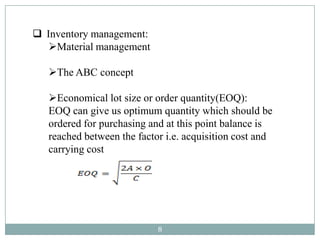
 Inventory management:
   Material management

   The ABC concept

   Economical lot size or order quantity(EOQ):
   EOQ can give us optimum quantity which should be
   ordered for purchasing and at this point balance is
   reached between the factor i.e. acquisition cost and
   carrying cost


                            8
Where, A=annual or periodical requirement
       O=ordering cost
       C=carrying cost per unit

 Consignment checks
   Integrity of package
   Seal intact
   Corresponds with the purchase order
   Delivery note
   Supplier’s labels


                             9
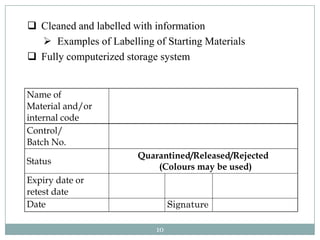
 Cleaned and labelled with information
   Examples of Labelling of Starting Materials
 Fully computerized storage system


Name of
Material and/or
internal code
Control/
Batch No.
                       Quarantined/Released/Rejected
Status
                           (Colours may be used)
Expiry date or
retest date
Date                            Signature

                           10
 Appropriate measure to ensure identity of
  contents of materials
 Use only QC released material if within shelf-life
 Dispensing
   designated persons
   written procedure
   Correct materials accurately weighed
   clean, properly labelled containers
 Independent checks and record
   material and weight or volume
 Dispensed material
   kept together and labelled


                           11
Packaging materials

  Type of packaging materials:
     Primary packaging materials
     Secondary packaging materials
     Printed and Unprinted packaging materials
  Each delivery or batch: specific reference number or
   identification mark
  Delivery to packaging department
    Check quantity, identity and conformity to packaging
      instructions

                              12
 Outdated or obsolete material
   Destroyed
   Disposal record


                             13
Vendor selection and Evaluation

 This SOP describes the procedure to be followed during the
  vendor assessment and vendor evaluation for purchasing of
  raw materials, critical and non critical packaging
  components, laboratory supplies, engineering supplies and
  imported finished goods from the vendor.
 These instructions are essential for approving prospective
  vendor.
 The SOP doesn’t describe the process of selection of a
  contract Manufacturer.


                             14                     14
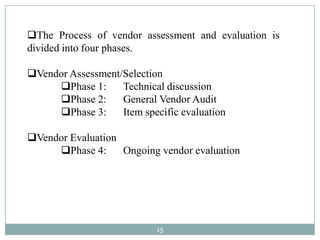
The Process of vendor assessment and evaluation is
divided into four phases.

Vendor Assessment/Selection
     Phase 1:     Technical discussion
     Phase 2:     General Vendor Audit
     Phase 3:     Item specific evaluation

Vendor Evaluation
     Phase 4:     Ongoing vendor evaluation


                            15
Vendor certification

 This procedure aim to describe the process by which a
  vendor may be certified to supply materials or services.
 This procedure applies to vendors that supply a material
  or service to be used at any stage of manufacture by
  operations.
 Here you will get the roles of each department in the
  process to certify an approved vendor.


                             16
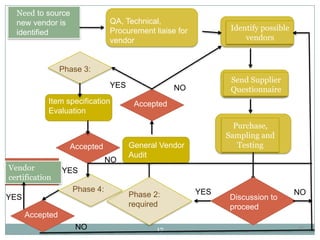
Need to source
  new vendor is                QA, Technical,
                               Procurement liaise for          Identify possible
  identified
                               vendor                              vendors


                 Phase 3:
                                                               Send Supplier
                               YES               NO            Questionnaire
            Item specification        Accepted
            Evaluation
                                                                Purchase,
                                                              Sampling and
                   Accepted          General Vendor              Testing
                                     Audit
                               NO
Vendor           YES
certification
                    Phase 4:                            YES                        NO
YES                                  Phase 2:                 Discussion to
                                     required                 proceed
      Accepted
                     NO                     17                                     17
Specifications

 Authorized, approved, signed and dated
     Starting, packaging materials and finished products:
      include tests on identity, content, purity, quality
     Intermediates and bulk
     Water, solvents and reagents
 QC, QA or documentation centre


                            18
Specifications: Starting and packaging materials

Include:
   Name (e.g. INN) and internal code
   Pharmacopoeia (if applicable)
   Qualitative and quantitative requirements and limits
Other data may include:
   Supplier
   Sampling procedure or reference
   Storage conditions, precautions
   Retest date


                               19
Quality control of raw material and finished
                   product
         Retest Dating of Raw Materials
The purpose of this procedure is:
 to describe how to run the expired stock report; to describe
  how to define the requirements for the retesting and assignment
  of storage period for active ingredients, excipients and raw
  materials;
 to instruct retesting procedure and to determine the status of a
  finished goods batch with a shorter shelf life.


                               20
Archiving Laboratory Documentation

 This procedure describes retention and disposal procedures of
  laboratory documentation, general laboratory documentation
  system that includes
   handling of rejected raw material and finished product
    reports,
   finished goods certificate of analysis,

   finished goods register,

   raw material certificate of analysis,

   procedure for long term document retention.


                              21
Raw Materials-Laboratory Testing and
                  Documentation
 This SOP describes the procedure for
     sampling,
     location,
     pre-testing,
     testing and documentation of all raw materials and
      components subject to test,
     out of specification results,
     microbiological tests and
     release procedure for passed raw materials and components.


                                22
Finished Goods-Laboratory Testing and
                  Documentation
 This SOP describes the procedure for
     sampling, location, pre-testing,
     testing and documentation of all finished products subject to
      test,
     reagents and standards to be used for analysis,
     management of out of specification results,
     microbiological tests and
     release procedure for passed finished goods.


                                 23
INTRODUCTION

 SPECIFICATION:
 “Defined as list of tests, references to analytical
  procedures, and appropriate acceptance criteria which
  are numerical limits, ranges or other criteria for the
  test described.”

 It establishes the set of criteria to which the drug
 substance, drug product or material at any stages of
 manufacture should conform that they are acceptable
 for their intended use.


                           24
 It describes in detail the requirements with which
   products or materials used or obtained during
   manufacturing have to conform.
  Conformance to specification means that the drug
   substance and drug product ,when tested according to the
   listed analytical procedures will meet the acceptance
   criteria.
Finished product:
  A pharmaceutical product that has under gone all stages of
   production and quality control including being packaged in
   its final container and labeled.
  Finished product should be held under quarantine until their
   final release ,after which they should be stored as usable
   stock under conditions established by manufacturer.

                             25
 Types of specifications
     Raw material specifications
     Container closure specifications
     Finished product specifications

 Finished product specifications
    Release specifications:
   The combinations of physical, chemical, biological and
   microbiological test requirements that determine whether a
   drug product is suitable for release at the time of manufacture.

   Stability indicating specifications:
   The combination of physical, chemical, biological and
   microbiological test requirements that the active ingredients
   or a drug product must meet during its shelf life

                               26
OBJECTIVE OF THE
                 SPECIFICATIONS
 The objective of specifications is to assure that each unit
  contains the amount of drug claimed on the label, that all the
  drug in each unit is available for complete use ,that the drug
  stable in the formulation in its specific final container for
  its expected shelf life ,and that it contains no toxic foreign
  substance
It provide guideline on the setting and justification of
acceptance criteria and the selection of test procedure for new
drug substances of synthetic chemical origin and new drug
product made for them, which have not previously been
registered in any of the pharmacopoeia.

                               27
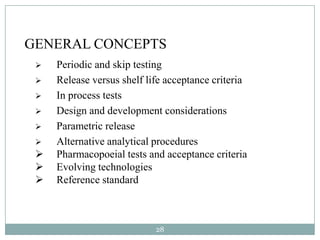
GENERAL CONCEPTS
    Periodic and skip testing
    Release versus shelf life acceptance criteria
    In process tests
    Design and development considerations
    Parametric release
    Alternative analytical procedures
    Pharmacopoeial tests and acceptance criteria
    Evolving technologies
    Reference standard


                            28
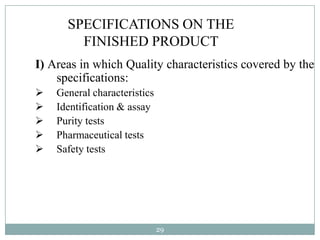
SPECIFICATIONS ON THE
        FINISHED PRODUCT
I) Areas in which Quality characteristics covered by the
    specifications:
   General characteristics
   Identification & assay
   Purity tests
   Pharmaceutical tests
   Safety tests


                              29
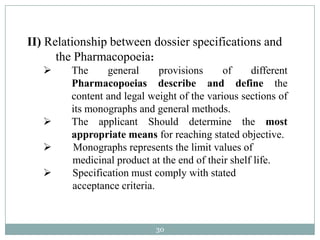
II) Relationship between dossier specifications and
      the Pharmacopoeia:
       The     general      provisions     of     different
        Pharmacopoeias describe and define the
        content and legal weight of the various sections of
        its monographs and general methods.
       The applicant Should determine the most
        appropriate means for reaching stated objective.
       Monographs represents the limit values of
        medicinal product at the end of their shelf life.
       Specification must comply with stated
        acceptance criteria.


                            30
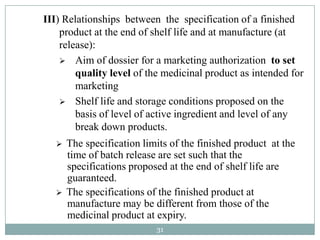
III) Relationships between the specification of a finished
    product at the end of shelf life and at manufacture (at
    release):
     Aim of dossier for a marketing authorization to set
        quality level of the medicinal product as intended for
        marketing
     Shelf life and storage conditions proposed on the
        basis of level of active ingredient and level of any
        break down products.
      The specification limits of the finished product at the
       time of batch release are set such that the
       specifications proposed at the end of shelf life are
       guaranteed.
      The specifications of the finished product at
       manufacture may be different from those of the
       medicinal product at expiry.
                            31
IV) Specifications and routine tests for the release of batches of
    finished product at the time of manufacture (at release) :

    Relationship between validation of the manufacturing
     process, GMP and establishment of specifications.
    Routine tests and periodic tests. Different type of tests.
    Scheme for verifying specifications


                              32
V) Acceptance limits :

 Acceptance limits of pharmaco technical
  parameters
 Maximum acceptable deviation in the content of
  active substances “unless there is appropriate
  justification”
 Acceptance limits for excipients.


                        33
SPECIFICATION FOR DOCUMENTATION
           OF FINISHED PRODUCT
Designated name of the product and the code reference where
applicable.
 Designated name(s) of the active ingredients(s).

 Formula or reference to formula.

 Dosage form description and the package details

Directions for sampling and testing or a reference to procedures.

 Quantitative and qualitative requirements with acceptance limit.
Storage conditions and precautions where applicable.
 Shelf life.
                                 34
SPECIFICATIONS FOR STORAGE
          OF FINISHED PRODUCT
   Should be held in quarantine until their final release
   Separate area should be provided for the storage
   Stored according to their dosage form
    Storage areas should have adequate height and ventilation,
adequate storage equipment .
     Adjacent to finished product area, an assembling and
packaging area may be provided.


                              35
GENERALLY ACCEPTABLE
    SPECIFICATIONS FOR DRUG PRODUCTS
  General:
  Organoleptic properties (appearance, color, odor)
  Identification
  Purity
  PH
  Moisture content
  Abnormal toxicity
 Specific
   Capsules
   Emulsions
   Tablet
   Oral solutions and suspension
                              36
   Oral powders
   Metered dose inhalation aerosols
   Topical and ophthalmic preparation
   Small volume parenterals
   Large volume parenterals
   Suppositories
   Drug additives


                          37
REFERENCE:
1.   Good manufacturing practices for pharmaceuticals. 4th
     edition ,Sidney H.Willig , James R.Stoker, Marcel
     Dekker INC. Page no.386-401

2.   cGMP ,documentation and validation, Prof. Manohar
     A.Potdar, PharmaMed press, Page no.113-149,354-360

3.   Pharmaceutical dosage forms: Parentral medications
     Volume 3,2nd edition ,Edited by Kenneth E.Avis,Herbert
     A. Lieberman, and Leon Lachman ,Marcel Dekker INC.
     Page no.58-62


                              38
4. Pharmaceutical dosage forms: Tablets, Volume 1,2nd
edition ,Edited by Herbert A. Lieberman, Leon Lachman
and Joseph B. Schwartz , Marcel Dekker INC. Page
no.548-551

5. QA Manual by D.H.shah,Pp:125-149

6. Industrial Pharmacy, edited by Herbert A. Lieberman,
Leon Lachman ,page no.747-756


                        39
40

Raw mat, specification 112070804009

  • 1.
    RAW MATERIALS, SPECIFICATIONOF MATERIALS AND FINISHED PRODUCTS 1 P R E PA R E D B Y: K E Y U R R . P R A J A PAT I M.PHARM SEM-I (Q . A) G U I D E D B Y : M R . A N A N D K . PAT E L D E PA R T M E N T O F Q . A A . P. M . C . C O L L E G E O F P H A R M A C Y H I M M AT N A G A R
  • 2.
    CONTENET  Introduction  Rawmaterial • Purchase specifications, • Maintenance of Stores, • Selection of Vendors, • Control on raw materials and finished dosage forms  Specification of finished products • Introduction • General concepts • Specifications for the finished product • Specifications for documentation of the finished product • Specifications for storage of the finished product • Generally acceptable specifications for drug products 2
  • 3.
    INTRODUCTION  GMP: “Good Manufacturing Practice is a set of regulations, codes, and guidelines for the manufacture of drug substances and drug products, medical devices, in vivo and in vitro diagnostic products, and foods.”  Raw materials: “It is the starting material used in the manufacture of finished product” 3
  • 4.
    Principle  Objective ofthe pharmaceutical manufacturer  produce finished products for patient's use from a combination of materials  Materials combined  Active pharmaceutical ingredients and  Excipients (auxiliary materials)  Packaging materials  Materials include also  Gases, solvents, reagents, process aids, etc.  Special attention 4
  • 5.
    General requirements formaterials  Materials for cleaning, lubrication, and pest control  Not in direct contact with product  Suitable grade, e.g. food grade if possible  All incoming materials and finished products  quarantined after receipt or processing until released for use or distribution Maintenance of stores Good state of repair: Walls, Ceiling Paint, Plumbing, Electrical damages Protection from light and Exposure to air 5
  • 6.
     Storage specification • under appropriate conditions • orderly fashion (batch segregation) • materials management • stock rotation (FEFO)  Water – suitable for use 6
  • 7.
    Starting Materials  PurchasingSpecifications:  important –highly techno commercial operation  From approved suppliers – if possible, direct from the manufacturer  Vendor selection and certification  Consistency of Quality  Capacity of plant for Volume Requirements  Consistency of price 7
  • 8.
     Inventory management: Material management The ABC concept Economical lot size or order quantity(EOQ): EOQ can give us optimum quantity which should be ordered for purchasing and at this point balance is reached between the factor i.e. acquisition cost and carrying cost 8
  • 9.
    Where, A=annual orperiodical requirement O=ordering cost C=carrying cost per unit  Consignment checks  Integrity of package  Seal intact  Corresponds with the purchase order  Delivery note  Supplier’s labels 9
  • 10.
     Cleaned andlabelled with information  Examples of Labelling of Starting Materials  Fully computerized storage system Name of Material and/or internal code Control/ Batch No. Quarantined/Released/Rejected Status (Colours may be used) Expiry date or retest date Date Signature 10
  • 11.
     Appropriate measureto ensure identity of contents of materials  Use only QC released material if within shelf-life  Dispensing  designated persons  written procedure  Correct materials accurately weighed  clean, properly labelled containers  Independent checks and record  material and weight or volume  Dispensed material  kept together and labelled 11
  • 12.
    Packaging materials Type of packaging materials:  Primary packaging materials  Secondary packaging materials  Printed and Unprinted packaging materials  Each delivery or batch: specific reference number or identification mark  Delivery to packaging department  Check quantity, identity and conformity to packaging instructions 12
  • 13.
     Outdated orobsolete material  Destroyed  Disposal record 13
  • 14.
    Vendor selection andEvaluation  This SOP describes the procedure to be followed during the vendor assessment and vendor evaluation for purchasing of raw materials, critical and non critical packaging components, laboratory supplies, engineering supplies and imported finished goods from the vendor.  These instructions are essential for approving prospective vendor.  The SOP doesn’t describe the process of selection of a contract Manufacturer. 14 14
  • 15.
    The Process ofvendor assessment and evaluation is divided into four phases. Vendor Assessment/Selection Phase 1: Technical discussion Phase 2: General Vendor Audit Phase 3: Item specific evaluation Vendor Evaluation Phase 4: Ongoing vendor evaluation 15
  • 16.
    Vendor certification  Thisprocedure aim to describe the process by which a vendor may be certified to supply materials or services.  This procedure applies to vendors that supply a material or service to be used at any stage of manufacture by operations.  Here you will get the roles of each department in the process to certify an approved vendor. 16
  • 17.
    Need to source new vendor is QA, Technical, Procurement liaise for Identify possible identified vendor vendors Phase 3: Send Supplier YES NO Questionnaire Item specification Accepted Evaluation Purchase, Sampling and Accepted General Vendor Testing Audit NO Vendor YES certification Phase 4: YES NO YES Phase 2: Discussion to required proceed Accepted NO 17 17
  • 18.
    Specifications  Authorized, approved,signed and dated  Starting, packaging materials and finished products: include tests on identity, content, purity, quality  Intermediates and bulk  Water, solvents and reagents  QC, QA or documentation centre 18
  • 19.
    Specifications: Starting andpackaging materials Include:  Name (e.g. INN) and internal code  Pharmacopoeia (if applicable)  Qualitative and quantitative requirements and limits Other data may include:  Supplier  Sampling procedure or reference  Storage conditions, precautions  Retest date 19
  • 20.
    Quality control ofraw material and finished product Retest Dating of Raw Materials The purpose of this procedure is:  to describe how to run the expired stock report; to describe how to define the requirements for the retesting and assignment of storage period for active ingredients, excipients and raw materials;  to instruct retesting procedure and to determine the status of a finished goods batch with a shorter shelf life. 20
  • 21.
    Archiving Laboratory Documentation This procedure describes retention and disposal procedures of laboratory documentation, general laboratory documentation system that includes  handling of rejected raw material and finished product reports,  finished goods certificate of analysis,  finished goods register,  raw material certificate of analysis,  procedure for long term document retention. 21
  • 22.
    Raw Materials-Laboratory Testingand Documentation  This SOP describes the procedure for  sampling,  location,  pre-testing,  testing and documentation of all raw materials and components subject to test,  out of specification results,  microbiological tests and  release procedure for passed raw materials and components. 22
  • 23.
    Finished Goods-Laboratory Testingand Documentation  This SOP describes the procedure for  sampling, location, pre-testing,  testing and documentation of all finished products subject to test,  reagents and standards to be used for analysis,  management of out of specification results,  microbiological tests and  release procedure for passed finished goods. 23
  • 24.
    INTRODUCTION  SPECIFICATION: “Definedas list of tests, references to analytical procedures, and appropriate acceptance criteria which are numerical limits, ranges or other criteria for the test described.”  It establishes the set of criteria to which the drug substance, drug product or material at any stages of manufacture should conform that they are acceptable for their intended use. 24
  • 25.
     It describesin detail the requirements with which products or materials used or obtained during manufacturing have to conform.  Conformance to specification means that the drug substance and drug product ,when tested according to the listed analytical procedures will meet the acceptance criteria. Finished product:  A pharmaceutical product that has under gone all stages of production and quality control including being packaged in its final container and labeled.  Finished product should be held under quarantine until their final release ,after which they should be stored as usable stock under conditions established by manufacturer. 25
  • 26.
     Types ofspecifications  Raw material specifications  Container closure specifications  Finished product specifications  Finished product specifications  Release specifications: The combinations of physical, chemical, biological and microbiological test requirements that determine whether a drug product is suitable for release at the time of manufacture. Stability indicating specifications: The combination of physical, chemical, biological and microbiological test requirements that the active ingredients or a drug product must meet during its shelf life 26
  • 27.
    OBJECTIVE OF THE SPECIFICATIONS  The objective of specifications is to assure that each unit contains the amount of drug claimed on the label, that all the drug in each unit is available for complete use ,that the drug stable in the formulation in its specific final container for its expected shelf life ,and that it contains no toxic foreign substance It provide guideline on the setting and justification of acceptance criteria and the selection of test procedure for new drug substances of synthetic chemical origin and new drug product made for them, which have not previously been registered in any of the pharmacopoeia. 27
  • 28.
    GENERAL CONCEPTS  Periodic and skip testing  Release versus shelf life acceptance criteria  In process tests  Design and development considerations  Parametric release  Alternative analytical procedures  Pharmacopoeial tests and acceptance criteria  Evolving technologies  Reference standard 28
  • 29.
    SPECIFICATIONS ON THE FINISHED PRODUCT I) Areas in which Quality characteristics covered by the specifications:  General characteristics  Identification & assay  Purity tests  Pharmaceutical tests  Safety tests 29
  • 30.
    II) Relationship betweendossier specifications and the Pharmacopoeia:  The general provisions of different Pharmacopoeias describe and define the content and legal weight of the various sections of its monographs and general methods.  The applicant Should determine the most appropriate means for reaching stated objective.  Monographs represents the limit values of medicinal product at the end of their shelf life.  Specification must comply with stated acceptance criteria. 30
  • 31.
    III) Relationships betweenthe specification of a finished product at the end of shelf life and at manufacture (at release):  Aim of dossier for a marketing authorization to set quality level of the medicinal product as intended for marketing  Shelf life and storage conditions proposed on the basis of level of active ingredient and level of any break down products.  The specification limits of the finished product at the time of batch release are set such that the specifications proposed at the end of shelf life are guaranteed.  The specifications of the finished product at manufacture may be different from those of the medicinal product at expiry. 31
  • 32.
    IV) Specifications androutine tests for the release of batches of finished product at the time of manufacture (at release) :  Relationship between validation of the manufacturing process, GMP and establishment of specifications.  Routine tests and periodic tests. Different type of tests.  Scheme for verifying specifications 32
  • 33.
    V) Acceptance limits:  Acceptance limits of pharmaco technical parameters  Maximum acceptable deviation in the content of active substances “unless there is appropriate justification”  Acceptance limits for excipients. 33
  • 34.
    SPECIFICATION FOR DOCUMENTATION OF FINISHED PRODUCT Designated name of the product and the code reference where applicable.  Designated name(s) of the active ingredients(s).  Formula or reference to formula.  Dosage form description and the package details Directions for sampling and testing or a reference to procedures.  Quantitative and qualitative requirements with acceptance limit. Storage conditions and precautions where applicable.  Shelf life. 34
  • 35.
    SPECIFICATIONS FOR STORAGE OF FINISHED PRODUCT  Should be held in quarantine until their final release  Separate area should be provided for the storage  Stored according to their dosage form  Storage areas should have adequate height and ventilation, adequate storage equipment .  Adjacent to finished product area, an assembling and packaging area may be provided. 35
  • 36.
    GENERALLY ACCEPTABLE SPECIFICATIONS FOR DRUG PRODUCTS  General: Organoleptic properties (appearance, color, odor) Identification Purity PH Moisture content Abnormal toxicity  Specific  Capsules  Emulsions  Tablet  Oral solutions and suspension 36
  • 37.
    Oral powders  Metered dose inhalation aerosols  Topical and ophthalmic preparation  Small volume parenterals  Large volume parenterals  Suppositories  Drug additives 37
  • 38.
    REFERENCE: 1. Good manufacturing practices for pharmaceuticals. 4th edition ,Sidney H.Willig , James R.Stoker, Marcel Dekker INC. Page no.386-401 2. cGMP ,documentation and validation, Prof. Manohar A.Potdar, PharmaMed press, Page no.113-149,354-360 3. Pharmaceutical dosage forms: Parentral medications Volume 3,2nd edition ,Edited by Kenneth E.Avis,Herbert A. Lieberman, and Leon Lachman ,Marcel Dekker INC. Page no.58-62 38
  • 39.
    4. Pharmaceutical dosageforms: Tablets, Volume 1,2nd edition ,Edited by Herbert A. Lieberman, Leon Lachman and Joseph B. Schwartz , Marcel Dekker INC. Page no.548-551 5. QA Manual by D.H.shah,Pp:125-149 6. Industrial Pharmacy, edited by Herbert A. Lieberman, Leon Lachman ,page no.747-756 39
  • 40.