Pharmacognosy By Sir Tanveer Khan                               Compiled By >>>

Lecture: Chromatography

                                 CHROMATOGRAPHY
INTRODUCTION
Chromatography is a combination of two words;
* Chromo – Meaning color
* Graphy – representation of something on paper
DEFINITION
“ It is a physical separation method in which the components of a mixture are separated by
differences in their distribution between two phases, one of which is stationary (stationary phase)
while the other (mobile phase) moves through it in a definite direction . The substances must
interact with the stationary phase to be retained and separated by it .

CHROMATOGRAPHY TERMS
       Chromatogram:
       It is the visual output of the chromatograph.
       Chromatograph:
       It is equipment that enables a sophisticated Separation.
       Stationary phase (bounded phase):
       It is a phase that is covalently bonded to the support particles or to the inside wall of the
       columntubing.
       Mobile phase:
       It is the phase which moves in a definite direction.
       Analyte (Sample):
       It is the substance to be separated during chromatography.
       Eluate:
       It is the mobile phase leaving the column.
       Retention time:
       It is the characteristic time it takes for aparticular analyte to pass through the system(from
       the column inlet to the detector) under set conditions.
       Eluent:
       It is the solvent that will carry the analyte.
       Retardation factor ( R ):
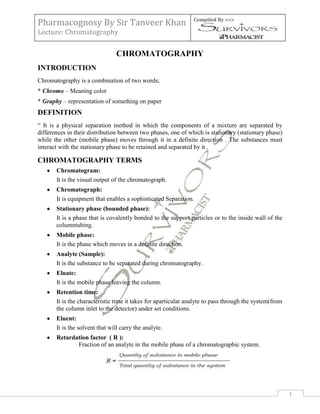
              Fraction of an analyte in the mobile phase of a chromatographic system.


                                                                                                        1
Pharmacognosy By Sir Tanveer Khan                              Compiled By >>>

 Lecture: Chromatography

 CLASSIFICATION
    According to mechanism of separation

    1) Ion-exchange chromatography
    2) Affinity chromatography
    3) Size-exclusion chromatography
    4) Adsorption chromatography
    5) Partition chromatography

 ION-EXCHANGE CHROMATOGRAPHY
 It is a process that allows the separation of ions and polar molecules based on their charge.

 DEFINITION:
 In this type of chromatography, a resin (the stationary solid phase) is used to covalently attach
 anions or cations onto it. Solute ions of the opposite charge in the mobile liquid phase are
 attracted to the resin by electrostatic forces. Ion exchange chromatography is performed in
 columns but can also be useful in planar mode.

 PRINCIPLE:
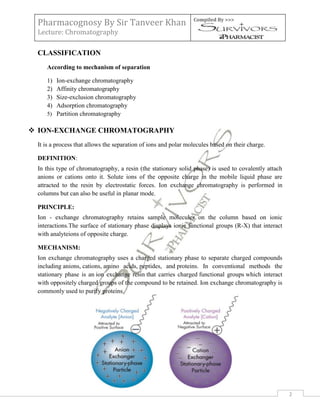
 Ion - exchange chromatography retains sample molecules on the column based on ionic
 interactions.The surface of stationary phase displays ionic functional groups (R-X) that interact
 with analyteions of opposite charge.

 MECHANISM:
 Ion exchange chromatography uses a charged stationary phase to separate charged compounds
 including anions, cations, amino acids, peptides, and proteins. In conventional methods the
 stationary phase is an ion exchange resin that carries charged functional groups which interact
 with oppositely charged groups of the compound to be retained. Ion exchange chromatography is
 commonly used to purify proteins.


                                                                                                     2
Pharmacognosy By Sir Tanveer Khan                               Compiled By >>>

 Lecture: Chromatography

 TYPES:

  Cation exchange chromatography:
    Cation exchange chromatography retains positively charged cationsbecause the stationary
    phase displays a negatively charged functional group.

  Anion exchange chromatography:
    Anion exchange chromatography retains anions using positively charged functional group.

 APPLICATIONS:

 It can be used for almost any kind of charged molecule including large proteins, small
 nucleotides and amino acids.

        Protein purification
        Water analysis
        Quality control

 AFFINITY CHROMATOGRAPHY
 This is the most selective type of chromatography.
 The method was discovered and developed by PedroCuatrecasas and Meir Wilchek for which
 the Wolf Prize in Medicine was awarded in 1987 .It is a method of separating biochemical
 mixtures and based on a highly specific biological interaction such as that between antigen and
 antibody, enzyme and substrate, or receptor and ligand.

 DEFINITION:

 “ It utilizes the specific interaction between one kind of solute molecule
 and a second molecule that is immobilized on a stationary phase”.

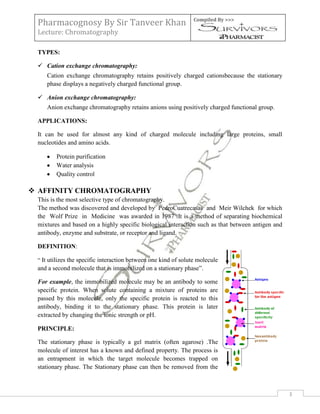
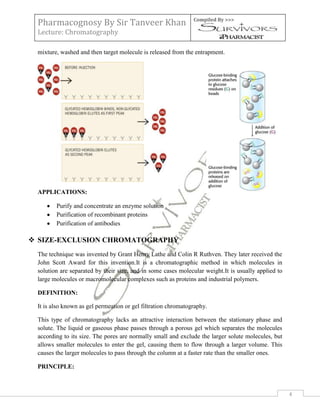
 For example, the immobilized molecule may be an antibody to some
 specific protein. When solute containing a mixture of proteins are
 passed by this molecule, only the specific protein is reacted to this
 antibody, binding it to the stationary phase. This protein is later
 extracted by changing the ionic strength or pH.

 PRINCIPLE:

 The stationary phase is typically a gel matrix (often agarose) .The
 molecule of interest has a known and defined property. The process is
 an entrapment in which the target molecule becomes trapped on
 stationary phase. The Stationary phase can then be removed from the


                                                                                                   3
Pharmacognosy By Sir Tanveer Khan                             Compiled By >>>

 Lecture: Chromatography

 mixture, washed and then target molecule is released from the entrapment.


 APPLICATIONS:

        Purify and concentrate an enzyme solution
        Purification of recombinant proteins
        Purification of antibodies

 SIZE-EXCLUSION CHROMATOGRAPHY
 The technique was invented by Grant Henry Lathe and Colin R Ruthven. They later received the
 John Scott Award for this invention.It is a chromatographic method in which molecules in
 solution are separated by their size, and in some cases molecular weight.It is usually applied to
 large molecules or macromolecular complexes such as proteins and industrial polymers.

 DEFINITION:

 It is also known as gel permeation or gel filtration chromatography.

 This type of chromatography lacks an attractive interaction between the stationary phase and
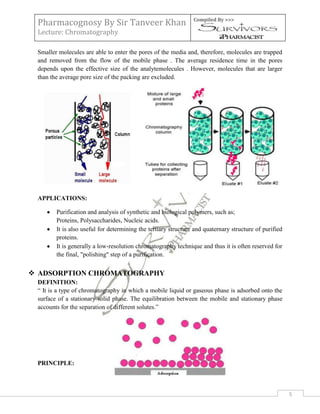
 solute. The liquid or gaseous phase passes through a porous gel which separates the molecules
 according to its size. The pores are normally small and exclude the larger solute molecules, but
 allows smaller molecules to enter the gel, causing them to flow through a larger volume. This
 causes the larger molecules to pass through the column at a faster rate than the smaller ones.

 PRINCIPLE:


                                                                                                     4
Pharmacognosy By Sir Tanveer Khan                              Compiled By >>>

 Lecture: Chromatography

 Smaller molecules are able to enter the pores of the media and, therefore, molecules are trapped
 and removed from the flow of the mobile phase . The average residence time in the pores
 depends upon the effective size of the analytemolecules . However, molecules that are larger
 than the average pore size of the packing are excluded.


 APPLICATIONS:

        Purification and analysis of synthetic and biological polymers, such as;
        Proteins, Polysaccharides, Nucleic acids.
        It is also useful for determining the tertiary structure and quaternary structure of purified
        proteins.
        It is generally a low-resolution chromatography technique and thus it is often reserved for
        the final, "polishing" step of a purification.


 ADSORPTION CHROMATOGRAPHY
 DEFINITION:
 “ It is a type of chromatography in which a mobile liquid or gaseous phase is adsorbed onto the
 surface of a stationary solid phase. The equilibration between the mobile and stationary phase
 accounts for the separation of different solutes.”


 PRINCIPLE:


                                                                                                        5
Pharmacognosy By Sir Tanveer Khan                            Compiled By >>>

Lecture: Chromatography

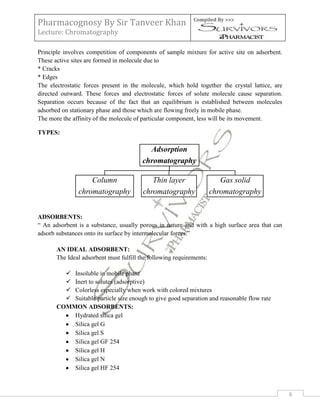
Principle involves competition of components of sample mixture for active site on adsorbent.
These active sites are formed in molecule due to
* Cracks
* Edges
The electrostatic forces present in the molecule, which hold together the crystal lattice, are
directed outward. These forces and electrostatic forces of solute molecule cause separation.
Separation occurs because of the fact that an equilibrium is established between molecules
adsorbed on stationary phase and those which are flowing freely in mobile phase.
The more the affinity of the molecule of particular component, less will be its movement.

TYPES:

                                           Adsorption
                                         chromatography

                   Column                   Thin layer                   Gas solid
               chromatography            chromatography               chromatography


ADSORBENTS:
“ An adsorbent is a substance, usually porous in nature and with a high surface area that can
adsorb substances onto its surface by intermolecular forces.”

       AN IDEAL ADSORBENT:
       The Ideal adsorbent must fulfill the following requirements:

          Insoluble in mobile phase
          Inert to solutes (adsorptive)
          Colorless especially when work with colored mixtures
          Suitable particle size enough to give good separation and reasonable flow rate
       COMMON ADSORBENTS:
           Hydrated silica gel
           Silica gel G
           Silica gel S
           Silica gel GF 254
           Silica gel H
           Silica gel N
           Silica gel HF 254


                                                                                                 6
Pharmacognosy By Sir Tanveer Khan                          Compiled By >>>

Lecture: Chromatography

             Silica gel PF 254
             Modified silica gel
             Alumina
             Kieselghur (Diatomaceous earth)
             Cellulose MN 300
             Cellulose microcrystalline

   THIN-LAYER CHROMATOGRAPHY
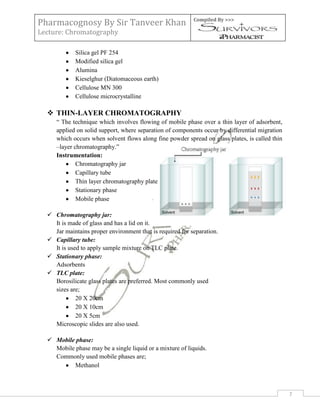
     “ The technique which involves flowing of mobile phase over a thin layer of adsorbent,
     applied on solid support, where separation of components occur by differential migration
     which occurs when solvent flows along fine powder spread on glass plates, is called thin
     –layer chromatography.”
     Instrumentation:
             Chromatography jar
             Capillary tube
             Thin layer chromatography plate
             Stationary phase
             Mobile phase

   Chromatography jar:
    It is made of glass and has a lid on it.
    Jar maintains proper environment that is required for separation.
   Capillary tube:
    It is used to apply sample mixture on TLC plate.
   Stationary phase:
    Adsorbents
   TLC plate:
    Borosilicate glass plates are preferred. Most commonly used
    sizes are;
             20 X 20cm
             20 X 10cm
             20 X 5cm
    Microscopic slides are also used.

   Mobile phase:
    Mobile phase may be a single liquid or a mixture of liquids.
    Commonly used mobile phases are;
          Methanol


                                                                                                7
Pharmacognosy By Sir Tanveer Khan                           Compiled By >>>

Lecture: Chromatography

              Ethanol
              Ethyl acetate
              Diethyl ether
              Acetone
              Chloroform
      Procedure:
           Clean and dried chromatography jar is taken.
           A paper impregnated in the mobile phase is applied to the walls to ensure that
              atmosphere of the jar is saturated with solvent vapors.
           Mobile phase is added to the jar at a length of 0.5-1cm from the bottom.
           Jar is closed.
           Equilibrium is allowed to be maintained.
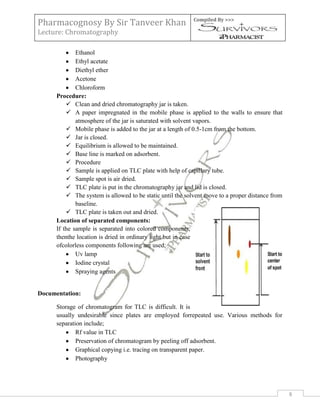
           Base line is marked on adsorbent.
           Procedure
           Sample is applied on TLC plate with help of capillary tube.
           Sample spot is air dried.
           TLC plate is put in the chromatography jar and lid is closed.
           The system is allowed to be static until the solvent move to a proper distance from
              baseline.
           TLC plate is taken out and dried.
      Location of separated components:
      If the sample is separated into colored components,
      thenthe location is dried in ordinary light but in case
      ofcolorless components following are used;
              Uv lamp
              Iodine crystal
              Spraying agents


Documentation:

      Storage of chromatogram for TLC is difficult. It is
      usually undesirable since plates are employed forrepeated use. Various methods for
      separation include;
              Rf value in TLC
              Preservation of chromatogram by peeling off adsorbent.
              Graphical copying i.e. tracing on transparent paper.
              Photography


                                                                                                  8
Pharmacognosy By Sir Tanveer Khan                             Compiled By >>>

 Lecture: Chromatography

 Applications:

        It is used for separation and identification of;
                 Amino acids
                 Peptides and proteins
                 Alkaloids
                 Carbohydrates
                 Fats and fatty acids
                 Antibiotics
                 Narcotic analgesics
                 Glycosides

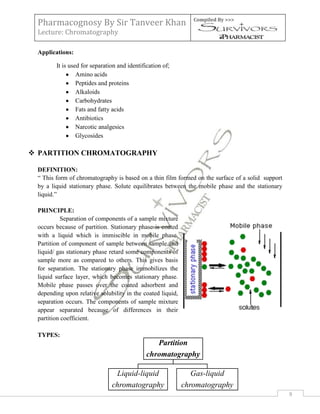
 PARTITION CHROMATOGRAPHY

 DEFINITION:
 “ This form of chromatography is based on a thin film formed on the surface of a solid support
 by a liquid stationary phase. Solute equilibrates between the mobile phase and the stationary
 liquid.”

 PRINCIPLE:
          Separation of components of a sample mixture
 occurs because of partition. Stationary phase is coated
 with a liquid which is immiscible in mobile phase.
 Partition of component of sample between sample and
 liquid/ gas stationary phase retard some components of
 sample more as compared to others. This gives basis
 for separation. The stationary phase immobilizes the
 liquid surface layer, which becomes stationary phase.
 Mobile phase passes over the coated adsorbent and
 depending upon relative solubility in the coated liquid,
 separation occurs. The components of sample mixture
 appear separated because of differences in their
 partition coefficient.

 TYPES:
                                                 Partition
                                              chromatography

                                Liquid-liquid                  Gas-liquid
                               chromatography               chromatography
                                                                                                  9
Pharmacognosy By Sir Tanveer Khan                           Compiled By >>>

Lecture: Chromatography

   PAPER CHROMATOGRAPHY
     Instrumentation:
           Chromatography jar
           Capillary tube
           Stationary phase (liquid impregnated paper)
           Mobile phase

          Chromatography jar:
                       It is made of glass and has a lid on it. Jar maintains proper environment
                       that is required for separation.
          Capillary tube:
                       It is used to apply sample mixture.
          Stationary phase:
     liquid impregnated paper
          Mobile phase:
                      Mobile phase may be a single liquid or a mixture of liquids.
     Commonly used mobile phases are;
             Methanol
             Ethanol
             Ethyl acetate
             Diethyl ether
             Acetone
             Chloroform
     Procedure:
          Clean and dried chromatography jar is taken.
          A paper impregnated in the mobile phase is applied to the walls to ensure that
             atmosphere of the jar is saturated with solvent vapors.
          Mobile phase is added to the jar at a length of 0.5-1cm from the bottom.
          Jar is closed.
          Equilibrium is allowed to be maintained.
          Base line is marked on adsorbent.
          Sample is applied on paper with help of capillary tube.
          Sample spot is air dried.
          Paper is put in the chromatography jar and lid is closed.
          The system is allowed to be static until the solvent move to a proper distance from
             baseline.
          Paper is taken out and dried.


                                                                                                   10
Pharmacognosy By Sir Tanveer Khan                          Compiled By >>>

Lecture: Chromatography

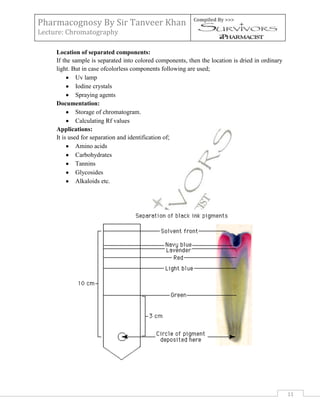
     Location of separated components:
     If the sample is separated into colored components, then the location is dried in ordinary
     light. But in case ofcolorless components following are used;
              Uv lamp
              Iodine crystals
              Spraying agents
     Documentation:
              Storage of chromatogram.
              Calculating Rf values
     Applications:
     It is used for separation and identification of;
              Amino acids
              Carbohydrates
              Tannins
              Glycosides
              Alkaloids etc.


                                                                                                  11

Chromatography

  • 1.
    Pharmacognosy By SirTanveer Khan Compiled By >>> Lecture: Chromatography CHROMATOGRAPHY INTRODUCTION Chromatography is a combination of two words; * Chromo – Meaning color * Graphy – representation of something on paper DEFINITION “ It is a physical separation method in which the components of a mixture are separated by differences in their distribution between two phases, one of which is stationary (stationary phase) while the other (mobile phase) moves through it in a definite direction . The substances must interact with the stationary phase to be retained and separated by it . CHROMATOGRAPHY TERMS Chromatogram: It is the visual output of the chromatograph. Chromatograph: It is equipment that enables a sophisticated Separation. Stationary phase (bounded phase): It is a phase that is covalently bonded to the support particles or to the inside wall of the columntubing. Mobile phase: It is the phase which moves in a definite direction. Analyte (Sample): It is the substance to be separated during chromatography. Eluate: It is the mobile phase leaving the column. Retention time: It is the characteristic time it takes for aparticular analyte to pass through the system(from the column inlet to the detector) under set conditions. Eluent: It is the solvent that will carry the analyte. Retardation factor ( R ): Fraction of an analyte in the mobile phase of a chromatographic system. 1
  • 2.
    Pharmacognosy By SirTanveer Khan Compiled By >>> Lecture: Chromatography CLASSIFICATION According to mechanism of separation 1) Ion-exchange chromatography 2) Affinity chromatography 3) Size-exclusion chromatography 4) Adsorption chromatography 5) Partition chromatography  ION-EXCHANGE CHROMATOGRAPHY It is a process that allows the separation of ions and polar molecules based on their charge. DEFINITION: In this type of chromatography, a resin (the stationary solid phase) is used to covalently attach anions or cations onto it. Solute ions of the opposite charge in the mobile liquid phase are attracted to the resin by electrostatic forces. Ion exchange chromatography is performed in columns but can also be useful in planar mode. PRINCIPLE: Ion - exchange chromatography retains sample molecules on the column based on ionic interactions.The surface of stationary phase displays ionic functional groups (R-X) that interact with analyteions of opposite charge. MECHANISM: Ion exchange chromatography uses a charged stationary phase to separate charged compounds including anions, cations, amino acids, peptides, and proteins. In conventional methods the stationary phase is an ion exchange resin that carries charged functional groups which interact with oppositely charged groups of the compound to be retained. Ion exchange chromatography is commonly used to purify proteins. 2
  • 3.
    Pharmacognosy By SirTanveer Khan Compiled By >>> Lecture: Chromatography TYPES:  Cation exchange chromatography: Cation exchange chromatography retains positively charged cationsbecause the stationary phase displays a negatively charged functional group.  Anion exchange chromatography: Anion exchange chromatography retains anions using positively charged functional group. APPLICATIONS: It can be used for almost any kind of charged molecule including large proteins, small nucleotides and amino acids. Protein purification Water analysis Quality control  AFFINITY CHROMATOGRAPHY This is the most selective type of chromatography. The method was discovered and developed by PedroCuatrecasas and Meir Wilchek for which the Wolf Prize in Medicine was awarded in 1987 .It is a method of separating biochemical mixtures and based on a highly specific biological interaction such as that between antigen and antibody, enzyme and substrate, or receptor and ligand. DEFINITION: “ It utilizes the specific interaction between one kind of solute molecule and a second molecule that is immobilized on a stationary phase”. For example, the immobilized molecule may be an antibody to some specific protein. When solute containing a mixture of proteins are passed by this molecule, only the specific protein is reacted to this antibody, binding it to the stationary phase. This protein is later extracted by changing the ionic strength or pH. PRINCIPLE: The stationary phase is typically a gel matrix (often agarose) .The molecule of interest has a known and defined property. The process is an entrapment in which the target molecule becomes trapped on stationary phase. The Stationary phase can then be removed from the 3
  • 4.
    Pharmacognosy By SirTanveer Khan Compiled By >>> Lecture: Chromatography mixture, washed and then target molecule is released from the entrapment. APPLICATIONS: Purify and concentrate an enzyme solution Purification of recombinant proteins Purification of antibodies  SIZE-EXCLUSION CHROMATOGRAPHY The technique was invented by Grant Henry Lathe and Colin R Ruthven. They later received the John Scott Award for this invention.It is a chromatographic method in which molecules in solution are separated by their size, and in some cases molecular weight.It is usually applied to large molecules or macromolecular complexes such as proteins and industrial polymers. DEFINITION: It is also known as gel permeation or gel filtration chromatography. This type of chromatography lacks an attractive interaction between the stationary phase and solute. The liquid or gaseous phase passes through a porous gel which separates the molecules according to its size. The pores are normally small and exclude the larger solute molecules, but allows smaller molecules to enter the gel, causing them to flow through a larger volume. This causes the larger molecules to pass through the column at a faster rate than the smaller ones. PRINCIPLE: 4
  • 5.
    Pharmacognosy By SirTanveer Khan Compiled By >>> Lecture: Chromatography Smaller molecules are able to enter the pores of the media and, therefore, molecules are trapped and removed from the flow of the mobile phase . The average residence time in the pores depends upon the effective size of the analytemolecules . However, molecules that are larger than the average pore size of the packing are excluded. APPLICATIONS: Purification and analysis of synthetic and biological polymers, such as; Proteins, Polysaccharides, Nucleic acids. It is also useful for determining the tertiary structure and quaternary structure of purified proteins. It is generally a low-resolution chromatography technique and thus it is often reserved for the final, "polishing" step of a purification.  ADSORPTION CHROMATOGRAPHY DEFINITION: “ It is a type of chromatography in which a mobile liquid or gaseous phase is adsorbed onto the surface of a stationary solid phase. The equilibration between the mobile and stationary phase accounts for the separation of different solutes.” PRINCIPLE: 5
  • 6.
    Pharmacognosy By SirTanveer Khan Compiled By >>> Lecture: Chromatography Principle involves competition of components of sample mixture for active site on adsorbent. These active sites are formed in molecule due to * Cracks * Edges The electrostatic forces present in the molecule, which hold together the crystal lattice, are directed outward. These forces and electrostatic forces of solute molecule cause separation. Separation occurs because of the fact that an equilibrium is established between molecules adsorbed on stationary phase and those which are flowing freely in mobile phase. The more the affinity of the molecule of particular component, less will be its movement. TYPES: Adsorption chromatography Column Thin layer Gas solid chromatography chromatography chromatography ADSORBENTS: “ An adsorbent is a substance, usually porous in nature and with a high surface area that can adsorb substances onto its surface by intermolecular forces.” AN IDEAL ADSORBENT: The Ideal adsorbent must fulfill the following requirements:  Insoluble in mobile phase  Inert to solutes (adsorptive)  Colorless especially when work with colored mixtures  Suitable particle size enough to give good separation and reasonable flow rate COMMON ADSORBENTS: Hydrated silica gel Silica gel G Silica gel S Silica gel GF 254 Silica gel H Silica gel N Silica gel HF 254 6
  • 7.
    Pharmacognosy By SirTanveer Khan Compiled By >>> Lecture: Chromatography Silica gel PF 254 Modified silica gel Alumina Kieselghur (Diatomaceous earth) Cellulose MN 300 Cellulose microcrystalline  THIN-LAYER CHROMATOGRAPHY “ The technique which involves flowing of mobile phase over a thin layer of adsorbent, applied on solid support, where separation of components occur by differential migration which occurs when solvent flows along fine powder spread on glass plates, is called thin –layer chromatography.” Instrumentation: Chromatography jar Capillary tube Thin layer chromatography plate Stationary phase Mobile phase  Chromatography jar: It is made of glass and has a lid on it. Jar maintains proper environment that is required for separation.  Capillary tube: It is used to apply sample mixture on TLC plate.  Stationary phase: Adsorbents  TLC plate: Borosilicate glass plates are preferred. Most commonly used sizes are; 20 X 20cm 20 X 10cm 20 X 5cm Microscopic slides are also used.  Mobile phase: Mobile phase may be a single liquid or a mixture of liquids. Commonly used mobile phases are; Methanol 7
  • 8.
    Pharmacognosy By SirTanveer Khan Compiled By >>> Lecture: Chromatography Ethanol Ethyl acetate Diethyl ether Acetone Chloroform Procedure:  Clean and dried chromatography jar is taken.  A paper impregnated in the mobile phase is applied to the walls to ensure that atmosphere of the jar is saturated with solvent vapors.  Mobile phase is added to the jar at a length of 0.5-1cm from the bottom.  Jar is closed.  Equilibrium is allowed to be maintained.  Base line is marked on adsorbent.  Procedure  Sample is applied on TLC plate with help of capillary tube.  Sample spot is air dried.  TLC plate is put in the chromatography jar and lid is closed.  The system is allowed to be static until the solvent move to a proper distance from baseline.  TLC plate is taken out and dried. Location of separated components: If the sample is separated into colored components, thenthe location is dried in ordinary light but in case ofcolorless components following are used; Uv lamp Iodine crystal Spraying agents Documentation: Storage of chromatogram for TLC is difficult. It is usually undesirable since plates are employed forrepeated use. Various methods for separation include; Rf value in TLC Preservation of chromatogram by peeling off adsorbent. Graphical copying i.e. tracing on transparent paper. Photography 8
  • 9.
    Pharmacognosy By SirTanveer Khan Compiled By >>> Lecture: Chromatography Applications: It is used for separation and identification of; Amino acids Peptides and proteins Alkaloids Carbohydrates Fats and fatty acids Antibiotics Narcotic analgesics Glycosides  PARTITION CHROMATOGRAPHY DEFINITION: “ This form of chromatography is based on a thin film formed on the surface of a solid support by a liquid stationary phase. Solute equilibrates between the mobile phase and the stationary liquid.” PRINCIPLE: Separation of components of a sample mixture occurs because of partition. Stationary phase is coated with a liquid which is immiscible in mobile phase. Partition of component of sample between sample and liquid/ gas stationary phase retard some components of sample more as compared to others. This gives basis for separation. The stationary phase immobilizes the liquid surface layer, which becomes stationary phase. Mobile phase passes over the coated adsorbent and depending upon relative solubility in the coated liquid, separation occurs. The components of sample mixture appear separated because of differences in their partition coefficient. TYPES: Partition chromatography Liquid-liquid Gas-liquid chromatography chromatography 9
  • 10.
    Pharmacognosy By SirTanveer Khan Compiled By >>> Lecture: Chromatography  PAPER CHROMATOGRAPHY Instrumentation: Chromatography jar Capillary tube Stationary phase (liquid impregnated paper) Mobile phase  Chromatography jar: It is made of glass and has a lid on it. Jar maintains proper environment that is required for separation.  Capillary tube: It is used to apply sample mixture.  Stationary phase: liquid impregnated paper  Mobile phase: Mobile phase may be a single liquid or a mixture of liquids. Commonly used mobile phases are; Methanol Ethanol Ethyl acetate Diethyl ether Acetone Chloroform Procedure:  Clean and dried chromatography jar is taken.  A paper impregnated in the mobile phase is applied to the walls to ensure that atmosphere of the jar is saturated with solvent vapors.  Mobile phase is added to the jar at a length of 0.5-1cm from the bottom.  Jar is closed.  Equilibrium is allowed to be maintained.  Base line is marked on adsorbent.  Sample is applied on paper with help of capillary tube.  Sample spot is air dried.  Paper is put in the chromatography jar and lid is closed.  The system is allowed to be static until the solvent move to a proper distance from baseline.  Paper is taken out and dried. 10
  • 11.
    Pharmacognosy By SirTanveer Khan Compiled By >>> Lecture: Chromatography Location of separated components: If the sample is separated into colored components, then the location is dried in ordinary light. But in case ofcolorless components following are used; Uv lamp Iodine crystals Spraying agents Documentation: Storage of chromatogram. Calculating Rf values Applications: It is used for separation and identification of; Amino acids Carbohydrates Tannins Glycosides Alkaloids etc. 11