
PRESENTED BY : -
PRAVEEN KUMAR
ROLL NO. – 16206112
BRANCH – ICE(M.TECH., 3rd SEM.)
1
Chromatography
8/23/2017
Contents:-
 Introduction
 History
 Technical terms
 Types of chromatography
 Applications
 Advantages
 Disadvantages
 References
2
Introduction
 The Term Chromatography (chroma = a colour; graphein = to write) is
the collective term for a set of laboratory techniques for the separation
of mixtures.
 Chromatography involves a sample (or sample extract) being dissolved
in a mobile phase (which may be a gas, a liquid or a supercritical fluid).
 The mobile phase is then forced through an immobile,
immiscible stationary phase.
 The phases are chosen such that components of the sample have
different solubility in each phase.
 A component which is quite soluble in the stationary phase will take
longer to travel through it than a component which is not very soluble in
the stationary phase but very soluble in the mobile phase.
3
 As a result of these differences in mobilities, sample components will
become separated from each other as they travel through the stationary
phase.
 Techniques such as H.P.L.C. (High Performance Liquid Chromatography)
and G.C. (Gas Chromatography) use columns - narrow tubes packed with
stationary phase, through which the mobile phase is forced.
 The sample is transported through the column by continuous addition of
mobile phase. This process is called elution.
4
Conti.
History
 Chromatography was first employed in Russia by the Italian-born scientist
Mikhail Tswett in 1906.
 He employed a technique to separate various pigments such as chlorophylls
and xanthophylls by passing the solution of these compounds into the glass
column which was packed with finely divided calcium carbonate.
 Almost after three decades, in 1935 Adams and Holmes observed the Ion
Exchange characteristics in crushed phonograph. This observation opened
the field for preparation of Ion Exchanged resins.
 The concept of Gas-Liquid Chromatography was first introduced by Martin
and Synge in 1941.
 In 1944, from Martin laboratory, the separation of amino acid by paper
chromatography was reported.
 In 1952, the importance of the chromatography was observed when both
Synge and Martin were awarded with Nobel Prize.
5
Conti.
 In 1959, a technique known as Gel Filtration chromatography was
observed which is used to separate low molecular weight substances from
high molecular substances.
 In 1970, further improvement in liquid chromatography led to the
development of High Performance Liquid Chromatography.
 Decade of 1990’s saw an improvement in the field of adsorption
chromatography in the form of Affinity chromatography which was mainly
based on biological interactions.
 In 2007 Ionic chromatography used for determining the contamination of
sugar by-products by nitrite and nitrate.
 In 2017 Supercritical fluid chromatography approach used in a sustainable
manufacturing of new stereo isomeric anticancer agent.
6
Technical terms
The chromatographic behavior of a solute can be
described either by its retardation factor(R) or by retention volume (Vr). By
varying sorbent-solvent combinations and operating parameters, the degree of
retardation can be varied over a wide range from nearly total retention to a state
of free migration. Let us define some technical terms related to chromatography.
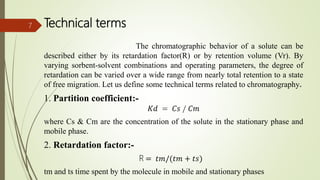
1. Partition coefficient:-
𝐾𝑑 = 𝐶𝑠 / 𝐶𝑚
where Cs & Cm are the concentration of the solute in the stationary phase and
mobile phase.
2. Retardation factor:-
R = 𝑡𝑚/(𝑡𝑚 + 𝑡𝑠)
tm and ts time spent by the molecule in mobile and stationary phases
7
8
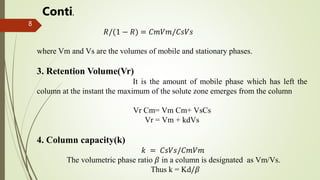
𝑅/(1 − 𝑅) = 𝐶𝑚𝑉𝑚/𝐶𝑠𝑉𝑠
where Vm and Vs are the volumes of mobile and stationary phases.
3. Retention Volume(Vr)
It is the amount of mobile phase which has left the
column at the instant the maximum of the solute zone emerges from the column
Vr Cm= Vm Cm+ VsCs
Vr = Vm + kdVs
4. Column capacity(k)
𝑘 = 𝐶𝑠𝑉𝑠/𝐶𝑚𝑉𝑚
The volumetric phase ratio 𝛽 in a column is designated as Vm/Vs.
Thus k = Kd/𝛽
Conti.
Types of chromatography
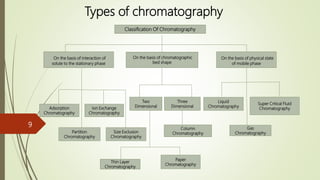
Classification Of Chromatography
On the basis of interaction of
solute to the stationary phase
On the basis of chromatographic
bed shape
On the basis of physical state
of mobile phase
Adsorption
Chromatography
Partition
Chromatography
Ion Exchange
Chromatography
Size Exclusion
Chromatography
Two
Dimensional
Three
Dimensional
Thin Layer
Chromatography
Paper
Chromatography
Column
Chromatography
Liquid
Chromatography
Gas
Chromatography
Super Critical Fluid
Chromatography
9
1.On the basis of interaction of solute to the
stationary phase
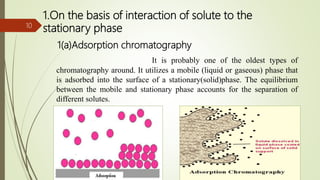
1(a)Adsorption chromatography
It is probably one of the oldest types of
chromatography around. It utilizes a mobile (liquid or gaseous) phase that
is adsorbed into the surface of a stationary(solid)phase. The equilibrium
between the mobile and stationary phase accounts for the separation of
different solutes.
10
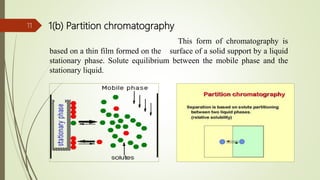
1(b) Partition chromatography
This form of chromatography is
based on a thin film formed on the surface of a solid support by a liquid
stationary phase. Solute equilibrium between the mobile phase and the
stationary liquid.
11
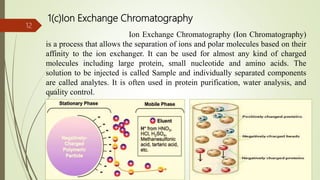
1(c)Ion Exchange Chromatography
Ion Exchange Chromatography (Ion Chromatography)
is a process that allows the separation of ions and polar molecules based on their
affinity to the ion exchanger. It can be used for almost any kind of charged
molecules including large protein, small nucleotide and amino acids. The
solution to be injected is called Sample and individually separated components
are called analytes. It is often used in protein purification, water analysis, and
quality control.
12
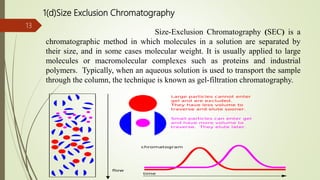
1(d)Size Exclusion Chromatography
Size-Exclusion Chromatography (SEC) is a
chromatographic method in which molecules in a solution are separated by
their size, and in some cases molecular weight. It is usually applied to large
molecules or macromolecular complexes such as proteins and industrial
polymers. Typically, when an aqueous solution is used to transport the sample
through the column, the technique is known as gel-filtration chromatography.
13
2.On the basis of chromatographic bed shape
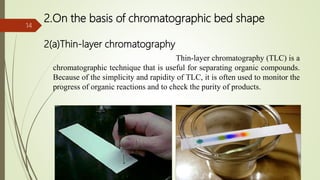
2(a)Thin-layer chromatography
Thin-layer chromatography (TLC) is a
chromatographic technique that is useful for separating organic compounds.
Because of the simplicity and rapidity of TLC, it is often used to monitor the
progress of organic reactions and to check the purity of products.
14
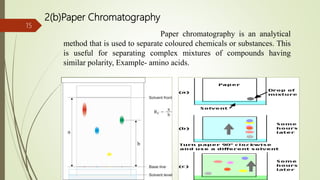
2(b)Paper Chromatography
Paper chromatography is an analytical
method that is used to separate coloured chemicals or substances. This
is useful for separating complex mixtures of compounds having
similar polarity, Example- amino acids.
15
3 On the base of physical state of mobile phase
3(a)Liquid chromatography
16
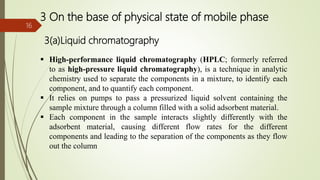
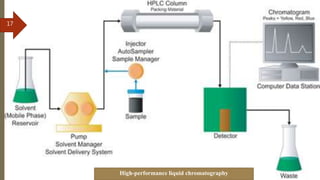
 High-performance liquid chromatography (HPLC; formerly referred
to as high-pressure liquid chromatography), is a technique in analytic
chemistry used to separate the components in a mixture, to identify each
component, and to quantify each component.
 It relies on pumps to pass a pressurized liquid solvent containing the
sample mixture through a column filled with a solid adsorbent material.
 Each component in the sample interacts slightly differently with the
adsorbent material, causing different flow rates for the different
components and leading to the separation of the components as they flow
out the column
17
High-performance liquid chromatography
17
3(b)Gas Chromatography
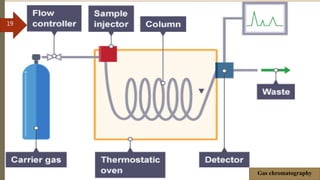
 Gas chromatography (GC), is a common type of chromatography used
in analytical chemistry for separating and analyzing compounds that can
be vaporized without decomposition.
 Typical uses of GC include testing the purity of a particular substance, or
separating the different components of a mixture (the relative amounts of
such components can also be determined).
 In some situations, GC may help in identifying a compound.
In preparative chromatography, GC can be used to prepare pure
compounds from a mixture.
18
Gas chromatography
19
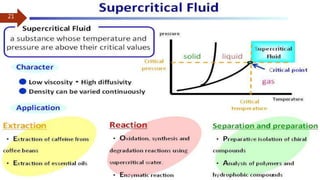
3(c)Supercritical Fluid Chromatography
Supercritical Fluid Chromatography (SFC) is a form
of normal phase chromatography, that is used for the analysis and
purification of low to moderate molecular weight, thermally labile
molecules.
Principles are similar to those of high performance liquid
chromatography (HPLC), however SFC typically utilizes carbon
dioxide as the mobile phase; therefore the entire chromatographic flow
path must be pressurized.
The supercritical phase represents a state in which liquid and gas
properties converge, supercritical fluid chromatography is sometimes
called "convergence chromatography."
20
21
21
Applications
The process is used to find out what substances are composed
of by separating compounds into their various components and its use affects
everything from what you eat to how you fight disease
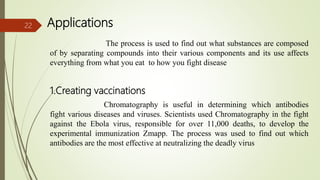
1.Creating vaccinations
Chromatography is useful in determining which antibodies
fight various diseases and viruses. Scientists used Chromatography in the fight
against the Ebola virus, responsible for over 11,000 deaths, to develop the
experimental immunization Zmapp. The process was used to find out which
antibodies are the most effective at neutralizing the deadly virus
22
23
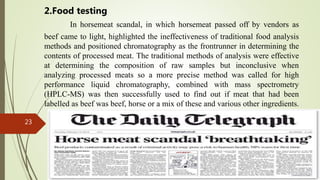
In horsemeat scandal, in which horsemeat passed off by vendors as
beef came to light, highlighted the ineffectiveness of traditional food analysis
methods and positioned chromatography as the frontrunner in determining the
contents of processed meat. The traditional methods of analysis were effective
at determining the composition of raw samples but inconclusive when
analyzing processed meats so a more precise method was called for high
performance liquid chromatography, combined with mass spectrometry
(HPLC-MS) was then successfully used to find out if meat that had been
labelled as beef was beef, horse or a mix of these and various other ingredients.
2.Food testing
3. Beverage testing
Food isn't the only thing you consume which has been tested
using chromatography. Many drinks manufacturers use this technique to
ensure each bottle of their product is exactly the same, so you can rely on a
consistent taste. Many brands uses chromatography to monitor the levels of
sugar in their final product.
4. Drug testing
As chromatography can accurately identify substances within
the bloodstream, it is widely used in sport to test athletes for doping or
performance enhancing drugs, something to think about the next time you're
watching your favorite sport.
24
5. Forensic testing
 Chromatography is used to determine which fluids and compounds are
present in human body after death or analyze blood samples to know
whether he was poisoned to death etc.
 It is also used to analyze blood and cloth samples, helping to identify
criminals and bring them to justice
25
Advantages
 Chromatography is one of the most versatile techniques available to
a chemist (the other one being spectroscopy.) If you understand the
principles of both of these techniques, you covered about 80% of
standard lab instruments.
 It is mainly used to separate complex mixtures. You can separate
compounds based on their size, molecular weight, ionic mobility,
polarity, boiling point etc. This allows us to measure the
concentration of a specific compound in a mixture.
26
Disadvantages
 Gas chromatography is not suitable for temperature sensitive samples.
 During injection of sample into column proper attention is required.
 Sample should be soluble and don’t react with column.
27
28
 http://www.waters.com/webassets/cms/category/media/other_images/primer_T_Ion_Exchange_CHromato
graphy.jpg
 http://xray.bmc.uu.se/Courses/MPC/students_files/ION_EXCHANGE_CHROMATOGRAPHY.pptx
 http://www.thefreedictionary.com/chromatography
 http://www.britannica.com/EBchecked/topic/115917/chromatography/80518/Liquid-chromatography
 http://www.ltt.com.au/simulab/5/Laboratory/StudyNotes/snClassifChromatoMeth.htm
 http://www.rpi.edu/dept/chem-eng/Biotech-Environ/CHROMO/be_types.htm
 http://en.wikipedia.org/wiki/Paper_chromatography
 http://en.wikipedia.org/wiki/Aqueous_normal-phase_chromatography
 http://s3.amazonaws.com/ppt-download/principlesandapplicationofchromatography-
130121011302phpapp02.pptx?responsecontentdisposition=attachment&Signature=lvlIqsf0i6utymK3xLID
RIThCG8%3D&Expires=1426432486&AWSAccessKeyId=AKIAIA7QTBOH2LDUZRTQ
 http://s3.amazonaws.com/ppt-download/hplc-120622032932-phpapp01.pptx?response-
contentdisposition=attachment&Signature=of%2FKpbRF%2BdvtUfOS0nOATt4kMIg%3D&Expires=142
6433000&AWSAccessKeyId=AKIAIA7QTBOH2LDUZRTQ
References
Thanks
29

chromatograpgy

  • 1.
    PRESENTED BY :- PRAVEEN KUMAR ROLL NO. – 16206112 BRANCH – ICE(M.TECH., 3rd SEM.) 1 Chromatography 8/23/2017
  • 2.
    Contents:-  Introduction  History Technical terms  Types of chromatography  Applications  Advantages  Disadvantages  References 2
  • 3.
    Introduction  The TermChromatography (chroma = a colour; graphein = to write) is the collective term for a set of laboratory techniques for the separation of mixtures.  Chromatography involves a sample (or sample extract) being dissolved in a mobile phase (which may be a gas, a liquid or a supercritical fluid).  The mobile phase is then forced through an immobile, immiscible stationary phase.  The phases are chosen such that components of the sample have different solubility in each phase.  A component which is quite soluble in the stationary phase will take longer to travel through it than a component which is not very soluble in the stationary phase but very soluble in the mobile phase. 3
  • 4.
     As aresult of these differences in mobilities, sample components will become separated from each other as they travel through the stationary phase.  Techniques such as H.P.L.C. (High Performance Liquid Chromatography) and G.C. (Gas Chromatography) use columns - narrow tubes packed with stationary phase, through which the mobile phase is forced.  The sample is transported through the column by continuous addition of mobile phase. This process is called elution. 4 Conti.
  • 5.
    History  Chromatography wasfirst employed in Russia by the Italian-born scientist Mikhail Tswett in 1906.  He employed a technique to separate various pigments such as chlorophylls and xanthophylls by passing the solution of these compounds into the glass column which was packed with finely divided calcium carbonate.  Almost after three decades, in 1935 Adams and Holmes observed the Ion Exchange characteristics in crushed phonograph. This observation opened the field for preparation of Ion Exchanged resins.  The concept of Gas-Liquid Chromatography was first introduced by Martin and Synge in 1941.  In 1944, from Martin laboratory, the separation of amino acid by paper chromatography was reported.  In 1952, the importance of the chromatography was observed when both Synge and Martin were awarded with Nobel Prize. 5
  • 6.
    Conti.  In 1959,a technique known as Gel Filtration chromatography was observed which is used to separate low molecular weight substances from high molecular substances.  In 1970, further improvement in liquid chromatography led to the development of High Performance Liquid Chromatography.  Decade of 1990’s saw an improvement in the field of adsorption chromatography in the form of Affinity chromatography which was mainly based on biological interactions.  In 2007 Ionic chromatography used for determining the contamination of sugar by-products by nitrite and nitrate.  In 2017 Supercritical fluid chromatography approach used in a sustainable manufacturing of new stereo isomeric anticancer agent. 6
  • 7.
    Technical terms The chromatographicbehavior of a solute can be described either by its retardation factor(R) or by retention volume (Vr). By varying sorbent-solvent combinations and operating parameters, the degree of retardation can be varied over a wide range from nearly total retention to a state of free migration. Let us define some technical terms related to chromatography. 1. Partition coefficient:- 𝐾𝑑 = 𝐶𝑠 / 𝐶𝑚 where Cs & Cm are the concentration of the solute in the stationary phase and mobile phase. 2. Retardation factor:- R = 𝑡𝑚/(𝑡𝑚 + 𝑡𝑠) tm and ts time spent by the molecule in mobile and stationary phases 7
  • 8.
    8 𝑅/(1 − 𝑅)= 𝐶𝑚𝑉𝑚/𝐶𝑠𝑉𝑠 where Vm and Vs are the volumes of mobile and stationary phases. 3. Retention Volume(Vr) It is the amount of mobile phase which has left the column at the instant the maximum of the solute zone emerges from the column Vr Cm= Vm Cm+ VsCs Vr = Vm + kdVs 4. Column capacity(k) 𝑘 = 𝐶𝑠𝑉𝑠/𝐶𝑚𝑉𝑚 The volumetric phase ratio 𝛽 in a column is designated as Vm/Vs. Thus k = Kd/𝛽 Conti.
  • 9.
    Types of chromatography ClassificationOf Chromatography On the basis of interaction of solute to the stationary phase On the basis of chromatographic bed shape On the basis of physical state of mobile phase Adsorption Chromatography Partition Chromatography Ion Exchange Chromatography Size Exclusion Chromatography Two Dimensional Three Dimensional Thin Layer Chromatography Paper Chromatography Column Chromatography Liquid Chromatography Gas Chromatography Super Critical Fluid Chromatography 9
  • 10.
    1.On the basisof interaction of solute to the stationary phase 1(a)Adsorption chromatography It is probably one of the oldest types of chromatography around. It utilizes a mobile (liquid or gaseous) phase that is adsorbed into the surface of a stationary(solid)phase. The equilibrium between the mobile and stationary phase accounts for the separation of different solutes. 10
  • 11.
    1(b) Partition chromatography Thisform of chromatography is based on a thin film formed on the surface of a solid support by a liquid stationary phase. Solute equilibrium between the mobile phase and the stationary liquid. 11
  • 12.
    1(c)Ion Exchange Chromatography IonExchange Chromatography (Ion Chromatography) is a process that allows the separation of ions and polar molecules based on their affinity to the ion exchanger. It can be used for almost any kind of charged molecules including large protein, small nucleotide and amino acids. The solution to be injected is called Sample and individually separated components are called analytes. It is often used in protein purification, water analysis, and quality control. 12
  • 13.
    1(d)Size Exclusion Chromatography Size-ExclusionChromatography (SEC) is a chromatographic method in which molecules in a solution are separated by their size, and in some cases molecular weight. It is usually applied to large molecules or macromolecular complexes such as proteins and industrial polymers. Typically, when an aqueous solution is used to transport the sample through the column, the technique is known as gel-filtration chromatography. 13
  • 14.
    2.On the basisof chromatographic bed shape 2(a)Thin-layer chromatography Thin-layer chromatography (TLC) is a chromatographic technique that is useful for separating organic compounds. Because of the simplicity and rapidity of TLC, it is often used to monitor the progress of organic reactions and to check the purity of products. 14
  • 15.
    2(b)Paper Chromatography Paper chromatographyis an analytical method that is used to separate coloured chemicals or substances. This is useful for separating complex mixtures of compounds having similar polarity, Example- amino acids. 15
  • 16.
    3 On thebase of physical state of mobile phase 3(a)Liquid chromatography 16  High-performance liquid chromatography (HPLC; formerly referred to as high-pressure liquid chromatography), is a technique in analytic chemistry used to separate the components in a mixture, to identify each component, and to quantify each component.  It relies on pumps to pass a pressurized liquid solvent containing the sample mixture through a column filled with a solid adsorbent material.  Each component in the sample interacts slightly differently with the adsorbent material, causing different flow rates for the different components and leading to the separation of the components as they flow out the column
  • 17.
  • 18.
    3(b)Gas Chromatography  Gaschromatography (GC), is a common type of chromatography used in analytical chemistry for separating and analyzing compounds that can be vaporized without decomposition.  Typical uses of GC include testing the purity of a particular substance, or separating the different components of a mixture (the relative amounts of such components can also be determined).  In some situations, GC may help in identifying a compound. In preparative chromatography, GC can be used to prepare pure compounds from a mixture. 18
  • 19.
  • 20.
    3(c)Supercritical Fluid Chromatography SupercriticalFluid Chromatography (SFC) is a form of normal phase chromatography, that is used for the analysis and purification of low to moderate molecular weight, thermally labile molecules. Principles are similar to those of high performance liquid chromatography (HPLC), however SFC typically utilizes carbon dioxide as the mobile phase; therefore the entire chromatographic flow path must be pressurized. The supercritical phase represents a state in which liquid and gas properties converge, supercritical fluid chromatography is sometimes called "convergence chromatography." 20
  • 21.
  • 22.
    Applications The process isused to find out what substances are composed of by separating compounds into their various components and its use affects everything from what you eat to how you fight disease 1.Creating vaccinations Chromatography is useful in determining which antibodies fight various diseases and viruses. Scientists used Chromatography in the fight against the Ebola virus, responsible for over 11,000 deaths, to develop the experimental immunization Zmapp. The process was used to find out which antibodies are the most effective at neutralizing the deadly virus 22
  • 23.
    23 In horsemeat scandal,in which horsemeat passed off by vendors as beef came to light, highlighted the ineffectiveness of traditional food analysis methods and positioned chromatography as the frontrunner in determining the contents of processed meat. The traditional methods of analysis were effective at determining the composition of raw samples but inconclusive when analyzing processed meats so a more precise method was called for high performance liquid chromatography, combined with mass spectrometry (HPLC-MS) was then successfully used to find out if meat that had been labelled as beef was beef, horse or a mix of these and various other ingredients. 2.Food testing
  • 24.
    3. Beverage testing Foodisn't the only thing you consume which has been tested using chromatography. Many drinks manufacturers use this technique to ensure each bottle of their product is exactly the same, so you can rely on a consistent taste. Many brands uses chromatography to monitor the levels of sugar in their final product. 4. Drug testing As chromatography can accurately identify substances within the bloodstream, it is widely used in sport to test athletes for doping or performance enhancing drugs, something to think about the next time you're watching your favorite sport. 24
  • 25.
    5. Forensic testing Chromatography is used to determine which fluids and compounds are present in human body after death or analyze blood samples to know whether he was poisoned to death etc.  It is also used to analyze blood and cloth samples, helping to identify criminals and bring them to justice 25
  • 26.
    Advantages  Chromatography isone of the most versatile techniques available to a chemist (the other one being spectroscopy.) If you understand the principles of both of these techniques, you covered about 80% of standard lab instruments.  It is mainly used to separate complex mixtures. You can separate compounds based on their size, molecular weight, ionic mobility, polarity, boiling point etc. This allows us to measure the concentration of a specific compound in a mixture. 26
  • 27.
    Disadvantages  Gas chromatographyis not suitable for temperature sensitive samples.  During injection of sample into column proper attention is required.  Sample should be soluble and don’t react with column. 27
  • 28.
    28  http://www.waters.com/webassets/cms/category/media/other_images/primer_T_Ion_Exchange_CHromato graphy.jpg  http://xray.bmc.uu.se/Courses/MPC/students_files/ION_EXCHANGE_CHROMATOGRAPHY.pptx http://www.thefreedictionary.com/chromatography  http://www.britannica.com/EBchecked/topic/115917/chromatography/80518/Liquid-chromatography  http://www.ltt.com.au/simulab/5/Laboratory/StudyNotes/snClassifChromatoMeth.htm  http://www.rpi.edu/dept/chem-eng/Biotech-Environ/CHROMO/be_types.htm  http://en.wikipedia.org/wiki/Paper_chromatography  http://en.wikipedia.org/wiki/Aqueous_normal-phase_chromatography  http://s3.amazonaws.com/ppt-download/principlesandapplicationofchromatography- 130121011302phpapp02.pptx?responsecontentdisposition=attachment&Signature=lvlIqsf0i6utymK3xLID RIThCG8%3D&Expires=1426432486&AWSAccessKeyId=AKIAIA7QTBOH2LDUZRTQ  http://s3.amazonaws.com/ppt-download/hplc-120622032932-phpapp01.pptx?response- contentdisposition=attachment&Signature=of%2FKpbRF%2BdvtUfOS0nOATt4kMIg%3D&Expires=142 6433000&AWSAccessKeyId=AKIAIA7QTBOH2LDUZRTQ References
  • 29.