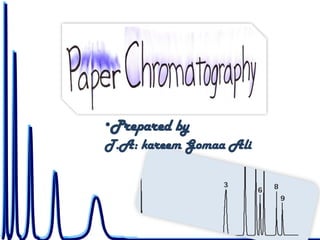
•Prepared by
T.A: kareem Gomaa Ali
Introduction
⚫Chromatography (from Greek , chroma "color and graphy "
to write") is the collective term for a set of bio-physical
laboratory technique used for separation, identification,
quantification and purification of components of a mixture. in
which the components to be separated are, distributed between two
phases, one of which is stationary phase while the other is mobile
phase, moves in a definite direction.
⚫ It is used in many areas of study particularly in chemistry,
biology and medicine.
⚫ Pigments, dyes, amino acids, vitamins, polymers, etc can
be separated by using the chromatography technique.
History of Chromatography
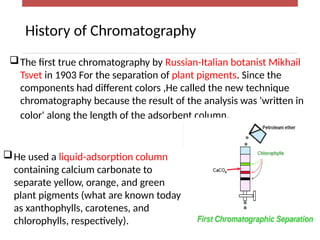
The first true chromatography by Russian-Italian botanist Mikhail
Tsvet in 1903 For the separation of plant pigments. Since the
components had different colors ,He called the new technique
chromatography because the result of the analysis was 'written in
color' along the length of the adsorbent column.
He used a liquid-adsorption column
containing calcium carbonate to
separate yellow, orange, and green
plant pigments (what are known today
as xanthophylls, carotenes, and
chlorophylls, respectively).
Principles of Chromatography
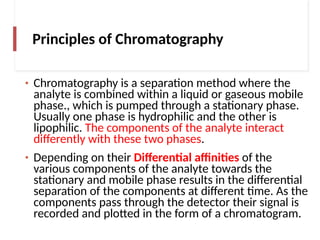
• Chromatography is a separation method where the
analyte is combined within a liquid or gaseous mobile
phase., which is pumped through a stationary phase.
Usually one phase is hydrophilic and the other is
lipophilic. The components of the analyte interact
differently with these two phases.
• Depending on their Differential affinities of the
various components of the analyte towards the
stationary and mobile phase results in the differential
separation of the components at different time. As the
components pass through the detector their signal is
recorded and plotted in the form of a chromatogram.
⚫ The factors effective on this separation process include
molecular characteristics related to adsorption, partition ,
and affinity or charge of molecules in a sample and differences
among their molecular weights.
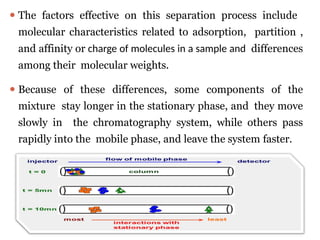
⚫ Because of these differences, some components of the
mixture stay longer in the stationary phase, and they move
slowly in the chromatography system, while others pass
rapidly into the mobile phase, and leave the system faster.
Chromatography may be preparative or analytical
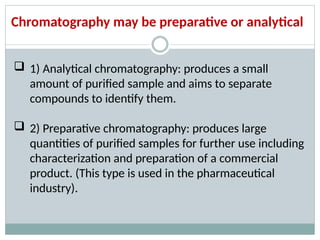
 1) Analytical chromatography: produces a small
amount of purified sample and aims to separate
compounds to identify them.
 2) Preparative chromatography: produces large
quantities of purified samples for further use including
characterization and preparation of a commercial
product. (This type is used in the pharmaceutical
industry).
Basic chromatographic terminologies
•Analyte – the substance to be separated during chromatography.
It is also normally what is needed from the mixture.
⚫ Stationary phase is a fixed phase and may be either solid
or liquid
⚫ Mobile phase Is a moving phase that contains the mixture
components and may be liquid or gas.
⚫ These two phases are immiscible with each other
Definition
⚫Eluent fluid entering the column
⚫ Eluate fluid exiting the column (that is collected in flasks)
⚫Elution the process of washing out a compound through a column
using a suitable solvent.
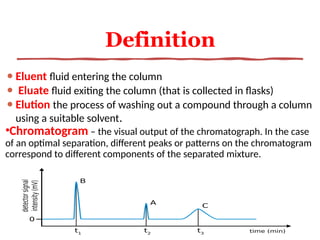
•Chromatogram – the visual output of the chromatograph. In the case
of an optimal separation, different peaks or patterns on the chromatogram
correspond to different components of the separated mixture.
Types of Chromatography
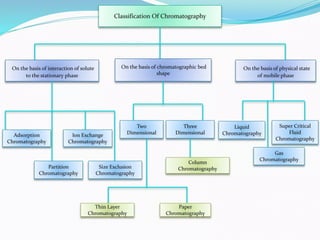
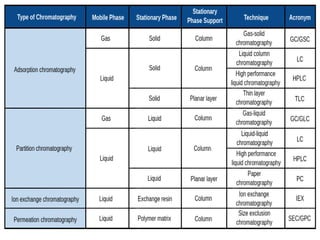
 Chromatography can be classified by various ways:
1) On the basis of chromatographic bed shape
2) Techniques by physical state of mobile phase
3) On the basis of interaction of solute to the stationary
phase)mechanism of separation )
1)Acc. to chromatographic bed shape
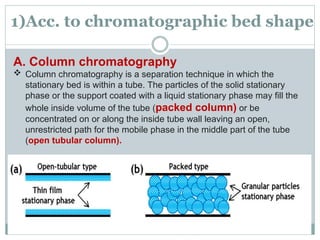
A. Column chromatography
 Column chromatography is a separation technique in which the
stationary bed is within a tube. The particles of the solid stationary
phase or the support coated with a liquid stationary phase may fill the
whole inside volume of the tube (packed column) or be
concentrated on or along the inside tube wall leaving an open,
unrestricted path for the mobile phase in the middle part of the tube
(open tubular column).
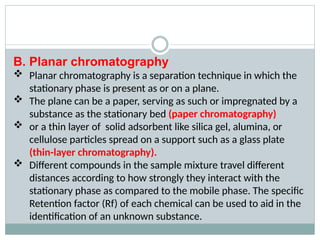
B. Planar chromatography
 Planar chromatography is a separation technique in which the
stationary phase is present as or on a plane.
 The plane can be a paper, serving as such or impregnated by a
substance as the stationary bed (paper chromatography)
 or a thin layer of solid adsorbent like silica gel, alumina, or
cellulose particles spread on a support such as a glass plate
(thin-layer chromatography).
 Different compounds in the sample mixture travel different
distances according to how strongly they interact with the
stationary phase as compared to the mobile phase. The specific
Retention factor (Rf) of each chemical can be used to aid in the
identification of an unknown substance.
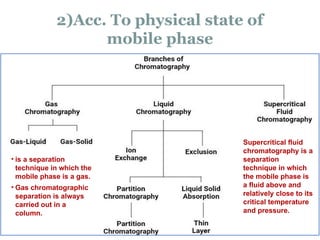
2)Acc. To physical state of
mobile phase
• is a separation
technique in which the
mobile phase is a gas.
• Gas chromatographic
separation is always
carried out in a
column.
Supercritical fluid
chromatography is a
separation
technique in which
the mobile phase is
a fluid above and
relatively close to its
critical temperature
and pressure.
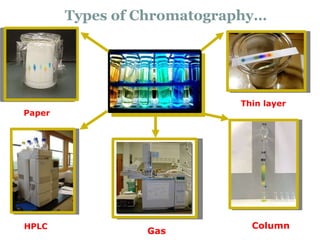
Types of Chromatography…
Paper
HPLC
Gas
Thin layer
Column
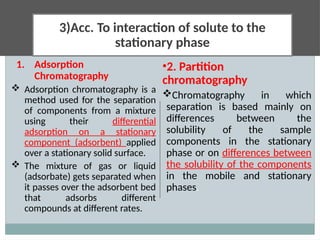
3)Acc. To interaction of solute to the
stationary phase
1. Adsorption
Chromatography
 Adsorption chromatography is a
method used for the separation
of components from a mixture
using their differential
adsorption on a stationary
component (adsorbent) applied
over a stationary solid surface.
 The mixture of gas or liquid
(adsorbate) gets separated when
it passes over the adsorbent bed
that adsorbs different
compounds at different rates.
•2. Partition
chromatography
Chromatography in which
separation is based mainly on
differences between the
solubility of the sample
components in the stationary
phase or on differences between
the solubility of the components
in the mobile and stationary
phases.
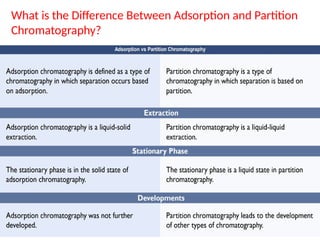
What is the Difference Between Adsorption and Partition
Chromatography?
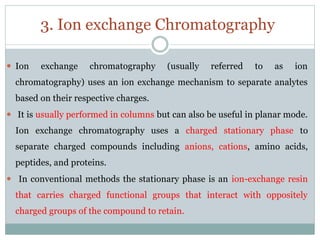
3. Ion exchange Chromatography
⚫ Ion exchange chromatography (usually referred to as ion
chromatography) uses an ion exchange mechanism to separate analytes
based on their respective charges.
⚫ It is usually performed in columns but can also be useful in planar mode.
Ion exchange chromatography uses a charged stationary phase to
separate charged compounds including anions, cations, amino acids,
peptides, and proteins.
⚫ In conventional methods the stationary phase is an ion-exchange resin
that carries charged functional groups that interact with oppositely
charged groups of the compound to retain.
3. Ion exchange Chromatography
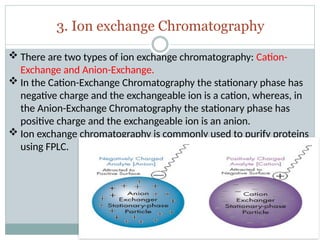
 There are two types of ion exchange chromatography: Cation-
Exchange and Anion-Exchange.
 In the Cation-Exchange Chromatography the stationary phase has
negative charge and the exchangeable ion is a cation, whereas, in
the Anion-Exchange Chromatography the stationary phase has
positive charge and the exchangeable ion is an anion.
 Ion exchange chromatography is commonly used to purify proteins
using FPLC.
4. Size Exclusion Chromatography
 Size-exclusion chromatography (SEC) is also known as gel
permeation chromatography (GPC) or gel filtration chromatography
and separates molecules according to their size .
 Smaller molecules are able to enter the pores of the media and,
therefore, molecules are trapped and removed from the flow of
the mobile phase. The average residence time in the pores
depends upon the effective size of the analyte molecules. However,
molecules that are larger than the average pore size of the packing
are excluded and thus suffer essentially no retention; such species
are the first to be eluted.
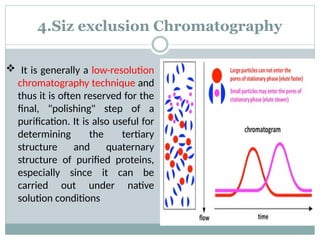
4.Siz exclusion Chromatography
 It is generally a low-resolution
chromatography technique and
thus it is often reserved for the
final, "polishing" step of a
purification. It is also useful for
determining the tertiary
structure and quaternary
structure of purified proteins,
especially since it can be
carried out under native
solution conditions
5. Affinity chromatography
 Affinity chromatography is based on selective non-covalent
interaction between an analyte and specific molecules. It is very
specific and it is the most selective type. It utilizes the specific
interaction between one kind of solute molecule and a second
molecule that is immobilized on a stationary phase .
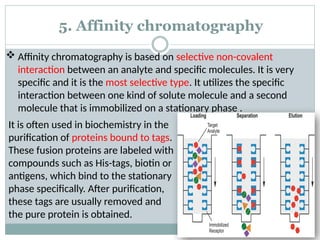
It is often used in biochemistry in the
purification of proteins bound to tags.
These fusion proteins are labeled with
compounds such as His-tags, biotin or
antigens, which bind to the stationary
phase specifically. After purification,
these tags are usually removed and
the pure protein is obtained.
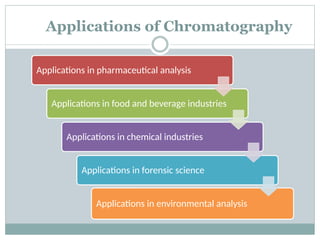
Applications of Chromatography
Applications in pharmaceutical analysis
Applications in food and beverage industries
Applications in chemical industries
Applications in forensic science
Applications in environmental analysis
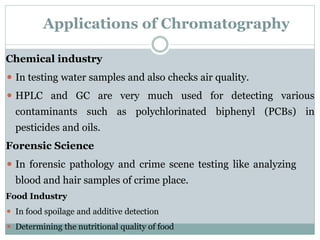
Applications of Chromatography
Chemical industry
⚫ In testing water samples and also checks air quality.
⚫ HPLC and GC are very much used for detecting various
contaminants such as polychlorinated biphenyl (PCBs) in
pesticides and oils.
Forensic Science
⚫ In forensic pathology and crime scene testing like analyzing
blood and hair samples of crime place.
Food Industry
⚫ In food spoilage and additive detection
⚫ Determining the nutritional quality of food
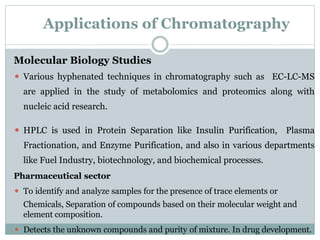
Applications of Chromatography
Molecular Biology Studies
⚫ Various hyphenated techniques in chromatography such as EC-LC-MS
are applied in the study of metabolomics and proteomics along with
nucleic acid research.
⚫ HPLC is used in Protein Separation like Insulin Purification, Plasma
Fractionation, and Enzyme Purification, and also in various departments
like Fuel Industry, biotechnology, and biochemical processes.
Pharmaceutical sector
⚫ To identify and analyze samples for the presence of trace elements or
Chemicals, Separation of compounds based on their molecular weight and
element composition.
⚫ Detects the unknown compounds and purity of mixture. In drug development.
introduction to chromatography separations .pptx

  • 1.
  • 2.
    Introduction ⚫Chromatography (from Greek, chroma "color and graphy " to write") is the collective term for a set of bio-physical laboratory technique used for separation, identification, quantification and purification of components of a mixture. in which the components to be separated are, distributed between two phases, one of which is stationary phase while the other is mobile phase, moves in a definite direction. ⚫ It is used in many areas of study particularly in chemistry, biology and medicine. ⚫ Pigments, dyes, amino acids, vitamins, polymers, etc can be separated by using the chromatography technique.
  • 3.
    History of Chromatography Thefirst true chromatography by Russian-Italian botanist Mikhail Tsvet in 1903 For the separation of plant pigments. Since the components had different colors ,He called the new technique chromatography because the result of the analysis was 'written in color' along the length of the adsorbent column. He used a liquid-adsorption column containing calcium carbonate to separate yellow, orange, and green plant pigments (what are known today as xanthophylls, carotenes, and chlorophylls, respectively).
  • 4.
    Principles of Chromatography •Chromatography is a separation method where the analyte is combined within a liquid or gaseous mobile phase., which is pumped through a stationary phase. Usually one phase is hydrophilic and the other is lipophilic. The components of the analyte interact differently with these two phases. • Depending on their Differential affinities of the various components of the analyte towards the stationary and mobile phase results in the differential separation of the components at different time. As the components pass through the detector their signal is recorded and plotted in the form of a chromatogram.
  • 5.
    ⚫ The factorseffective on this separation process include molecular characteristics related to adsorption, partition , and affinity or charge of molecules in a sample and differences among their molecular weights. ⚫ Because of these differences, some components of the mixture stay longer in the stationary phase, and they move slowly in the chromatography system, while others pass rapidly into the mobile phase, and leave the system faster.
  • 6.
    Chromatography may bepreparative or analytical  1) Analytical chromatography: produces a small amount of purified sample and aims to separate compounds to identify them.  2) Preparative chromatography: produces large quantities of purified samples for further use including characterization and preparation of a commercial product. (This type is used in the pharmaceutical industry).
  • 7.
    Basic chromatographic terminologies •Analyte– the substance to be separated during chromatography. It is also normally what is needed from the mixture. ⚫ Stationary phase is a fixed phase and may be either solid or liquid ⚫ Mobile phase Is a moving phase that contains the mixture components and may be liquid or gas. ⚫ These two phases are immiscible with each other
  • 8.
    Definition ⚫Eluent fluid enteringthe column ⚫ Eluate fluid exiting the column (that is collected in flasks) ⚫Elution the process of washing out a compound through a column using a suitable solvent. •Chromatogram – the visual output of the chromatograph. In the case of an optimal separation, different peaks or patterns on the chromatogram correspond to different components of the separated mixture.
  • 9.
    Types of Chromatography Chromatography can be classified by various ways: 1) On the basis of chromatographic bed shape 2) Techniques by physical state of mobile phase 3) On the basis of interaction of solute to the stationary phase)mechanism of separation )
  • 11.
    1)Acc. to chromatographicbed shape A. Column chromatography  Column chromatography is a separation technique in which the stationary bed is within a tube. The particles of the solid stationary phase or the support coated with a liquid stationary phase may fill the whole inside volume of the tube (packed column) or be concentrated on or along the inside tube wall leaving an open, unrestricted path for the mobile phase in the middle part of the tube (open tubular column).
  • 12.
    B. Planar chromatography Planar chromatography is a separation technique in which the stationary phase is present as or on a plane.  The plane can be a paper, serving as such or impregnated by a substance as the stationary bed (paper chromatography)  or a thin layer of solid adsorbent like silica gel, alumina, or cellulose particles spread on a support such as a glass plate (thin-layer chromatography).  Different compounds in the sample mixture travel different distances according to how strongly they interact with the stationary phase as compared to the mobile phase. The specific Retention factor (Rf) of each chemical can be used to aid in the identification of an unknown substance.
  • 13.
    2)Acc. To physicalstate of mobile phase • is a separation technique in which the mobile phase is a gas. • Gas chromatographic separation is always carried out in a column. Supercritical fluid chromatography is a separation technique in which the mobile phase is a fluid above and relatively close to its critical temperature and pressure.
  • 15.
  • 16.
    3)Acc. To interactionof solute to the stationary phase 1. Adsorption Chromatography  Adsorption chromatography is a method used for the separation of components from a mixture using their differential adsorption on a stationary component (adsorbent) applied over a stationary solid surface.  The mixture of gas or liquid (adsorbate) gets separated when it passes over the adsorbent bed that adsorbs different compounds at different rates. •2. Partition chromatography Chromatography in which separation is based mainly on differences between the solubility of the sample components in the stationary phase or on differences between the solubility of the components in the mobile and stationary phases.
  • 17.
    What is theDifference Between Adsorption and Partition Chromatography?
  • 18.
    3. Ion exchangeChromatography ⚫ Ion exchange chromatography (usually referred to as ion chromatography) uses an ion exchange mechanism to separate analytes based on their respective charges. ⚫ It is usually performed in columns but can also be useful in planar mode. Ion exchange chromatography uses a charged stationary phase to separate charged compounds including anions, cations, amino acids, peptides, and proteins. ⚫ In conventional methods the stationary phase is an ion-exchange resin that carries charged functional groups that interact with oppositely charged groups of the compound to retain.
  • 19.
    3. Ion exchangeChromatography  There are two types of ion exchange chromatography: Cation- Exchange and Anion-Exchange.  In the Cation-Exchange Chromatography the stationary phase has negative charge and the exchangeable ion is a cation, whereas, in the Anion-Exchange Chromatography the stationary phase has positive charge and the exchangeable ion is an anion.  Ion exchange chromatography is commonly used to purify proteins using FPLC.
  • 20.
    4. Size ExclusionChromatography  Size-exclusion chromatography (SEC) is also known as gel permeation chromatography (GPC) or gel filtration chromatography and separates molecules according to their size .  Smaller molecules are able to enter the pores of the media and, therefore, molecules are trapped and removed from the flow of the mobile phase. The average residence time in the pores depends upon the effective size of the analyte molecules. However, molecules that are larger than the average pore size of the packing are excluded and thus suffer essentially no retention; such species are the first to be eluted.
  • 21.
    4.Siz exclusion Chromatography It is generally a low-resolution chromatography technique and thus it is often reserved for the final, "polishing" step of a purification. It is also useful for determining the tertiary structure and quaternary structure of purified proteins, especially since it can be carried out under native solution conditions
  • 22.
    5. Affinity chromatography Affinity chromatography is based on selective non-covalent interaction between an analyte and specific molecules. It is very specific and it is the most selective type. It utilizes the specific interaction between one kind of solute molecule and a second molecule that is immobilized on a stationary phase . It is often used in biochemistry in the purification of proteins bound to tags. These fusion proteins are labeled with compounds such as His-tags, biotin or antigens, which bind to the stationary phase specifically. After purification, these tags are usually removed and the pure protein is obtained.
  • 23.
    Applications of Chromatography Applicationsin pharmaceutical analysis Applications in food and beverage industries Applications in chemical industries Applications in forensic science Applications in environmental analysis
  • 24.
    Applications of Chromatography Chemicalindustry ⚫ In testing water samples and also checks air quality. ⚫ HPLC and GC are very much used for detecting various contaminants such as polychlorinated biphenyl (PCBs) in pesticides and oils. Forensic Science ⚫ In forensic pathology and crime scene testing like analyzing blood and hair samples of crime place. Food Industry ⚫ In food spoilage and additive detection ⚫ Determining the nutritional quality of food
  • 25.
    Applications of Chromatography MolecularBiology Studies ⚫ Various hyphenated techniques in chromatography such as EC-LC-MS are applied in the study of metabolomics and proteomics along with nucleic acid research. ⚫ HPLC is used in Protein Separation like Insulin Purification, Plasma Fractionation, and Enzyme Purification, and also in various departments like Fuel Industry, biotechnology, and biochemical processes. Pharmaceutical sector ⚫ To identify and analyze samples for the presence of trace elements or Chemicals, Separation of compounds based on their molecular weight and element composition. ⚫ Detects the unknown compounds and purity of mixture. In drug development.