By
Mr. Vinayak R. Bodhankar
M. Pharm. (QA)
Content
Introduction
Principle
Methodology, Rf values
Advantages, disadvantages and applications.
 Chromatogrphic separation by using thin layer of adsorbent coated on plate.
 The history of thin layer chromatography dates back to 1938 when Izmailov
and Shraiber separated plant extracts using 2mm thick and firm layer of
alumina set on glass plate.
 In 1944, Consden, Goden and Martin used filter papers for separating amino
acids.
 In 1950, Kirchner identified terpens on filter paper and later glass fibre paper
coated with alumina.
 Only in 1958, Stahl developed standard equipment for analyzing by Thin
layer chromatography.
01 INTRODUCTION
 Thin Layer Chromatography can be defined as a method of separation or
identification of a mixture of components into individual components by using
finely divided adsorbent coated or spread over a chromatographic plate.
 The mobile phase solvent flows through because of capillary action (against
gravitational force).
 The components move according to their affinities towards the adsorbent.
 The component with more affinity towards the stationary phase travels slower.
The component with lesser affinity towards the stationary phase travels faster.
Thus the components are separated on a thin layer chromatographic plate
based on the affinity of the components towards the stationary phase.
02 PRINCIPLE
1. Selection of stationary phase
2. Preparation of plate
3. Activation of plate
4. Purification of adsorbent
5. Application of sample
6. Tank development
7. Selection of solvent
8. Detection of components
03 METHODOLOGY
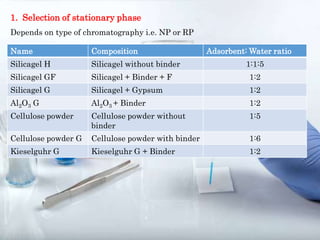
1. Selection of stationary phase
Depends on type of chromatography i.e. NP or RP
Name Composition Adsorbent: Water ratio
Silicagel H Silicagel without binder 1:1:5
Silicagel GF Silicagel + Binder + F 1:2
Silicagel G Silicagel + Gypsum 1:2
Al2O3 G Al2O3 + Binder 1:2
Cellulose powder Cellulose powder without
binder
1:5
Cellulose powder G Cellulose powder with binder 1:6
Kieselguhr G Kieselguhr G + Binder 1:2
2. Preparation of plate
 The sizes of the glass plates for use with commercially available spreaders are
usually 20 X 20, 20 X 10 or 20 X 5 cm.
 In general, the glass plates should be of good quality and should be withstand
temperatures
Methods:
 Pouring
 Spraying
 Spreading
 Dipping
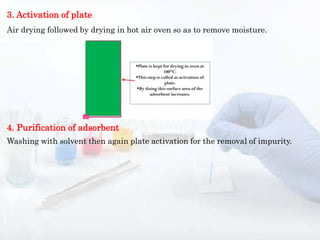
3. Activation of plate
Air drying followed by drying in hot air oven so as to remove moisture.
4. Purification of adsorbent
Washing with solvent then again plate activation for the removal of impurity.
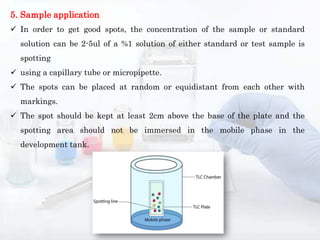
5. Sample application
 In order to get good spots, the concentration of the sample or standard
solution can be 2-5ul of a %1 solution of either standard or test sample is
spotting
 using a capillary tube or micropipette.
 The spots can be placed at random or equidistant from each other with
markings.
 The spot should be kept at least 2cm above the base of the plate and the
spotting area should not be immersed in the mobile phase in the
development tank.
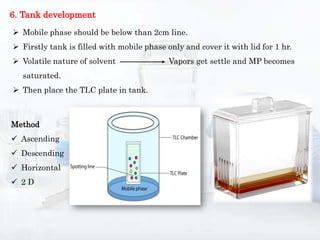
6. Tank development
 Mobile phase should be below than 2cm line.
 Firstly tank is filled with mobile phase only and cover it with lid for 1 hr.
 Volatile nature of solvent Vapors get settle and MP becomes
saturated.
 Then place the TLC plate in tank.
Method
 Ascending
 Descending
 Horizontal
 2 D
7. Selection of solvent
Selection of the mobile phase depends upon the below factors
 Nature of the substances to be separated
 Nature of the stationary phase used
 Mode of chromatography (Normal phase or reverse phase)
List of solvents (of increasing polarity)
Petroleum ether, Carbon tetrachloride, Cyclohexane, Carbon di-sulphide, Ether,
Acetone, Benzene, Toluene, Ethyl acetate, Chloroform, Alcohols like methanol or
ethanol, Water, pyridine.
Polarity
7. Detection of components
After the development of TLC plates, the spots should be visualized. Detecting
colored spots can be done visually. But for detecting colorless spots, any one of
the following techniques can be used.
a. Specific methods
In this method particular detecting agents are used to find out the nature of
compounds or for identification purposes.
Examples are
 Ferric chloride- for phenolic compounds and tannins.
 Ninhydrin in acetone- for amino acids
 Dragendroff's reagent- for alkaloids
 2,4- Dinitrophenyl hydrazine -for aldehydes and ketones
b. Nonspecific methods:
Where the number of spots can be detected, but not the exact nature or type of
compound.
Examples
1. lodine chamber method: Where brown or amber spots are observed when the
TLC plates are kept in a tank with few iodine crystals at the bottom.
2. Sulphuric acid spray reagent: 70-80% v/v of sulphuric acid with few mg of
either potassium dichromate or potassium permanganate or few ml of nitric
acid as oxidizing agent is used. This reagent after spraying on TLC plates is
heated in an oven. Black spots are seen due to charring of compounds.
3. Using fluorescent stationary phase: When the compound s are not flourscent,
a fluorescent stationary phase is used. When the plates are viewed under UV
chamber, dark spots are seen on a fluorescent background.
Examples of such stationary phase is Silica gel GF
1. It is a simple process with a short development time.
2. It helps with the visualization of separated compound spots easily.
3. It helps in isolating of most of the compounds.
4. The separation process is faster and the selectivity for compounds is higher
(even small
differences in chemistry is enough for clear separation).
5. It is a cheaper chromatographic technique.
7. TLC offers a faster and more efficient separation than paper chromatography
and the
majority of paper chromatographic separations have now been replaced by the
TLC.
04 ADVANTAGES
 Separation of mixtures of drugs of chemicals or biological origin, plant extracts,
etc.
 Separation of carbohydrate, vitamins, antibiotics, proteins, alkaloids.
Glycosides, etc.
 Identification of drugs.
 Automation is not possible
 Only soluble components of mixture can be separated
 Separation is done in open system which can affect by temperature or humidity
05 DISADVANTAGES
06 APPLICATIONS

Thin layer chromatography by Mr. Vinayak Bodhankar

  • 1.
    By Mr. Vinayak R.Bodhankar M. Pharm. (QA)
  • 2.
  • 3.
     Chromatogrphic separationby using thin layer of adsorbent coated on plate.  The history of thin layer chromatography dates back to 1938 when Izmailov and Shraiber separated plant extracts using 2mm thick and firm layer of alumina set on glass plate.  In 1944, Consden, Goden and Martin used filter papers for separating amino acids.  In 1950, Kirchner identified terpens on filter paper and later glass fibre paper coated with alumina.  Only in 1958, Stahl developed standard equipment for analyzing by Thin layer chromatography. 01 INTRODUCTION
  • 4.
     Thin LayerChromatography can be defined as a method of separation or identification of a mixture of components into individual components by using finely divided adsorbent coated or spread over a chromatographic plate.  The mobile phase solvent flows through because of capillary action (against gravitational force).  The components move according to their affinities towards the adsorbent.  The component with more affinity towards the stationary phase travels slower. The component with lesser affinity towards the stationary phase travels faster. Thus the components are separated on a thin layer chromatographic plate based on the affinity of the components towards the stationary phase. 02 PRINCIPLE
  • 5.
    1. Selection ofstationary phase 2. Preparation of plate 3. Activation of plate 4. Purification of adsorbent 5. Application of sample 6. Tank development 7. Selection of solvent 8. Detection of components 03 METHODOLOGY
  • 6.
    1. Selection ofstationary phase Depends on type of chromatography i.e. NP or RP Name Composition Adsorbent: Water ratio Silicagel H Silicagel without binder 1:1:5 Silicagel GF Silicagel + Binder + F 1:2 Silicagel G Silicagel + Gypsum 1:2 Al2O3 G Al2O3 + Binder 1:2 Cellulose powder Cellulose powder without binder 1:5 Cellulose powder G Cellulose powder with binder 1:6 Kieselguhr G Kieselguhr G + Binder 1:2
  • 7.
    2. Preparation ofplate  The sizes of the glass plates for use with commercially available spreaders are usually 20 X 20, 20 X 10 or 20 X 5 cm.  In general, the glass plates should be of good quality and should be withstand temperatures Methods:  Pouring  Spraying  Spreading  Dipping
  • 8.
    3. Activation ofplate Air drying followed by drying in hot air oven so as to remove moisture. 4. Purification of adsorbent Washing with solvent then again plate activation for the removal of impurity.
  • 9.
    5. Sample application In order to get good spots, the concentration of the sample or standard solution can be 2-5ul of a %1 solution of either standard or test sample is spotting  using a capillary tube or micropipette.  The spots can be placed at random or equidistant from each other with markings.  The spot should be kept at least 2cm above the base of the plate and the spotting area should not be immersed in the mobile phase in the development tank.
  • 10.
    6. Tank development Mobile phase should be below than 2cm line.  Firstly tank is filled with mobile phase only and cover it with lid for 1 hr.  Volatile nature of solvent Vapors get settle and MP becomes saturated.  Then place the TLC plate in tank. Method  Ascending  Descending  Horizontal  2 D
  • 11.
    7. Selection ofsolvent Selection of the mobile phase depends upon the below factors  Nature of the substances to be separated  Nature of the stationary phase used  Mode of chromatography (Normal phase or reverse phase) List of solvents (of increasing polarity) Petroleum ether, Carbon tetrachloride, Cyclohexane, Carbon di-sulphide, Ether, Acetone, Benzene, Toluene, Ethyl acetate, Chloroform, Alcohols like methanol or ethanol, Water, pyridine. Polarity
  • 12.
    7. Detection ofcomponents After the development of TLC plates, the spots should be visualized. Detecting colored spots can be done visually. But for detecting colorless spots, any one of the following techniques can be used. a. Specific methods In this method particular detecting agents are used to find out the nature of compounds or for identification purposes. Examples are  Ferric chloride- for phenolic compounds and tannins.  Ninhydrin in acetone- for amino acids  Dragendroff's reagent- for alkaloids  2,4- Dinitrophenyl hydrazine -for aldehydes and ketones
  • 13.
    b. Nonspecific methods: Wherethe number of spots can be detected, but not the exact nature or type of compound. Examples 1. lodine chamber method: Where brown or amber spots are observed when the TLC plates are kept in a tank with few iodine crystals at the bottom. 2. Sulphuric acid spray reagent: 70-80% v/v of sulphuric acid with few mg of either potassium dichromate or potassium permanganate or few ml of nitric acid as oxidizing agent is used. This reagent after spraying on TLC plates is heated in an oven. Black spots are seen due to charring of compounds. 3. Using fluorescent stationary phase: When the compound s are not flourscent, a fluorescent stationary phase is used. When the plates are viewed under UV chamber, dark spots are seen on a fluorescent background. Examples of such stationary phase is Silica gel GF
  • 14.
    1. It isa simple process with a short development time. 2. It helps with the visualization of separated compound spots easily. 3. It helps in isolating of most of the compounds. 4. The separation process is faster and the selectivity for compounds is higher (even small differences in chemistry is enough for clear separation). 5. It is a cheaper chromatographic technique. 7. TLC offers a faster and more efficient separation than paper chromatography and the majority of paper chromatographic separations have now been replaced by the TLC. 04 ADVANTAGES
  • 15.
     Separation ofmixtures of drugs of chemicals or biological origin, plant extracts, etc.  Separation of carbohydrate, vitamins, antibiotics, proteins, alkaloids. Glycosides, etc.  Identification of drugs.  Automation is not possible  Only soluble components of mixture can be separated  Separation is done in open system which can affect by temperature or humidity 05 DISADVANTAGES 06 APPLICATIONS