Downloaded 1,053 times

![• Permeability
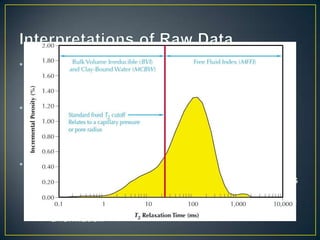
Based on scientific models that show permeability
increases with porosity combined with core data
• PropertiesCoates Model:
of Reservoir Fluids
Based on T1 and T2 times which indicates pore
sizes. Clay-bound water, capillary-bound
water,Perm= [total brine, hydrocarbons can all be
movable water,
differentiated based 2(producible sizes
porosity/C) on various pore
porosity/Bulk irreducible
volume)]2](https://image.slidesharecdn.com/nuclearmagneticresonance-111119171800-phpapp02/85/Nuclear-magnetic-resonance-9-320.jpg)
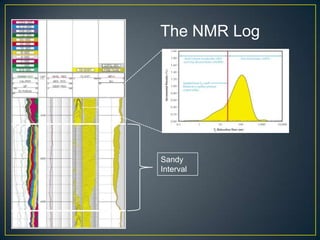
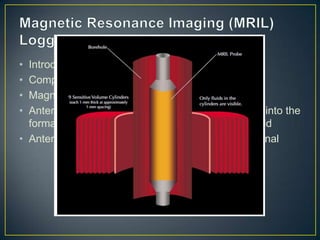
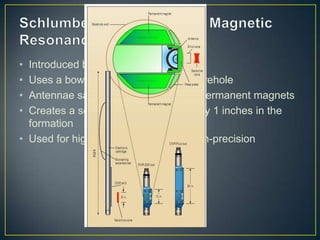
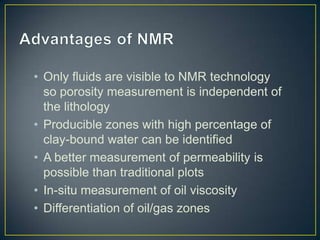
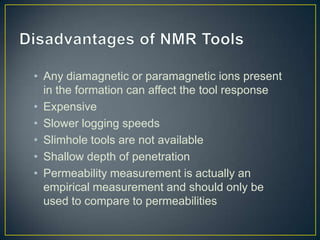
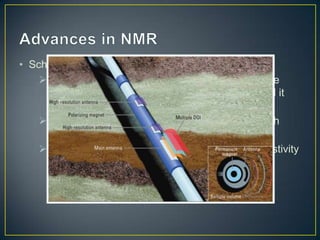
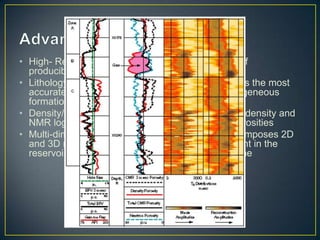


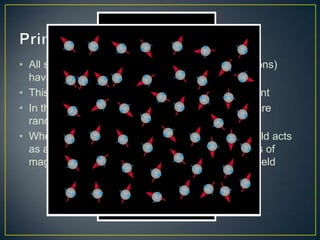
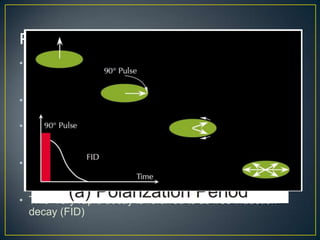
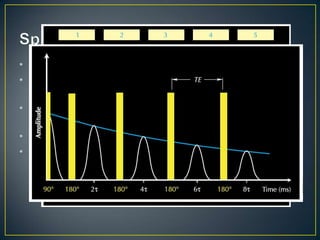
NMR logging uses nuclear magnetic resonance to infer properties of rock formations such as porosity, permeability, and fluid distributions. It works by applying a magnetic field to align hydrogen proton spins, then measuring the decay of the signal as the spins relax. This decay provides information about pore sizes and fluid types. Main advantages are lithology-independent porosity and improved permeability estimates compared to conventional well logs. Limitations include cost, speed, and shallow depth of investigation. Recent advances aim to improve resolution and differentiate fluid and rock properties.


