PARASYMPATHOMIMETICS
(CHOLINERGIC AGONISTS)
BY
KENCHA SWATHI
ASSISTANT PROFESSOR
DEPT.OF MEDICINAL CHEMISTRY
ADITYA BIPER
BANGALORE
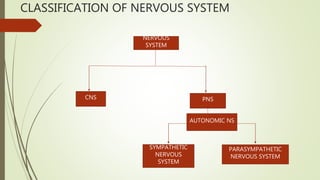
CLASSIFICATION OF NERVOUS SYSTEM
NERVOUS
SYSTEM
CNS PNS
SYMPATHETIC
NERVOUS
SYSTEM
PARASYMPATHETIC
NERVOUS SYSTEM
AUTONOMIC NS
PARASYMPATHETIC NEUROTRANSMITTER
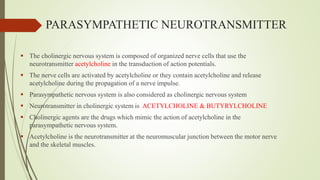
 The cholinergic nervous system is composed of organized nerve cells that use the
neurotransmitter acetylcholine in the transduction of action potentials.
 The nerve cells are activated by acetylcholine or they contain acetylcholine and release
acetylcholine during the propagation of a nerve impulse.
 Parasympathetic nervous system is also considered as cholinergic nervous system
 Neurotransmitter in cholinergic system is ACETYLCHOLINE & BUTYRYLCHOLINE
 Cholinergic agents are the drugs which mimic the action of acetylcholine in the
parasympathetic nervous system.
 Acetylcholine is the neurotransmitter at the neuromuscular junction between the motor nerve
and the skeletal muscles.
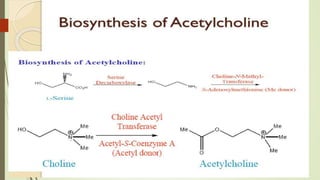
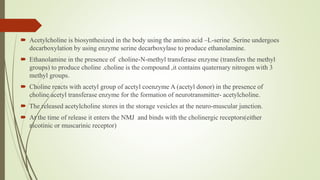
 Acetylcholine is biosynthesized in the body using the amino acid –L-serine .Serine undergoes
decarboxylation by using enzyme serine decarboxylase to produce ethanolamine.
 Ethanolamine in the presence of choline-N-methyl transferase enzyme (transfers the methyl
groups) to produce choline .choline is the compound ,it contains quaternary nitrogen with 3
methyl groups.
 Choline reacts with acetyl group of acetyl coenzyme A (acetyl donor) in the presence of
choline acetyl transferase enzyme for the formation of neurotransmitter- acetylcholine.
 The released acetylcholine stores in the storage vesicles at the neuro-muscular junction.
 At the time of release it enters the NMJ and binds with the cholinergic receptors(either
nicotinic or muscarinic receptor)
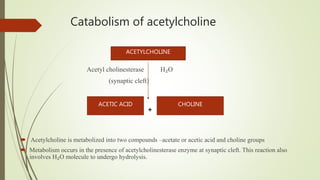
Catabolism of acetylcholine
Acetyl cholinesterase H₂O
(synaptic cleft)
+
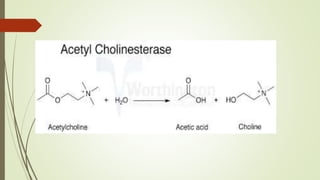
 Acetylcholine is metabolized into two compounds –acetate or acetic acid and choline groups
 Metabolism occurs in the presence of acetylcholinesterase enzyme at synaptic cleft. This reaction also
involves H₂O molecule to undergo hydrolysis.
ACETYLCHOLINE
ACETIC ACID CHOLINE
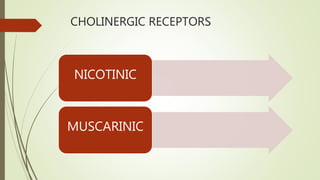
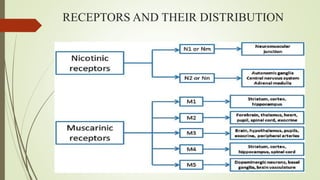
CHOLINERGIC RECEPTORS
NICOTINIC
MUSCARINIC
RECEPTORS AND THEIR DISTRIBUTION
PARASYMPATHOMIMETICS
 Parasympathomimetics are the drugs or chemical agents which mimic the actions of
acetylcholine.
 These drugs bind with the cholinergic receptors and shows the stimulative action
similar to acetylcholine .
 Parasympathomimetics are also called as cholinergic agonists or cholinomimetics.
 Cholinergic agonists have a direct action on the receptor for acetylcholine action.
 Cholinergic agonists are classified into two types:
A.Direct acting cholinergic agonists
B. Indirect acting cholinergic agonists.
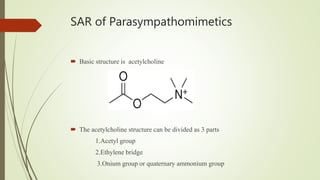
SAR of Parasympathomimetics
 Basic structure is acetylcholine
 The acetylcholine structure can be divided as 3 parts
1.Acetyl group
2.Ethylene bridge
3.Onium group or quaternary ammonium group
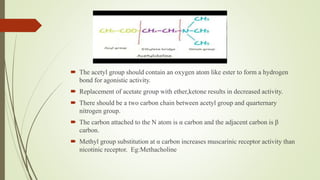
 The acetyl group should contain an oxygen atom like ester to form a hydrogen
bond for agonistic activity.
 Replacement of acetate group with ether,ketone results in decreased activity.
 There should be a two carbon chain between acetyl group and quarternary
nitrogen group.
 The carbon attached to the N atom is α carbon and the adjacent carbon is β
carbon.
 Methyl group substitution at α carbon increases muscarinic receptor activity than
nicotinic receptor. Eg:Methacholine
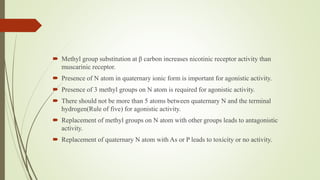
 Methyl group substitution at β carbon increases nicotinic receptor activity than
muscarinic receptor.
 Presence of N atom in quaternary ionic form is important for agonistic activity.
 Presence of 3 methyl groups on N atom is required for agonistic activity.
 There should not be more than 5 atoms between quaternary N and the terminal
hydrogen(Rule of five) for agonistic activity.
 Replacement of methyl groups on N atom with other groups leads to antagonistic
activity.
 Replacement of quaternary N atom with As or P leads to toxicity or no activity.
DIRECT ACTING CHOLINERGIC AGONISTS
 The drugs which binds to the cholinergic receptors either muscarinic or nicotinic and
shows the action similar to acetylcholine are called as direct acting cholinergic
agonists.
Eg: Acetylcholine
Carbachol
Bethanechol
Methacholine
Pilocarpine
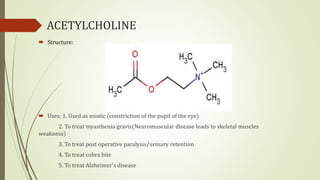
ACETYLCHOLINE
 Structure:
 Uses: 1. Used as miotic (constriction of the pupil of the eye)
2. To treat myasthenia gravis(Neuromuscular disease leads to skeletal muscles
weakness)
3. To treat post operative paralysis/urinary retention
4. To treat cobra bite
5. To treat Alzheimer’s disease
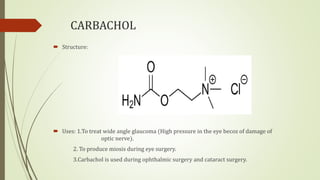
CARBACHOL
 Structure:
 Uses: 1.To treat wide angle glaucoma (High pressure in the eye becoz of damage of
optic nerve).
2. To produce miosis during eye surgery.
3.Carbachol is used during ophthalmic surgery and cataract surgery.
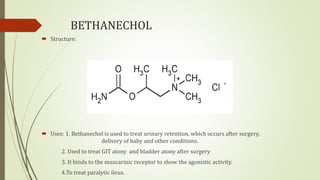
BETHANECHOL
 Structure:
 Uses: 1. Bethanechol is used to treat urinary retention, which occurs after surgery,
delivery of baby and other conditions.
2. Used to treat GIT atony and bladder atony after surgery
3. It binds to the muscarinic receptor to show the agonistic activity.
4.To treat paralytic ileus.
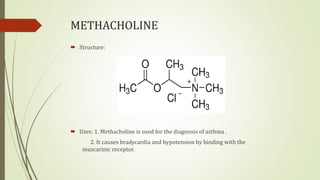
METHACHOLINE
 Structure:
 Uses: 1. Methacholine is used for the diagnosis of asthma .
2. It causes bradycardia and hypotension by binding with the
muscarinic receptor.
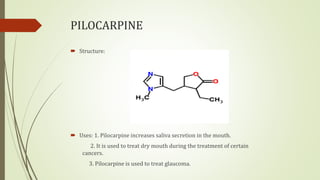
PILOCARPINE
 Structure:
 Uses: 1. Pilocarpine increases saliva secretion in the mouth.
2. It is used to treat dry mouth during the treatment of certain
cancers.
3. Pilocarpine is used to treat glaucoma.
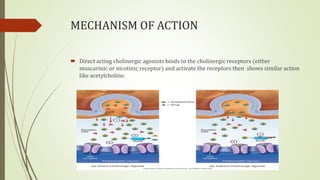
MECHANISM OF ACTION
 Direct acting cholinergic agonists binds to the cholinergic receptors (either
muscarinic or nicotinic receptor) and activate the receptors then shows similar action
like acetylcholine.
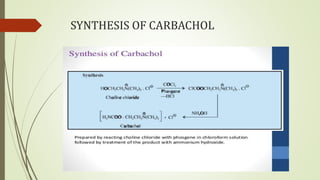
SYNTHESIS OF CARBACHOL
INDIRECT ACTING CHOLINERGIC AGONISTS
 Drugs or chemical agents which inhibits acetylcholinesterase enzyme thereby
increasing the concentration of acetylcholine levels at the neuromuscular junction or
synaptic cleft.
 Then the drugs enhance the cholinergic functions via activation of muscarinic or
nicotinic receptors.
 Acetylcholinesterase is the enzyme responsible for breakdown of acetylcholine into
acetate ion and choline.
 Inhibition of this enzyme leads to excess amount of AcH at NMJ.
 Indirect acting cholinergic agonists are also called as cholinesterase inhibitors or
Anticholinesterases.
CLASSIFICATION
 Indirect acting cholinergic agonists are classified as :
1. Reversible cholinesterase inhibitors: The drugs binds to the cholinesterase enzyme
for a period of few minutes to few hours and later release the acetylcholinesterase
enzyme are called as reversible cholinesterase inhibitors.
Eg: Physostigmine,Neostigmine,pyridostigmine,Edrophonium,Tacrine
2.Irreversible cholinesterase inhibitors: Drugs bind to the cholinesterase enzyme
and forms a permanent covalent bond to form drug-enzyme complex Irreversibly for a
long time are called as irreversible cholinesterase inhibitors.
Eg: Parathion, Malathion, Ambenonium chloride, Isofluorphate,
Echothiophate
3. Cholinesterase reactivator: Drugs of this group reverse the inactivation of
acetylcholinesterase enzyme which is inhibited by irreversible anticholinesterases.
Eg: Pralidoxime
REVERSIBLE CHOLINERGIC AGONISTS
 Carbamates - Eg:Physostigmine
Neostigmine
Pyridostigmine
 Non-carbamate quaternary compounds - Eg:Edrophonium chloride
 Acridine derivatives -Eg: Tacrine chloride
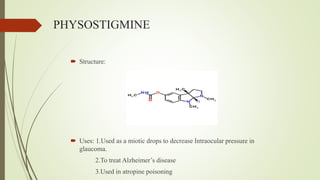
PHYSOSTIGMINE
 Structure:
 Uses: 1.Used as a miotic drops to decrease Intraocular pressure in
glaucoma.
2.To treat Alzheimer’s disease
3.Used in atropine poisoning
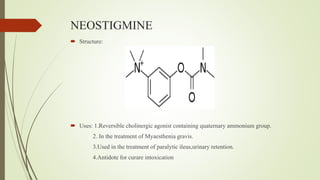
NEOSTIGMINE
 Structure:
 Uses: 1.Reversible cholinergic agonist containing quaternary ammonium group.
2. In the treatment of Myaesthenia gravis.
3.Used in the treatment of paralytic ileus,urinary retention.
4.Antidote for curare intoxication
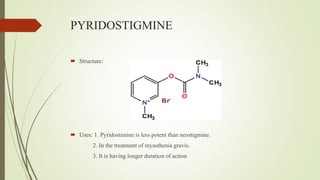
PYRIDOSTIGMINE
 Structure:
 Uses: 1. Pyridostimine is less potent than neostigmine.
2. In the treatment of myasthenia gravis.
3. It is having longer duration of action
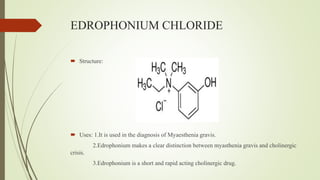
EDROPHONIUM CHLORIDE
 Structure:
 Uses: 1.It is used in the diagnosis of Myaesthenia gravis.
2.Edrophonium makes a clear distinction between myasthenia gravis and cholinergic
crisis.
3.Edrophonium is a short and rapid acting cholinergic drug.
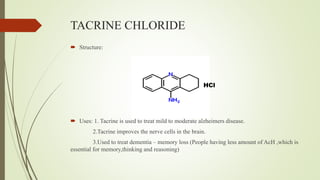
TACRINE CHLORIDE
 Structure:
 Uses: 1. Tacrine is used to treat mild to moderate alzheimers disease.
2.Tacrine improves the nerve cells in the brain.
3.Used to treat dementia – memory loss (People having less amount of AcH ,which is
essential for memory,thinking and reasoning)
HCl
Side effects
 Bradycardia
 Hypotension
 Increases Saliva secretion
 CNS effects
 Convulsions
 Hepatotoxicity(Eg:Tacrine)
 Carbamate poisoning
Saliva secretion
MECHANISM OF ACTION
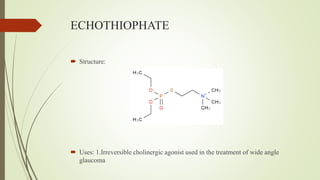
 Reversible cholinesterase inhibitors binds at the active of cholinesterase enzyme.
 Acetylcholine reacts with water in the body very rapidly and makes the esteratic site become free with
in a milli fraction of second.
 Drugs binds in this site and forms drug-enzyme complex or carbamated enzyme.
 This carbamated enzyme reacts slowly and releases slowly in the NMJ.
 More amount of Acetylcholine is available in the synaptic cleft.
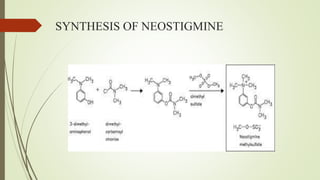
SYNTHESIS OF NEOSTIGMINE
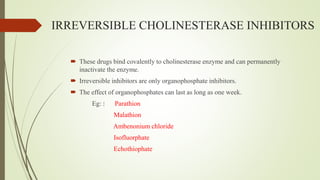
IRREVERSIBLE CHOLINESTERASE INHIBITORS
 These drugs bind covalently to cholinesterase enzyme and can permanently
inactivate the enzyme.
 Irreversible inhibitors are only organophosphate inhibitors.
 The effect of organophosphates can last as long as one week.
Eg: : Parathion
Malathion
Ambenonium chloride
Isofluorphate
Echothiophate
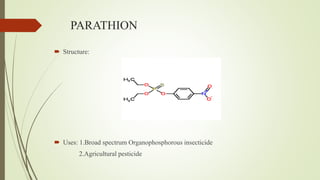
PARATHION
 Structure:
 Uses: 1.Broad spectrum Organophosphorous insecticide
2.Agricultural pesticide
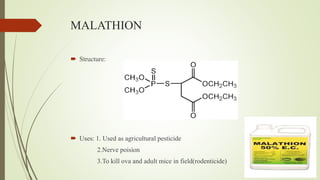
MALATHION
 Structure:
 Uses: 1. Used as agricultural pesticide
2.Nerve poision
3.To kill ova and adult mice in field(rodenticide)
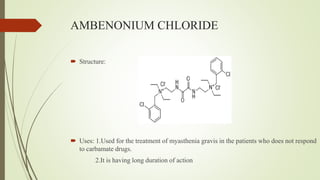
AMBENONIUM CHLORIDE
 Structure:
 Uses: 1.Used for the treatment of myasthenia gravis in the patients who does not respond
to carbamate drugs.
2.It is having long duration of action
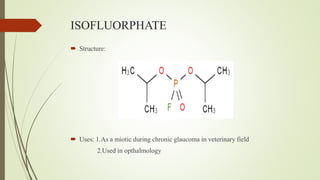
ISOFLUORPHATE
 Structure:
 Uses: 1.As a miotic during chronic glaucoma in veterinary field
2.Used in opthalmology
ECHOTHIOPHATE
 Structure:
 Uses: 1.Irreversible cholinergic agonist used in the treatment of wide angle
glaucoma
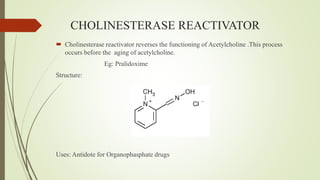
CHOLINESTERASE REACTIVATOR
 Cholinesterase reactivator reverses the functioning of Acetylcholine .This process
occurs before the aging of acetylcholine.
Eg: Pralidoxime
Structure:
Uses: Antidote for Organophasphate drugs
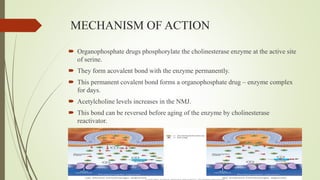
MECHANISM OF ACTION
 Organophosphate drugs phosphorylate the cholinesterase enzyme at the active site
of serine.
 They form acovalent bond with the enzyme permanently.
 This permanent covalent bond forms a organophosphate drug – enzyme complex
for days.
 Acetylcholine levels increases in the NMJ.
 This bond can be reversed before aging of the enzyme by cholinesterase
reactivator.
REFERENCES
 Wilson and Gisvold’s textbook of pharmaceutical and medicinal
chemistry.
 Textbook of medicinal chemistry by Graham Patrick.
 Textbook of Medicinal chemistry by Ashutosh Kar.
 A textbook of medicinal chemistry by Ilango.
CHOLINERGIC AGONISTS

CHOLINERGIC AGONISTS

  • 1.
    PARASYMPATHOMIMETICS (CHOLINERGIC AGONISTS) BY KENCHA SWATHI ASSISTANTPROFESSOR DEPT.OF MEDICINAL CHEMISTRY ADITYA BIPER BANGALORE
  • 2.
    CLASSIFICATION OF NERVOUSSYSTEM NERVOUS SYSTEM CNS PNS SYMPATHETIC NERVOUS SYSTEM PARASYMPATHETIC NERVOUS SYSTEM AUTONOMIC NS
  • 3.
    PARASYMPATHETIC NEUROTRANSMITTER  Thecholinergic nervous system is composed of organized nerve cells that use the neurotransmitter acetylcholine in the transduction of action potentials.  The nerve cells are activated by acetylcholine or they contain acetylcholine and release acetylcholine during the propagation of a nerve impulse.  Parasympathetic nervous system is also considered as cholinergic nervous system  Neurotransmitter in cholinergic system is ACETYLCHOLINE & BUTYRYLCHOLINE  Cholinergic agents are the drugs which mimic the action of acetylcholine in the parasympathetic nervous system.  Acetylcholine is the neurotransmitter at the neuromuscular junction between the motor nerve and the skeletal muscles.
  • 5.
     Acetylcholine isbiosynthesized in the body using the amino acid –L-serine .Serine undergoes decarboxylation by using enzyme serine decarboxylase to produce ethanolamine.  Ethanolamine in the presence of choline-N-methyl transferase enzyme (transfers the methyl groups) to produce choline .choline is the compound ,it contains quaternary nitrogen with 3 methyl groups.  Choline reacts with acetyl group of acetyl coenzyme A (acetyl donor) in the presence of choline acetyl transferase enzyme for the formation of neurotransmitter- acetylcholine.  The released acetylcholine stores in the storage vesicles at the neuro-muscular junction.  At the time of release it enters the NMJ and binds with the cholinergic receptors(either nicotinic or muscarinic receptor)
  • 6.
    Catabolism of acetylcholine Acetylcholinesterase H₂O (synaptic cleft) +  Acetylcholine is metabolized into two compounds –acetate or acetic acid and choline groups  Metabolism occurs in the presence of acetylcholinesterase enzyme at synaptic cleft. This reaction also involves H₂O molecule to undergo hydrolysis. ACETYLCHOLINE ACETIC ACID CHOLINE
  • 8.
  • 9.
    RECEPTORS AND THEIRDISTRIBUTION
  • 10.
    PARASYMPATHOMIMETICS  Parasympathomimetics arethe drugs or chemical agents which mimic the actions of acetylcholine.  These drugs bind with the cholinergic receptors and shows the stimulative action similar to acetylcholine .  Parasympathomimetics are also called as cholinergic agonists or cholinomimetics.  Cholinergic agonists have a direct action on the receptor for acetylcholine action.  Cholinergic agonists are classified into two types: A.Direct acting cholinergic agonists B. Indirect acting cholinergic agonists.
  • 11.
    SAR of Parasympathomimetics Basic structure is acetylcholine  The acetylcholine structure can be divided as 3 parts 1.Acetyl group 2.Ethylene bridge 3.Onium group or quaternary ammonium group
  • 12.
     The acetylgroup should contain an oxygen atom like ester to form a hydrogen bond for agonistic activity.  Replacement of acetate group with ether,ketone results in decreased activity.  There should be a two carbon chain between acetyl group and quarternary nitrogen group.  The carbon attached to the N atom is α carbon and the adjacent carbon is β carbon.  Methyl group substitution at α carbon increases muscarinic receptor activity than nicotinic receptor. Eg:Methacholine
  • 13.
     Methyl groupsubstitution at β carbon increases nicotinic receptor activity than muscarinic receptor.  Presence of N atom in quaternary ionic form is important for agonistic activity.  Presence of 3 methyl groups on N atom is required for agonistic activity.  There should not be more than 5 atoms between quaternary N and the terminal hydrogen(Rule of five) for agonistic activity.  Replacement of methyl groups on N atom with other groups leads to antagonistic activity.  Replacement of quaternary N atom with As or P leads to toxicity or no activity.
  • 14.
    DIRECT ACTING CHOLINERGICAGONISTS  The drugs which binds to the cholinergic receptors either muscarinic or nicotinic and shows the action similar to acetylcholine are called as direct acting cholinergic agonists. Eg: Acetylcholine Carbachol Bethanechol Methacholine Pilocarpine
  • 15.
    ACETYLCHOLINE  Structure:  Uses:1. Used as miotic (constriction of the pupil of the eye) 2. To treat myasthenia gravis(Neuromuscular disease leads to skeletal muscles weakness) 3. To treat post operative paralysis/urinary retention 4. To treat cobra bite 5. To treat Alzheimer’s disease
  • 16.
    CARBACHOL  Structure:  Uses:1.To treat wide angle glaucoma (High pressure in the eye becoz of damage of optic nerve). 2. To produce miosis during eye surgery. 3.Carbachol is used during ophthalmic surgery and cataract surgery.
  • 17.
    BETHANECHOL  Structure:  Uses:1. Bethanechol is used to treat urinary retention, which occurs after surgery, delivery of baby and other conditions. 2. Used to treat GIT atony and bladder atony after surgery 3. It binds to the muscarinic receptor to show the agonistic activity. 4.To treat paralytic ileus.
  • 18.
    METHACHOLINE  Structure:  Uses:1. Methacholine is used for the diagnosis of asthma . 2. It causes bradycardia and hypotension by binding with the muscarinic receptor.
  • 19.
    PILOCARPINE  Structure:  Uses:1. Pilocarpine increases saliva secretion in the mouth. 2. It is used to treat dry mouth during the treatment of certain cancers. 3. Pilocarpine is used to treat glaucoma.
  • 20.
    MECHANISM OF ACTION Direct acting cholinergic agonists binds to the cholinergic receptors (either muscarinic or nicotinic receptor) and activate the receptors then shows similar action like acetylcholine.
  • 21.
  • 22.
    INDIRECT ACTING CHOLINERGICAGONISTS  Drugs or chemical agents which inhibits acetylcholinesterase enzyme thereby increasing the concentration of acetylcholine levels at the neuromuscular junction or synaptic cleft.  Then the drugs enhance the cholinergic functions via activation of muscarinic or nicotinic receptors.  Acetylcholinesterase is the enzyme responsible for breakdown of acetylcholine into acetate ion and choline.  Inhibition of this enzyme leads to excess amount of AcH at NMJ.  Indirect acting cholinergic agonists are also called as cholinesterase inhibitors or Anticholinesterases.
  • 23.
    CLASSIFICATION  Indirect actingcholinergic agonists are classified as : 1. Reversible cholinesterase inhibitors: The drugs binds to the cholinesterase enzyme for a period of few minutes to few hours and later release the acetylcholinesterase enzyme are called as reversible cholinesterase inhibitors. Eg: Physostigmine,Neostigmine,pyridostigmine,Edrophonium,Tacrine 2.Irreversible cholinesterase inhibitors: Drugs bind to the cholinesterase enzyme and forms a permanent covalent bond to form drug-enzyme complex Irreversibly for a long time are called as irreversible cholinesterase inhibitors. Eg: Parathion, Malathion, Ambenonium chloride, Isofluorphate, Echothiophate 3. Cholinesterase reactivator: Drugs of this group reverse the inactivation of acetylcholinesterase enzyme which is inhibited by irreversible anticholinesterases. Eg: Pralidoxime
  • 24.
    REVERSIBLE CHOLINERGIC AGONISTS Carbamates - Eg:Physostigmine Neostigmine Pyridostigmine  Non-carbamate quaternary compounds - Eg:Edrophonium chloride  Acridine derivatives -Eg: Tacrine chloride
  • 25.
    PHYSOSTIGMINE  Structure:  Uses:1.Used as a miotic drops to decrease Intraocular pressure in glaucoma. 2.To treat Alzheimer’s disease 3.Used in atropine poisoning
  • 26.
    NEOSTIGMINE  Structure:  Uses:1.Reversible cholinergic agonist containing quaternary ammonium group. 2. In the treatment of Myaesthenia gravis. 3.Used in the treatment of paralytic ileus,urinary retention. 4.Antidote for curare intoxication
  • 27.
    PYRIDOSTIGMINE  Structure:  Uses:1. Pyridostimine is less potent than neostigmine. 2. In the treatment of myasthenia gravis. 3. It is having longer duration of action
  • 28.
    EDROPHONIUM CHLORIDE  Structure: Uses: 1.It is used in the diagnosis of Myaesthenia gravis. 2.Edrophonium makes a clear distinction between myasthenia gravis and cholinergic crisis. 3.Edrophonium is a short and rapid acting cholinergic drug.
  • 29.
    TACRINE CHLORIDE  Structure: Uses: 1. Tacrine is used to treat mild to moderate alzheimers disease. 2.Tacrine improves the nerve cells in the brain. 3.Used to treat dementia – memory loss (People having less amount of AcH ,which is essential for memory,thinking and reasoning) HCl
  • 30.
    Side effects  Bradycardia Hypotension  Increases Saliva secretion  CNS effects  Convulsions  Hepatotoxicity(Eg:Tacrine)  Carbamate poisoning Saliva secretion
  • 31.
    MECHANISM OF ACTION Reversible cholinesterase inhibitors binds at the active of cholinesterase enzyme.  Acetylcholine reacts with water in the body very rapidly and makes the esteratic site become free with in a milli fraction of second.  Drugs binds in this site and forms drug-enzyme complex or carbamated enzyme.  This carbamated enzyme reacts slowly and releases slowly in the NMJ.  More amount of Acetylcholine is available in the synaptic cleft.
  • 32.
  • 33.
    IRREVERSIBLE CHOLINESTERASE INHIBITORS These drugs bind covalently to cholinesterase enzyme and can permanently inactivate the enzyme.  Irreversible inhibitors are only organophosphate inhibitors.  The effect of organophosphates can last as long as one week. Eg: : Parathion Malathion Ambenonium chloride Isofluorphate Echothiophate
  • 34.
    PARATHION  Structure:  Uses:1.Broad spectrum Organophosphorous insecticide 2.Agricultural pesticide
  • 35.
    MALATHION  Structure:  Uses:1. Used as agricultural pesticide 2.Nerve poision 3.To kill ova and adult mice in field(rodenticide)
  • 36.
    AMBENONIUM CHLORIDE  Structure: Uses: 1.Used for the treatment of myasthenia gravis in the patients who does not respond to carbamate drugs. 2.It is having long duration of action
  • 37.
    ISOFLUORPHATE  Structure:  Uses:1.As a miotic during chronic glaucoma in veterinary field 2.Used in opthalmology
  • 38.
    ECHOTHIOPHATE  Structure:  Uses:1.Irreversible cholinergic agonist used in the treatment of wide angle glaucoma
  • 39.
    CHOLINESTERASE REACTIVATOR  Cholinesterasereactivator reverses the functioning of Acetylcholine .This process occurs before the aging of acetylcholine. Eg: Pralidoxime Structure: Uses: Antidote for Organophasphate drugs
  • 40.
    MECHANISM OF ACTION Organophosphate drugs phosphorylate the cholinesterase enzyme at the active site of serine.  They form acovalent bond with the enzyme permanently.  This permanent covalent bond forms a organophosphate drug – enzyme complex for days.  Acetylcholine levels increases in the NMJ.  This bond can be reversed before aging of the enzyme by cholinesterase reactivator.
  • 41.
    REFERENCES  Wilson andGisvold’s textbook of pharmaceutical and medicinal chemistry.  Textbook of medicinal chemistry by Graham Patrick.  Textbook of Medicinal chemistry by Ashutosh Kar.  A textbook of medicinal chemistry by Ilango.