

SRP:Cholinergic Neurotransmitter
1
Cholinergic
Neurotransmitter
Part I
Agonist
Presented By….
Prof. Sonali R. Pawar
Medicinal Chemistry I
Cholinergic
Neurotransmitter
Agonist
SRP:Cholinergic Neurotransmitter
2
Syllabus Content
3
a) Cholinergic neurotransmitters:
Biosynthesis and catabolism of acetylcholine.
Cholinergic receptors (Muscarinic & Nicotinic) and
their distribution.
b) Parasympathomimetic agents: SAR of
Parasympathomimetic agents
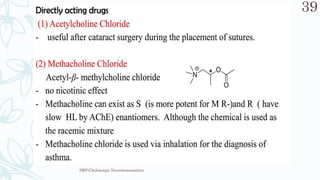
 Direct acting agents:
 Acetylcholine,
 Carbachol,
 Bethanechol,
 Methacholinea
 Pilocarpine.
Part I
 Indirect acting/ Cholinesterase inhibitors
(Reversible & Irreversible):
 Physostigmine,
 Neostigmine,
 Pyridostigmine
 Edrophonium chloride,
 Donepezil,
 Tacrine hydrochloride,
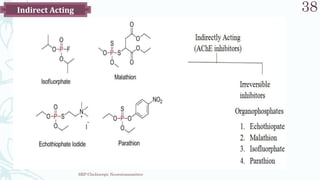
 Isofluorophate
 Echothiophate Iodide
 Parathion,
 Malathion.
 Cholinesterase reactivator: Pralidoxime chloride.
SRP:Cholinergic Neurotransmitter
4
 The neurotransmitter acetylcholine (ACh) is the only neurotransmitter used in
the motor division of the somatic nervous system and the
principal neurotransmitter at autonomic ganglia.
 In the CNS, the neurons that release and respond to ACh comprise
the cholinergic system, which causes anti-excitatory effects.
ACETYLCHOLINE
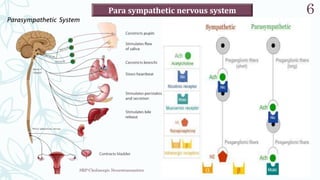
 It is also the preganglionic neurotransmitter for both the
sympathetic and parasympathetic nervous system.
 Acetylcholine (ACh) is the postganglionic neurotransmitter in the
parasympathetic nervous system
SRP:Cholinergic Neurotransmitter
5
SRP:Cholinergic Neurotransmitter
6
Para sympathetic nervous system
SRP:Cholinergic Neurotransmitter
7
Nerve impulse Animation - YouTube
Anatomy and Physiology - Action Potential Generation and Propagation - YouTube
SRP:Cholinergic Neurotransmitter
8
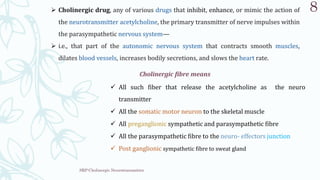
 Cholinergic drug, any of various drugs that inhibit, enhance, or mimic the action of
the neurotransmitter acetylcholine, the primary transmitter of nerve impulses within
the parasympathetic nervous system—
 i.e., that part of the autonomic nervous system that contracts smooth muscles,
dilates blood vessels, increases bodily secretions, and slows the heart rate.
Cholinergic fibre means
 All such fiber that release the acetylcholine as the neuro
transmitter
 All the somatic motor neuron to the skeletal muscle
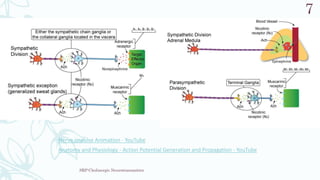
 All preganglionic sympathetic and parasympathetic fibre
 All the parasympathetic fibre to the neuro- effectors junction
 Post ganglionic sympathetic fibre to sweat gland
SRP:Cholinergic Neurotransmitter
9
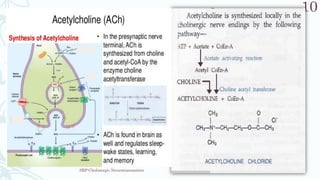
 Where are cholinergic neurotransmitters found?
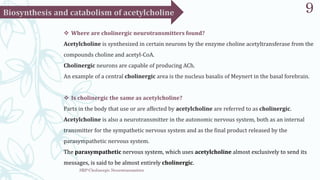
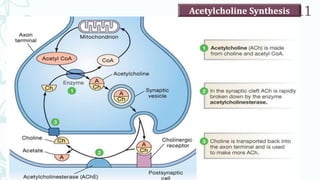
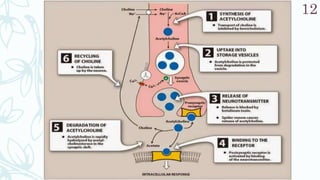
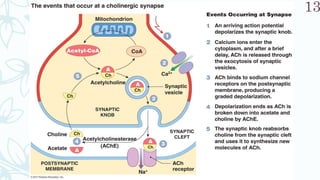
Acetylcholine is synthesized in certain neurons by the enzyme choline acetyltransferase from the
compounds choline and acetyl-CoA.
Cholinergic neurons are capable of producing ACh.
An example of a central cholinergic area is the nucleus basalis of Meynert in the basal forebrain.
 Is cholinergic the same as acetylcholine?
Parts in the body that use or are affected by acetylcholine are referred to as cholinergic.
Acetylcholine is also a neurotransmitter in the autonomic nervous system, both as an internal
transmitter for the sympathetic nervous system and as the final product released by the
parasympathetic nervous system.
The parasympathetic nervous system, which uses acetylcholine almost exclusively to send its
messages, is said to be almost entirely cholinergic.
SRP:Cholinergic Neurotransmitter
10
SRP:Cholinergic Neurotransmitter
11
Acetylcholine Synthesis
SRP:Cholinergic Neurotransmitter
12
SRP:Cholinergic Neurotransmitter
13
SRP:Cholinergic Neurotransmitter
14
Cholinergic receptors
(Muscarinic & Nicotinic) and
their distribution.
SRP:Cholinergic Neurotransmitter
15
SRP:Cholinergic Neurotransmitter
16
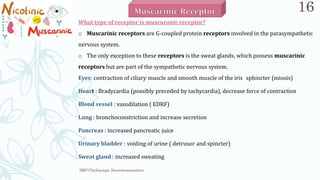
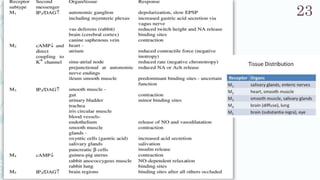
What type of receptor is muscuranic receptor?
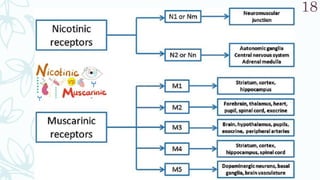
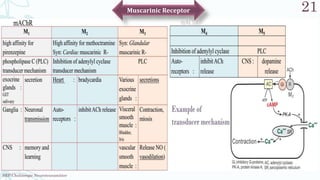
o Muscarinic receptors are G-coupled protein receptors involved in the parasympathetic
nervous system.
o The only exception to these receptors is the sweat glands, which possess muscarinic
receptors but are part of the sympathetic nervous system.
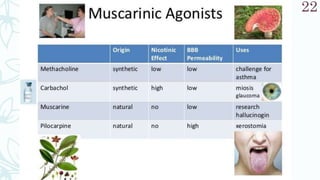
Eyes: contraction of ciliary muscle and smooth muscle of the iris sphincter (miosis)
Heart : Bradycardia (possibly preceded by tachycardia), decrease force of contraction
Blood vessel : vasodilation ( EDRF)
Lung : bronchoconstriction and increase secretion
Pancreas : increased pancreatic juice
Urinary bladder : voiding of urine ( detrusor and spincter)
Sweat gland : increased sweating
SRP:Cholinergic Neurotransmitter
17
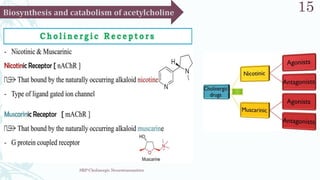
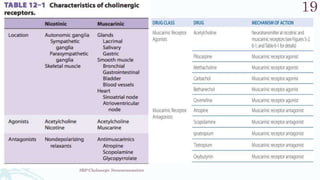
 Muscarinic receptors are divided into five main subtypes M1, M2, M3, M4, and M5.
While each of the subtypes exists within the central nervous system, they are encoded by
separate genes and localized to different tissue types. The M1 receptor is primarily
found in the cerebral cortex, gastric, and salivary glands.
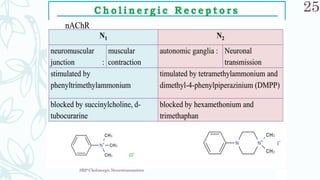
 Nicotinic receptors :In vertebrates, nicotinic receptors are broadly classified into
two subtypes based on their primary sites of expression: muscle-type nicotinic
receptors and neuronal-type nicotinic receptors.
 Nicotinic acetylcholine receptors (nAChRs) belong to the “Cys-loop” superfamily of
ligand-gated ion channels that includes GABAA, glycine, and serotonin (5-
HT3) receptors. There are 16 homologous mammalian nAChR subunits encoded by a
multigene family.
SRP:Cholinergic Neurotransmitter
18
SRP:Cholinergic Neurotransmitter
19
SRP:Cholinergic Neurotransmitter
20
SRP:Cholinergic Neurotransmitter
21
Muscarinic Receptor
SRP:Cholinergic Neurotransmitter
22
SRP:Cholinergic Neurotransmitter
23
24
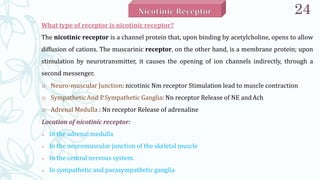
What type of receptor is nicotinic receptor?
The nicotinic receptor is a channel protein that, upon binding by acetylcholine, opens to allow
diffusion of cations. The muscarinic receptor, on the other hand, is a membrane protein; upon
stimulation by neurotransmitter, it causes the opening of ion channels indirectly, through a
second messenger.
o Neuro-muscular Junction: nicotinic Nm receptor Stimulation lead to muscle contraction
o SympatheticAnd P
.Sympathetic Ganglia: Nn receptor Release of NE andAch
o Adrenal Medulla : Nn receptor Release of adrenaline
Location of nicotinic receptor:
 In the adrenal medulla
 In the neuromuscular junction of the skeletal muscle
 In the central nervous system.
 In sympathetic and parasympathetic ganglia
SRP:Cholinergic Neurotransmitter
25
SRP:Cholinergic Neurotransmitter
26
Parasympathomimetic Agents
.
&
.
Structural Activity Relationship
(SAR) of Parasympathomimetic
Agents
SRP:Cholinergic Neurotransmitter
27
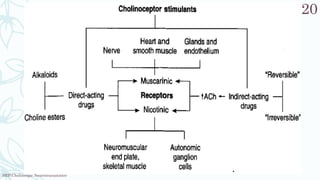
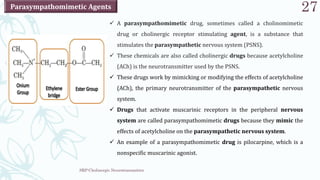
 A parasympathomimetic drug, sometimes called a cholinomimetic
drug or cholinergic receptor stimulating agent, is a substance that
stimulates the parasympathetic nervous system (PSNS).
 These chemicals are also called cholinergic drugs because acetylcholine
(ACh) is the neurotransmitter used by the PSNS.
 These drugs work by mimicking or modifying the effects of acetylcholine
(ACh), the primary neurotransmitter of the parasympathetic nervous
system.
 Drugs that activate muscarinic receptors in the peripheral nervous
system are called parasympathomimetic drugs because they mimic the
effects of acetylcholine on the parasympathetic nervous system.
 An example of a parasympathomimetic drug is pilocarpine, which is a
nonspecific muscarinic agonist.
Parasympathomimetic Agents
SRP:Cholinergic Neurotransmitter
28
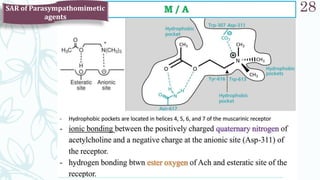
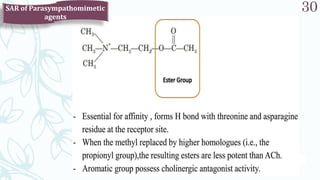
SAR of Parasympathomimetic
agents
SRP:Cholinergic Neurotransmitter
29
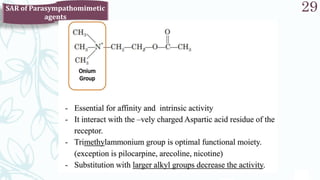
SAR of Parasympathomimetic
agents
SRP:Cholinergic Neurotransmitter
30
SAR of Parasympathomimetic
agents
SRP:Cholinergic Neurotransmitter
31
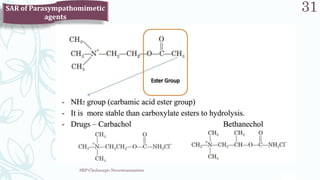
SAR of Parasympathomimetic
agents
SRP:Cholinergic Neurotransmitter
32
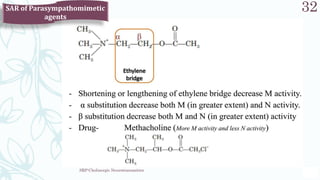
SAR of Parasympathomimetic
agents
SRP:Cholinergic Neurotransmitter
33
Classification of
Parasympathomimetic Agents
SRP:Cholinergic Neurotransmitter
34
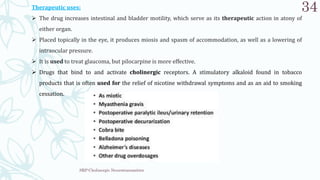
Therapeutic uses:
 The drug increases intestinal and bladder motility, which serve as its therapeutic action in atony of
either organ.
 Placed topically in the eye, it produces miosis and spasm of accommodation, as well as a lowering of
intraocular pressure.
 It is used to treat glaucoma, but pilocarpine is more effective.
 Drugs that bind to and activate cholinergic receptors. A stimulatory alkaloid found in tobacco
products that is often used for the relief of nicotine withdrawal symptoms and as an aid to smoking
cessation.
SRP:Cholinergic Neurotransmitter
35
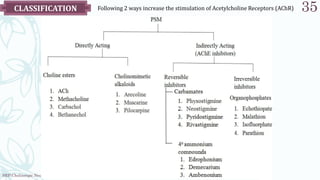
CLASSIFICATION Following 2 ways increase the stimulation of Acetylcholine Receptors (AChR)
SRP:Cholinergic Neurotransmitter
36
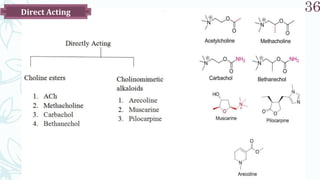
Direct Acting
SRP:Cholinergic Neurotransmitter
37
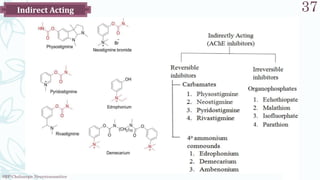
Indirect Acting
SRP:Cholinergic Neurotransmitter
38
Indirect Acting
SRP:Cholinergic Neurotransmitter
39
SRP:Cholinergic Neurotransmitter
40
SRP:Cholinergic Neurotransmitter
41
SRP:Cholinergic Neurotransmitter
42
ACETYLCHOLINE
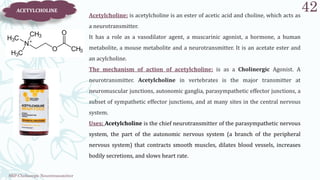
Acetylcholine: is acetylcholine is an ester of acetic acid and choline, which acts as
a neurotransmitter.
It has a role as a vasodilator agent, a muscarinic agonist, a hormone, a human
metabolite, a mouse metabolite and a neurotransmitter. It is an acetate ester and
an acylcholine.
The mechanism of action of acetylcholine: is as a Cholinergic Agonist. A
neurotransmitter. Acetylcholine in vertebrates is the major transmitter at
neuromuscular junctions, autonomic ganglia, parasympathetic effector junctions, a
subset of sympathetic effector junctions, and at many sites in the central nervous
system.
Uses: Acetylcholine is the chief neurotransmitter of the parasympathetic nervous
system, the part of the autonomic nervous system (a branch of the peripheral
nervous system) that contracts smooth muscles, dilates blood vessels, increases
bodily secretions, and slows heart rate.
SRP:Cholinergic Neurotransmitter
43
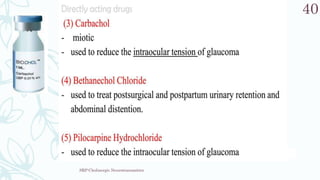
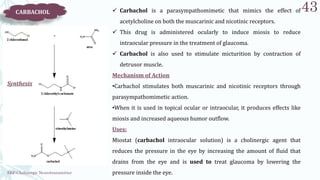
CARBACHOL  Carbachol is a parasympathomimetic that mimics the effect of
acetylcholine on both the muscarinic and nicotinic receptors.
 This drug is administered ocularly to induce miosis to reduce
intraocular pressure in the treatment of glaucoma.
 Carbachol is also used to stimulate micturition by contraction of
detrusor muscle.
Mechanism of Action
•Carbachol stimulates both muscarinic and nicotinic receptors through
parasympathomimetic action.
•When it is used in topical ocular or intraocular, it produces effects like
miosis and increased aqueous humor outflow.
Uses:
Miostat (carbachol intraocular solution) is a cholinergic agent that
reduces the pressure in the eye by increasing the amount of fluid that
drains from the eye and is used to treat glaucoma by lowering the
pressure inside the eye.
Synthesis
SRP:Cholinergic Neurotransmitter
44
BETHANECHOL
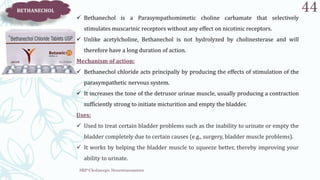
 Bethanechol is a Parasympathomimetic choline carbamate that selectively
stimulates muscarinic receptors without any effect on nicotinic receptors.
 Unlike acetylcholine, Bethanechol is not hydrolyzed by cholinesterase and will
therefore have a long duration of action.
Mechanism of action:
 Bethanechol chloride acts principally by producing the effects of stimulation of the
parasympathetic nervous system.
 It increases the tone of the detrusor urinae muscle, usually producing a contraction
sufficiently strong to initiate micturition and empty the bladder.
Uses:
 Used to treat certain bladder problems such as the inability to urinate or empty the
bladder completely due to certain causes (e.g., surgery, bladder muscle problems).
 It works by helping the bladder muscle to squeeze better, thereby improving your
ability to urinate.
SRP:Cholinergic Neurotransmitter
45
METHACHOLINE
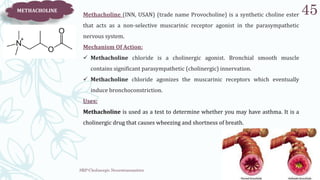
Methacholine (INN, USAN) (trade name Provocholine) is a synthetic choline ester
that acts as a non-selective muscarinic receptor agonist in the parasympathetic
nervous system.
Mechanism Of Action:
 Methacholine chloride is a cholinergic agonist. Bronchial smooth muscle
contains significant parasympathetic (cholinergic) innervation.
 Methacholine chloride agonizes the muscarinic receptors which eventually
induce bronchoconstriction.
Uses:
Methacholine is used as a test to determine whether you may have asthma. It is a
cholinergic drug that causes wheezing and shortness of breath.
SRP:Cholinergic Neurotransmitter
46
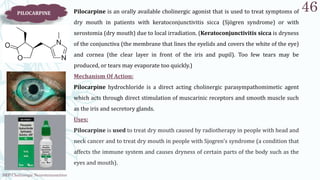
PILOCARPINE Pilocarpine is an orally available cholinergic agonist that is used to treat symptoms of
dry mouth in patients with keratoconjunctivitis sicca (Sjögren syndrome) or with
xerostomia (dry mouth) due to local irradiation. (Keratoconjunctivitis sicca is dryness
of the conjunctiva (the membrane that lines the eyelids and covers the white of the eye)
and cornea (the clear layer in front of the iris and pupil). Too few tears may be
produced, or tears may evaporate too quickly.)
Mechanism Of Action:
Pilocarpine hydrochloride is a direct acting cholinergic parasympathomimetic agent
which acts through direct stimulation of muscarinic receptors and smooth muscle such
as the iris and secretory glands.
Uses:
Pilocarpine is used to treat dry mouth caused by radiotherapy in people with head and
neck cancer and to treat dry mouth in people with Sjogren's syndrome (a condition that
affects the immune system and causes dryness of certain parts of the body such as the
eyes and mouth).
47
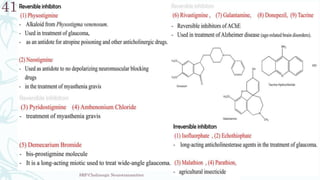
PHYSOSTIGMINE
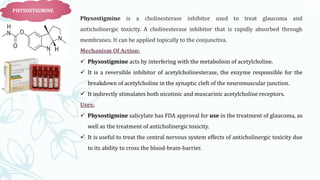
Physostigmine is a cholinesterase inhibitor used to treat glaucoma and
anticholinergic toxicity. A cholinesterase inhibitor that is rapidly absorbed through
membranes. It can be applied topically to the conjunctiva.
Mechanism Of Action:
 Physostigmine acts by interfering with the metabolism of acetylcholine.
 It is a reversible inhibitor of acetylcholinesterase, the enzyme responsible for the
breakdown of acetylcholine in the synaptic cleft of the neuromuscular junction.
 It indirectly stimulates both nicotinic and muscarinic acetylcholine receptors.
Uses:
 Physostigmine salicylate has FDA approval for use in the treatment of glaucoma, as
well as the treatment of anticholinergic toxicity.
 It is useful to treat the central nervous system effects of anticholinergic toxicity due
to its ability to cross the blood-brain-barrier.
SRP:Cholinergic Neurotransmitter
48
NEOSTIGMINE
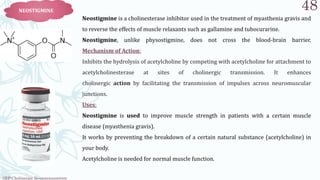
Neostigmine is a cholinesterase inhibitor used in the treatment of myasthenia gravis and
to reverse the effects of muscle relaxants such as gallamine and tubocurarine.
Neostigmine, unlike physostigmine, does not cross the blood-brain barrier.
Mechanism of Action:
Inhibits the hydrolysis of acetylcholine by competing with acetylcholine for attachment to
acetylcholinesterase at sites of cholinergic transmission. It enhances
cholinergic action by facilitating the transmission of impulses across neuromuscular
junctions.
Uses:
Neostigmine is used to improve muscle strength in patients with a certain muscle
disease (myasthenia gravis).
It works by preventing the breakdown of a certain natural substance (acetylcholine) in
your body.
Acetylcholine is needed for normal muscle function.
SRP:Cholinergic Neurotransmitter
49
PYRIDOSTIGMINE
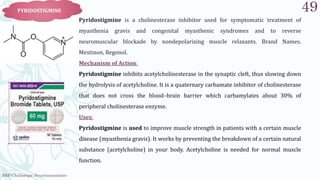
Pyridostigmine is a cholinesterase inhibitor used for symptomatic treatment of
myasthenia gravis and congenital myasthenic syndromes and to reverse
neuromuscular blockade by nondepolarizing muscle relaxants. Brand Names.
Mestinon, Regonol.
Mechanism of Action:
Pyridostigmine inhibits acetylcholinesterase in the synaptic cleft, thus slowing down
the hydrolysis of acetylcholine. It is a quaternary carbamate inhibitor of cholinesterase
that does not cross the blood–brain barrier which carbamylates about 30% of
peripheral cholinesterase enzyme.
Uses:
Pyridostigmine is used to improve muscle strength in patients with a certain muscle
disease (myasthenia gravis). It works by preventing the breakdown of a certain natural
substance (acetylcholine) in your body. Acetylcholine is needed for normal muscle
function.
SRP:Cholinergic Neurotransmitter
50
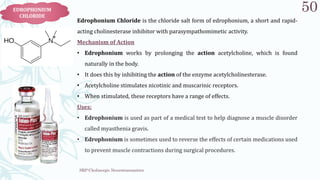
EDROPHONIUM
CHLORIDE
Edrophonium Chloride is the chloride salt form of edrophonium, a short and rapid​-
acting cholinesterase inhibitor with parasympathomimetic activity.
Mechanism of Action
• Edrophonium works by prolonging the action acetylcholine, which is found
naturally in the body.
• It does this by inhibiting the action of the enzyme acetylcholinesterase.
• Acetylcholine stimulates nicotinic and muscarinic receptors.
• When stimulated, these receptors have a range of effects.
Uses:
• Edrophonium is used as part of a medical test to help diagnose a muscle disorder
called myasthenia gravis.
• Edrophonium is sometimes used to reverse the effects of certain medications used
to prevent muscle contractions during surgical procedures.
SRP:Cholinergic Neurotransmitter
51
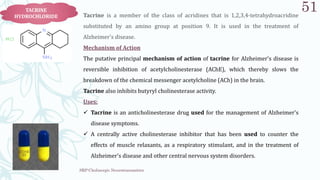
TACRINE
HYDROCHLORIDE Tacrine is a member of the class of acridines that is 1,2,3,4-tetrahydroacridine
substituted by an amino group at position 9. It is used in the treatment of
Alzheimer's disease.
Mechanism of Action
The putative principal mechanism of action of tacrine for Alzheimer's disease is
reversible inhibition of acetylcholinesterase (AChE), which thereby slows the
breakdown of the chemical messenger acetylcholine (ACh) in the brain.
Tacrine also inhibits butyryl cholinesterase activity.
Uses:
 Tacrine is an anticholinesterase drug used for the management of Alzheimer's
disease symptoms.
 A centrally active cholinesterase inhibitor that has been used to counter the
effects of muscle relaxants, as a respiratory stimulant, and in the treatment of
Alzheimer's disease and other central nervous system disorders.
SRP:Cholinergic Neurotransmitter
52
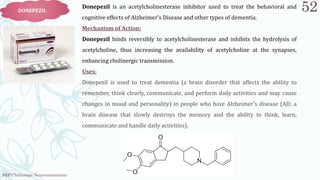
DONEPEZIL
Donepezil is an acetylcholinesterase inhibitor used to treat the behavioral and
cognitive effects of Alzheimer's Disease and other types of dementia.
Mechanism of Action:
Donepezil binds reversibly to acetylcholinesterase and inhibits the hydrolysis of
acetylcholine, thus increasing the availability of acetylcholine at the synapses,
enhancing cholinergic transmission.
Uses:
Donepezil is used to treat dementia (a brain disorder that affects the ability to
remember, think clearly, communicate, and perform daily activities and may cause
changes in mood and personality) in people who have Alzheimer's disease (AD; a
brain disease that slowly destroys the memory and the ability to think, learn,
communicate and handle daily activities).
SRP:Cholinergic Neurotransmitter
53
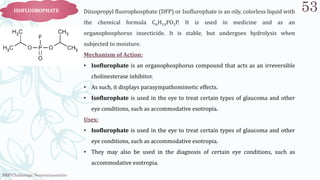
ISOFLUOROPHATE Diisopropyl fluorophosphate (DFP) or Isoflurophate is an oily, colorless liquid with
the chemical formula C6H14FO3P. It is used in medicine and as an
organophosphorus insecticide. It is stable, but undergoes hydrolysis when
subjected to moisture.
Mechanism of Action:
• Isoflurophate is an organophosphorus compound that acts as an irreversible
cholinesterase inhibitor.
• As such, it displays parasympathomimetic effects.
• Isoflurophate is used in the eye to treat certain types of glaucoma and other
eye conditions, such as accommodative esotropia.
Uses:
• Isoflurophate is used in the eye to treat certain types of glaucoma and other
eye conditions, such as accommodative esotropia.
• They may also be used in the diagnosis of certain eye conditions, such as
accommodative esotropia.
SRP:Cholinergic Neurotransmitter
54
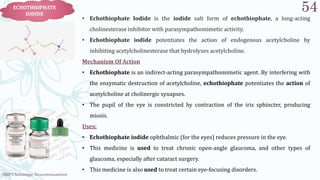
ECHOTHIOPHATE
IODIDE
• Echothiophate Iodide is the iodide salt form of echothiophate, a long-acting
cholinesterase inhibitor with parasympathomimetic activity.
• Echothiophate iodide potentiates the action of endogenous acetylcholine by
inhibiting acetylcholinesterase that hydrolyzes acetylcholine.
Mechanism Of Action
• Echothiophate is an indirect-acting parasympathomimetic agent. By interfering with
the enzymatic destruction of acetylcholine, echothiophate potentiates the action of
acetylcholine at cholinergic synapses.
• The pupil of the eye is constricted by contraction of the iris sphincter, producing
miosis.
Uses:
• Echothiophate iodide ophthalmic (for the eyes) reduces pressure in the eye.
• This medicine is used to treat chronic open-angle glaucoma, and other types of
glaucoma, especially after cataract surgery.
• This medicine is also used to treat certain eye-focusing disorders.
SRP:Cholinergic Neurotransmitter
55
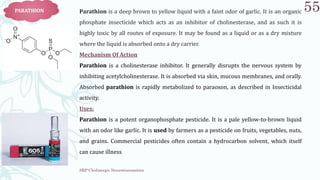
PARATHION Parathion is a deep brown to yellow liquid with a faint odor of garlic. It is an organic
phosphate insecticide which acts as an inhibitor of cholinesterase, and as such it is
highly toxic by all routes of exposure. It may be found as a liquid or as a dry mixture
where the liquid is absorbed onto a dry carrier.
Mechanism Of Action
Parathion is a cholinesterase inhibitor. It generally disrupts the nervous system by
inhibiting acetylcholinesterase. It is absorbed via skin, mucous membranes, and orally.
Absorbed parathion is rapidly metabolized to paraoxon, as described in Insecticidal
activity.
Uses:
Parathion is a potent organophosphate pesticide. It is a pale yellow-to-brown liquid
with an odor like garlic. It is used by farmers as a pesticide on fruits, vegetables, nuts,
and grains. Commercial pesticides often contain a hydrocarbon solvent, which itself
can cause illness
SRP:Cholinergic Neurotransmitter
56
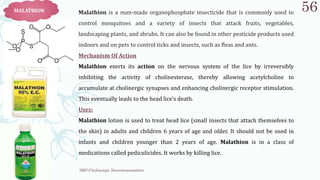
MALATHION Malathion is a man-made organophosphate insecticide that is commonly used to
control mosquitoes and a variety of insects that attack fruits, vegetables,
landscaping plants, and shrubs. It can also be found in other pesticide products used
indoors and on pets to control ticks and insects, such as fleas and ants.
Mechanism Of Action
Malathion exerts its action on the nervous system of the lice by irreversibly
inhibiting the activity of cholinesterase, thereby allowing acetylcholine to
accumulate at cholinergic synapses and enhancing cholinergic receptor stimulation.
This eventually leads to the head lice's death.
Uses:
Malathion lotion is used to treat head lice (small insects that attach themselves to
the skin) in adults and children 6 years of age and older. It should not be used in
infants and children younger than 2 years of age. Malathion is in a class of
medications called pediculicides. It works by killing lice.
SRP:Cholinergic Neurotransmitter
57
CHOLINESTERASE
REACTIVATORS
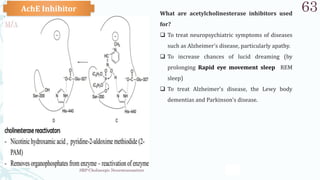
Cholinesterase reactivators Definition:
 A drug used to reverse the inactivation of cholinesterase caused by organophosphates or
sulfonates.
 Cholinesterase reactivators (oximes) should be theoretically effective as an antidote for
OP poisoning.
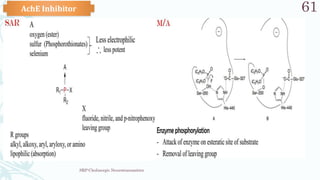
 Oximes work by removal of the phosphoryl group from the inhibited AChE enzyme,
resulting in enzyme reactivation.
 Pralidoxime (PAM) is the most commonly used oxime worldwide.
What is the function of cholinesterase?
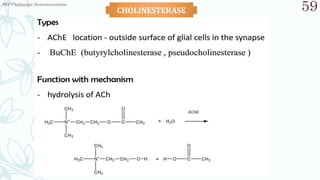
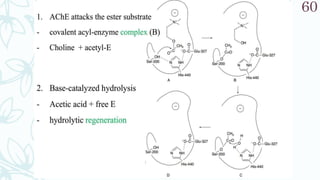
Cholinesterase is a family of enzymes that catalyzes the hydrolysis of the neurotransmitter
acetylcholine (ACh) into choline and acetic acid, a reaction necessary to allow a cholinergic
neuron to return to its resting state after activation.
SRP:Cholinergic Neurotransmitter
58
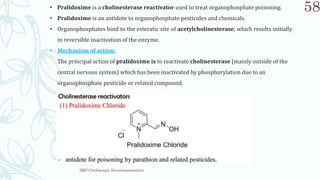
• Pralidoxime is a cholinesterase reactivator used to treat organophosphate poisoning.
• Pralidoxime is an antidote to organophosphate pesticides and chemicals.
• Organophosphates bind to the esteratic site of acetylcholinesterase, which results initially
in reversible inactivation of the enzyme.
• Mechanism of action:
The principal action of pralidoxime is to reactivate cholinesterase (mainly outside of the
central nervous system) which has been inactivated by phosphorylation due to an
organophosphate pesticide or related compound.
SRP:Cholinergic Neurotransmitter
59
CHOLINESTERASE
SRP:Cholinergic Neurotransmitter
60
SRP:Cholinergic Neurotransmitter
61
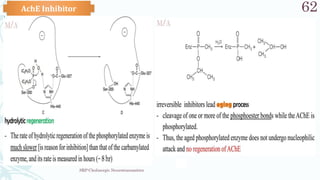
AchE Inhibitor
SRP:Cholinergic Neurotransmitter
62
AchE Inhibitor
SRP:Cholinergic Neurotransmitter
63
AchE Inhibitor What are acetylcholinesterase inhibitors used
for?
 To treat neuropsychiatric symptoms of diseases
such as Alzheimer's disease, particularly apathy.
 To increase chances of lucid dreaming (by
prolonging Rapid eye movement sleep REM
sleep)
 To treat Alzheimer's disease, the Lewy body
dementias and Parkinson's disease.
SRP:Cholinergic Neurotransmitter
64