GOURAV SINGH 1
Anesthesia
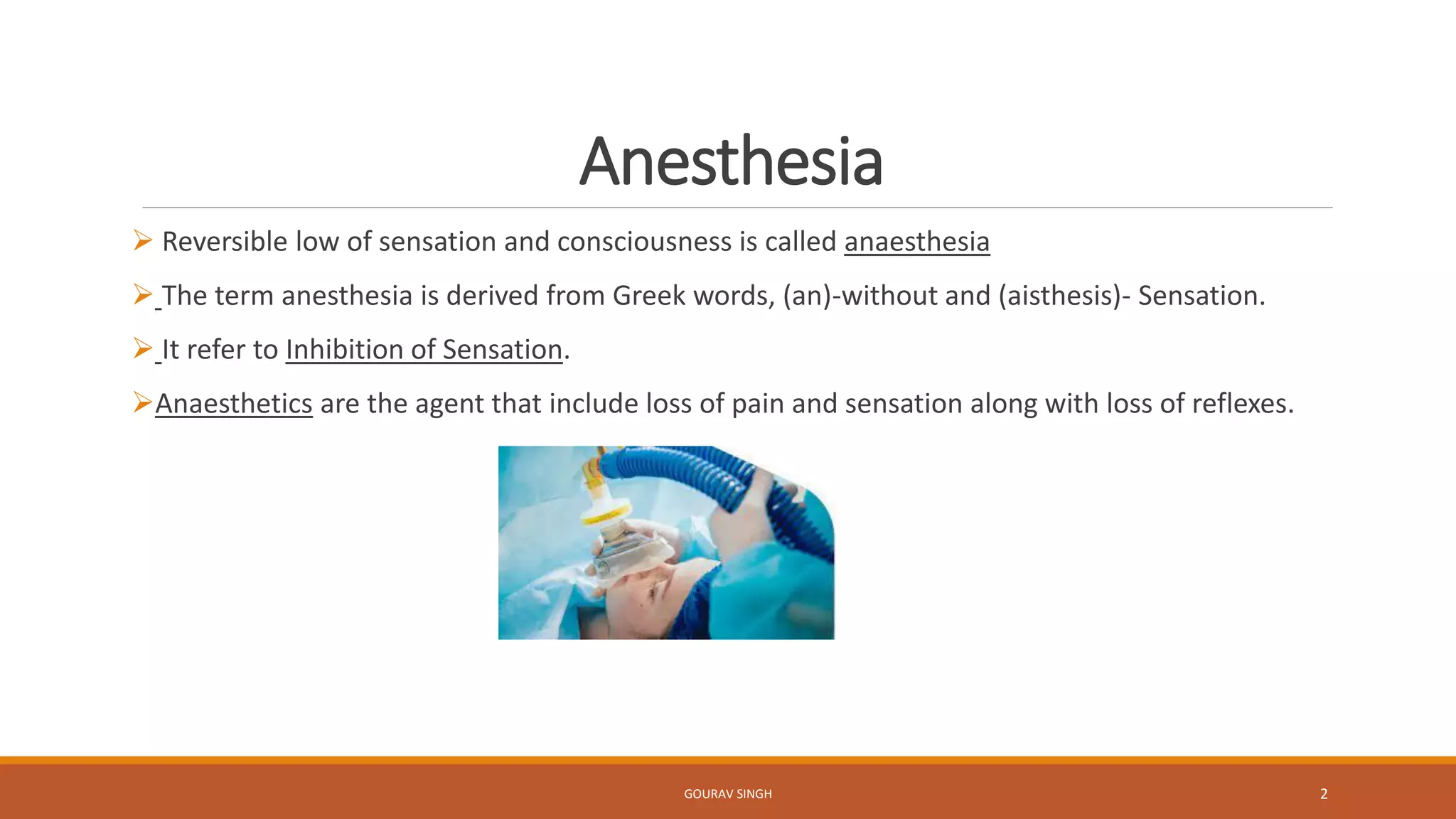
 Reversible low of sensation and consciousness is called anaesthesia
 The term anesthesia is derived from Greek words, (an)-without and (aisthesis)- Sensation.
 It refer to Inhibition of Sensation.
Anaesthetics are the agent that include loss of pain and sensation along with loss of reflexes.
2
GOURAV SINGH
Anesthesia
3
• Should induce anaesthetics
smoothly.
• Permits rapid induction and
rapid recovery.
• Should have a wide margin of
safety.
• Should be devoid of adverse
effects.
Properties of an
anaesthetics:
• Local Anesthesia (LA)
• General Anesthesia (GA)
Types of
anaesthetics:
GOURAV SINGH
General Anesthesia
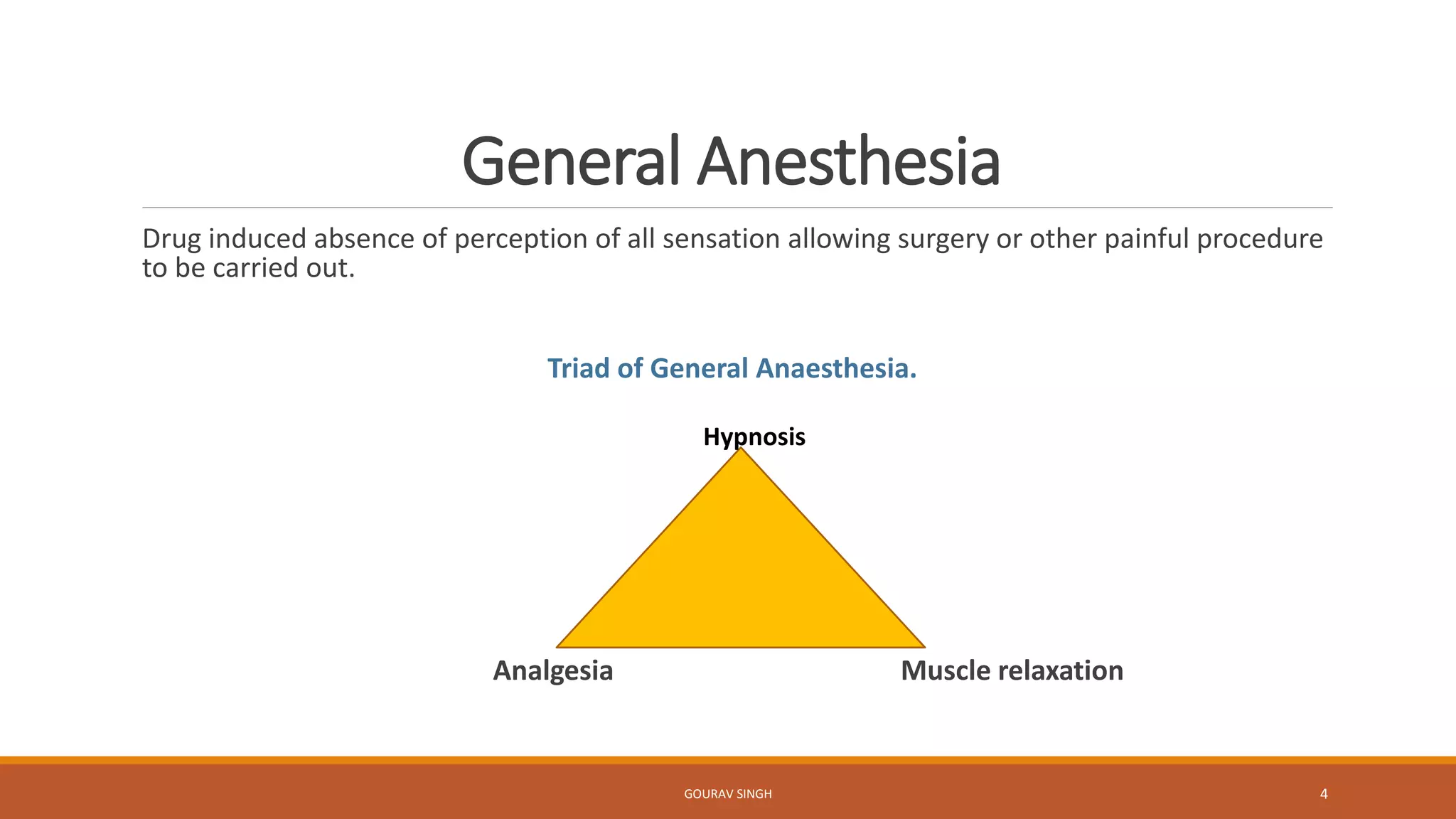
Drug induced absence of perception of all sensation allowing surgery or other painful procedure
to be carried out.
Triad of General Anaesthesia.
Analgesia Muscle relaxation
4
Hypnosis
GOURAV SINGH
Stages of Anesthesia
Stage I:- Analgesia
1.Consciousness is maintained and analgesia is produced.
2.It have Higher cortical centers are depressed.
3.This stage is also known as Cortical stages.
Stage II:- Stage of excitement
1. Consciousness is lost.
2. Further removal of cortical inhibition lead of excitement.
3. Patient may move cough, salivate, vomit, hypertension and tachycardia e.t.c are occur
4. To avoid excitement stages, short-acting intravenous anaesthesia may given. (Eg. Thiopental
sodium)
5
GOURAV SINGH
Stages of Anesthesia
 Stages III:- Surgical Anaesthesia
1. Skeletal muscles are relaxed.
2. Hence, most of the operative procedure are performed at this stages
3. It subdivide into 4 phase as increasing depth of anaesthesia and decrease respiration as
follows:
a) Plane I – Cessation of eye movement.
b) Plane II – Beginning of paralysis of respiratory muscles.
c) Plane III – Paralysis of all the respiratory muscles except diaphragm.
d) Plane IV – Paralysis of diaphragmatic muscles
6
GOURAV SINGH
Stages of Anesthesia
 Stages IV:- Respiratory paralysis
1. This is toxic or overdose stages.
2. Which begin with complete respiratory paralysis and end with failure circulation or collapse
cardiovascular.
3. Tissue becomes anoxic.
4. The anaesthesized patient is sequence of awakening event
5. It is essentially a reverse process to that of induction
6. Usually autonomic reflexes, like- Pupillary size, blood pressure and heart rate are good index
to judge the depth of anaesthesia.
7
GOURAV SINGH
Pre-Anesthesia Medication
 It is the use of drugs prior to anesthesia to make it more safe and pleasant.
1) To relieve anxiety – benzodiazepines
2) To prevent allergic reaction - antihistaminics
3) To prevent nausea and vomiting – antiemetics.
4) To provide analgesia – Opioids
5) To prevent Bradyacardia and secretion – atropine.
8
GOURAV SINGH
Mechanism of Action
 All these agent are lipid soluble compounds of simple but diversified structure.
Different theory stressing upon the relationship between physical properties of anaesthetics
agents and anaesthetics potency.
a. Meyer-Overton Hypothesis:- In year 1901, Independently correlates the potency of
anaesthetics agents wit their lipid solubility.
b. Critical volume hypothesis:-
1) It is an extension of Meyer-Overtone theory.
2) The hydrocarbon core of the lipid bilayer region of nerve membrane accommodates the
anaesthetics molecules which expand the membrane by fluidizing result into disorganization of
its functional components.
9
GOURAV SINGH
Mechanism of Action
c. Ferguson’s Principal (1939):-
I. Anesthetic agent distort the cell membrane or block ions channels.
II. It suggest relationship between anaesthetics potency and thermodynamics activity of a
drugs.
d. Krnjevic hypothesis (1972):-
I. Anaesthetics agents inhibit both the release and action of neurotransmitter by reducing the
availability of free Ca ++ ions in the sarcoplasm.
e. According some scientist, anaesthesia agents exert their action by affecting the energy
yielding processes in the CNS.
10
GOURAV SINGH
Classification of General Anaesthesia
General
Anesthetics
Inhalation
Anesthetics
Gas
Eg. Nitrous oxide
Volatile
liquids
Eg. Ether, Halothane,
Methoxyflurane,
Enflurane,
Isoflurane,
Deesflurane,
Intravenous
Anesthetics
Benzodiazepines
Eg Diazepam,
lorazepam, Midazolam
Dissociative
Anesthetics
Eg. Ketamine,
hydrochloride
Opioid
Analgesic
Eg. Fontanyl
Inducing
Agents
Eg. Thiopental Sodium,
Thiamylal Sodium,
Methohexital Sodium,
Propofol, Etomidate
11
GOURAV SINGH
Inhalation Anaesthetic
12
Gaseous
Anaesthetic
Agents:
Cyclopropane and nitrous oxide are the general anaesthetic agents which
exist in gaseous form at room temperature and usual atmosphere
temperature
1) Cyclopropane (1929):
1. It is dense, colourless gas with sweet odour and taste.
2. About 15-20% cyclopropane mixed with 80-85% oxygen in sufficient to
achieve a stage of surgical anaesthesia.
3. It form an explosive mixture with air.
4. It produce a rapid but smooth induction of anaesthesia.
5. It. Is rapidly excreted out by lungs in an unchanged form.
GOURAV SINGH
Inhalation Anaesthetic
13
Gaseous
Anaesthetic
Agents:
2) Nitrous oxide:
1. It is a useful analgesic and light non-inflammable anaesthetic agent.
2. It is less depressant to both, cardiovascular and respiratory systems.
3. It lacks irritation properties.
4. It cannot produce a stage of surgical anaesthesia within therapeutics
dose-range.
5. Anaesthesia occurs with a mixture of 80% 𝑁2𝑂 with 20% 𝑂2 which is
accompanied by nausea, vomiting and excitement.
6. Hence, this gas is often termed as laughing gas.
GOURAV SINGH
Inhalation Anaesthetic
Volatile
Liquid
Anaesthetic
Agents
1) Diethyl ether
1. It gets oxidized rapidly upon exposure to light, air or moisture to form
unstable peroxide & acetaldehyde which are of exposure in nature.
2. It has slow induction time.
3. It has unpleasant after taste and stimulates the brain stem respiratory
center
2) Fluroxene
1. It is a light anaesthetics agents with an inflammable and explosive in
nature.
2. Nausea is quite common.
14
GOURAV SINGH
Inhalation Anaesthetic
Volatile
Liquid
Anaesthetic
Agents
3) Chloroform (1840)
1.It was a popular anaesthetic agent but is now seldom used.
2.It has good muscle relaxant activity.
3.It is hepatotoxic and nephrotoxic dangerous effect on cardiovascular
system.
4) Isoflurane (1981)
1. Very low solubility in tissues.
2. Induction and emergence that halothane.
3.It has similar properties with Halothane
15
GOURAV SINGH
Intravenous (Basal) Anaesthetic
Intravenous
(Basal)
Anaesthetics
1. The sodium salts of ultrashort acting barbiturates are usually
administered intravenously.
2. They are used to produce rapid and pleasant anaesthesia.
3. High lipid solubility and rapid destruction of these drugs by liver,
contribute to their short duration of action.
1) Hexobarbitone
1. Thiopental is depressant of both CVS and respiratory system.
2. Methohexital and Thiamylal are the other barbiturates which are used
as intravenous anaesthetic agents.
3. All these agents are poor analgesic and produce sign of catecholamine
and histamine release.
16
GOURAV SINGH
Intravenous (Basal) Anaesthetic
Intravenous
(Basal)
Anaesthetic
2) Ketamine hydrochloride
1.It has short duration of action & short surgical procedures which do not
require skeletal muscle relaxation.
2.Side effect include as increase in blood pressure, delirum & tachycardia.
3. Diazepam, morphine are the drug which reduce or abolish these
untoward effect
3) Propanidid
1.It is a eugenol derivatives.
2. Oily liquid having anaesthetic action of very short duration.
3. Nausea and vomiting is more frequently with propandid than any other
I.V. anaesthetics.
17
GOURAV SINGH
Intravenous (Basal) Anaesthetic
Intravenous
(Basal)
Anaesthetic
3) Propanidid
4. Cardiovascular collapse is frequently in hypertensive patients.
5. It attacked at its ester linkage by the serum cholinesterase in plasma and
liver.
6. Acid further undergoes metabolism with the loss of diethylamino group.
4) Miscellaneous agents
1. Althesin is reported to possess anaesthetic activity.
2. It is a mixture of alphaxalone and alphadolone acetate dispersed in
polyoxyethylated castor oil.
18
GOURAV SINGH
Narcoanalysis
1. The person with criminal background, to expose out his real thoughts and motives,
intravenous barbiturates are given in subanaesthetic doses.
2. The person looses his inhibition and feels to free to talk the truth.
3. Barbiturates which are used for this purpose include pentobarbitone, thiopentone, and
amylobarbitone.
4. These agent are also of value in regaining the memory in the cases of neurotic amnesia.
19
GOURAV SINGH
Dissociative Anesthesia
1. This is the stage of partial anaesthesia where some part of brain are anaesthesized by the
drug while rest of the region remains unaffected.
2. The persons is detached from its surrounding and hence this state is known as dissociative
anaesthesia.
3. Ketamine and phencyclidine are the drug which cause dissociative anaesthesia.
4. To carry out minor surgery and diagnostic investigations in very young children.
20
GOURAV SINGH
Pre-medications
Pre-medication is required to supplement the anaesthesia and to create suitable working
condition for the surgeon.
Drugs are commonly include:
1) Tranquilizers –Diazepams, lorazepam, and midazolam.
2) Sedative-hypnotics –Etomidate, etc
3) Anticholinergic agents –Atropine, hyoscine.
4) Opioid analgesics –Morphine, meperidine, fentanyl, alfentanil and sufentanil.
5) Neuroleptic compounds –Droperidol
21
GOURAV SINGH
22
GOURAV SINGH

General anesthetic and pre anesthetics

  • 1.
  • 2.
    Anesthesia  Reversible lowof sensation and consciousness is called anaesthesia  The term anesthesia is derived from Greek words, (an)-without and (aisthesis)- Sensation.  It refer to Inhibition of Sensation. Anaesthetics are the agent that include loss of pain and sensation along with loss of reflexes. 2 GOURAV SINGH
  • 3.
    Anesthesia 3 • Should induceanaesthetics smoothly. • Permits rapid induction and rapid recovery. • Should have a wide margin of safety. • Should be devoid of adverse effects. Properties of an anaesthetics: • Local Anesthesia (LA) • General Anesthesia (GA) Types of anaesthetics: GOURAV SINGH
  • 4.
    General Anesthesia Drug inducedabsence of perception of all sensation allowing surgery or other painful procedure to be carried out. Triad of General Anaesthesia. Analgesia Muscle relaxation 4 Hypnosis GOURAV SINGH
  • 5.
    Stages of Anesthesia StageI:- Analgesia 1.Consciousness is maintained and analgesia is produced. 2.It have Higher cortical centers are depressed. 3.This stage is also known as Cortical stages. Stage II:- Stage of excitement 1. Consciousness is lost. 2. Further removal of cortical inhibition lead of excitement. 3. Patient may move cough, salivate, vomit, hypertension and tachycardia e.t.c are occur 4. To avoid excitement stages, short-acting intravenous anaesthesia may given. (Eg. Thiopental sodium) 5 GOURAV SINGH
  • 6.
    Stages of Anesthesia Stages III:- Surgical Anaesthesia 1. Skeletal muscles are relaxed. 2. Hence, most of the operative procedure are performed at this stages 3. It subdivide into 4 phase as increasing depth of anaesthesia and decrease respiration as follows: a) Plane I – Cessation of eye movement. b) Plane II – Beginning of paralysis of respiratory muscles. c) Plane III – Paralysis of all the respiratory muscles except diaphragm. d) Plane IV – Paralysis of diaphragmatic muscles 6 GOURAV SINGH
  • 7.
    Stages of Anesthesia Stages IV:- Respiratory paralysis 1. This is toxic or overdose stages. 2. Which begin with complete respiratory paralysis and end with failure circulation or collapse cardiovascular. 3. Tissue becomes anoxic. 4. The anaesthesized patient is sequence of awakening event 5. It is essentially a reverse process to that of induction 6. Usually autonomic reflexes, like- Pupillary size, blood pressure and heart rate are good index to judge the depth of anaesthesia. 7 GOURAV SINGH
  • 8.
    Pre-Anesthesia Medication  Itis the use of drugs prior to anesthesia to make it more safe and pleasant. 1) To relieve anxiety – benzodiazepines 2) To prevent allergic reaction - antihistaminics 3) To prevent nausea and vomiting – antiemetics. 4) To provide analgesia – Opioids 5) To prevent Bradyacardia and secretion – atropine. 8 GOURAV SINGH
  • 9.
    Mechanism of Action All these agent are lipid soluble compounds of simple but diversified structure. Different theory stressing upon the relationship between physical properties of anaesthetics agents and anaesthetics potency. a. Meyer-Overton Hypothesis:- In year 1901, Independently correlates the potency of anaesthetics agents wit their lipid solubility. b. Critical volume hypothesis:- 1) It is an extension of Meyer-Overtone theory. 2) The hydrocarbon core of the lipid bilayer region of nerve membrane accommodates the anaesthetics molecules which expand the membrane by fluidizing result into disorganization of its functional components. 9 GOURAV SINGH
  • 10.
    Mechanism of Action c.Ferguson’s Principal (1939):- I. Anesthetic agent distort the cell membrane or block ions channels. II. It suggest relationship between anaesthetics potency and thermodynamics activity of a drugs. d. Krnjevic hypothesis (1972):- I. Anaesthetics agents inhibit both the release and action of neurotransmitter by reducing the availability of free Ca ++ ions in the sarcoplasm. e. According some scientist, anaesthesia agents exert their action by affecting the energy yielding processes in the CNS. 10 GOURAV SINGH
  • 11.
    Classification of GeneralAnaesthesia General Anesthetics Inhalation Anesthetics Gas Eg. Nitrous oxide Volatile liquids Eg. Ether, Halothane, Methoxyflurane, Enflurane, Isoflurane, Deesflurane, Intravenous Anesthetics Benzodiazepines Eg Diazepam, lorazepam, Midazolam Dissociative Anesthetics Eg. Ketamine, hydrochloride Opioid Analgesic Eg. Fontanyl Inducing Agents Eg. Thiopental Sodium, Thiamylal Sodium, Methohexital Sodium, Propofol, Etomidate 11 GOURAV SINGH
  • 12.
    Inhalation Anaesthetic 12 Gaseous Anaesthetic Agents: Cyclopropane andnitrous oxide are the general anaesthetic agents which exist in gaseous form at room temperature and usual atmosphere temperature 1) Cyclopropane (1929): 1. It is dense, colourless gas with sweet odour and taste. 2. About 15-20% cyclopropane mixed with 80-85% oxygen in sufficient to achieve a stage of surgical anaesthesia. 3. It form an explosive mixture with air. 4. It produce a rapid but smooth induction of anaesthesia. 5. It. Is rapidly excreted out by lungs in an unchanged form. GOURAV SINGH
  • 13.
    Inhalation Anaesthetic 13 Gaseous Anaesthetic Agents: 2) Nitrousoxide: 1. It is a useful analgesic and light non-inflammable anaesthetic agent. 2. It is less depressant to both, cardiovascular and respiratory systems. 3. It lacks irritation properties. 4. It cannot produce a stage of surgical anaesthesia within therapeutics dose-range. 5. Anaesthesia occurs with a mixture of 80% 𝑁2𝑂 with 20% 𝑂2 which is accompanied by nausea, vomiting and excitement. 6. Hence, this gas is often termed as laughing gas. GOURAV SINGH
  • 14.
    Inhalation Anaesthetic Volatile Liquid Anaesthetic Agents 1) Diethylether 1. It gets oxidized rapidly upon exposure to light, air or moisture to form unstable peroxide & acetaldehyde which are of exposure in nature. 2. It has slow induction time. 3. It has unpleasant after taste and stimulates the brain stem respiratory center 2) Fluroxene 1. It is a light anaesthetics agents with an inflammable and explosive in nature. 2. Nausea is quite common. 14 GOURAV SINGH
  • 15.
    Inhalation Anaesthetic Volatile Liquid Anaesthetic Agents 3) Chloroform(1840) 1.It was a popular anaesthetic agent but is now seldom used. 2.It has good muscle relaxant activity. 3.It is hepatotoxic and nephrotoxic dangerous effect on cardiovascular system. 4) Isoflurane (1981) 1. Very low solubility in tissues. 2. Induction and emergence that halothane. 3.It has similar properties with Halothane 15 GOURAV SINGH
  • 16.
    Intravenous (Basal) Anaesthetic Intravenous (Basal) Anaesthetics 1.The sodium salts of ultrashort acting barbiturates are usually administered intravenously. 2. They are used to produce rapid and pleasant anaesthesia. 3. High lipid solubility and rapid destruction of these drugs by liver, contribute to their short duration of action. 1) Hexobarbitone 1. Thiopental is depressant of both CVS and respiratory system. 2. Methohexital and Thiamylal are the other barbiturates which are used as intravenous anaesthetic agents. 3. All these agents are poor analgesic and produce sign of catecholamine and histamine release. 16 GOURAV SINGH
  • 17.
    Intravenous (Basal) Anaesthetic Intravenous (Basal) Anaesthetic 2)Ketamine hydrochloride 1.It has short duration of action & short surgical procedures which do not require skeletal muscle relaxation. 2.Side effect include as increase in blood pressure, delirum & tachycardia. 3. Diazepam, morphine are the drug which reduce or abolish these untoward effect 3) Propanidid 1.It is a eugenol derivatives. 2. Oily liquid having anaesthetic action of very short duration. 3. Nausea and vomiting is more frequently with propandid than any other I.V. anaesthetics. 17 GOURAV SINGH
  • 18.
    Intravenous (Basal) Anaesthetic Intravenous (Basal) Anaesthetic 3)Propanidid 4. Cardiovascular collapse is frequently in hypertensive patients. 5. It attacked at its ester linkage by the serum cholinesterase in plasma and liver. 6. Acid further undergoes metabolism with the loss of diethylamino group. 4) Miscellaneous agents 1. Althesin is reported to possess anaesthetic activity. 2. It is a mixture of alphaxalone and alphadolone acetate dispersed in polyoxyethylated castor oil. 18 GOURAV SINGH
  • 19.
    Narcoanalysis 1. The personwith criminal background, to expose out his real thoughts and motives, intravenous barbiturates are given in subanaesthetic doses. 2. The person looses his inhibition and feels to free to talk the truth. 3. Barbiturates which are used for this purpose include pentobarbitone, thiopentone, and amylobarbitone. 4. These agent are also of value in regaining the memory in the cases of neurotic amnesia. 19 GOURAV SINGH
  • 20.
    Dissociative Anesthesia 1. Thisis the stage of partial anaesthesia where some part of brain are anaesthesized by the drug while rest of the region remains unaffected. 2. The persons is detached from its surrounding and hence this state is known as dissociative anaesthesia. 3. Ketamine and phencyclidine are the drug which cause dissociative anaesthesia. 4. To carry out minor surgery and diagnostic investigations in very young children. 20 GOURAV SINGH
  • 21.
    Pre-medications Pre-medication is requiredto supplement the anaesthesia and to create suitable working condition for the surgeon. Drugs are commonly include: 1) Tranquilizers –Diazepams, lorazepam, and midazolam. 2) Sedative-hypnotics –Etomidate, etc 3) Anticholinergic agents –Atropine, hyoscine. 4) Opioid analgesics –Morphine, meperidine, fentanyl, alfentanil and sufentanil. 5) Neuroleptic compounds –Droperidol 21 GOURAV SINGH
  • 22.