PARASYMPATHOMIMETICS/
CHOLINOMIMETICS/
CHOLINERGIC AGONISTS-I
CHOLINERGIC DRUGS
Cholinergic drugs act on receptors that are activated by acetylcholine
(Ach)
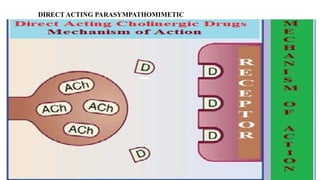
1-Directly acting cholinergic drugs
These are esters of choline and may be natural alkaloids or synthetic
derivatives.
2-Indirectly acting cholinergic drugs
ACETYLCHOLINE
Acetylcholine is the primary neurotransmitter at parasympathetic nerve
endings.
Synthetic Ach cannot be used due to :
Quick Hydrolysis by Acetylcholine Esterase
Short duration of Actions
Depending on type of receptor, the actions of acetylcholine are
classified into 2 types
Muscarinic
Nicotinic
MUSCARINIC ACTIONS OF ACETYLCHOLINE
Organ
System
Receptor Effect
Eye:
1-Circular
Muscle
2-Ciliary
Muscle
3-Lacrimal
Glands
M3
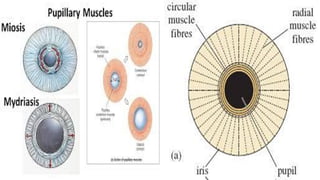
1-Contraction of smooth muscle of iris sphincter-
Miosis
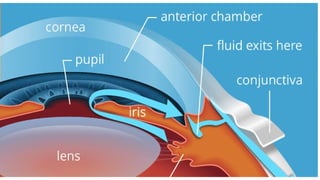
↑ drainage of aqueous humor-↓ in intraocular
pressure
2-Contraction of ciliary muscle for near vision-
Accommodation
3-Increase in secretions
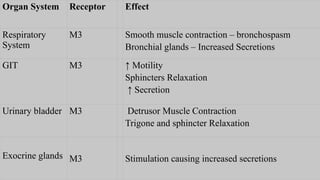
Organ System Receptor Effect
Respiratory
System
M3 Smooth muscle contraction – bronchospasm
Bronchial glands – Increased Secretions
GIT M3 ↑ Motility
Sphincters Relaxation
↑ Secretion
Urinary bladder M3 Detrusor Muscle Contraction
Trigone and sphincter Relaxation
Exocrine glands M3 Stimulation causing increased secretions
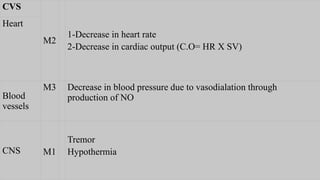
CVS
M2
1-Decrease in heart rate
2-Decrease in cardiac output (C.O= HR X SV)
Heart
Blood
vessels
M3 Decrease in blood pressure due to vasodialation through
production of NO
CNS M1
Tremor
Hypothermia
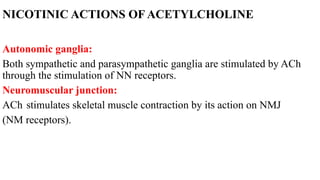
NICOTINIC ACTIONS OF ACETYLCHOLINE
Autonomic ganglia:
Both sympathetic and parasympathetic ganglia are stimulated by ACh
through the stimulation of NN receptors.
Neuromuscular junction:
ACh stimulates skeletal muscle contraction by its action on NMJ
(NM receptors).
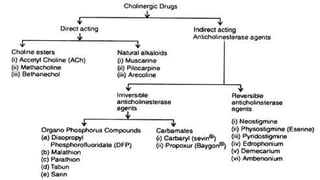
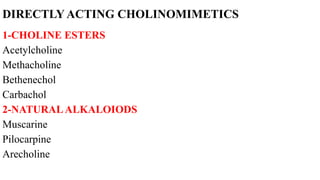
DIRECTLY ACTING CHOLINOMIMETICS
1-CHOLINE ESTERS
Acetylcholine
Methacholine
Bethenechol
Carbachol
2-NATURALALKALOIODS
Muscarine
Pilocarpine
Arecholine
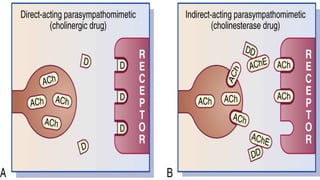
DIRECT ACTING PARASYMPATHOMIMETIC
SYNTHETIC CHOLINE ESTERS
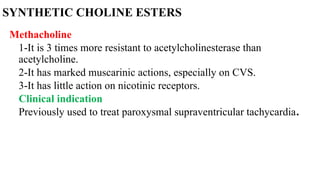
Methacholine
1-It is 3 times more resistant to acetylcholinesterase than
acetylcholine.
2-It has marked muscarinic actions, especially on CVS.
3-It has little action on nicotinic receptors.
Clinical indication
Previously used to treat paroxysmal supraventricular tachycardia.
SYNTHETIC CHOLINE ESTERS
Bethenechol
1-It is not destroyed by Acetylcholinesterase or Butyrylcholinesterase,
2-It has strong muscarinic activity but no nicotinic actions.
3-It has selective action on GIT and Urinary bladder.
Clinical Indications
1-Atony of bladder in post operative or post-partum urinary retention.
2-Neurogenic atony of bladder
3-Megacolon
SYNTHETIC CHOLINE ESTERS
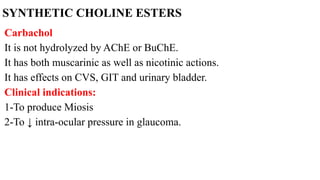
Carbachol
It is not hydrolyzed by AChE or BuChE.
It has both muscarinic as well as nicotinic actions.
It has effects on CVS, GIT and urinary bladder.
Clinical indications:
1-To produce Miosis
2-To ↓ intra-ocular pressure in glaucoma.
PROPERTIES OF CHOLINESTERS:
Source Physiological
neurotransmitter
Synthetic Synthetic Synthetic
Effect of AChE Destroyed readily Destroyed but 3 x
more resistant
than Ach.
No No
Effect of
BuChE
Destroyed readily Not destroyed No No
Muscarinic
Action
+++ ++++ ++ ++
Nicotinic action +++ - - +++
Acetylcholine Methacholine Bethanechol carbachol
CHOLINOMIMETIC NATURALALKALOIDS
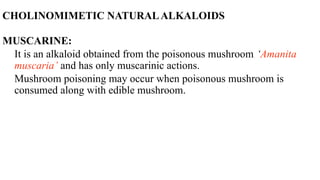
MUSCARINE:
It is an alkaloid obtained from the poisonous mushroom ‘Amanita
muscaria’ and has only muscarinic actions.
Mushroom poisoning may occur when poisonous mushroom is
consumed along with edible mushroom.
CHOLINOMIMETIC NATURALALKALOIDS
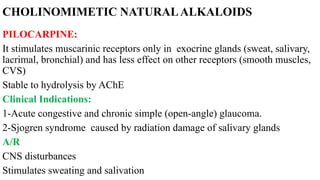
PILOCARPINE:
It stimulates muscarinic receptors only in exocrine glands (sweat, salivary,
lacrimal, bronchial) and has less effect on other receptors (smooth muscles,
CVS)
Stable to hydrolysis by AChE
Clinical Indications:
1-Acute congestive and chronic simple (open-angle) glaucoma.
2-Sjogren syndrome caused by radiation damage of salivary glands
A/R
CNS disturbances
Stimulates sweating and salivation
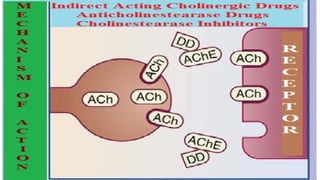
INDIRECTLY ACTING PARASYMPATHOMIMETICS
( ANTICHOLINESTRASES)
They competitively inhibit the enzyme cholinesterase, thus increase the
concentration and duration of effect of acetylcholine at its receptors.
Reversible:
More clinical value
Irreversible
Insecticides
War gases
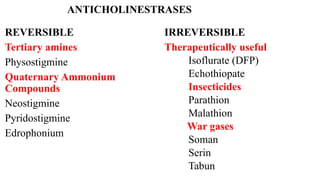
ANTICHOLINESTRASES
REVERSIBLE
Tertiary amines
Physostigmine
Quaternary Ammonium
Compounds
Neostigmine
Pyridostigmine
Edrophonium
IRREVERSIBLE
Therapeutically useful
Isoflurate (DFP)
Echothiopate
Insecticides
Parathion
Malathion
War gases
Soman
Serin
Tabun
REVERSIBLE CHOLINESTRASES
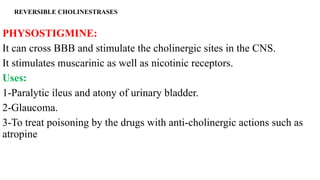
PHYSOSTIGMINE:
It can cross BBB and stimulate the cholinergic sites in the CNS.
It stimulates muscarinic as well as nicotinic receptors.
Uses:
1-Paralytic ileus and atony of urinary bladder.
2-Glaucoma.
3-To treat poisoning by the drugs with anti-cholinergic actions such as
atropine
REVERSIBLE CHOLINESTRASES
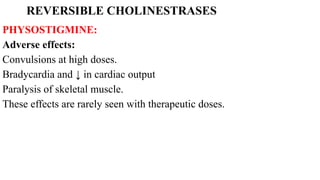
PHYSOSTIGMINE:
Adverse effects:
Convulsions at high doses.
Bradycardia and ↓ in cardiac output
Paralysis of skeletal muscle.
These effects are rarely seen with therapeutic doses.
REVERSIBLE CHOLINESTRASES
NEOSTIGMINE
Neostigmine is a quaternary compound.
It does not enter the CNS.
It inhibits cholinesterase.
Pharmacological effects
1- Skeletal muscles:
↑ in the strength of muscular contraction
2- Eye
Miosis
↓ intraocular pressure
REVERSIBLE CHOLINESTRASES
NEOSTIGMINE:
Therapeutic uses:
Post operative paralytic ileus and urinary retention
Antidote for competitive neuromuscular-blocking agents.
Myasthenia gravis.
Adverse effects:
Salivation, flushing, ↓ blood pressure, abdominal pain, diarrhea, and
bronchospasm.
(contraindicated in intestinal or urinary bladder obstruction)
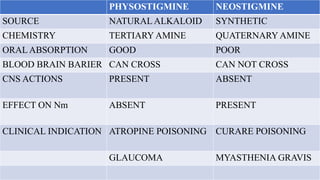
PHYSOSTIGMINE NEOSTIGMINE
SOURCE NATURAL ALKALOID SYNTHETIC
CHEMISTRY TERTIARY AMINE QUATERNARY AMINE
ORAL ABSORPTION GOOD POOR
BLOOD BRAIN BARIER CAN CROSS CAN NOT CROSS
CNS ACTIONS PRESENT ABSENT
EFFECT ON Nm ABSENT PRESENT
CLINICAL INDICATION ATROPINE POISONING CURARE POISONING
GLAUCOMA MYASTHENIA GRAVIS
REVERSIBLE CHOLINESTRASES
PYRIDOSTIGMINE AND AMBENONIUM
Used in the chronic management of myasthenia gravis.
Longer acting than Neostigmine
(LESS FREQUENT DOSING REQUIRED)
Adverse effects of these agents are similar to those of neostigmine.
REVERSIBLE CHOLINESTRASES
EDROPHONIUM
Edrophonium is a quaternary amine
It has a direct stimulant effect on the neuromuscular junction, in addition
to anticholinesterase activity.
Clinical indications:
1-It is used in the diagnosis of myasthenia gravis
2-To reverse the effects of d-tubo curarine AFTER SURGERY.
3-To distinguish between cholinergic crisis and myasthenia crises.
REVERSIBLE CHOLINESTRASES
TACRINE
DONEPEZIL
RIVASTIGMINE
GALANTAMINE
Clinical indication
Alzheimer’s disease:
Deficiency of cholinergic neurons in the CNS.

BScN Parasympathomimetics drugs a complete

  • 1.
  • 2.
    CHOLINERGIC DRUGS Cholinergic drugsact on receptors that are activated by acetylcholine (Ach) 1-Directly acting cholinergic drugs These are esters of choline and may be natural alkaloids or synthetic derivatives. 2-Indirectly acting cholinergic drugs
  • 5.
    ACETYLCHOLINE Acetylcholine is theprimary neurotransmitter at parasympathetic nerve endings. Synthetic Ach cannot be used due to : Quick Hydrolysis by Acetylcholine Esterase Short duration of Actions Depending on type of receptor, the actions of acetylcholine are classified into 2 types Muscarinic Nicotinic
  • 6.
    MUSCARINIC ACTIONS OFACETYLCHOLINE Organ System Receptor Effect Eye: 1-Circular Muscle 2-Ciliary Muscle 3-Lacrimal Glands M3 1-Contraction of smooth muscle of iris sphincter- Miosis ↑ drainage of aqueous humor-↓ in intraocular pressure 2-Contraction of ciliary muscle for near vision- Accommodation 3-Increase in secretions
  • 9.
    Organ System ReceptorEffect Respiratory System M3 Smooth muscle contraction – bronchospasm Bronchial glands – Increased Secretions GIT M3 ↑ Motility Sphincters Relaxation ↑ Secretion Urinary bladder M3 Detrusor Muscle Contraction Trigone and sphincter Relaxation Exocrine glands M3 Stimulation causing increased secretions
  • 10.
    CVS M2 1-Decrease in heartrate 2-Decrease in cardiac output (C.O= HR X SV) Heart Blood vessels M3 Decrease in blood pressure due to vasodialation through production of NO CNS M1 Tremor Hypothermia
  • 11.
    NICOTINIC ACTIONS OFACETYLCHOLINE Autonomic ganglia: Both sympathetic and parasympathetic ganglia are stimulated by ACh through the stimulation of NN receptors. Neuromuscular junction: ACh stimulates skeletal muscle contraction by its action on NMJ (NM receptors).
  • 12.
    DIRECTLY ACTING CHOLINOMIMETICS 1-CHOLINEESTERS Acetylcholine Methacholine Bethenechol Carbachol 2-NATURALALKALOIODS Muscarine Pilocarpine Arecholine
  • 13.
  • 14.
    SYNTHETIC CHOLINE ESTERS Methacholine 1-Itis 3 times more resistant to acetylcholinesterase than acetylcholine. 2-It has marked muscarinic actions, especially on CVS. 3-It has little action on nicotinic receptors. Clinical indication Previously used to treat paroxysmal supraventricular tachycardia.
  • 15.
    SYNTHETIC CHOLINE ESTERS Bethenechol 1-Itis not destroyed by Acetylcholinesterase or Butyrylcholinesterase, 2-It has strong muscarinic activity but no nicotinic actions. 3-It has selective action on GIT and Urinary bladder. Clinical Indications 1-Atony of bladder in post operative or post-partum urinary retention. 2-Neurogenic atony of bladder 3-Megacolon
  • 16.
    SYNTHETIC CHOLINE ESTERS Carbachol Itis not hydrolyzed by AChE or BuChE. It has both muscarinic as well as nicotinic actions. It has effects on CVS, GIT and urinary bladder. Clinical indications: 1-To produce Miosis 2-To ↓ intra-ocular pressure in glaucoma.
  • 17.
    PROPERTIES OF CHOLINESTERS: SourcePhysiological neurotransmitter Synthetic Synthetic Synthetic Effect of AChE Destroyed readily Destroyed but 3 x more resistant than Ach. No No Effect of BuChE Destroyed readily Not destroyed No No Muscarinic Action +++ ++++ ++ ++ Nicotinic action +++ - - +++ Acetylcholine Methacholine Bethanechol carbachol
  • 18.
    CHOLINOMIMETIC NATURALALKALOIDS MUSCARINE: It isan alkaloid obtained from the poisonous mushroom ‘Amanita muscaria’ and has only muscarinic actions. Mushroom poisoning may occur when poisonous mushroom is consumed along with edible mushroom.
  • 19.
    CHOLINOMIMETIC NATURALALKALOIDS PILOCARPINE: It stimulatesmuscarinic receptors only in exocrine glands (sweat, salivary, lacrimal, bronchial) and has less effect on other receptors (smooth muscles, CVS) Stable to hydrolysis by AChE Clinical Indications: 1-Acute congestive and chronic simple (open-angle) glaucoma. 2-Sjogren syndrome caused by radiation damage of salivary glands A/R CNS disturbances Stimulates sweating and salivation
  • 20.
    INDIRECTLY ACTING PARASYMPATHOMIMETICS (ANTICHOLINESTRASES) They competitively inhibit the enzyme cholinesterase, thus increase the concentration and duration of effect of acetylcholine at its receptors. Reversible: More clinical value Irreversible Insecticides War gases
  • 22.
  • 23.
    REVERSIBLE CHOLINESTRASES PHYSOSTIGMINE: It cancross BBB and stimulate the cholinergic sites in the CNS. It stimulates muscarinic as well as nicotinic receptors. Uses: 1-Paralytic ileus and atony of urinary bladder. 2-Glaucoma. 3-To treat poisoning by the drugs with anti-cholinergic actions such as atropine
  • 24.
    REVERSIBLE CHOLINESTRASES PHYSOSTIGMINE: Adverse effects: Convulsionsat high doses. Bradycardia and ↓ in cardiac output Paralysis of skeletal muscle. These effects are rarely seen with therapeutic doses.
  • 25.
    REVERSIBLE CHOLINESTRASES NEOSTIGMINE Neostigmine isa quaternary compound. It does not enter the CNS. It inhibits cholinesterase. Pharmacological effects 1- Skeletal muscles: ↑ in the strength of muscular contraction 2- Eye Miosis ↓ intraocular pressure
  • 26.
    REVERSIBLE CHOLINESTRASES NEOSTIGMINE: Therapeutic uses: Postoperative paralytic ileus and urinary retention Antidote for competitive neuromuscular-blocking agents. Myasthenia gravis. Adverse effects: Salivation, flushing, ↓ blood pressure, abdominal pain, diarrhea, and bronchospasm. (contraindicated in intestinal or urinary bladder obstruction)
  • 27.
    PHYSOSTIGMINE NEOSTIGMINE SOURCE NATURALALKALOID SYNTHETIC CHEMISTRY TERTIARY AMINE QUATERNARY AMINE ORAL ABSORPTION GOOD POOR BLOOD BRAIN BARIER CAN CROSS CAN NOT CROSS CNS ACTIONS PRESENT ABSENT EFFECT ON Nm ABSENT PRESENT CLINICAL INDICATION ATROPINE POISONING CURARE POISONING GLAUCOMA MYASTHENIA GRAVIS
  • 28.
    REVERSIBLE CHOLINESTRASES PYRIDOSTIGMINE ANDAMBENONIUM Used in the chronic management of myasthenia gravis. Longer acting than Neostigmine (LESS FREQUENT DOSING REQUIRED) Adverse effects of these agents are similar to those of neostigmine.
  • 29.
    REVERSIBLE CHOLINESTRASES EDROPHONIUM Edrophonium isa quaternary amine It has a direct stimulant effect on the neuromuscular junction, in addition to anticholinesterase activity. Clinical indications: 1-It is used in the diagnosis of myasthenia gravis 2-To reverse the effects of d-tubo curarine AFTER SURGERY. 3-To distinguish between cholinergic crisis and myasthenia crises.
  • 30.

Editor's Notes

  • #29 In the diagnosis of myasthenia gravis. 2 mg is injected i.v. as a test dose. If nothing untoward happens, the remaining 8 mg is injected after 30–60 sec. Reversal of weakness and short-lasting improvement in the strength of affected muscles occurs only in myasthenia gravis whereas it will worsen the condition if it is due to cholinergic crisis. (Tensilon test)